Hongkong
 China
China


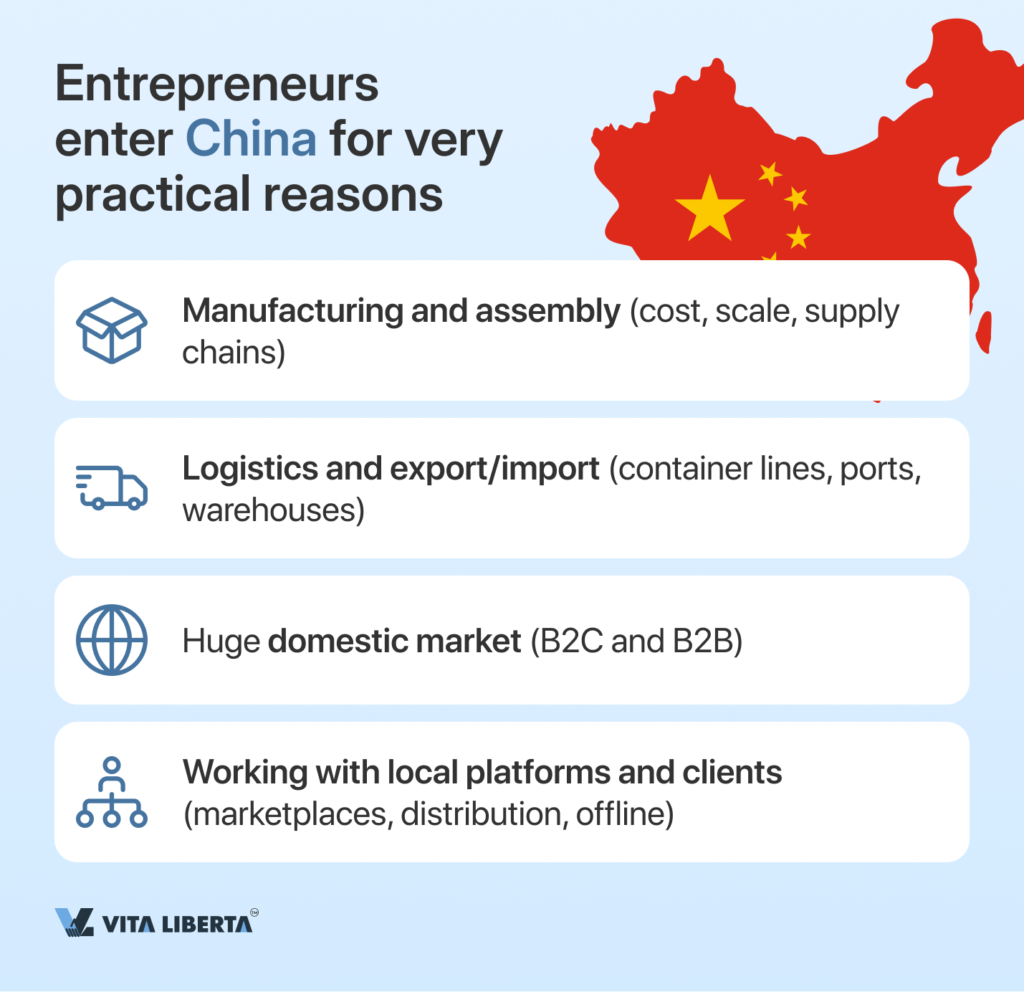
Starting a business in mainland China and in Hong Kong are not the same thing at all. Mainland China offers direct access to the market, factories, logistics, and domestic demand. Hong Kong often functions as a convenient international platform: a company for contracts, payments, holding, and trade with the world — including China — without constantly battling currency restrictions and local bureaucracy.
China and Hong Kong: Business Specifics
Hong Kong, meanwhile, is formally part of China but has a separate legal and tax system and its own financial infrastructure. This explains the popularity of the model: “we work with China, but keep the company in Hong Kong.” Legally, it’s easier to conclude international contracts, receive payment in foreign currency, and build a holding structure.
It’s important to understand: Hong Kong does not replace mainland operations if you genuinely need a physical presence “on the ground” (office, staff, sales within the PRC, manufacturing). But it often addresses tasks where a mainland company becomes too burdensome.
Formats of Presence in Mainland China: What Foreigners Choose
You can choose from two main options.
WFOE — A Wholly Foreign-Owned Enterprise
A WFOE (Wholly Foreign-Owned Enterprise) is a company with 100% foreign capital for operating in mainland China. You can independently conduct sales, sign contracts, hire people, rent an office, and handle import/export (with the necessary license).
- Pros: Full control without a Chinese partner, and all processes can be tailored to your needs.
- Cons: Lengthy timelines and extensive documentation, a real office is required, strict currency rules, and reporting.
Joint Venture (JV) with a Chinese Partner
A JV is chosen when access to the market, channels, licenses, or resources is difficult without a Chinese partner. They become your “entry door.”
- Cons: Control must be shared, conflicts can arise in practice, and exiting the project and dividing assets is usually complicated.
Representative Office
A Representative Office is a format for presence in China but without full-fledged commercial activity. Suitable for marketing, negotiations, supplier control, and preparing to launch a WFOE/JV. Earning revenue directly through a Representative Office is not allowed or is very limited.
Mainland China: Regulatory Landscape You Need to Be Prepared For
In short: China loves order, paperwork, and verifiable logic for every transaction.
In practice, this looks like:
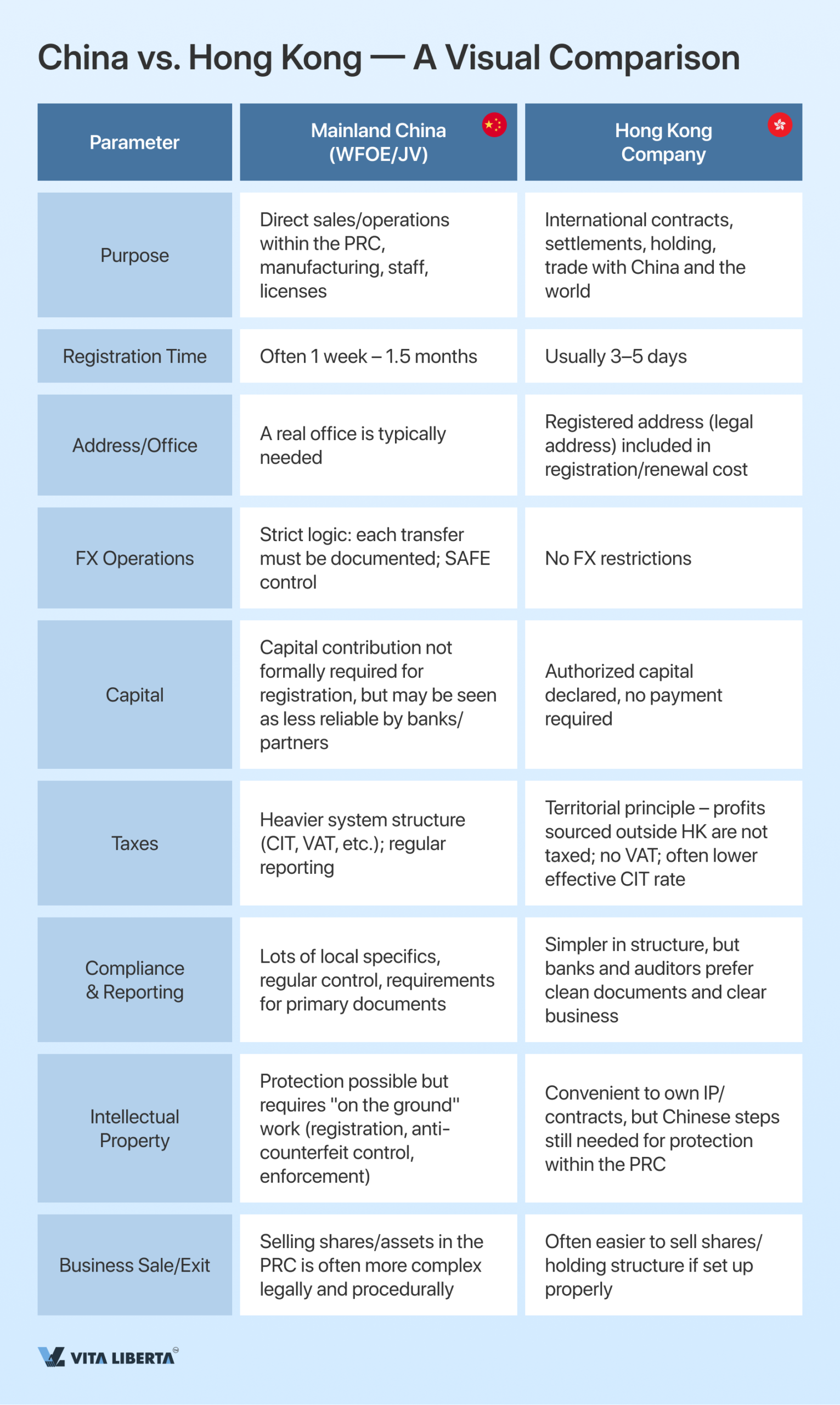
- Registration timelines often take from one week to one and a half months (depends on the city, industry, document readiness, office lease, and licenses).
- A real office is often mandatory; a “virtual address” won’t suffice.
- Foreign exchange transactions require evidential support: contracts, invoices, acceptance certificates, payment logic. Transfers and conversions can’t be done simply because “it’s more convenient.”
- The registered capital threshold is abolished and is determined by the necessary level of investment in the company until operational income covers the costs.
- The tax burden is usually heavier in structure — corporate income tax, VAT, plus regular reporting.
Register a Company in China and Operate Directly
- Direct contracts with suppliers, no agents
- Full control of import, export, and logistics
- Legal online and offline sales in China
Hong Kong as an Alternative: Why It’s Chosen as an International Base
Hong Kong is often chosen not for the love of geography, but for speed and clear rules.
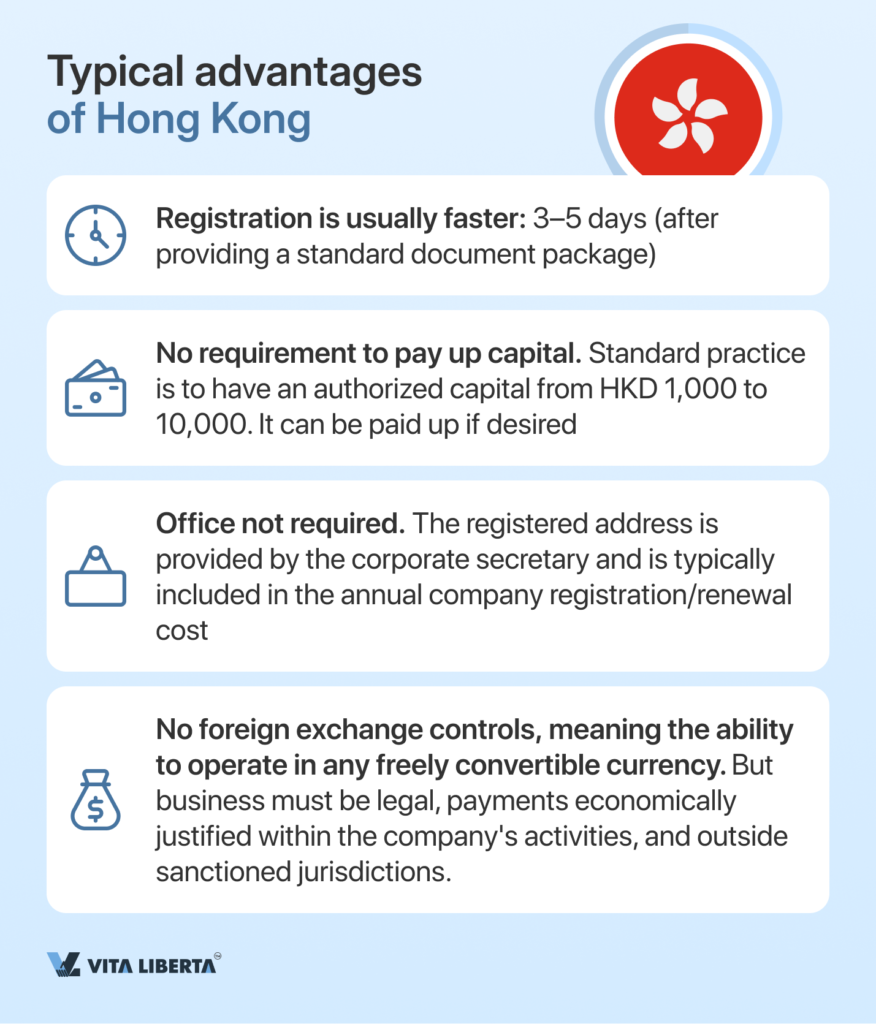
Hong Kong has a different tax logic. The territorial principle applies, so profits deemed sourced outside Hong Kong are not subject to local tax with correct justification and accounting. Profits sourced in Hong Kong are taxed at 8.25% on the first HKD 2 million and 16.5% on the excess. In mainland China, the standard corporate income tax rate is 25%.
Comparison of China and Hong Kong
When to Open a Company Specifically in Mainland China
You are almost certainly “ready” for the PRC if you have:
- Manufacturing/assembly in China. Need employees, quality control, warehouse, local contracts, sometimes licenses.
- Offline retail or active sales in the domestic market. Especially if working with Chinese platforms, distributors, chains.
- Government procurement, state projects, work with large PRC corporations. They often want to see a counterparty within the country.
- Intensive B2B/B2C work inside China. Where money, logistics, and service essentially reside within the PRC.
Procurement of goods from PRC enterprises/companies without an export license.
Besides the idea, the entrepreneur will need patience with timelines and inspections, willingness to maintain a real office, and a fully set-up Chinese accounting and tax framework from the start, not on a “we’ll figure it out later” principle.
When It’s More Logical to Start with Hong Kong
Hong Kong often wins if:
- International trade with Chinese factories. You buy in the PRC — sell to other countries, and your sales office is not in China.
- Export/import and payments in different currencies. Need a convenient “contract center” that doesn’t break down with every transfer.
- IT services, consulting, services. Team is distributed across different countries, and there is no physical presence in the PRC.
- You are still testing the market. Don’t want to immediately invest in a lengthy WFOE registration, office, and local reporting.
At the start, a practical model is: open a Hong Kong company as a center for contracts and payments, and work in China through contractors — for manufacturing, logistics, quality inspections, and fulfillment. It’s better to launch a WFOE later, when clear volumes appear and the necessity of your own legal entity in the PRC becomes obvious.
Use China for Business Growth and Global Expansion
- Export VAT refund of up to 13%
- Corporate bank account in China and other currencies
- Office, warehouse, or manufacturing in China
Conclusion
Mainland China and Hong Kong solve different problems, so the choice shouldn’t be “where is it easier,” but “where is the result needed.” China is direct access to the domestic market, manufacturing, personnel, and contracts within the PRC, but you pay for it with time, office, paperwork, and strict rules on currency and reporting. Hong Kong is a convenient international platform for contracts, payments, holding, and trade with China without excessive bureaucracy, but it won’t replace a real presence if you operate inside China. The most practical path for many is to start with Hong Kong for international operations and connect a Chinese WFOE when stable volume appears and the need to “set down roots” in the PRC arises.