Hongkong
 China
China


Liquidation of a company in Hong Kong from 950 $
Direct service from a licensed registrar saves up to 40% of your budget and ensures full compliance with the requirements of the Hong Kong Companies Ordinance in the liquidation of a business.

Full support of the company in the process of liquidation in order to comply with the legislation
100% compliance with all requirements of the law and support of the victorious end process.
Liquidation
— cancellation of company registration (removal of the company from the register)
Members’ voluntary winding up
— voluntary liquidation by the company’s participants
It is the most widely used way to liquidate a company. This method is possible if the company has never started its activity or stopped it more than 3 months ago and the company has no outstanding obligations.
Before filing an application for registration (liquidation) of a company with the Hong Kong Registration Authority (in accordance with section 750 of the Companies Ordinance), it is possible if the following conditions are met:
- all participants of the company agree to the implementation of the process of deregistration (liquidation);
- the company either did not start commercial activity, or ceased such activity at least 3 months before filing an application for deregistration (liquidation);
- the Hong Kong company has no outstanding obligations;
- The Hong Kong company is not involved in litigation;
- the company does not have real estate in Hong Kong;
- the company is a holding company and none of the assets (namely real estate) of its subsidiaries is located in Hong Kong;
- Deregistration is not opposed by the Hong Kong Inland Revenue Department (a company applying for deregistration (liquidation) is required to prepare and submit a tax return to the Hong Kong Inland Revenue Department with an appendix of audited financial statements before it ceases commercial activity. This is necessary as part of the implementation of Hong Kong law and also to receive a notice of no objection. The company’s final financial statements should reflect that the company has no outstanding obligations and is ready to initiate the deregistration/liquidation procedure in Hong Kong).

The registration (liquidation) process in Hong Kong, on average, takes a period of 8 months or more (depending on the specific situation and the workload/speed of processing each specific case by the Hong Kong government authorities).
Important: Until the moment of official deregistration (liquidation), a company in Hong Kong is obliged to comply with all the norms of the current legislation on companies in Hong Kong, including filing annual declarations and notifications, accounting and auditing, holding meetings of directors and participants.
After registration (liquidation) and despite this fact, the obligations of the company, if any, as well as of each director, officer and participant of the company must be fulfilled.
The property (movable and immovable), as well as the rights owned or held in trust by the Hong Kong Company immediately before its deregistration (liquidation), will be considered as having no owner and will pass into the possession of the Hong Kong Government. Therefore, it is important to take care of the correct transfer of the company’s assets before the liquidation of the company.


The purpose of voluntary liquidation by the campaign participants in Hong Kong is to complete the company’s activities and liquidate the legal entity. Voluntary liquidation of the company is possible when the company is able to fully repay its obligations within the statutory period.
The approximate period is from 8 to 14 months



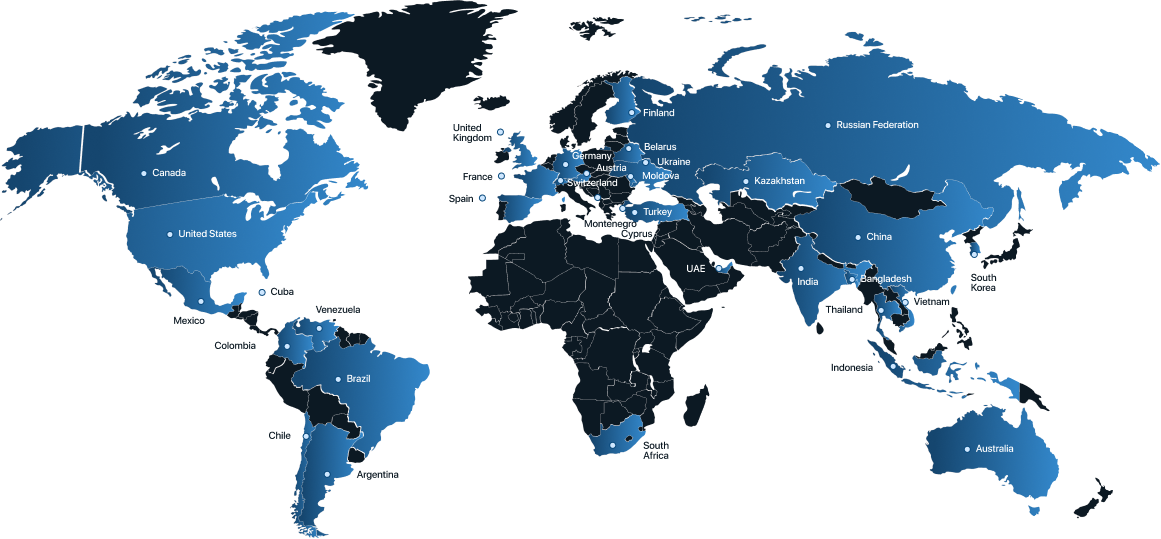
China, India, UK, France, Spain, Venezuela, USA, Switzerland, Austria, Finland, Germany, Mexico, Australia, Thailand, Cyprus, Vietnam, Bangladesh, UAE, South Korea, Indonesia, Montenegro, Argentina, Chile, Brazil, South Africa, Canada, Kazakhstan, Russia, Ukraine, Moldova, Turkey
Frequently asked questions
On average, this process takes from 8 to 14 months (depending on the situation, it may take longer). But we do all the work. It’s not noticeable to you.
Yes, but this is a more complex process. Creditors and members of the company may propose candidates for liquidators. The liquidator performs the duties of distributing the remaining assets of the liquidated company and satisfying the queue of creditors, and is also obliged to check the company’s operations for illegal actions.
Providing false or incomplete information may have legal consequences for authorized persons of the company, up to criminal liability. Therefore, it is necessary to provide information in full and reliable form.
We do not recommend it. As a result, court decisions will be taken against the company to collect fines for repeated violations of Hong Kong law, directors and shareholders will be blacklisted in Hong Kong, and criminal proceedings may be initiated if large amounts of income are concealed. All these consequences are not worth bringing to them. The company needs to be closed in a legal way.