Hongkong
 China
China





Getting the structure wrong at the outset costs more than it looks — switching later drags months of re-approvals behind it. Here’s how to pick the format that actually fits you.
What’s on the table for a foreign investor
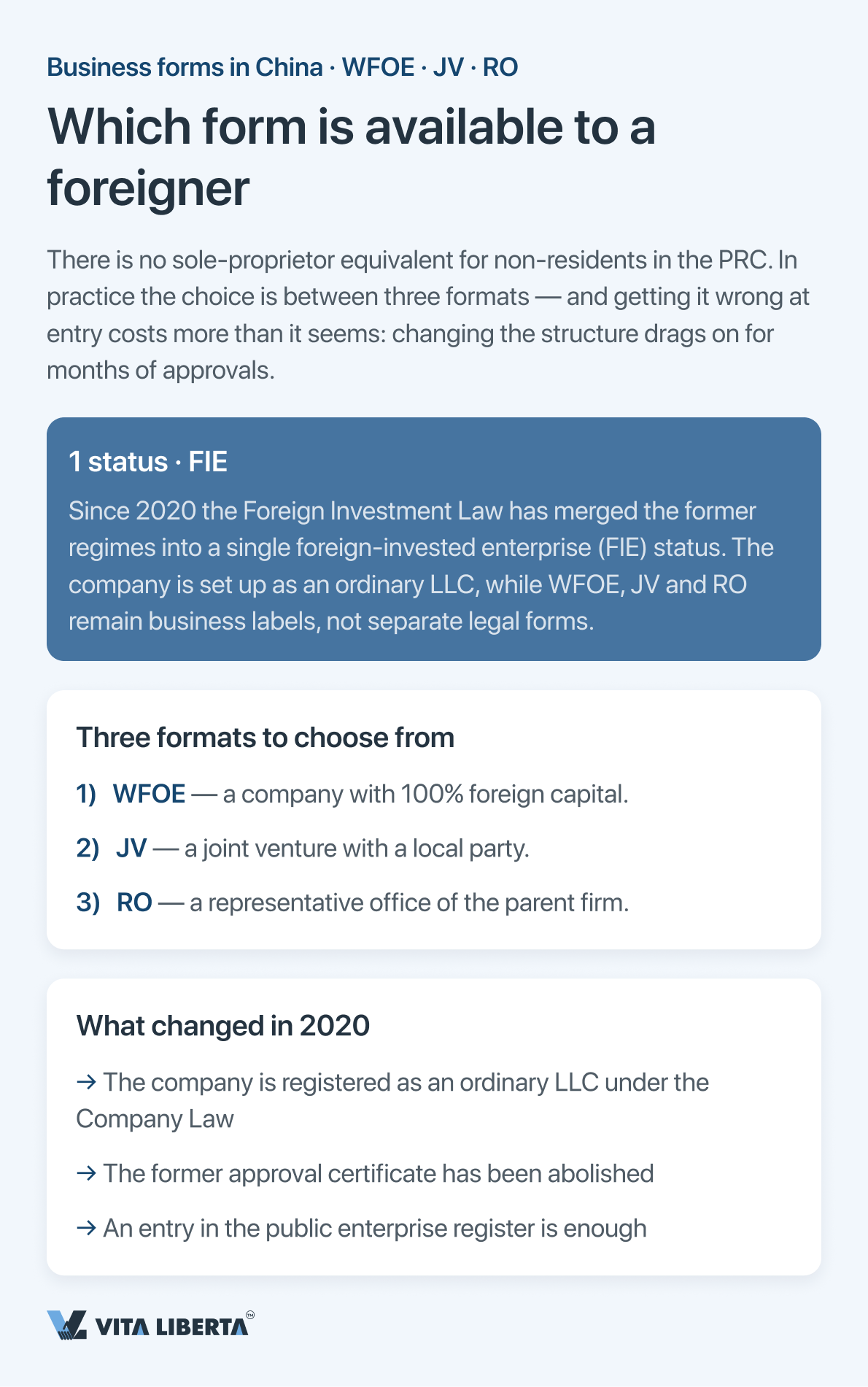
There’s no sole-proprietor route for non-residents in the PRC. In practice the choice comes down to three formats: a company that is 100% foreign-owned, a partnership with a local side, and a representative office.
One status: the FIE
Since 2020, the Foreign Investment Law folded the old regimes into a single foreign-invested enterprise (FIE) status, and the company itself is now incorporated as an ordinary limited liability company under the Company Law. The familiar labels WFOE, JV and RO survive as business shorthand, not as separate legal forms. The old approval certificate is gone — an entry in the public enterprise register is enough.
WFOE: full control
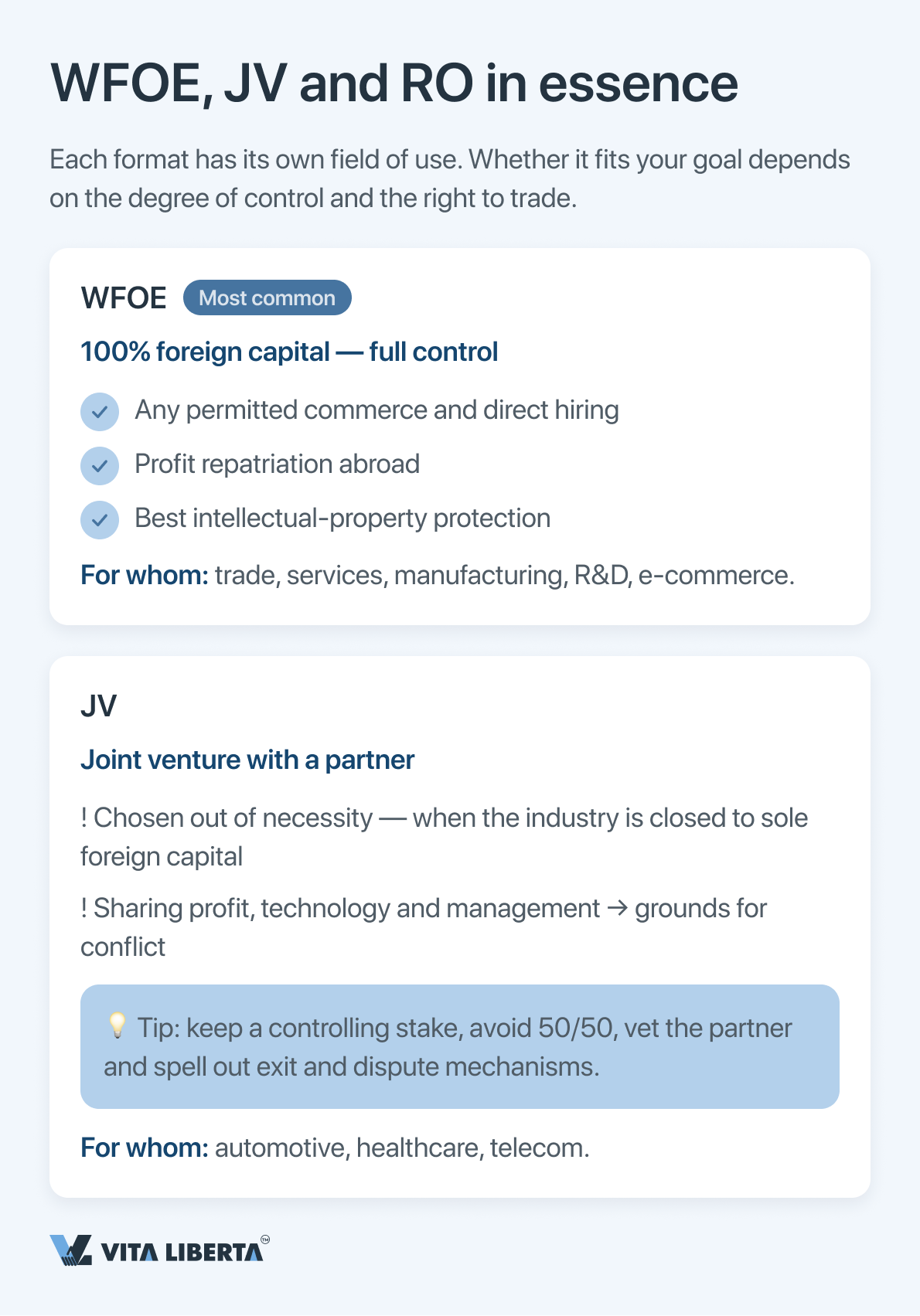
A wholly foreign-owned enterprise hands the owner all of the management, the right to carry on any permitted commercial activity, direct hiring of staff, profit repatriation abroad, and the strongest protection for intellectual property. It’s the go-to vehicle for trading, services, manufacturing, R&D and e-commerce — think localising an IT product or running direct-supply of goods.
Joint venture (JV)
A partnership with a Chinese side is usually a forced choice — when the sector is closed to sole foreign capital, or when local resources and connections are unavoidable (automotive, healthcare, telecoms). The downside: profit, technology and management decisions all get shared, which is fertile ground for corporate conflict.
💡 Tip: In a JV, hold a controlling stake and steer clear of a 50/50 split. Vet the partner in advance and write in an exit mechanism and a dispute-resolution route from day one.
Representative office (RO)
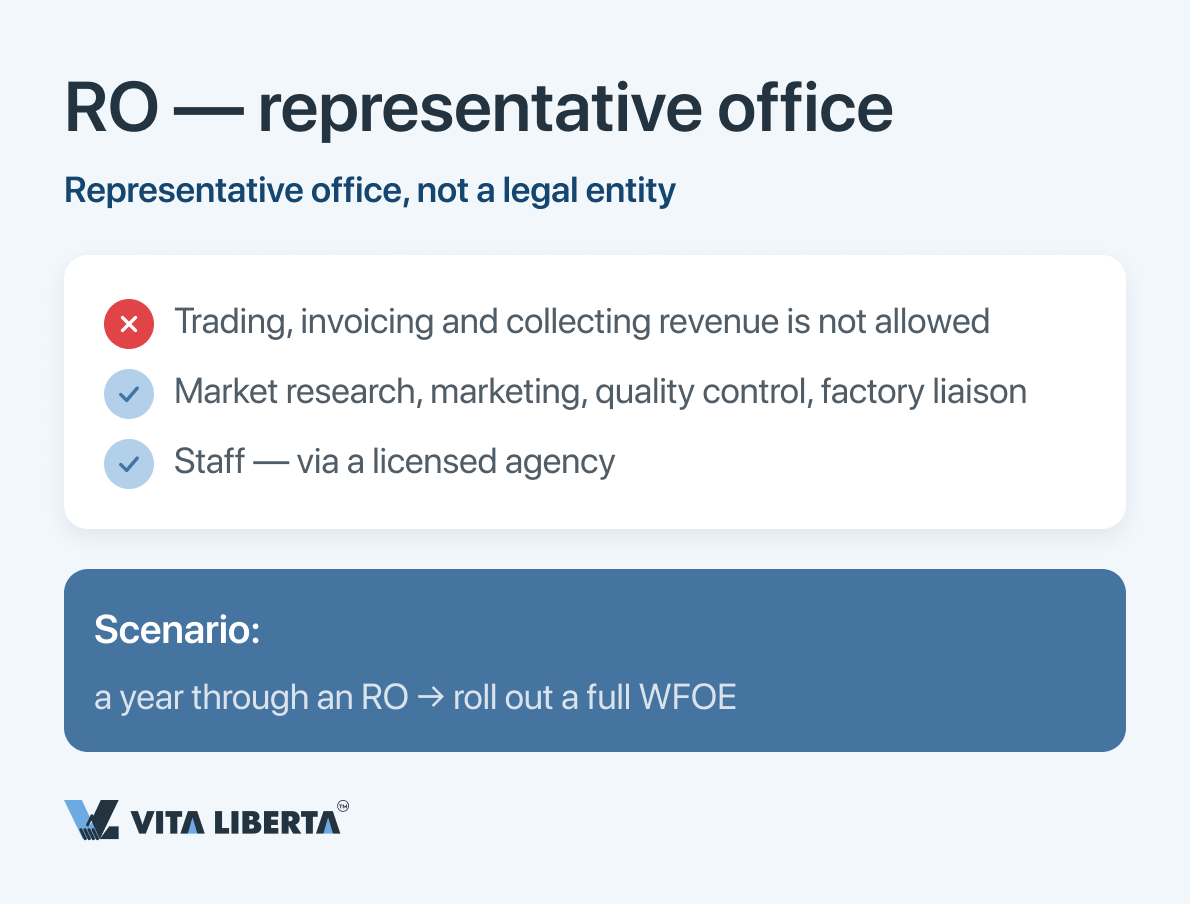
An RO is not a standalone legal entity — it’s an accredited arm of the parent company and its liabilities run back to the parent. It cannot trade, issue invoices or take in revenue. What it is good for is market scouting, marketing, quality control and factory liaison; local staff are hired through a licensed dispatch agency. The classic path is a year operating through an RO, then rolling out a full WFOE.
Unsure which business form to choose?
- Right structure for your goals
- Compare tax and liability
- Matched to your business activity

The three forms side by side
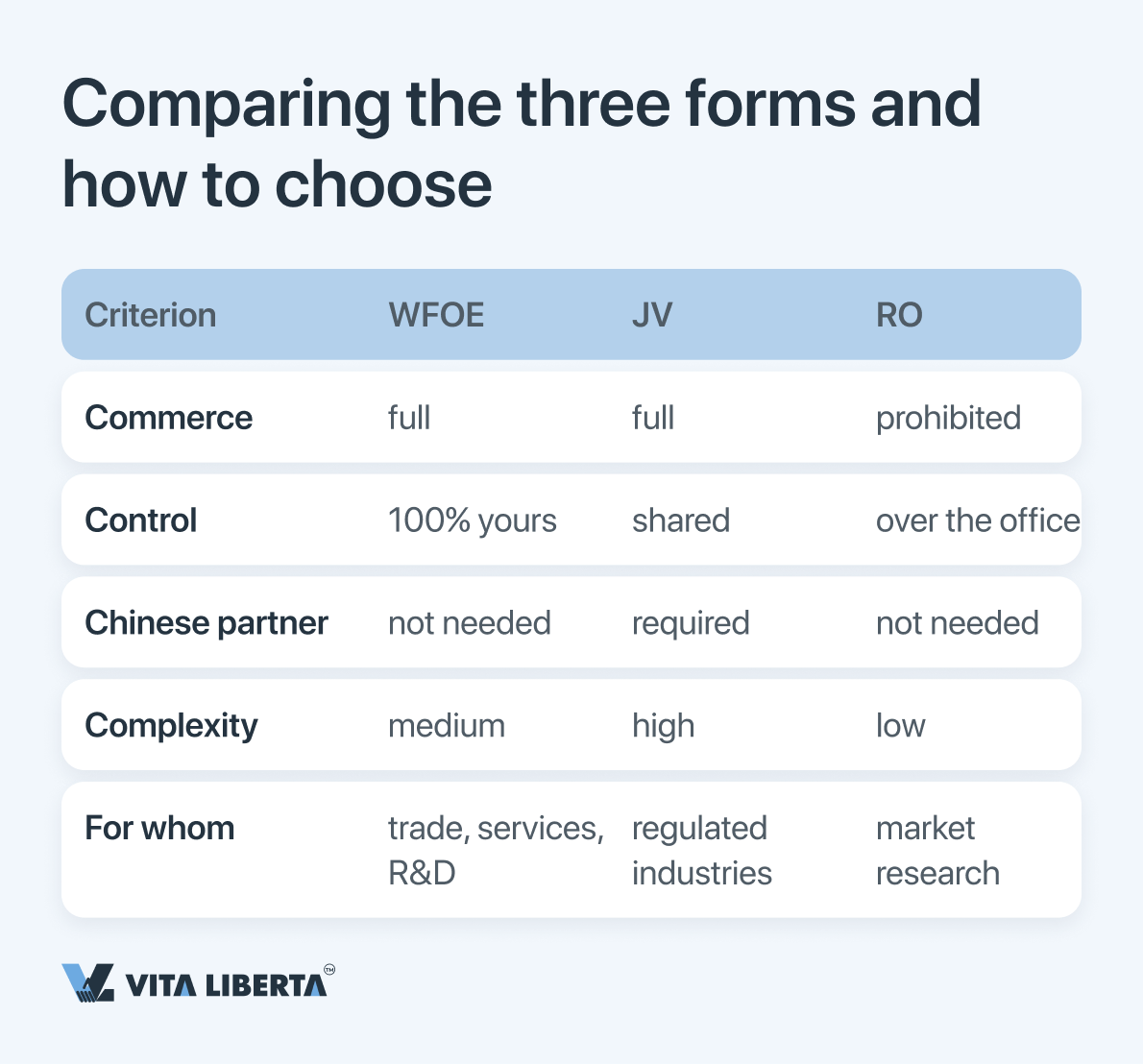
| Criterion | WFOE | JV | RO |
| Commerce | full | full | prohibited |
| Control | 100% yours | shared | over the office only |
| Chinese partner | not needed | mandatory | not needed |
| Complexity | medium | high | low |
| Best for | trade, services, R&D | regulated sectors | market scouting |
How to pick a form
Start from your goal and your sector. The algorithm is simple:
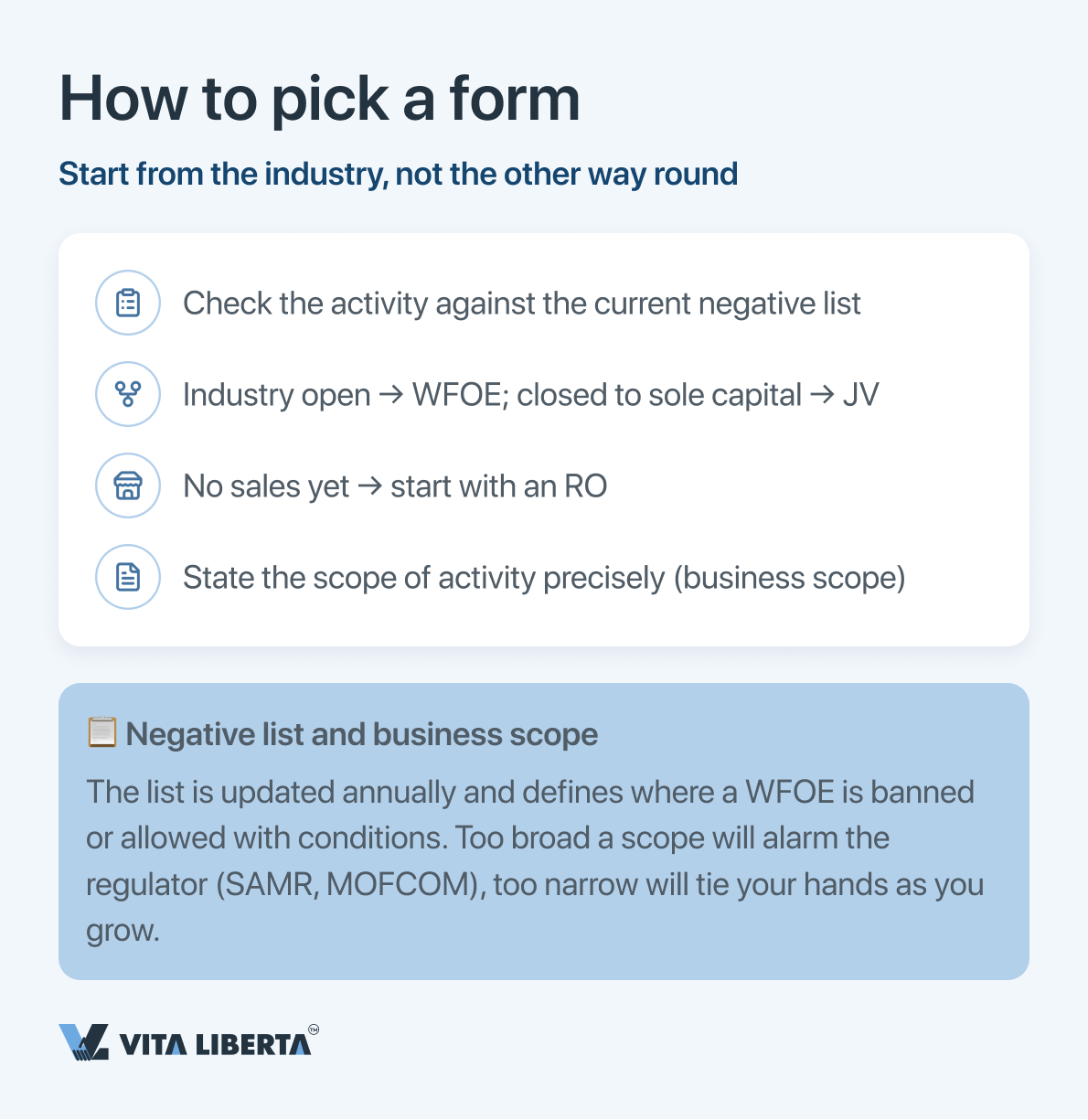
- Check your activity against the current Foreign Investment Negative List.
- If the sector is open — take a WFOE; if it’s closed to sole foreign capital — you’re left with a JV.
- If you’re not planning sales yet — start with an RO.
- Word your business scope precisely.
Negative list and business scope
The list of restrictions is refreshed every year and defines the sectors where a WFOE is banned or allowed only on conditions. Wording the scope is a balancing act: too broad and the regulator (SAMR, MOFCOM) gets nervous; too narrow and you tie your own hands as you grow — and may need separate licences.
Registration, timelines and tax
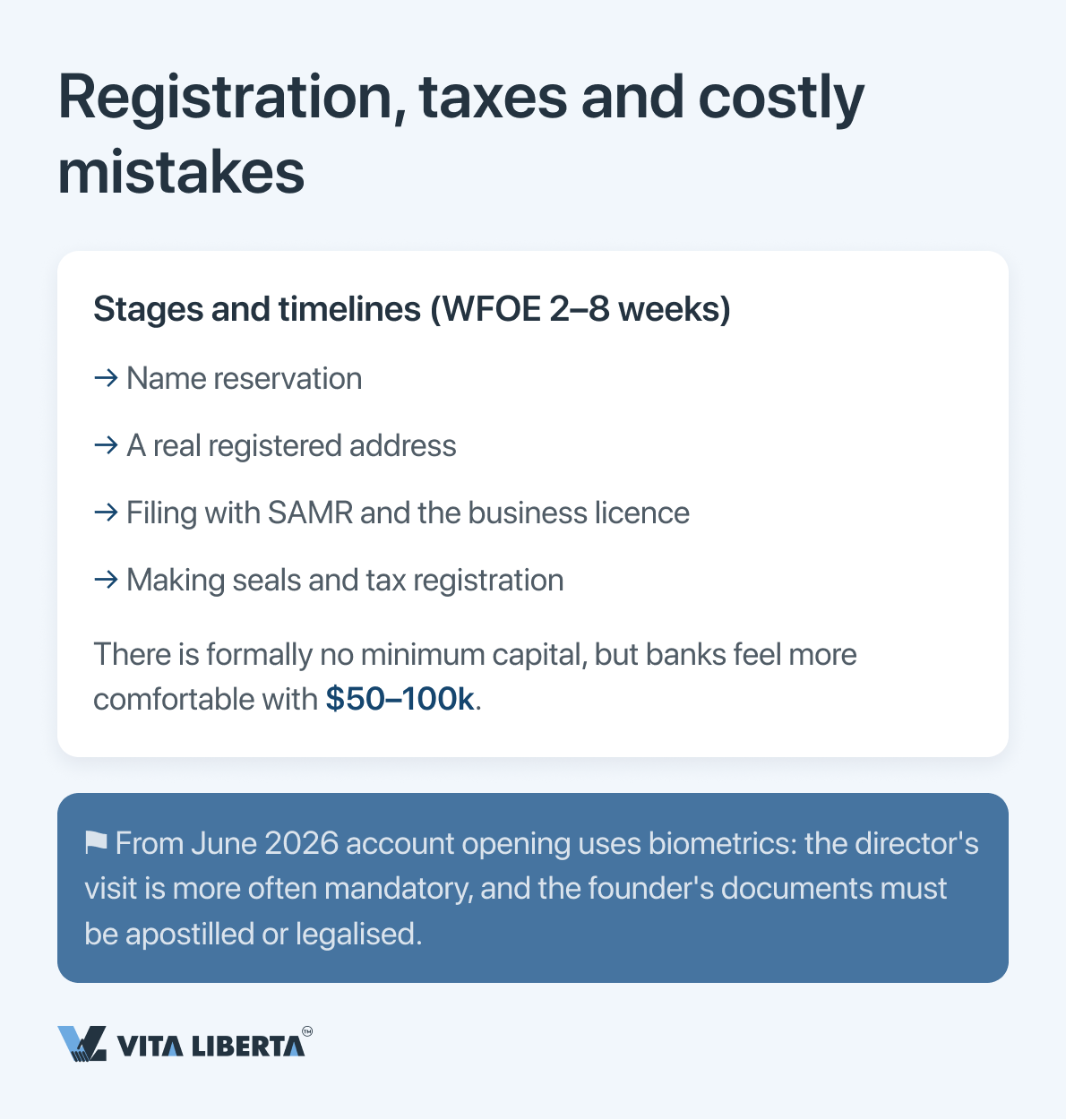
The core steps: name reservation, a real registered address, filing with SAMR, obtaining the business licence, cutting the company chops, and tax registration. A WFOE usually opens in 2–8 weeks, an RO takes longer. There’s no formal minimum capital, but banks and counterparties feel calmer looking at a figure in the USD 50,000–100,000 range.
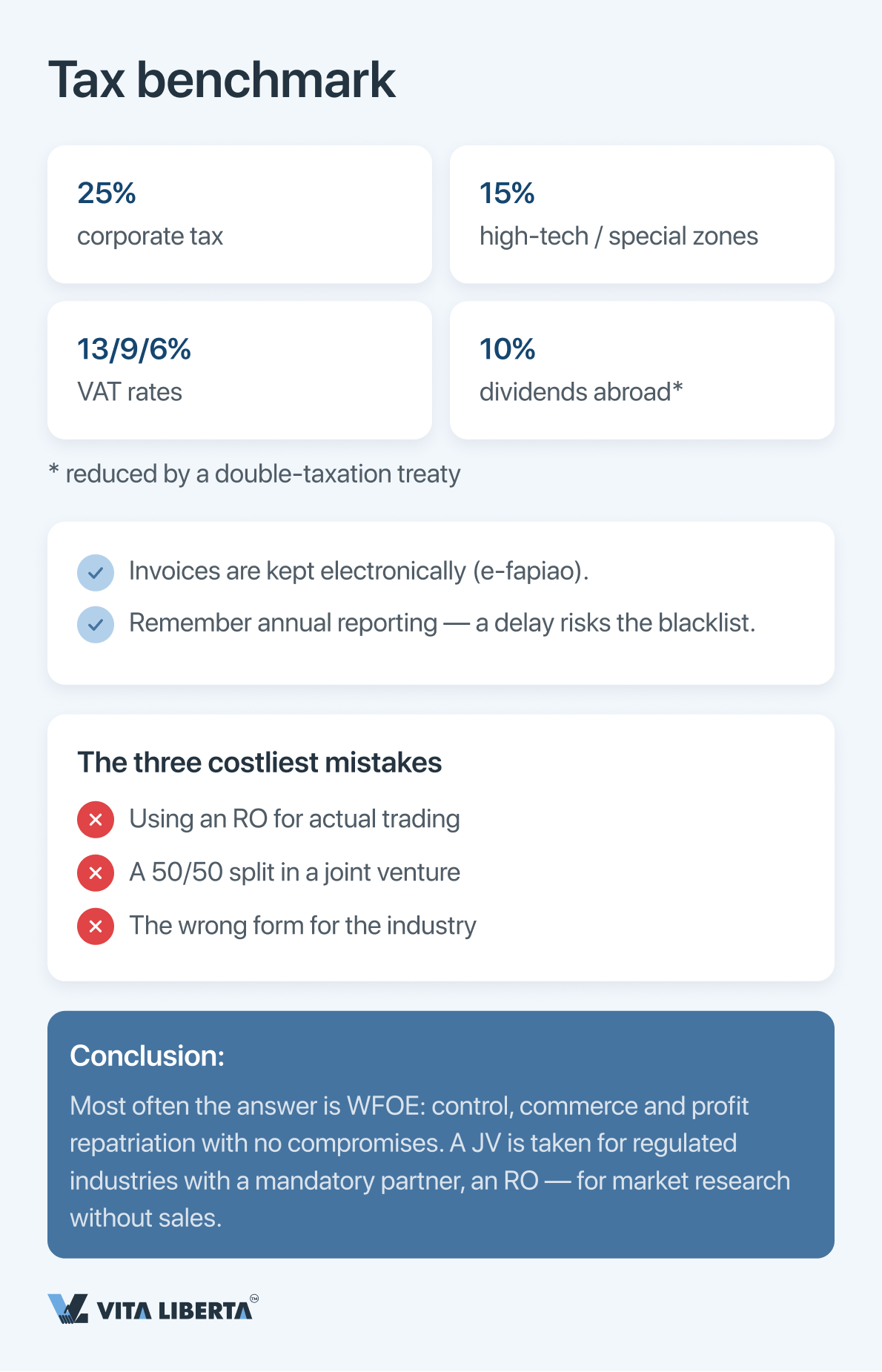
Tax benchmark: corporate income tax 25%, 15% for high-tech companies and certain zones, VAT at 13/9/6%, and a 10% dividend withholding tax on repatriation abroad (reduced under a double-tax treaty). Invoicing runs electronically (e-fapiao).
Factor in the banking step: from June 2026 account opening uses biometric identification, so a director’s visit is more often mandatory and the founder’s documents need to be apostilled or legalised.
Risks and mistakes
⚠️ Important: Using an RO for actual trading, a 50/50 JV split, and the wrong form for your sector are the three most expensive mistakes. They translate into re-registration, fines and even loss of operational control.
One thing that’s routinely underestimated is the supervisor’s authority in a small WFOE: they can demand any financial documentation and litigate on the company’s behalf, and in a conflict that gets used against the investor. Don’t forget annual reporting either — a missed deadline risks a blacklisting.
“Most companies coming into China need exactly a WFOE — it gives control and asset protection. People go to a joint venture not out of choice but when the sector leaves them no other option; and then the whole defence rests on a well-drafted charter and shareholders’ agreement.”
— Sergey Konon, China corporate lawyer
Most often the answer is a WFOE: control, commerce and profit repatriation without compromise. JVs are for regulated sectors with a mandatory partner; ROs are for scouting the market before any sales. Check the sector against the negative list first, then choose the form to fit the goal — not the other way round.
Decided on your China entity?
- WFOE, JV or RO registration
- Full legal support included
- Launch with no costly mistakes

FAQ
A WFOE is owned entirely by the foreign founder, who runs the company single-handedly and controls the profit. A joint venture is set up together with a Chinese side — that format opens sectors closed to foreigners and gives access to local networks, but management and income have to be shared with the partner.
It’s a non-commercial arm of the parent organisation, meant for marketing, gauging demand and keeping up contacts. It isn’t a legal entity of its own and essentially works as an observation post ahead of a serious market entry.
If you plan to sell, produce and invoice domestically on your own, you need a WFOE. A joint venture fits where the sector is restricted for foreign capital or a local partner is unavoidable. A representative office suits only a first, scouting presence.
No. It can’t sign commercial deals, sell goods or receive revenue in the country. Once real trading begins, the business is moved to a WFOE or a joint venture.
A WFOE and a JV pay corporate income tax and operate as full VAT payers. An RO is more often taxed on a deemed basis from its expenses, since it makes no sales. Note too that mainland China’s tax regime differs markedly from Hong Kong’s, which runs its own system — the mainland rules above do not apply to Hong Kong or Macau.