Hongkong
 China




China’s rules for completing an export declaration cover 49 boxes. Almost all of them are routine. The bill of lading, the invoice and the customs reference tables tell you what to enter, and the last two boxes hold the declarant’s details and the customs endorsement. One box works differently: its content is decided long before the cargo ships.
The core problem
“We bought a batch in Yiwu, the supplier shipped it and sent us a scan of the declaration. Our broker took one look and said: the box shows 1039, so nobody got a tax rebate and the price was set differently from the start. Why didn’t anyone tell me before shipment?”
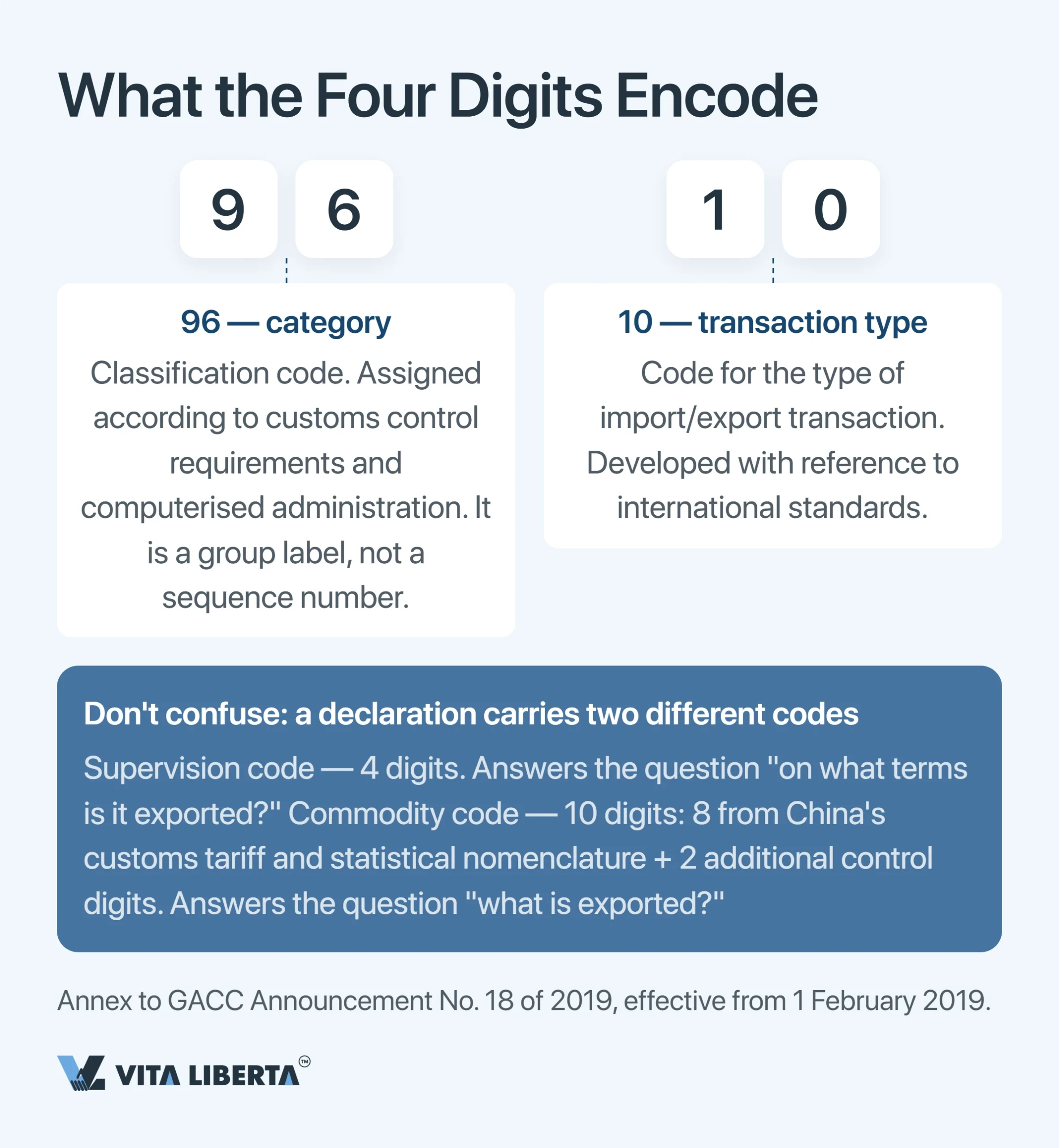
Importers who source through China’s wholesale market clusters ask this more often than almost anything else. What’s at stake is a percentage of the contract value.
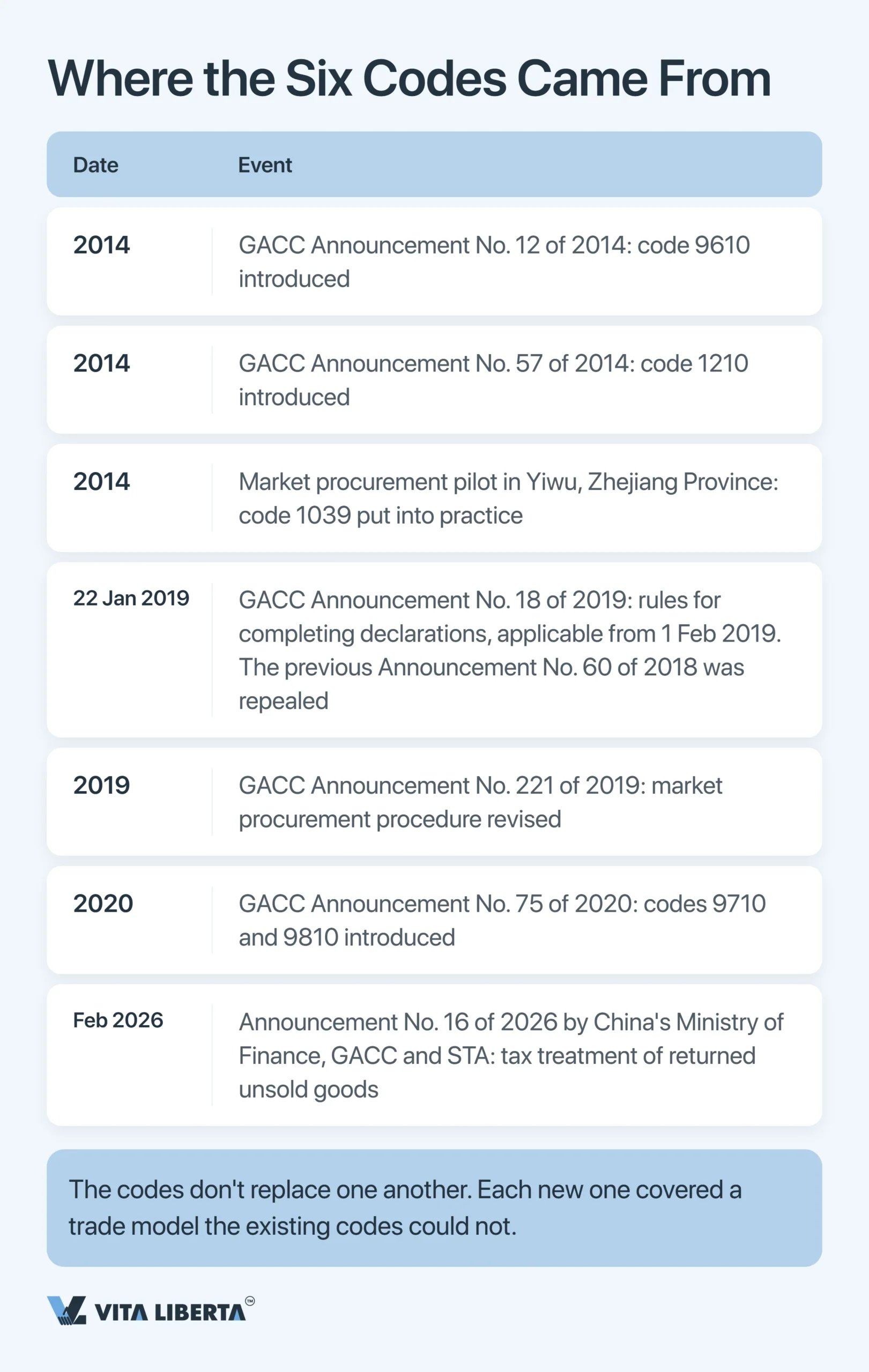
The rule behind this box has applied since 1 February 2019. It came in as an annex to GACC Announcement No. 18 of 2019 (海关总署公告2019年第18号, 关于修订《中华人民共和国海关进出口货物报关单填制规范》的公告), which revised the rules for filling in import and export declarations. The General Administration of Customs of China (GACC) signed it on 22 January that year. The rules apply nationwide and are still in force in 2026.
Box 14 decoded: how a supervision code works
The supervision mode (监管方式, customs supervision code) is not a statistical formality. Tax treatment, the document set and release speed all depend on it.
Reading 9610: two category digits plus two transaction digits
Take the code apart digit by digit.
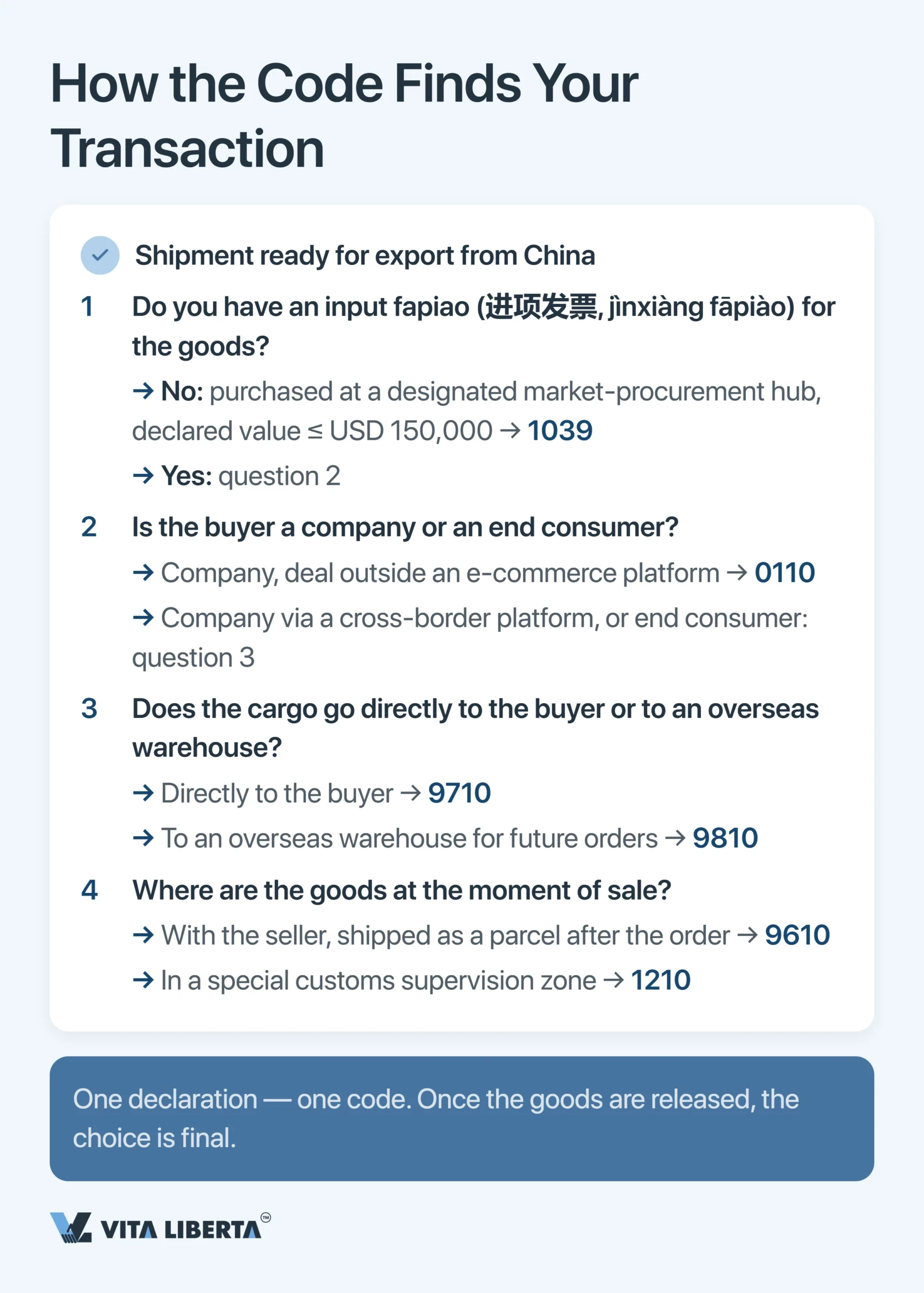
The first two digits classify. Customs assigns them according to what supervision and computerised control need. They label a category and do not rank anything. “96” in 9610 and “98” in 9810 don’t place one mode ahead of the other.
The last two digits describe the deal. They encode the form of the import or export transaction, and this half was designed with international standards in mind.
Don’t confuse it with the field next to it. The commodity code on the same declaration has ten digits. Eight come from China’s tariff and statistical classification, and two more form an extra supervision pair. The commodity code tells customs what you’re exporting. The supervision code tells it on what terms.
One declaration, one code, one licence: no room to edit
The rules forbid combining two regimes on one declaration. Announcement 18/2019 gives each declaration exactly one slot for the supervision mode. The permit field works the same way: one licence number, and no space for a second.
Once customs has accepted a declaration, you generally can’t change it. Correction or cancellation is possible only in the cases and under the procedure GACC has set. That is a separate process that needs justification, not a quick swap of digits.
A common and costly mistake by foreign buyers is to learn the code from the scan after release. By then the regime has already fixed the tax outcome of the deal and its price. In practice, your broker reads box 14, not the seller’s assurances.
The takeaway: ask for a scan of the declaration with this box filled in before you pay the balance, not after shipment. After shipment there’s nothing left to renegotiate.
0110 vs 1039: VAT rebate or exemption without rebate
Conventional exports split on one question: does the shipper hold an incoming special VAT invoice (fapiao, 增值税专用发票) for the goods it bought?
0110: a fapiao in exchange for 13%
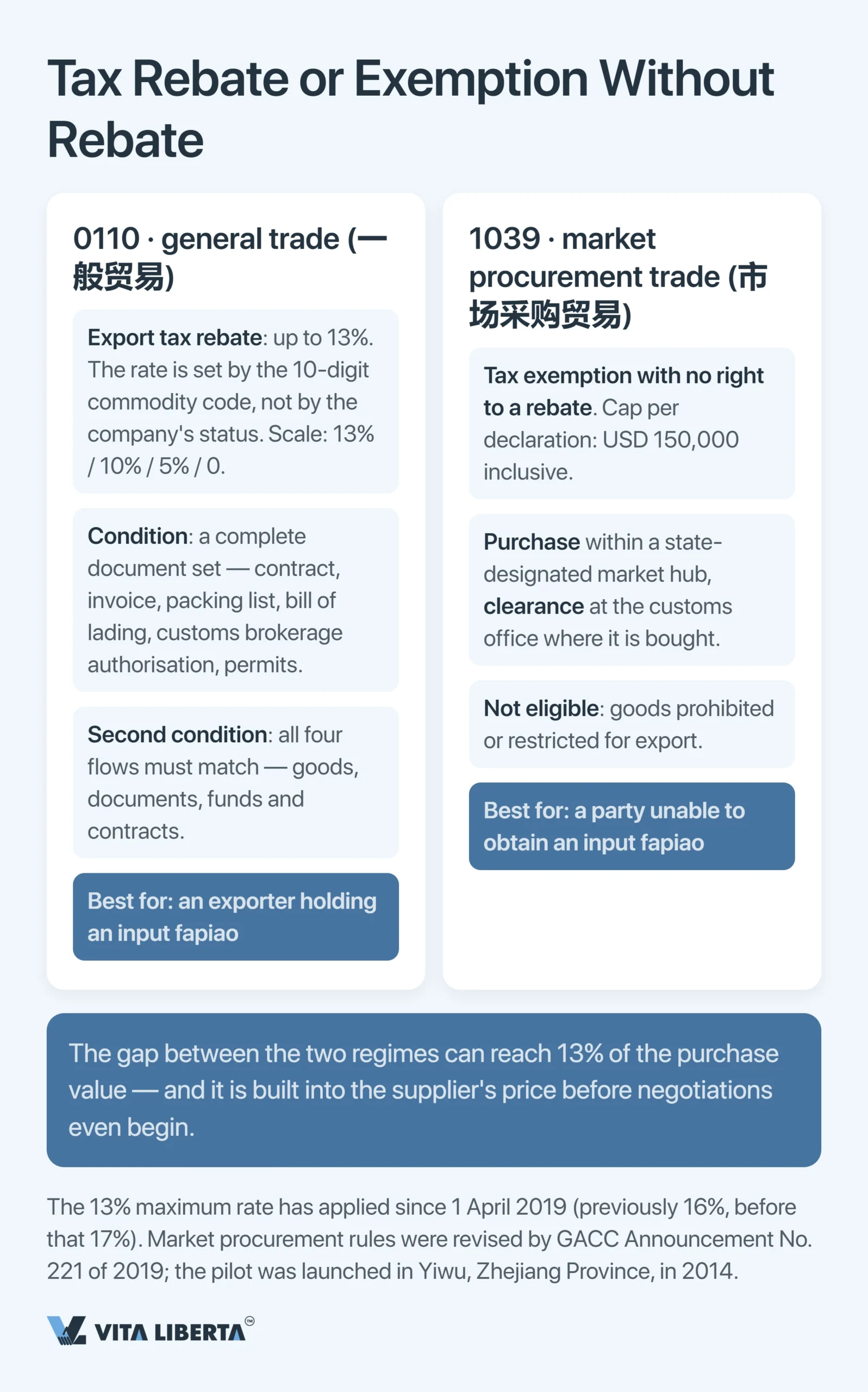
13% is a ceiling, not a promise. That maximum export VAT rebate rate has applied since 1 April 2019 (财政部 税务总局 海关总署公告2019年第39号). Before that the ceiling was 16%, and earlier still 17%.
Since 20 March 2020, rebate rates come in four tiers: 13%, 9%, 6% and 0% (财政部 税务总局公告2020年第15号). Each product’s rate is tied to its code in the State Taxation Administration’s rebate rate database (退税率文库), and the database is revised periodically.
For example, from 1 April 2026 photovoltaic products and several other items lost the rebate. Batteries went from 9% to 6% until 31 December 2026, and lose the rebate entirely from 1 January 2027 (财政部 税务总局公告2026年第2号).
Taxpayer status matters too. A small-scale taxpayer’s exports are VAT-exempt but get no rebate. If you buy from a small-scale taxpayer, your rebate rate can’t exceed that supplier’s tax rate.
Code 0110 (“general trade”, 一般贸易) is the regime where that rate is paid out in full. The cost is paperwork: a contract, invoice, packing list, bill of lading, declaration power of attorney and any required permits. On top of that, four flows have to line up: goods, documents, money and the contract.
From 1 January 2026, export VAT refunds and exemptions are governed by the PRC VAT Law (中华人民共和国增值税法) and joint Announcement No. 11 of 2026 of the Ministry of Finance and the STA (财政部 税务总局公告2026年第11号). It replaced the earlier circular 财税〔2012〕39号.
For exports from 2026 onward, the deadlines are:
- File the rebate claim by 30 April of the following year.
- If you miss that date, you can still claim within 36 months of the export declaration date, provided you attach proof that the foreign currency proceeds arrived.
- After 36 months, the export is taxed as a domestic sale.
1039: a USD 150,000 cap and wholesale market clusters
Under this code, the price is already net of tax, so there’s nothing to refund. Market procurement trade (市场采购贸易) gives you exemption without any right to a rebate. That is the point of the regime: it was built for traders who can’t obtain an incoming fapiao.
The conditions are strict, and customs checks three of them at once:
- Value. No more than USD 150,000 per declaration, inclusive.
- Place. You buy inside a state-recognised market cluster and clear customs at the office where you bought.
- Goods. Items banned or restricted for export don’t qualify.
It started with a pilot in Yiwu (Zhejiang province) in 2013. Today the regime works only in markets recognised by MOFCOM and other agencies, several dozen of them across different provinces. GACC Announcement No. 221 of 2019 (海关总署公告2019年第221号) revised the customs procedure.
Check the supervision code before your goods leave China
- Review of box 14 on the declaration
- Matching the regime against your contract
- Assessment of the VAT rebate
9610, 1210, 9710, 9810: the e-commerce codes
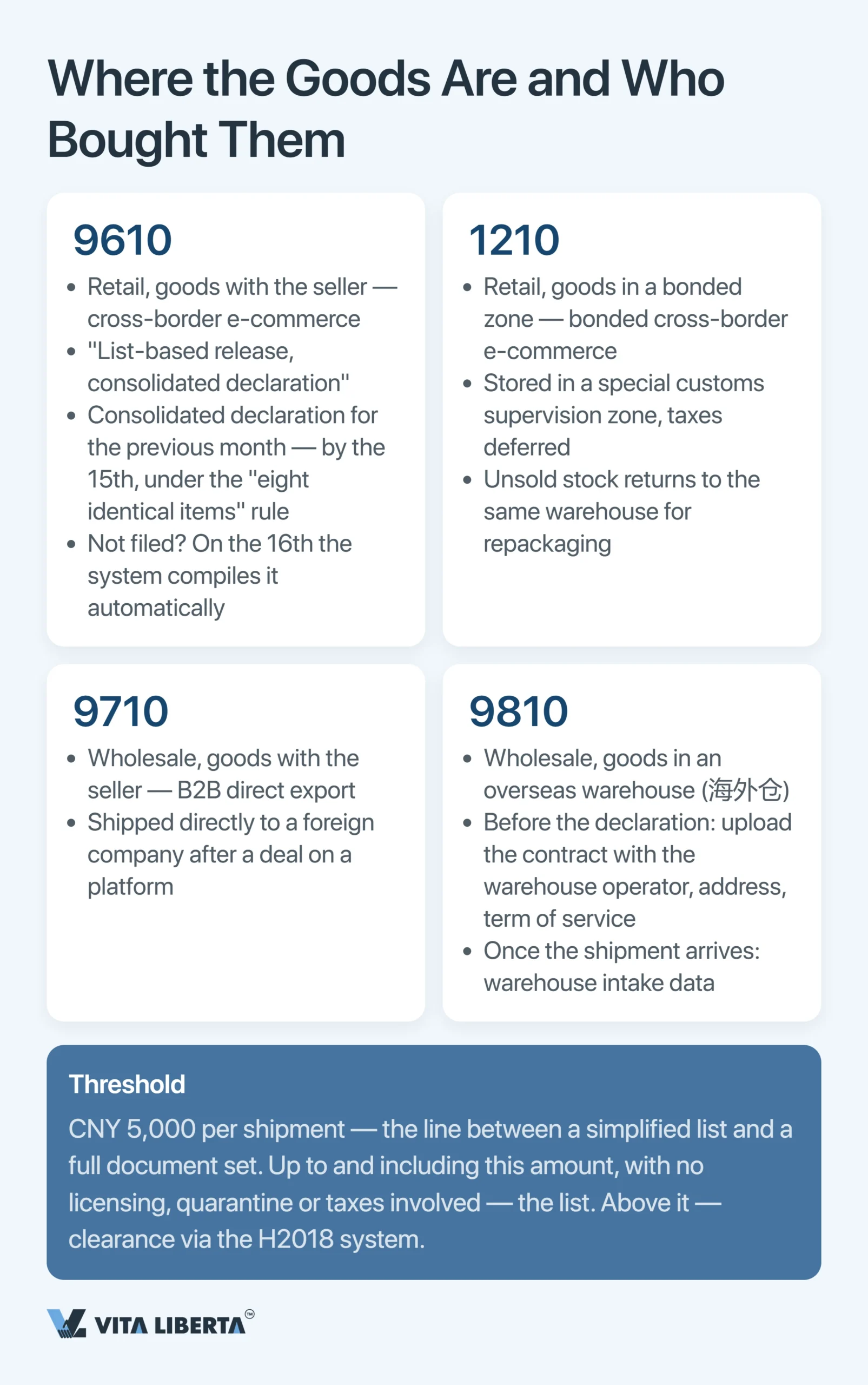
The platform you sell on doesn’t separate these four codes. What separates them is when ownership passes and where the cargo sits at the moment of sale.
From 9610 to 1210: direct retail vs retail from a bonded warehouse
GACC Announcement No. 12 of 2014 (海关总署公告2014年第12号) introduced 9610. It runs on “list clearance, consolidated declaration” (清单核放、汇总申报):
- Customs releases the shipment list quickly.
- The consolidated declaration for the previous month is due by the 15th.
- Lines are merged under an eight-match rule: same shipper, same transport mode, same destination country, same ten-digit code, and so on.
- If you don’t file, the system builds the declaration for you on the 16th.
1210 rests on GACC Announcement No. 57 of 2014 (海关总署公告2014年第57号), and its logic runs the other way. The goods go into a special customs supervision zone in advance. For the supplier, moving goods into the zone and selling them to a zone resident or a foreign buyer counts as an export. That means the VAT refund right arises at this stage already (Announcement 11/2026). Unsold stock doesn’t come back from another continent. It goes back to the same warehouse for repacking and a second attempt.
A tip with a safety margin: set your internal deadline for the 14th. If the 15th falls on a weekend or public holiday, the deadline moves to the next working day (海关总署公告2018年第194号). Planning to file on the last possible day is still a bad idea.
Wholesale and overseas warehouses: 9710 and 9810
GACC Announcement No. 75 of 2020 (海关总署公告2020年第75号), in force since 1 July 2020, added both codes.
CNY 5,000 is the line between a list and a full declaration:
- CNY 5,000 or less, with no licensing, inspection or tax payment needed: the exporter can choose a simplified list in the unified cross-border e-commerce system or a declaration in the H2018 system.
- Above CNY 5,000: clearance goes through H2018 only.
The second code is often misunderstood. 9810 is a declaration mode, not a warehousing solution. Before filing, the exporter sends customs the electronic booking data for space in an overseas warehouse (海外仓; 订仓单). Since 15 December 2024, you no longer need to register the 9810 mode separately with customs (海关总署公告2024年第167号).
| Code | Legal definition | Key parameter | Legal basis | Practitioner’s note |
| 0110 | General trade | Rebate rate up to 13% | VAT refund: 财政部 税务总局公告2026年第11号 | Confirmed, with a caveat. Check the rate by commodity code; buying from a small-scale taxpayer lowers it |
| 1039 | Market procurement | ≤ USD 150,000 per declaration | 海关总署公告2019年第221号 | Check carefully: exemption without rebate, so there is no “VAT discount” here |
| 1210 | Bonded e-commerce | Storage in a special supervision zone | 海关总署公告2014年第57号 | Confirmed. Unsold goods return within China, not from another continent |
| 9610 | Cross-border e-commerce | Consolidated declaration by the 15th | 海关总署公告2014年第12号; 海关总署公告2018年第194号 | Needs adjusting. Missing the deadline brings no fine, but the system assembles the declaration on its own terms |
| 9710 | B2B direct export | CNY 5,000 threshold per shipment | 海关总署公告2020年第75号 | Confirmed, with a caveat. The threshold applies per shipment, not per contract |
| 9810 | Export to overseas warehouse | Warehouse booking data (订仓单) | 海关总署公告2020年第75号; 海关总署公告2024年第167号 | Check carefully: customs won’t accept the declaration without booking data; registering the mode is no longer required since 15 Dec 2024 |
2026: what Announcement No. 16-2026 changed
Three agencies acted together in February 2026: the Ministry of Finance, GACC and the State Taxation Administration. Their joint Announcement No. 16 of 2026 (财政部 海关总署 税务总局公告2026年第16号) was signed on 6 February. It carries a relief that used to cover exports from 2023 to the end of 2025 forward into 2026–2027. For online sellers, it once again deals with an old complaint: shipping goods out was easy, getting them back was not.
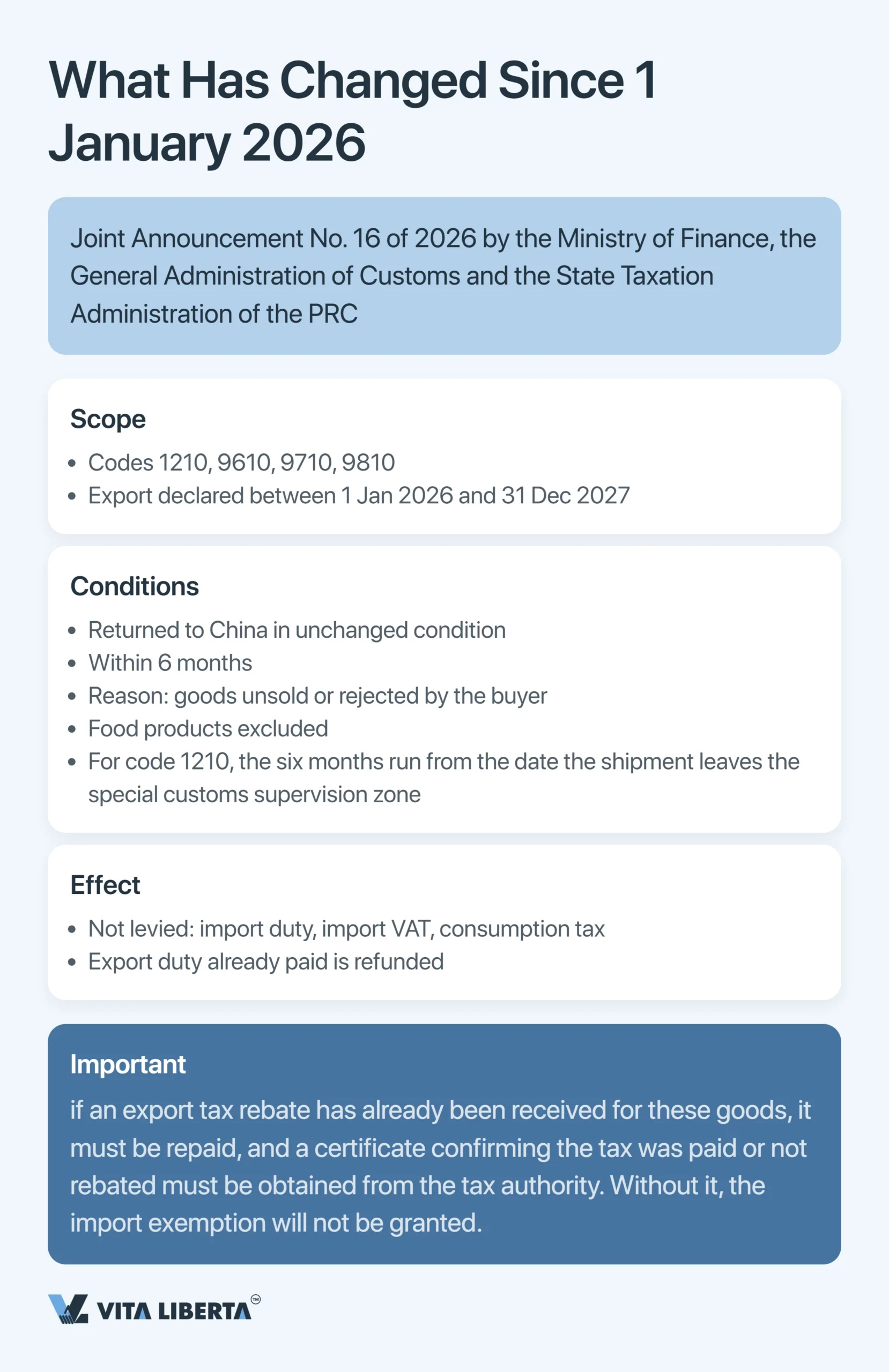
Here is how it plays out. Suppose you declared a shipment under 1210, 9610, 9710 or 9810, and the declaration is dated in calendar year 2026 or 2027. The stock doesn’t sell, or the buyer sends it back. You then have six months to bring it into China in the same state it left in. Make that window and customs charges nothing on re-entry, whether duty, VAT at the border or consumption tax. Any export duty you paid on the way out is refunded to you. Food is the one category left out.
Two details are easy to miss. VAT and consumption tax you paid at the export stage are a separate matter: you account for them the way you would for goods returned after a domestic sale. And for 1210, the clock starts when the goods leave the special customs supervision zone.
One trap catches exporters who have already claimed a rebate. If the returning goods earned you a refund, you owe it back under the current rules. The tax office then has to issue a certificate confirming that the tax was repaid or never refunded. Customs won’t apply the import exemption without that paper.
So the relief has a narrow target. No new codes join the list, and every declaration requirement stays in place. What goes away is the cost of guessing demand wrong.
Choose a China export regime without losing money
- Code selection for your supply model
- Checking caps and thresholds
- Support through customs release

China export supervision codes: strategic takeaways
Box 14 is the most rigidly fixed field on the declaration: one code, one chance, no edits. Yet it has become the declaration’s most flexible tool. Six regimes cover every case, from a container leaving a factory under contract to a parcel sent to an overseas warehouse ahead of a future order.
Choose the code before the deal, not after. After release it is no longer a setting you control; it is a fact that lawyers work with.
The economics follow the code. The gap between 0110 and 1039 can reach 13% of the VAT-exclusive purchase price, and it’s built into the supplier’s price before negotiations even start.
Watch the end-2027 cut-off. The returns relief stops at declarations made after the last day of 2027, and the classic codes 0110 and 1039 sit outside it.
The four digits on a Chinese declaration are therefore more than a record of a finished deal. They set its economics. You fix them when you choose the supplier and structure the delivery, not read them off a scan afterwards.
Frequently asked questions
That number names the regime customs used to release your goods. From it you can tell whether the shipper got a tax rebate, what paperwork was involved and which restrictions applied. What to do: compare it with your contract before the final payment goes out.
Nothing was ever going to be refunded. Under market procurement the goods are tax-exempt and the exporter has no right to a rebate, so the price never held a tax portion to give back. What to do: if a rebate matters to you, insist on clearance under a regime that allows one (in most cases 0110) and ask to see the incoming special fapiao.
That’s 9810. Your exporter must transmit the warehouse booking data (订仓单) to customs electronically before the declaration is filed. Registering the mode with customs separately has been unnecessary since 15 December 2024. What to do: get the warehouse booking confirmed ahead of the first shipment.
Not by overwriting it. Each declaration holds a single supervision code, and release locks it in. Fixing it later means going through a separate correction procedure. What to do: settle the regime while you’re still negotiating the price.
Yes, if three things line up. The goods left under 1210, 9610, 9710 or 9810 on a declaration dated in 2026 or 2027. They come back in their original condition within six months. And they aren’t food. In that case you pay no duty, import VAT or consumption tax when they re-enter. What to do: if a rebate was claimed on that stock, have the certificate of tax repayment or non-rebate ready before the goods arrive.