Hongkong
 China


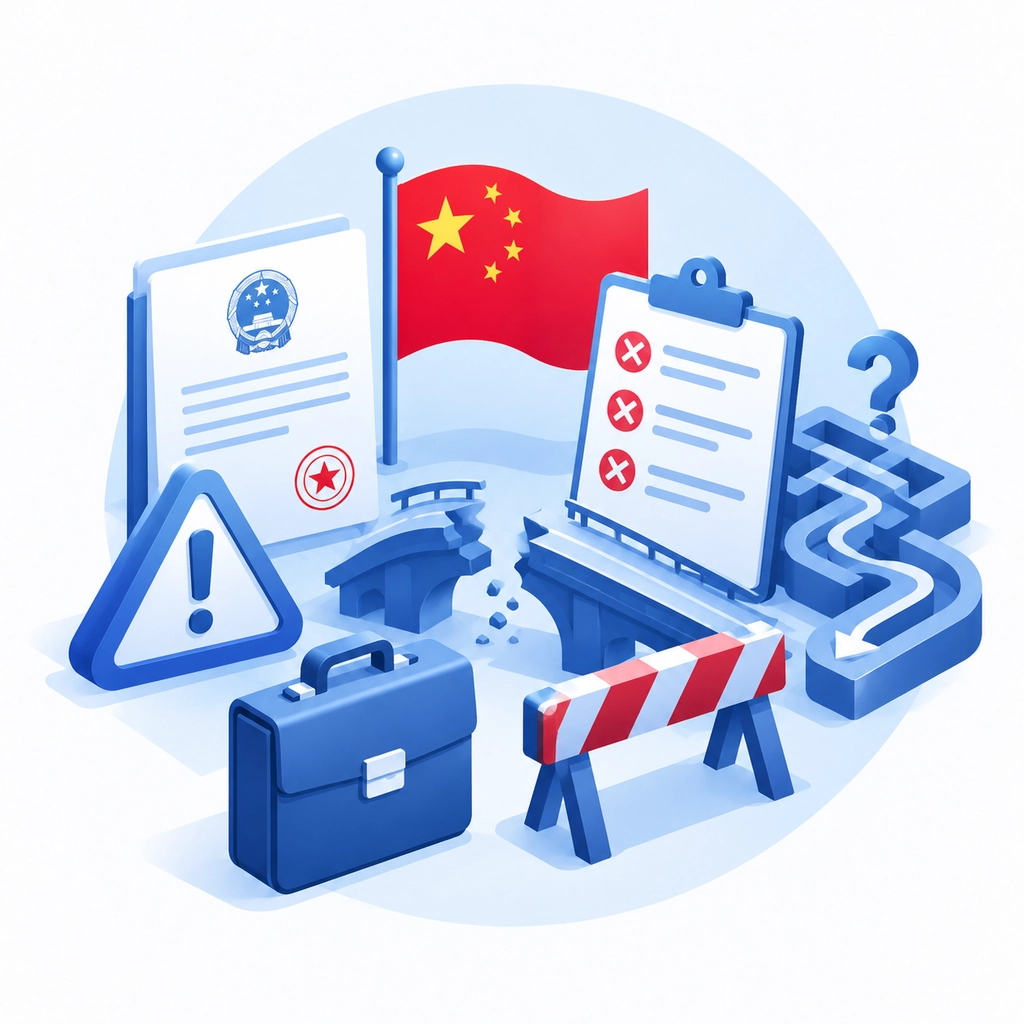


A weak product seldom kills a China launch. Decisions made before entry do: a vehicle that doesn’t fit, a contract that sends disputes to someone else’s courts, a partner nobody looked into. The field is also getting crowded. MOFCOM (商务部) counted 70,392 new foreign-invested enterprises (FIEs) in 2025, up 19.1% on 2024. The more newcomers there are, the more it costs to get in, and the more a wrong move costs you.
The core problem
“Our goods went to China on 50% prepayment terms, and the contract named a court in our own country. The buyer was a shell. The money is lost, the balance will never be paid, and collecting it means two lawsuits: one at home, one in the PRC. What did we miss before the shipment?”
We hear versions of this question from China newcomers more often than almost any other.
Strategic mistakes made before entry
Lawyers and tax come later. The first mistakes are about how you see the country. You treat it as one uniform space, and you pick a corporate form because it’s the one you used elsewhere. You will pay for both for years.
Why “entering China” is the wrong goal
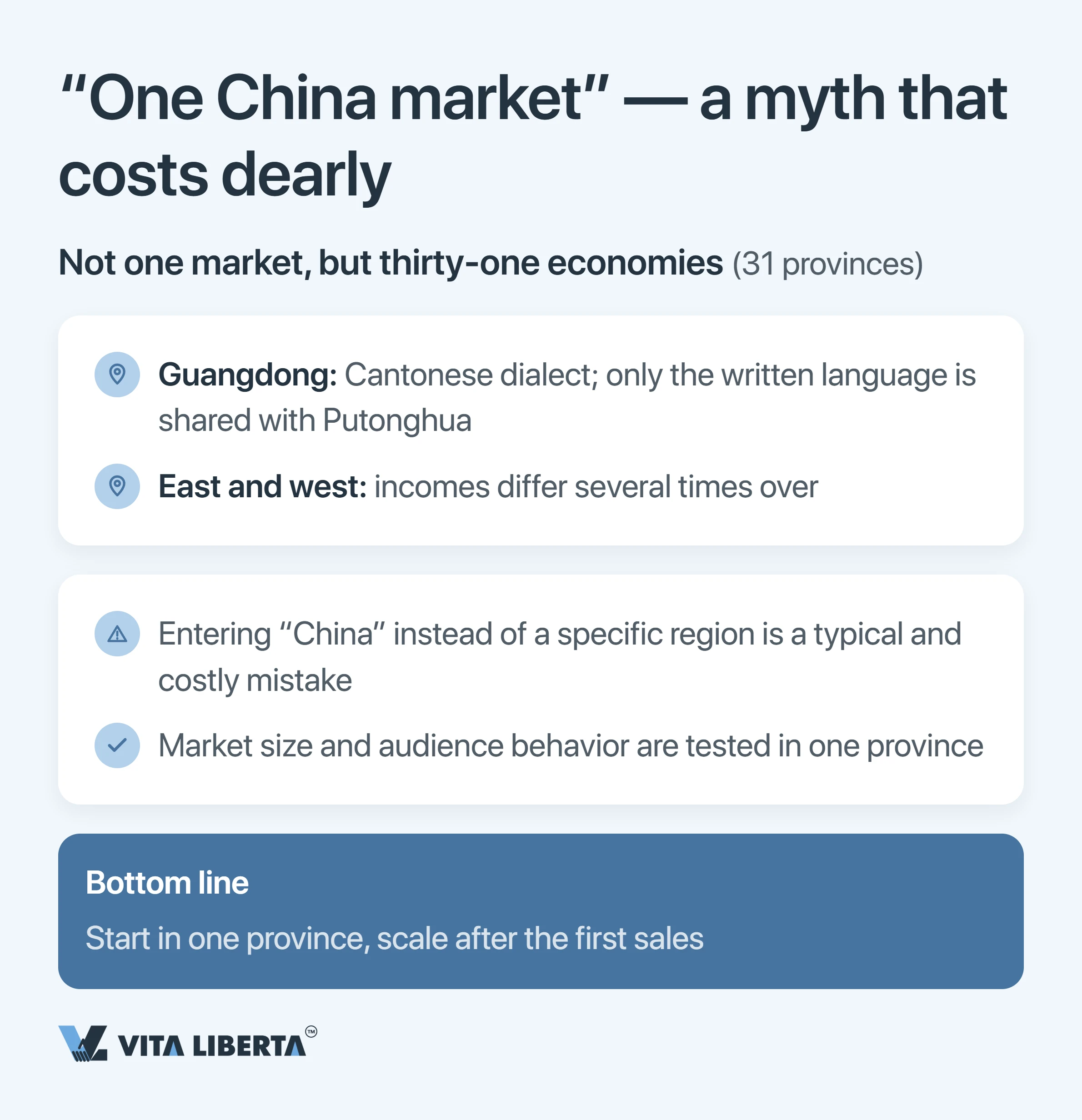
Think of 31 countries, not one. That is roughly what China’s 31 provincial-level units are, each comparable in size to a separate state. Guangdong speaks Cantonese, and only the script links it to Putonghua. Incomes in the east and the west are several times apart. So when an international company aims at “China” rather than one region, it makes an error that is both common and expensive. Pick one province, launch there, and scale afterwards.
WFOE, JV or RO: three forms you can’t swap
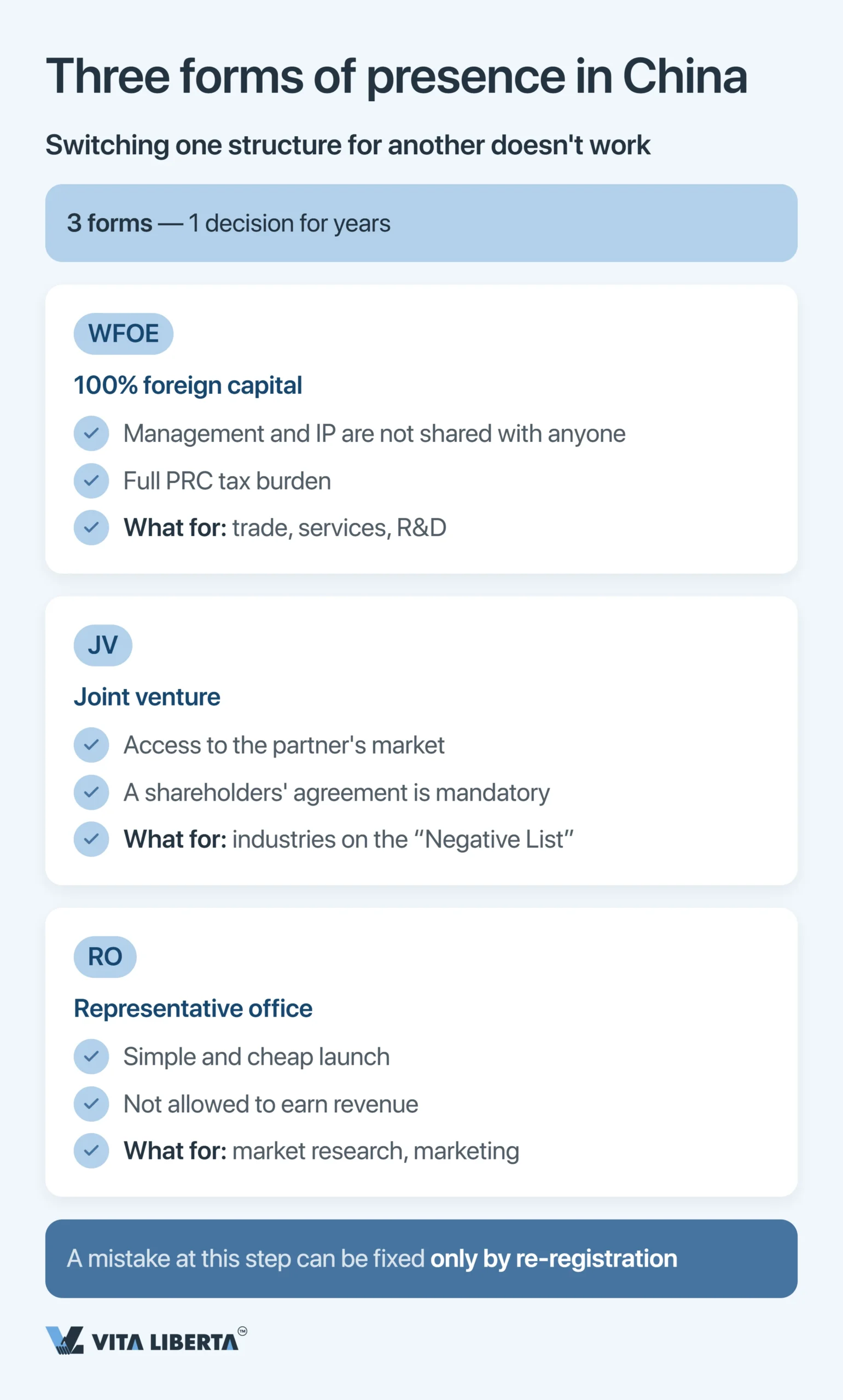
Choosing the form at random is mistake number two. You have three options, and none of them can stand in for another.
Some background first. The rules changed on 1 January 2020 with the PRC Foreign Investment Law (中华人民共和国外商投资法). From that date, any company with foreign money takes one of the forms in the PRC Company Law. “WFOE” is just everyday shorthand for a limited liability company you own outright. Older vehicles set up under the joint-venture and foreign-enterprise laws had until 31 December 2024 to adapt. If yours is one of them, it now has to follow the new rules.
- WFOE: you decide alone. Every share is in foreign hands, so you split neither control nor IP.
- JV: you take it when you have no choice. That happens when the Negative List (外商投资准入特别管理措施(负面清单)(2024年版)) says your sector needs a Chinese partner. The list came out under joint NDRC–MOFCOM Order No. 23 (国家发展改革委 商务部令第23号) and applies from 1 November 2024. It keeps 29 restrictions, and manufacturing is no longer among them.
- RO: you get a display window without a cash register. It can market and coordinate. It can’t book revenue.
Choose wrong, and you start registration again from zero.
| Form | What you gain | What holds you back | When it fits |
| WFOE (all capital foreign) | You keep full control and your IP | You carry the full PRC tax load | Trading, services, R&D |
| Joint venture (JV) | You tap into your partner’s market | You share control; the articles of association (章程) are mandatory | Sectors on the Negative List |
| Representative office (RO) | You are present without a separate legal entity | No revenue, no sales; yearly report with an expense audit (1 March – 30 June) | Scouting the market, marketing |
Legal architecture: the weak points of the structure
After the form comes the design, and this is where experienced investors trip too. Watch three spots: capital, the chop and the choice of court. Don’t underestimate the third one. You can pick your home law if you like, but China’s overriding mandatory rules will still apply, whatever the parties wanted. And a win in a foreign court is only paper until it is enforced in the PRC.
Registered capital: a deadline you answer for personally
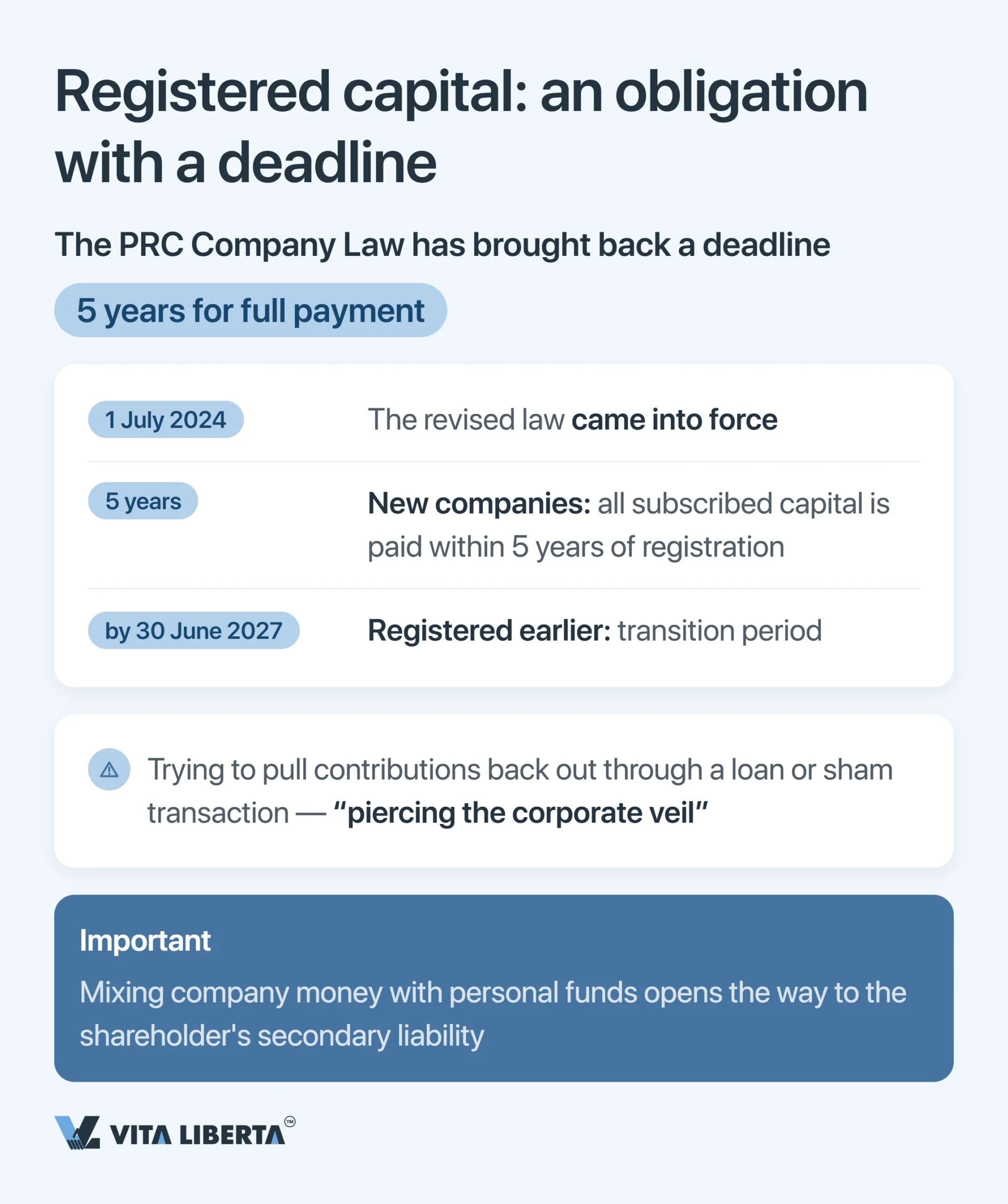
Think of registered capital as a debt you owe your own company, not a figure you are free to set. And that debt now has a due date.
Deadline. The Company Law was rewritten (中华人民共和国公司法, 主席令第十五号), and the new text applies from 1 July 2024. It brings back a cut-off. Most WFOEs are limited liability companies, and such a company has 5 years from registration to pay in everything it subscribed.
Registered before 30 June 2024? Then the State Council’s Decree 784 (国务院令第784号) gives you a transition. Look at what is left of your payment term as of 1 July 2027. If that is more than 5 years, cut it to 5 by 30 June 2027 and amend your articles to match. Your capital then has to arrive by 30 June 2032 at the latest. Companies limited by shares don’t get those 5 years: their shares must be fully paid by 30 June 2027.
What it costs you. Suppose you move paid-in money back out, dressed up as a loan or a fake deal. That counts as unlawful capital withdrawal (抽逃出资). You, as shareholder, give the money back. Any director behind the move covers the company’s losses alongside you.
Important: use the company card for a private dinner, or blur company and personal money in any other way, and a court can pierce the corporate veil. If you use the company’s separate status to run from its creditors, you pay its debts together with it.
Chop and legal representative: the point where everything can freeze
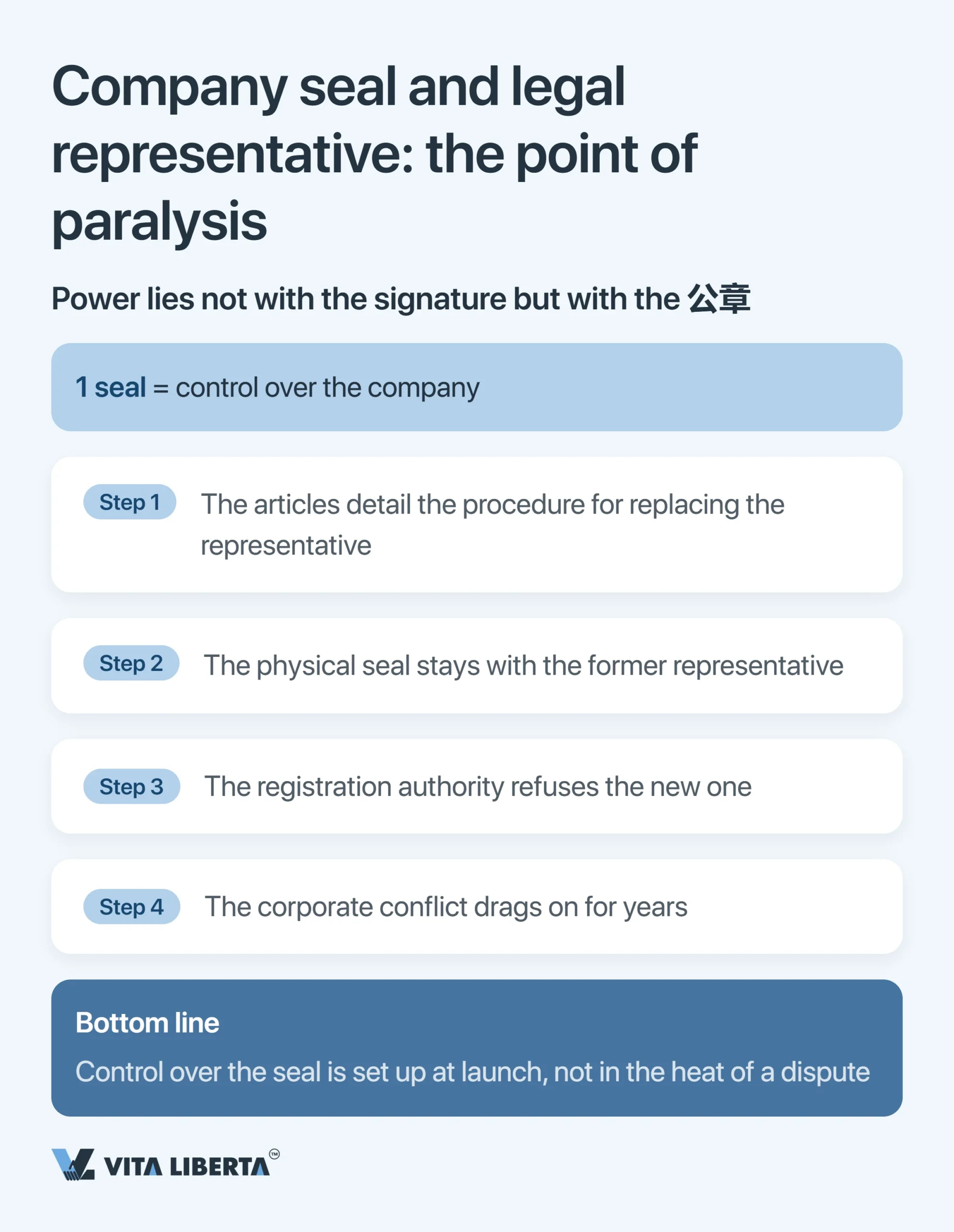
A signature carries little weight in a Chinese company. Authority sits in the official chop (公章) and with the person named as legal representative. From 1 July 2024, Article 35 of the Company Law unblocks the classic standoff. The incoming legal representative signs the change filing, so an outgoing one who sits on the chop can’t stop it at the registry anymore. You still need the chop at the bank, on contracts and for a long list of other steps, so fights over it keep showing up in shareholder disputes. Decide who controls it while you set up, not once the fight has started.
Build your China business structure without mistakes
- WFOE or JV: which one fits you
- Negative List screening
- Registered capital model

Tax traps: PE exposure and getting profit out
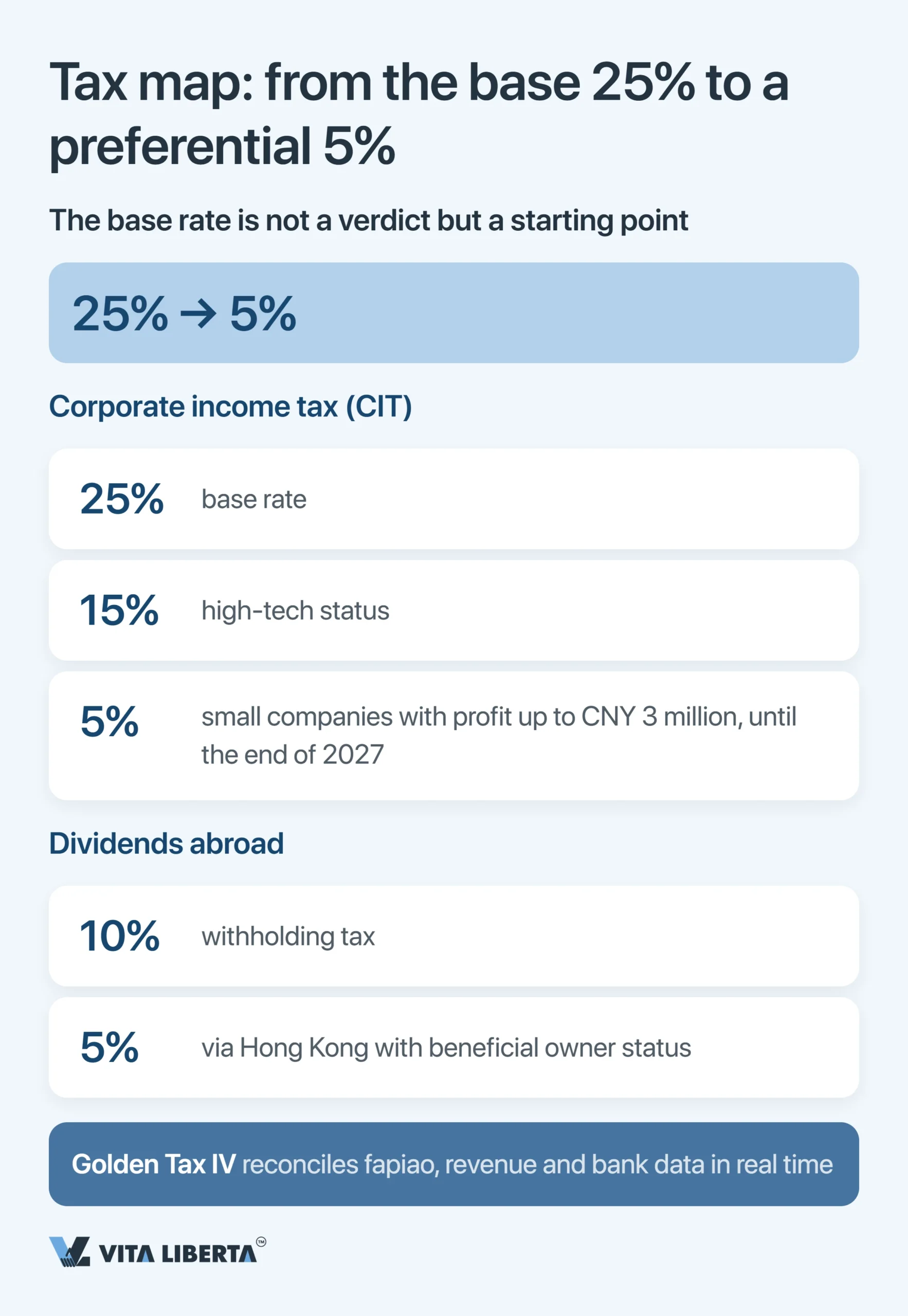
Investors tend to patch their tax model together as they go, and they overpay for it. Read the 25% Corporate Income Tax (CIT) as the point where incentives start, not where you end up. Earn high-tech status, and you pay 15%.
Smaller firms (小型微利企业, small low-profit enterprises) end up at 5%. Only a quarter of taxable income goes into the base, and that base is taxed at 20%. You fit if your taxable profit is CNY 3 million or less, your staff is 300 or fewer, your assets are CNY 50 million or less, and your line of business isn’t restricted or banned. You can use this until 31 December 2027 (Announcement No. 12 of 2023, 财政部 税务总局公告2023年第12号).
Investors lose the most in three places.
First, you work in China without registering. An inspector calls it a permanent establishment (PE), and China taxes all the profit tied to it.
Second, you own the Chinese company directly and plan nothing. Every dividend that leaves the country loses 10% at source. Put a Hong Kong holding company in between, with a direct stake of at least 25% and beneficial-owner status, and you pay 5% instead. That comes from the Mainland–Hong Kong tax arrangement (内地和香港特别行政区关于对所得避免双重征税和防止偷漏税的安排). Hong Kong has its own tax system and appears here only as the place where the shares are held. The State Taxation Administration (STA, 国家税务总局) won’t accept a paper holding: among other things, it checks for real business activity (STA Announcement No. 9 of 2018, 国家税务总局公告2018年第9号). Build the structure mainly to get the 5%, and you won’t get it.
Keeping your money in China? There is a tool for that too. Put dividends earned in China straight into a new direct investment inside the country during 2025–2028, and 10% of what you invest comes off your tax. Whatever you can’t use this year rolls into later years (Announcement No. 2 of 2025, 财政部 税务总局 商务部公告2025年第2号, valid through 31 December 2028).
Third, you run grey schemes. Golden Tax IV (金税四期) lets the tax office line up your digital fapiao (数电票, in use across the country since 1 December 2024) with your returns and with what banks and other agencies report.
| Where the structure fails | What you pay for it | What fixes it |
| Your activity amounts to a PE | China taxes the profit linked to the PE | Register an FIE and separate the functions |
| Dividends go out directly | 10% is withheld at source | HK holding with a direct stake of 25%+ and beneficial-owner status (real business in the holding) → 5% |
| You mix company and personal assets | You are jointly liable for the company’s debts | Keep the company’s books apart from the shareholder’s |
Partners and brands: where trust breaks twice
Once you are in, two risks go straight for your cash: a partner you never checked and a brand you never registered.
Shell companies: the check most people skip
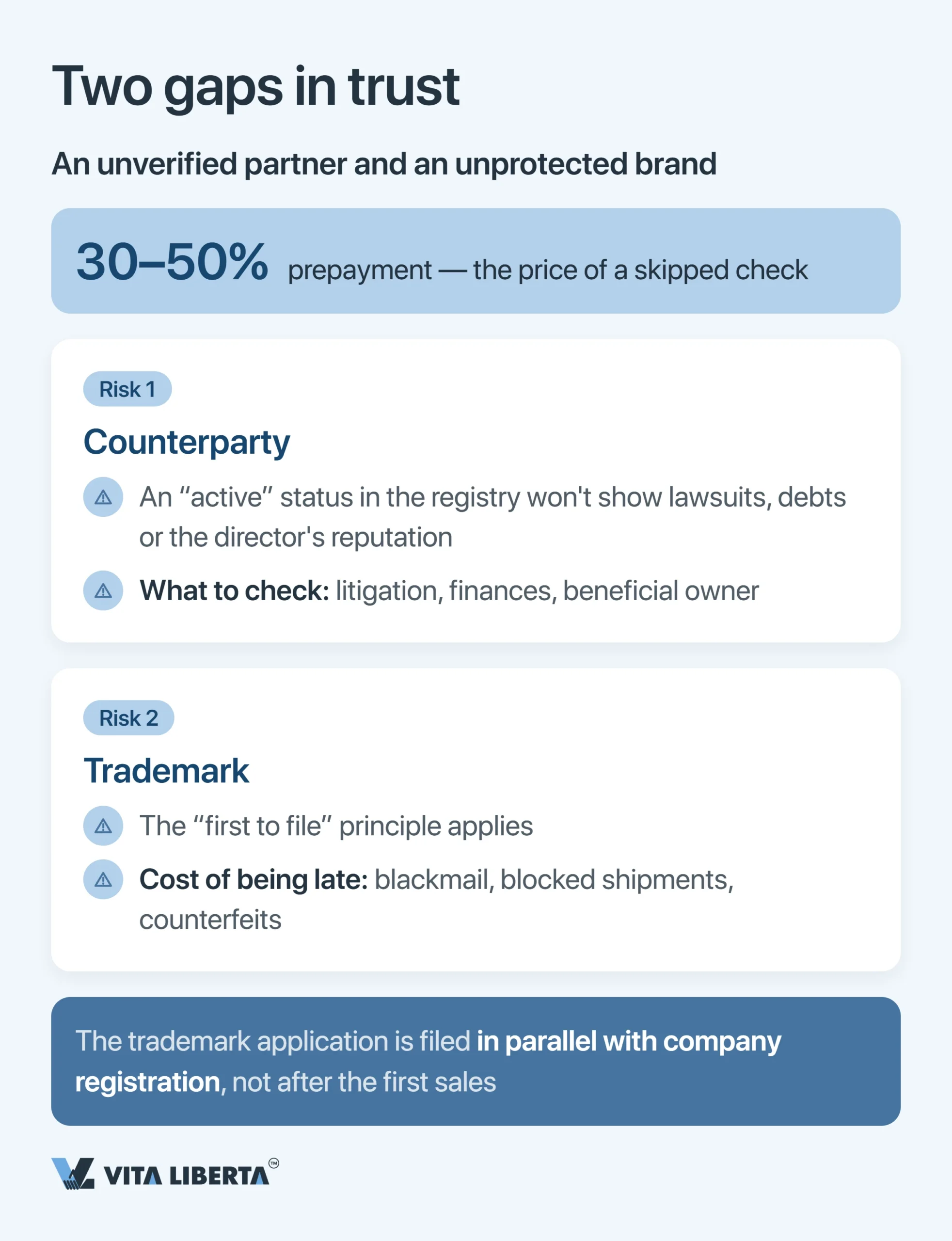
Shell operators count on one thing: that you will stop at the public register. They build the scenery for exactly that moment, with a clean office, courteous people and a polished site. Then your 30–50% advance arrives, and they go quiet.
So yes, start with the register. Take the 18-character code the company was issued at registration (统一社会信用代码, USCC) and look it up at gsxt.gov.cn, the state’s own disclosure database (国家企业信用信息公示系统). You can’t skip this step. But what it gives you is thin. A green “active” label doesn’t mention whether the company is being sued, who it still owes money to, or what kind of record its director has.
That is why the real check works in three directions at once: litigation history, the money, and the person who ultimately owns the business. Honesty has no single tell.
Brand squatting: the first filer takes it
In China, a mark goes to whoever applies first, not to whoever used it first. Arrive without a registration, and you may find your own name already filed by a rival or an ex-partner. What follows is ransom demands, stopped shipments and fakes on the market.
The Trademark Law has been revised (主席令第七十七号): adopted on 26 June 2026, in force from 1 January 2027. Squatters get a harder time. A filing made with no plan to use the mark, and clearly beyond what a business normally needs, will be refused.
So your trademark belongs in your entry preparation, not in the final polish.
Enter the Chinese market without legal risk
- Turnkey company registration
- Trademark protection in the PRC
- Tax planning for profit repatriation

Entering the Chinese market: strategic takeaways
China is strict on form and open on opportunity at the same time. The chop, the fapiao and the five-year capital clock sit next to reduced tax rates and the encouraged-industries catalogue (鼓励外商投资产业目录(2025年版)). NDRC and MOFCOM signed off on its latest edition, which runs from 1 February 2026 with 1,679 entries, 205 more than in 2022. Investors who see both sides come out ahead.
- Settle the big questions first. Changing your business form, court or ownership chain later is expensive.
- Price in your personal exposure. Company money is not the founder’s wallet.
- Register the brand and check the partner before the first deal, not after it.
Seen this way, the common mistakes of entering the Chinese market are not a list of things you can’t do. They are a map of decisions that turn entry into a project you control. The paperwork you do at the start is not red tape at the finish line. It is what gives you a footing in the largest market on the planet.
5 key questions and answers on China market entry mistakes
Not while you’re testing. A distributor or a cross-border storefront will show you whether there is demand. Once you want to control your prices and protect your technology, though, you need your own entity, usually a WFOE. Your trademark is a separate matter: a foreign company can file without a PRC entity, through a trademark agency registered in China. Bottom line: first decide whether you are testing or scaling. The goal picks the form, not the other way round.
It all turns on the Negative List. If your sector is open and you want to keep your technology fully in your hands, go with a WFOE. If the list forces a local partner on you, or a partner can open doors you need, go with a joint venture. Bottom line: run the Negative List check before anything goes to the local Administration for Market Regulation (市场监督管理局). The form you choose shapes your taxes and staffing for years.
If your company is new, you have five years from registration to pay in full. If it was set up before 1 July 2024, you have until 30 June 2027 to cut whatever payment term is left down to five years and put that in your articles. For a limited liability company, the money then has to arrive by 30 June 2032. The deadline itself is not the danger. The danger is pulling paid-in money back out. You would have to return it, and any director involved would cover the company’s losses with you. Mix company money with your own to get away from the company’s debts, and you will pay those debts personally. Bottom line: schedule your capital payments early and never mix personal and company money.
Don’t trust the register entry on its own. A company can look perfectly alive there while it is buried in lawsuits and unpaid bills, run by a director you would never do business with. That blind spot is exactly what shell firms use before they vanish with a 30–50% advance. Bottom line: order a full check of courts, finances and the beneficial owner. Where you can, pay the advance in instalments, each one released only as the matching delivery stage is completed.
Before you enter. China gives the mark to the first filer, so if you are late, a rival or a former partner can register your name, and ransom demands and stopped shipments follow. Bottom line: file for the trademark while the company is being registered, not after your first sales.