Hongkong
 China




China’s tax system works less like a wall and more like a turnstile. You can pass through, but each step you take is recorded and checked against your return by machine.
The core problem:
“Our WFOE in Hangzhou pays 25% on profit. Next door, in the same industrial park, a company with our turnover pays 15%. Our accountant swears we’ve done everything right. Then why do we pay more?”
Most questions like this come from firms that got into China through trading and haven’t looked at their tax status since day one. Nearly every time, the explanation sits in one of three places: what kind of taxpayer you are, how good your incoming paperwork is, and how you handle the calendar.
Who Pays and Who Checks: Three Budget Levels, One Chain of Command
Your tax ends up in three pots — central, provincial and city — yet only one service collects it. In practice you deal with one filing channel, and one database sees everything your company does.
STA, Golden Tax IV and e-fapiao: Matching in Real Time
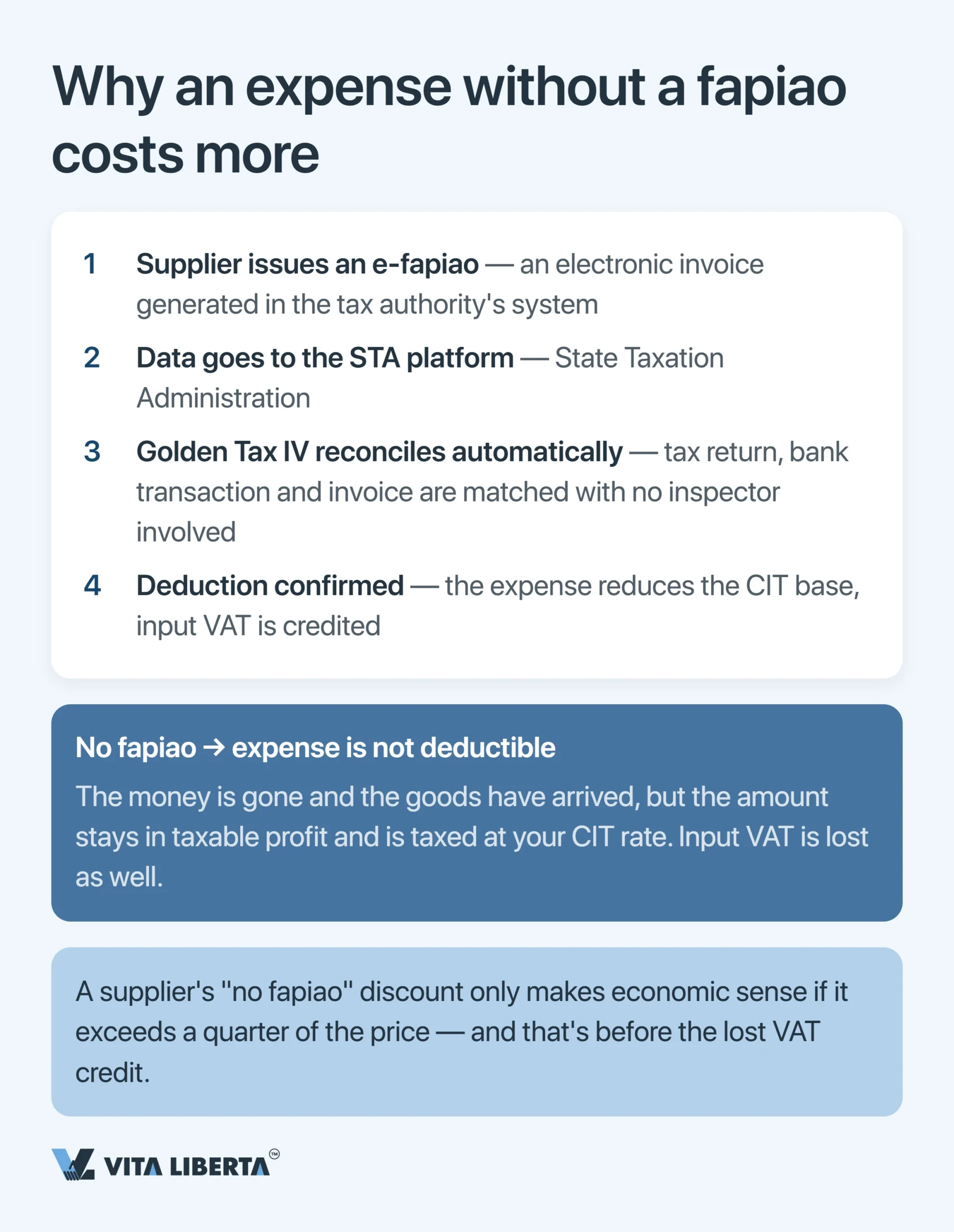
The collector is the State Taxation Administration (STA, 国家税务总局). Back in 2018, the old split between state bureaus (国税) and local bureaus (地税) at provincial level and below was folded into it. Returns go in online. From there, Golden Tax Phase IV (金税四期), the fourth generation of the system, cross-checks what you declared against your bank flows and the invoices you issued. No inspector has to lift a finger.
Treat the electronic fapiao as the key to a deduction, not as an accounting chore. Fully digital fapiao (数电票) have covered the whole country since 1 December 2024 (国家税务总局公告2024年第11号). Pay a supplier, receive the goods, but get no fapiao — and the cost still won’t lower your taxable profit.
When you buy anything that carries VAT, the STA’s rules on deduction documents (国家税务总局公告2018年第28号) make the fapiao your basis for writing it off; other paperwork works only in narrow cases. Your deadline for collecting it is the close of the annual CIT reconciliation — 31 May of the next year. Miss that and the expense isn’t lost for good: you can still claim it later, but only within five years.
Here is where many international firms pay dearly. A Chinese contractor sends a free-form invoice, the kind European bookkeeping happily accepts, and nobody spots the problem until the annual reconciliation shows missing deductions. The lesson: in China, compliance begins with the document you receive, not the return you file.
TRE, Non-TRE and Permanent Establishment: Where the Line Runs
How much you owe depends first on which side of the residency line you’re on. Incorporated under PRC law? You’re a Tax Resident Enterprise (TRE). Incorporated elsewhere but run from inside China? Also a TRE. Either way, you report income from everywhere in the world.
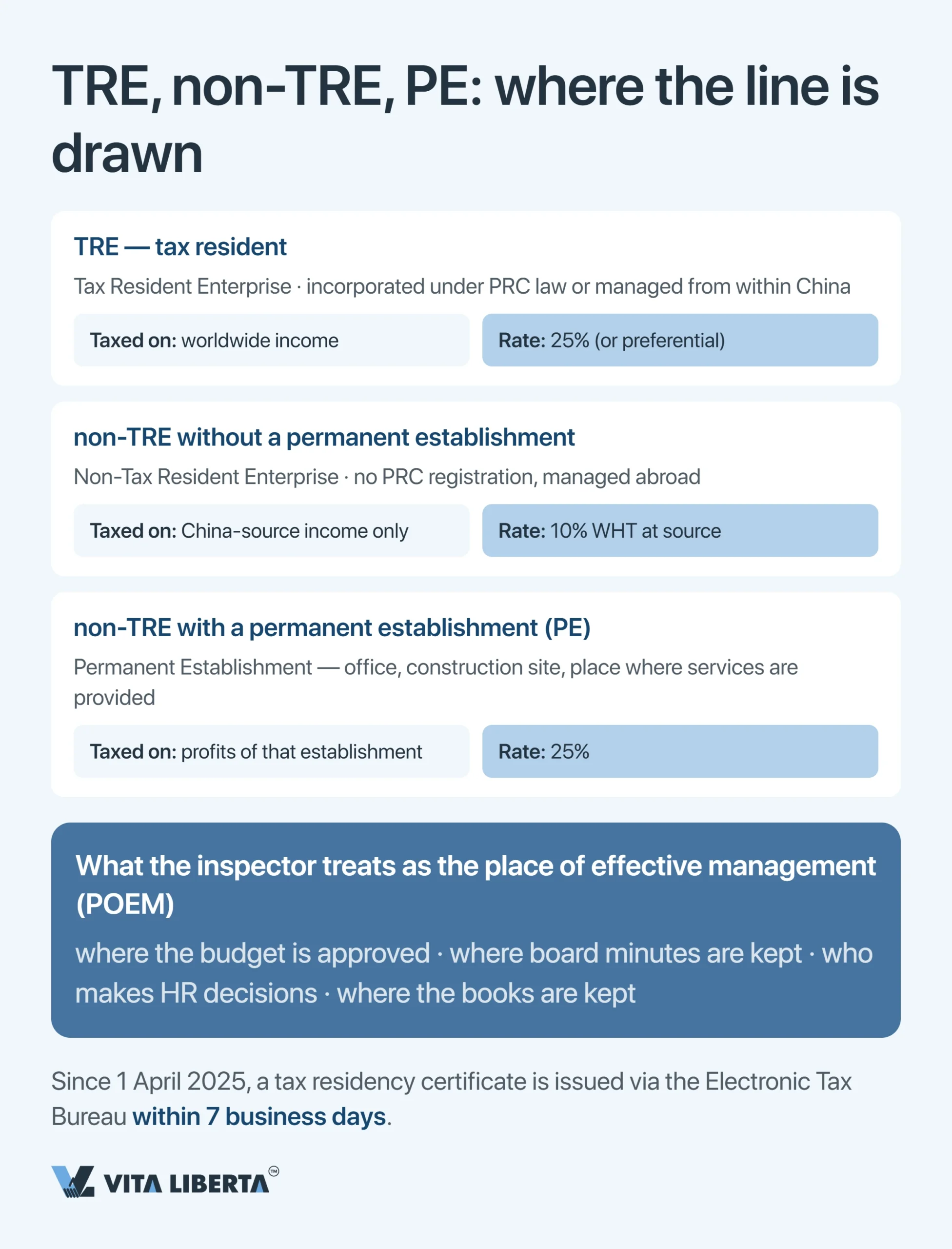
Stay a non-resident (non-TRE) and only your China-source income is in scope — until you acquire a permanent establishment (PE), such as an office, a building site or a location where you deliver services. From that point the PE’s profit is taxed like any other company’s.
To find your place of effective management (POEM), the inspector ignores the registered address and asks practical questions. Who signs off the budget? Where do the minutes live? Who handles hiring and firing?
One practical point. A new procedure for Chinese tax residence certificates has been in force since 1 April 2025 (国家税务总局公告2025年第4号). Where the tax office can establish your status on its own, you’ll have the certificate in seven working days. A Chinese resident uses it to get treaty relief abroad. Dividends leaving China for a foreign shareholder need something else: a certificate from the shareholder’s own tax authority. Ask for it well ahead — not in the same week as the payment.
CIT: From the Standard 25% Down to 15% and 5%
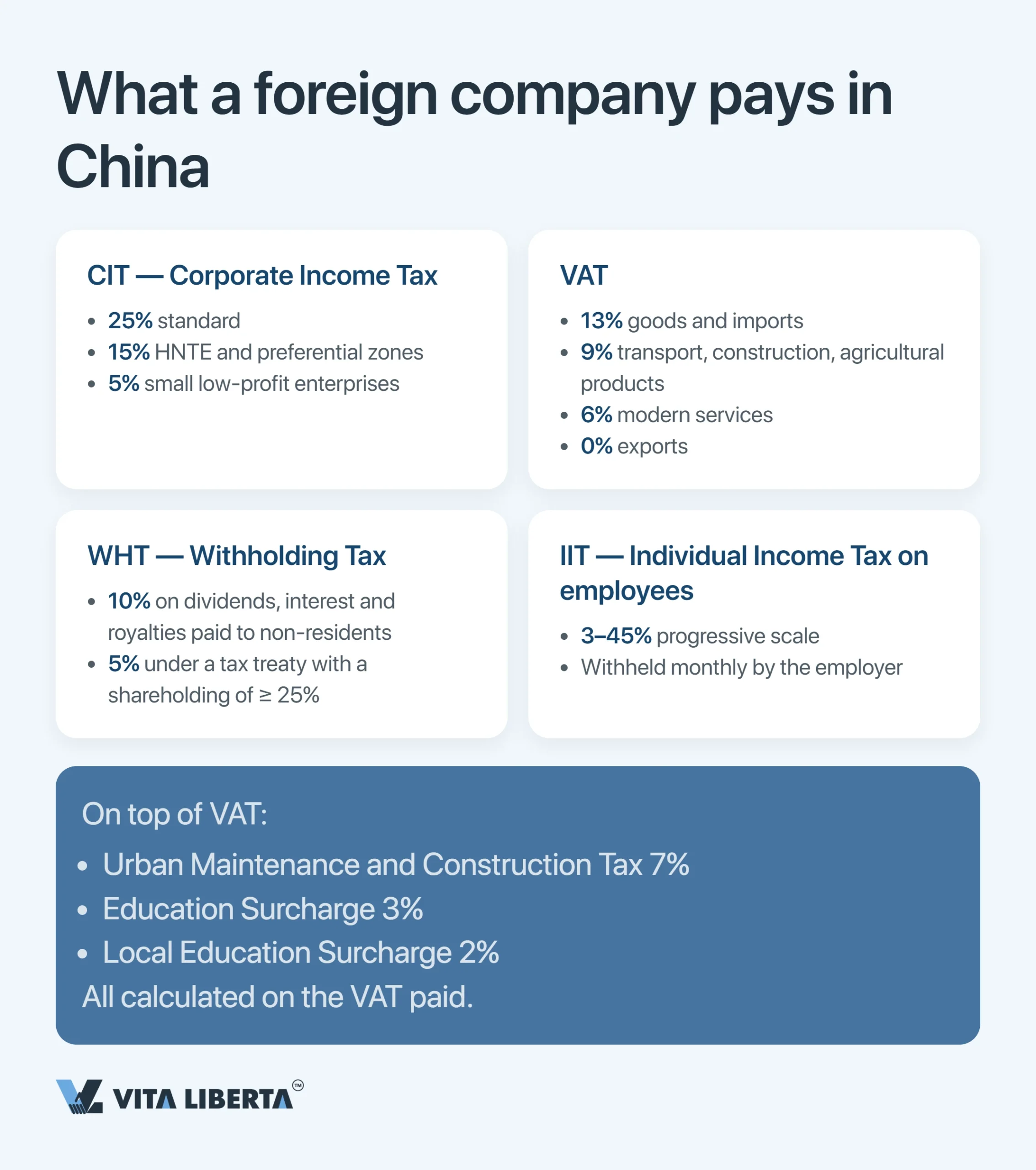
Every CIT incentive in China is measured against one number: 25%. That rate comes from the Enterprise Income Tax Law of the PRC (中华人民共和国企业所得税法), the EIT Law for short. You pay it on income after deducting expenses you can document and losses from earlier years.
A loss can absorb profits for the following five years. If you’re an HNTE (High and New Technology Enterprise) or a technology-based SME (科技型中小企业), you get ten — and that longer window reaches back to losses from the five years before you obtained the status (财税〔2018〕76号).
| Who you are | Rate | What you need | Where the inspector looks | Reach, duration and act |
| Ordinary company (WFOE, JV) | 25% | Nothing special | Whether every expense has a fapiao and a business reason | Whole country, open-ended (EIT Law) |
| HNTE | 15% | A certificate, enough R&D spending, IP you own | Timing. The 15% starts in the year the certificate is issued. In its final year you may still prepay at 15%; fail to renew by 31 December and you pay the difference up to 25% for that year | Whole country; certificate lasts 3 years (国家税务总局公告2017年第24号) |
| Small low-profit enterprise | 5% effective | Profit up to RMB 3 million (~$445k at the PBOC rate of CNY 6.7367 per USD on 8 October 2026), no more than 300 staff, assets up to RMB 50 million | That none of the three limits is breached | Whole country; ends 31 December 2027 (财政部 税务总局公告2023年第12号) |
| Business in the Hainan Free Trade Port | 15% | Activity on Hainan’s encouraged list, plus genuine substance | A real office, people and running costs in the zone — a mailbox won’t do | Hainan; ends 31 December 2027 (财税〔2020〕31号, extended by 财税〔2025〕3号) |
| Business in Lingang, Shanghai | 15% | Only integrated circuits, AI, biopharma and civil aviation; set up in the zone from 2020 onwards; actual manufacturing or R&D | A plant or lab inside the zone and a place on the beneficiary list | Lingang New Area; five years counted from incorporation (财税〔2020〕38号) |
| Business in Qianhai, Shenzhen | 15% | Activity on Qianhai’s encouraged list, plus genuine substance | A real office, people and running costs in the zone — a mailbox won’t do | Qianhai; ends 31 December 2027 (财税〔2021〕30号, 财税〔2024〕13号, extended by 财税〔2026〕3号) |
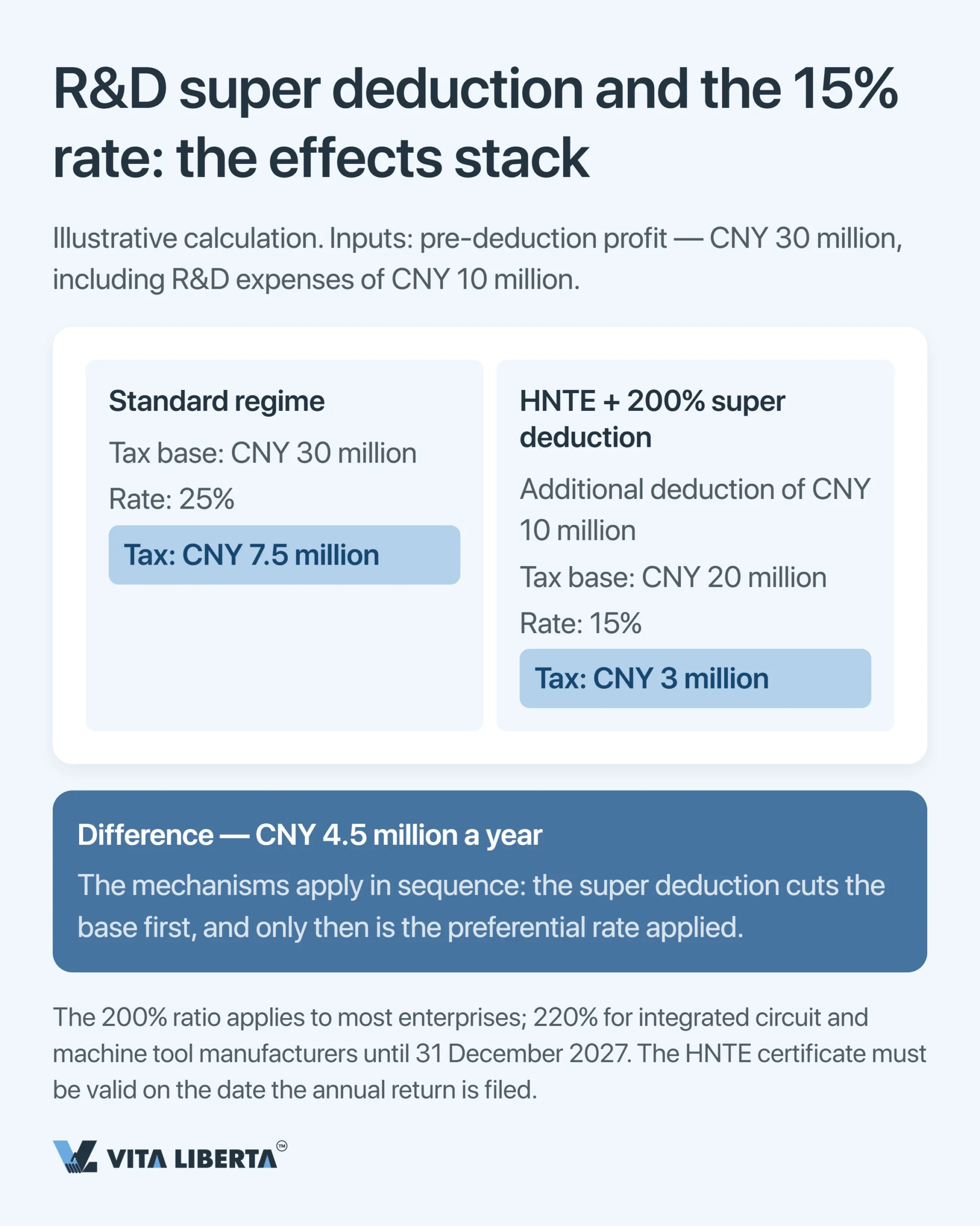
Your R&D spending can then be deducted twice over: 200% of the real cost (财政部 税务总局公告2023年第7号). Chip businesses across the chain — fabrication, design, equipment, materials, packaging and testing — along with producers of advanced machine tools (工业母机), get 220% through 31 December 2027 (财政部 税务总局 国家发展改革委 工业和信息化部公告2023年第44号).
Not every business qualifies. Wholesale and retail, leasing and business services are among the excluded sectors, so a trading WFOE should leave the super deduction out of its plans.
The two levers work together: the deduction cuts your base first, and only then is the 15% rate applied. In other words, the gap between 25% and 15% isn’t something the law hands you. It’s a file you rebuild and defend every single year.
Find the right tax regime for your company in China
- Status and residency check
- Eligibility review for the 15% rate
- Tax burden calculated before registration

VAT and Fapiao: 13, 9, 6 and Zero
VAT got its own statute on 1 January 2026. The Value-Added Tax Law of the PRC (中华人民共和国增值税法, 主席令第四十一号), passed on 25 December 2024, replaced the provisional regulations, and its Implementing Regulations (国务院令第826号) started the same day. Nothing happened to the rates. Goods and imports carry 13%. Transport, building work, farm produce and utilities sit at 9%. Modern services pay 6%, and exports leave at zero.
Small-Scale or General Taxpayer: The RMB 5 Million Line
Where you land depends on one figure: RMB 5 million of annual revenue (~$742k at the PBOC rate on 8 October 2026).
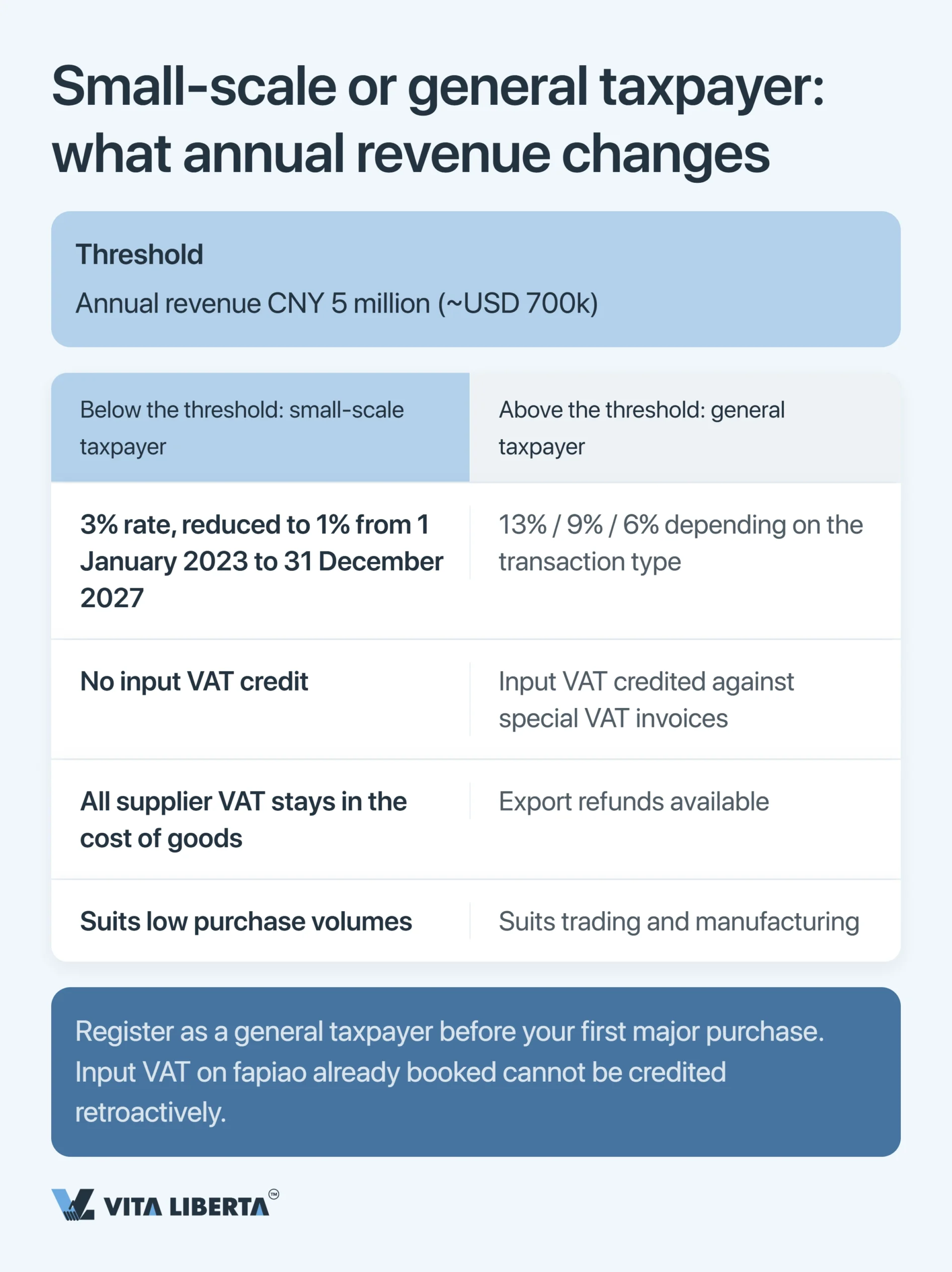
Below the line — small-scale taxpayer. Normally you’d pay a flat 3%. Between 1 January 2026 and 31 December 2027 you pay 1% instead, on everything except real estate (whether sold or let) and land-right transfers (财政部 税务总局公告2026年第10号; the 2023–2025 version of this relief ran under 财政部 税务总局公告2023年第19号). Stay under RMB 100,000 a month — RMB 300,000 a quarter — and your VAT bill is zero. The catch: there’s no input credit, so whatever VAT your suppliers add becomes part of your cost.
Above the line — general taxpayer. You charge 13, 9 or 6% and offset the input tax shown on special VAT invoices. Your VAT bill then attracts three add-ons: 7% for urban maintenance and construction inside city limits, plus 3% and 2% for the national and local education surcharges. All three are percentages of the VAT you actually pay — revenue doesn’t enter into it.
A safe rule of thumb for traders: become a general taxpayer before the first big purchase. Do it afterwards, and the input VAT on fapiao you’ve already booked can’t be offset.
Export Rebates: What Changed on 1 April 2026
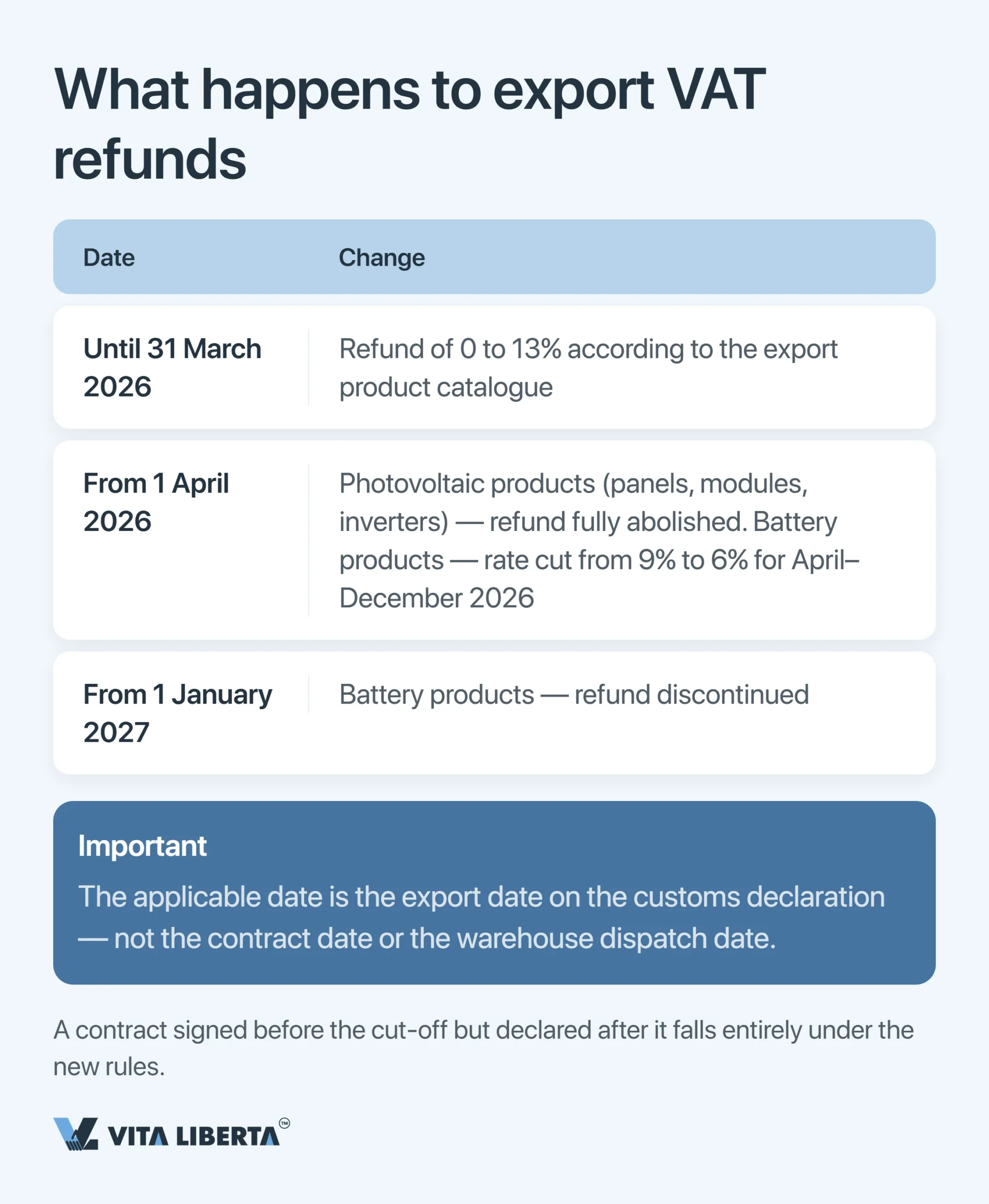
Exported goods carry zero VAT, and the input tax you paid comes back to you — anywhere from 0 to 13%, depending on the product’s customs heading. On 1 April 2026 that cushion got thinner (财政部 税务总局公告2026年第2号 of 8 January 2026). Photovoltaic products no longer get anything back. Batteries drop from 9% to 6% for April–December 2026 and get nothing from 1 January 2027.
Put simply, battery exporters lose three points and PV exporters lose all nine — straight off their margin.
The date that matters is the export date printed on the customs declaration. When goods left the warehouse or when you were paid makes no difference.
Important: a contract you signed before April 2026 but declared after it falls entirely under the new rules. Get the shipping schedule wrong, and your loss is the rate difference times the size of the batch.
Getting Profit Out and the Calendar: 10% WHT and 31 May
Making a profit in China and getting it out of China are different exercises, each with its own checklist and its own set of people who can say no.
Dividends to a Non-Resident: 10%, 5% and the Beneficial Owner Test
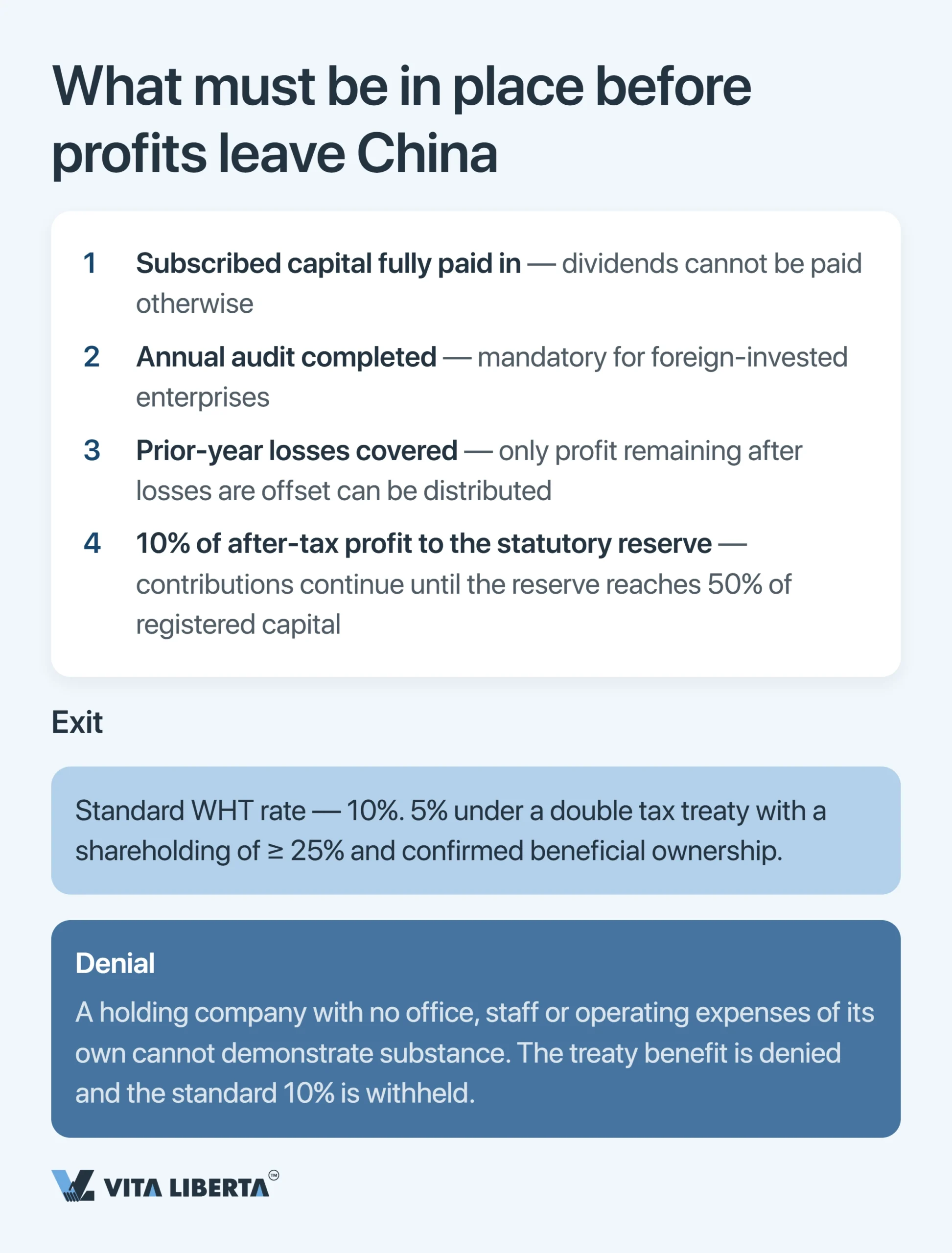
You don’t pay the dividend tax yourself — the Chinese company does it for you. As withholding agent, it holds back Withholding Tax (WHT) from the payout and sends it to the budget. Start from 10%. A double tax treaty (DTT) may cut that to 5%, but each treaty sets its own terms. Take Russia and China: 5% requires a direct holding of at least 25% and an investment of at least EUR 80,000. For a Hong Kong parent, the mainland–Hong Kong arrangement (内地和香港税收安排) asks for a direct holding of at least 25%.
Nothing leaves until four things are true. Your subscribed capital has been paid in full. The year’s audit is finished. Old losses have been made good. And a tenth of net profit has gone to the statutory reserve — a contribution you keep making until the reserve equals half of registered capital. On top of that, if a single payment exceeds USD 50,000, the bank won’t send it until the payment has been registered with the tax office (对外支付税务备案) under 国家税务总局 国家外汇管理局公告2013年第40号 — Announcement 40 for short.
Watch out for the empty holding company: no office, no people, no costs of its own. The inspector decides who really receives the income by what actually happens, not by the org chart. No substance means the 5% is denied and 10% is withheld.
There’s also the option of not sending the money out at all. Between 2025 and 2028, a foreign investor can put the profit into direct investment in an encouraged industry in China and keep it there for five years or more. In exchange, a tenth of the amount reinvested is credited against the investor’s tax (财政部 税务总局 商务部公告2025年第2号; applies nationwide).
Deadlines and the Cost of Being Late
| When | What’s due | What happens if you miss it |
| By the 15th of every month | VAT return; IIT you withheld | 0.05% of the unpaid tax for every day of delay |
| Within 15 days of quarter-end | CIT advance payment | The same 0.05% a day — and awkward turnover questions at year-end reconciliation |
| 31 May | Last year’s annual CIT return | 0.05% a day on what’s unpaid. No return at all: a fine of up to RMB 2,000, or up to RMB 10,000 if the case is serious (Article 62, Law of the PRC on the Administration of Tax Collection, 中华人民共和国税收征收管理法). Tax not paid: 50% to five times the missing amount (Article 64 of the same law) |
| Before paying a dividend | Finish the audit; put 10% into the reserve | The bank won’t make the FX transfer |
| Before any single transfer over USD 50,000 | Register the payment with the tax office (对外支付税务备案) | The bank won’t make the FX transfer |
The corporate tax year ends on 31 May. Leave anything unpaid and from 1 June the daily surcharge starts running — the same mechanism that kicks in on the first day a quarterly advance is late. Meanwhile, foreign staff who are tax residents have their own annual Individual Income Tax (IIT) reconciliation between 1 March and 30 June.
Take your profit out of China without blocked transfers
- Beneficial owner file preparation
- Audit and statutory reserve fund
- 5% WHT instead of 10%

China’s Tax System: Strategic Takeaways
China combines two things that rarely go together: near-total formalism in bookkeeping and genuinely generous incentives. No fapiao, no deduction; every entry passes through Golden Tax IV. Yet the same system will double-count your R&D and drop your rate from 25% to 15%. The companies that win are the ones that accept the first rule precisely to unlock the second.
- If you innovate. Run two tracks in parallel — the HNTE certificate for 15% and the 200–220% R&D deduction. Expect to prove your case every year. Let the status lapse past the end of the certificate’s final year, and that year is retaxed at 25%.
- If you trade or manufacture. Your leverage is in fapiao and VAT status. Choosing the regime before the first purchase, and keeping incoming paperwork tight, beats any clever fix applied after the fact.
- If a foreign shareholder sits above you. Residency, PE exposure and the holding company’s substance decide whether profit leaves at 5% or 10%. You set that up on the way in, not when the transfer is due.
Seen this way, Chinese tax isn’t a cost you just absorb. It’s a variable in your financial model — and you tune it in advance through your status, your zone, your paperwork and your calendar.
Frequently asked questions
Probably, yes. Incorporation under PRC law is only one route to TRE status; the other is having your place of effective management (POEM) in China. The inspector checks the reality: who approves the budget, where board minutes are kept, who decides on staff, where the accounts are maintained. If you’re caught, the company pays 25% on its worldwide income rather than only on what it earns in China. What to do: if management is meant to stay offshore, build the paper trail — minutes, resolutions, correspondence and books all kept outside China.
To get High and New Technology Enterprise certification, you have to clear several bars at once: R&D spending as a share of revenue, IP you own, the proportion of specialist staff, and the share of sales coming from high-tech products. Watch the dates. The 15% applies from the year the certificate names as its issue date. In the certificate’s last year you can prepay at 15%, but without reconfirmation by 31 December the full year is topped up to 25% (国家税务总局公告2017年第24号). What to do: treat recertification as a hard deadline, just like 31 May — otherwise you’ll spend a year at 25%.
Look at the discount after tax, not before. Without a fapiao the purchase isn’t deductible, so the money stays in your profit and gets taxed at your CIT rate. At 25%, a discount smaller than a quarter of the price leaves you worse off — and you’ve also lost the input VAT credit. What to do: settle the fapiao question when you sign, not when you pay, and make issuing it a contractual obligation of the supplier.
Expect 10% to be withheld at source. A treaty may bring it to 5%, on that treaty’s terms: Russia–China requires at least 25% ownership and at least EUR 80,000 invested. A Hong Kong parent qualifies for 5% with at least 25% ownership, provided it can show it is the beneficial owner of the income. Before any payout, make sure the subscribed capital is fully paid, the annual audit is done, earlier losses are covered, and 10% of net profit has gone into the reserve until it reaches half of registered capital. A single transfer above USD 50,000 also needs the payment registered with the tax office (对外支付税务备案). What to do: get the shareholder’s residence certificate from its home jurisdiction and assemble proof of the holding’s substance before you declare the dividend.
That depends on what you ship. PV products have had no rebate since 1 April 2026. Battery rebates fell from 9% to 6% for April–December 2026 and disappear on 1 January 2027. In both cases the export date on the customs declaration decides — not the day you signed or shipped. What to do: rerun the margin on every live contract shipping after the cut-off and reopen pricing before the goods are declared.