Hongkong
 China
China





The idea of opening a company in China is inspiring: new niches are formed here annually—from digital services and biotechnologies to the export of premium goods and green-tech solutions. The market actively supports innovation, and the growth of domestic demand makes the PRC attractive not only for industrial investments but also for agile projects.
However, it is important to remember: without the correct registration of a legal entity, any commercial activity by a foreigner is considered illegal. Even preparation for market entry requires compliance with the established procedure—starting from choosing the legal form and ending with tax registration.
What You Need to Know Before Registering a Company in China
Since 2020, the procedure has become simpler thanks to the Foreign Investment Law and the digitalization of public services: for example, registration through the One-Stop Service allows submitting documents to the SAMR, tax authorities, and bank within a single process.
But simplification does not cancel responsibility. Mistakes at the stage of choosing the structure (for example, an attempt to conduct direct sales through a representative office) can lead to the suspension of activities and fines.
Business Structure Options for Foreigners
As of 2026, the legislation of the PRC allows the following forms of presence:
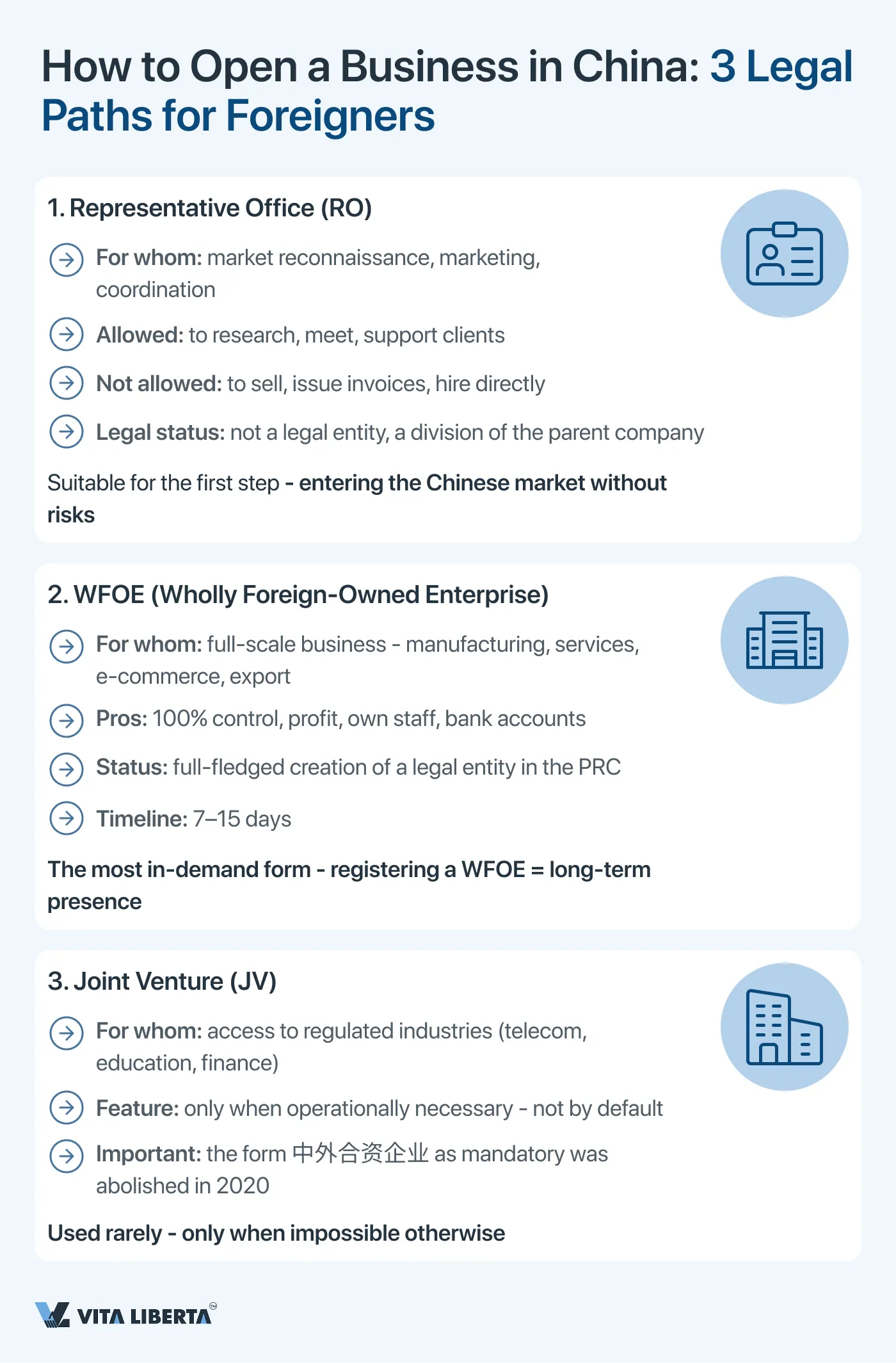
- Representative Office – suitable only for marketing, research, and logistical coordination. Direct commercial activity is prohibited (clause 5 of the Regulations on Representative Offices of Foreign Enterprises, SAMR, 2023).
- Wholly Foreign-Owned Enterprise (WFOE) – fully foreign-owned capital, the ability to conduct business, hire staff, and receive profits. The most popular form for long-term presence.
- Legal entity with a Chinese partner (Joint Venture) – today it is used rarely and only for operational reasons (for example, access to licensed spheres: telecom, education). The form 中外合资企业 as mandatory has been abolished.
The choice depends on the goal: entering the Chinese market with on-site sales almost always requires a WFOE, while market reconnaissance and B2B support can be handled with a representative office.
WFOE: An Independent Legal Entity for Foreign Business in China
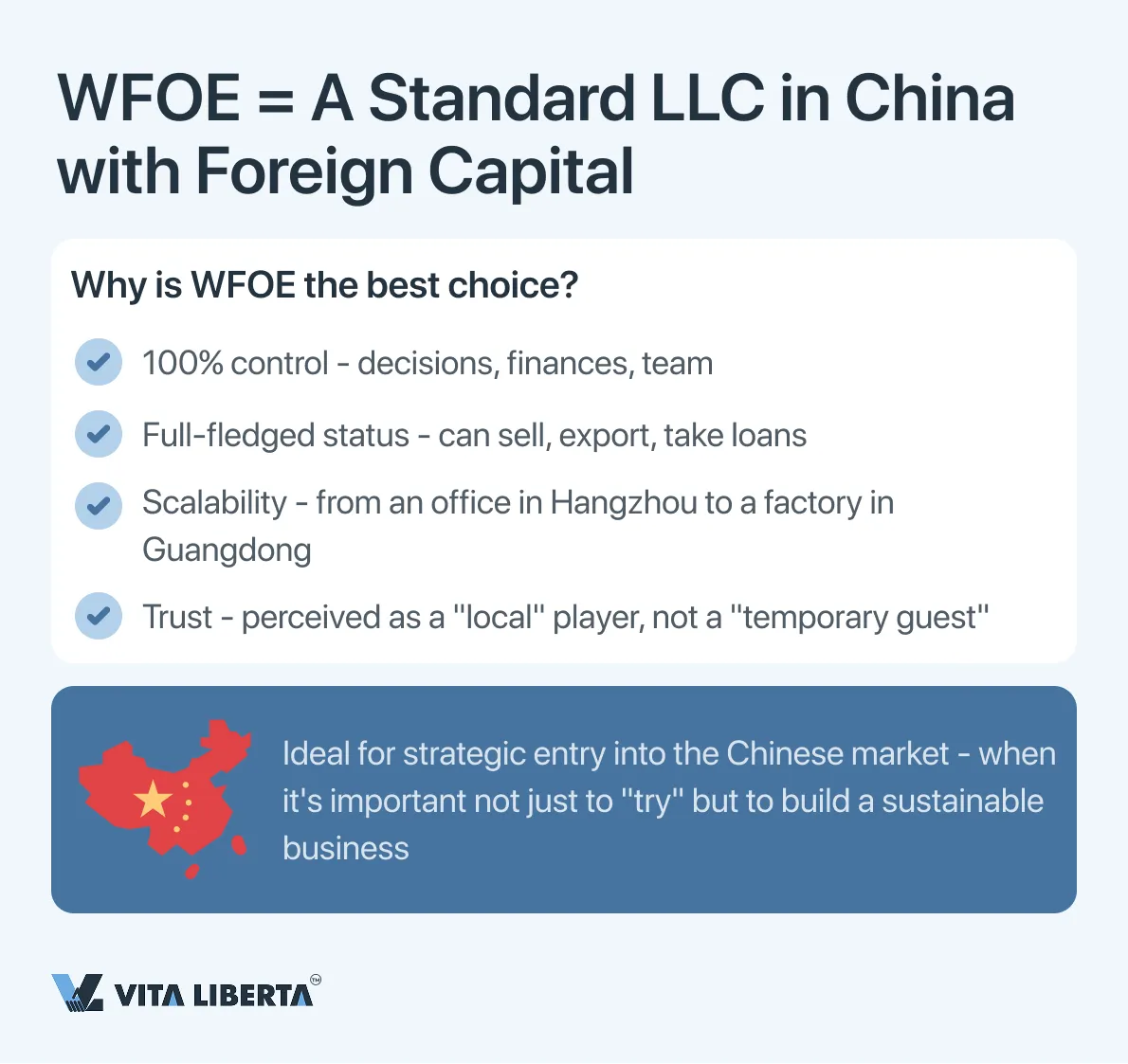
A Wholly Foreign-Owned Enterprise (WFOE) is an ordinary limited liability company registered in the PRC, where 100% of the capital is owned by a foreign investor – an individual or legal entity. No Chinese co-founders, neither in capital nor in management, are required – this is directly confirmed by Article 4 of the Foreign Investment Law (2024).
This form is in demand when opening a business in China, where control, transparency, and long-term stability are important.
What does a WFOE actually allow?
- Full control: appointment of the general director, team selection, approval of financial policy – everything is decided by the foreign owner.
- Broad scope of activity: manufacturing, services, B2B/B2C trade, export-import operations – as long as the activities do not fall under the prohibitions of the Negative List.
- Rights like any Chinese legal entity: opening accounts in RMB and USD, registering office or warehouse for lease/ownership, participation in tenders, payment of dividends abroad.
- Standard tax scheme: corporate tax – 25% (reduced to 15% in preferential zones, for example, Hainan or Pudong), reporting according to CAS standards, submission of forms through the STA electronic cabinet.
How does the company registration in China in the WFOE format proceed?
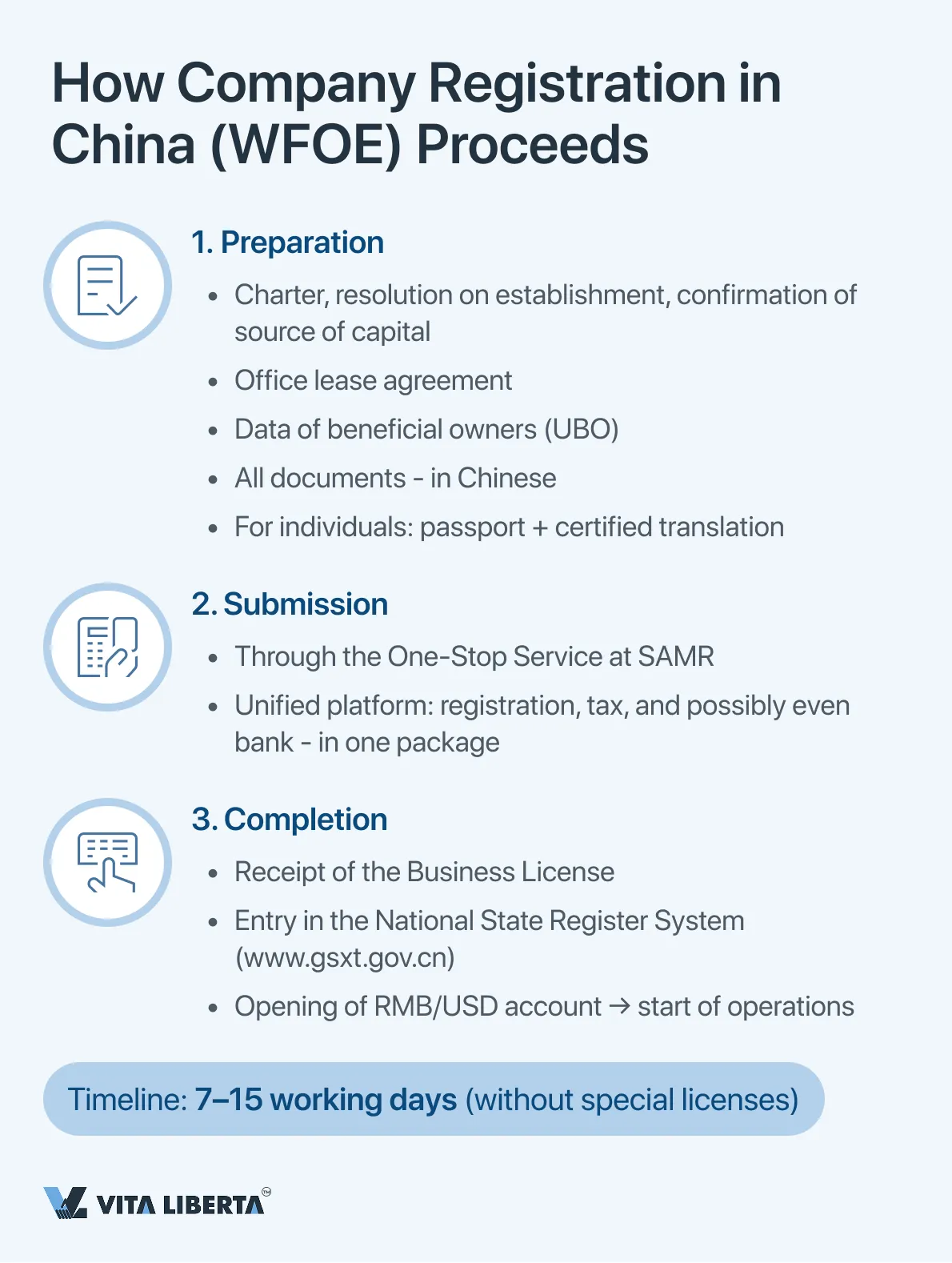
- Document submission – through the One-Stop Service at SAMR: charter, resolution on establishment, confirmation of source of funds, data of beneficial owners.
- All materials – in Chinese; for individuals – passport with apostille and notarized translation.
- Timeline – from 7 to 12 working days in 2026, if no additional licenses are needed (for example, for medical products or online trade).
Important: since 2020, the Approval Certificate has been abolished – instead, an entry in the National Enterprise Public Information System (www.gsxt.gov.cn) is sufficient. A WFOE is not a “special regime,” but a standard LLC with foreign capital.
This model is the best choice for those planning entry into the Chinese market as a strategic direction: without management compromises, with the ability to develop a brand, scale logistics, and build a local team – from a startup office in Suzhou to an industrial cluster in Guangdong.
Joint Venture in China: When Partnership with a Local Company is a Strategic Advantage
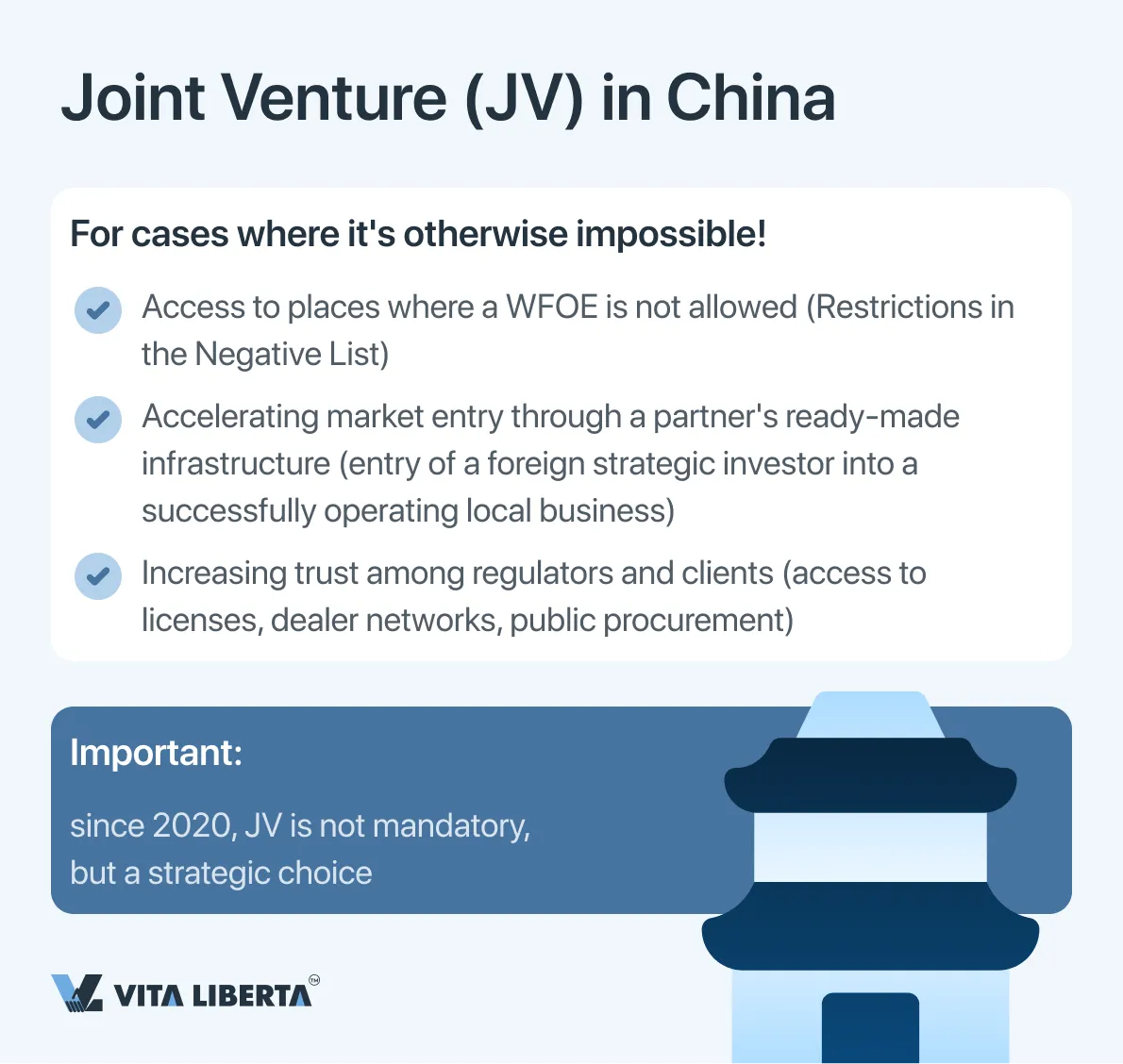
A Joint Venture (JV) is a legal entity established in the territory of the PRC with the participation of both a foreign and a Chinese investor. This form is in demand when entry into the Chinese market is associated with restrictions on foreign capital share or requires deep localization – for example, in the fields of telecommunications, automotive industry, or higher education.
Although the mandatory establishment of JVs in most industries was abolished with the adoption of the Foreign Investment Law (2020), it remains a key tool in segments included in the Special Administrative Measures (Negative List), approved by MOFCOM and NDRC (ed. 2025).
Two Operational JV Models
In modern practice, two formats are used, enshrined in Chapter IV of the Company Law:
- Equity Joint Venture (EJV) – a classic structure where the share of participation directly determines the right to profit and a vote on the board of directors. Accounting is conducted according to unified CAS rules, and the enterprise is liable for its obligations with its own assets.
- Cooperative Joint Venture (CJV) – a flexible form allowing asymmetry: for example, the Chinese side contributes land or a license, the foreign side contributes technology and capital, and profits are distributed 60/40. The terms are detailed in the Contract of Cooperation, which takes precedence over the charter (clause 22 of the SAMR Guidelines on CJV, 2024).
What is important when establishing a JV?
- The founding agreement (and charter) is registered with SAMR as the basis for creating a legal entity in the PRC.
- All parties bear joint and several liability for the accuracy of contributions (monetary, property, intangible assets) – verification is conducted within the framework of preliminary due diligence (Deloitte China, 2025).
- Management is built on the principle of consent: key decisions (budget, dividends, change of director) require a quorum on the board, the size of which is determined by the agreement.
- Disputes between partners are most often regulated through CIETAC (China International Economic and Trade Arbitration Commission) – an arbitration clause is mandatory when signing.
Example: in the automotive industry (outside preferential zones, for example, Jinan New District), until 2025, there was a 50% limit on the foreign share in a JV with internal combustion engine production. Starting from 2026, the restriction has been lifted for electric vehicles — but JV remains effective for access to the dealer network and public procurement.
When is a JV a reasonable choice?
When access to licenses is needed that cannot be obtained directly by a foreigner;
When localizing production within the framework of state programs (for example, “Made in China 2025”);
To reduce risks in regions with high regulatory uncertainty – a local partner takes on coordination with authorities.
This approach allows foreign investors not only to comply with requirements but also to integrate into the ecosystem – relying on proven connections and an understanding of the local business context.
Representative Office in China: An Official “Bridge,” But Not a Business Unit
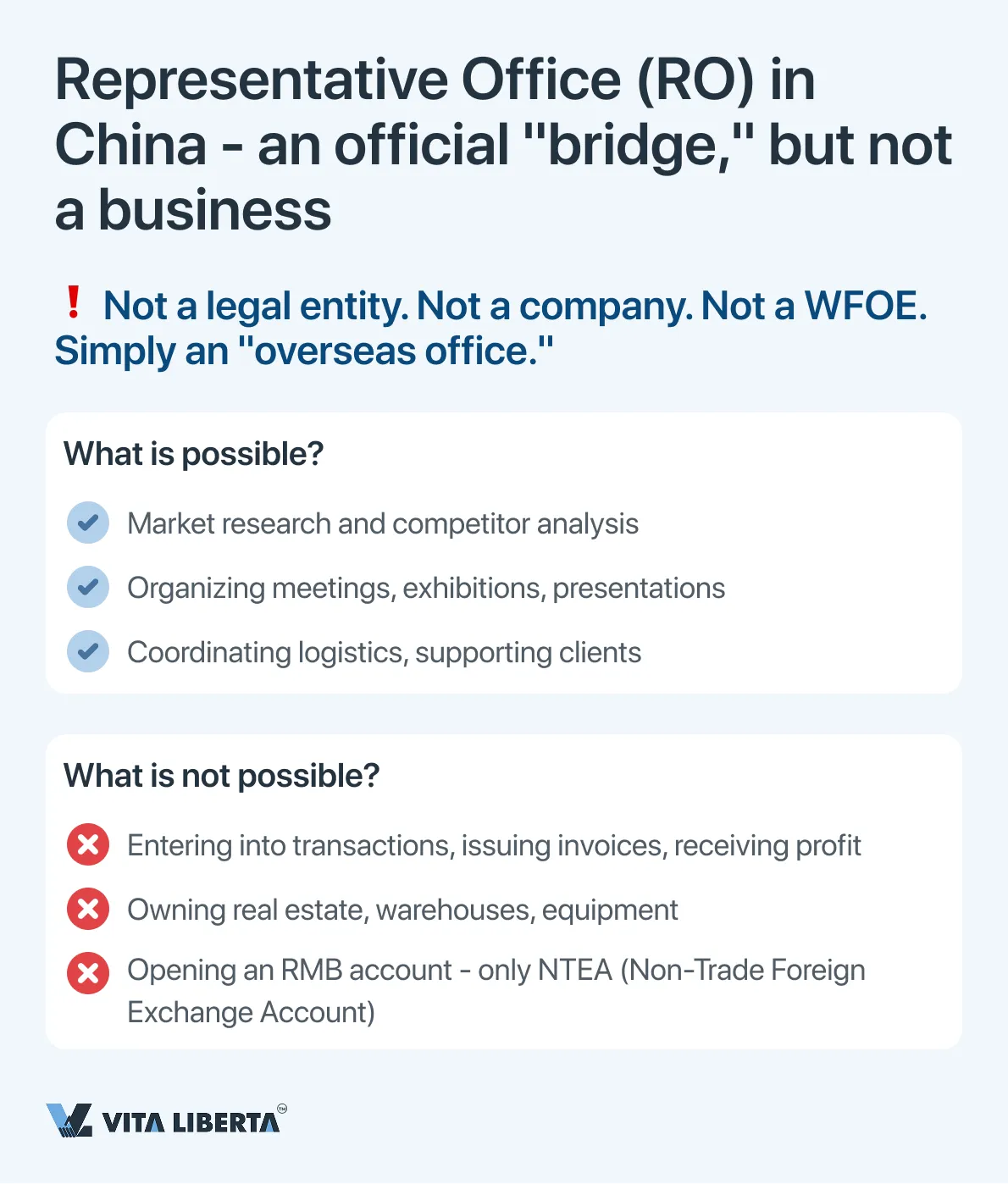
A Representative Office (RO) is not a legal entity, but a territorial subdivision of a foreign company, officially accredited in the PRC for non-commercial activities. It acts on behalf of the head office and does not have independent legal personality.
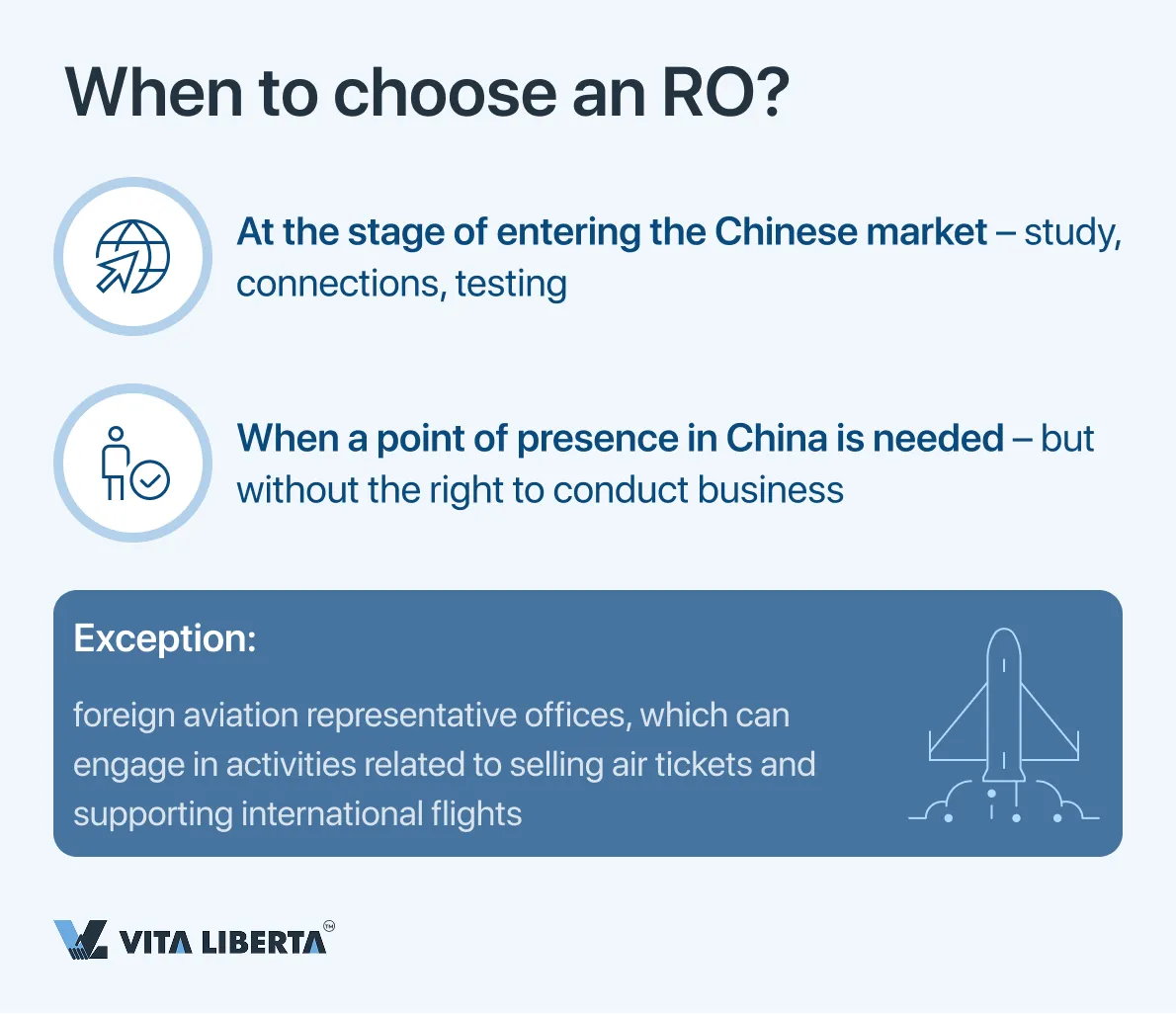
This form is in demand at the stage of entering the Chinese market, when it is necessary to study demand, establish contacts, and form a strategy – without obligations for taxes, registered capital, or complex establishment.
What an RO can and cannot do?
Permitted:
• Conducting market research and competitor analysis;
• Organizing meetings, presentations, exhibition participation;
• Coordinating logistics, supporting clients, communicating with suppliers;
• Hiring personnel through authorized HR agencies.
Prohibited:
• Entering into transactions, issuing invoices, receiving revenue in China;
• Owning commercial real estate, warehouse stocks, or equipment;
• Opening an RMB account – only a special account of the Non-Trade Foreign Exchange Account (NTEA) type to cover current expenses.
Unlike a WFOE, a Representative Office (RO) is not registered as an independent legal entity in the PRC. Instead, it undergoes an official accreditation procedure with the State Administration for Market Regulation (SAMR).
Key differences and procedure:
- Not a legal entity, but a subdivision: An RO is a legal but dependent office of the parent foreign company. It is liable for the obligations of the parent firm.
- Accreditation timeline: The approval process and issuance of the representative office registration certificate typically take from 20 to 45 working days from the moment of submitting the complete document package. In fact, registering a representative office takes longer than registering a WFOE.
- Document package: The main set includes: a completed application on the prescribed form, legalized constituent documents of the parent company, a resolution to establish the representative office, as well as an official explanatory letter outlining the planned activities of the representative office in the territory of the PRC.
All responsibility – financial and regulatory – lies with the foreign parent company. Violation of restrictions (for example, an attempt to conclude a contract on behalf of the RO) leads to the annulment of accreditation and a fine of up to 100,000 CNY.
Therefore, an RO is not a company registration in China, but a temporary preparatory tool for it. It is ideal for those just beginning to open a business in China and wanting to avoid the risks of premature commercial activity.
Open a Company in China Without Mistakes or Delays
- Business structure tailored to your goals
- Complete documentation package
- End-to-end support until license issuance

How to Prepare for Company Registration in China – and Where to Open a Business in 2026
Before submitting the package to SAMR, it is crucial to conduct preliminary verification – otherwise, even a perfectly registered legal entity may fail the verification stage at the stage of obtaining licenses. For example, selling dietary supplements without CFDA Registration or launching a platform without an ICP/EDI License entails domain blocking and a fine of up to CNY 100,000 (STA, Regulation No. 7, 2025).
Mandatory steps before submission:
- Clarify if your activity is included in the Negative List for Foreign Investment (MOFCOM & NDRC, 2025);
- Determine if special permits are needed: Medical Device Registration (Class II/III), Network Security Review (for applications with access to personal data), Cross-Border Data Transfer Assessment;
- Check if mandatory certification is required: CCC (electronics, automotive), GB standards (drinking water, cosmetics), China Green Product;
- Assess if a “catchment warehouse” model (bonded warehouse) is possible or if localization is needed – this affects the choice of form: registering a WFOE.
Geography as a Strategic Asset: Choosing a Location for Entering the Chinese Market
Determining the region for registration is not merely a technical step, but a fundamental strategic decision. It should only be undertaken after developing the business model, analyzing the regulatory field, and choosing the organizational form (WFOE, FICE, or representative office). It is the location that will become the key factor determining your operational efficiency, financial model, and growth potential.
The correct choice affects not only the tax rate but also:
- Launch speed: from 3 working days to 3-4 weeks in less prepared provinces.
- Access to resources: the partner ecosystem, talent pool, and integration into logistics chains.
- Regulatory climate: the level of administrative pressure and frequency of inspections, especially in sensitive industries (fintech, healthcare, data processing).
Below is an overview of key jurisdictions relevant for long-term planning in 2026.
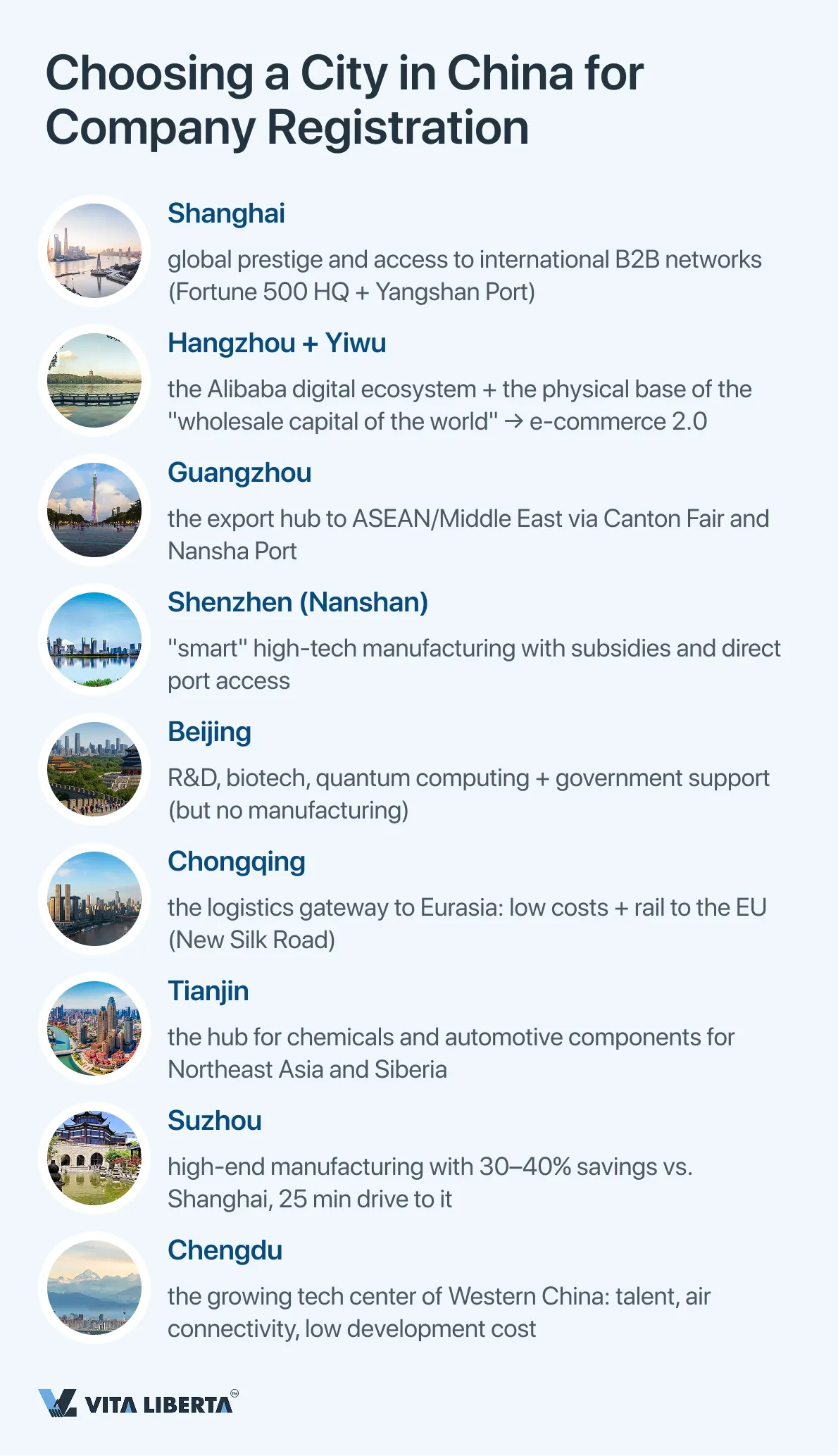
Shanghai: A Platform for Global Premium Business
- For whom: Fintech, luxury segment, B2B consulting, high-margin logistics, and global supply chain management.
- Context: The Yangshan Port complex is a world leader in cargo turnover; the city is home to over 700 regional headquarters from the Fortune Global 500 list.
- Challenge: Maximum competition for talent, high wages, and high cost of Class A rental space.
- Strategic value: It has no equal for building long-term prestige and deep integration into international business networks.
Hangzhou: An Ecosystem for Digital Leaders and Global Wholesale Trade
- For whom: Digital companies: SaaS, AI, cross-border e-commerce platforms, big data services. Wholesalers and distributors: Companies engaged in B2B sales of small-wholesale goods (from consumer electronics to textiles and souvenirs) to global markets.
- Context and ecosystem: Hangzhou is not just a city, but the core of the digital economy that gave rise to Alibaba, Ant Group, NetEase, DeepSeek. A complete infrastructure for digital business has been created here: from MVP testing in Qiantang Valley to scaling through the APIs of platforms like Tmall Global and Cainiao Logistics.
- Key strategic advantage: proximity to the city of Yiwu – the “wholesale capital of the world” and Shanghai – a global financial center.
Yiwu is a global small-wholesale hub, where tens of thousands of factories and suppliers are concentrated, offering incredible product variety based on the principle of “small order, big variety”. Registering a company in Hangzhou provides a legal and operational status in a developed metropolis with simultaneous direct access to the commodity flows of Yiwu, located just ~150 km away (about 1 hour by high-speed train) and Shanghai.
The ideal “office in Hangzhou, warehouse/logistics in Yiwu” model: You locate your headquarters, sales department, and digital team in the modern ecosystem of Hangzhou, while conducting procurement, order assembly, and export logistics through the capacities of Yiwu, including its famous market and super-modern airport (Yiwu Airport), specializing in cargo air transportation.
Advantages for business:
- For digital projects: Record registration speed (3–5 working days), preferential tax rates (from 10%), access to venture capital and technical talent.
- For wholesale trade: A combination of Hangzhou’s digital tools (Alibaba.com, international online payments) and Yiwu’s physical product base. This allows for creating hybrid business models, such as launching dropshipping platforms or managing supply chains for Amazon/Shopify with minimal costs.
Strategic value:
- Hangzhou (in conjunction with Yiwu) offers a unique symbiosis of digital infrastructure and a physical product base. This is the ideal jurisdiction for companies that want to not just sell goods from China, but build technologically advanced, scalable business models in the fields of e-commerce and global distribution, having both code and product at hand. This is a choice for speed, innovation, and an unprecedented connection to the supply chain.
Guangzhou: The Hub of Physical Export
- For whom: Manufacturers and wholesale exporters focused on ASEAN, Middle Eastern, and African markets.
- Context: Host of the Canton Fair – the world’s largest import-export fair, creating a unique concentration of verified suppliers and buyers.
- Advantage: Direct access to the Nansha port infrastructure and a culture of B2B cooperation developed over decades.
- Strategic value: Reducing transactional costs and time-to-market for physical goods globally.
Shenzhen (Nanshan): The Factory of Industry 4.0
- For whom: High-tech manufacturing with a focus on robotics, precision components, medical equipment, and smart automation.
- Context: The flagship “smart manufacturing” cluster within the Greater Bay Area project, with direct logistics corridors.
- Support: Direct subsidies for modern equipment (up to ¥3 million), tax holidays, and minimal distance to the port.
- Strategic value: Operational advantage for export-oriented high-tech factories with an automation rate of 70% or higher.
Beijing: The Center of Strategic Innovation
- For whom: R&D centers, startups in deep tech, biotech, quantum computing, and “smart cities.”
- Context: Concentration of scientific elite (92 state laboratories, 36 top universities) and regulatory bodies.
- Important: Manufacturing with any significant emissions is practically impossible to approve — priority is given to “clean” technologies.
- Strategic value: Direct access to state grants, strategic partnerships, and the “brains” of the nation.
Chongqing: The Gateway to the Eurasian Continent
- For whom: Logistics operators, projects in automotive and green energy, targeting the domestic market of Western China and Eurasia.
- Context: The largest river port in the PRC and a key node of the “New Silk Road” land routes.
- Advantage: Significantly lower land and labor costs (35-50% lower than on the coast) + direct railway links to Europe.
- Strategic value: The optimal point for cheap placement of production facilities with subsequent shipment of products to the EU by land.
Tianjin: The Industrial Hub of Northern China
- For whom: Enterprises in the chemical, petrochemical industry, and automotive component manufacturers.
- Context: The country’s second-largest port by cargo turnover, integrated into the Bohai Bay cluster with BMW, Toyota, Volkswagen plants.
- Advantage: Expedited registration procedure in the Binhai Zone (5-7 days) and specialized incentives for advanced manufacturing.
- Strategic value: Logistical advantage for working with markets in Northeast Asia, Mongolia, and Eastern Siberia.
Suzhou: Shanghai’s High-Precision Manufacturing Twin
- For whom: Manufacturers of electronics, semiconductors, medical equipment, and pharmaceuticals.
- Context: Located 25 minutes by high-speed train from Shanghai, this cluster produces critical components for world technology giants.
- Advantage: Rental rates and operational costs are 30-40% lower than Shanghai’s, with full access to its infrastructure and talent.
- Strategic value: The ideal balance between proximity to the financial-logistical center and cost of ownership for high-end manufacturing.
Chengdu: The Technological Capital of the West
- For whom: Software development centers, projects in the aerospace industry, biotech, and GovTech.
- Context: China’s fourth most significant technology hub with the Tianfu Park (1000+ foreign IT companies) and R&D centers of Intel, Siemens.
- Advantage: A deep talent pool cultivated by leading universities and developed air connectivity (100+ international flights).
- Strategic value: Control over the growing western market of China with a significantly lower cost of talent than in Beijing or Shanghai.
Preparing a Company Name: What to Consider
Before starting the company registration process in China, it is necessary to approve its future name. This is a mandatory procedure upon which the success of all subsequent legal work depends.
The main rule: the name must be completely unique nationwide. This applies to both the Chinese version and the English translation. The verification is conducted by the local market regulation authority (SAMR branch). Specialists compare the proposed options with the national registry, assess them for similarity to already existing ones, and check compliance with the corporate law norms of the PRC.
Strict requirements are imposed on the name:
- It is prohibited to use words that may mislead government authorities or the public.
- It is not allowed to include indications of the type of activity if the company does not plan to engage in it or does not have the necessary licenses.
- The name must not contain terms contrary to public interests or the cultural traditions of China.
- If the verification reveals a match or non-compliance, you will have to choose a new option and submit it for re-examination. The procedure is repeated until a positive decision is obtained. Upon approval, you will receive an official certificate, which will be necessary for the next stages: submitting documents for the creation of a legal entity in the PRC, opening a bank account, and obtaining all subsequent permits.
Documentation Package for Opening a Business in China
Successfully navigating the formalities requires careful preparation of the documentation package. We recommend gathering it in advance.
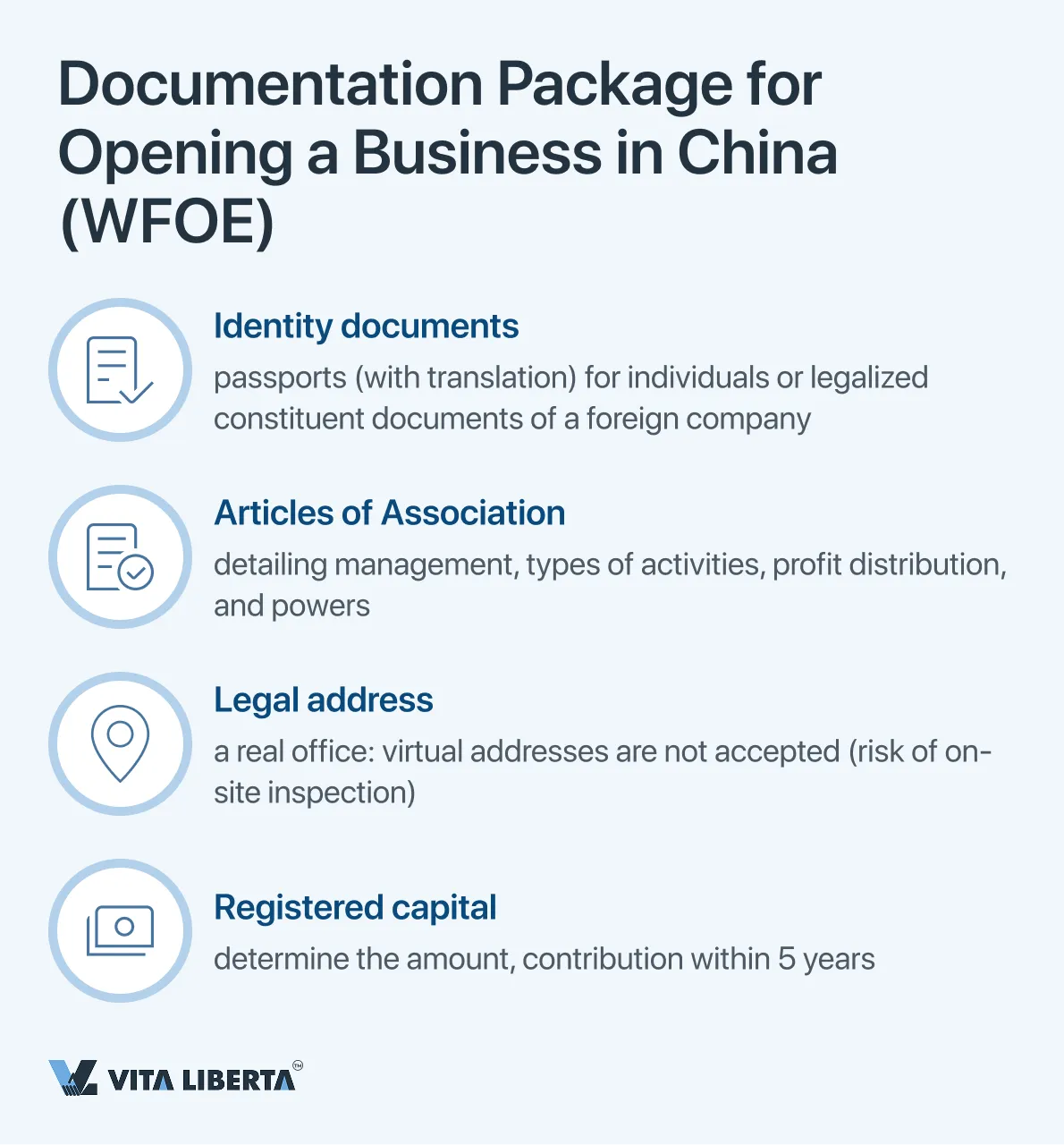
- Founders’ documents. For individuals – notarized copies of foreign passports. If the founder is a foreign company, a full set of its legalized constituent documents will be required.
- Company Articles of Association. This document must clearly define the management structure, types of economic activities, profit distribution procedures, and other key provisions. It will become the foundation for your enterprise’s operations.
- Proof of legal address. For registering a WFOE, a lease agreement for a real office space is generally required. Using a virtual address is often impossible, as the registering authority has the right to conduct an on-site inspection of the specified location.
- Confirmation of registered capital. Although for most industries there is no mandatory minimum amount set, the presence of capital must be confirmed. At the registration stage, a bank statement is usually sufficient; later, the funds must be deposited into the opened corporate account.
- Legalized translations. All documents issued outside the PRC must be translated into Chinese by a professional translator, and their copies must be notarized.
- Additional documents (if necessary). For sectors with special regulation (e.g., finance, education, healthcare), industry-specific licenses must be obtained in advance. A business plan or recommendation letters may also be required upon request.
A correctly prepared documentation package submitted through the “One-Stop Service” system significantly speeds up entry into the Chinese market and reduces the risk of receiving official rejections.
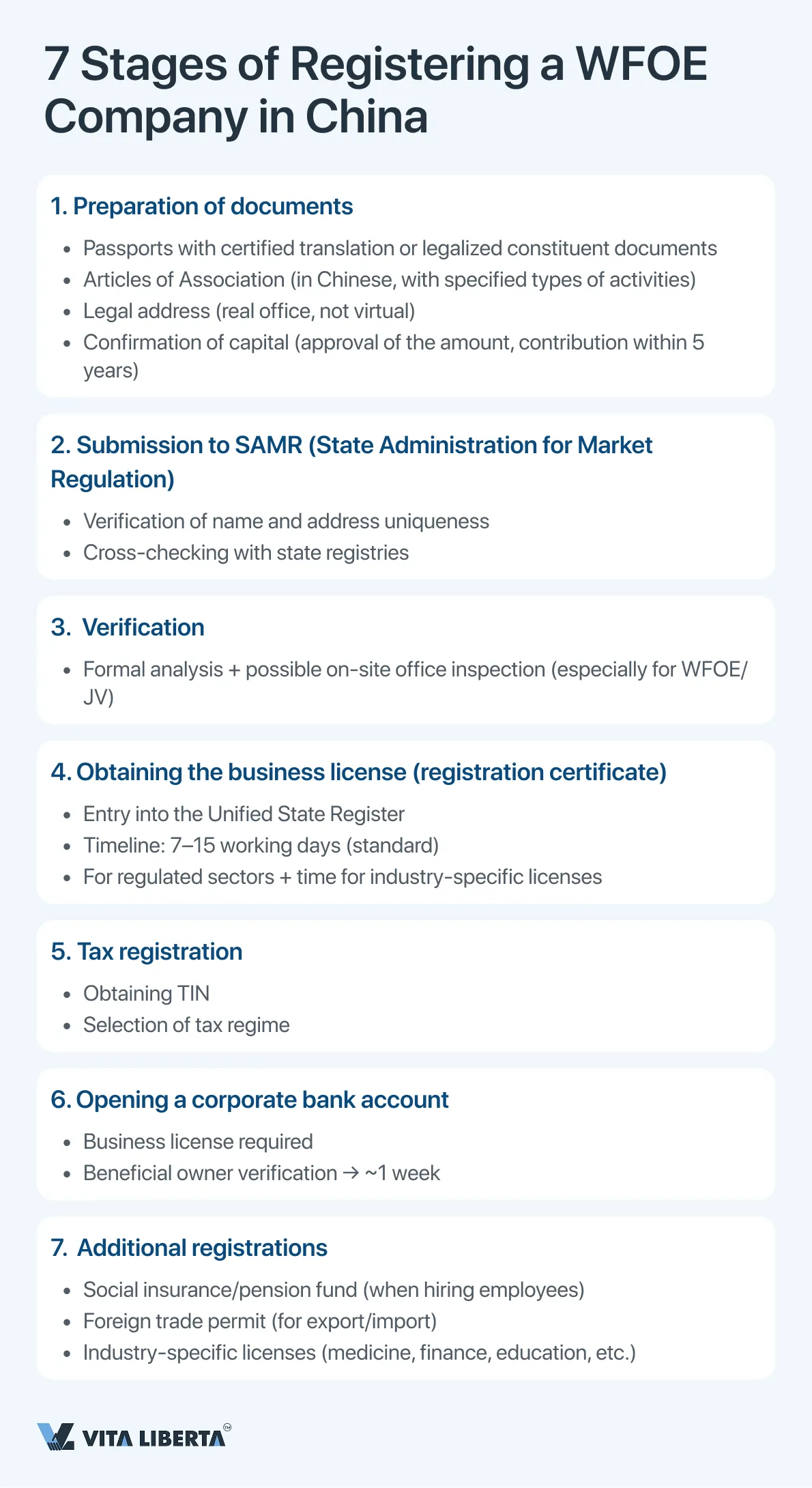
Stages and Procedure for Registering a Legal Entity in the People’s Republic of China
The process begins with the preparation of documents. Each document must strictly comply with Chinese norms, including a certified translation into the state language. Inaccuracies at this step will lead to delays later.
Submission of Documents to the Authorized Body
The prepared package is submitted to the territorial market regulation authority (SAMR). Employees conduct a detailed verification:
- All data is cross-checked with national registries.
- Particular attention is paid to the uniqueness of the name and the correctness of the legal address.
- Even a minor error can be grounds for returning documents for revision.
Verification Procedure
The check includes formal analysis and, in some cases, actual actions. For enterprises with foreign investment, such as a WFOE, an on-site inspection of the declared office premises is possible. For joint ventures (Joint Venture), inspectors carefully study the contract between participants and the distribution of powers.
Obtaining the Registration Certificate (Business License)
After successfully passing all checks, the registering authority – the State Administration for Market Regulation (SAMR) – enters the company into the Unified State Register and issues the Enterprise Registration Certificate (Business License, 营业执照). This document serves as legal confirmation of the company’s creation and its primary identification for conducting business activities.
Under the standard procedure through the “One-Stop Service” system, the issuance of the certificate typically takes from 7 to 15 working days from the moment of submitting a complete and correct documentation package.
For types of activities requiring additional approvals (e.g., in healthcare, finance, or education), the overall company registration timeline in China increases. Delays are related to the need to obtain separate industry-specific licenses after the SAMR registry entry stage.
In special economic zones or for projects in priority industries, an accelerated registration procedure may apply, reducing the timeframe to 3-5 working days.
This regulated process allows the investor to accurately plan the schedule for entering the Chinese market and minimize administrative risks.
Understanding this sequence helps in properly planning the opening of a business in China and minimizing the risks of delays.
Subsequent Steps After Initial Registration
Obtaining the license is only the first stage. For the company to operate legally, a series of mandatory procedures must be completed.
Tax Registration
The company is obliged to obtain a Taxpayer Identification Number (TIN). At this stage, the applicable tax regime (e.g., VAT, corporate income tax) corresponding to the types of activities is determined.
Opening a Bank Account
A bank will open a corporate account only upon presentation of the business license. The procedure includes verification of the documentation package and beneficial owners and usually takes about one week.
Registration with Social Insurance Funds
Hiring employees obligates the company to register with social and pension insurance funds and make contributions for each worker.
Obtaining Special Permits
Engaging in foreign trade activities requires a separate permit. Operating in regulated sectors (finance, education, medicine) is possible only after obtaining the relevant specialized licenses from the respective ministries.
Regular Company Obligations After Completing Registration in the People’s Republic of China
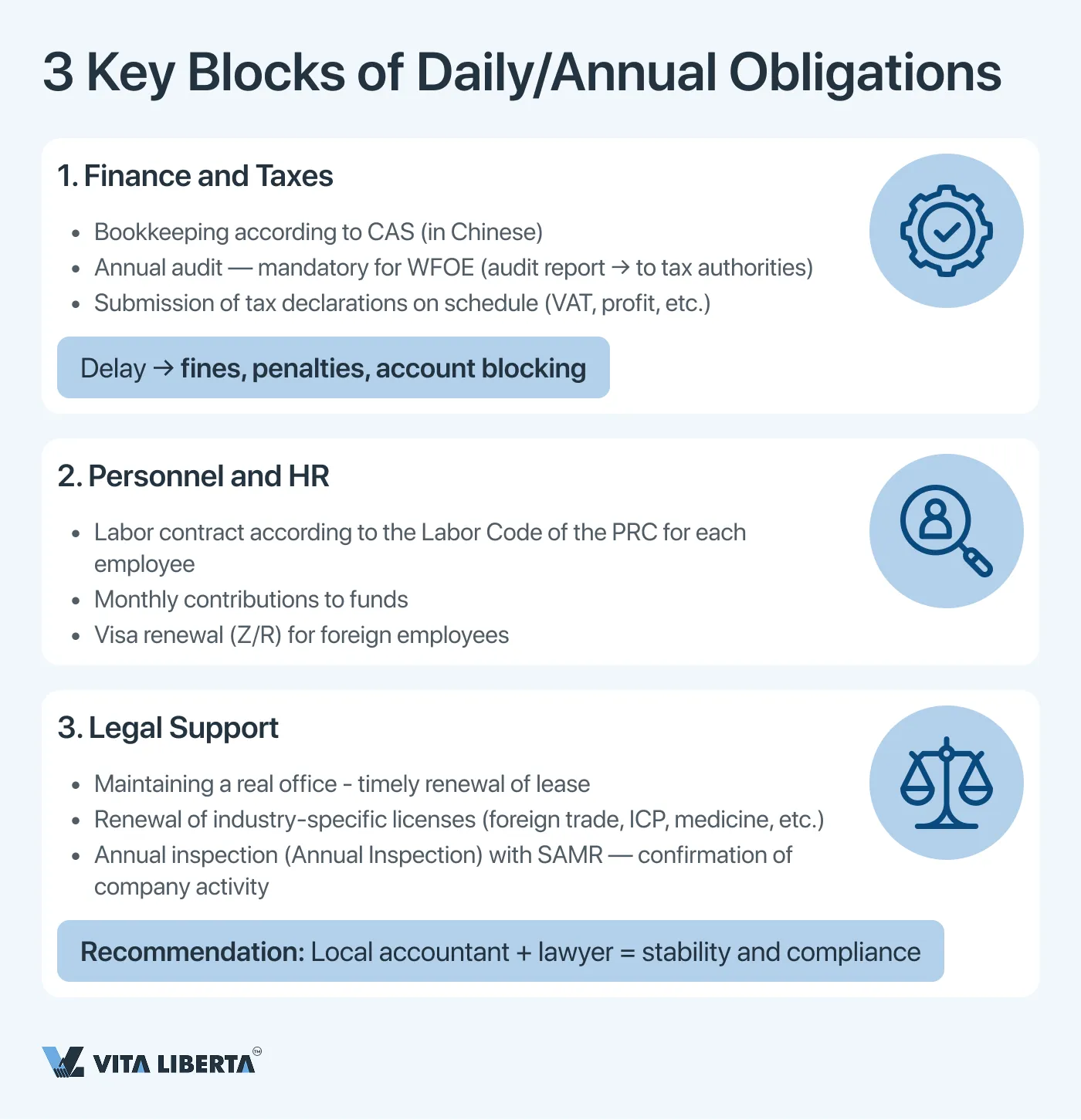
After a legal entity is officially established, its management must ensure continuous compliance with a series of administrative and fiscal norms. These obligations are permanent and require a systematic approach.
1. Financial Accounting, Audit, and Tax Reporting
Bookkeeping must strictly comply with the Chinese Accounting Standards (CAS). All accounting registers and reports are prepared in the Chinese language.
Key requirements:
- Mandatory annual audit: For companies with 100% foreign participation (WFOE), conducting an independent financial audit at the end of the year is a legislative requirement. The audit report is submitted to the tax authorities.
- Regular submission of declarations
Consequences of violations: Delayed submission of reports or tax payments leads to penalty charges, substantial fines, and in serious cases – to the blocking of bank accounts and restriction of activities.
2. Personnel Records and Compliance with Labor Norms
Legal registration of employees is the foundation of stable operations. Each employee must have an official labor contract, drawn up in accordance with the Labor Code of the PRC.
Mandatory procedures include:
- Registration and monthly contributions to social, medical, pension insurance funds, as well as the unemployment fund.
- Timely renewal or processing of new work visas and residence permits (Z, R category visas) for foreign employees.
- Compliance with occupational health and safety regulations, which are regularly inspected by relevant authorities.
3. Maintaining Legal Status and Renewing Permits
Legal address and the right to operate must remain up-to-date.
This block includes:
Renewal of office lease agreement: A valid lease agreement for physical premises is a mandatory condition for maintaining the company’s legal address. Its expiration without timely renewal leads to the risk of being listed in the “dishonest companies” register.
Renewal of industry-specific licenses: Permits for certain types of activities (e.g., import-export, ICP license for IT) have a limited validity period and require timely renewal.
Annual company inspection (Annual Inspection): Submission of basic company data to the SAMR authorities to confirm the continuity of operations. Systematic management of these processes, often involving a local accountant and lawyer, is the key to the long-term and uninterrupted operation of the enterprise in the Chinese market.
Turnkey Business Registration in China
- WFOE, JV & Representative Office setup
- License eligibility & compliance verification
- Ongoing accounting support
5 FAQs on Launching a Business in China
For long-term and independent business operations with the right to sell, hire employees, and receive profits, the optimal choice is a WFOE (Wholly Foreign-Owned Enterprise). This is a full-fledged Chinese legal entity with 100% foreign capital, which gives full control over the business. A Representative Office (RO) does not allow commercial activity, and a Joint Venture (JV) is primarily used today for access to regulated industries (e.g., telecommunications or education).
These are fundamentally different forms of presence:
- WFOE is a legal entity in the PRC. It can sign contracts, issue invoices, receive revenue, own property, and hire employees directly. The registration process takes 7-15 days.
- Representative Office (RO) is not a legal entity, but merely an accredited subdivision of a foreign company. It cannot conduct commercial activity (sell, receive profit) and is intended only for marketing, research, and client support. The accreditation process takes 20-45 days. An RO is a tool for market “reconnaissance,” not for conducting business.
Answer: The choice depends on the business model and industry:
- Shanghai: For fintech, premium brands, B2B consulting, and managing global supply chains.
- Hangzhou: Ideal for digital projects (SaaS, AI, e-commerce) and wholesale trade thanks to the Alibaba ecosystem and proximity to the “wholesale capital of the world,” Yiwu.
- Shenzhen (Nanshan): For high-tech manufacturing and Industry 4.0.
- Guangzhou: For traditional export and access to ASEAN and Middle Eastern markets.
- Beijing: For R&D centers, deep tech, and biotech startups.
Key stages through the “One-Stop Service” system:
- Preparation of documents: Articles of Association, founders’ documents with legalization and translation, proof of legal address (real office).
- Submission and verification to SAMR: approval of a unique company name and verification of documents.
- Obtaining the Business License: Issued within 7-15 working days after successful verification.
- Subsequent steps: tax registration, opening a corporate bank account (~1 more week), registration with social insurance funds.
After launch, the company must comply with constant administrative norms:
- Finance and taxes: Maintaining bookkeeping according to Chinese standards (CAS), submitting regular tax reports, and a mandatory annual audit for WFOEs.
- Personnel: Registering employees according to the Labor Code of the PRC, making monthly contributions to social and pension insurance funds, legally processing visas for foreign employees.
- Legal status: Maintaining an up-to-date legal address (timely renewal of office lease), renewing industry-specific licenses, and undergoing the annual inspection (Annual Inspection) with the SAMR authorities.