Hongkong
 China


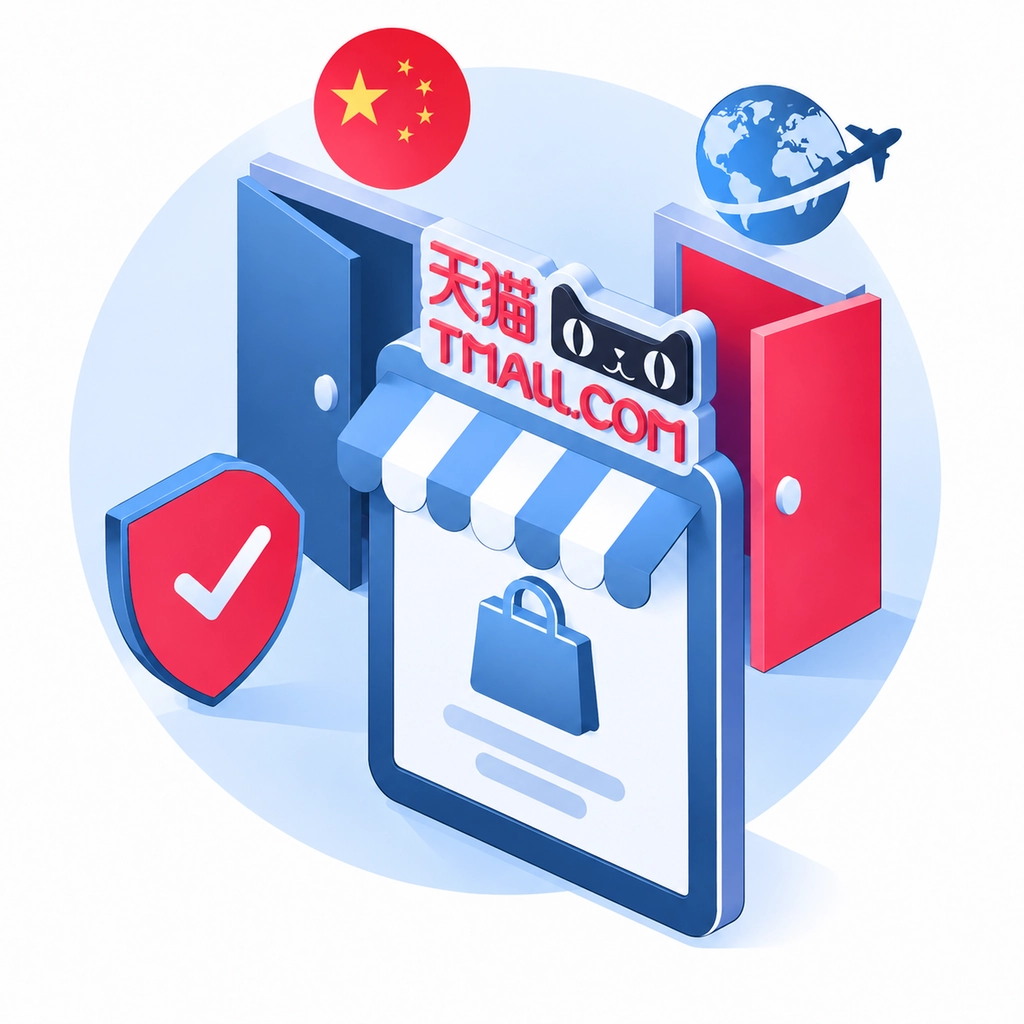


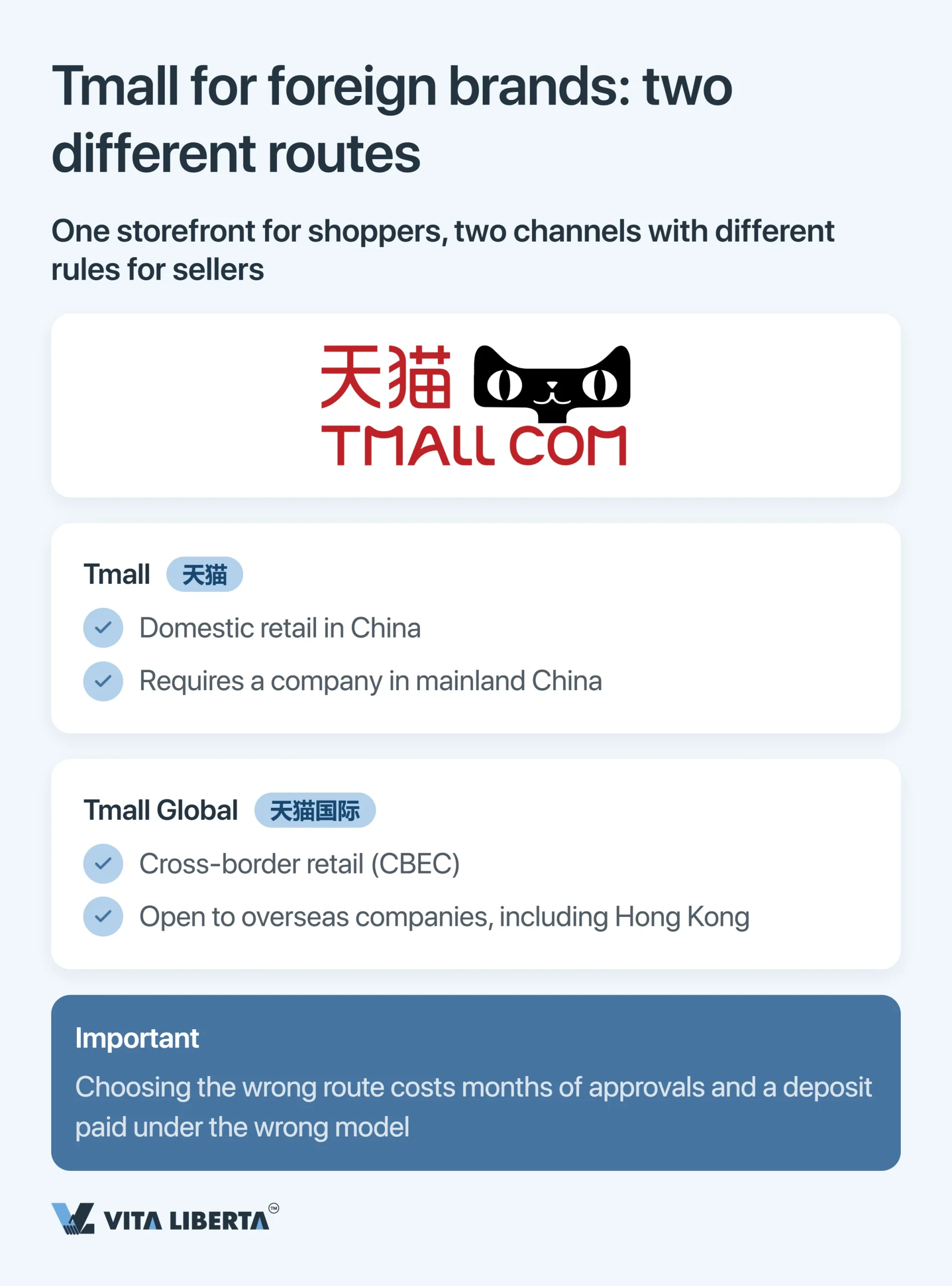
Shoppers see Tmall as one storefront. For sellers there are two separate entrances, and each needs its own key: domestic Tmall (天猫) and cross-border Tmall Global (天猫国际).
The core problem
“I have a Hong Kong company and my own skincare brand. Consultants say Tmall needs a Chinese legal entity, a warehouse in mainland China and registration for every single cream. Is there really no way to sell into China without a WFOE?”
Foreign brand owners ask us this more often than almost anything else. The answer depends on which customs regime your goods use to cross the border.
Tmall vs Tmall Global: your legal entity sets the route
In legal terms, these are two different channels. One is domestic retail. The other is a retail import shipped to a specific individual buyer.
Domestic Tmall: a Chinese company and the full import cycle
Only a company registered in mainland China gets in. For a foreign owner, that means setting up a WFOE or working with a distributor who holds the store in its own name. Goods enter through ordinary import, which means Chinese labelling, permits and, for cosmetics and food, approvals that must be done before the first shipment. Cosmetics, for instance, need either registration (注册) or notification filing (备案), depending on the product class, under the Regulations on the Supervision and Administration of Cosmetics (化妆品监督管理条例, State Council Decree No. 727). Getting in has become cheaper, though. New merchants have paid no annual fee since 1 September 2024, and Tmall confirmed this again on 10 March 2026.
Tmall Global: an overseas company under the CBEC regime
Here, you sell through a company registered outside mainland China. Hong Kong, Macau and Taiwan count as outside. The model runs on cross-border e-commerce retail imports (CBEC). Your goods are treated as imported for the buyer’s personal use. So you don’t need a first-import licence, registration or notification filing (a joint notice from MOFCOM and five other agencies, 商财发〔2018〕486号). There are three conditions in return: a spending cap, a closed list of eligible products and a ban on resale. Whatever a shopper buys through CBEC is for their own use and can’t be resold on the Chinese domestic market (财关税〔2018〕49号).
| Parameter | Tmall | Tmall Global | What it means for your brand |
| Legal entity | mainland China company | overseas, Hong Kong included | without a WFOE, only the second entrance is open |
| Product range | any lawful product | positive list only | check the HS code before you apply |
| Inventory | warehouse inside China | bonded warehouse or overseas | you don’t have to hold stock in mainland China |
| Purchase limit | none | RMB 5,000 / 26,000 | high-priced items lose the tax break |
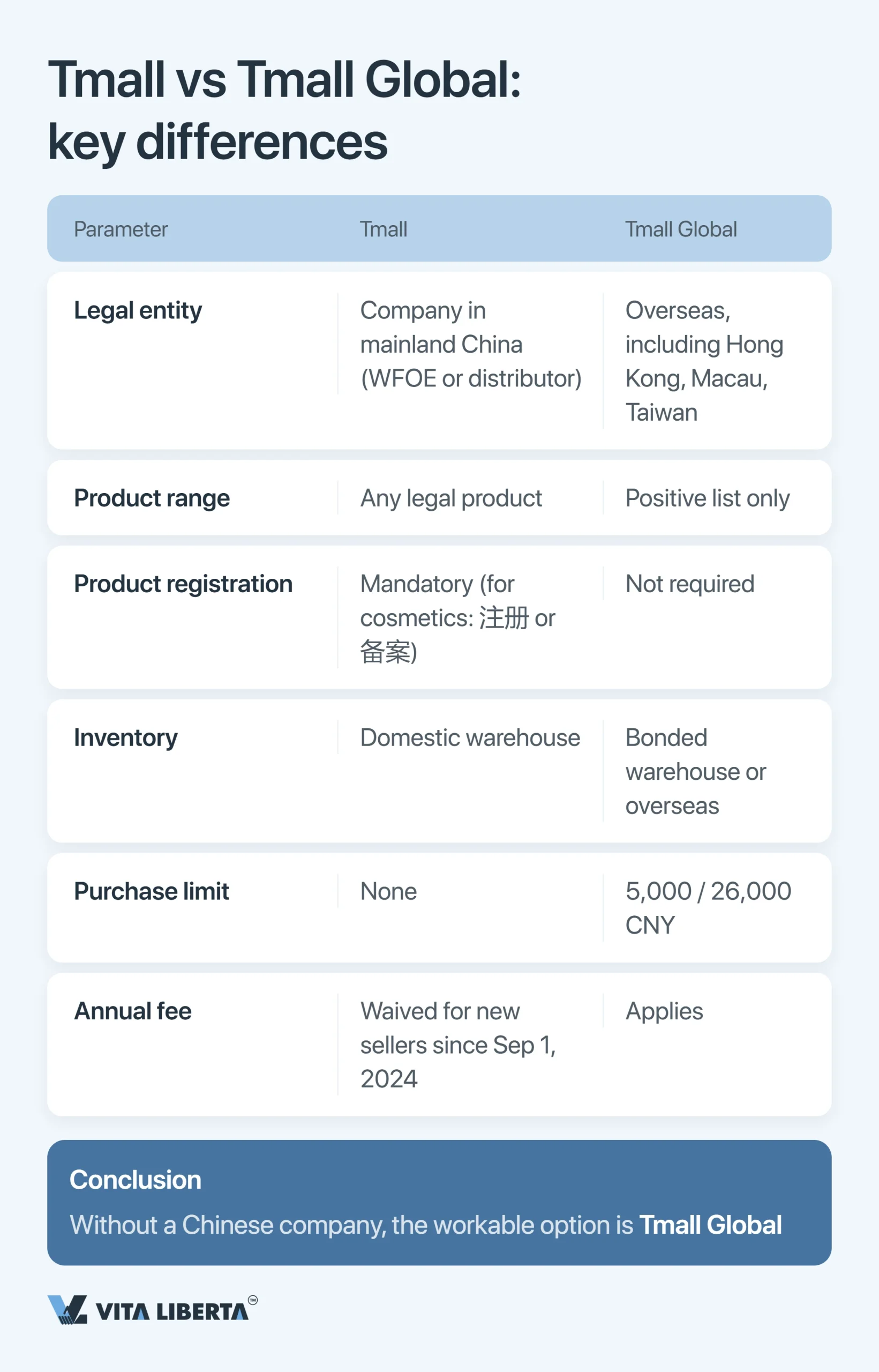
Bottom line: if you have no Chinese company, Tmall Global is the route that works. Domestic Tmall can wait until demand is proven.
Getting approved on Tmall Global: company, trademark, positive list
The platform checks three things: you as the seller, your brand and the product itself.
Who qualifies and which store to open
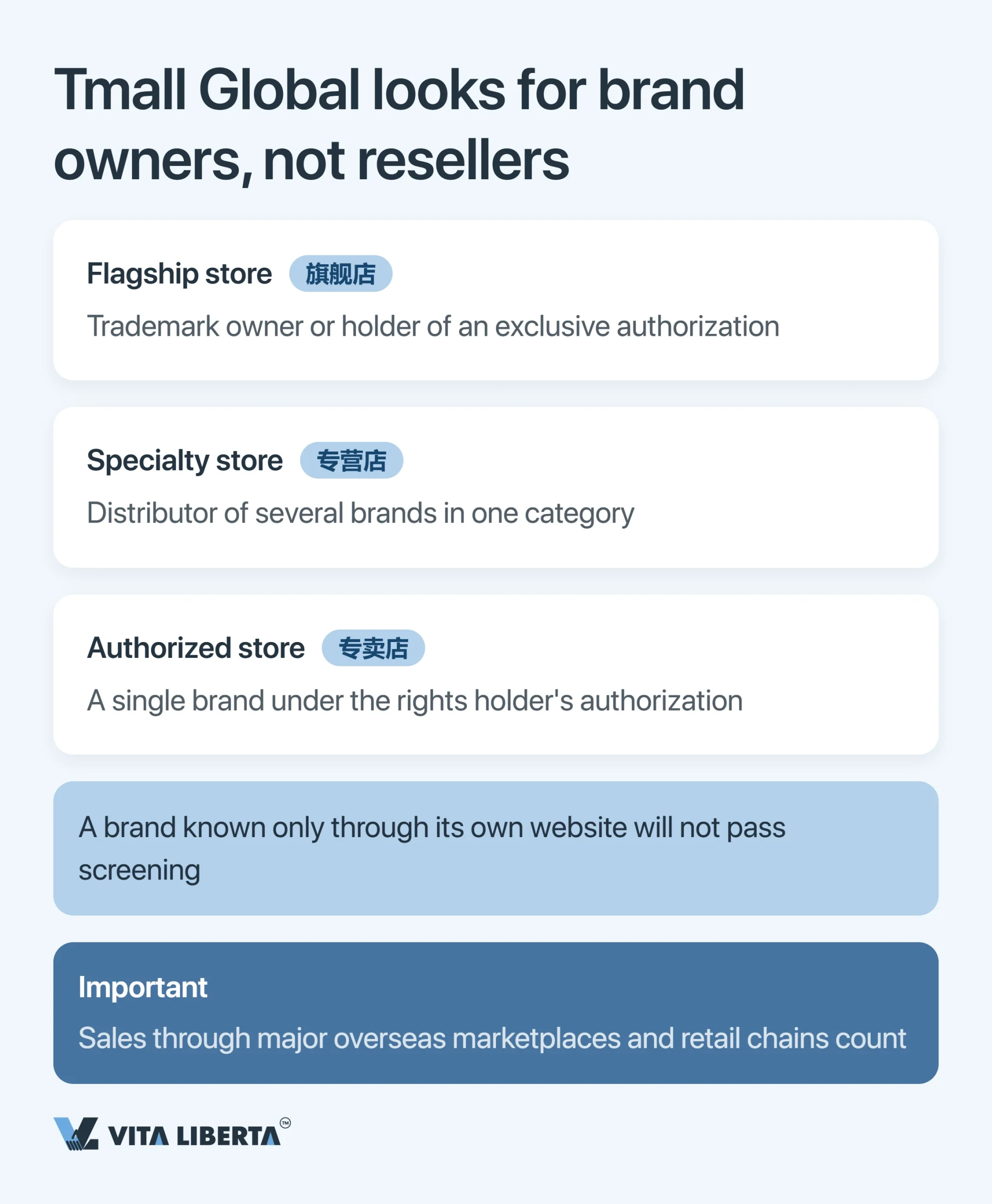
Tmall Global recruits brand owners and authorised distributors. It doesn’t take resellers.
- Flagship store (旗舰店). For the trademark owner or the holder of an exclusive authorisation.
- Specialty store (专营店). For a distributor carrying several brands within one category.
- Authorised store (专卖店). For a single brand, sold under the rights holder’s authorisation.
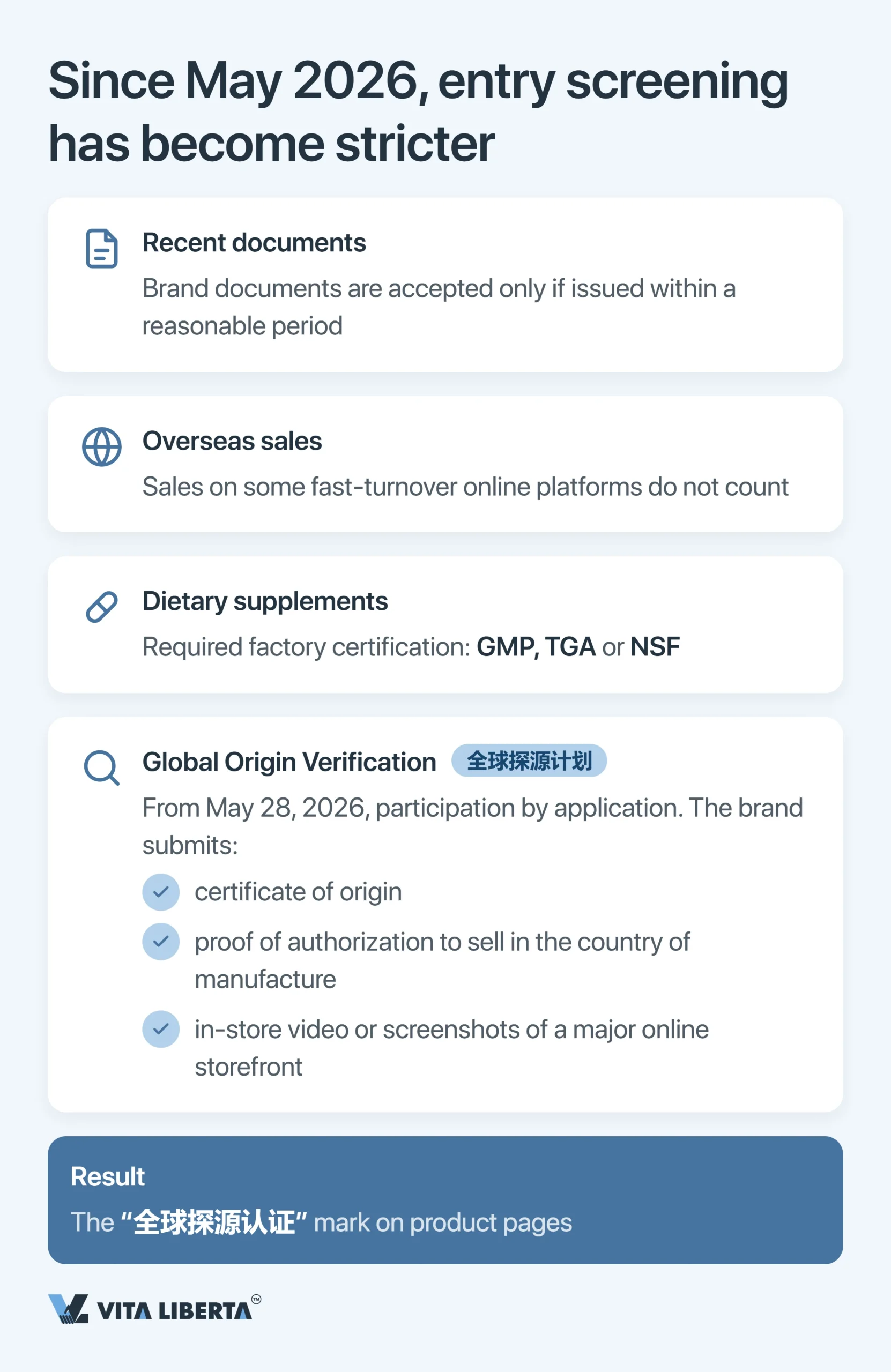
Since May 2026, Tmall Global has applied stricter entry checks. Brand documents are accepted only if they were issued within a reasonable period. Sales on some fast-turnover online platforms no longer count toward your overseas track record. For dietary supplements, the factory needs GMP, TGA or NSF certification. On 28 May 2026 the platform also launched Global Origin Tracing (全球探源计划), a programme that brands join by applying. Participants provide a certificate of origin and proof that the product is on free sale or approved for sale in its country of manufacture. They also provide visual evidence of overseas sales, such as a video from a physical store or screenshots of a major online storefront. In return, their product pages carry the “全球探源认证” badge, and shoppers can open those documents from it.
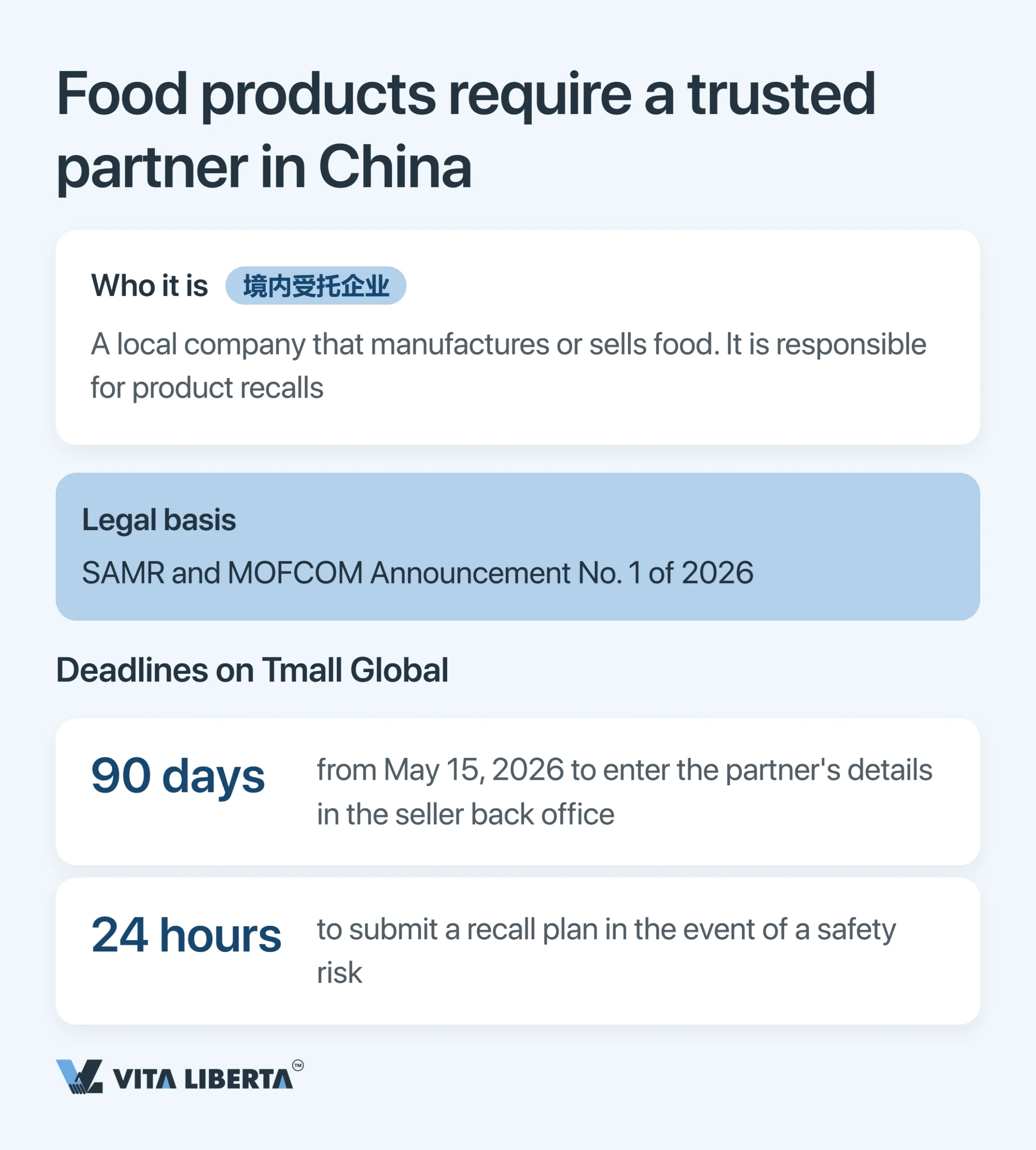
Food sellers face a separate state requirement from 2026. You must appoint a domestic entrusted company in China (境内受托企业). This is a local company that produces or sells food and carries out product recalls. You report its details to the platform (SAMR and MOFCOM Announcement No. 1 of 2026, 市场监管总局 商务部关于进一步加强跨境电商零售进口食品召回监管的公告). On Tmall Global, you enter the partner’s details in the seller back office within 90 days of the platform’s notice dated 15 May 2026. If a safety threat arises, you and your partner have 24 hours from notification to send the platform a recall plan.
A common and expensive mistake among foreign applicants is to submit a brand that is known only from its own website. What counts is sales through major overseas marketplaces or retail chains.
The positive list and the RMB 5,000 / 26,000 limits
CBEC handles only items on the positive list (正面清单). The list has had 1,476 entries since 1 March 2022. Eight agencies, MOF among them, approved the current edition (财政部 发展改革委 工业和信息化部 生态环境部 农业农村部 商务部 海关总署 中华人民共和国濒危物种进出口管理办公室公告2022年第7号). As long as a purchase stays within the limits, the buyer pays 0% customs duty, and VAT and consumption tax drop to 70% of the normal amount (财关税〔2016〕18号). Notice 财关税〔2018〕49号 raised the limits from 1 January 2019 to RMB 5,000 per order and RMB 26,000 per buyer per year. You can still sell something priced above RMB 5,000, as long as it’s the only item in the order and fits within the buyer’s annual limit. In that case the buyer pays full duty, VAT and consumption tax, and the amount still counts toward the annual limit. Once a buyer passes the annual limit, general trade rules apply.
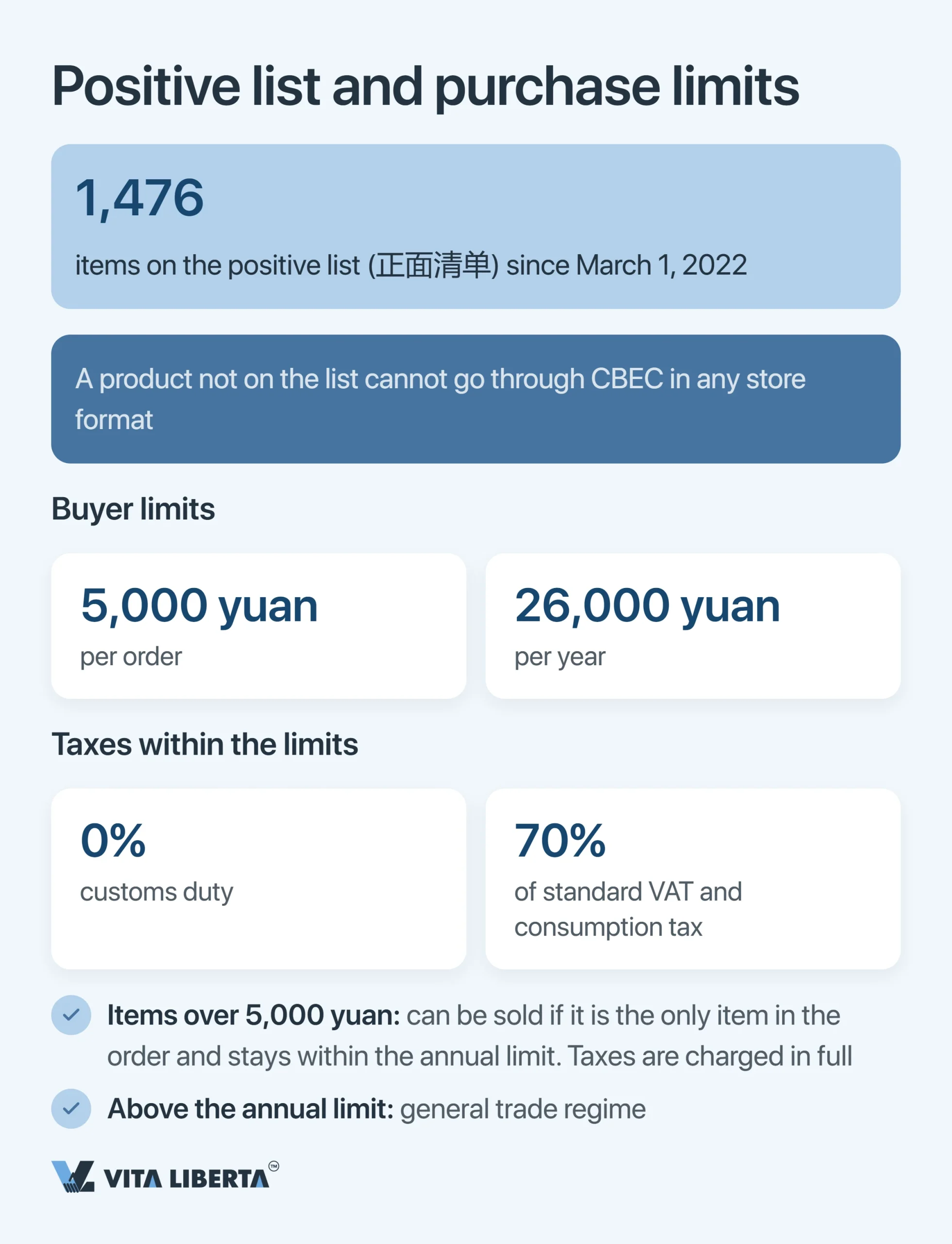
Important: if an item isn’t on the positive list, it can’t go through CBEC, whatever store format you choose. Your application will be rejected before the deposit is even discussed.
What entry costs: from the deposit to the 1% Alipay fee
Your launch budget has four payments: three to the platform and one to the payment operator. The fee schedule (天猫国际资费标准) changes every year, so check the amounts against the current edition.
- Security deposit (保证金). Collateral against violations and buyer claims. The amount depends on the category and the trademark’s status. Baby food, dietary supplements, OTC medicines and maternity products need RMB 300,000.
- Annual technical service fee. There are two tiers, RMB 30,000 or RMB 60,000. If you sell in several categories, the higher tier applies.
- Commission. A category rate of 2% to 5%, taken from every sale in real time.
- Alipay fee: 1%. Your revenue is converted and paid out to your company’s overseas account.
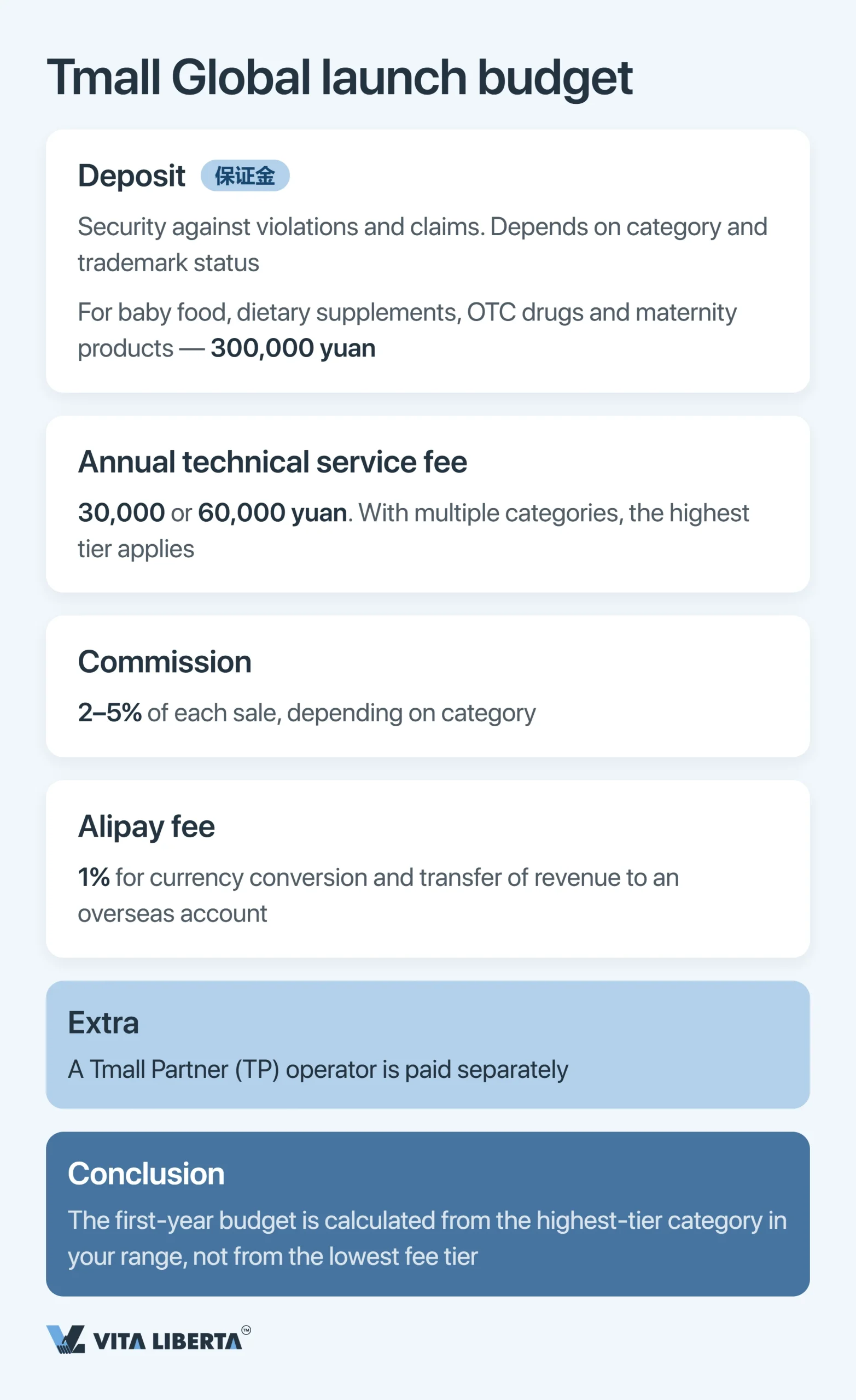
The annual fee waiver on domestic Tmall doesn’t cover the cross-border channel. In 2025, Tmall Global ran its own programme for new merchants. Stores opened between 1 April and 30 September 2025 that operated for six months in a row get the fee back as a credit toward the next fiscal year. From 1 July 2025 to 31 March 2026, new merchants in the RMB 60,000 tier paid the RMB 30,000 rate. The Tmall Partner (TP) operator isn’t part of this fee schedule. Most foreign brands run their store through a TP.
Bottom line: base your first-year budget on the highest-tier category in your range, not on the lowest fee tier.
Check your brand before you apply to Tmall Global
- Product check against the positive list
- Audit of your chain of authorisations
- First-year budget calculation
Launching the store: stages, logistics, failure points
A failure at any stage sends your application back to the beginning.
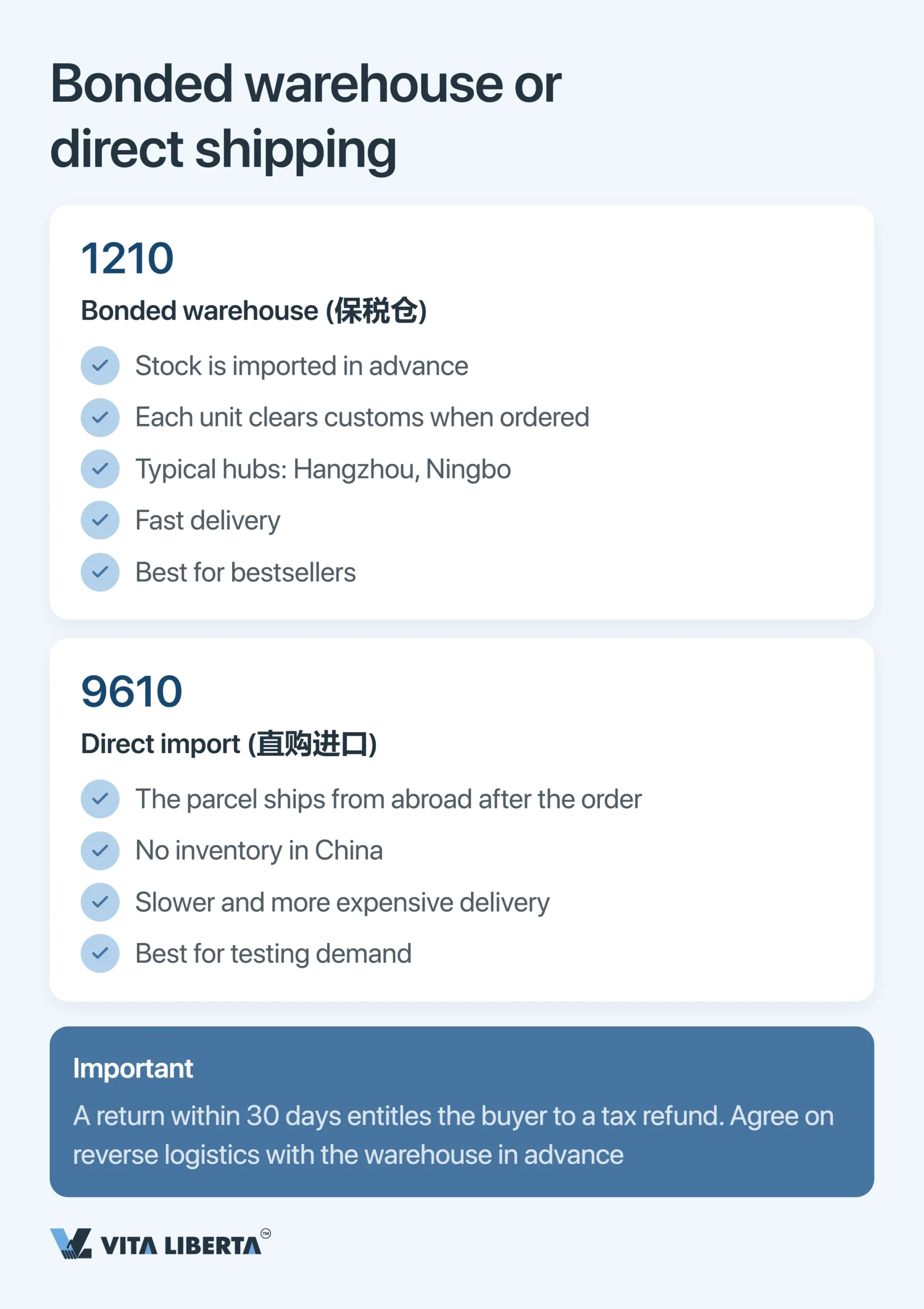
Bonded warehouse or direct shipping
Choose your supply model before you apply. With a bonded warehouse (保税仓, customs code 1210), you send a batch in advance and each unit clears customs when someone orders it. Hangzhou and Ningbo are the usual hubs. The 1210 model is available in cities that have a free trade zone, a CBEC comprehensive pilot zone, a comprehensive bonded zone, an import trade promotion demonstration zone or a Type B bonded logistics centre, once local customs confirms it (商财发〔2021〕39号). With direct import (直购进口, code 9610), the parcel leaves from abroad after the order is placed. You keep no stock in China, but delivery is slower and costs more. If a buyer returns an item within 30 days of customs release, they can claim back the tax, and their annual purchase total is adjusted (财关税〔2016〕18号). Agree how returns will flow with your warehouse before you launch.
| Stage | What you submit | Where rejections usually happen |
| Application | store type, brand, category, company details | category not on the positive list |
| Qualification review | company registration, trademark or chain of authorisations, evidence of overseas sales | expired documents |
| Preparation | Alipay activation, deposit payment | broken chain of authorisations |
| Launch | Chinese-language product pages, annual fee | claims of a therapeutic effect |
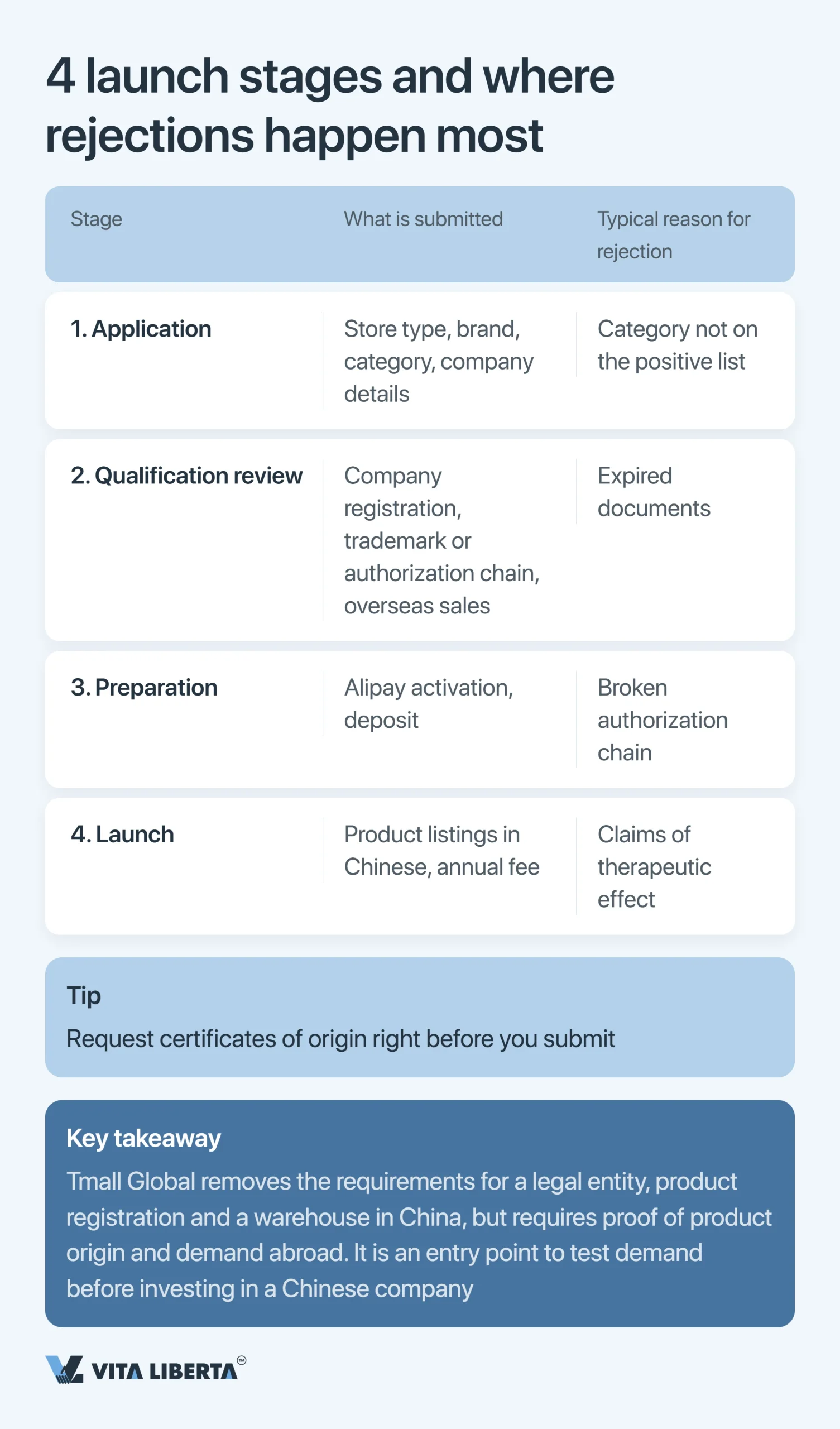
Quick tip: request origin documents just before you submit. The platform won’t accept a document that has expired.
Open your Tmall Global store without rejections
- Document package preparation
- Choosing the right store format
- Setting up your supply model
Tmall Global: strategic takeaways
Tmall Global works on a paradox. It removes the heaviest parts of importing into China for a foreign brand: the local entity, product registration and a warehouse in China. In exchange, you have to prove two things that used to go unchecked: where your product really comes from and that people abroad really buy it.
- Your entity and price point set the route. If you have no Chinese company or your price is above RMB 5,000, decide before you apply, not after a rejection.
- Product checks come before the budget. The positive list and sales evidence can stop you before any deposit does.
- Logistics grows in stages. Use code 9610 to test the market and 1210 for your bestsellers.
A Tmall Global store isn’t the end goal of your export plan. It’s your way in. It tests demand before your brand invests in a Chinese company and full product registration.
Frequently asked questions
No. The seller is a company based outside mainland China, and a Hong Kong company qualifies. Food sellers must also appoint a trusted partner in China, a local company that handles product recalls. That partner is not a subsidiary. You can sell through your overseas entity and set up a WFOE once demand is confirmed.
Yes, as long as it’s the only item in the order. The buyer loses the tax break, though, and pays full duty, VAT and consumption tax. The purchase also counts toward the RMB 26,000 annual limit. For high-priced items, it’s worth costing a separate route through domestic Tmall.
You need a certificate of origin, proof of free sale or approval for sale in the country of manufacture, and visual evidence of overseas sales. Brands join the programme by applying. The document validity rule introduced in May 2026 applies to every seller: documents must be issued within a reasonable period, and expired ones are rejected. Put the package together before you apply, rather than waiting for the reviewer to ask.
No. The waiver that started on 1 September 2024 covers new merchants on domestic Tmall. In 2025, Tmall Global ran its own fee refund scheme for new stores opened between 1 April and 30 September 2025 that operated for six consecutive months. Budget the annual fee based on your highest-tier category.
Direct shipping (code 9610) means you keep no stock in China, but delivery takes longer. A bonded warehouse (code 1210) ties up a batch of stock in China, but orders reach buyers faster. A practical approach is to test demand through 9610 and move bestsellers to 1210.