


Step-by-Step Guide 2026: From Company Registration to an R Visa and Permanent Residence
The Core Problem:
“I established a WFOE in China. Now I want to come, become its General Director, manage the business, and live here with my family. But Ministry of Foreign Affairs staff say: you cannot work in your own firm—you are the founder! Where is the logic in this?”
Such inquiries are among the most frequent from foreign entrepreneurs.
The answer: you can—but only on the condition of absolute legal clarity of the structure and adherence to 12 critical steps.
Otherwise: permit denial, fines, deportation, entry ban.
Introduction: A Unique Status – A Unique Procedure
A foreign investor who is simultaneously the founder (shareholder) of a Chinese company and plans to hold a senior management position within it (e.g., General Director, Director, Board Member) faces a specific legal and administrative situation. Their status combines two key roles: business owner (investor/owner) and employee (hired worker). Chinese legislation clearly separates these concepts, and for lawful residence and work in China, it is necessary to meet the requirements for each of them.
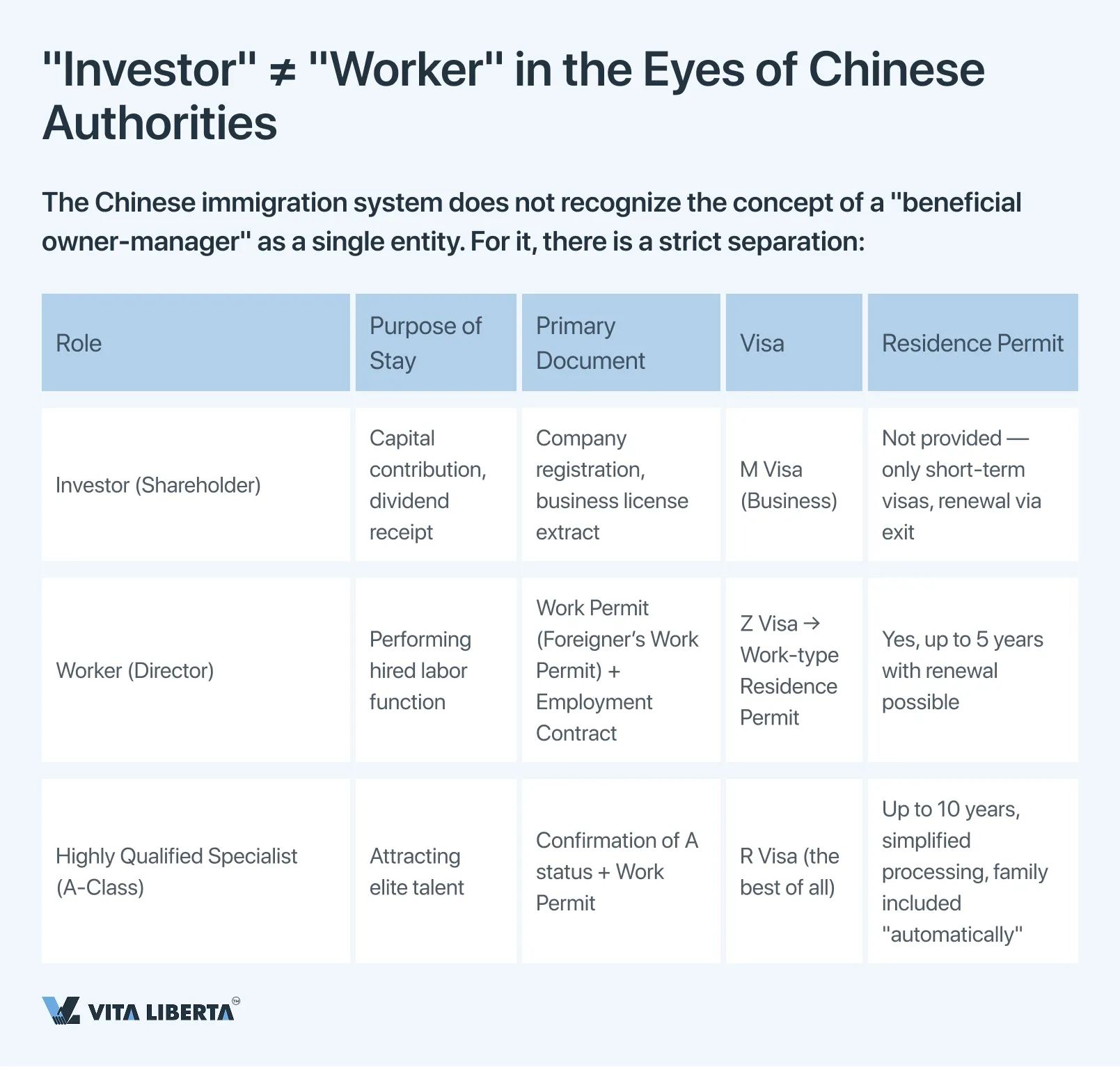
This article explains the complex process in detail: from company creation to obtaining a work visa and residence permit for a foreign investor/director. The focus is on Zhejiang Province, but the general principles apply throughout China, taking into account local specificities.
Legal Framework
- The process is regulated by the following main regulatory acts:
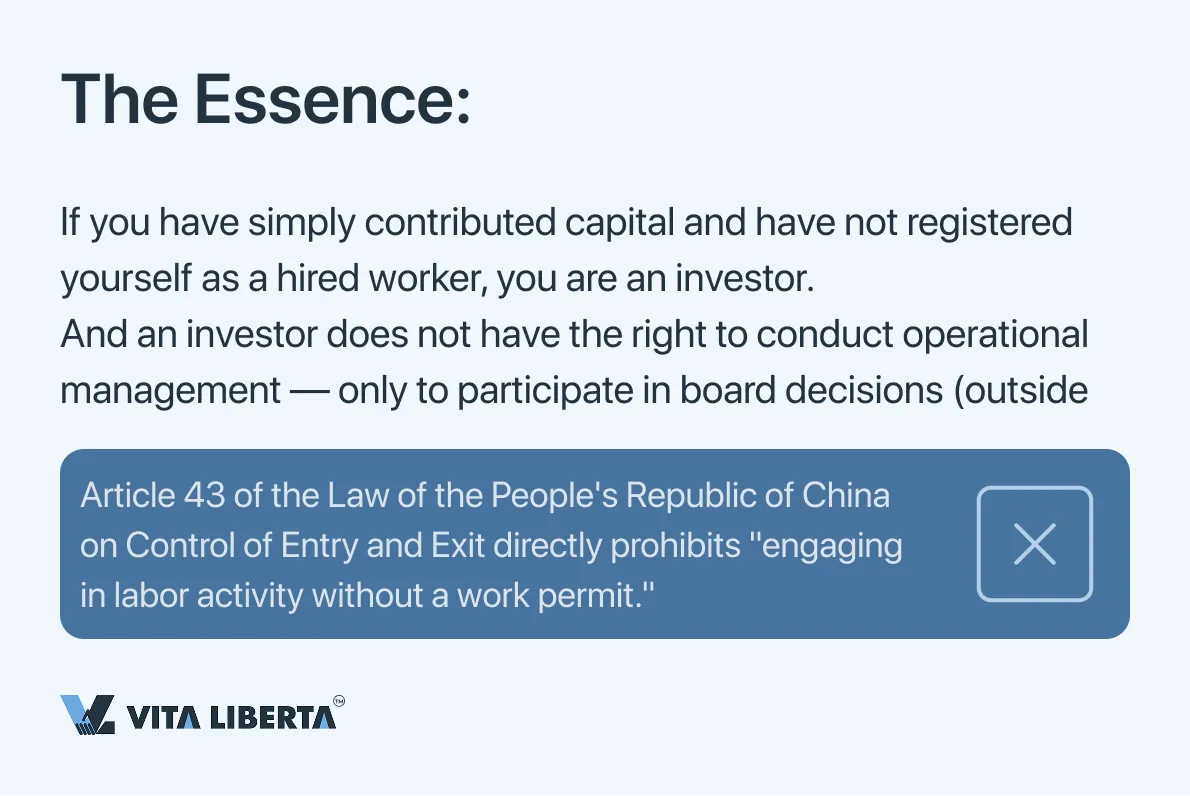
- Law of the People’s Republic of China on Control of Entry and Exit of Foreigners: Article 41 establishes a mandatory rule: any foreigner working in China must obtain a work permit (工作许可) and a work-type residence permit (工作类居留证件). Work without these documents is illegal.
- Regulations on the Administration of Entry and Exit of Foreigners: Specify the procedures, particularly for Z (work) and R (for highly qualified specialists) visa categories.
- Regulations on the Employment of Foreigners in China: Detail requirements for employers and employees.
- Local Regulations: Such as the published Zhejiang Province Handbook, which specify local procedures within the framework of national legislation.
Classification of Foreign Workers (A, B, C) in China
The key factor determining the complexity and speed of the procedure is the classification of the foreigner into one of the following categories:
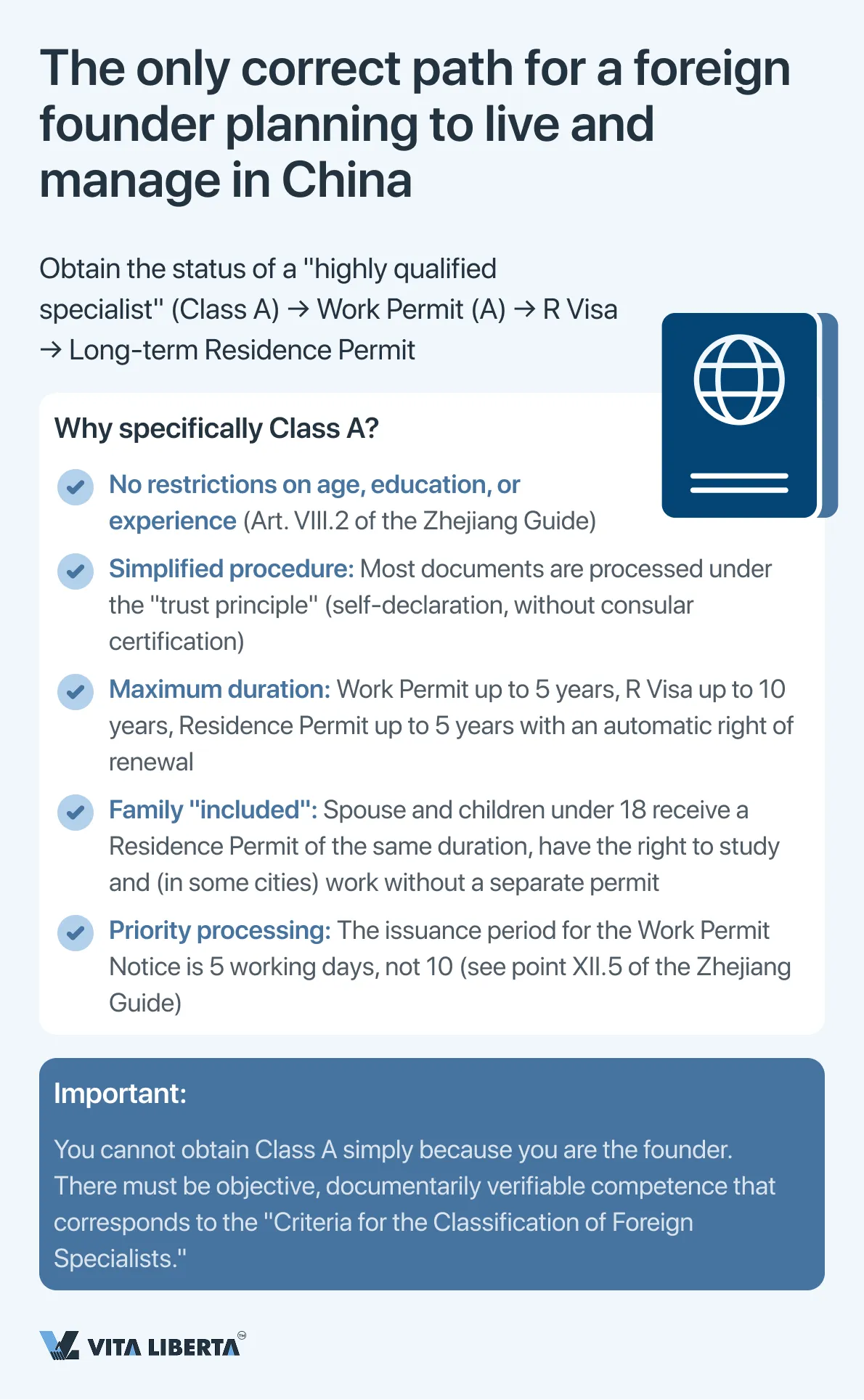
“Top-tier, precise, cutting-edge, and scarce” talent. Foreign investors often fall into this category, especially with significant investment volumes, the introduction of advanced technologies, or management of companies in priority industries for China. Advantages: No restrictions on age, education, or experience. Simplified procedure (often entirely online), acceptance of commitment letters instead of certain individual documents (e.g., criminal record check), the permit is issued for up to 5 years. For an investor-director, classification as Category A is the best-case scenario.
Category B (Professionals)
Qualified specialists with a higher education degree and at least 2 years of work experience, meeting labor market needs. Age limit – usually up to 60 years. This is the most common category for hired directors and managers. The procedure is standard, requiring the submission of a full set of documents.
Category C (Others)
Unskilled or seasonal labor, strictly regulated by quotas. Not applicable to an investor-director.
An investor-director, especially with a significant share in the registered capital or investments in the high-tech sector, has every chance of qualifying as Category A. The decision is made by the Bureau of Foreign Experts Affairs (formerly the State Administration of Foreign Experts Affairs) based on the submitted evidence (business plan, investment amount, patents, etc.).
Work Permit vs. Visa vs. Residence Permit in China
The First Document: The Work Permit Notification — a document issued by the Chinese authorities (the Bureau of Foreign Experts Affairs). Based on it, a foreigner obtains a visa at a Chinese consulate abroad.
This is not the permit, not a visa, and not even the card. It is an official document issued by the Bureau of Foreign Experts Affairs that confirms: “Yes, we have approved you as a worker, and your future employer (even if that is yourself) is permitted to hire you.”
Without this notification — no visas. At all.
Key Features:
- Generated electronically immediately after application approval, but the original paper copy, sent by mail, is required for the consulate.
- Valid for exactly 3 months from the date of issue — no more, no less.
- For Category A (highly qualified specialists), it is issued within 5 working days; for B and C — 10–15 days.
- Important: The notification text clearly states: “This notification is not a visa and cannot be used in place of a visa.” This is not a bureaucratic formality — it is a direct instruction that at this stage you do not yet have the right to enter.
The Second Stage: Z or R Visa — The Border Pass. Issued by a Chinese consulate abroad. Allows entry into China for the purpose of work.
Only after receiving the notification can you go to the consular section of a Chinese Embassy and apply for a work visa. Here, there are two options:
- Z Visa — the standard work visa. Suitable for B and C categories. It specifies an entry date and validity period (usually 30 or 90 days). But the most important thing is: when crossing the border, immigration officers stamp your passport with the entry date, and it is from this moment that the 30-day countdown begins, within which you must apply for the residence permit.
- R Visa — a visa for highly qualified specialists of Category A. This is not just a privilege but an acceleration tool: processing time is 2–4 days, the visa can be issued for 12–24 months, and, crucially, it grants the right to multiple entries at this stage — meaning you can enter, start the formalities, leave to handle other matters, and return without a new visa. Common mistake: Attempting to enter on an M visa (business) and “get sorted out inside.” This is directly prohibited by Article 41 of the “Law on Control of Entry and Exit”: “Foreigners in China must obtain a work permit and a work-type residence permit. Hiring individuals without these documents is prohibited.” Violation: deportation, fines up to ¥20,000, and inclusion on a “blacklist.”
The Third Stage: The Work Permit (Card) — Your Professional Status
After entry, you have 15 days to submit documents to obtain the physical Work Permit Card — yellow, with a chip and QR code. It is this card that confirms your belonging to Category A, B, or C, specifies the employer, and the validity period.
This document is the foundation for everything else:
- Without it, a bank will refuse to open an account (even if you are the director and founder);
- Without it, you cannot sign a long-term lease agreement;
- Without it, a school will not admit your child to an international class.
And yes — this card does not grant the right of residence. It is merely proof that you have the right to work. You can only reside after the next step.
The Fourth and Main Stage: The Work-Type Residence Permit — Your Legal Place in China
Only after receiving the Work Permit Card do you apply to the Public Security Bureau (PSB, 派出所) for the work-type residence permit. This is not a separate document, but a passport insert, resembling a visa, but with two critical differences:
- It is valid for up to 5 years (for Category A — contract-dependent, up to 5 years);
- It grants the right to multiple entry and exit without obtaining new visas.
It is this document that makes you a resident, not a temporary guest. With it, you can:
- Purchase real estate (in some cities without the 5-year waiting period);
- Obtain a Chinese driver’s license;
- Participate in state digital systems (Health Code, Alipay Health, electronic museum tickets, etc.).
Table: Work Permit vs. Visa vs. Residence Permit in China
| Document | Issued By | Where Valid | Purpose | Validity Period | Key Features |
| 1. Work Permit Notification | Bureau of Foreign Experts Affairs (SAFEA/Provincial Bureau) | Outside China (at the consulate) | Confirms you are approved as a worker in China. Without it — no visa. | 3 months from issue date | Issued online as PDF + original by mail. For Category A — 5 work days, for B/C — 10–15. Does not grant entry or work rights! |
| 2. Work Visa: Z-Visa or R-Visa (for talents) | Consular Department of Chinese Embassy/Consulate-General | For entry into China | Grants the right to cross the border for employment upon invitation. | Specified in visa (usually 30–90 days for single entry) | Z-Visa: Standard for B and C categories. R-Visa: Only for Category A. Longer validity, priority processing. Upon entry, border control stamps the date starting the 30-day countdown to apply for the Residence Permit. |
| 3. Work Permit (Card) | Same Experts Bureau (SAFEA) | Within China (after entry) | The primary document confirming your status as a foreign worker for tax authorities, banks, and employer. | Up to 5 years (5 years max only for Category A with salary ≥ ¥500k/year) | Physical yellow card with a chip. Is not a Residence Permit! Without it — rejection of Residence Permit application. Specifies category (A/B/C), employer, validity. |
| 4. Work-Type Residence Permit | Public Security Bureau (PSB) | In China (place of residence/registration) | Grants the right to legally reside and enter/exit multiple times without a new visa. | Up to 5 years (matches the Work Permit validity) | Format: passport insert with a chip. Enables: opening a bank account, renting property, obtaining a driver’s license, enrolling a child in an international school. Invalidated if absent from China for >180 consecutive days. |
Step-by-Step Action Plan for the Investor-Director
Step 0: Company Preparation and Registration – Creating the Legal Basis for Status A
At this stage, it’s important not just to register a company, but to create a structure that automatically meets the criteria for an “investor-entrepreneur” in Category A.
Key Actions:
Choice of Structure
- WFOE (Wholly Foreign-Owned Enterprise) – the optimal option for a foreign founder planning to become the General Director.
- Joint Venture is not recommended: The division of authority makes it difficult to prove the founder’s “key role” and increases the risk of rejection for Class A.
Registered Capital: Not a Minimum, but a Strategy
- Chinese law indeed does not set a minimum amount and allows capital to be contributed over 5 years.
- However, to qualify for Class A under the “investor-entrepreneur” criterion, demonstration of reasonable investments is required, showing intent and covering initial startup costs. Even if you contribute only a part initially, but specify a justified target capital in the articles of association and confirm the intention with a bank statement for the corporate account opening — this is sufficient to apply for Class A.
Registration with SAMR (State Administration for Market Regulation)
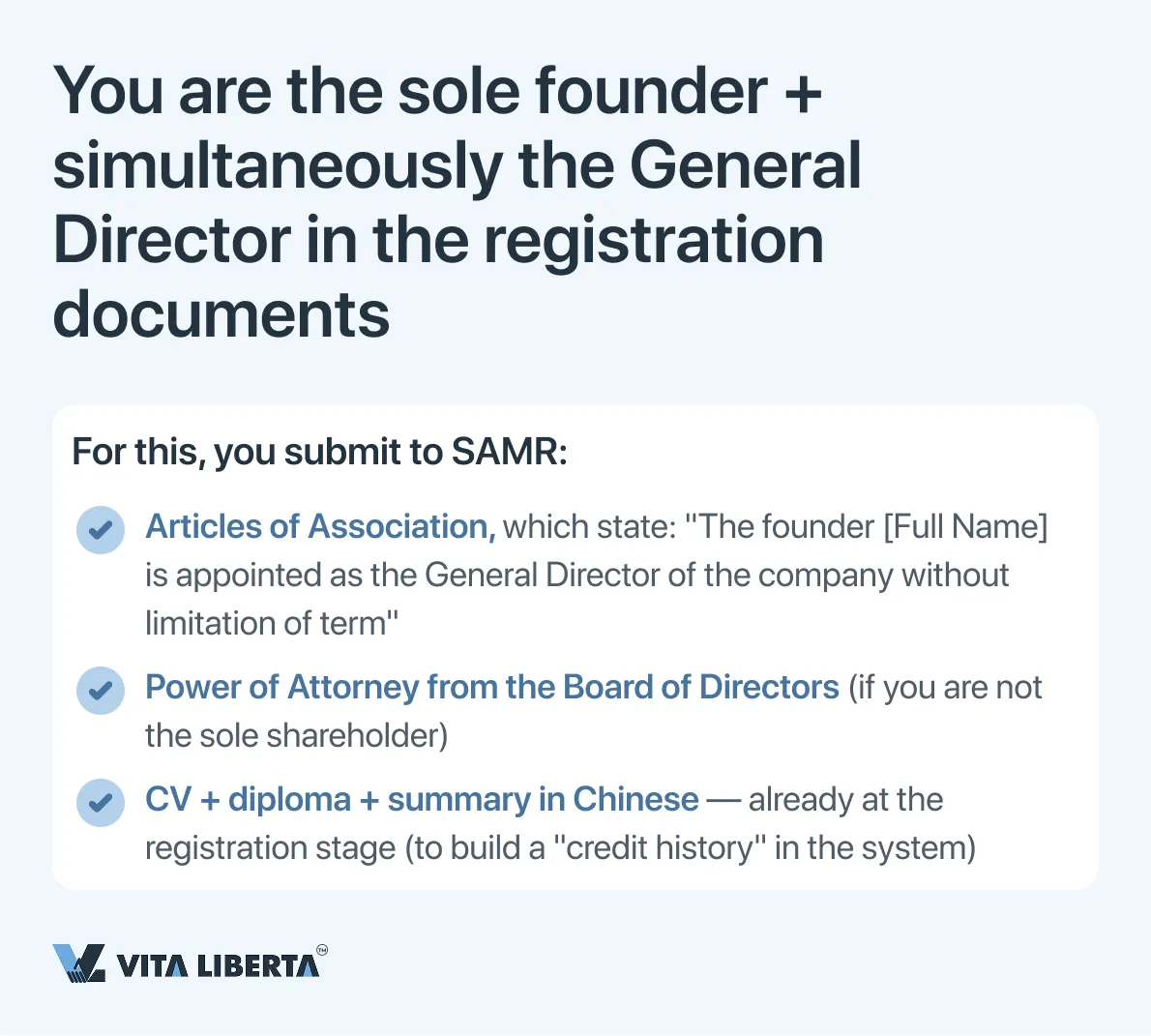
- In the Articles of Association, it is mandatory to state: “The founder [Full Name] is appointed as the General Director of the company for an indefinite term.”
- The Business License must indicate industry codes corresponding to the “Province’s Priority Industries Catalogue” — this critically influences automatic qualification as A.
Opening a Corporate Bank Account
- Do this within 30 days of registration – otherwise SAMR may initiate an inspection.
- The bank will request the business license, company seal, and the director’s passport – ensure you are already registered as the General Director.
Tax and (if necessary) Customs Registration
- Mandatory: Registration with the tax authorities (within 30 days).
- Customs registration (inclusion in the Customs Registration List) – only if you plan foreign trade activities. For Class A, it is not mandatory but desirable – confirms the “significance of operations.”
Important Clarification:
Successful company registration is not the end, but the beginning of the process of confirming investor status. Already at this stage, start collecting evidence for the Category A dossier:
- Screenshots from the National Enterprise Credit Information System with your name as director,
- Office lease agreement (SAMR requirement — a real address),
- First bank transactions (to confirm “activity”).
Only this way do you lay the foundation for a quick transition to Step 1 – applying for the Category A work permit.
Step 1: Employer Registration in the System – Creating Your Company’s “Digital Passport” for Hiring Foreigners
Before applying for a work permit for yourself, you must register not yourself, but your company as an employer in the system. This is akin to “accreditation” – the state first checks the organization and only then allows it to hire foreigners.
How to do this in practice:
- Go to the “Management and Service System for Foreigners Working in China” platform (外国人来华工作管理服务系统) → select “Legal Entity” (法人登录).
Note: A personal account (e.g., for your own visa application) is created later – at this stage you are acting on behalf of the company.
- Upload 6 mandatory documents:
- Employer Registration Form – filled out online, printed, stamped with the company seal, and signed (by the head).
- Business License – in PDF format, with the Unified Social Credit Code (USCC) clearly visible.
- Passport of the Company Head – if you are the founder and General Director, this is your passport (page with photo and data).
- Passport of the Authorized Representative – can be the same person (you), but it’s a formally separate role.
- Seal Power of Attorney (if you are using not the main company seal, but, for example, an HR seal).
- Commitment Letter for Work Permit Application (外国人来华工作许可申请承诺书) – with your signature as head and the company seal.
The key difficulty for a foreign founder:
There is no field in the system for “I am hiring myself.” But you are not violating the law – and here is how to correctly formalize it:
- In the “Responsible Person” field, enter yourself (name, passport, contacts).
- In the “Contact Person for Hiring Matters” field, also enter yourself – this is technically acceptable.
- In the “Planned Hiring” section, when filling it out, specify: “Position: General Director. Category: A. Basis: Section 5 of the Classification – ‘Investor and Key Manager.'”
Timeline and Result:
- After uploading the documents, the system conducts an automatic check of the USCC and a verification against the SAMR registry.
- If there are no errors – approval within 1–3 working days.
- You receive the status “Employer Confirmed” and access to the function “Apply for Work Permit.”
Important: What NOT to do
- Do NOT register the company through a third party (e.g., a Chinese nominee) if you plan to become the director. The system will link the company’s USCC to your passport – and in case of a mismatch, will request explanations.
- Do NOT use low-resolution scans: the seal (must be fully legible) and the USCC number are especially critical.
- Do NOT skip the hiring commitment letter – without it, the system blocks the transition to the next step.
- After completing this stage, your company becomes a “trusted employer” in the eyes of SAFEA.
Step 2: Determining the Worker Category (A) and Preparing the Dossier
Even before applying, it is necessary to prepare evidence for classification as Category A.
The guide indicates that Category A includes, among others, “international entrepreneurs” and individuals meeting the criteria of the points system for high-level talents.
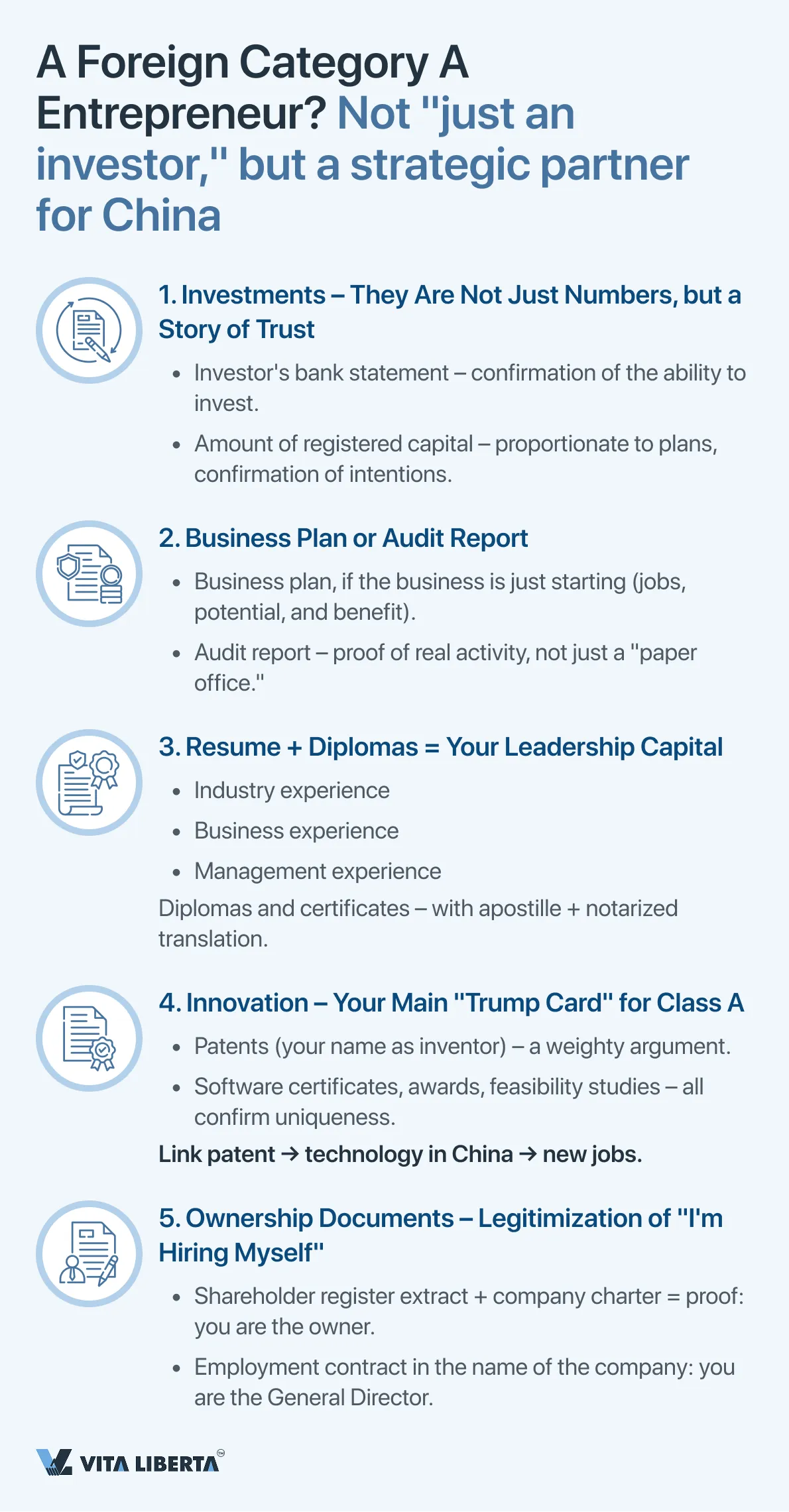
- Evidence of Investment: Show the seriousness of your intentions and financial solvency. For example, a shareholder’s bank statement: This is a basic but essential document.
- Audit Report (if available): If the company has been operating for some time, an independent auditor’s report confirming financial health and implementation of the investment plan is an indisputable argument in your favor. It shows that you have not simply “registered and forgotten,” but are conducting transparent and responsible activities.
- Combine these documents into a narrative: “We registered the company with registered capital X, confirmed by statement Y. These funds are allocated for equipment purchase and personnel hiring, as described in our business plan. Our first audit report (if available) demonstrates stable development.” Goal: To transform numbers into proof of reliability and long-term plans.
- Business Plan: Your main “marketing” document for the authorities. The business plan should be written not only for investors but specifically for the officials of the Bureau of Foreign Experts Affairs (SAFEA).
- Emphasize alignment with national and local priorities (“Made in China 2025”, development of the digital economy, “green” technologies actively promoted in Zhejiang). Do not simply list that you use SaaS. Describe how your technology (e.g., a proprietary AI-based platform, a unique production process) fills a gap in the local market or surpasses existing solutions. Reference Chinese or international standards.
- Job Creation: Indicate not only the number of planned positions (manager, developer) but also their quality. Emphasize that you will hire and train local Chinese specialists, transferring knowledge and expertise to them. This is extremely important for the authorities.
- Export Potential: Show how your company in Zhejiang will contribute to the export of Chinese goods/services or, conversely, attract advanced foreign practices. An export plan is a powerful argument for gaining support. Structure the business plan with clearly highlighted sections that directly address the criteria of “high-end, precise, and advanced.” The goal is to present your company not as just another foreign firm, but as a strategic partner in the development of the region.
- Resume (CV): Confirm your leadership capital and expertise. The resume should reflect not just a chronology of employment, but a history of success and leadership. Emphasis on:
• Management experience (number of subordinates, size of managed budget).
• Experience in launching projects “from scratch” or expanding a business into new markets (direct analogy with your current task in China).
• Industry expertise aligned with the direction of your Chinese company.
- Diplomas and Certificates: Diplomas and professional certificates must be legalized (apostille or consular legalization) and accompanied by a notarized translation into Chinese. Your resume and diplomas should paint a portrait of an international entrepreneur and expert whose knowledge is critically necessary for the success of this enterprise in China. Goal: Prove that your personal qualification, and not just your capital, is the key asset of the company.
- Patents, Certificates: Evidence of innovation as a competitive advantage. This is one of the strongest arguments for Category A.
- Patents: Provide copies of international or national patents where you are listed as the inventor or rights holder. Support them with a description of how this intellectual property will be used or adapted in the Chinese project.
- Software certificates, technical attestations, awards: Any documents confirming the uniqueness of your product or international recognition of your professional merits (industry awards, grants). Link your innovations to the points in the business plan. Show the chain: “I have a patent for technology X. We will implement it at our factory in Zhejiang. This will give us a market advantage and allow us to create high-tech jobs.” Goal: To move innovations from the realm of abstraction into a concrete plan for economic impact.
- Company Ownership Documents: Legitimization of the dual status.
• Shareholder Register Extract: This document, obtained from the Chinese Market Regulation Administration (SAMR), legally proves your ownership right. It removes any question of why the company is hiring you—because you are its owner and key strategic decision-maker.
• Company Charter: It will also list the composition of the founders and the size of shares. Submit these documents together with the employment contract. This creates a complete and transparent picture: “I, as the owner (Document A), hire myself for the position of General Director (Document B) to implement our investment plan (Document C).” Goal: To eliminate any potential suspicion of sham employment and show the complete alignment of your legal status with business logic.
Final Tactic for Step 2:
• Not disjointed, but systematic: Don’t just send a folder of documents. Create a cover letter or a brief explanatory note (in Chinese), where you connect all elements of the dossier into a single convincing narrative through key points: “Based on proven investments, innovation potential, and personal experience, I, as the owner and key manager of [Company Name], plan to implement a project that will contribute to the development of [e.g., the digital economy sector] in Zhejiang, creating jobs and transferring technology. This meets the criteria for a foreign high-level talent (Category A).”
• Translation quality: All documents must be translated into Chinese by a qualified translator, and key points (resume, business plan) should be edited by a native speaker for flawless understanding.
Category A is a status that must be earned in the eyes of the official through documents. Your dossier is your weapon in this fight for privileged status. The more convincing, complete, and strategically precise it is, the higher the chances of success and obtaining all the advantages associated with Category A.
However, an important note: it must be a true story, not a fairy tale!
Get a China Investor Visa Without Rejections
- Eligibility assessment for residence permit
- Complete documentation preparation
- End-to-end support until permit issuance

Step 3: Applying for the “Work Permit Notification”
This stage represents the formal online initiation of the process to legalize your status. The correctly chosen route and an impeccably prepared digital document package determine not only the timeline but the overall success of the endeavor. The procedure is legally divided into two fundamentally different paths, the choice between which depends on the current geographical location and visa status of the foreign citizen.
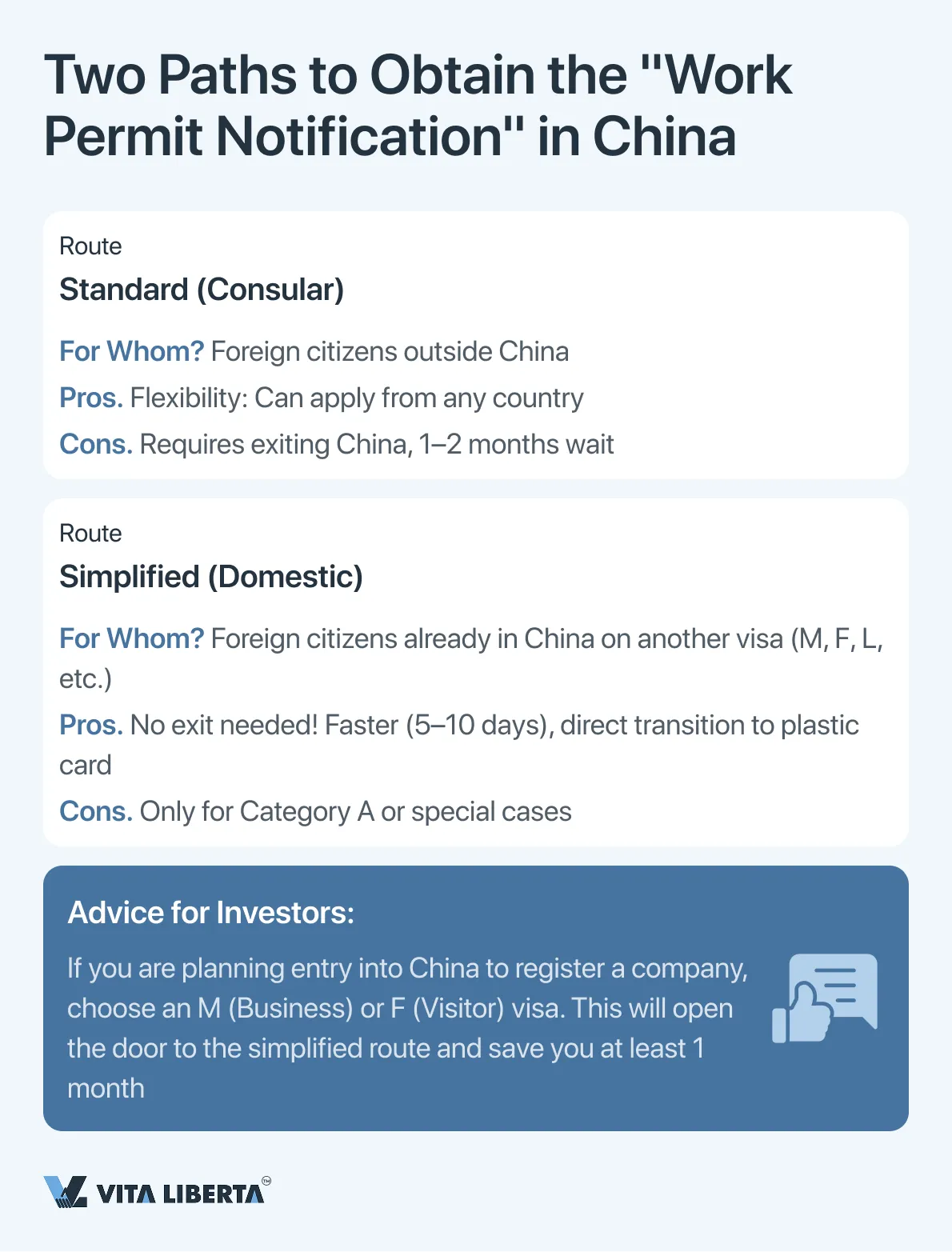
Strategic Choice of Procedure: Two Branches of Development
- Standard (Consular) Route: The traditional path, involving visa issuance outside China. Requires exiting the country and is mandatory for individuals located abroad or not meeting the criteria for domestic processing.
- Simplified (Domestic) Route: A special procedure for individuals already legally in China on other types of visas. It is an exclusive privilege that avoids the need for consular visa issuance and should be used at the first opportunity.
Option I: Standard (Consular) Application Route for Individuals Outside China
This process is relevant if the foreign investor-director is outside China.
Phase 1: Formation and Submission of the Digital Dossier via the Integrated System
The employer (your Chinese company) logs into the “System for the Management of Foreigners’ Work” and initiates a new application. Each attached document must be scanned in high resolution and correctly renamed. Key components of the dossier requiring special attention from the investor:
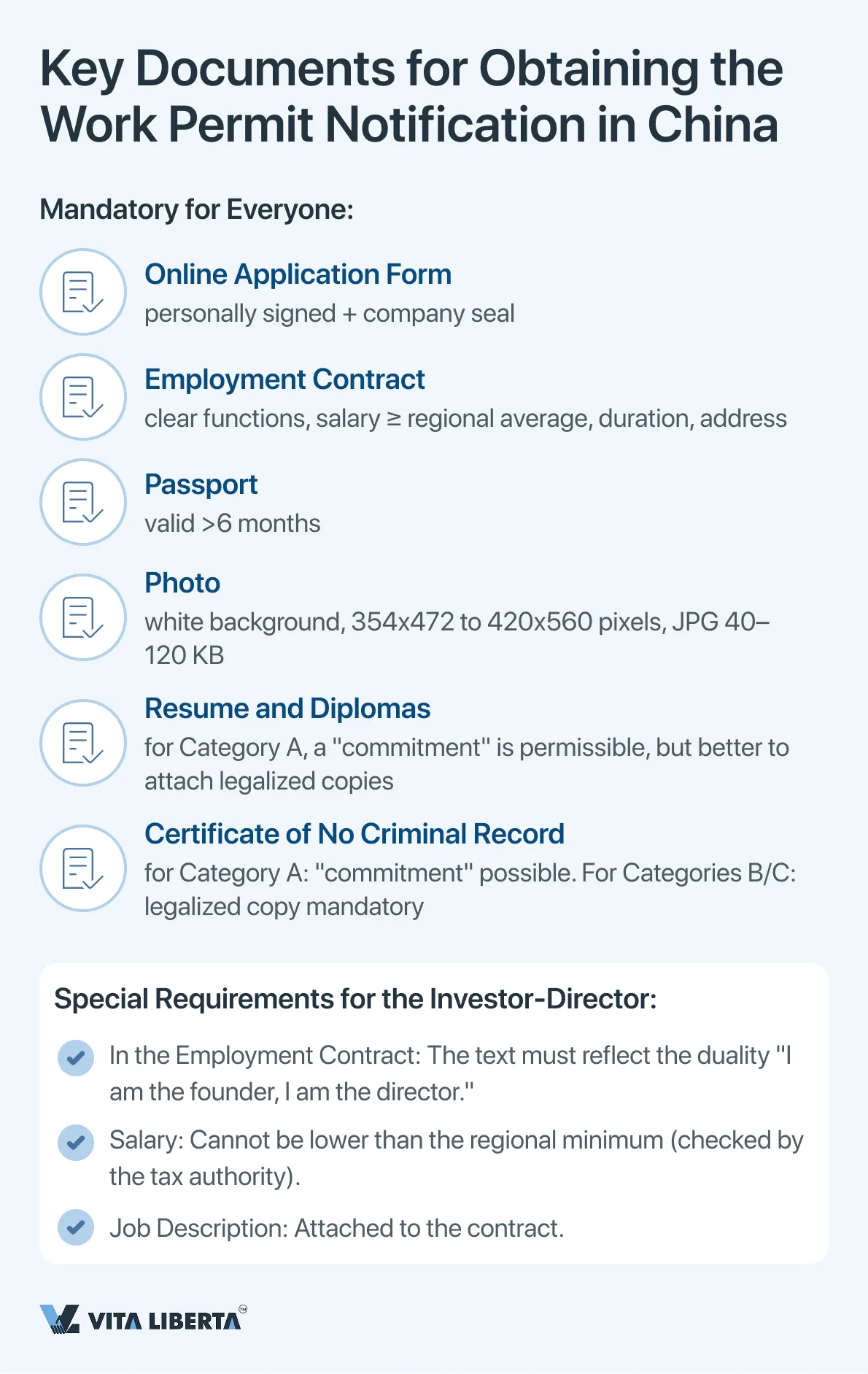
- Online Application Form: Generated by the system after filling out web forms. Key Point: The form is printed, personally signed by the foreign applicant, then scanned together with the official company seal of the employer. This symbolizes bilateral consent.
- Proof of Professional Experience: For Category A applicants falling under the criteria of “leading scientists” or “leaders in the scientific and technical field,” this point is handled through a written commitment mechanism. However, for an investor-manager, even using this benefit, it is strategically correct to attach a structured resume (CV) with referee contacts. For Category B, legalized certificates from previous employers are required.
- Higher Education Document: For Category A applicants, the commitment system also applies. Nevertheless, providing a notarized and apostilled copy of the diploma with a professional Chinese translation strengthens the applicant’s position and eliminates the need to provide the document later.
- Certificate of No Criminal Record: One of the most complex documents. Must be issued by competent authorities of the country of citizenship or permanent residency (residence >1 year) and legalized by a Chinese consulate or apostilled. For Category A, at the notification request stage, submission of a commitment is permissible, which is a fundamental simplification. For Categories B and C, the original with legalization is mandatory.
- Employment Contract or Appointment Document: The central document for the investor-director, requiring meticulous precision. Since the contracting parties are the legal entity (company) and the natural person (its own director-founder), the text must flawlessly reflect this duality. Mandatory sections:
- Clearly formulated job functions, corresponding to the claimed management level.
- Place of work (full company registration address).
- Salary (base salary) in RMB/CNY, matching or exceeding the regional average level (data from the local statistics bureau). This item cannot be contractually reduced.
- Precise contract duration.
- Complete details of both parties, the foreigner’s handwritten signature, and the impression of the Chinese company’s seal.
- A detailed job description is attached to the contract.
- Valid Passport: Scan of the biographical data page. Validity must exceed 6 months from the application date.
- Digital Photograph: Strict requirements: light background, size 40-120 KB, dimensions from 354×472 to 420×560 pixels.
- Health Examination: Can be postponed and presented at the stage of obtaining the plastic permit card inside China. Submission of a temporary commitment is allowed.
- Documentation for Accompanying Dependents: If necessary, include spouse and minor children in the application immediately by preparing copies of their passports, (legalized) marriage/birth certificates, and photographs.
Phase 2: Interdepartmental Verification and Approval
After online submission of the document package, the responsible territorial authority (e.g., the Bureau of Foreign Experts Affairs of Zhejiang Province) conducts a preliminary audit within 5 working days. In case of incompleteness or non-compliance, the applicant receives a reasoned list of comments for correction. If formal criteria are met, the application is assigned the status “accepted for review.”
Phase 3: Decision Making and Notification Generation
At the substantive review stage, lasting up to 10 working days, specialists analyze the essence of the provided data. If positive, the official form “Notification of Work Permit for Foreigner in the PRC (Work Period Over 90 Days)” becomes available for download and printing in the employer’s personal account.
This document has a limited validity period (usually 3 months) and serves solely as the basis for applying for a work visa.
Option II: Simplified (Domestic) Application Route for Individuals Already in China
This procedure is optimal for an investor if they have already entered China on another permitted basis (e.g., business visa M, tourist visa L). It allows bypassing the stage of obtaining the notification and visa abroad, by directly applying for the plastic permit card.
Critical Conditions for Qualification:
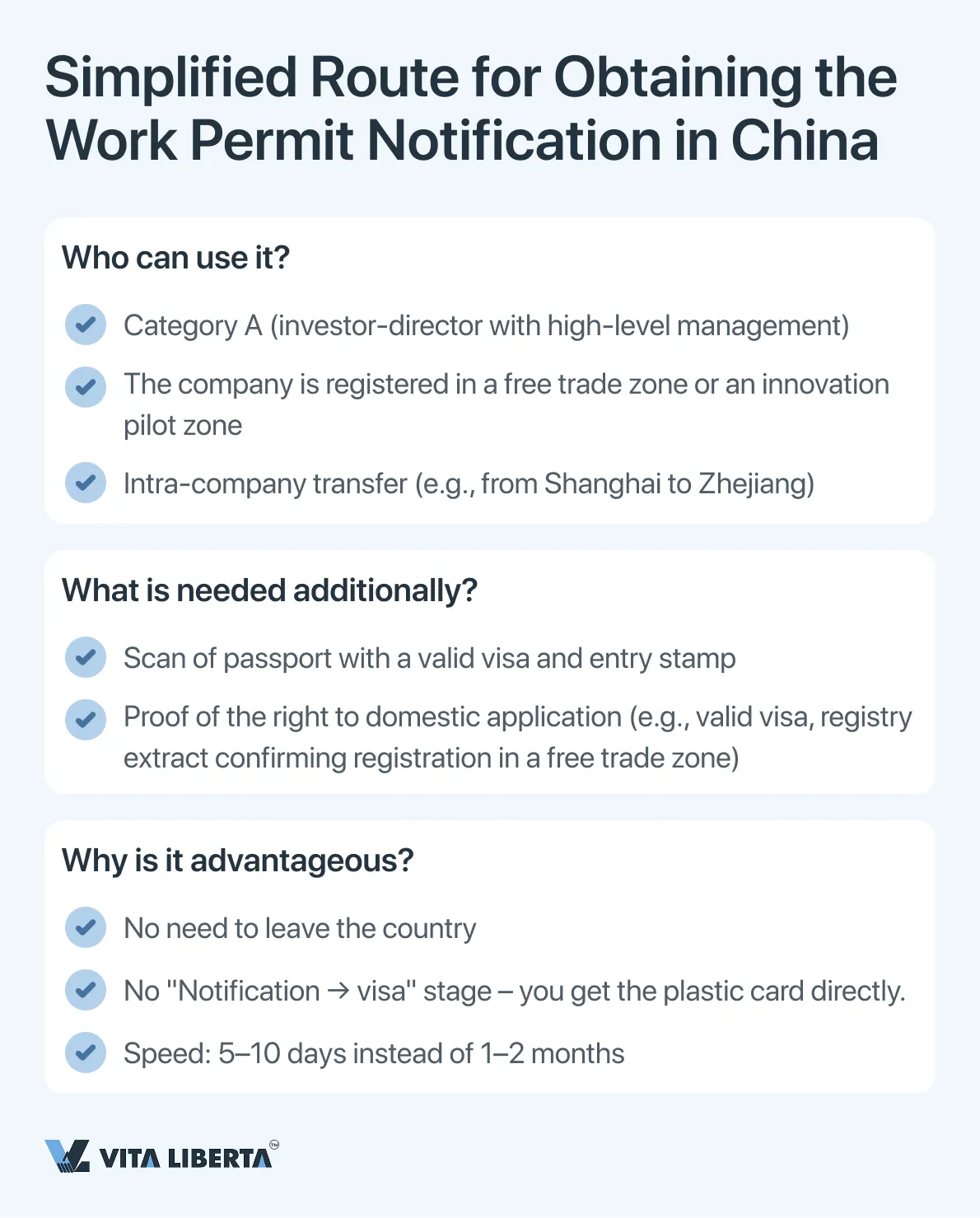
- Status as a foreign highly qualified specialist (Category A) with a valid visa of any type except a work visa.
- Eligibility for the preferential policies of innovation pilot zones or free trade zones where the enterprise is registered.
- The fact of an intra-corporate transfer within an international group of companies.
- Other special circumstances deemed relevant by the regulatory authority.
Practical Implementation:
The document set is identical to the standard one, with a few tactical exceptions:
- Instead of a criminal record certificate from abroad, a similar certificate obtained within China (if the foreigner has lived in the country for over a year) can be submitted, or the right to a commitment (for Category A) can be used.
- The package must include scan copies of passport pages with the valid visa and the last entry stamp, as well as documentary justification for the right to apply domestically (e.g., an extract confirming the company’s registration in a free trade zone).
Processing timelines are similar, but the result of a successful review is a direct transition to the production of the plastic “Work Permit” card, bypassing the “Notification” stage.
For an investor-director whose business often requires constant presence in the initial phase, the simplified route is a priority. Even at the planning stage of the first entry into China for company registration, it is worth choosing a visa category (M, F) that will later allow using the domestic procedure, saving at least 1-2 months and avoiding a mandatory exit.
Step 4: Obtaining a Work Visa (Category Z or R) Outside China
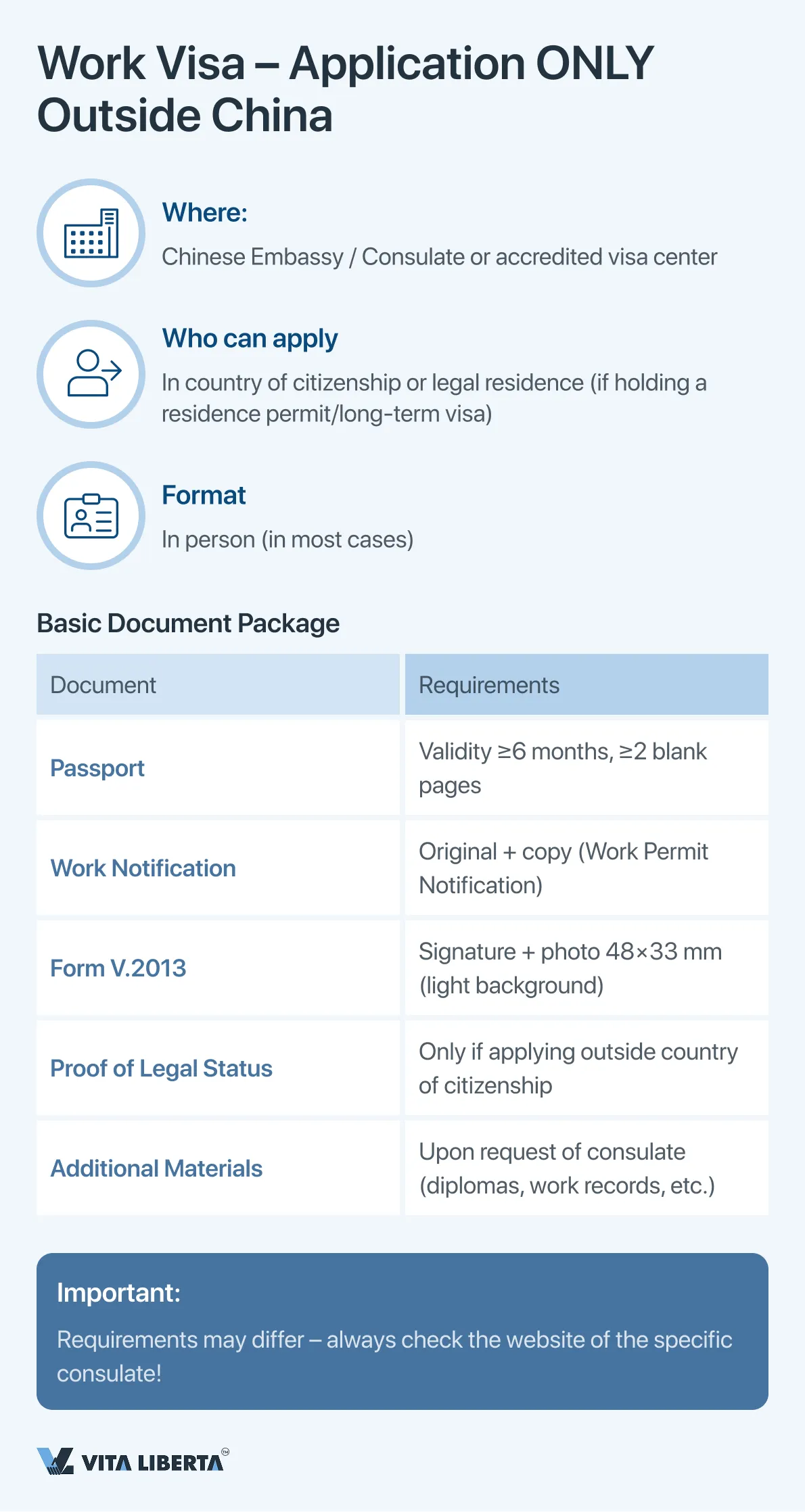
This stage is the final one in the preliminary procedure for legalizing the work activity of a foreign specialist in China. It is carried out exclusively abroad, in the territory of the applicant’s country of citizenship or country of permanent legal residence.
Standard Document Submission Procedure:
- Choosing the Submission Institution: The applicant must apply in person to a diplomatic mission of China (Consular Section of an Embassy or Consulate-General) or an accredited Chinese visa center in the relevant country.
- Preparing the Document Package: The basic package includes:
- A passport, valid for at least 6 months at the time of application and with blank pages.
- Original and copy of the “Notification Letter of Work Permit for Foreigners”, issued by the authorized Chinese bureau for foreign specialists affairs. This is the key document confirming preliminary work approval.
- A completed and signed visa application form V.2013 (application for a Chinese visa), usually with an attached color photograph meeting the required specifications (light background, size 48mm x 33mm).
- Proof of legal stay in the country of application (if applying outside the country of citizenship). This can be a residence permit, long-term visa, or similar document.
- Additional documents as required by the specific consular institution (e.g., proof of previous work experience, copies of diplomas). Important: Requirements may vary slightly between consulates, so it is necessary to check the current list on their official websites in advance.
Strategic Visa Category Choice: Z or R
- Work Visa Category Z (Z Visa) – This is the basic and most common visa, intended for the majority of foreign workers invited for employment in China. It is issued based on the Notification and serves solely for the initial entry into China for the purpose of subsequently obtaining a residence permit (Residence Permit).
- Work Visa Category R (R Visa) – A visa for highly qualified foreign talents belonging to Category A according to the national classification. Its application is recommended and prioritized for such specialists.
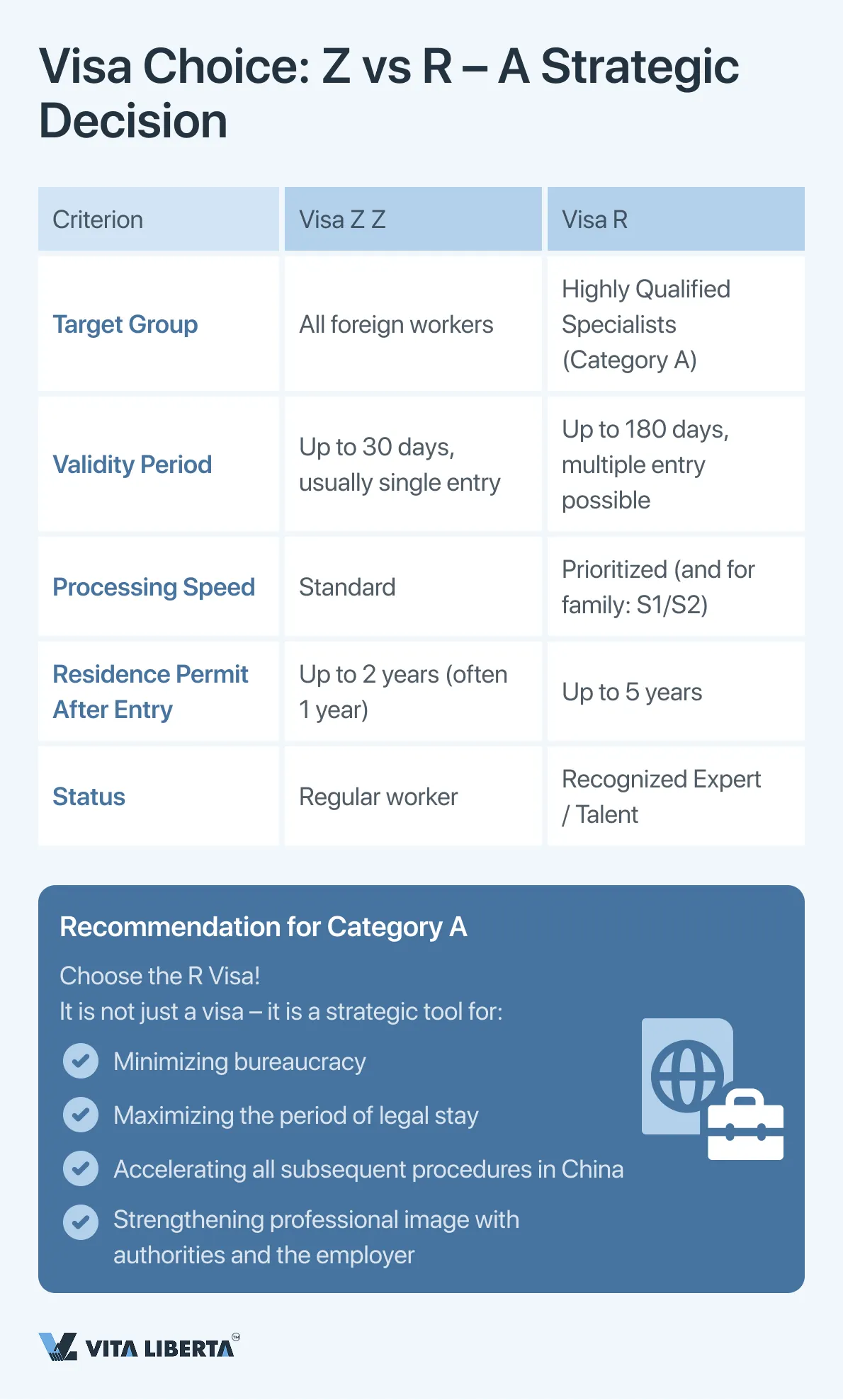
Key Advantages of the R Visa for Further Processing:
- Extended Initial Stay Period: The R visa is often issued for up to 180 days with the right of single, double, or multiple entry. This is significantly longer than the standard Z visa period (usually 30 days) and provides a comfortable time buffer for all administrative procedures upon arrival.
- Priority and Expedited Service: Holders of R visas and their family members (applying for S1/S2 visas) often receive priority when submitting documents and having applications processed, both at consulates and at Public Security Bureau organs in China.
- Simplified Transition to Long-Term Residency: The status confirmed by the R visa is the basis for obtaining a Residence Permit for up to 5 years (the maximum possible), which minimizes the need for annual document renewals.
- Positive Signal for Future Interactions: Possession of an R visa confirms the officially recognized high status of the specialist, which can simplify further visa procedures, interactions with banks, government, and other institutions.
After receiving the Work Permit Notification, it is strongly recommended for a Category A foreign specialist to initiate the application specifically for the Category R work visa at the Chinese consular institution, providing all necessary documents. This is a strategically correct step that provides significant procedural advantages at the next stage – obtaining the residence permit in China after entering the country.
Step 5: Entry into China and Receiving the Plastic “Foreigner’s Work Permit” Card
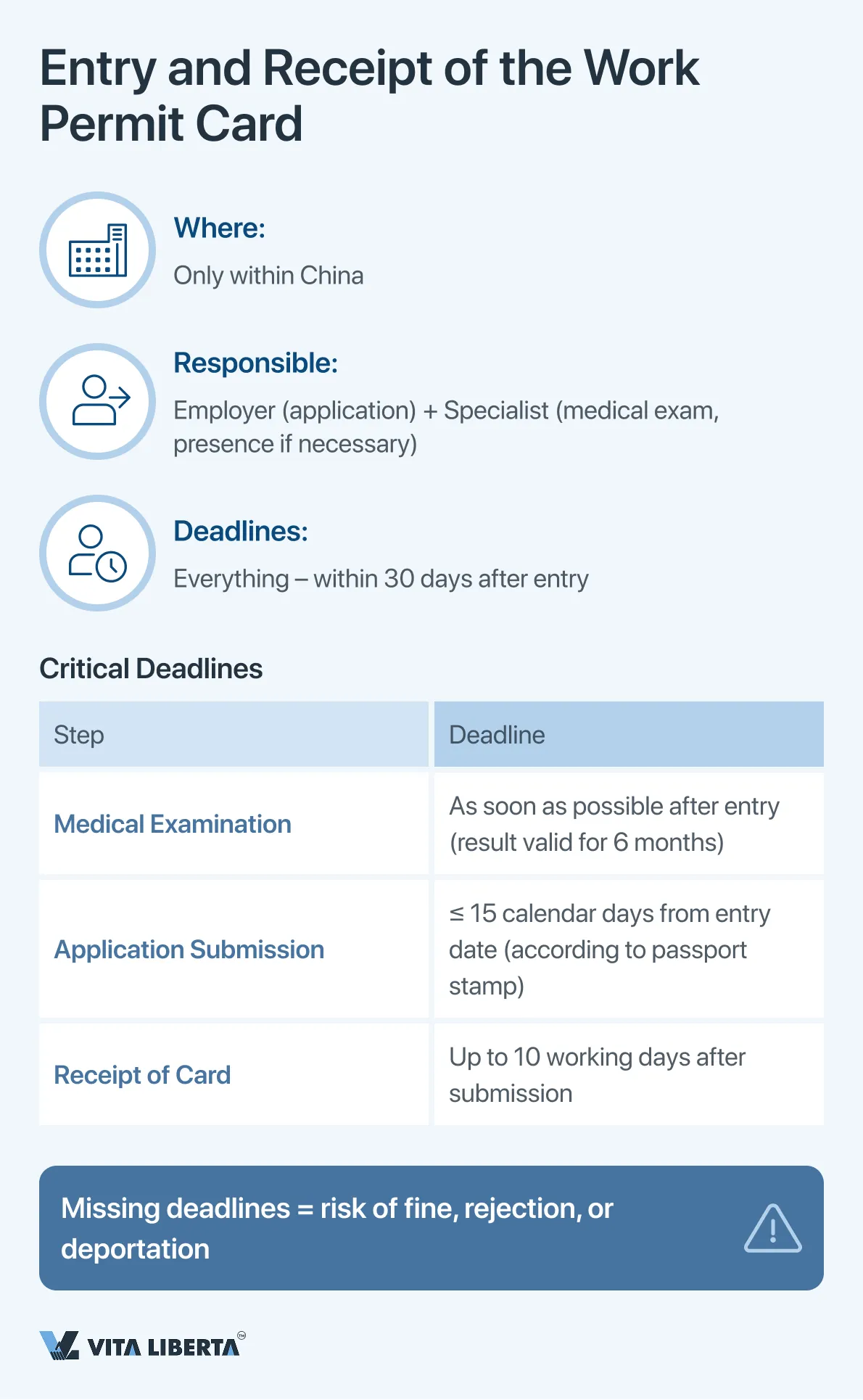
This stage is the final one and is implemented exclusively within China. Upon arrival with a valid visa (Z or R), the foreign specialist and their employer must, within strictly established deadlines, complete the procedure for legalizing work activity by obtaining the personal plastic “Foreigner’s Work Permit Card”. This document is the primary proof of the right to work and legal stay related to employment.
Step-by-step procedure after entry into China:
1. Undergoing a Medical Examination (Top Priority)
Within the shortest possible time after arrival, the foreigner must undergo a full medical examination at a medical institution accredited by Chinese health authorities for visa and permit purposes (usually specialized departments in large international hospitals or clinics). The result is the official “Foreigner Physical Examination Report”, typically valid for 6 months. Without this document, applying for the card is impossible.
2. Submission of the Card Application by the Employer (Within the Legally Established Deadline)
Within 15 calendar days from the foreigner’s entry date indicated in the border crossing stamp, the employer is obligated to submit a complete set of documents to the National Service System for Foreign Experts (Foreign Expert Service System or another approved platform).
The responsibility for submission lies entirely with the employer.
The purpose of the submission is to obtain a decision on issuing the physical card based on the already approved Notification and the newly provided originals.
3. Preparation and Submission of the Final Document Package
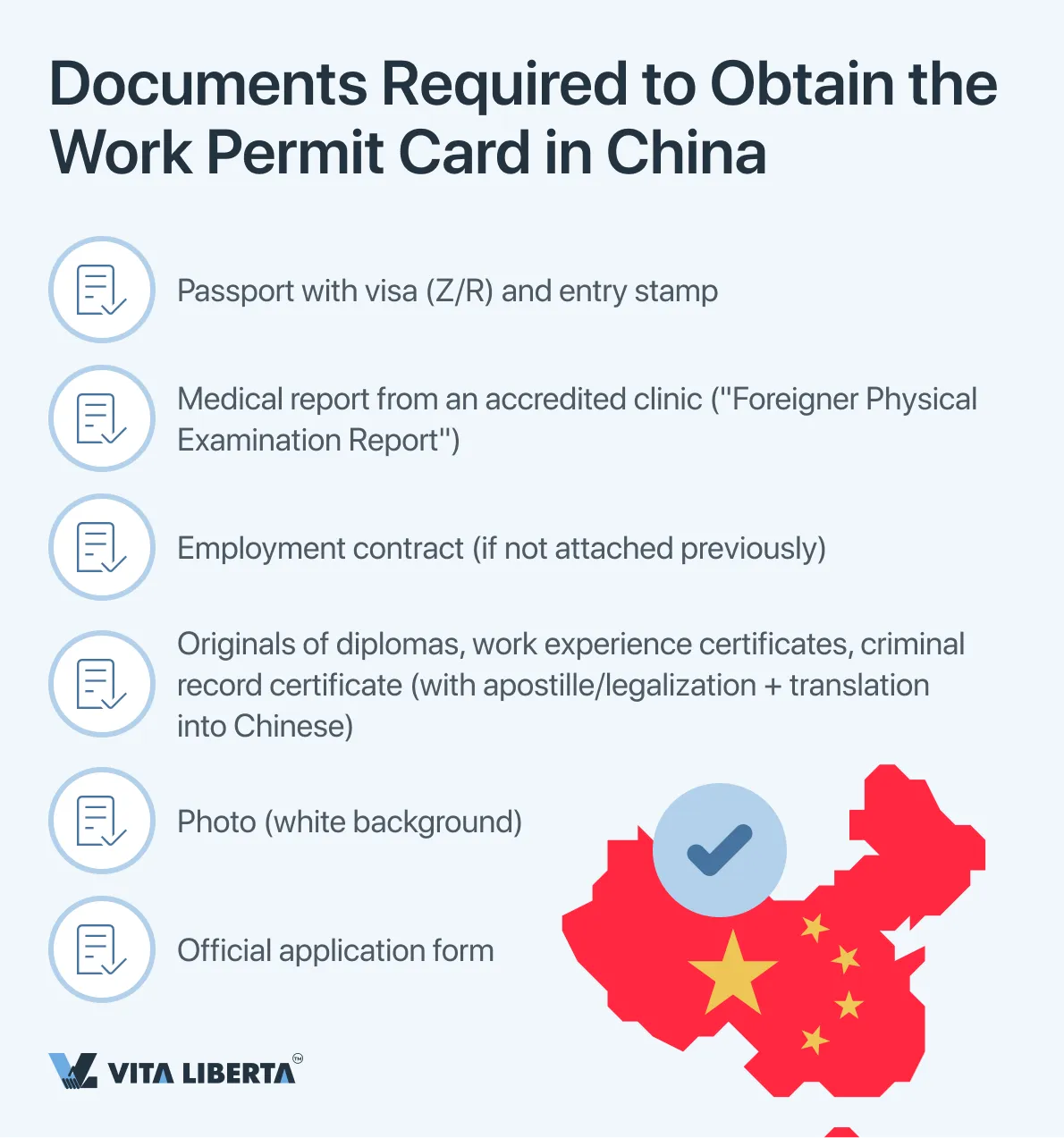
For submission to the authorized local bureau for foreign experts affairs (often at a local branch of the Ministry of Science and Technology or the Ministry of Human Resources and Social Security), a package is prepared, including:
- Original and copy of the passport with the valid visa (Z/R) and the stamp of the last entry into China.
- Original and copy of the medical examination report obtained from an accredited Chinese hospital.
- Original and copy of the employment contract signed by both parties (if not provided at the Notification stage).
The originals of all documents for which legalized or apostilled certified translations were used during the initial application (e.g., criminal record certificate with notarized Chinese translation, education certificates, work experience certificates). Presenting the originals is mandatory for the final verification.
- A photograph meeting the required specifications (usually white background).
- The completed official application form.
4. Review of the Application and Receipt of the Card
After successful submission of the documents, the authorized body conducts the final verification. The review and decision-making period is usually up to 10 working days from receipt of the complete package.
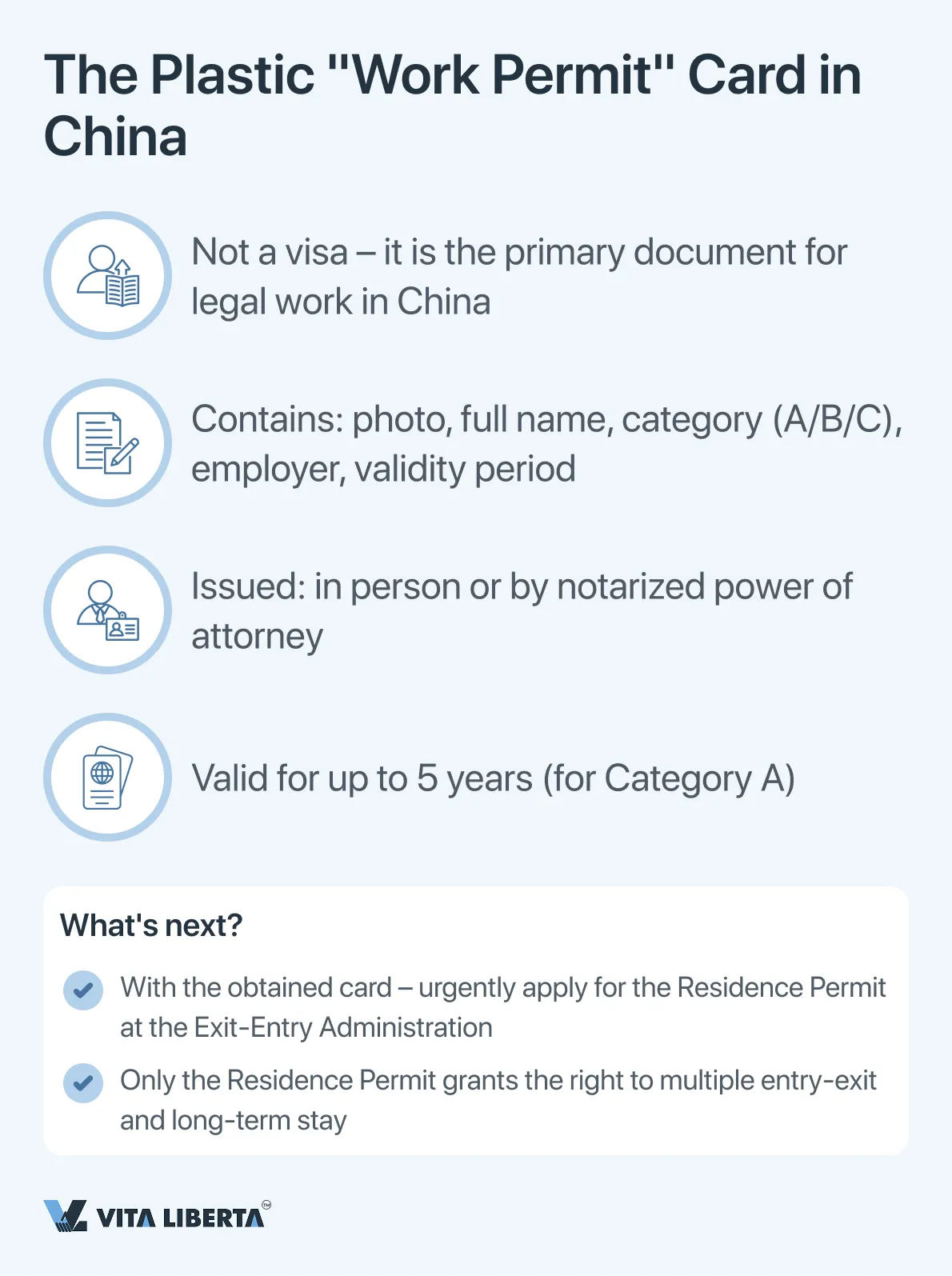
If positive, the personal plastic “Foreigner’s Work Permit Card” is produced. It contains photo, personal data, employer data, category (A, B, C), and validity period.
The card is issued in person to the foreign specialist or their authorized representative (with a notarized power of attorney) at the service window of the authorized body (for specific addresses and working hours, refer to Appendix 15 of the Guide or the official websites of local authorities).
Crucial Significance: From the moment of receiving this card, the foreigner’s status is fully legalized. The card is the primary document confirming the right to work and simultaneously serves as the basis for the next mandatory step – applying for the “Residence Permit” at the Exit-Entry Administration of the local Public Security Bureau (PSB), which secures the right to multiple entry-exit and long-term residence.
Step 6: Applying for a Residence Permit in China for Foreign Workers
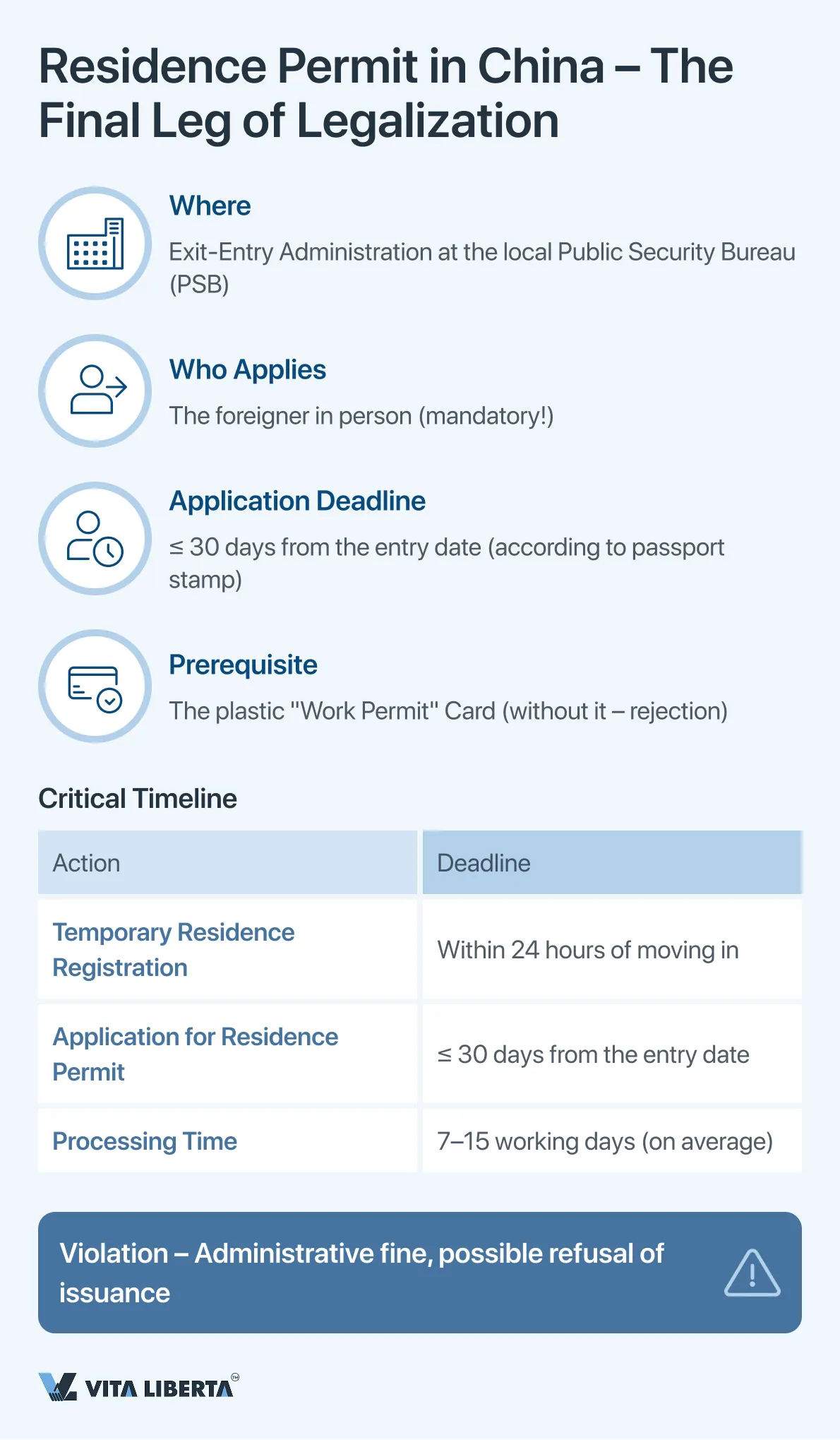
This stage is the concluding administrative procedure that legalizes the long-term stay of a foreign specialist in China based on work activity. After receiving the plastic “Work Permit” card, it is necessary to apply for a Residence Permit within the legally established timeframe. The Residence Permit replaces the initial visa (Z/R) and serves as the primary document for residence and multiple border crossings.
Key Requirement and Deadlines
The application for a Residence Permit must be made within 30 days of the entry date into China indicated in the passport stamp. It is important to note that the basis for the application is the already obtained “Work Permit” (plastic card). Therefore, Steps 5 and 6 must be completed sequentially and promptly after arrival.
Document Submission Procedure
The applicant is obliged to appear in person at the Exit-Entry Administration of the local Public Security Bureau (PSB) serving the area of their actual residence.
- Mandatory Document Package
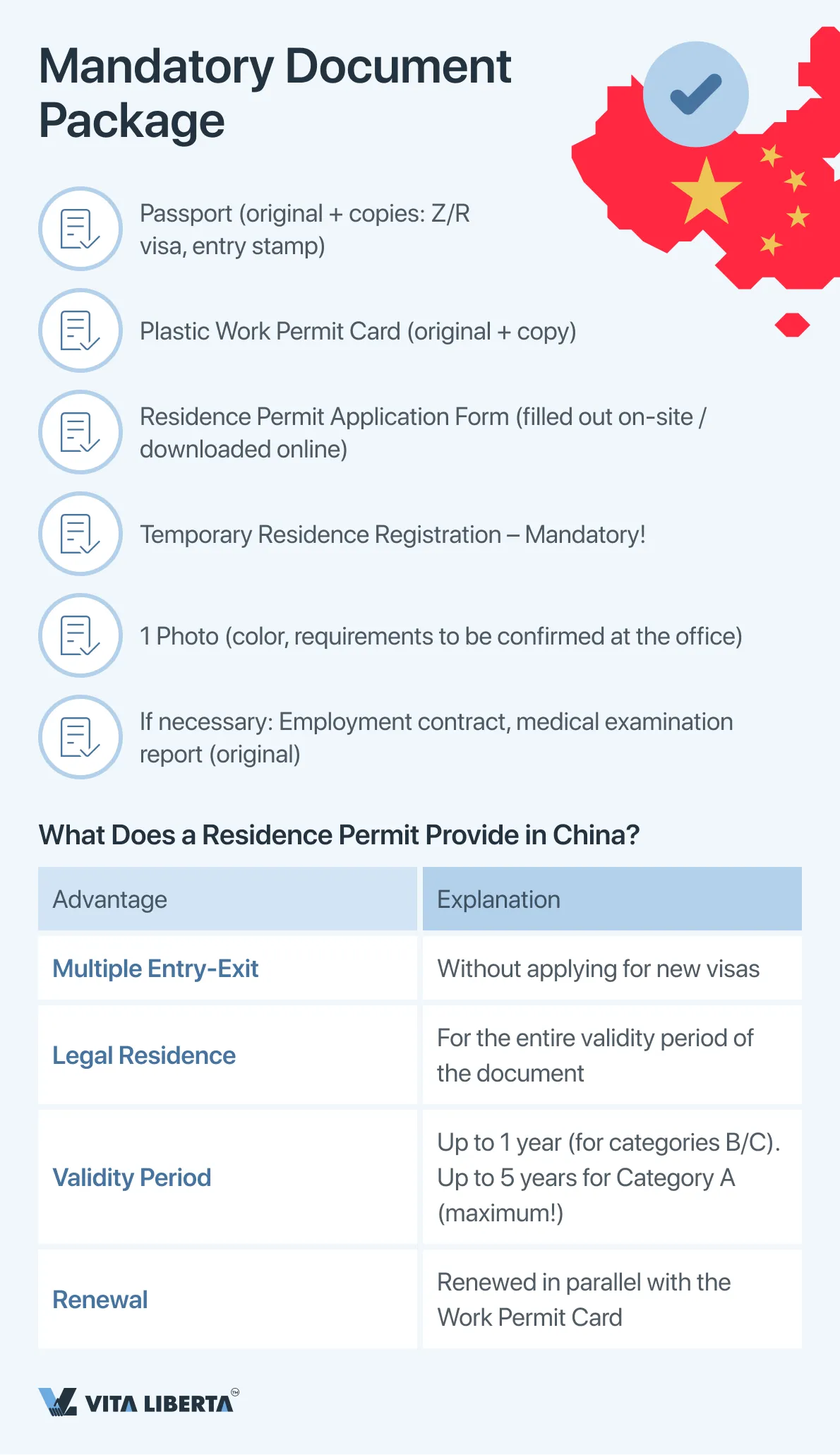
- Original and copy of the passport, as well as the pages with the valid visa (Z/R) and the stamp of the last entry.
- Original and copy of the plastic “Foreigner’s Work Permit Card”.
- Completed and signed Residence Permit application form (provided on-site or can be downloaded in advance from the authority’s official website).
- Document confirming temporary residence registration (Temporary Residence Registration Form). This document (obtained at the local police station or through the landlord) is mandatory and must be obtained within 24 hours of moving in. Without it, submitting the application is impossible.
- One color photograph meeting the required specifications (size and background to be confirmed at the specific office).
- Additional documents upon the inspector’s request (e.g., the original employment contract or medical examination report may be requested).
Result and Benefits
After processing the application (timelines vary, typically 7 to 15 working days), a residence permit sticker page is affixed to the applicant’s passport. This document provides the following key advantages:
- The right to multiple entry and exit from China without the need to apply for a new visa each time.
- The right to continuous residence within China for its entire validity period.
The validity period of the Residence Permit is directly tied to the validity of the “Work Permit”. For most categories, it is issued for 1 year with annual renewal. For highly qualified specialists of Category A, the maximum validity can be up to 5 years, which significantly reduces the administrative burden.
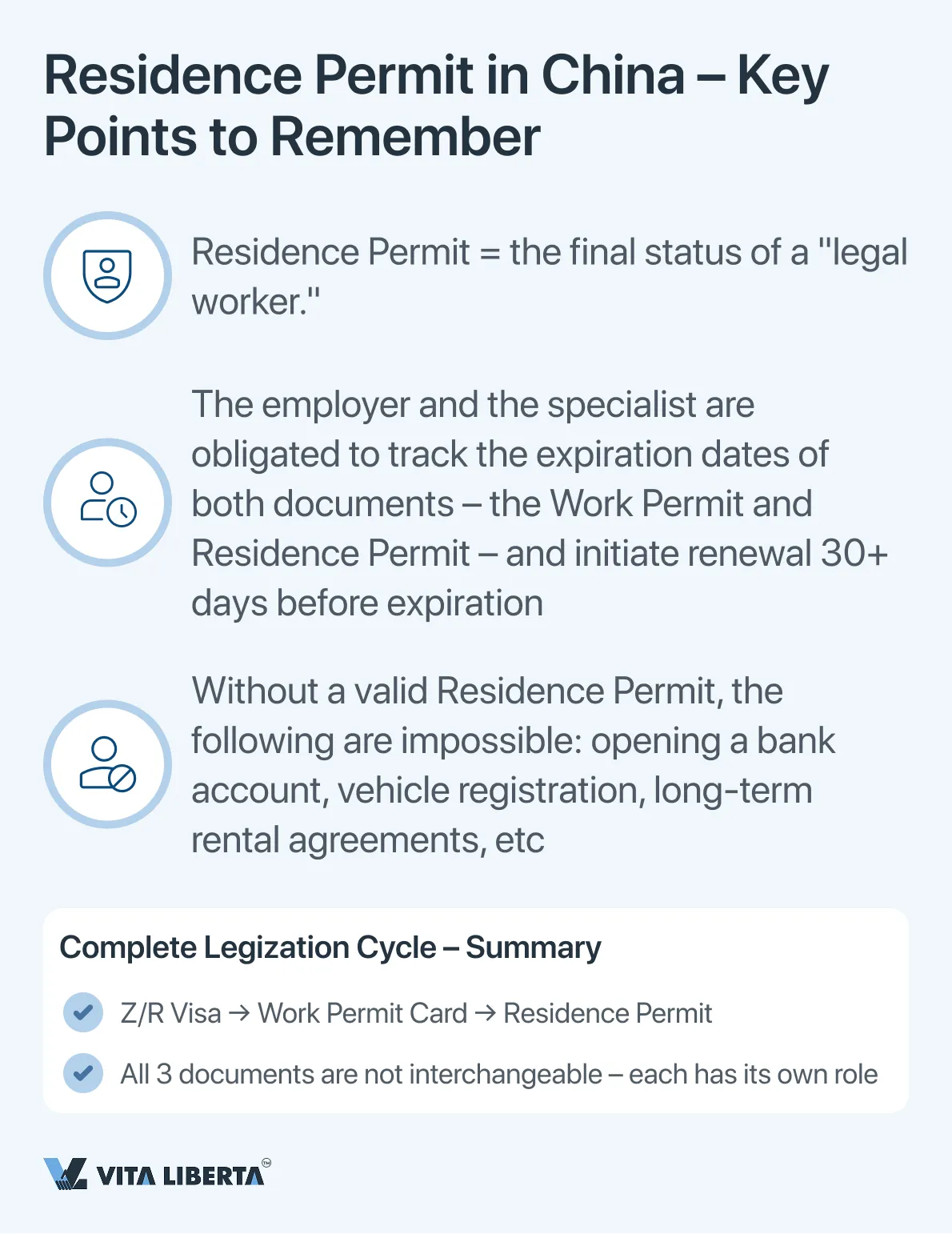
Important Note: The Residence Permit is the final link in the legalization chain. Its possession definitively confirms that the foreign worker’s status complies with all requirements of Chinese legislation. Subsequently, it is only necessary to timely renew both documents – the “Work Permit” and the Residence Permit – until the end of the employment contract.
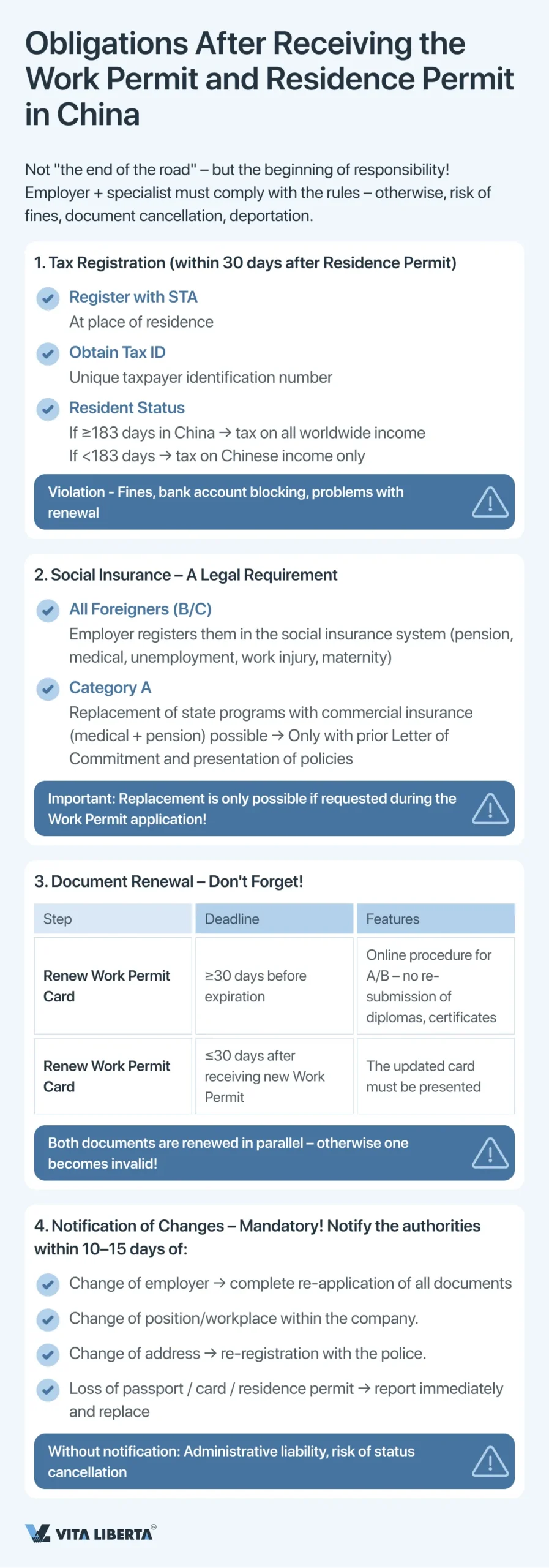
Step 7: Subsequent Legal and Administrative Obligations After Receiving the Residence Permit and Work Permit
After the successful completion of the main legalization stages and obtaining the plastic “Work Permit” card and “Residence Permit” in the passport, a number of permanent obligations are imposed on the foreign specialist and their employer. Compliance with these is critically important for maintaining legal status and unimpeded activity in China.
1. Tax Registration and Residency Status
Within 30 days of receiving the Residence Permit, the foreign worker is obligated to register as a taxpayer with the State Taxation Administration (STA) at their place of residence.
The specialist is assigned a Taxpayer Identification Number (TIN) for non-residents, which is used for income declaration and tax payment.
Important to note: According to the Tax Code of China, a foreigner acquires tax resident status if they spend 183 or more days on Chinese territory within one calendar year. In this case, they have an obligation to declare and pay taxes on all their worldwide income. Tax non-residents are only subject to taxation on income received from Chinese sources.
2. Mandatory Social Insurance
The employer is legally obligated to register the foreign employee in the national social insurance system (pension, medical, unemployment, work injury, maternity) and pay the established contributions monthly (a portion of which is also withheld from the employee’s salary).
Special feature for Category A: For highly qualified foreign specialists classified as Category A, based on mutual intergovernmental agreements or internal regulations, participation in the state pension and medical programs may be replaced by having comprehensive commercial medical and pension insurance of international standard. This replacement is carried out strictly based on a prior Letter of Commitment, submitted by the employer during the “Work Permit” application stage, and must be confirmed by the corresponding insurance policies.
3. Document Renewal
The renewal procedure must be initiated by the employer no later than 30 calendar days before the expiration of the current “Work Permit.”
Simplified procedure: Unlike the initial application, the renewal process for specialists of Categories A and B is typically significantly simpler. It is often conducted entirely online via the service platform and does not require re-submission of the full set of documents (e.g., legalized diplomas or certificates). Updated information regarding the employment contract and data on tax and contribution payments are required.
Within 30 days of obtaining the new “Work Permit,” the Residence Permit must also be renewed at the PSB office by presenting the updated card.
4. Obligation to Notify of Changes
The foreign specialist and employer are obligated to immediately notify the relevant authorities (foreign experts bureau and PSB) of the following changes:
- Change of workplace or employer (requires complete re-application of all documents).
- Change of position or workplace within the same company.
- Change of residential address (with subsequent re-registration at the police).
- Loss or theft of passport, residence permit, or work permit.
To ensure full compliance with the rapidly changing Chinese legislation in the fields of migration, labor, and tax law, it is strongly recommended for both the employer and the foreign employee to maintain regular contact with specialized lawyers or consultants.
Conclusion
The process of obtaining permits for a foreign investor who combines the functions of founder (shareholder) and sole executive body (e.g., General Director) in China is a complex but fully achievable administrative procedure. Its success is based on three key principles:
Correct Determination of Legal Status. It is critically important to legally distinguish and documentarily confirm the two statuses of the individual: as a foreign investor (in relation to the company) and as a hired manager (in relation to the work position). This separation is the foundation for all subsequent actions.
Impeccable Documentation. Special attention must be paid to preparing a well-reasoned justification for classification into the highest qualification category A, as well as drafting an employment contract that fully reflects management functions and complies with the requirements of both Chinese labor and investment legislation.
Strict Adherence to Regulations. Each stage of the procedure – from company licensing to obtaining a residence permit – has legally established deadlines. Violating them can lead to rejections, fines, and complications for further stay.
Chinese regions, including Zhejiang Province, demonstrate an interest in attracting responsible foreign investors and competent managers. This policy finds practical expression in the existence of detailed public guidelines and special simplified administrative procedures available to highly qualified specialists and entrepreneurs of Category A. Thus, the consistent and professional use of legally provided mechanisms allows the foreign investor-manager not only to successfully launch and develop a business in China but also to legalize their stay and work activity in the most effective and long-term manner.
China Residence Permit Through Business Setup
- Company registration tailored for visa eligibility
- Full compliance with immigration regulations
- Ongoing support for status renewal
5 Key Questions and Answers About Obtaining a Visa and Residence Permit for Foreign Investors in China
Chinese legislation clearly separates the roles of owner (investor) and employee (hired worker). As an investor, you have the right to own shares and receive dividends, but you do not have the right to engage in work activity (operational management, signing contracts, receiving a salary) without the corresponding permit documents. To work in your own company, you are obliged to register yourself as an employee – obtain a work permit (Work Permit) and a work-type residence permit (Work-type Residence Permit). Working without these documents is illegal and leads to fines, deportation, and being placed on a “blacklist.”
For a founder-director, Category A (highly qualified specialist/talent) is optimal and desirable. It provides key advantages: no strict age or education restrictions, accelerated and simplified application processing, permit validity up to 5 years, and the possibility of obtaining a long-term residence permit and benefits for the family.
To qualify as Category A, you need to provide evidence that you are not just an investor but a strategic manager or bearer of unique technologies. This is confirmed by a set of documents: a business plan emphasizing benefits for the local economy, evidence of investment, proof of management experience, patents or unique certificates.
The process consists of sequential steps that cannot be bypassed or rearranged:
- Company registration with your appointment as director in the articles of association.
- Registration of the company as an employer in the system for managing foreign labor.
- Application and receipt of the “Work Permit Notification” (Work Permit Notice) through the local Bureau of Foreign Experts Affairs.
- Application for a work visa (Z or preferably R) at a Chinese consulate abroad based on the obtained Notification.
- Entry into China, medical examination, and receipt of the plastic “Work Permit Card”.
- Application for a residence permit (Residence Permit) at the local public security bureau (PSB) within 30 days of entry.
Only after completing all 6 steps is your status fully legal.
These are three different but interconnected documents:
- Visa (R or Z): This is the entry pass. Issued by a consulate abroad. The R visa is for highly qualified specialists (Category A) – it offers a longer validity and priority processing.
- Work Permit (Work Permit Card): This is the right to engage in work activity. Issued in China after entry. A physical plastic card confirming your worker status.
- Residence Permit (Residence Permit): This is the right to reside and enter/exit multiple times. Affixed in the passport in China. This document is what makes you a resident.
- Important: Without a work permit, you will not be given a residence permit, and without an R/Z visa, you cannot enter the country to apply for them.
It is critically important to avoid the following mistakes:
- Attempting to work on a business (M) or tourist (L) visa. This is illegal. The purpose of the visa must strictly correspond to the activity.
- Incorrect drafting of an employment contract with oneself. The contract between you (the company) and you (the employee) must be legally flawless, with clear duties and a salary not lower than the regional norm.
- Missing deadlines. Missing deadlines (e.g., 30 days to apply for a residence permit after entry) leads to fines and complications.
- Insufficient justification for Category A. A formal application without a convincing document package (business plan, investment evidence, experience) can lead to rejection or assignment to the less privileged Category B.
- Ignoring subsequent obligations: After receiving the documents, you must register with the tax authorities, apply for renewals before expiration, and timely report changes (address, position) to the authorities.