Hongkong
 China
China


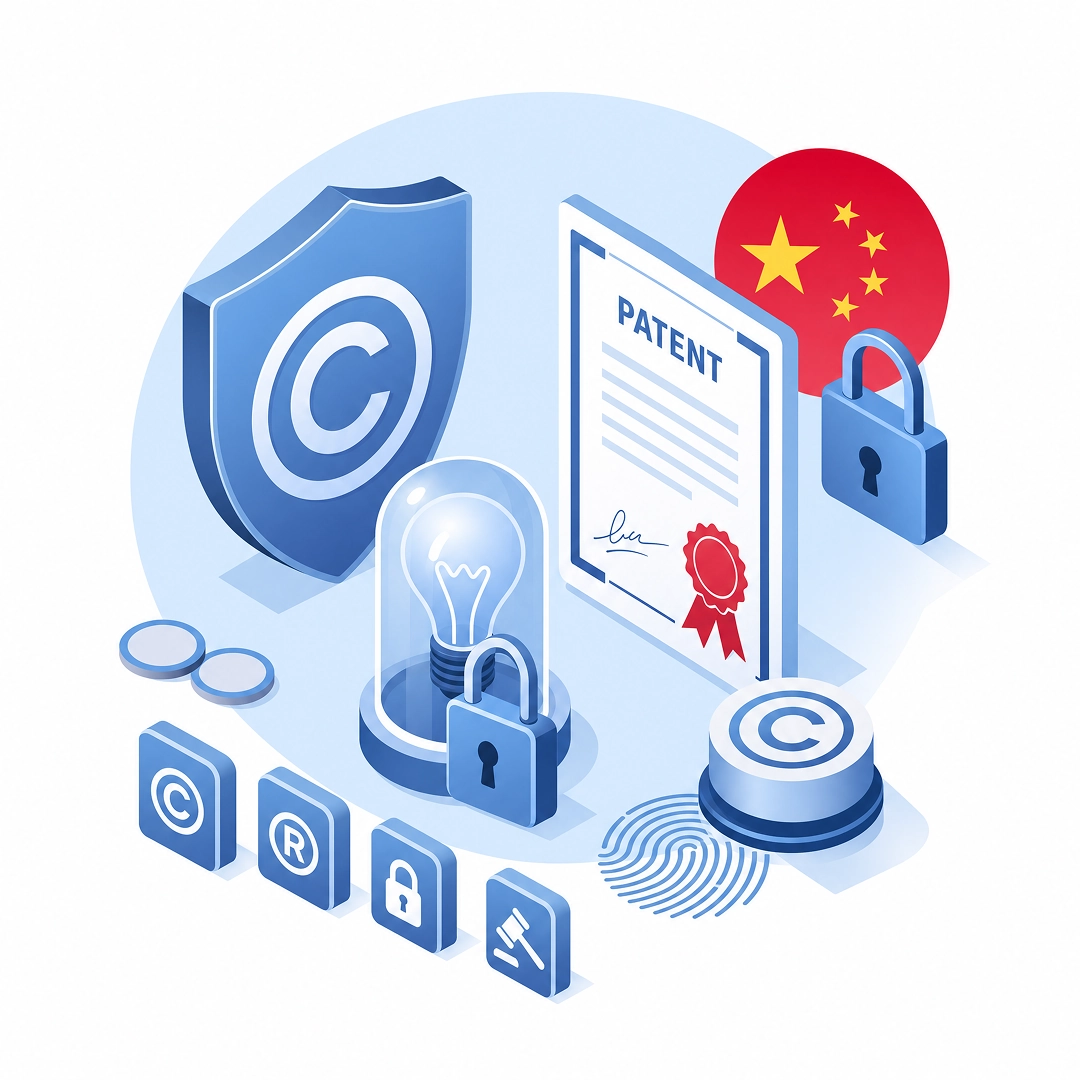


Entering the Chinese market with unregistered rights is like shipping a container with no seal — the contents can be claimed before you close your first deal. In China, securing your rights is the opening move, not a formality at the finish line.
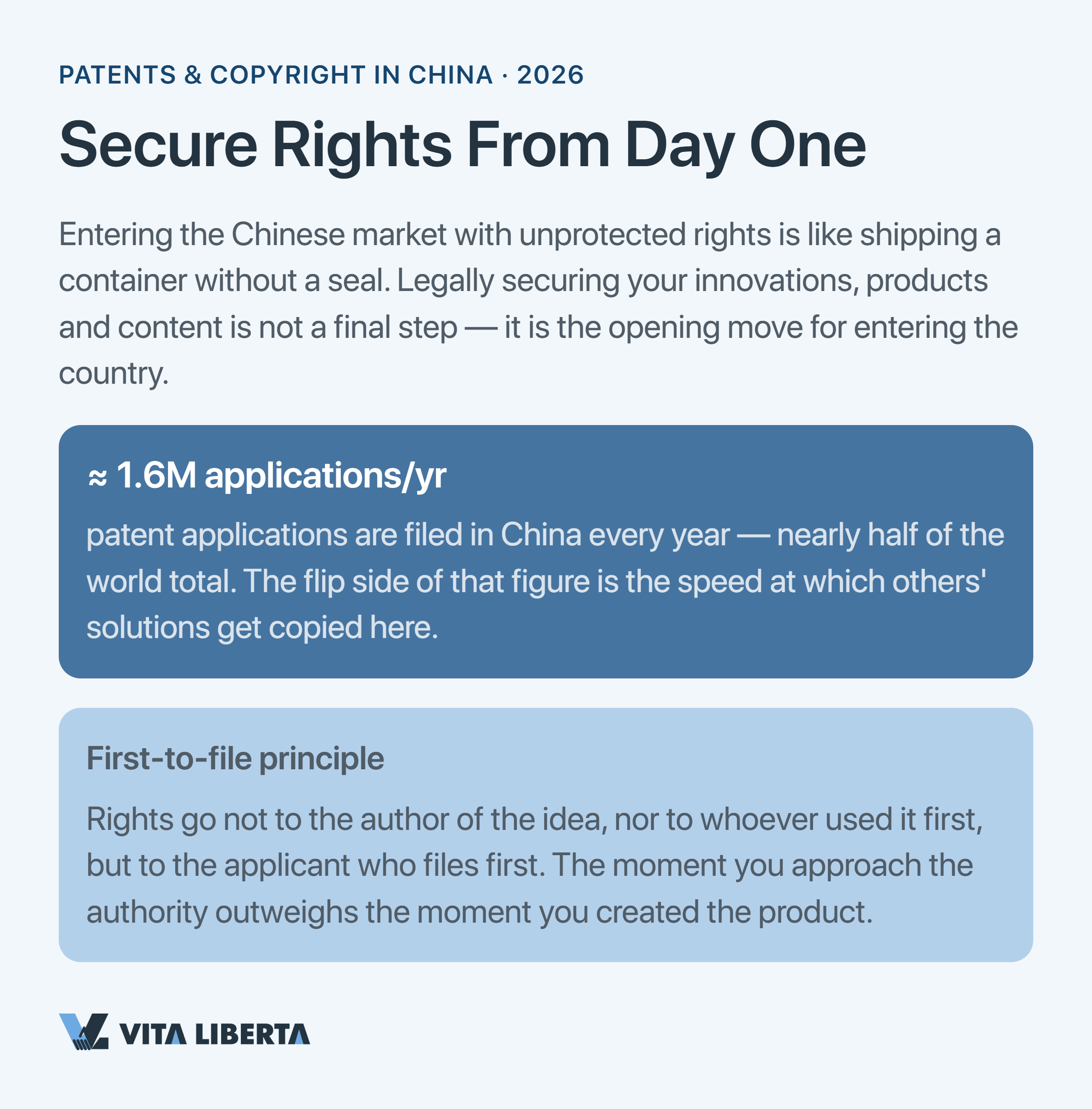
China accounts for roughly half of all patent applications filed on the planet — on the order of 1.6 million a year. Behind that figure sits its flip side: the speed at which existing solutions get reproduced here. That is exactly why locking down the legal rights to your technology, products and content belongs at the start of your China entry, not the end.
What a company loses by not securing rights early
China runs on a first-to-file system. The right goes not to whoever had the idea, nor to whoever used it first, but to the applicant who files the paperwork first. The moment you approach the office outweighs the moment you created the product — and any delay works against you.
The same story repeats constantly: a company unveils a product at a trade fair, and a few months later discovers that an unrelated party has already registered its mark. That leaves two options — buy your own brand back, or rebrand entirely.
⚠️ Important: get your applications on file before the product goes on public display or travels to a trade show. Filing afterwards is filing too late.
The legal framework: domestic statutes and treaty obligations
The country sits inside the global IP architecture rather than outside it. Beijing has signed up to the Berne and Paris Conventions, accepted the TRIPS obligations, joined the PCT framework for cross-border patent filing, and holds WTO membership. The practical consequence for you: an applicant based abroad is treated on the same footing as a company headquartered in Shenzhen.
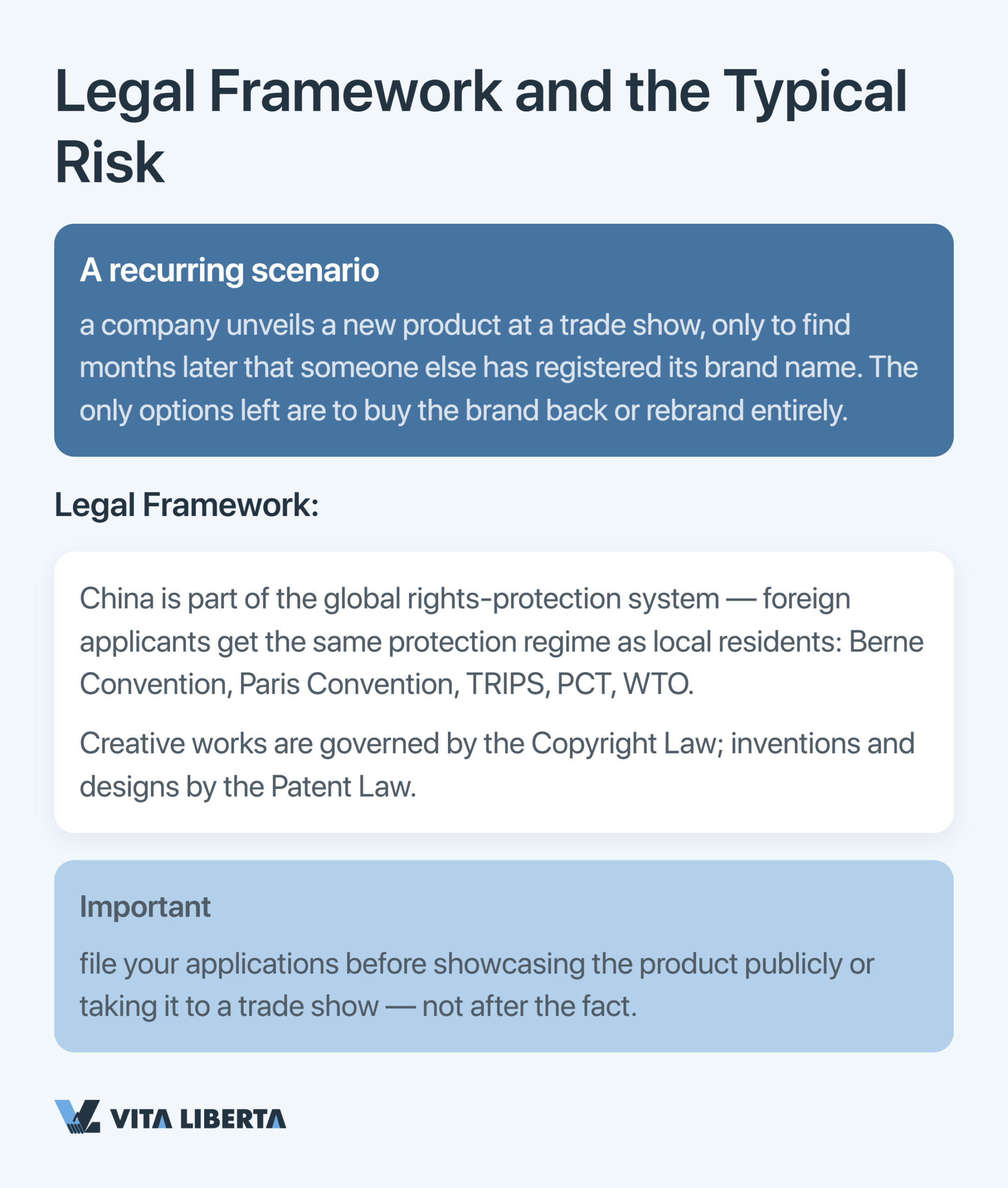
Two domestic statutes carry the load. Creative output falls under the Copyright Law; technical solutions and product appearance fall under the Patent Law. Both have been brought into line with the treaty commitments above, which is the mechanism that lets a rights holder sitting in Madrid or Manchester claim the same remedies a local business would.
Afraid of copycats in China?
- See what you can patent
- Freedom-to-operate check
- The right protection strategy
Patents in China: scope and who does the filing
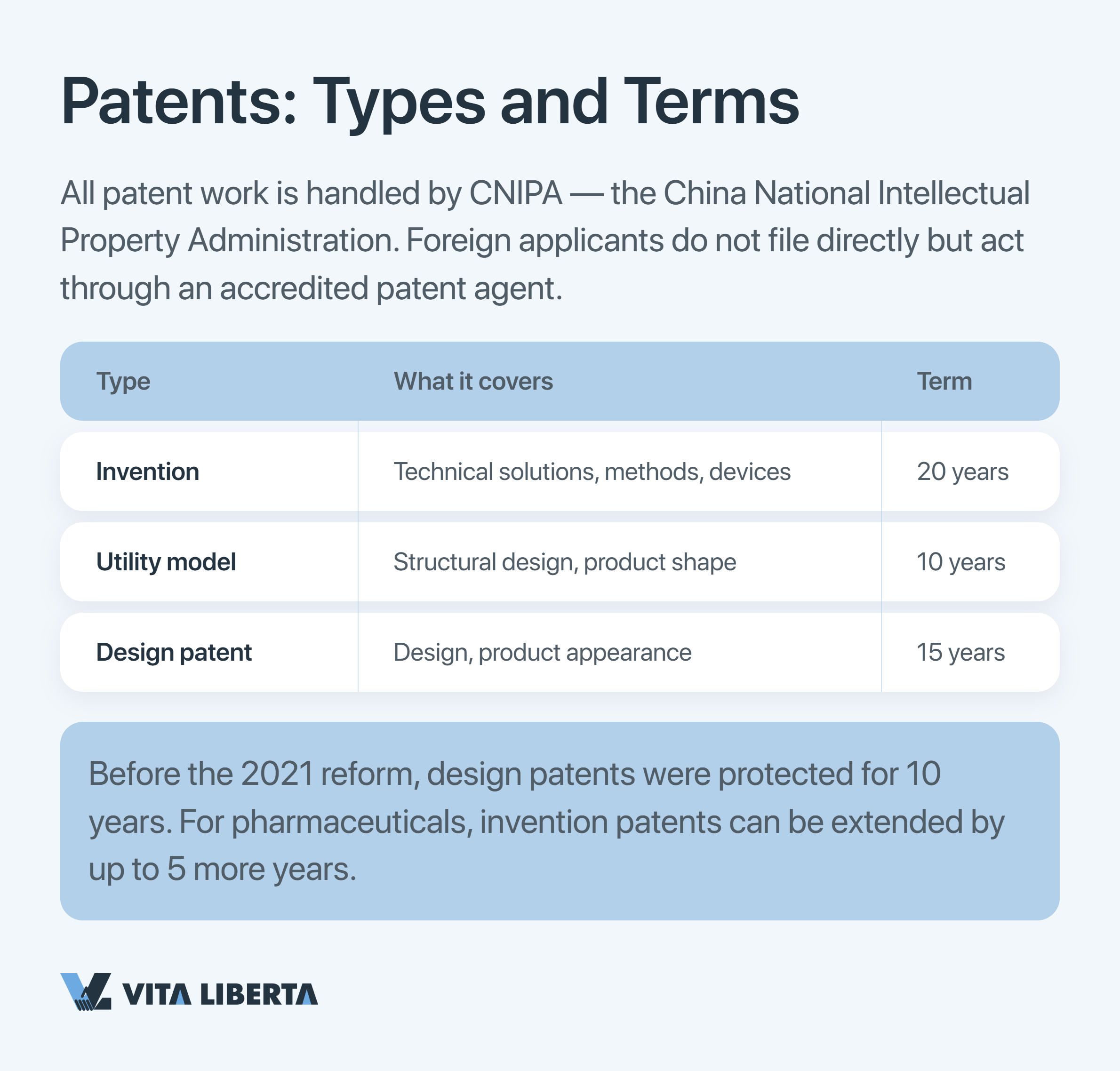
One agency handles the entire patent workflow: CNIPA, the China National Intellectual Property Administration. There is no direct channel for an overseas applicant — a licensed patent agent files and corresponds on your behalf.
| Type | Subject matter covered | Term | What it must satisfy |
| Invention | New technical solutions — processes, devices, methods | 20 years | New, inventively significant, industrially usable |
| Utility model | The shape and structural configuration of a physical product | 10 years | New, and workable in practice |
| Design | Product appearance — form, pattern, styling | 15 years | Original, with genuinely new defining features |
That fifteen-year figure for designs is a recent gain. Until the Patent Law was overhauled in 2021 the term sat at ten. Pharmaceuticals get their own carve-out: an invention covering a drug can pick up as much as five additional years of cover.
Working through the CNIPA process
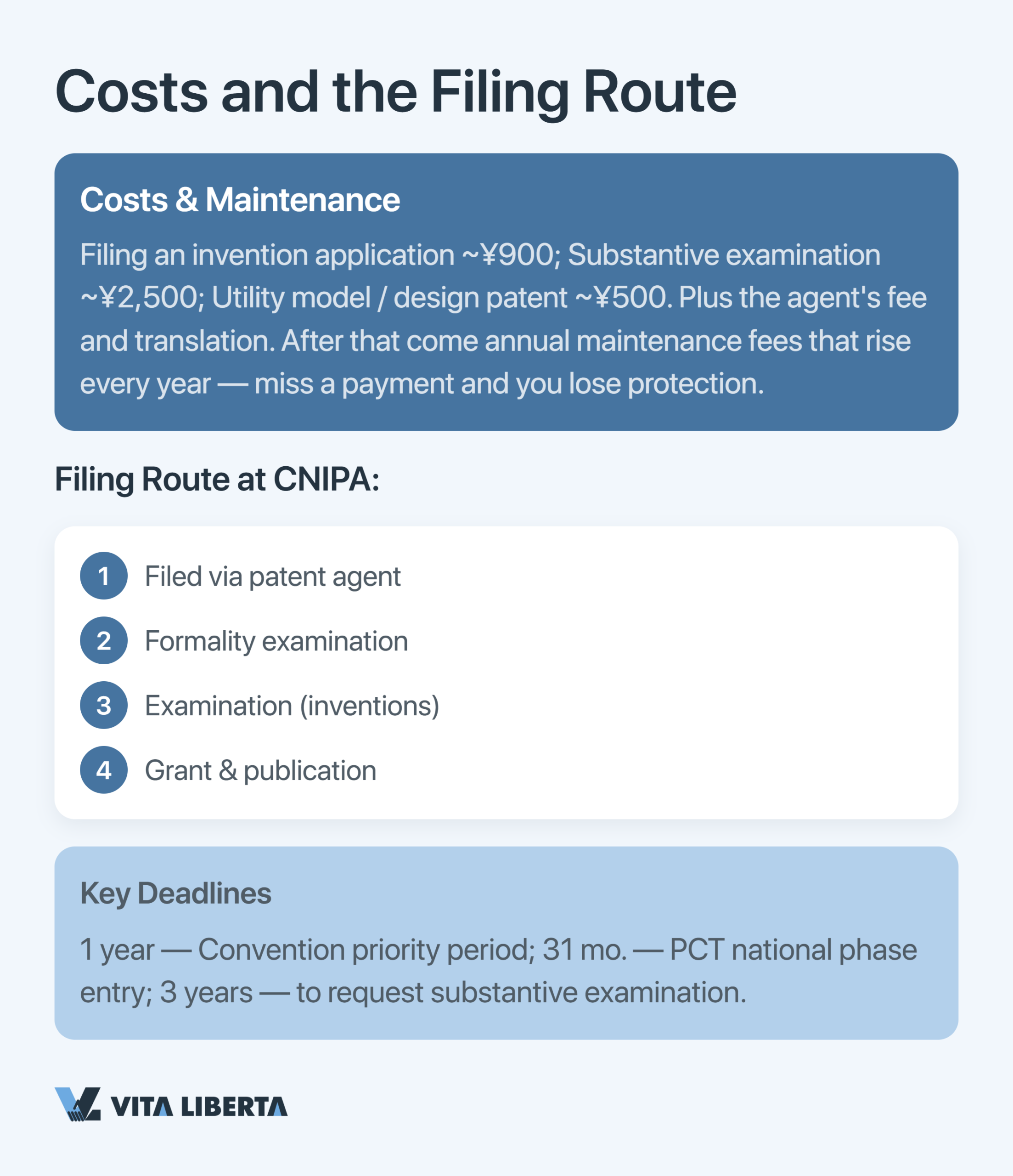
Every exchange with the agency happens in Chinese — there is no English track. Four stages take an application from filing to grant:
- Your agent assembles the documentation and submits it, electronically or on paper.
- A formal check confirms the filing is complete and correctly drafted.
- Substantive examination follows — but only for inventions; utility models and designs skip this entirely.
- The agency rules on the application and publishes the granted patent.
Several timing levers are available. Convention priority gives you twelve months from your earliest foreign filing. Coming in through the PCT route, the window for entering the national phase stretches to 31 months. There is also a grace period on novelty: showing the solution at a state-sanctioned exhibition or academic conference does not count as disclosure for the following six months. Substantive examination, by contrast, tolerates no drift — request it inside three years of filing or the application is treated as abandoned.
Budgeting for a patent, then keeping it alive
Three cost lines make up the total: what CNIPA charges, what your agent charges, and translation. On the official side, expect something in the region of RMB 900 to lodge an invention application, roughly RMB 2,500 when substantive examination is requested, and around RMB 500 for a utility model or a design.
Then come the annuities. They are payable every year and they climb steadily as the patent ages. That escalation is a policy choice, not an accident — rising costs force owners to decide whether a right is actually earning its keep, which keeps abandoned monopolies from clogging the register. Skip a payment and the protection lapses.
Subject matter that will not be granted
Several categories sit permanently outside the patent system in China:
- discoveries in pure science;
- diagnostic procedures and courses of medical treatment;
- plant cultivars and animal breeds;
- rules and schemes for purely mental activity;
- materials produced by transforming atomic nuclei;
- anything that breaks the law or offends public morality.
The logic splits two ways. Some of this is foundational knowledge that no single party should be able to fence off. The rest touches public welfare too directly to be handed to one owner.
Copyright: automatic on creation, but worth documenting
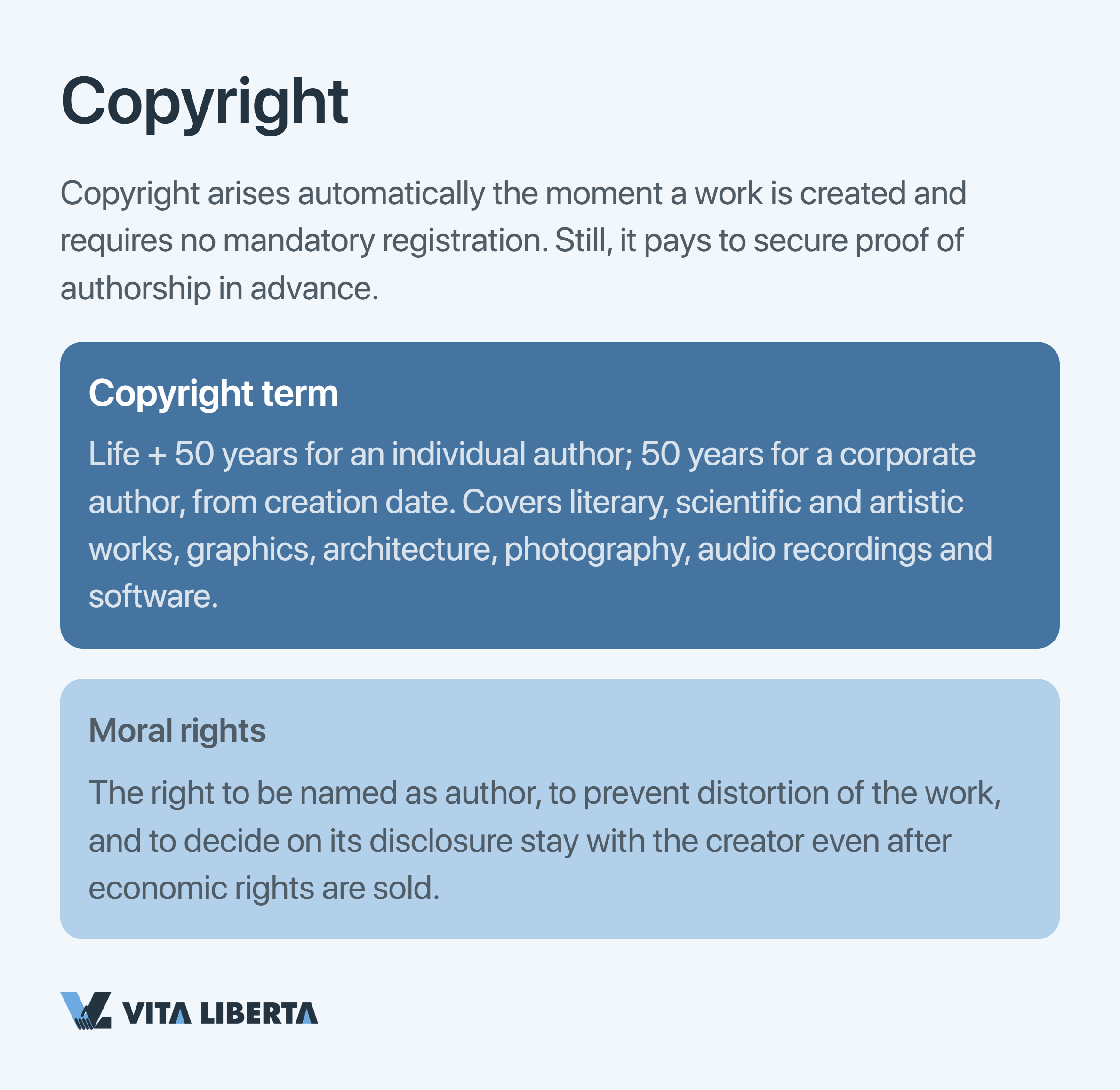
Nothing needs to be filed for copyright to exist. The right attaches the moment a work takes shape, and covers a broad field: writing, scientific and artistic output, graphic works, architectural plans, photography, sound recordings, software. Duration depends on who owns it — an individual author is covered for life plus a further fifty years, while a corporate owner gets fifty years counted from creation.
Whatever happens commercially, moral rights never leave the author. Attribution, the ability to block distortion of the work, and control over whether it goes public all remain personal to the creator, even once the economic rights have been sold on.
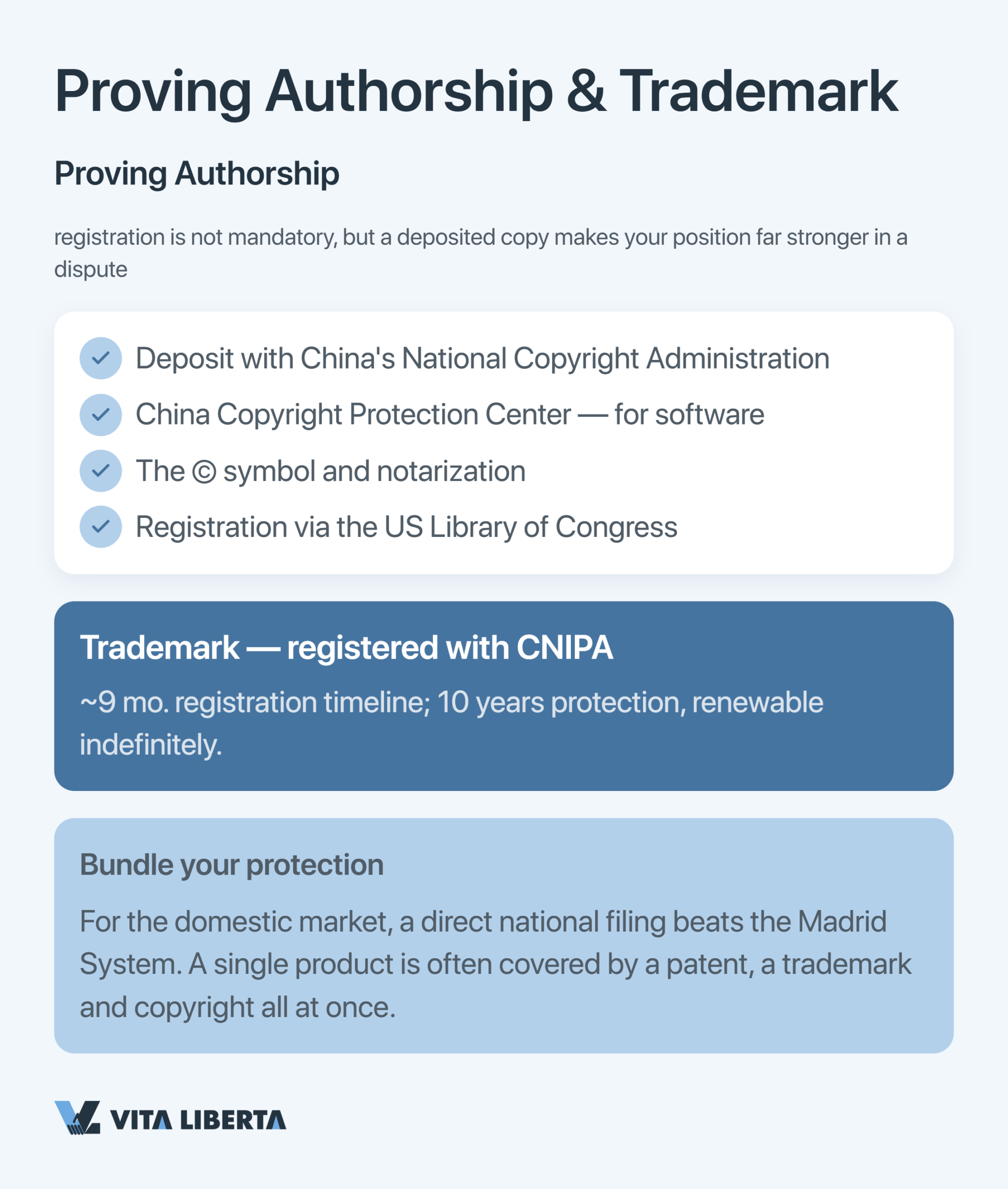
“Nobody forces you to register, and that’s precisely where companies get careless about evidence. The day someone contests authorship, having a copy already deposited with the competent authority changes the shape of the dispute entirely,” says Sergey Konon.
Several routes exist for pinning down authorship. Works can be deposited with the National Copyright Administration of China; software goes to the China Copyright Protection Center. Beyond that: marking material with the © symbol, having it notarised, or filing voluntarily with the US Library of Congress.
Where the trademark fits
Names, logos and brand graphics get locked down through trademark registration at CNIPA. Reckon on around nine months to completion. What you end up with runs for a decade and renews indefinitely, as often as you care to file.
For speed and durability inside the domestic Chinese market specifically, filing nationally outperforms coming in via the Madrid System. Worth adding: treating patents, trademarks and copyright as three separate exercises is a mistake. They overlap by design, and a single product frequently sits under two or three of them at once.
Hong Kong and Macau: separate systems
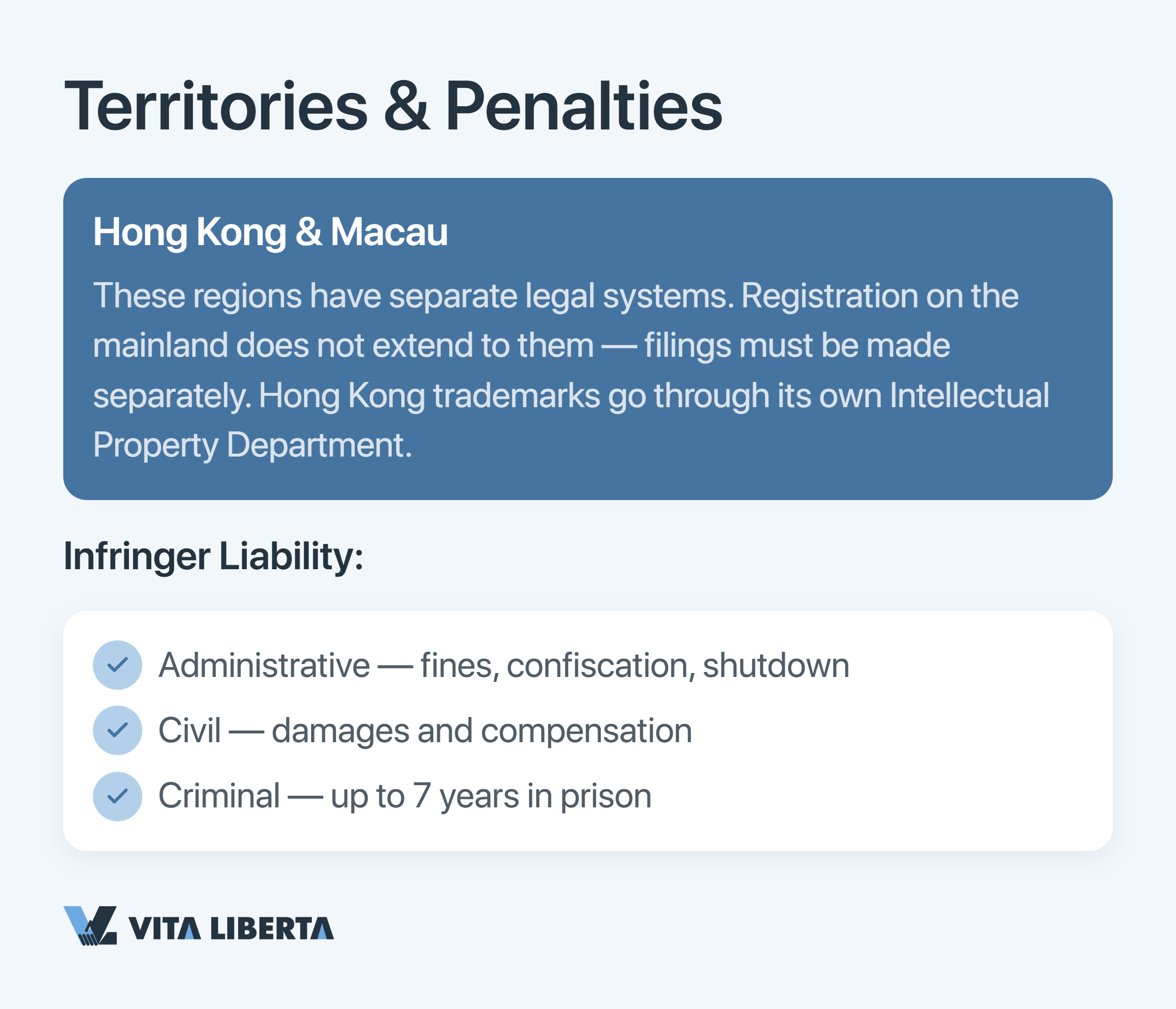
Both territories legislate their own IP regimes. A mainland registration simply does not travel across those borders — each requires its own filing. Hong Kong trademarks go through the SAR’s own Intellectual Property Department.
📌 Remember: mainland cover and Hong Kong or Macau cover are three different things, not one. Budget and file for each territory separately.
Enforcement: penalties and the tools available to you
Infringement is pursued along three tracks. Administratively, that means fines, seizure of counterfeit stock, and orders halting the infringer’s operations. Civil claims run in parallel. Where conduct is serious enough, criminal exposure reaches seven years behind bars.
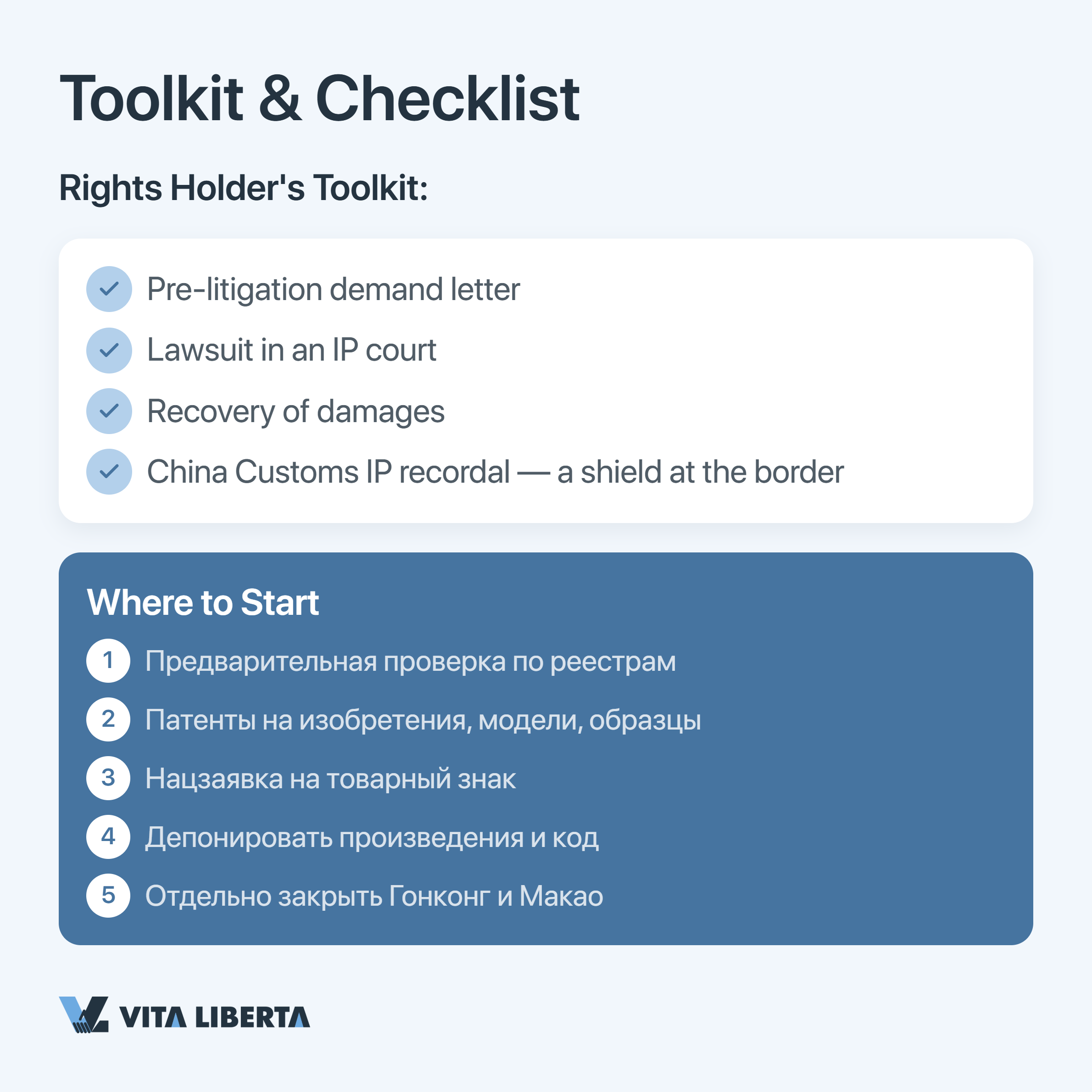
A rights holder has real options. Start with a cease-and-desist before litigating; take the matter to one of the specialised IP courts; claim proven losses or statutory damages; force the fakes off the market. Prevention deserves equal attention — recording your rights with Chinese customs stops counterfeit consignments at the border, whether they are heading in or heading out.
Where to start
Registration is what gets you into the market — it is not the paperwork you do on the way out. A workable minimum:
- have your agent run clearance searches across the registers;
- file for inventions, utility models and designs as applicable;
- put in a national trademark application;
- deposit works and source code where evidence matters;
- treat Hong Kong and Macau as separate filings.
Applications lodged early and drafted cleanly do two things at once: they cut your refusal risk, and they make you a much harder target to copy.
Want to protect your patent in China?
- Patent registration via CNIPA
- Copyright protection
- Action against infringers
FAQ
It isn’t — protection attaches automatically as soon as the work exists. That said, depositing it with the National Copyright Administration of China, or the China Copyright Protection Center for software, gives you documentary proof if ownership is ever challenged.
Only with an establishment in the country. Otherwise everything goes through a licensed Chinese patent agent, in Chinese.
Two decades, counted from the filing date, with no option to renew. Drug patents are the one exception, where up to five extra years may be available.
It does not. Hong Kong legislates separately, so the mark has to be filed again with the SAR’s Intellectual Property Department.
Administrative fines, seizure of counterfeit goods, and civil claims for losses or statutory damages. Serious cases carry prison terms of up to seven years.