Hongkong
 China




Many buyers reason like this: 1688 is cheaper than Alibaba, so buy there. The flaw is in what gets compared. You look at the price on the product card, not at the landed cost of the shipment once it reaches your warehouse.
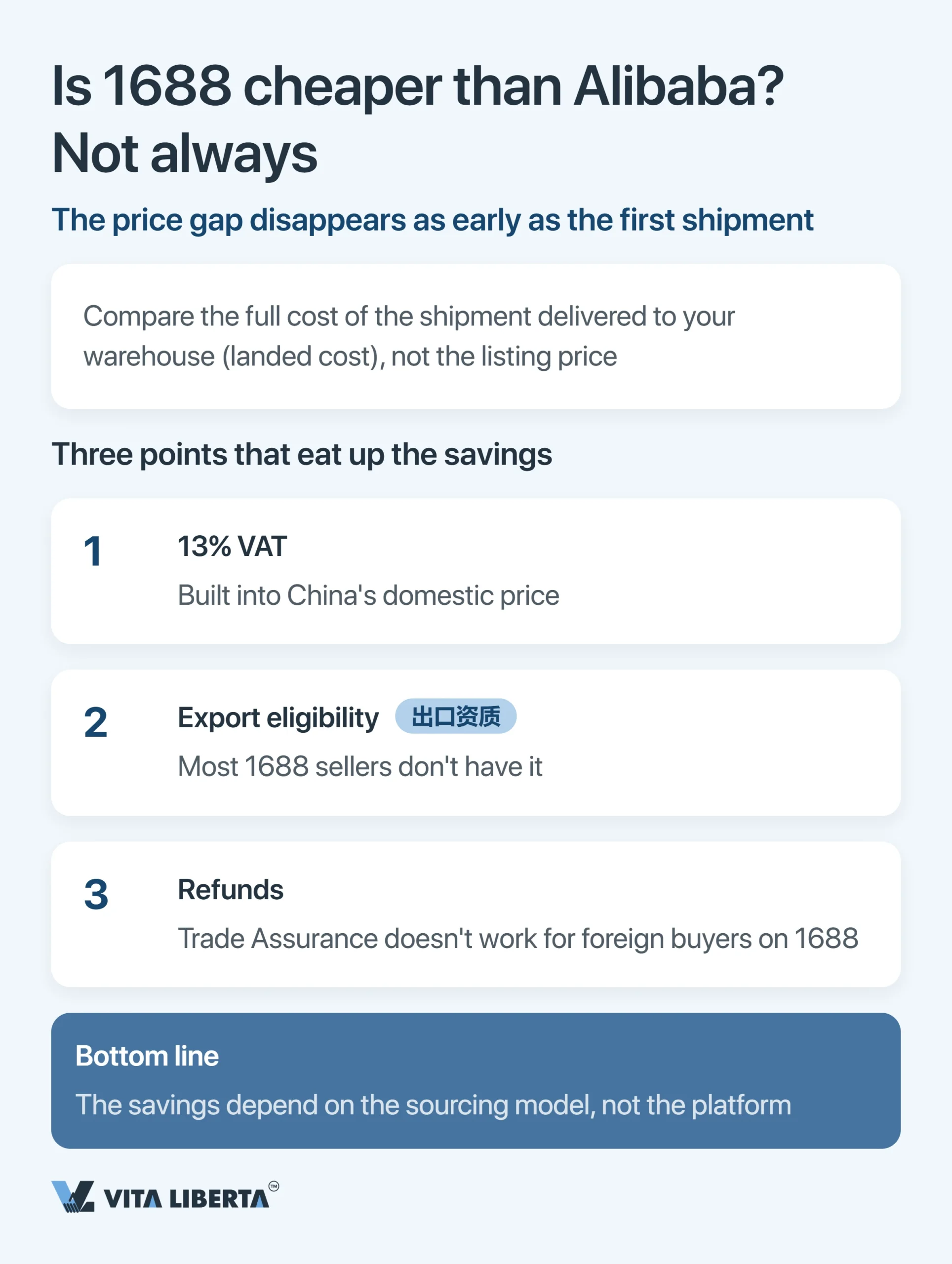
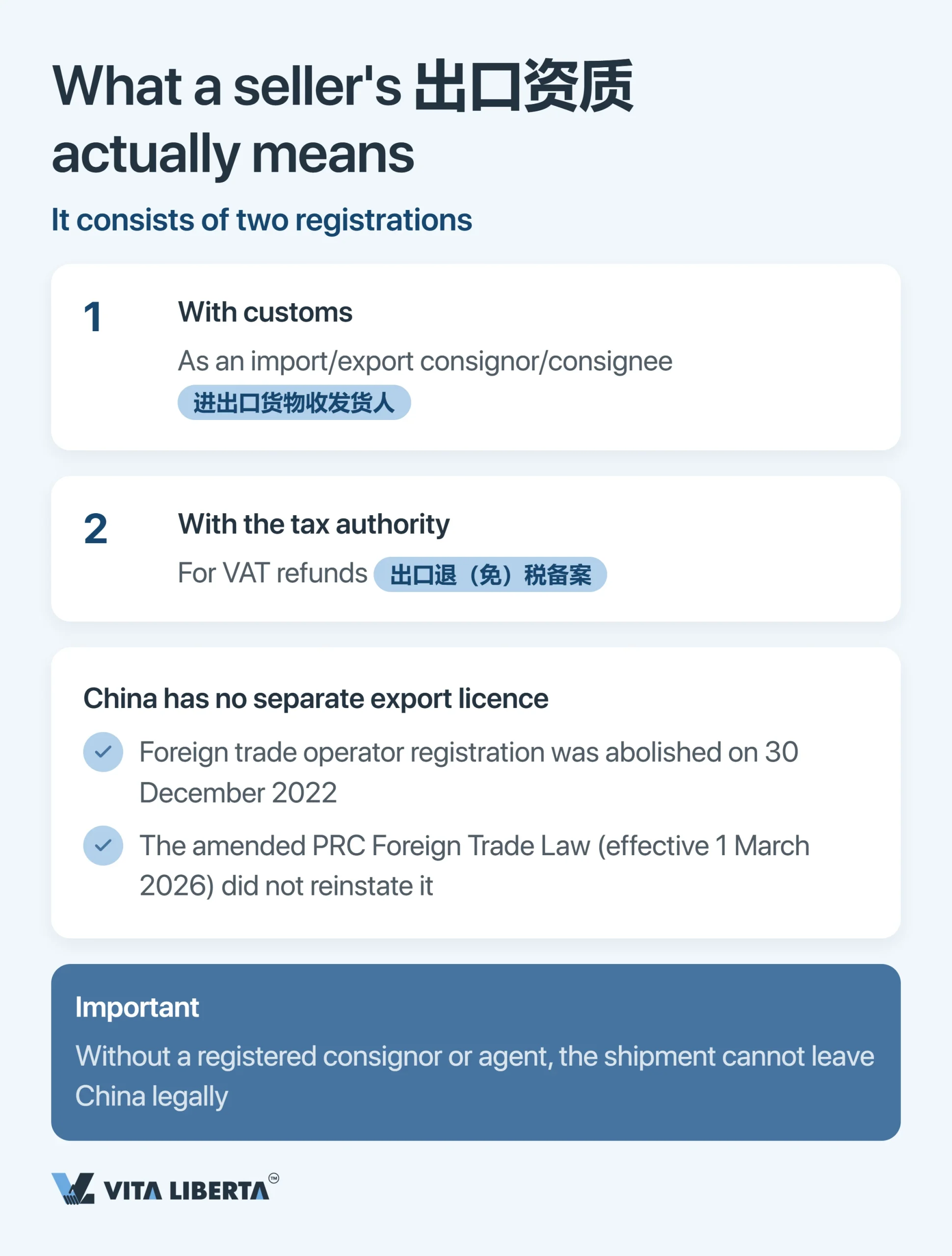
1688 is China’s domestic wholesale market. Its sellers expect a customer with a Chinese account and Chinese logistics. Most of them don’t have what they call export credentials (出口资质). In practice that means customs registration as a consignor or consignee of import and export goods (进出口货物收发货人) and, for the VAT rebate, a filing with the tax office (出口退(免)税备案).
China has no standalone export licence. Foreign trade operator registration was scrapped on 30 December 2022, and the revised Foreign Trade Law (中华人民共和国对外贸易法), in force since 1 March 2026, did not bring it back. As a foreign buyer on 1688, you also can’t rely on Trade Assurance.
Your margin depends on the purchasing model, not on the platform: who pays the supplier, who files the export declaration, and what happens to the 13% VAT built into the domestic price.
1688 or Alibaba: Choose by Deal Model
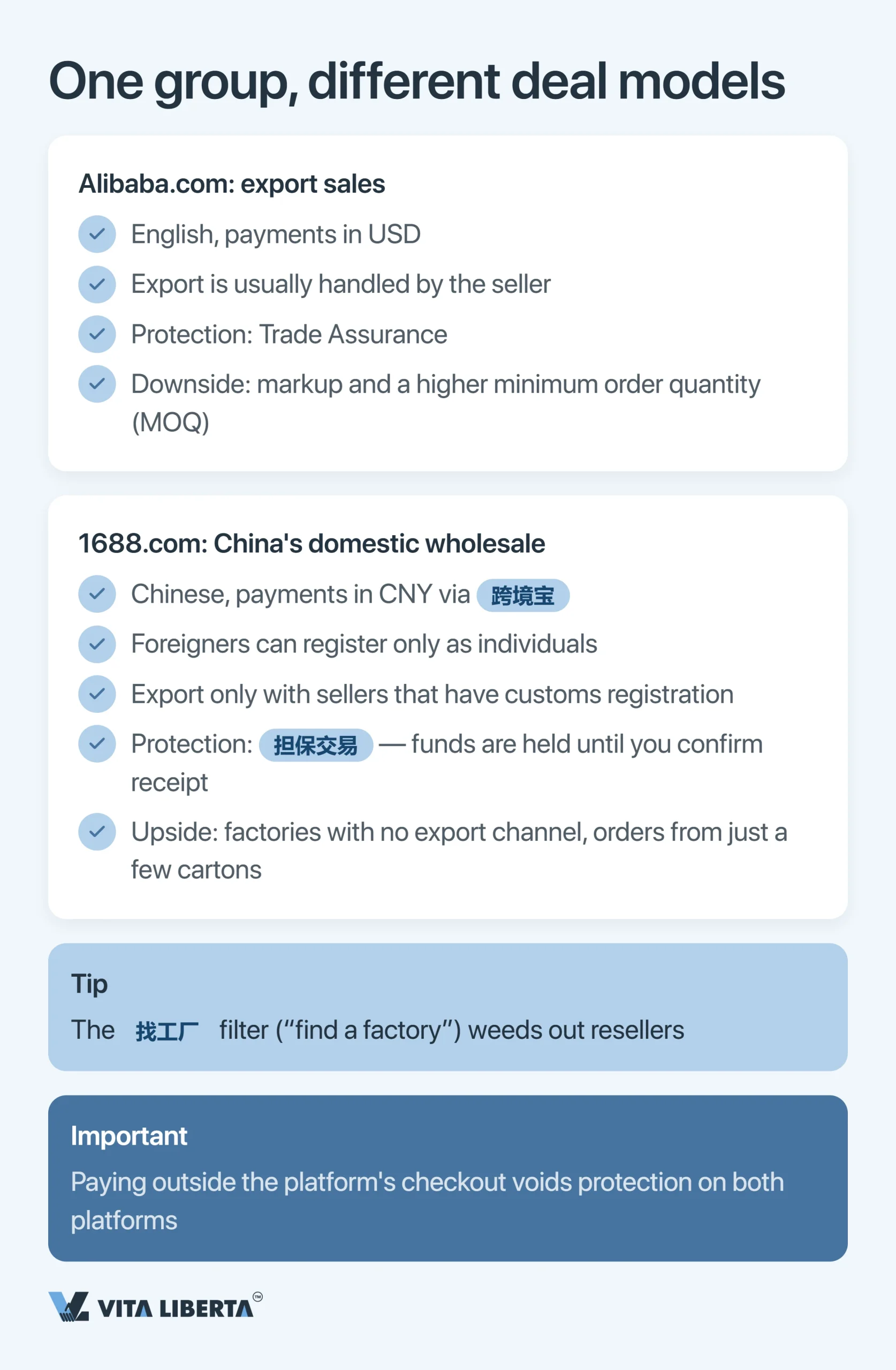
Both platforms belong to Alibaba Group and often list the same factory. They differ in language, settlement currency and buyer protection.
Alibaba.com: Export Sales Under Platform Arbitration
This is where you sign cross-border contracts. You negotiate in English and pay in US dollars, and the seller usually handles export clearance. You pay for that service through a markup, and the minimum order quantity (MOQ) is higher than the same factory sets inside China.
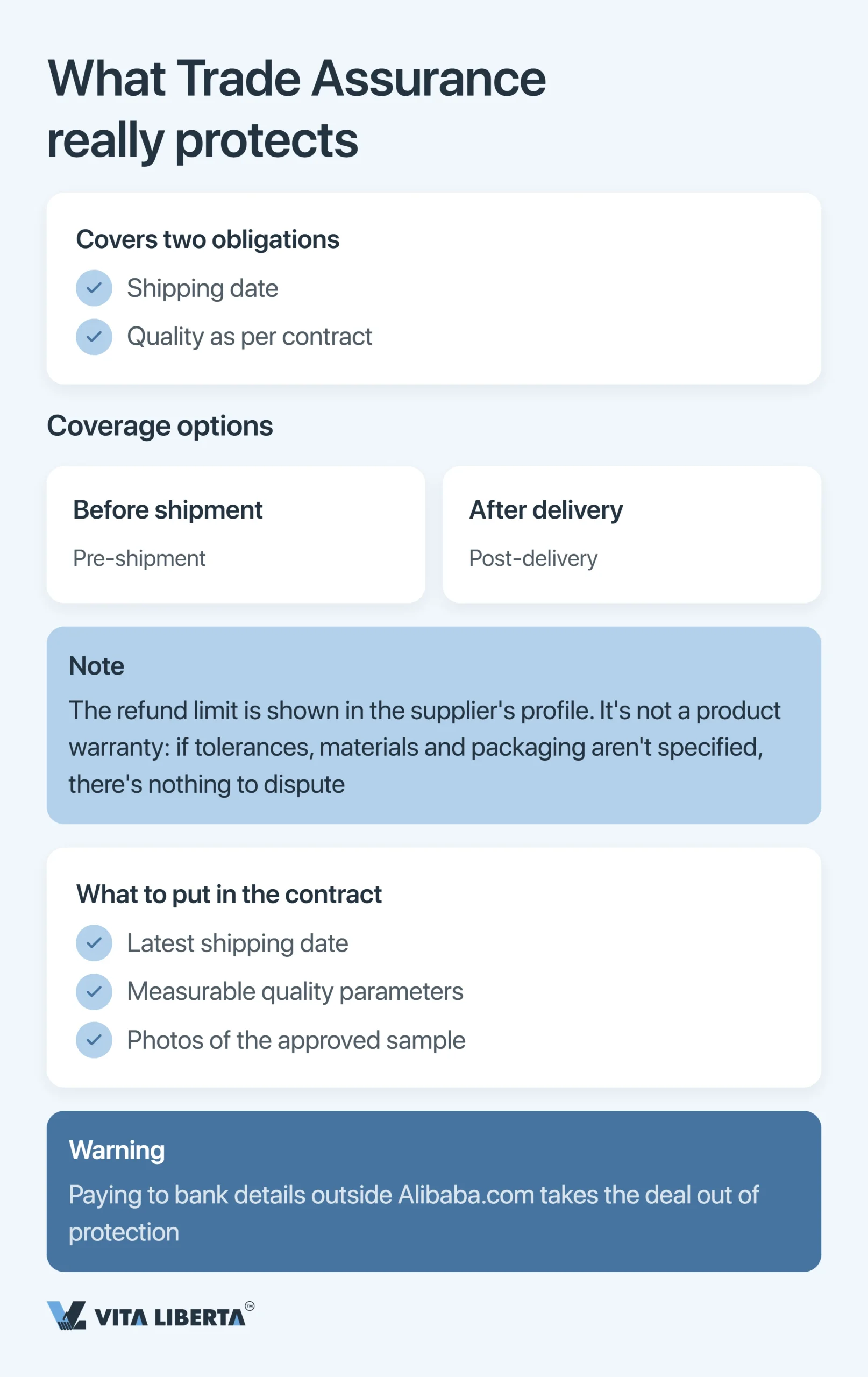
The key tool is Trade Assurance, and it is free. If the supplier misses the shipping date or quality requirements written into the contract, Alibaba.com refunds the covered amount.
1688.com: Domestic Wholesale With No Cover for Foreign Buyers
A foreign company can join 1688 only as an individual, because corporate accounts are for Chinese sellers. The interface is in Chinese, prices are in yuan, and most sellers ship only within China.
In return, you reach factories that never list on export platforms, and you can order just a few cartons. The 找工厂 (“find a factory”) filter removes resellers while you search.
| Aspect | Alibaba.com | 1688.com | What it means in practice |
| Payment protection | Trade Assurance, up to the supplier’s limit | 担保交易: funds are held until you confirm receipt | Pay outside the platform’s checkout and you lose protection on both |
| Export | Usually handled by the seller | Only by sellers with customs registration (进出口货物收发货人) | Without a customs-registered shipper or agent, the goods can’t leave China legally |
| Payment | USD, bank transfer or card | CNY via 跨境宝 | A regular bank transfer isn’t available at checkout |
Supplier Checks: Five Signals Before You Pay Anything
The signals below are ranked by how much a mistake would cost you.
- Export credentials. Ask about 出口资质 in your first message. If the answer is no, you will need a registered exporter or an agent.
- Matching legal entity. The name on the invoice and the payee’s bank details must match the seller’s registration on the platform. If a different entity shows up in the payment details, stop the payment.
- Credit rating. On 1688, check the Corporate Credit block: the 诚信通 (Chengxintong) score and the share of repeat orders. On Alibaba.com, look for Verified status, which is granted after an independent inspection.
- Factory profile. Look at the business licence, trademarks and the number of paid orders over the last 30 days.
- Sample. Place the bulk order only after you’ve received a sample, and put its specifications in writing.
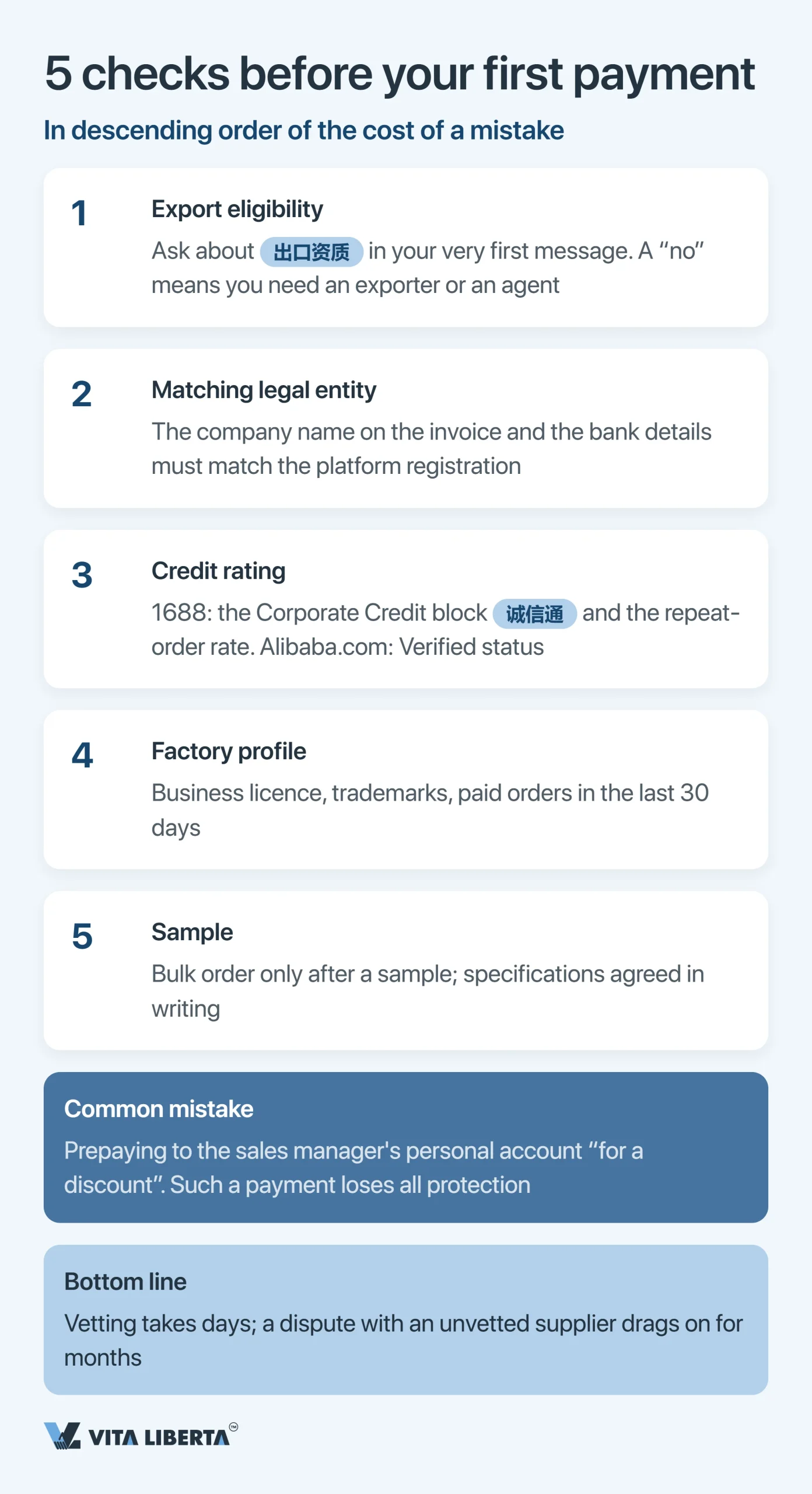
A common and expensive mistake among foreign buyers is paying a deposit into a sales manager’s personal account in return for a “discount for skipping the commission”. That money is covered by neither Trade Assurance nor 担保交易.
Bottom line: checking a supplier takes days, while a dispute with an unchecked one takes months.
Payment and Contract: Where Buyer Protection Ends
Your money is protected only as far as the contract and the platform’s payment channel reach.
Trade Assurance: What It Actually Covers
Trade Assurance covers two things: the shipping date and quality as defined in the contract. You choose pre-shipment or post-delivery cover, and any refund is capped at the limit shown in the supplier’s profile.
It isn’t a product warranty. If tolerances, materials and packaging aren’t written down, you have nothing to claim on. So put a latest shipping date and measurable quality parameters into the contract, and attach photos of the approved sample.
Important: if you pay to bank details outside Alibaba.com, the deal falls out of Trade Assurance and the platform won’t compensate you.
Check Your Chinese Supplier Before You Prepay
- Legal entity and credentials check
- Contract terms review
- A payment setup without the risk
跨境宝 and 担保交易: How to Pay on 1688
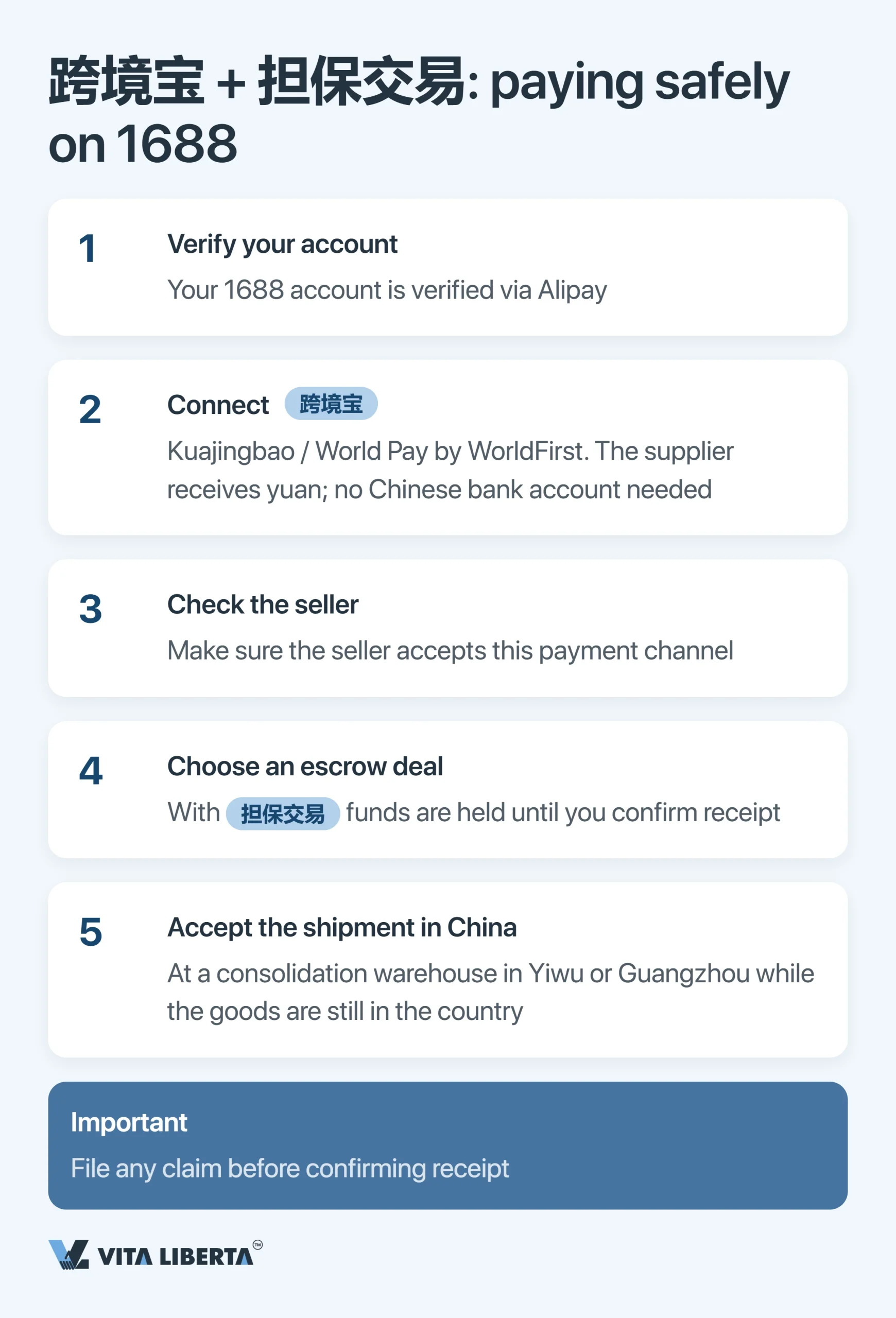
For foreign businesses, the official channel is 跨境宝 (Kuajingbao, offered by WorldFirst as World Pay). The supplier receives yuan, and you don’t need a Chinese bank account. Before you connect it, your 1688 account is verified through Alipay.
At checkout, choose the secured transaction (担保交易). The funds stay on hold until you confirm receipt, so raise any claim before you confirm. Not every seller supports this channel, so check before you order. It’s sensible to inspect the goods at a consolidation warehouse in Yiwu (Zhejiang province) or Guangzhou while they are still in China.
Your Own Company in China: 13% VAT, Fapiao and Export Rebates
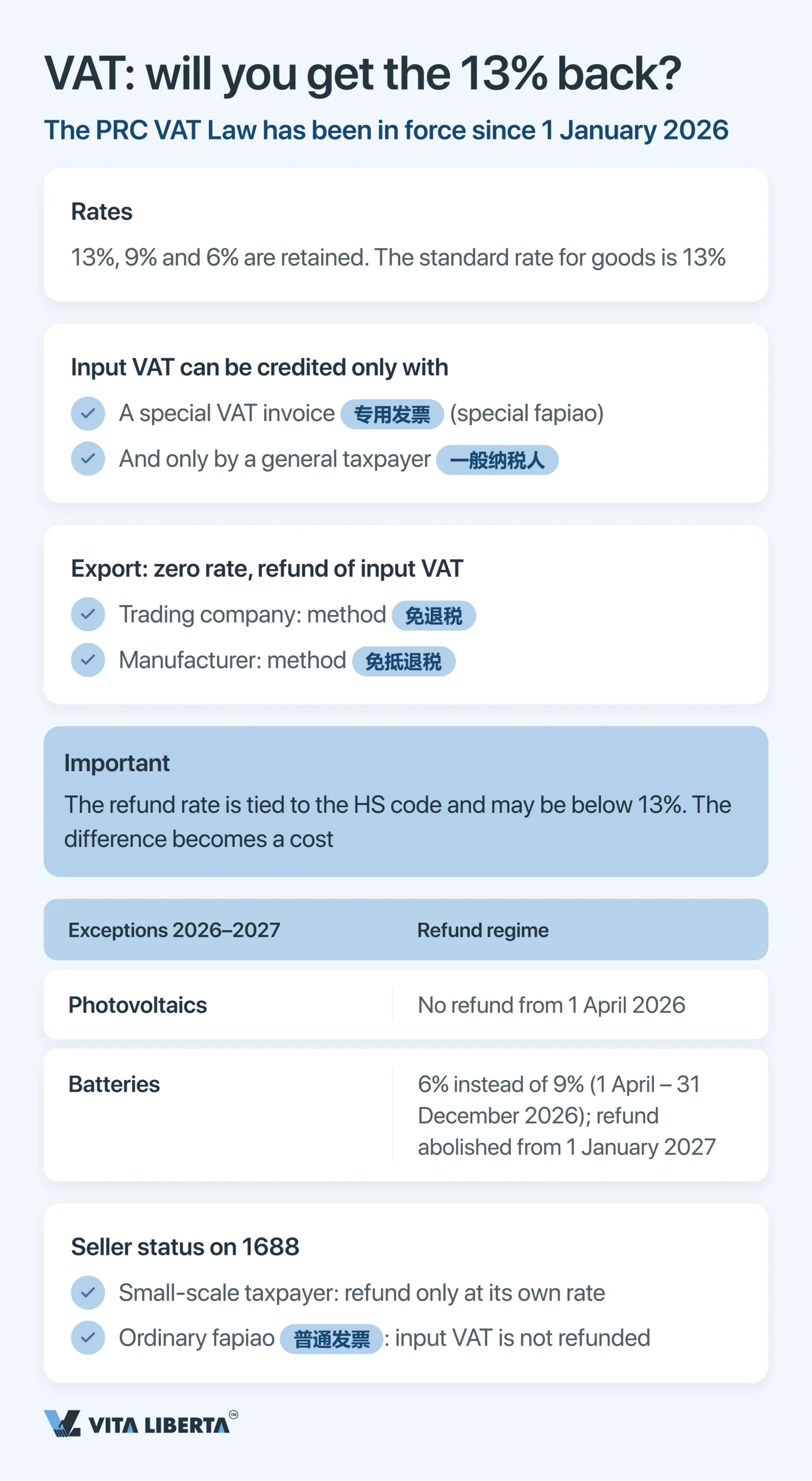
China’s VAT Law (中华人民共和国增值税法), adopted on 25 December 2024, has applied since 1 January 2026. It works together with its Implementing Regulations (中华人民共和国增值税法实施条例), approved by State Council Decree No. 826 (国务院令第826号). The 13%, 9% and 6% rates remain, and 13% is still the standard rate for goods.
The paperwork, not the price, decides whether you get this tax back. When you buy inside China, the input credit comes from a special VAT fapiao (专用发票), and only a general taxpayer (一般纳税人) can claim it. Exports are zero-rated.
From 1 January 2026, refunds follow the joint MOF and STA announcement 财政部 税务总局公告2026年第11号 (Announcement No. 11). A trading company recovers input VAT through exemption and refund (免退税). A manufacturer uses exemption, credit and refund (免抵退税).
The refund rate depends on the HS code and can be lower than 13%. Whatever isn’t refunded becomes a cost. Some products lose the refund completely. Under 财政部 税务总局公告2026年第2号 (Announcement No. 2), photovoltaic products get no refund from 1 April 2026. For batteries, the rate drops from 9% to 6% between 1 April and 31 December 2026, and the refund ends on 1 January 2027.
On 1688, the seller’s tax status matters. If you buy from a small-scale taxpayer (小规模纳税人), you get VAT back only at that seller’s levy rate, not at 13%. With a special fapiao, you get whichever is lower: the fapiao rate or the refund rate. If you buy on an ordinary fapiao (普通发票), the export is VAT-exempt, but you don’t get the input tax back.
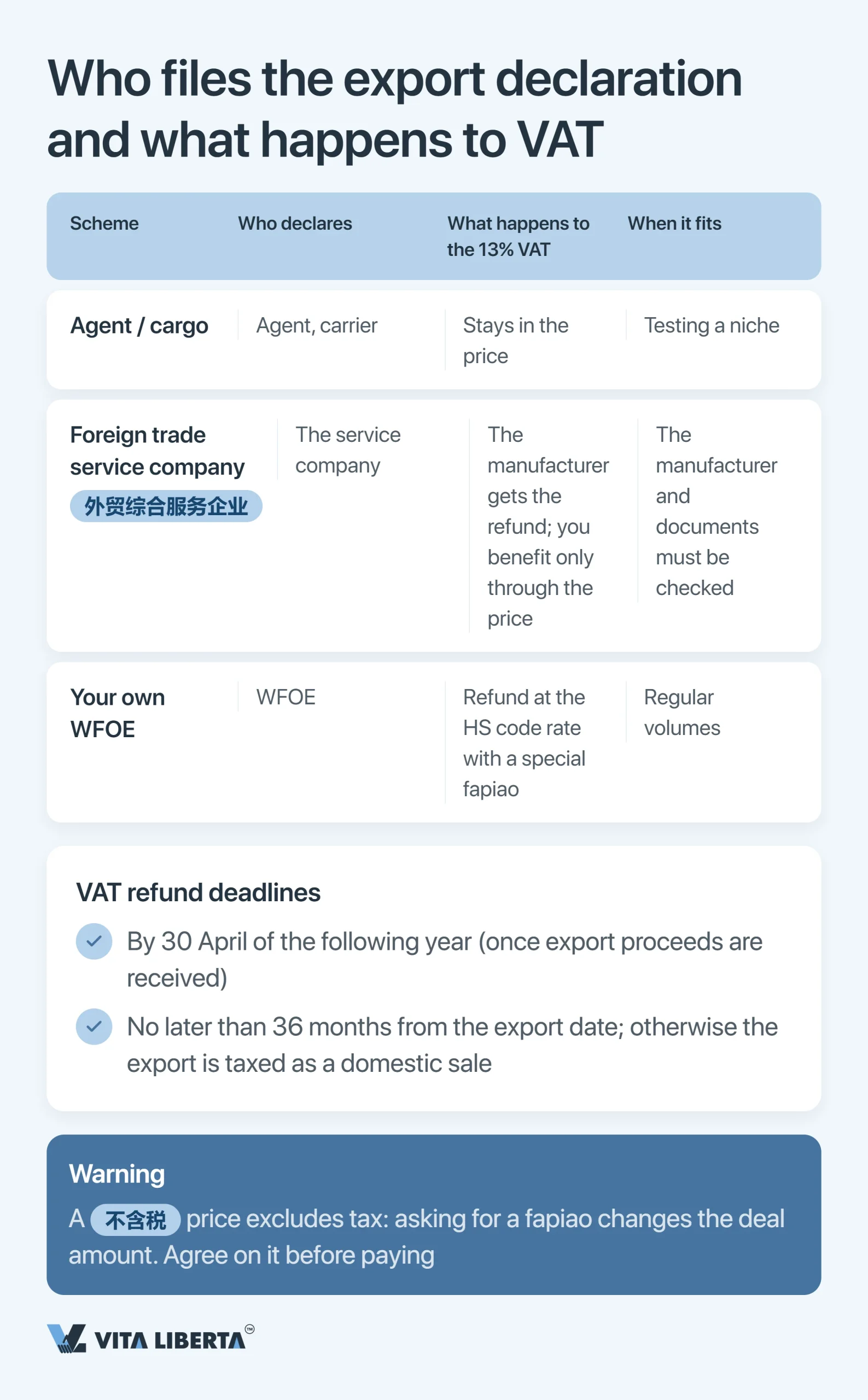
| Model | Who files the export declaration | What happens to the 13% VAT | Trade-off |
| Agent or cargo forwarder | Agent, carrier | Stays in the price | Good for testing a niche |
| Foreign trade integrated service company (外贸综合服务企业) | Service company | The manufacturer gets the refund; the service company files for it (代办退税, 国家税务总局公告2017年第35号) | You benefit only through the price; the manufacturer and documents need checking |
| Own WFOE | WFOE | Refund at the HS-code rate with a special fapiao | Pays off with regular volumes |
You file the refund by 30 April of the year after the export, as long as the export proceeds have been received. After that, you can still claim within 36 months of the export date. If you miss that window, the export is taxed as a domestic sale. Registration and filing since 1 January 2026 follow 国家税务总局公告2026年第5号 (STA Announcement No. 5).
A 1688 price marked 不含税 excludes tax, so asking for a fapiao changes the deal amount. Agree on this before you pay.
Bottom line: the structure you choose goes straight into the cost of every shipment.
Set Up a Company in China for Sourcing
- WFOE registration for sourcing and export
- General taxpayer status
- Export VAT rebate setup
Buying on 1688 and Alibaba: Strategic Takeaways
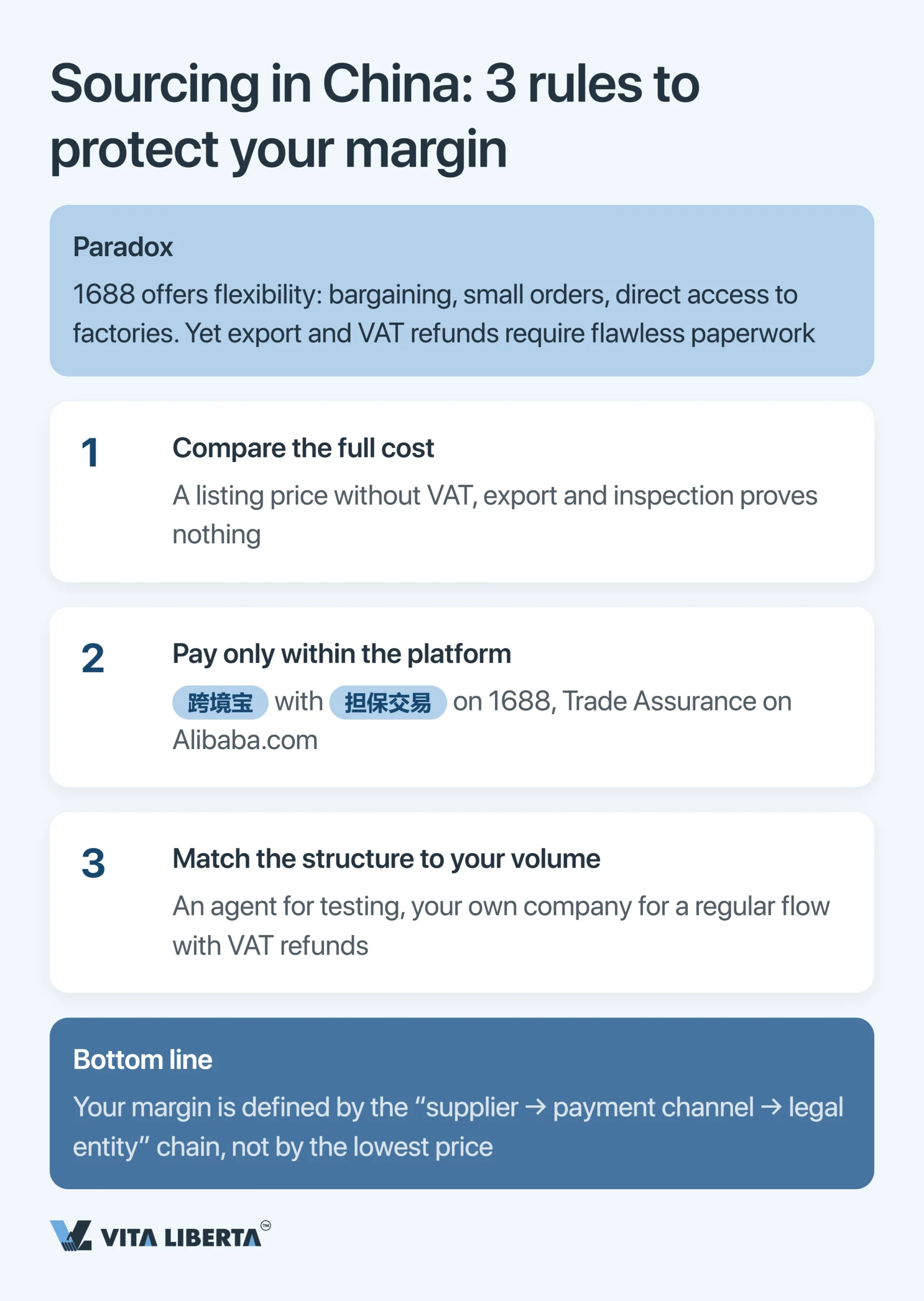
The core paradox is this: 1688 gives you the most flexibility, with haggling, small batches and direct factory access. Export and VAT rebates, on the other hand, need perfect paperwork: a special fapiao, a matching legal entity and the right HS code.
- Compare landed cost. A listing price that leaves out VAT, export and inspection proves nothing.
- Pay only through the platform. Use 跨境宝 with 担保交易 on 1688 and Trade Assurance on Alibaba.com.
- Match the structure to your volume. Use an agent for testing and your own company for a steady flow with VAT rebates.
Buying on 1688 and Alibaba isn’t about finding the lowest price. It’s a chain of supplier, payment channel and legal entity, and that chain sets your margin.
Frequently asked questions
No. Corporate sign-up on 1688 is only for Chinese sellers, so as a foreign buyer you open an individual account. The seller invoices whatever name is on the order. Agree on the recipient named in the documents before you pay. Otherwise, it will be hard to book the shipment through your company’s accounts and customs.
Yes, if you choose post-delivery cover at checkout instead of pre-shipment cover. You must inspect the goods within the period that Trade Assurance rules set for that cover, which starts from customs clearance. Any refund is capped at the supplier’s limit and applies only to parameters written into the contract. Without measurable tolerances, materials and packaging, you have nothing to base a claim on.
Without a Chinese entity that has general taxpayer status, you can’t get input VAT back. If you buy through an agent, the VAT stays in the price. A foreign trade service company won’t pass the refund on to you either: it files for the Chinese manufacturer, and you benefit only through the price. Even with your own company, the refund rate depends on the HS code and may be under 13% or zero. If you buy from a small-scale taxpayer, the refund is capped at that seller’s levy rate. Decide only after you’ve run the numbers for the specific product and how regularly you’ll buy it.
Use 跨境宝, the official channel for foreign businesses. The supplier receives yuan, and you verify your account through Alipay in advance. At checkout, choose 担保交易. The funds are held until you confirm receipt, so raise any problem with the shipment before you confirm.
The rates didn’t change: goods are still taxed at 13%, and the 9% and 6% rates remain. The Law replaced the old provisional regulations and took effect on 1 January 2026, together with State Council Decree No. 826. From the same date, export refunds have been governed by 财政部 税务总局公告2026年第11号 and 国家税务总局公告2026年第5号, which replace the earlier 财税〔2012〕39号. Some goods lost their refund under 财政部 税务总局公告2026年第2号, so check any refund figures in your supplier contracts against the current rules.