Hongkong
 China
China




Three letters missing from the box, and the box never reaches a shop. Below: who is caught by the 3C requirement, and how to work through it without writing off half a year.
What sits behind the acronym
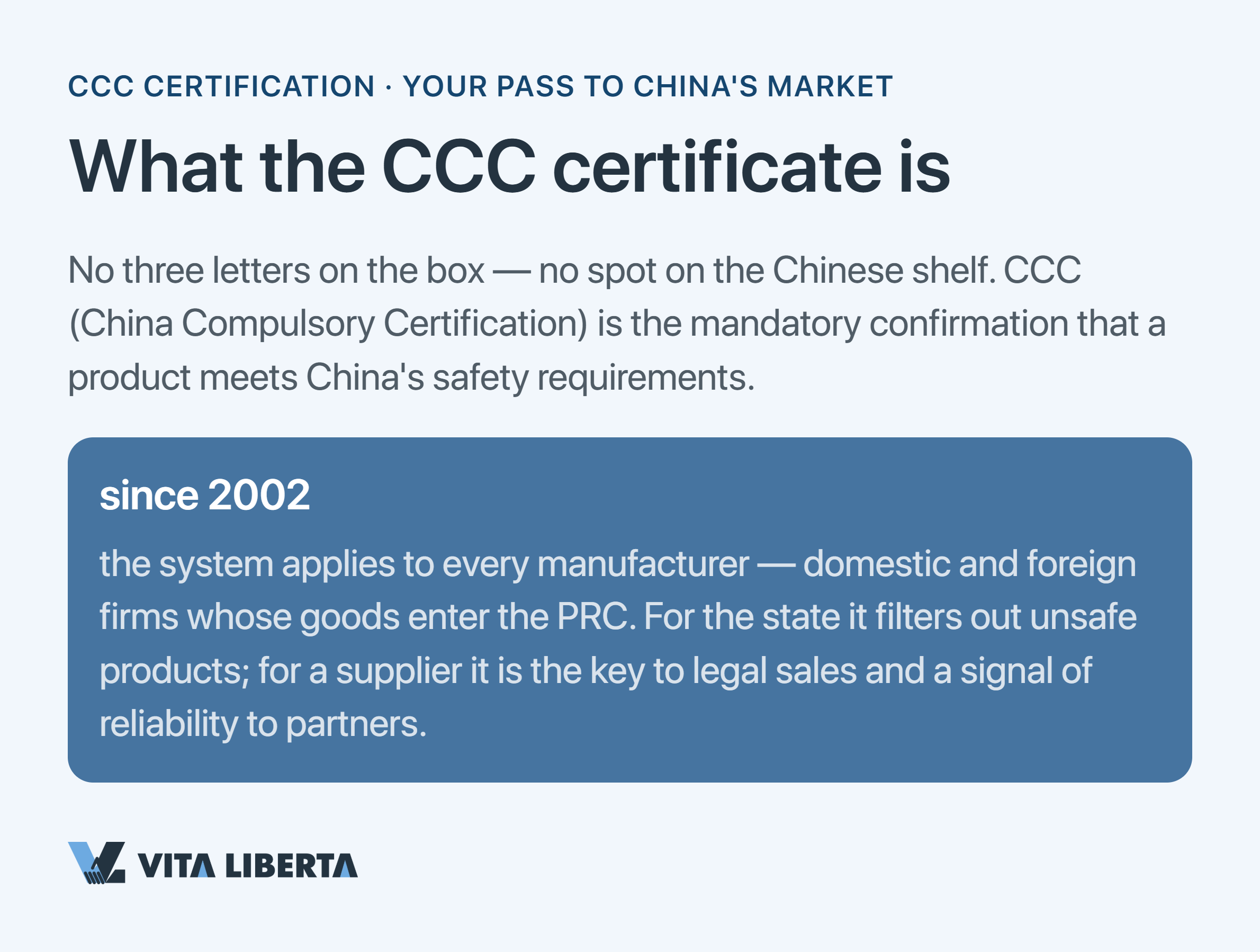
CCC — China Compulsory Certification, informally the 3C mark — is a state approval regime. Goods named on a government list have to demonstrate that they satisfy Chinese safety norms before anyone may bring them in or trade them. Beijing built the scheme in 2002, not long after WTO accession, and drew no line between local factories and overseas suppliers shipping into the mainland: both are inside it. Regulators treat it as a sieve for hazardous goods. For a seller it does double duty — legal access on one side, a credibility signal to Chinese counterparties on the other. Skip it, and a listed article is turned away at the frontier and barred from circulation.
Who is caught by the requirement
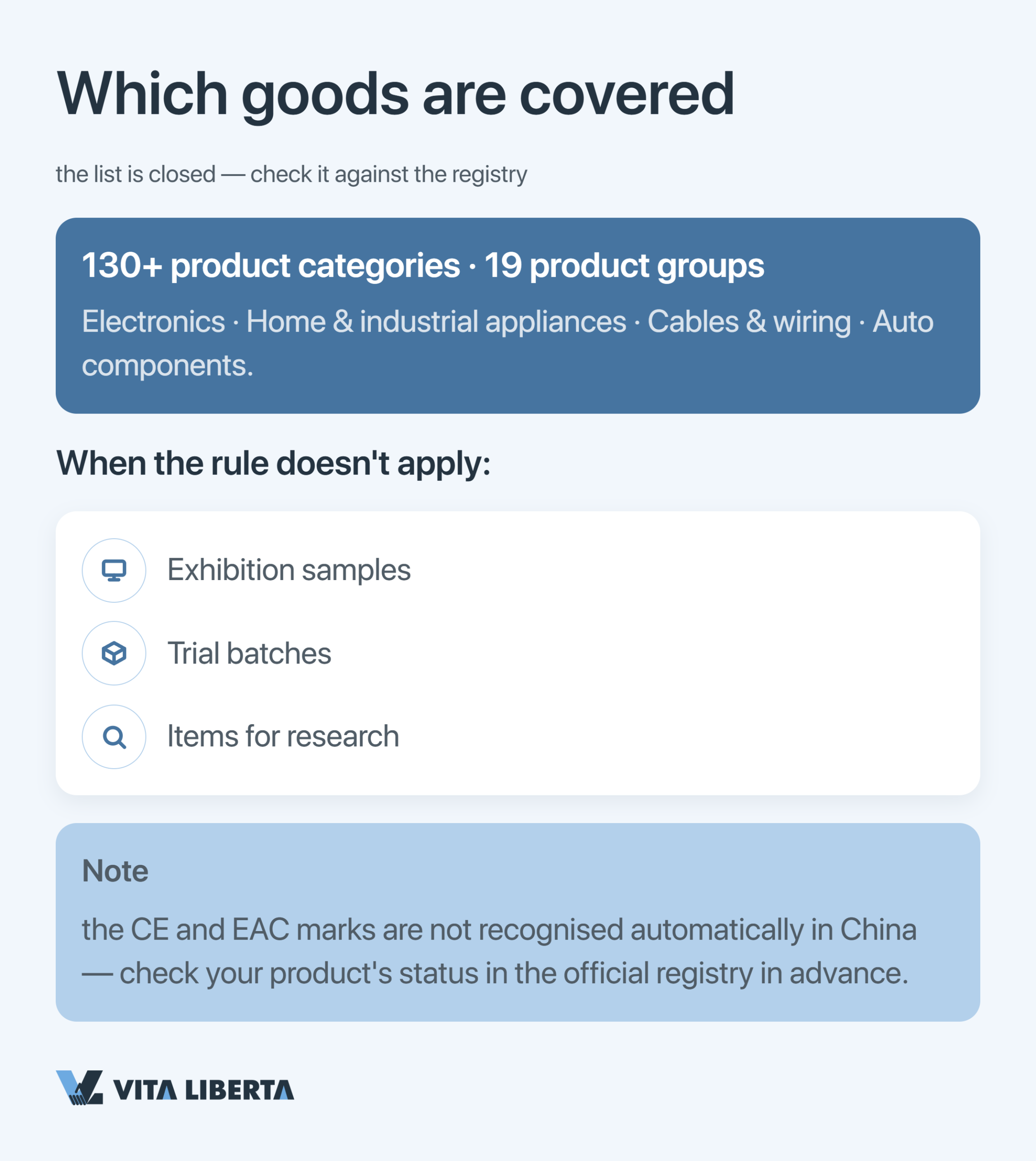
The list is finite: upwards of 130 items, sorted into 19 groups. Weight of it falls on cabling and conductors, consumer and industrial electrical goods, electronics, and parts for vehicles.
Where the rule bends
Some shipments escape the procedure on paper — trade-fair samples, pilot runs, articles bought for research. Reality is stickier: explanatory letters and case-by-case import clearance are frequently demanded anyway. One more assumption is worth abandoning early, because it is expensive: a CE marking from Europe or an EAC marking from the EAEU carries no automatic weight with Chinese authorities. Look your own article up in the regulator’s published catalogue first; everything else follows from that answer.
Where the certificate comes from
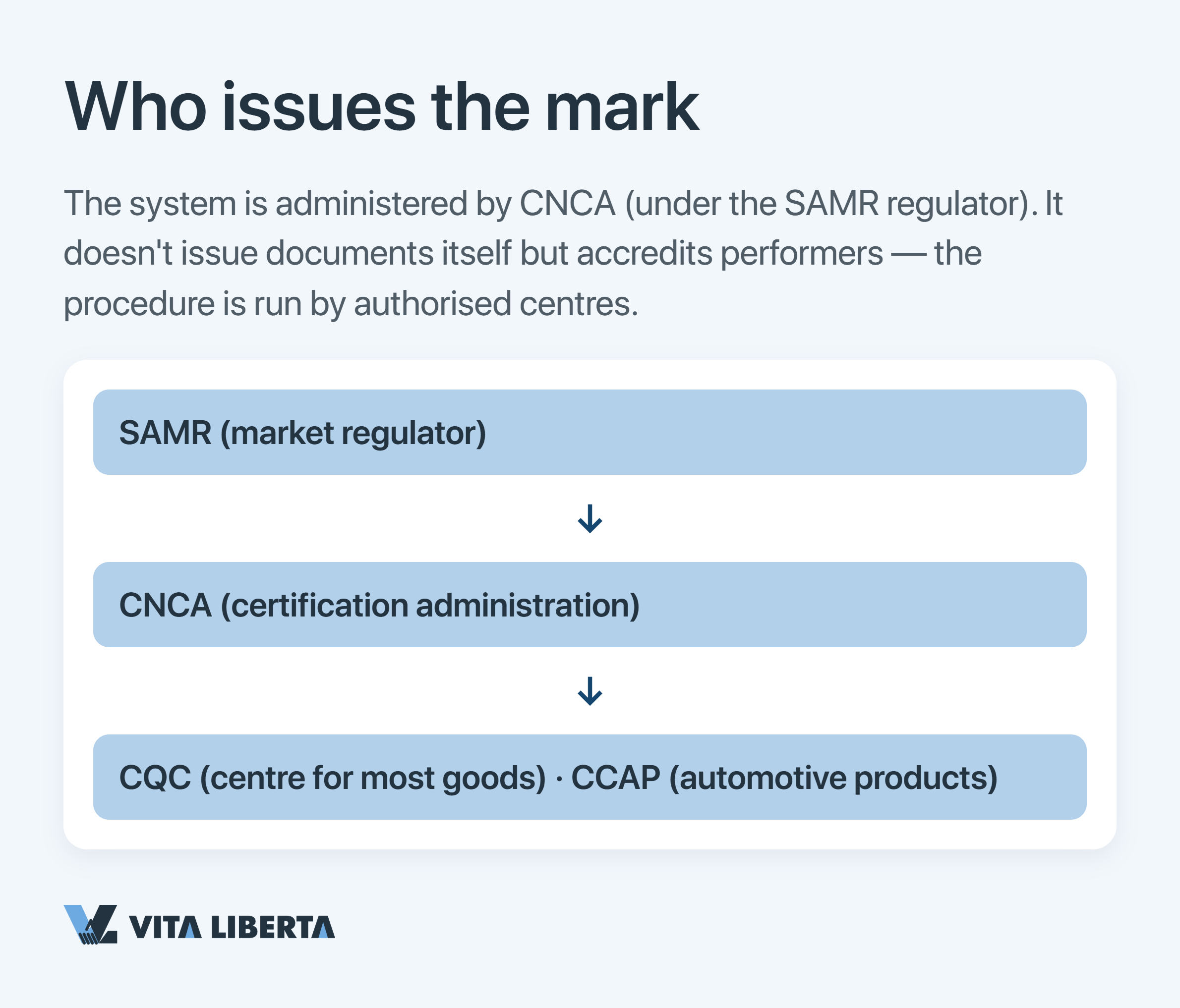
Oversight belongs to CNCA, which sits beneath the market watchdog SAMR. CNCA signs nothing itself. Its job is accreditation — appointing the certification bodies, laboratories and inspection units that do the work. Files are handled by designated centres: CQC covers most product families, while automotive goods go to the specialist body CCAP. Every issued approval lands in one national register, and that register is wired into customs, so border officers verify a mark against it without anyone asking.
Working through the procedure
Two blocks of work, roughly.
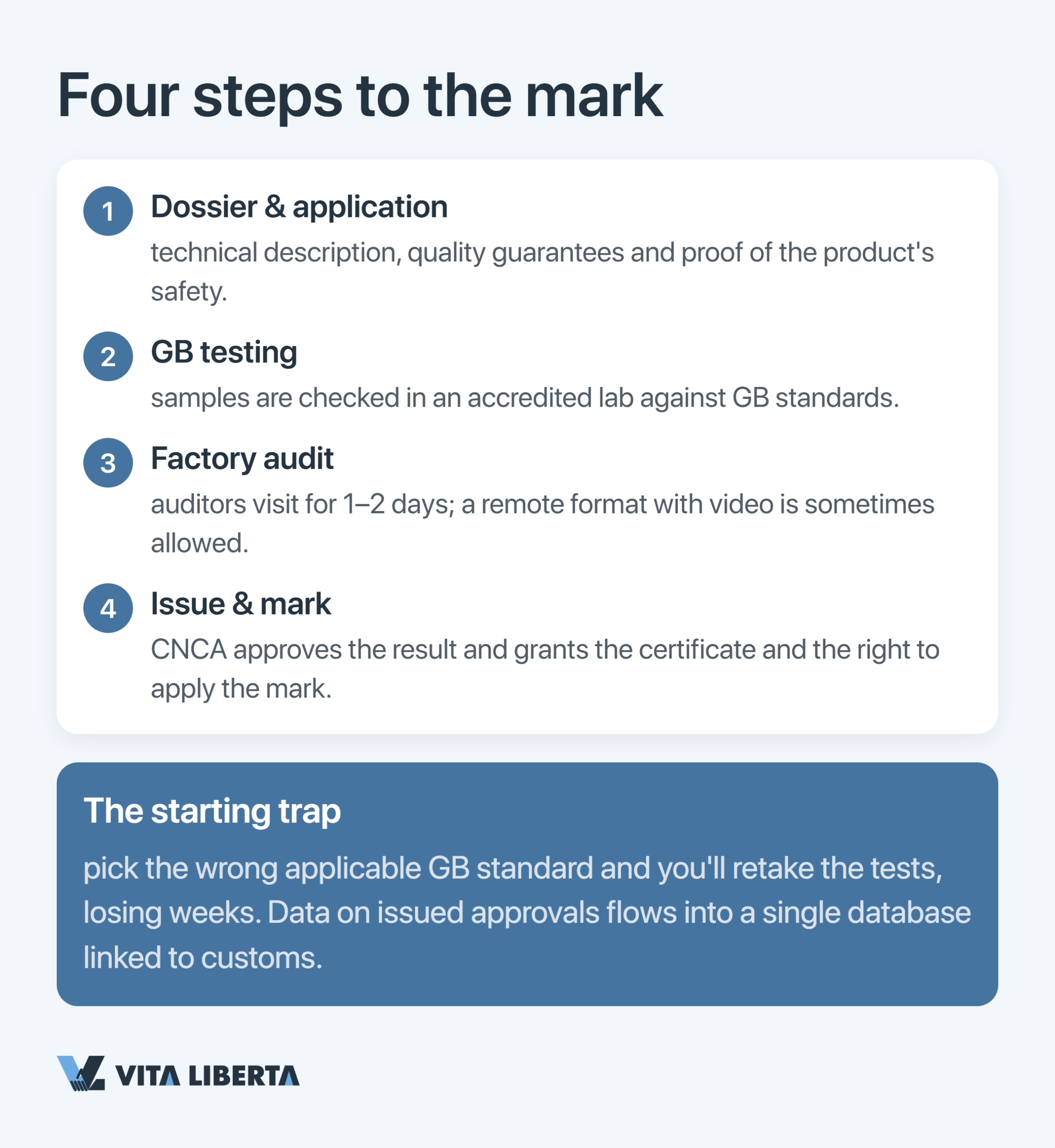
Filing and laboratory work. First comes the technical dossier — specifications, quality assurances, evidence on safety — and the application itself. Samples then travel to an accredited lab and are measured against the relevant GB national standards. A familiar trap opens here: name the wrong applicable standard at the start and the testing is redone from scratch, several weeks gone.
Plant inspection and issuance. Once results come back clean, auditors are dispatched to the production site. A visit typically absorbs one or two days; for certain cases a remote review with video evidence is accepted. Where the article and the plant both hold up, CNCA signs off, releases the certificate, and grants permission to carry the mark.
Does your product need CCC?
- Check if certification applies
- Identify your product category
- Estimate cost and timelines

Price tag and calendar
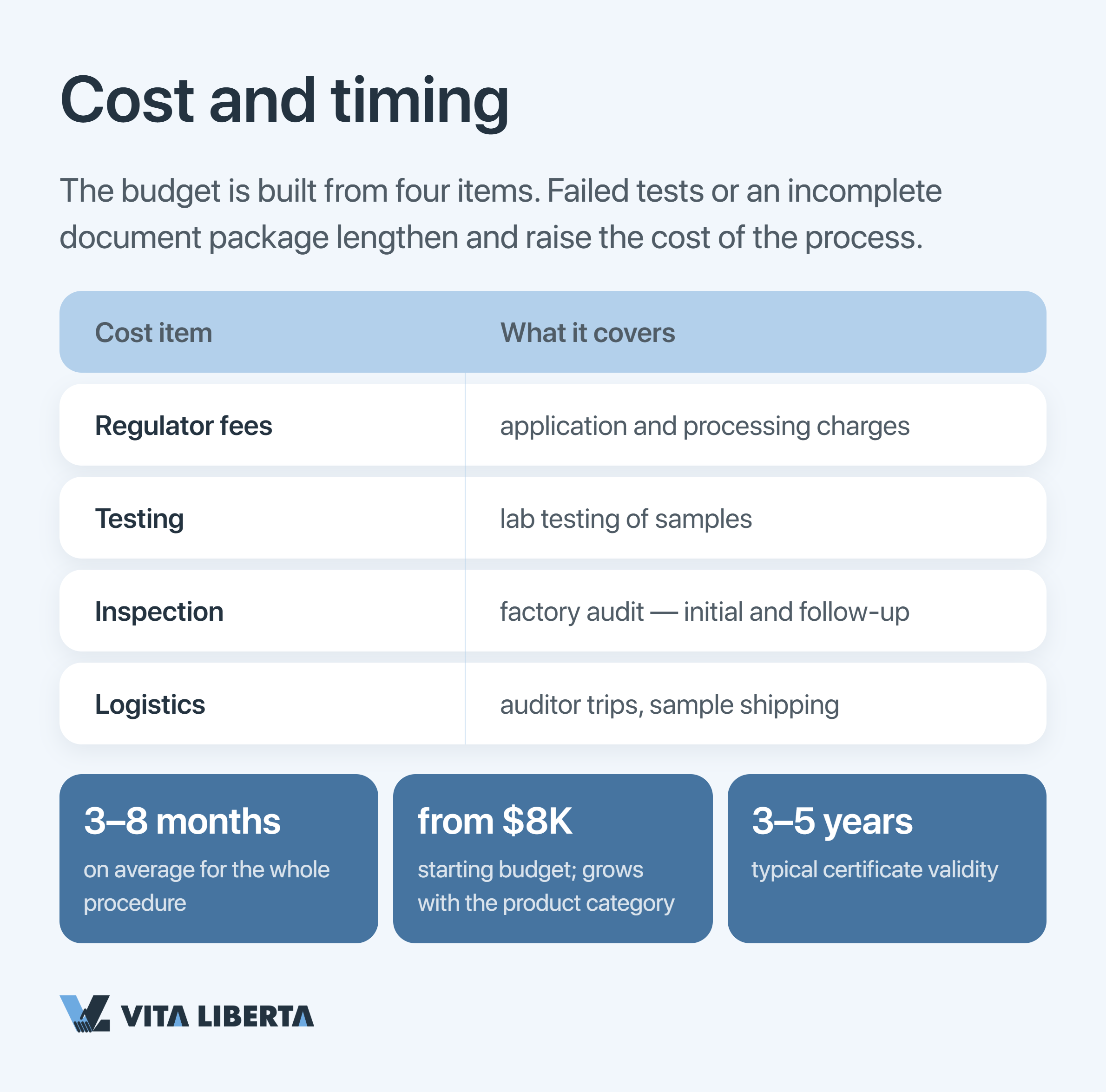
| Cost item | What it covers |
| Regulator fees | filing and processing charges |
| Testing | laboratory work on samples |
| Inspection | plant audit — first visit and later ones |
| Logistics | auditor travel, shipping of samples |
Expect the whole route to occupy 3–8 months. Budgets open at somewhere near US$8,000 and climb with the category. Anything that goes wrong — a failed test, a gap in the paperwork — pushes both figures up.
Staying certified
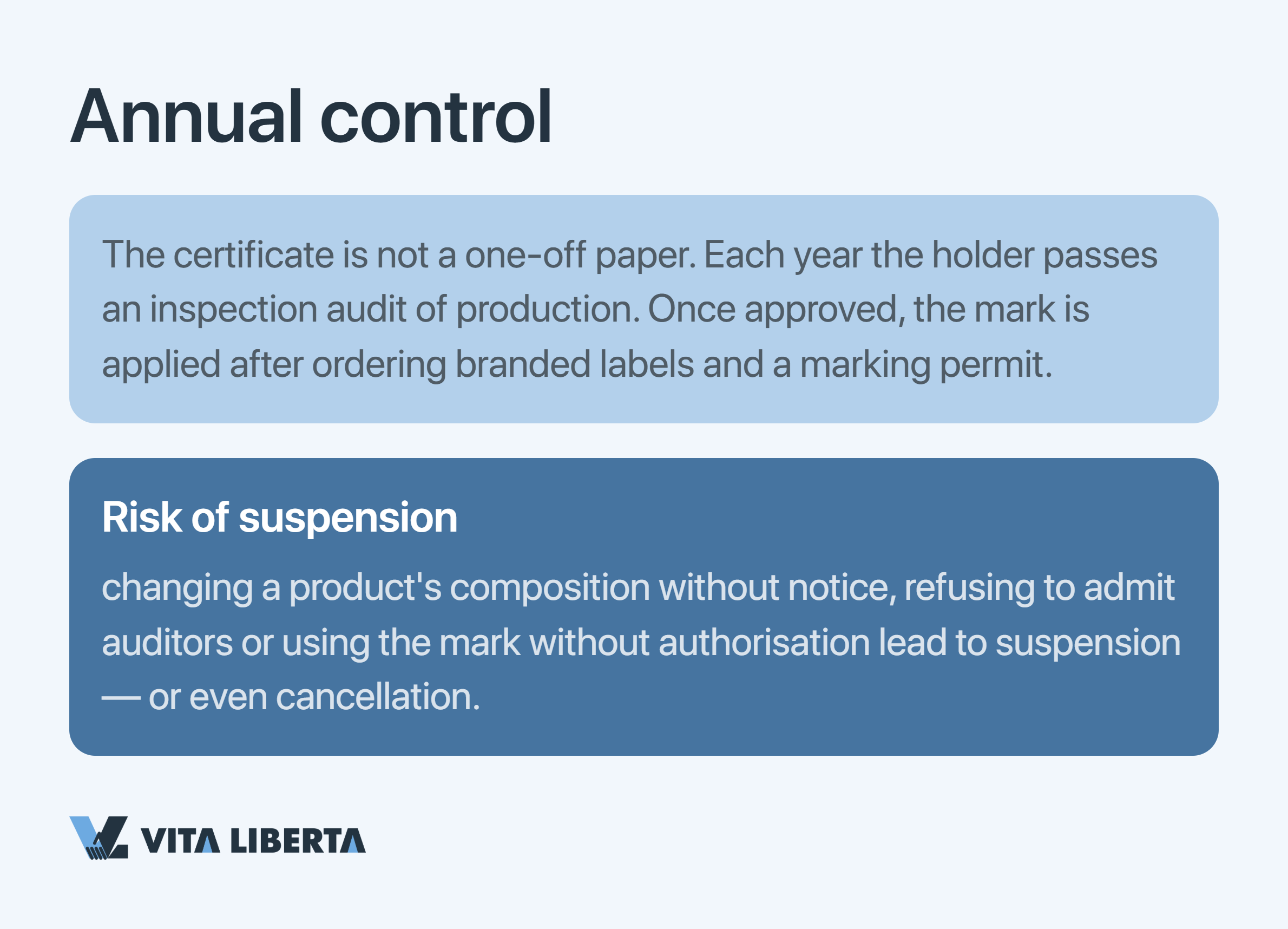
Three to five years is the usual term written on the certificate, but nobody files it away and forgets it. Every twelve months the holder sits a surveillance round, which includes a compressed audit of production. Marking itself waits on two things: ordering the official labels and securing printing permission. Change what a product is made of without telling anyone, turn auditors away at the gate, or use the mark you were never granted — each of those routes ends in suspension, and sometimes in withdrawal altogether.
Three acronyms, three jobs
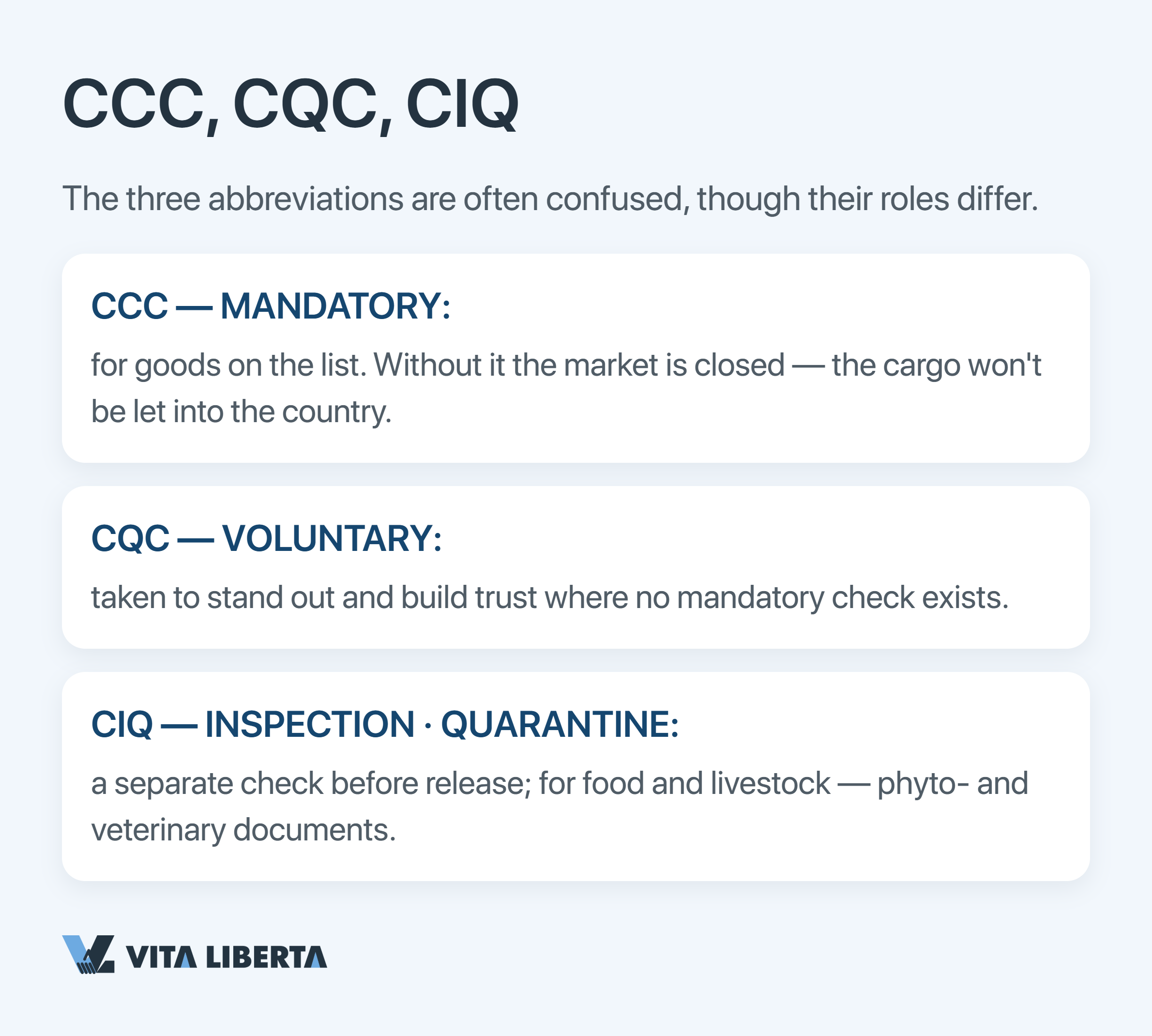
- CCC — compulsory for anything on the catalogue. No mark, no market.
- CQC — taken voluntarily, as a differentiator and trust-builder in segments where nothing is compulsory.
- CIQ — a separate inspection-and-quarantine track with its own catalogue. This is the one customs looks at before release; foodstuffs and animal-origin goods pick up phytosanitary and veterinary paperwork on top.
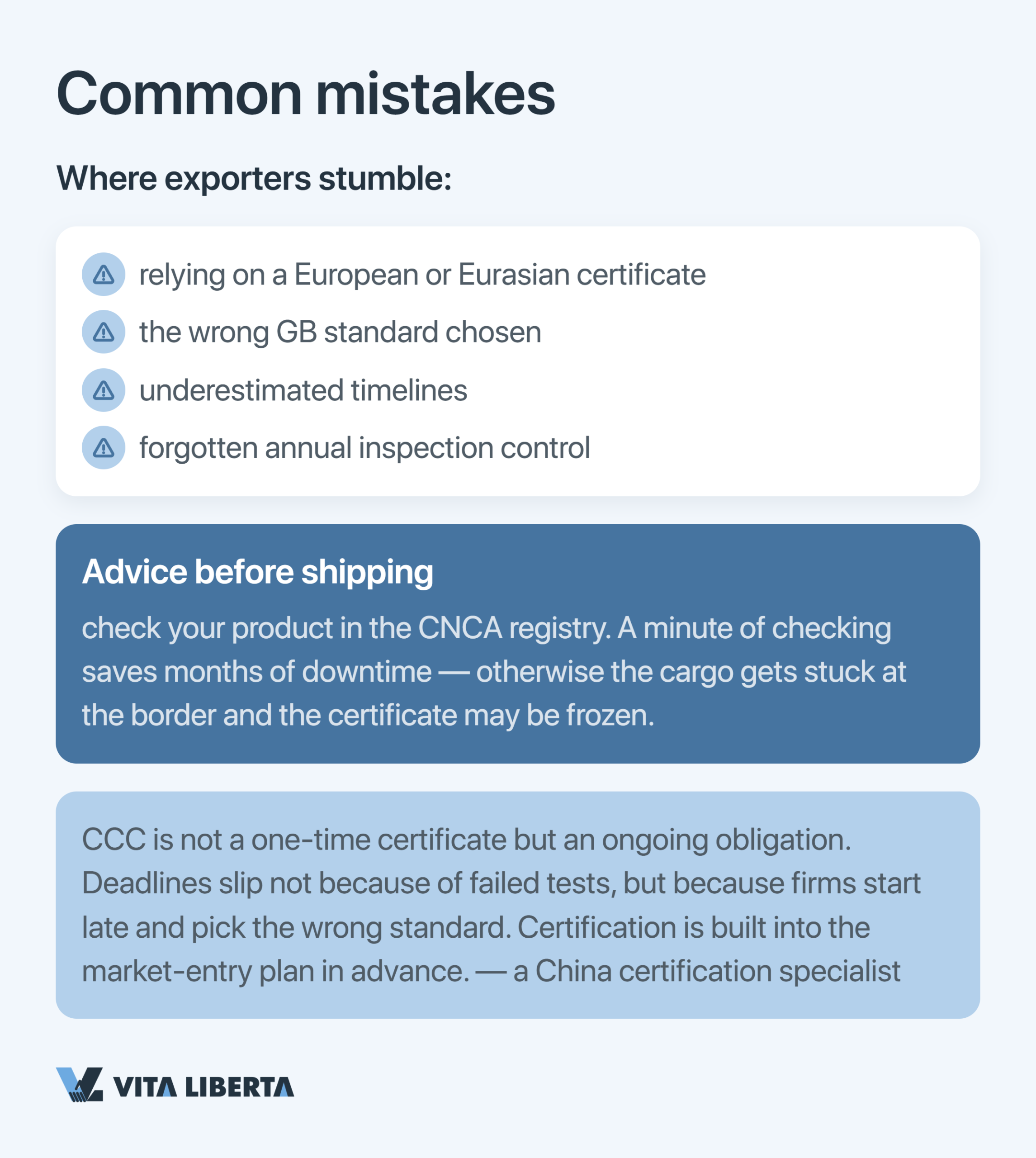
⚠️ Run the article through the CNCA catalogue before the container is booked. Sixty seconds of checking against months of idle cargo.
The recurring errors are predictable: leaning on a European or Eurasian certificate, misidentifying the standard, treating the calendar optimistically, letting the annual round slip. All four arrive at the same destination — freight immobilised at the border, and a certificate liable to be frozen with a sales ban attached.
“Treat 3C as a standing commitment, not a document you collect once. When companies blow their deadlines, it is rarely the testing that defeated them — they began too late and misread which standard applied. Certification belongs in the market-entry plan from day one, not in the week before the container leaves.”
— Sergey Konon, foreign-trade consultant (China)
The mark is what gets goods past the gate and keeps them there: catalogue lookup, laboratory work, an inspected plant, then surveillance that never really stops. Establish whether your particular article is listed, block out three to eight months and a realistic budget, keep the annual round in the calendar — and supply to Chinese shelves runs uninterrupted.
Planning to sell in China?
- CCC certificate obtained
- Support up to issuance
- Work with the test lab
FAQ
It is the approval regime China applies to a defined list of goods. Anything on that list stays out of the mainland — unsold and unimported — until it is certified. The point is to confirm that local safety norms are met, and the rule reaches domestic production just as it reaches imports.
Categories where safety is at stake. Think domestic appliances and consumer electronics, car parts, children’s toys, cabling — among many others. The authoritative list is published by the state, and checking an article against it is how you find out whether the requirement bites.
File, test, inspect, issue, mark. Samples go to an accredited laboratory, the production site is inspected, and once both clear, the certificate is released and the mark may be applied. Responsibility for running the process normally rests with the manufacturer or an authorised representative acting for it.
Both depend on the article and how much testing it attracts; several months is the usual order of magnitude. Laboratory work and the plant audit dominate the spend, which is why the schedule and the budget are settled before anything is filed.
It isn’t. The requirement belongs to mainland China; Hong Kong runs a separate regulatory system in which this certification has no application. Worth knowing in the other direction, though: Hong Kong laboratories holding HKAS/CNCA accreditation — STC among them — may now carry out CCC testing on goods manufactured anywhere, which is convenient for exporters routing into the mainland.