Hongkong
 China
China


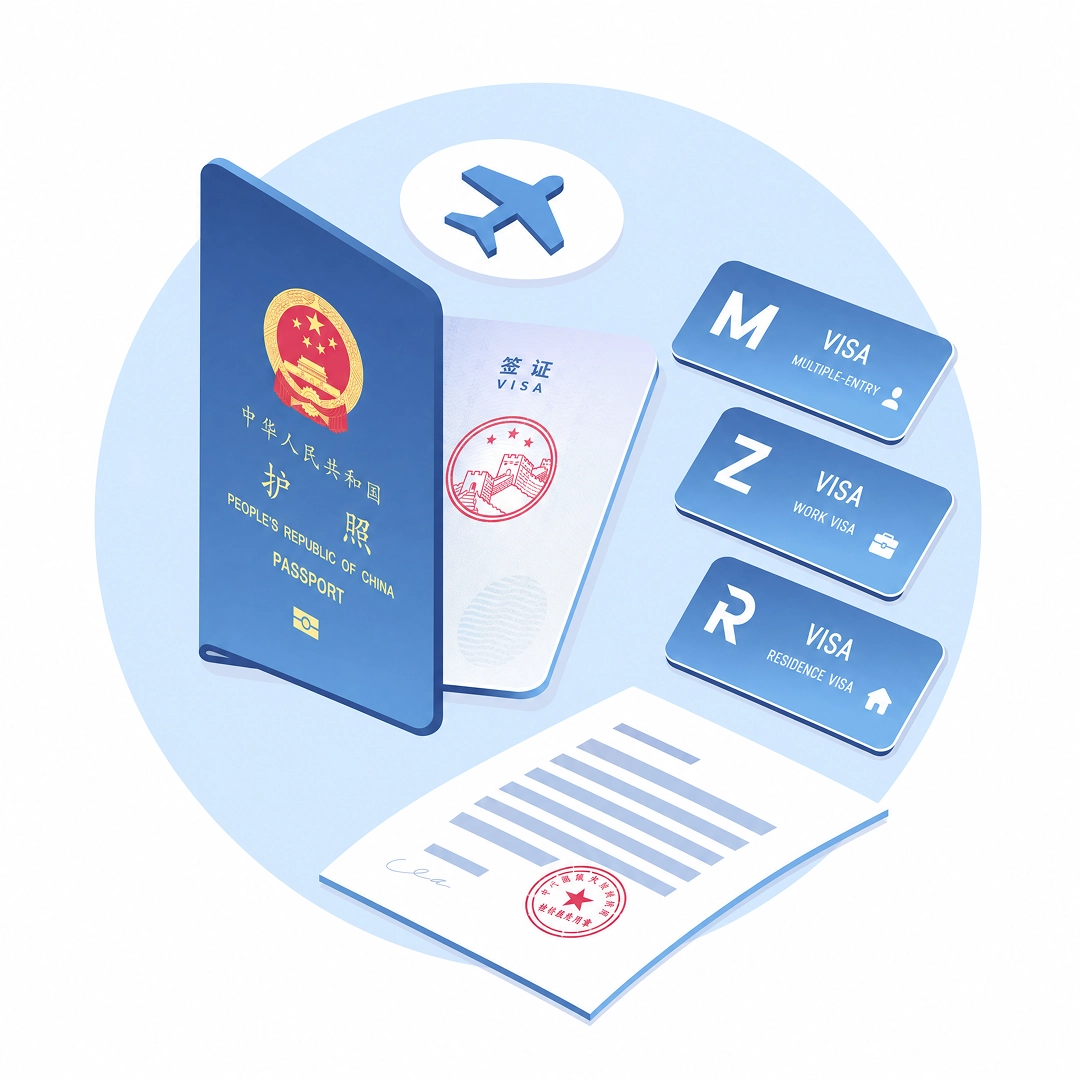


A trip described as “business” can land under any of three visa categories in China, and the categories are not interchangeable. Choosing the wrong letter is not a filing error to be corrected later — at its worst it ends in removal from the country. This guide sorts out which letter belongs to which trip.
Note: everything below concerns mainland China. Hong Kong and Macau operate their own immigration regimes, so an M, Z or R visa carries no weight at the SAR border.
When no visa is needed at all
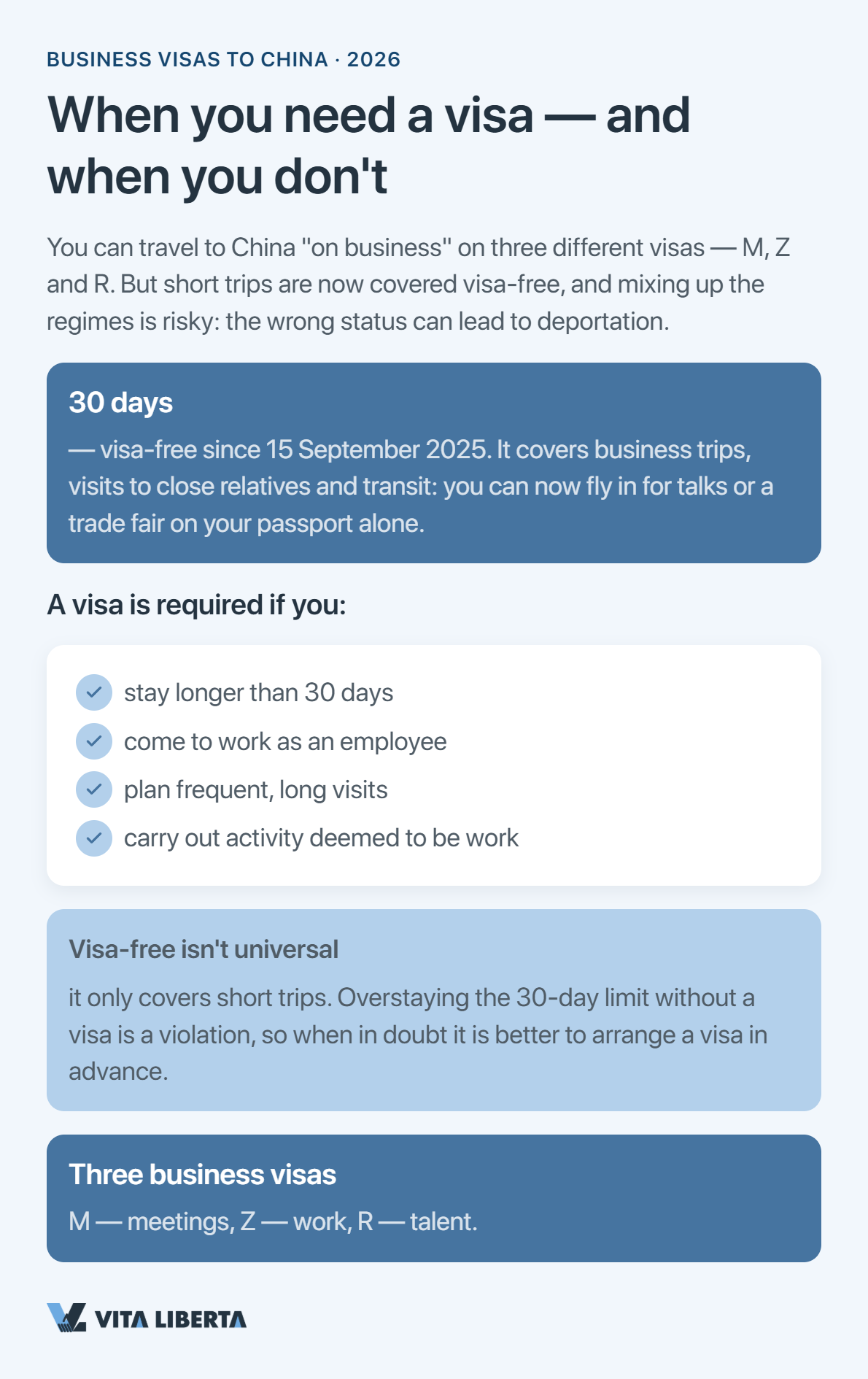
China’s unilateral visa-free scheme now extends to roughly 50 nationalities. Where it applies, an ordinary passport is enough on its own, the cap on the stay is 30 days, and the permitted purposes are broad: tourism, commercial visits, seeing family, transit. In practice that strips the paperwork out of short trips — two days of talks, or a week at a trade fair, no longer needs a consulate appointment at all.
The exemption has limits, though. A visa is still required once you:
- stay past the 30-day ceiling;
- arrive to take up paid employment;
- expect a pattern of frequent, drawn-out visits;
- do anything a border officer would read as work.
Day 31 without a visa in the passport puts you in breach, with penalties attached. On any itinerary that sits close to the line, the sensible economics point towards applying beforehand.
M visa: meetings and negotiations
Commercial travel that involves no employer-employee relationship in China belongs in this category.
Sub-types and the entry window
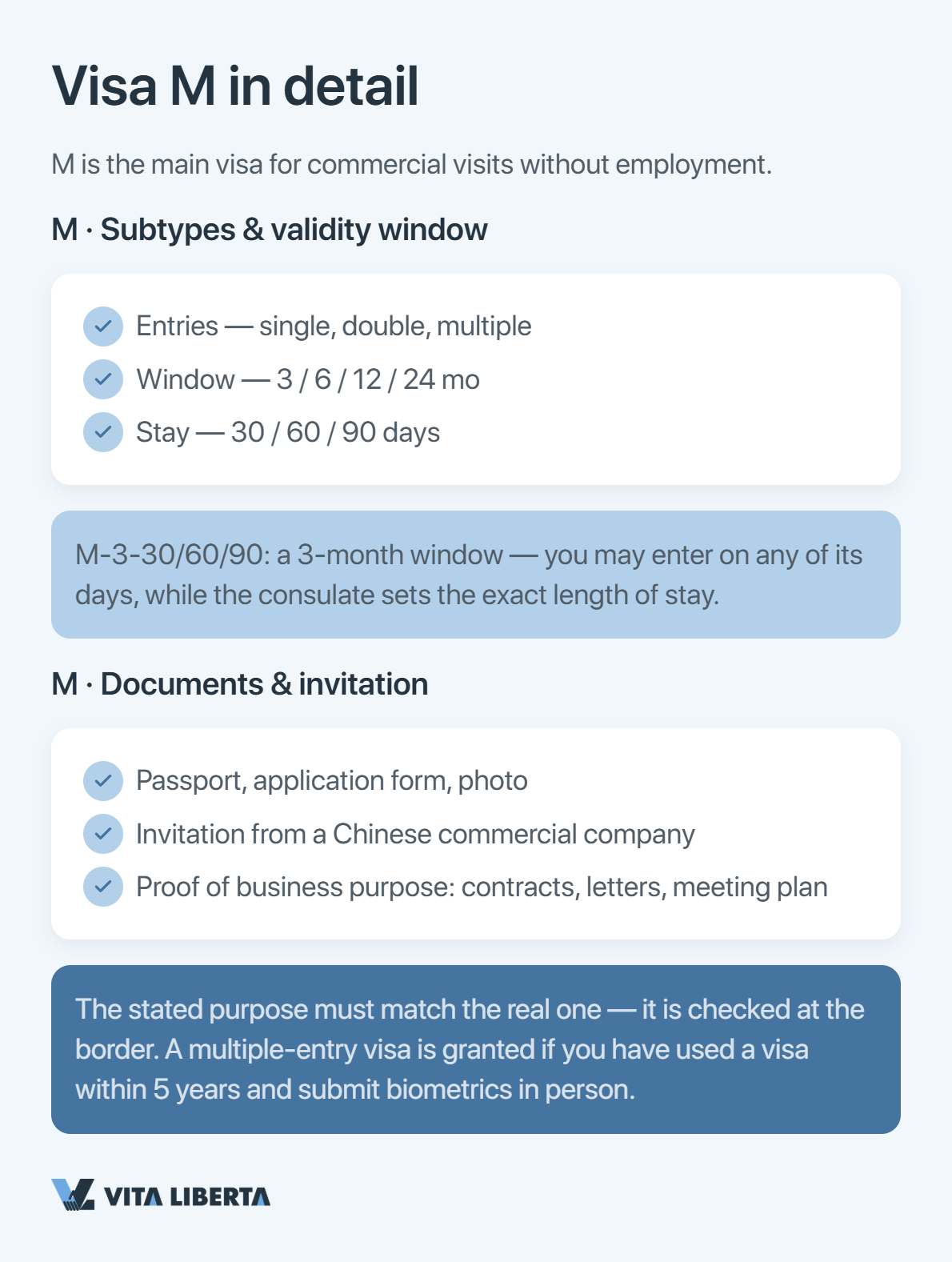
Three formats exist — single, double and multiple entry — and each carries two independent numbers. The first is the validity window: 3, 6, 12 or 24 months. The second is the stay: 30, 60 or 90 days. So “M-3-30/60/90” describes a three-month period in which entry may happen on any date, with the consulate, not the traveller, fixing how many days that entry buys. Two conditions gate the multiple-entry format — at least one Chinese visa used within the past five years, and submission in person, since biometrics are taken (and then retained for five years).
Documents and the invitation letter
Five things make up the file: passport, completed form, photograph, an invitation letter issued by a Chinese commercial company, and proof that the visit is genuinely commercial — contracts, correspondence, a meeting schedule. That last element matters more than applicants expect, because the declared purpose is checked against the actual one on arrival. Applicants operating as sole traders substitute a company extract and evidence of account balance where an employer’s letter would otherwise go.
Z visa: taking a job in China
Employment rests on one visa only. Without a Z visa — or an R visa, covered below — there is no lawful way to sit on a Chinese payroll.
Work permit and residence permit
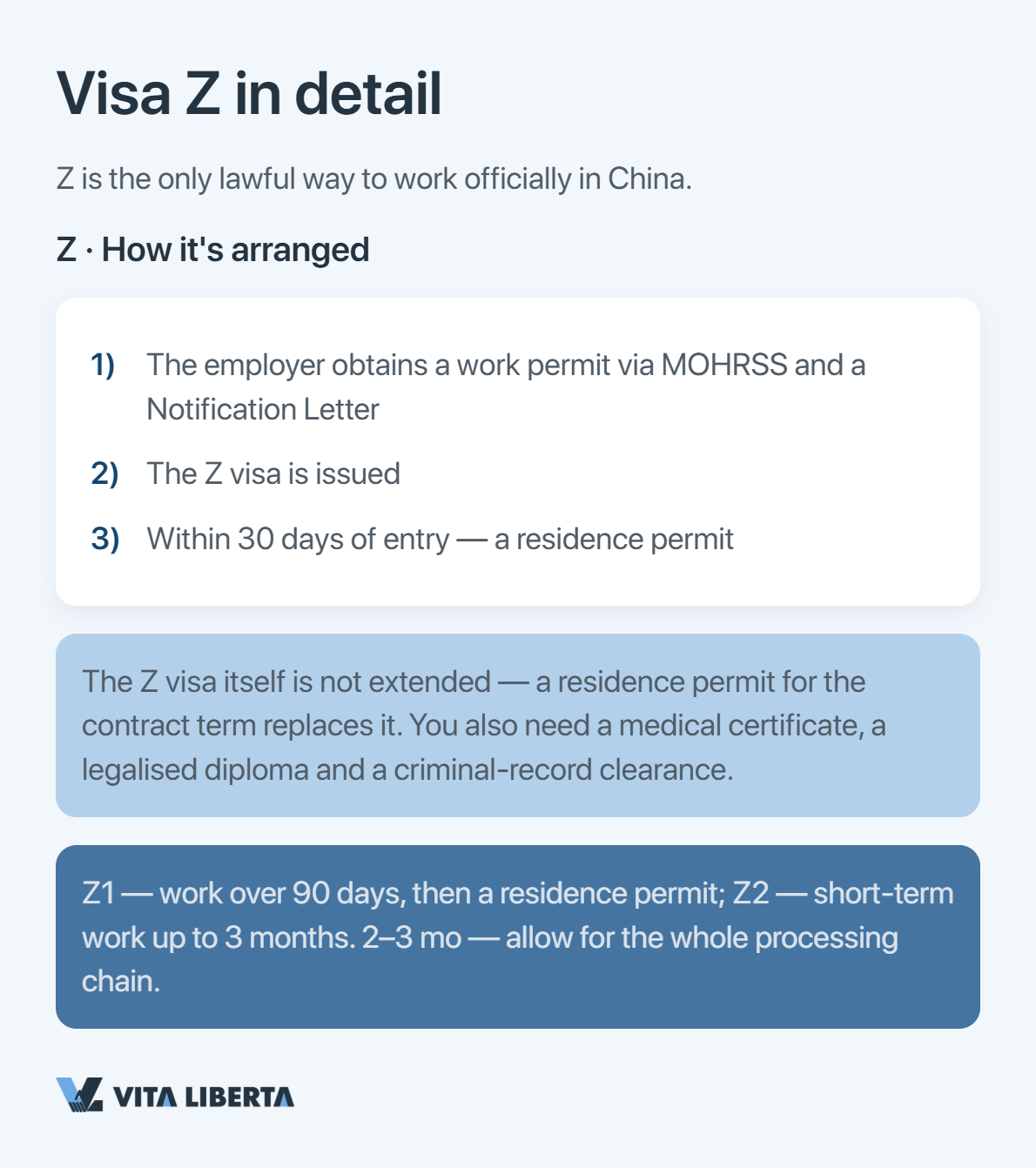
The sequence starts with the employer, not with you. Through the MOHRSS system the company applies for a work permit and receives a Notification Letter of Foreigner’s Work Permit; the Z visa is then issued against that letter, and never ahead of it. The visa gets you across the border — at which point a clock starts running: 30 days to appear at the local Public Security Bureau and exchange it for a residence permit. Extension was never part of the design, because from that moment your status is carried by the residence permit, issued for the term of the contract.
Supporting paperwork adds time of its own — a medical certificate, plus a diploma and a criminal-record check that have both been through legalisation. Realistically, budget 2–3 months for the full chain.
Z1 and Z2
The split is purely one of duration. Anything running beyond 90 days falls under Z1 and feeds into a residence permit; work capped at three months is a Z2. Neither escapes the work permit requirement — what differs is how long the resulting status lasts.
R visa: talent and scarce specialists
R is the category held for senior specialists and exceptional talent, and admission to it is decided by score rather than job title. Applicants are graded A, B or C under a points system, and that grade is what sets the length of the residence permit.
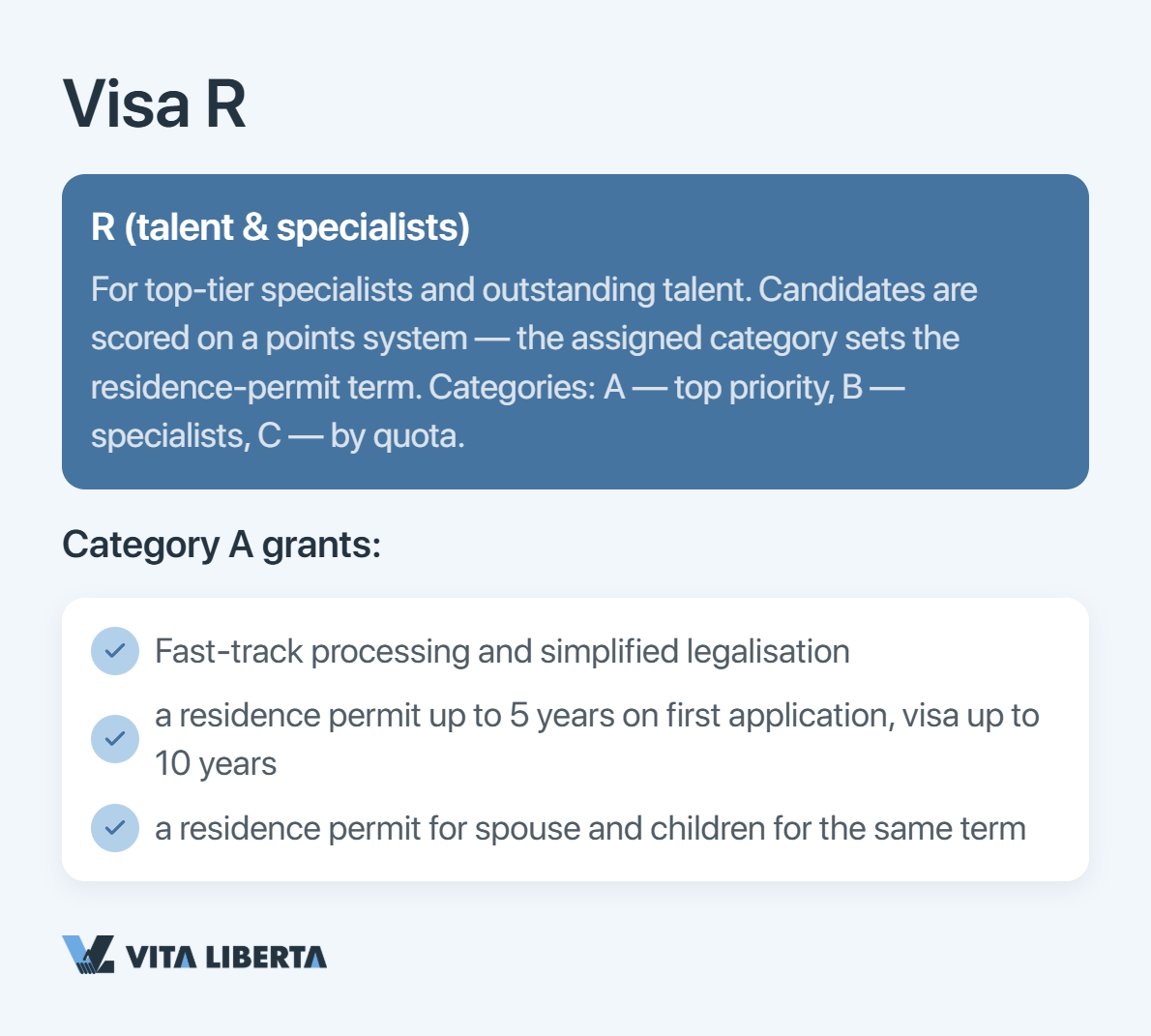
Grade A is where the advantages concentrate: processing moves faster, document legalisation is lighter, and a residence permit of up to five years is granted on the very first application, with visa validity that can stretch to 10 years. Family follows more easily as well — a spouse and children can be placed on residence for that same term.
Not sure which visa to apply for?
- Right visa type for your purpose
- We review your documents
- M, Z or R — sorted together

M, Z and R side by side
| M visa | Z visa | R visa | |
| Typical holder | company representatives, owners, buyers | staff hired onto a Chinese payroll | senior experts, in-demand specialists |
| What it covers | meetings, negotiations, trade fairs | employment under contract | employment under contract |
| Paid work allowed | no | yes | yes |
| Length of status | 30–90 days per entry | contract term, via residence permit | up to 5 years’ residence, visa up to 10 |
| Work permit needed | no | yes, obtained first by the employer | yes, obtained first by the employer |
How to choose
Work backwards from two facts about the trip — how long, and whether anyone is paying you inside China:
- brief visit, no work performed → visa-free entry, or an M visa;
- a job with a Chinese employer → Z;
- senior expertise and a long-term move → R.
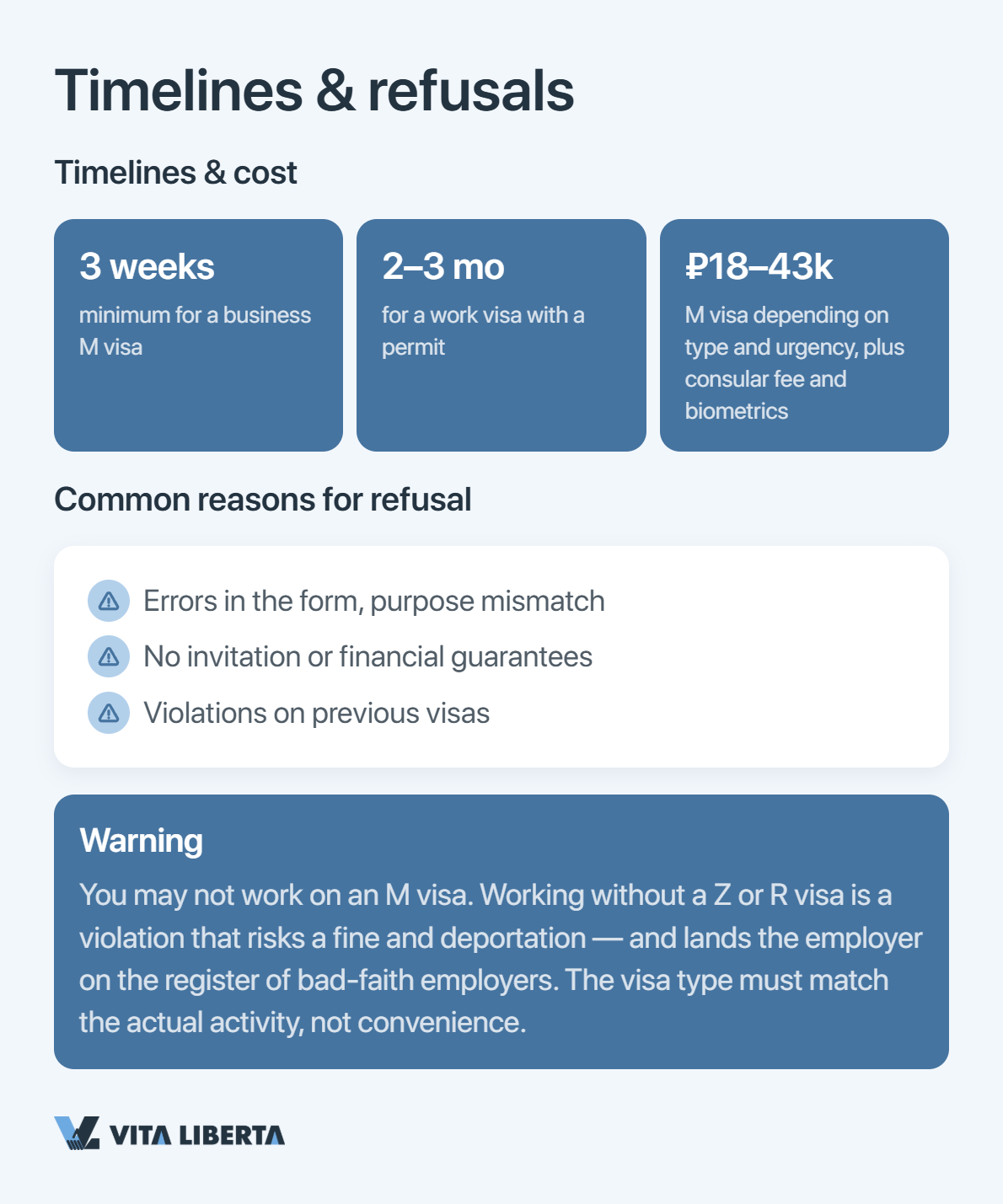
⚠️ Important: an M visa does not carry the right to work. Performing work without a Z or R visa exposes the individual to a fine and removal from the country, and puts the employer on the register of non-compliant hirers.
Timing, cost and refusals
Allow three weeks minimum for a business visa ahead of departure. A work visa is a different order of magnitude — plan on 2–3 months, since the work permit has to be secured before the visa file can even open. What you pay turns on nationality and the number of entries requested; where applications route through a CVASC, the service-centre charge sits on top of the consular fee, and multiple entry costs more than single. As for refusals, the recurring causes are familiar: errors on the form, a declared purpose that doesn’t line up with the trip, an invitation or guarantee that never arrived, and a record of breaches on earlier visas.
“The most expensive mistake a business owner makes is trying to work on a business visa. The weeks saved by skipping the Z process turn into deportation and a closed border. The visa type has to match the real activity, not what’s convenient.”
— Sergey Konon, China immigration consultant
Meetings and negotiations sit with M, employment with Z, talent and relocation with R. Narrowing that down takes two answers: the number of days involved, and whether any work will be performed while you are there. Get the character of the trip clear before anything else, choose the letter that corresponds to it, and make sure the purpose on the application is the purpose you carry out.
Need a China business visa?
- Help with invitation and visa
- Support at every stage
- Faster document processing

FAQ
Business travel by owners and company representatives falls to M. Where a Chinese employer has invited a foreign specialist to work, the correct letter is Z. R is reserved for experts at a senior level of qualification and presupposes an employment contract.
The M category. It was designed for commercial visits — working through deals, meeting partners, inspecting production sites, sourcing equipment, attending fairs such as the Canton Fair — and is issued on the strength of an invitation from the host party. It confers no right to work.
Yes. Legal employment is built on the Z visa, and the work permit and residence permit are both issued off the back of it. In practice the steps run in a fixed order: an invitation from the employer, entry on the Z visa, and then a filing made by the company with the relevant authorities.
Two groups: professionals at the senior end of their field, and specialists in occupations where the country faces a shortage. The category exists as a preferential route for expertise the economy places unusual value on, and applicants are generally expected to hold both strong qualifications and a signed contract.
No. Business activity is permitted — attending meetings, conducting negotiations — while employment is not. Since the purpose stated on the application can be checked against what the holder is actually doing in the country, anyone taking a job needs a Z visa instead.