Hongkong
 China




Every day, hundreds of businesses type “China export license” into a search bar. For four years now, no Chinese authority has handed a company a document carrying that name. Containers still wait at the terminal all the same.
Picture the old system as a gate with a queue. Until recently, you first had to earn the title of foreign trade operator, and only then could you ship anything. The queue has been dismantled, but the gate is still there. It now inspects what sits inside the container rather than who sent it.
If you are reading this from Hong Kong, keep in mind that the rules below are mainland rules. Hong Kong is a customs territory of its own: its strategic goods controls sit in Cap. 60G, and permits there come from the Trade and Industry Department.
The core problem:
“Our WFOE is in Ningbo. The business license is issued and the bank account works. Now the forwarder wants a scan of our export license, our lawyer says there’s no such thing, and the supplier claims customs won’t release the cargo without it. Who’s right, and what am I actually supposed to obtain?”
Each of them is right about something, and that is why foreign exporters keep running into this question. Let’s sort out what was scrapped, what still binds you and where a license is a real requirement.
There Is No Longer a Company-Level Export License in China
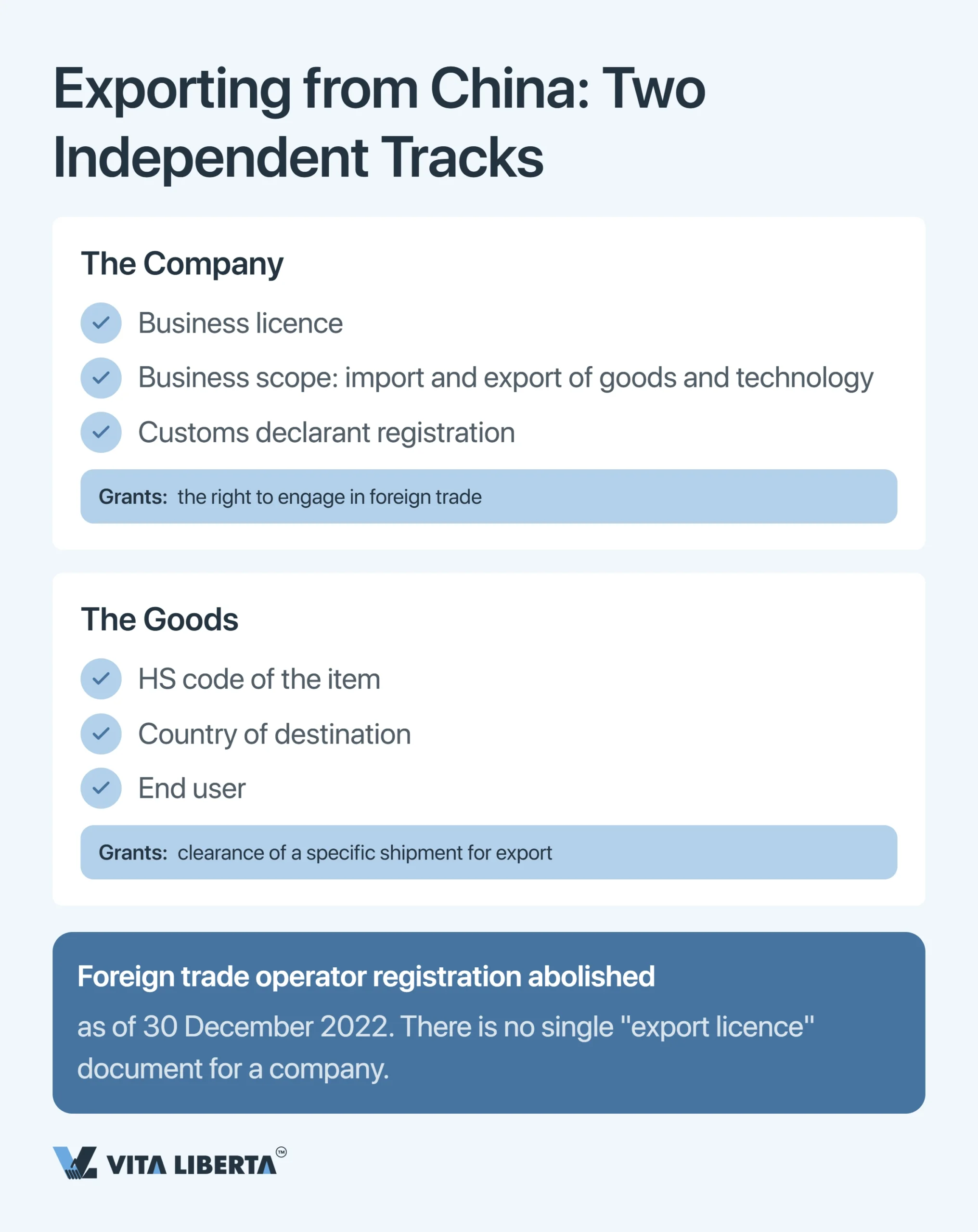
Forget the idea of one master permit. The old operator status has been replaced by two separate tracks: your company’s right to trade, and the clearance of each specific shipment.
Export Rights Come with the Business License
The turning point came on 30 December 2022, when the NPC Standing Committee struck Article 9 out of the Foreign Trade Law (中华人民共和国对外贸易法). That clause had obliged every trader to sign up with the foreign trade authority. The amendment applied from the moment it was published.
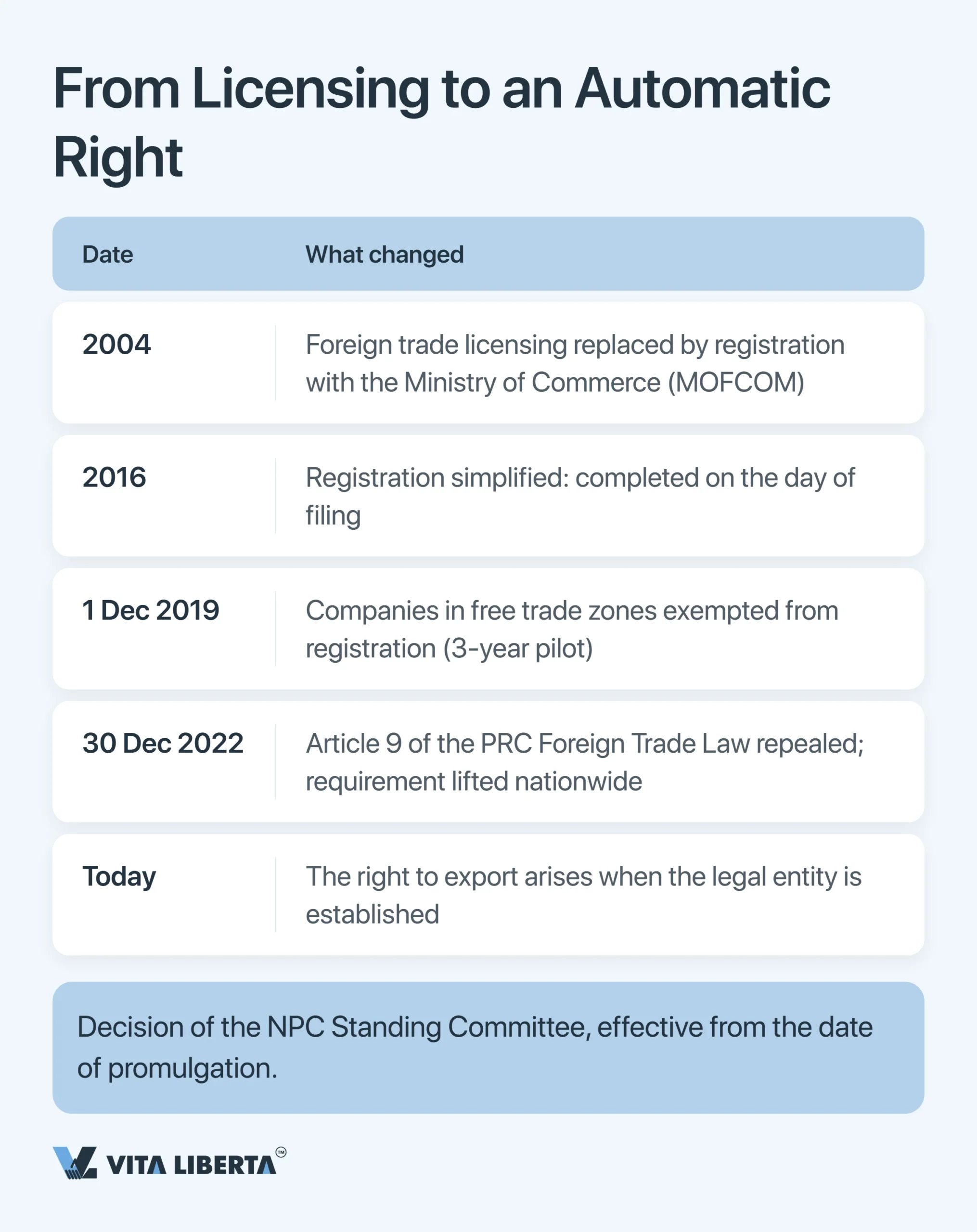
A fully revised version of the law (主席令第六十七号, Presidential Order No. 67) was passed on 27 December 2025 and has governed since 1 March 2026. It kept the old filing dead. Under Article 11, anyone already registered as a market entity counts as a foreign trade operator.
Looking back, each step pointed the same way:
- Licensing gave way to simple registration in 2004.
- Firms in pilot free trade zones got a three-year exemption from that registration starting 1 December 2019 (国发〔2019〕25号).
- At the end of 2022, the exemption became the national rule.
Put simply, a legal entity now has the right to export by the fact of being created. Nobody grants it as a separate status.
A tip with a safety margin: look at the business scope (经营范围, jingying fanwei) printed on your license. Add goods and technology import and export (货物进出口; 技术进出口) before you need it. If exporting isn’t covered, changing the scope through SAMR later will cost you time.
Customs Registration: The Step Most Often Skipped
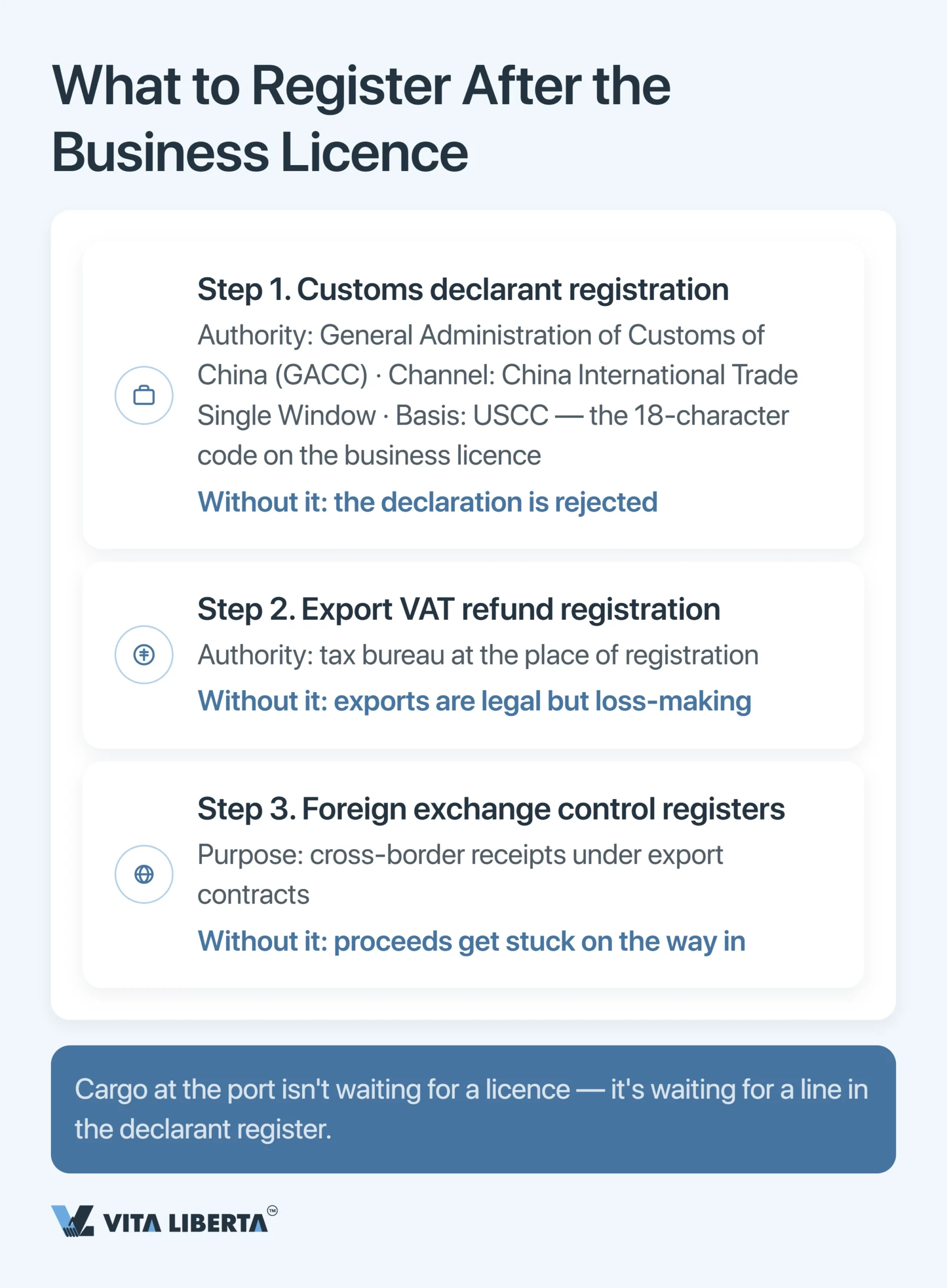
The operator status is gone, but your customs record is not. International firms that haven’t adapted their routines to Chinese practice pay a high price here. They assume the business license makes them exporters and find out otherwise when the first declaration is due. Three filings remain on your list:
- Customs declarant record. You file it with the General Administration of Customs (GACC Order No. 253, 中华人民共和国海关报关单位备案管理规定, effective since 1 January 2022) through China International Trade Single Window. The company is identified by its 18-character USCC from the business license. Another route is to tick the declarant box when SAMR registers the company under its “multiple certificates in one” (多证合一) scheme.
- Export VAT rebate filing (出口退(免)税备案) at your local tax bureau. Skip it, and your exports stay legal but lose money.
- Trade FX enterprise list (贸易外汇收支企业名录), which lets you receive cross-border payments under export contracts. Since 1 June 2024, your servicing bank handles this filing instead of SAFE (汇发〔2024〕11号). Get it done before the first payment.
Important: without a customs record, an export declaration simply cannot be submitted. In our Ningbo example, the cargo is not held up by a missing license. It is waiting for an entry in the declarant register. Until your own record is live, the only way to ship is through an agent: a trading company exporting on your behalf.
Let Us Set Up Your Company’s Export Access in China
- Business scope check
- Single Window registration
- VAT rebate filing

Licensing Targets the Product, Not the Company
Permits in China attach to two things: the HS code and the destination country. One exporter can ship item A without asking anyone, yet still need an official decision for item B right next to it in the tariff.
The Export License Catalogue: Quotas, Tenders and MOFCOM Permits
Each year, MOFCOM and GACC jointly revise the lists of goods whose export is restricted.
- 2026 edition. The catalogue (出口许可证管理货物目录(2026年)) came with Announcement No. 89 of 2025 (商务部 海关总署公告2025年第89号). From 1 January 2026, it names 43 kinds of goods.
- Steel. Steel got its own regime on the same date: about 300 steel products now need a license as well (商务部 海关总署公告2025年第79号).
- Quotas. Not everything goes through permits. Some volumes are handed out as quotas, either directly or by tender. In 2026, tenders decide the quotas for licorice, rush (蔺草) and articles made of them.
One misconception deserves a warning. Online guides keep naming SAMR as the keeper of these lists, sometimes glossing it as an “administration for foreign trade relations”. It is neither: SAMR regulates markets and plays no role in export licensing catalogues. Believe the myth, and you file with the wrong agency and lose a month.
Bottom line: start by matching your HS code against this year’s catalogue. The paperwork comes after.
Dual-Use Items: Order No. 792 and the Unified Control List
The core instrument here is State Council Order No. 792 (中华人民共和国两用物项出口管制条例, 国令第792号). It is dated 30 September 2024, was published three weeks later on 19 October, and has governed dual-use exports since 1 December 2024.
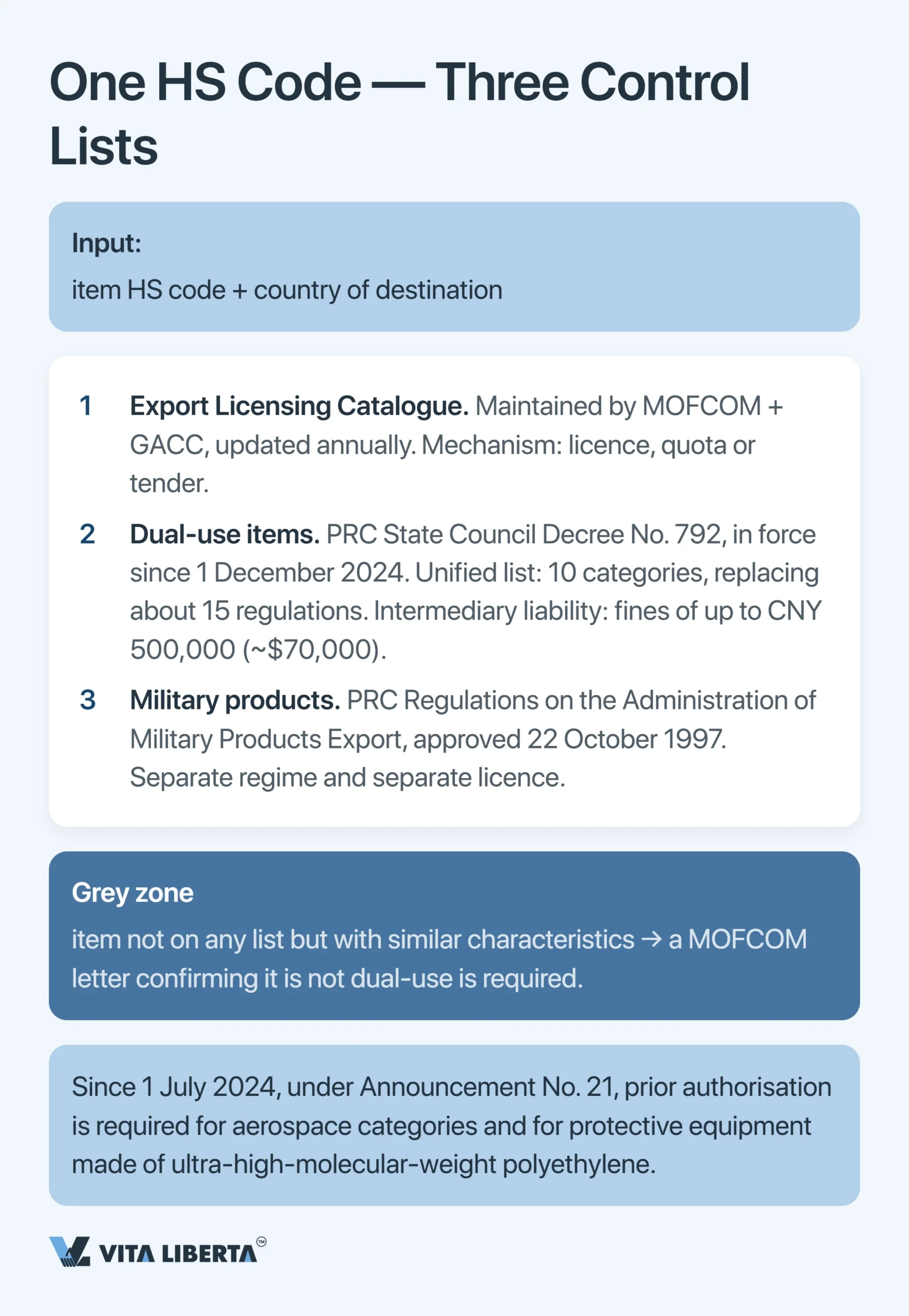
MOFCOM’s unified control list (商务部公告2024年第51号) took effect alongside it. The list covers 10 sectors and 5 item types. It pulls together, under one code system, items that used to be spread across rules of different rank. Being off the list is no guarantee, though: MOFCOM can impose temporary controls of up to two years on unlisted items.
Order 792 builds on the Export Control Law and widens the circle of responsible parties. Any of the following that suspects an illegal export has to tell MOFCOM: an agent, forwarder or carrier, a postal or courier operator, a customs broker, an e-commerce platform or a bank. Staying silent can mean a warning and a fine of up to RMB 100,000; serious cases run from RMB 100,000 to 500,000.
MOFCOM may even reach re-exports. That means foreign-made goods that contain Chinese dual-use parts or were built with Chinese technology.
Two Acts Above the List: The Military Regime and the 2024 Threshold
Arms are handled outside the dual-use system altogether, with a separate regime and license under a separate act (中华人民共和国军品出口管理条例).
- The State Council and the Central Military Commission issued it together on 22 October 1997. The text amended on 15 October 2002 is current.
- Old does not mean dormant: the act is applied.
- Military goods may leave China only through licensed military trading companies, and every contract is approved one by one. An ordinary WFOE has no way in.
On the civilian side, the line moved on 1 July 2024. The basis is a joint announcement of MOFCOM, GACC and the CMC Equipment Development Department (商务部 海关总署 中央军委装备发展部公告2024年第21号, signed 30 May 2024). Since then, you need a license to export:
- equipment, software and technology used to make aerospace structures and engines;
- several items linked to UHMWPE (ultra-high-molecular-weight polyethylene) fiber.
Ready-made armor from that fiber (helmets, vests, plates) counts as military. Verify such goods against the current edition of the unified list. Ship one without a permit, and the container doesn’t just run late: it stays at the terminal.
The risk people underestimate most sits beside the list. Say your product isn’t named on it, yet its specs come close. Customs can then open a query (质疑), ask for the contract and technical data, and send the goods to MOFCOM for assessment. Nothing moves until MOFCOM answers.
You can head this off. If you can’t classify the item yourself, write to MOFCOM first, describing its specs and what it will be used for.
The Application Package: 5 Data Blocks and 45 Working Days
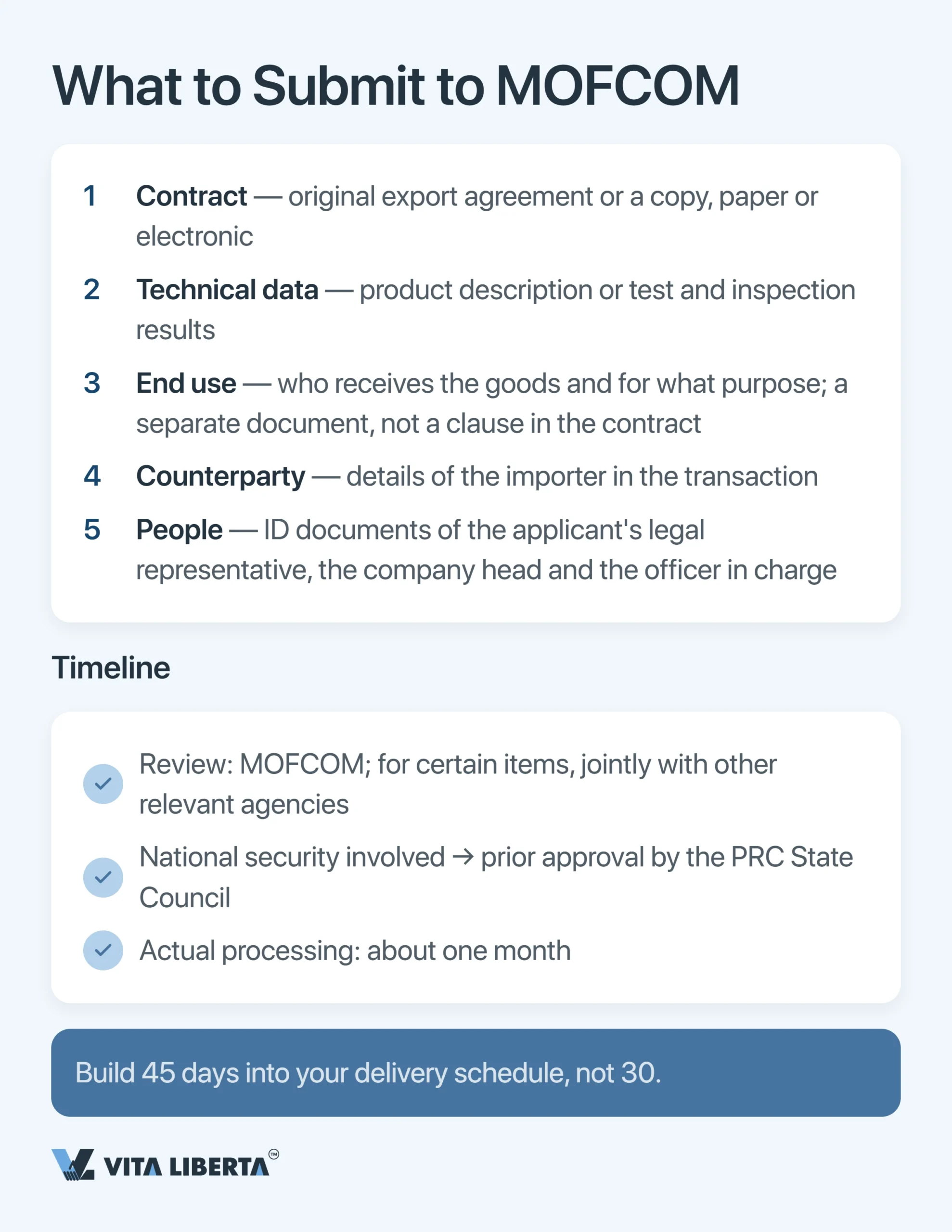
Article 16 of Order 792 shapes the file around whoever ends up using the goods, not around you as the applicant. MOFCOM expects:
- Deal evidence: a copy of the export contract or agreement, or other proof of the transaction.
- Technical file: a description of the item, or its test and assessment results.
- End-use proof: a standalone document stating who gets the goods and why. A clause in the contract won’t do.
- Importer details, if MOFCOM asks for them.
- IDs of the legal representative filing the application, the company head and the person in charge of the export.
What happens next depends on the item:
- MOFCOM alone. Some applications are settled by MOFCOM by itself.
- Joint review. For others, MOFCOM brings in fellow agencies and the review turns joint.
- National security. Where national security is touched, the State Council (sometimes together with the CMC) has to sign off, and no deadline applies.
Otherwise, MOFCOM has 45 working days, roughly two months on the calendar. The clock stops for assessments, expert consultations and site visits. Plan on at least two to three months in your delivery schedule.
| License type | Under the rules | In practice |
| Individual license | Single export to one end user; valid for up to one year | Shipping later but within validity needs no new license. Switching the item, country, end user or end use means applying again; other changes go through reissue, which takes 20 working days |
| General license | Repeated exports to one or more end users over up to three years | Within reach for exporters with working internal compliance and a shipment history; first-timers don’t get one |
| Registration-based certificate | Shipment data registered before each export; limited to listed cases such as repairs, tests, exhibitions or civil aircraft spare parts | Saves time, not paperwork: you still disclose the data |
Export VAT Rebate: A Filter That Costs More Than the License
The permit decides whether goods leave; the rebate decides what they cost. Since 1 April 2019, the top rate has been 13% (财政部 税务总局 海关总署公告2019年第39号). Targeted cuts followed:
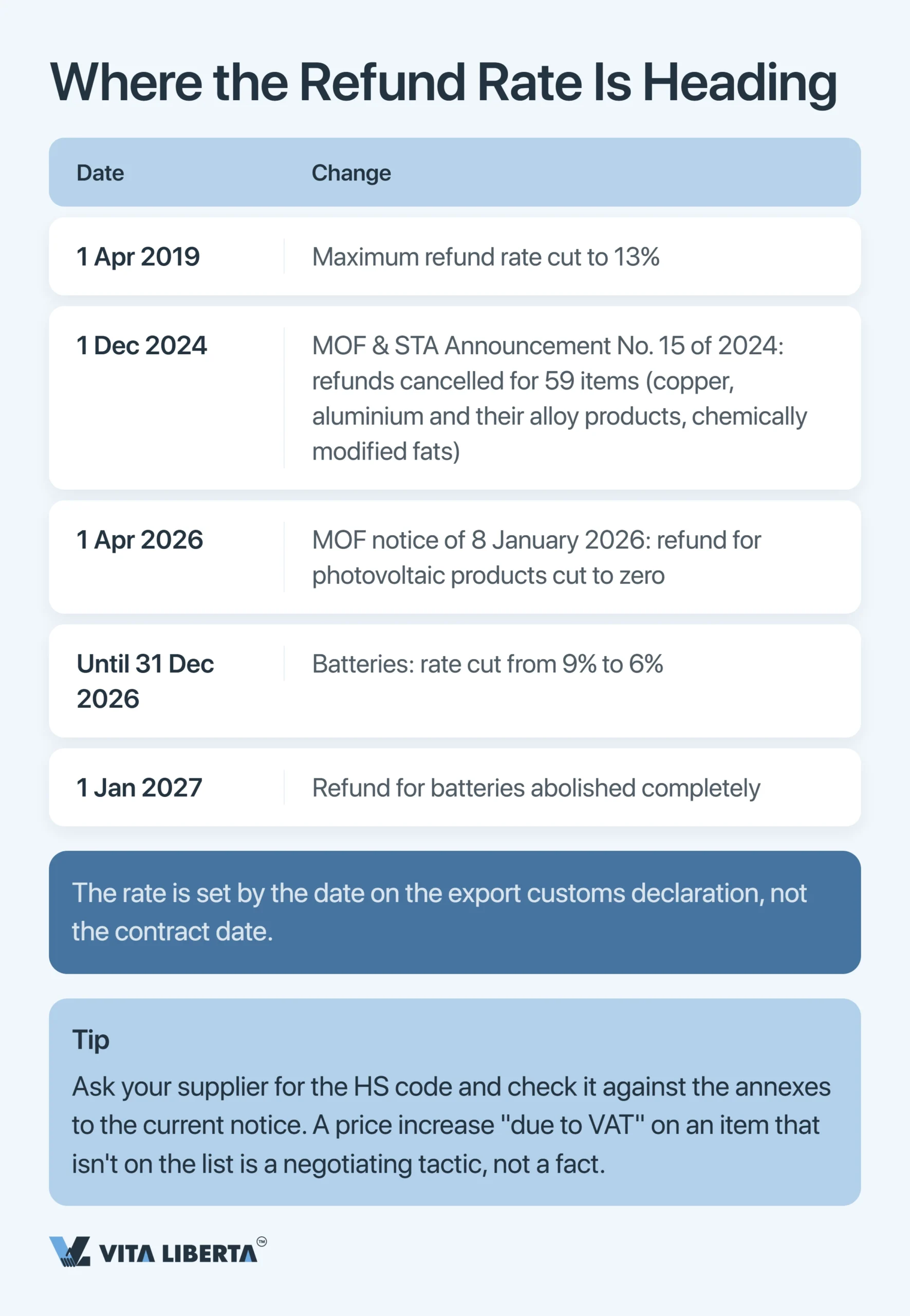
- From 1 December 2024 (MOF/STA Announcement No. 15, 财政部 税务总局公告2024年第15号): no rebate at all on 59 items, namely copper and aluminum goods and their alloys, plus chemically modified fats. The same announcement lowered the rate from 13% to 9% on 209 items, photovoltaic products and batteries among them.
- The 8 January 2026 notice (财政部 税务总局公告2026年第2号): photovoltaic products lose the rebate entirely from 1 April 2026. Batteries go from 9% to 6% between 1 April and 31 December 2026 and lose it altogether on 1 January 2027.
Which rate you get depends on the export date shown in the customs declaration. The contract date is irrelevant.
Bottom line: get the HS code from your supplier before you sign, and look for it in the annexes of the current notice. If it isn’t there, a “VAT-driven” price rise is a bargaining move, not a fact.
Check Your Product Against China’s Export Controls in Advance
- HS code screening against control lists
- MOFCOM application package
- Timeline planning for your contract
China Export License: Strategic Takeaways
Here lies the paradox. In ten years, getting into China’s foreign trade has become barrier-free. Meanwhile, control over single product lines has grown strict enough to make forwarders personally liable.
The revised Foreign Trade Law, in force from 1 March 2026, goes further. Forwarders, customs brokers, warehouses and trading platforms may not help anyone dodge Chinese countermeasures, on pain of fines of up to RMB 500,000. Entry got cheap; a mistake in four digits of an HS code got expensive.
- Rights belong to the company, permits to the goods. The right business scope plus a customs record settles access.
- Every permit question starts with classification. One code is checked against the license catalogue, the dual-use list and the rebate lists.
- Time can be managed. Write the 45 working days of review, plus assessment time, into the contract instead of discovering them a week before loading.
China’s permit set is no longer an entry barrier; it is a lever on cost and lead time. Know your code, and you can negotiate with suppliers and plan logistics. Hunt for a single “export license”, and you are chasing a document that doesn’t exist.
5 Key Questions About Getting an Export License in China
The term covers three very different things on the market: evidence that your company is on file with customs as a declarant; a MOFCOM permit for one controlled item; just the supplier’s ability to export. Ask which one they mean. For an ordinary product, your customs registration data and USCC are what they need.
Not necessarily. When the specs come close to controlled items, customs can query the shipment and pass it to MOFCOM for assessment. The goods stay put until the answer comes. If you ship electronics, machine tools, chemicals or composites, consult MOFCOM before you book the vessel.
Your company’s right to trade abroad comes with the legal entity itself, but the business scope should list import and export of goods. Update the 经营范围 through SAMR first, then register with customs. No declaration can go out in the company’s name before that.
General licenses cover repeated shipments over three years and assume a track record and in-house export controls. Begin with an individual license for one contract, and meanwhile build the file you’ll need to qualify for the general regime.
Both lists are set by regulation: Announcement No. 15 of 2024 (财政部 税务总局公告2024年第15号) ended the rebate on 59 items from 1 December 2024. The MOF/STA notice of 8 January 2026 (财政部 税务总局公告2026年第2号) brought photovoltaics to zero from 1 April 2026. Batteries drop from 9% to 6% until 31 December 2026, with no rebate at all from 1 January 2027. Check the HS code against the annexes. If it’s missing, ask the supplier to justify the increase.