Hongkong
 China




Ten years ago, an investor choosing a sector in China often learned about a barrier only from a rejection letter. That guessing game is over: the rules are published up front. The shift dates to 2020. On 1 January that year the Foreign Investment Law came into force (中华人民共和国外商投资法, FIL; Presidential Order No. 26). Ever since, access for foreign money has rested on two ideas: national treatment, and a single public list of the cases where that treatment doesn’t apply.
The key problem:
“We spent six months preparing a manufacturing project in Ningbo as a joint venture — we were sure a foreigner had no other option. At registration it turned out our industry had been 100% open for a long time. The Chinese partner was now redundant in the structure, but getting him out means more months and more money.”
Founders who worked from an out-of-date version of the list bring us this exact situation more often than almost any other.
How the negative list decides who gets in
The principle is short. If the list doesn’t mention your business, the rules written for Chinese companies apply to you as well. If it does, you’re in special territory. Below are both scenarios and a way to read the document without tripping.
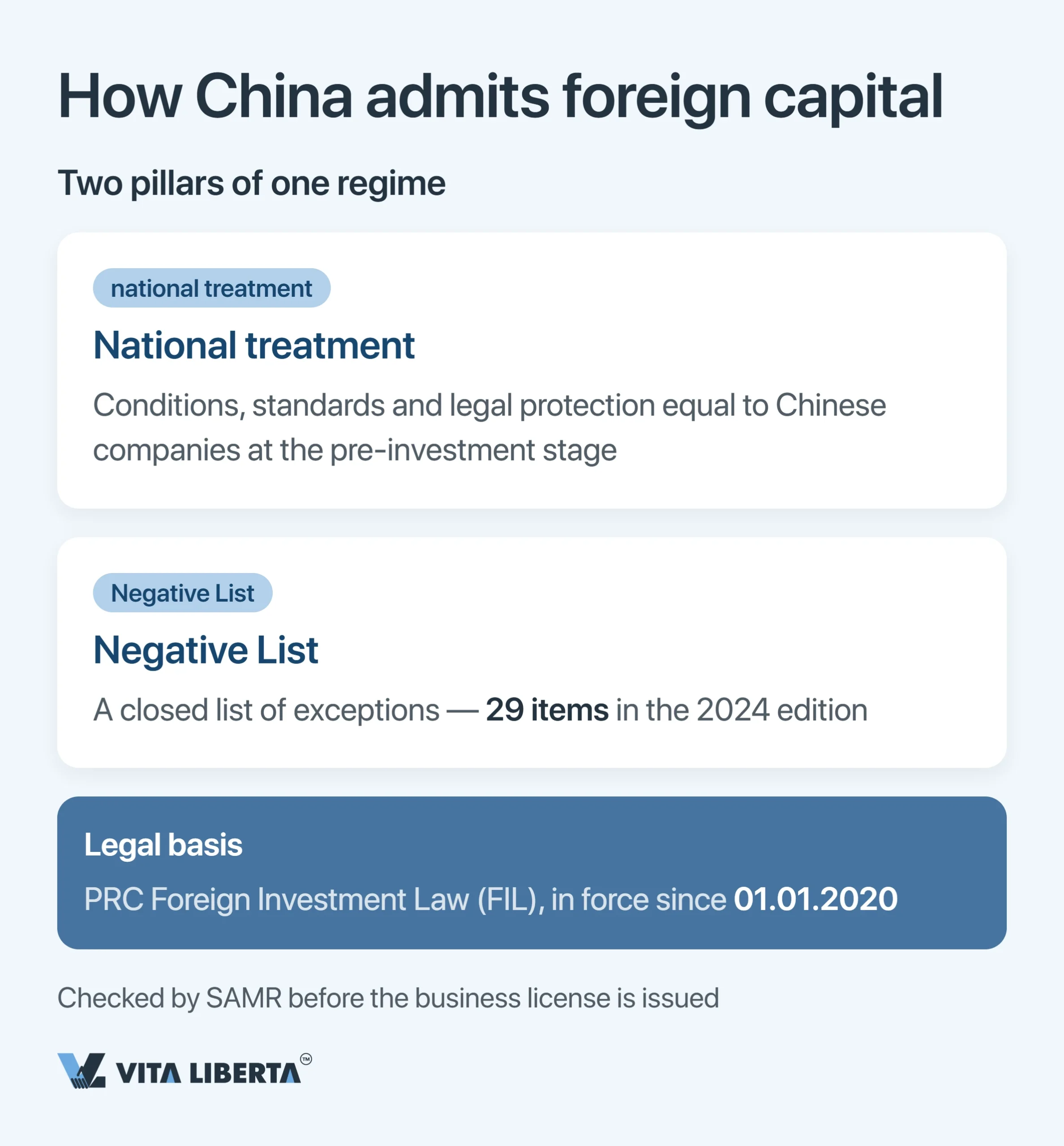
National treatment plus a negative list
Think of national treatment as a promise made before you invest: whatever standards and legal protection a Chinese founder gets, you get too. The list marks the places where that promise is suspended, and it does its work at the entrance, not later. Picture a project that falls into a listed sector but misses the condition written next to it. The outcome is simple: no permit, no company registration. This isn’t an interpretation — item 4 of the notes accompanying the list says it in plain terms. Who does the registering? Local market regulators, part of the SAMR system (国家市场监督管理总局). If your activity is absent from the list, nothing special happens. You file like any domestic founder, and the registration system passes your investment information on to the commerce authorities (Article 34 of the FIL).
Prohibited vs restricted: two different doors
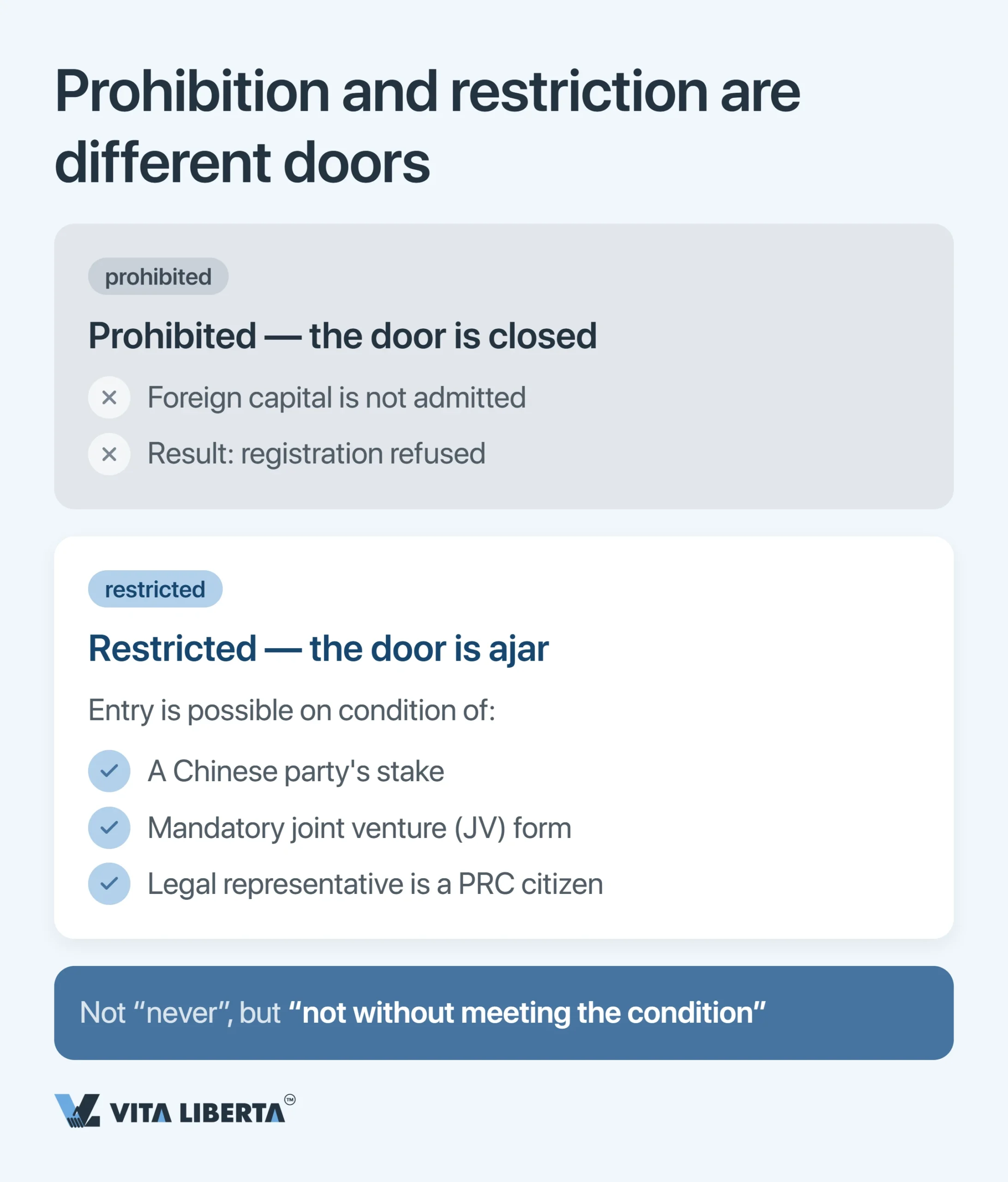
Two kinds of exception live on the list, and treating one as the other is an expensive error. The first kind is a closed door. Foreign capital simply has no way in, and an application to register will be rejected. The second kind is a door you can open with the right key. That key might be a share kept for a Chinese co-owner, a requirement to set up as a joint venture (JV), or a Chinese citizen in the role of legal representative. One more side effect: wherever ownership terms apply, you lose the option of a foreign-invested partnership (外商投资合伙企业). So the first thing to settle is whether you’re looking at a “never” or an “only if”.
Fully closed industries: where you will be refused
Bans form the hard core of the list. When the list gets shorter, they are the items touched last, because they protect what the state treats as matters of security and ideology.
Strategic and sensitive sectors
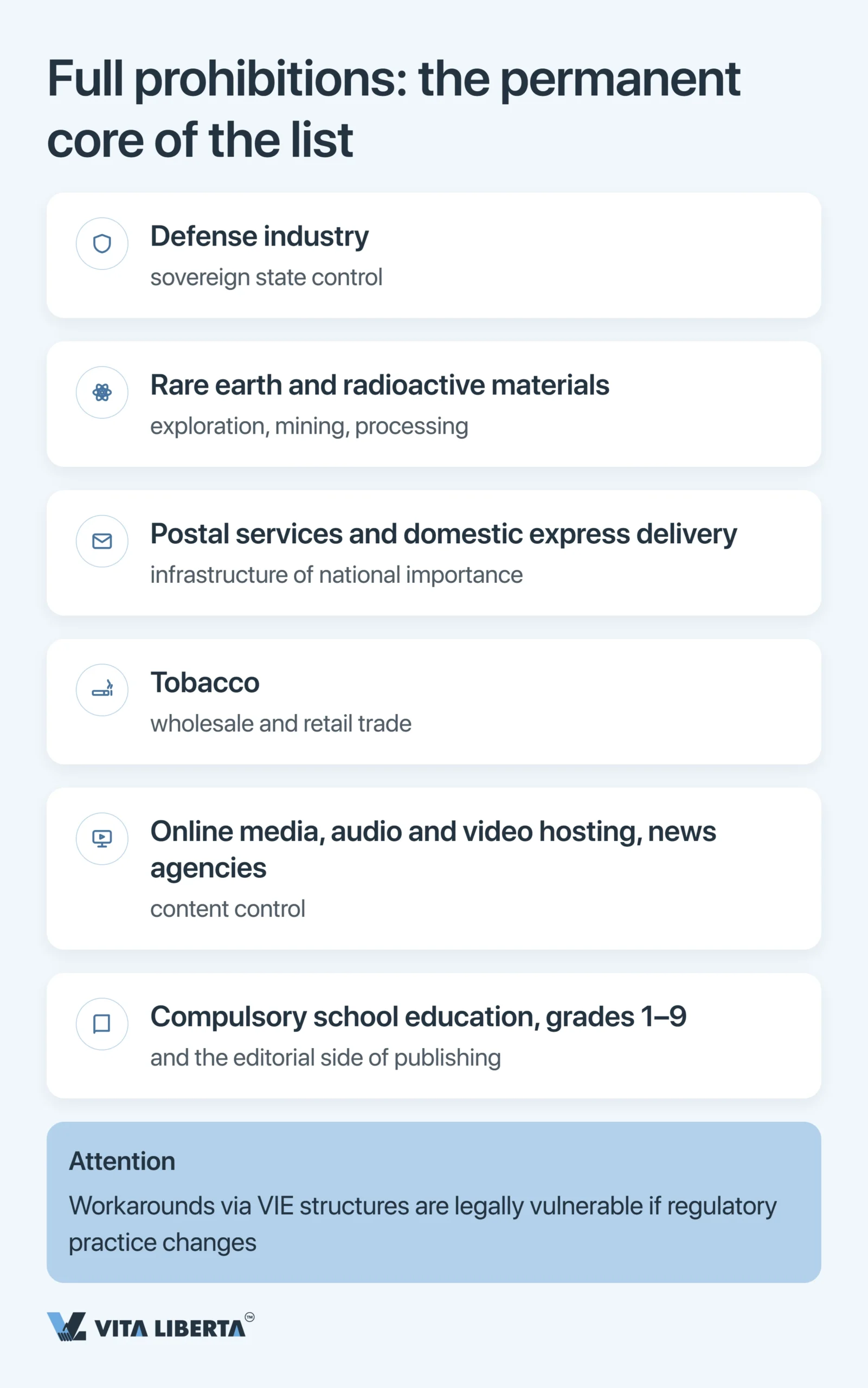
Start with what lies underground. Tungsten, rare earth metals and radioactive minerals are all out of reach for foreign owners, along the whole chain — from searching for deposits to extracting and enriching the ore. Letters come next: you can’t run a postal service, and you can’t deliver letters by express inside China. Then tobacco: selling it, whether in bulk or in shops, is closed to you. In each case the state sees a foreign owner as clashing with its sovereign control. The balance of the list says a lot. Out of 29 current items, bans make up 20; only 9 are restrictions.
Media, internet and publishing
Content is the other big closed area. You can’t own a news agency. Online, foreign capital is kept away from media outlets and from services that stream audio and video programmes. In publishing, the editorial part is closed to you. Education has its own exclusions: compulsory schooling (grades 1–9) and teaching religion. None of this is about money — the state wants to decide what people read, watch and learn. Many investors try to get in sideways through a VIE (variable interest entity), a web of contracts standing in for shares. It sits in a legal grey zone and can crack as soon as regulators change their practice. The list itself has a direct answer for such businesses. If a company whose work falls under a ban plans to list abroad, it first needs a green light from the competent authorities. Its foreign investors stay out of management, and how much they may own is capped by the portfolio-investment rules. You’ll find this in item 6 of the notes.
Restricted industries: stake, structure and nationality
A restriction keeps the sector open but attaches a price tag to your entry. Here is what that price looks like, sector by sector.
| Sector | Your entry price | Type of rule | Effect on you |
| Medical institutions | you need a joint venture | JV only | a 100% WFOE is normally ruled out; however, since September 2024 a pilot allows hospitals owned entirely by foreign capital in Beijing, Tianjin, Shanghai, Nanjing, Suzhou, Fuzhou, Guangzhou and Shenzhen, and throughout Hainan — with two exceptions: no traditional Chinese medicine hospitals, and no taking over state hospitals |
| Preschool, senior high school and higher education | you can only co-run a school; its head must be a Chinese citizen, and Chinese members fill at least half the seats on its governing body | Chinese-led (中方主导) | your partner keeps the last word on major management decisions |
| Civil airports | the Chinese stake has to be the largest of all | relative Chinese control (中方相对控股) | you have no veto; foreigners may neither build nor operate control towers |
| Air transport | a Chinese citizen acts as legal representative; an airline must also be in Chinese hands, and any single foreign investor together with its affiliates may hold 25% at most | nationality rule | management passes to a local person |
| Wheat seed | in breeding new wheat varieties and producing their seed, a partner gets at least 34%; for corn, control goes to the Chinese side | minimum Chinese share | a third of the capital leaves your hands by law |
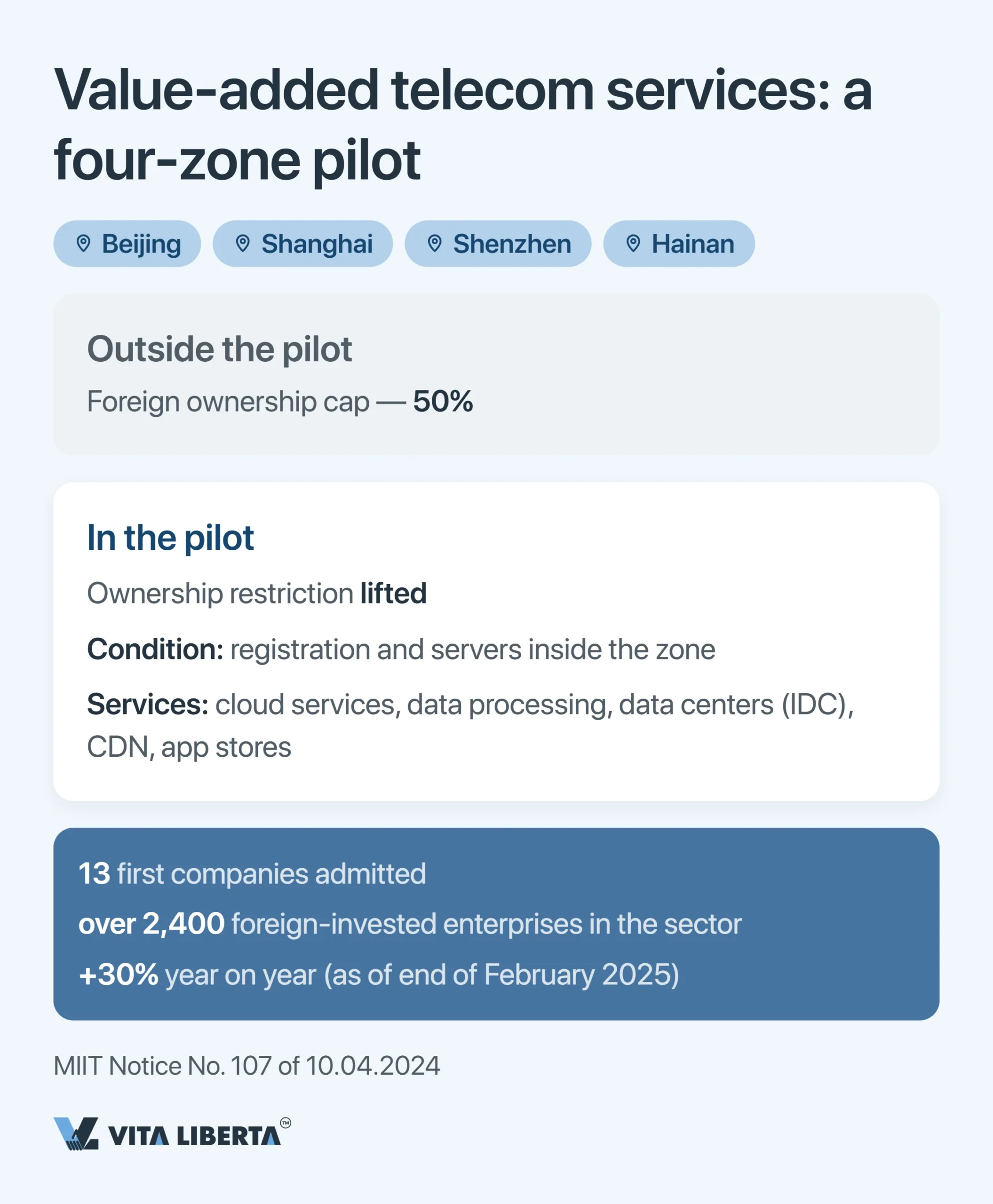
| Value-added telecom | your share stops at 50% (e-commerce, domestic multi-party communications, store-and-forward and call centres sit outside this cap) | foreign ceiling | expansion hits a glass ceiling |
| Basic telecom | more than half the shares in Chinese hands | Chinese control | you’re a minority owner with no operational say |
Telecom: a 50% cap and a four-location pilot
In value-added telecom you can watch a restriction being taken apart piece by piece. The default ceiling for your stake is half the company. MIIT (工业和信息化部) moved that ceiling in four places with a notice dated 8 April 2024 and released on 10 April (工信部通信函〔2024〕107号). The four places are Beijing’s integrated demonstration zone for opening up services; in Shanghai, the Lingang New Area of the FTZ plus Pudong; the Hainan Free Trade Port; and Shenzhen.
There, full ownership is possible across four groups of services:
- infrastructure — IDC data centres (cloud resources count too), CDN and ISP internet access;
- processing — handling data and transactions online;
- content — information platforms and content delivery, app stores included, though internet news, online publishing, audiovisual programmes and internet culture remain excluded;
- security — protecting and processing information.
Two strings are attached. Your company’s registration and its hardware have to be in the same pilot zone. And if you provide ISP access, you may serve only that zone.
The pace shows in the permit count. On 28 February 2025, thirteen foreign companies became the first to receive pilot permits. By 3 June 2026 the number had reached 166. As of June 2026, China had more than 3,100 foreign-invested telecom enterprises. The practical lesson: choosing a city to register in is now a strategic decision, because it caps the share you’ll be allowed to hold.
Not sure whether your industry is open in China?
- Sector check against the 2024 lists
- Assessment of your stake and company form
- Choosing an FTZ for your project

The 2024 edition and the geography of openness
Treat the list as a moving target. It is revised almost every year, and every revision cuts restrictions. The movement has two axes: time, measured in editions, and space, measured in special zones.
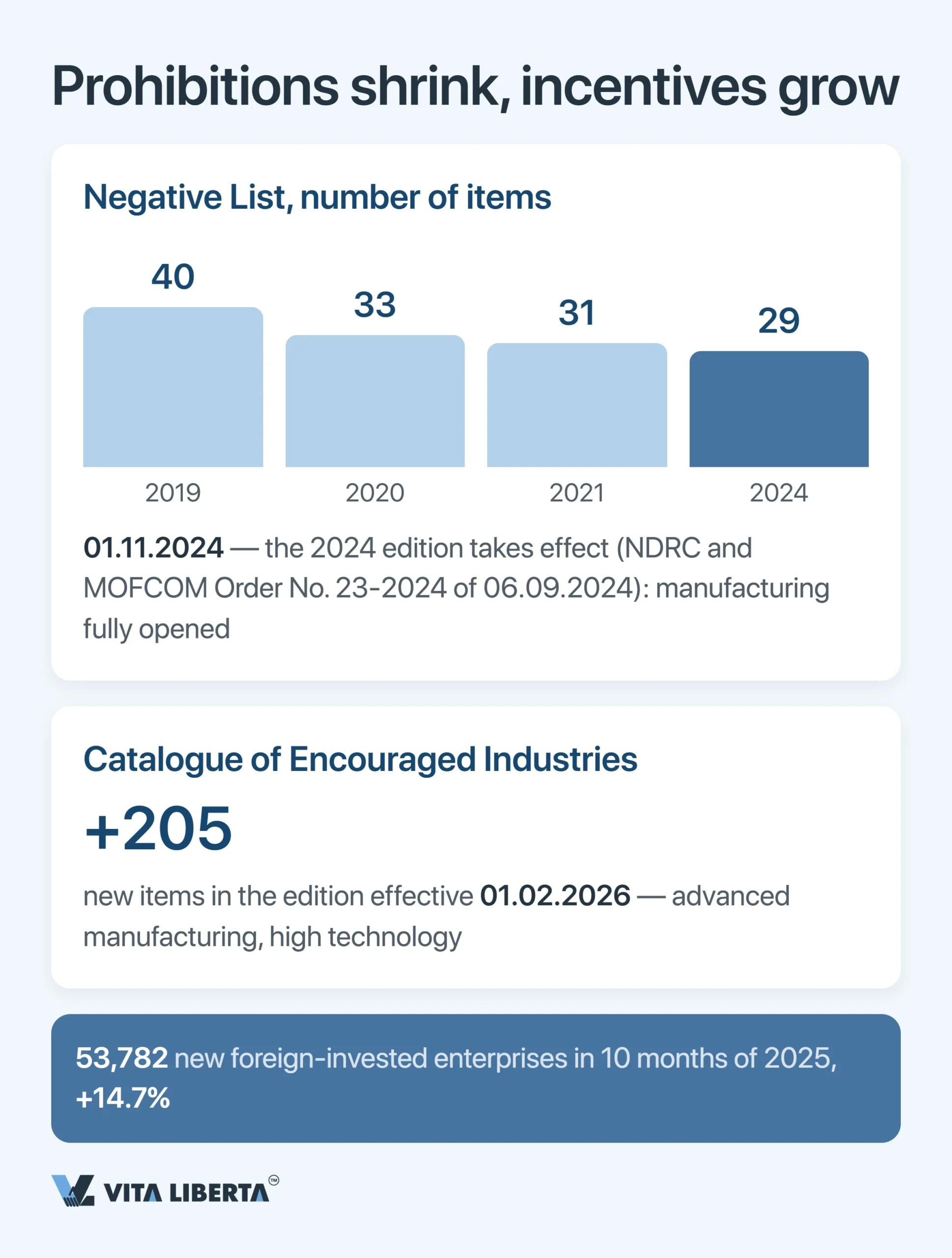
What changed in 2024: 29 items instead of 31
Here is the timeline of the current version. On 6 September 2024 the NDRC and MOFCOM signed a joint order approving it (国家发展改革委 商务部令2024年第23号). Two days later, on 8 September, it was published under the title 外商投资准入特别管理措施(负面清单)(2024年版). It has governed since 1 November 2024, and the 2021 version expired that same day. The count fell by two, to 29. Both cuts removed the last barriers in manufacturing: printing companies no longer need a Chinese controlling shareholder, and making traditional Chinese medicine from protected formulas is no longer forbidden to you. Manufacturing as a whole is therefore open — every activity in it is either encouraged or permitted.
Important: people still apply the 2020 or 2021 text to transactions, and it costs them. A “safety” JV in manufacturing that is already 100% open leaves you sharing your company with a partner you never needed — and with less control.
| Year | Items | Order (文号) | In force from | What investors gained |
| 2019 | 40 | 国家发展改革委 商务部令第25号 | 30.07.2019 | access to ship agency work, cinemas, performance agencies, city gas and heat supply networks, some value-added telecom, and oil and gas exploration and production |
| 2020 | 33 | 国家发展改革委 商务部令第32号 | 23.07.2020 | securities, futures and life insurance freed of ownership ceilings |
| 2021 | 31 | 国家发展改革委 商务部令第47号 | 01.01.2022 | passenger car plants and satellite TV equipment manufacturing no longer limited |
| 2024 (current) | 29 | 国家发展改革委 商务部令2024年第23号 | 01.11.2024 | manufacturing open without exceptions |
Shorter lists for FTZs and Hainan
Don’t assume one list covers all of China. Pilot free trade zones (FTZs) follow a separate 27-item list dated 2021 (Order No. 48, 国家发展改革委 商务部令第48号), applied since 1 January 2022. The Hainan Free Trade Port has its own list from 2020 — again 27 items (Order No. 39, 国家发展改革委 商务部令第39号), applied since 1 February 2021. Each one stops at the boundary of its territory. That is why an activity still restricted in the rest of the country can already be open inside an FTZ or in Hainan.
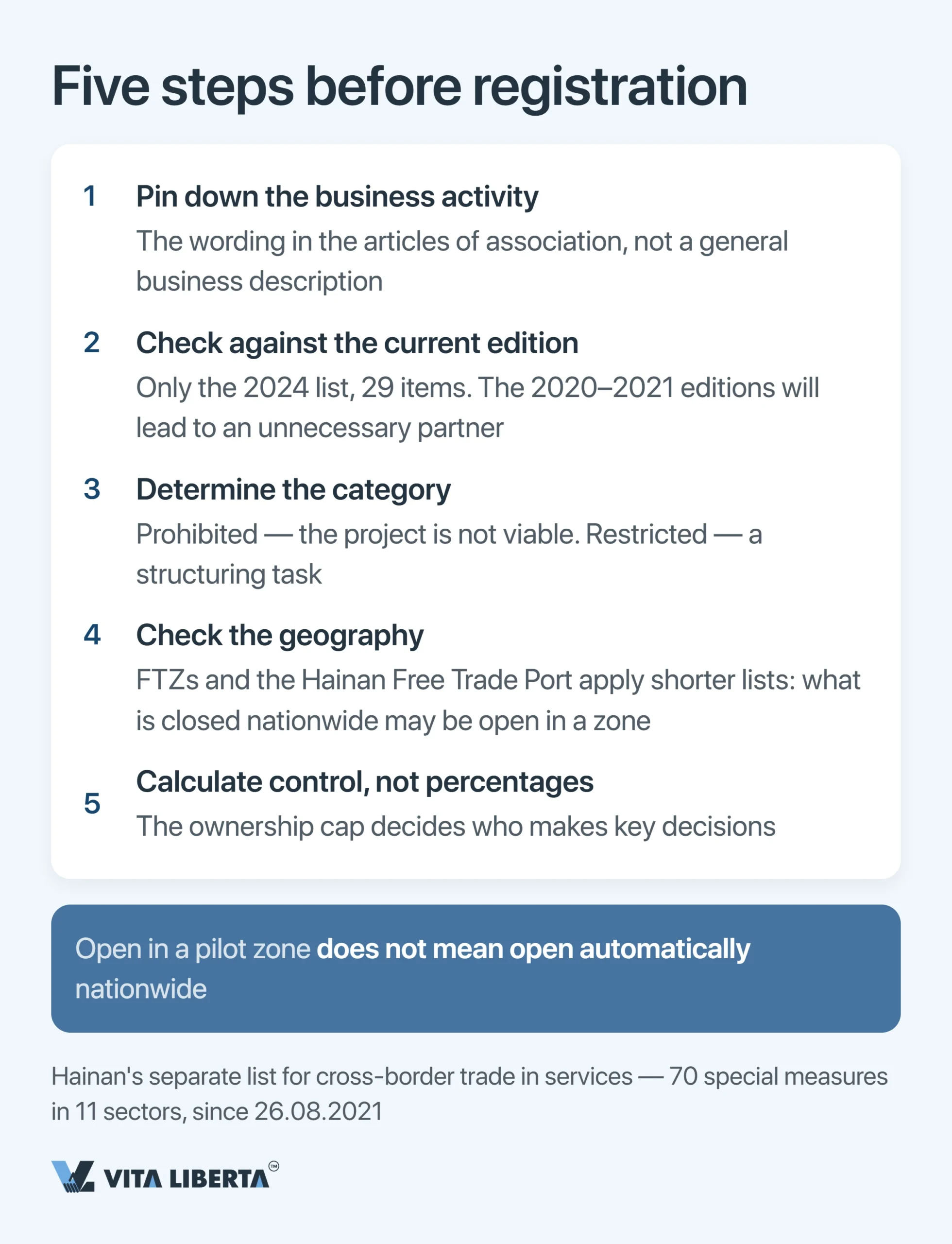
Services traded across borders follow yet another set of lists. Hainan went first, on 26 August 2021, with 70 special measures covering 11 sectors. On 21 April 2024 the rest of China followed with a national list of 71 items and an FTZ list of 68, both under MOFCOM Order 2024 No. 1 (商务部令2024年第1号).
Some doors open through pilots that no list mentions. Stem cell and gene therapy technologies are a good example. Nationally they sit on the banned side. Yet since September 2024, foreign-invested companies in Hainan and in the FTZs of Beijing, Shanghai and Guangdong may develop and use them to register and manufacture products.
The usual mistake follows from this. An investor reads that a pilot zone has opened something and decides the opening applies to China as a whole. It doesn’t: the permission is tied to one zone and comes only with registration inside it. Whether a project survives often depends on noticing that.
Ready to register a company in China without an unnecessary partner?
- A WFOE or JV structure that complies strictly with the law
- Support with your SAMR filing
- Protection of the founder’s control
China’s negative list: strategic takeaways
The name contains a paradox. Over the years the “negative” list keeps losing items — 40, 33, 31, now 29. Meanwhile its companion, the Catalogue of Encouraged Industries, keeps gaining them. The 2025 Catalogue (国家发展改革委 商务部令第37号) came into force on 1 February 2026 with 1,679 items, 205 more than the previous version. The additions centre on advanced manufacturing and modern services, and on the central, western and north-eastern regions plus Hainan. Barriers come down while incentives go up, and both trends point straight at you as a foreign investor.
- Check the date of the list you’re reading. Only the 2024 edition (29 items) applies, and it voids structural requirements that bound investors before 1 November 2024.
- Work out whether you face a ban or a condition. A ban ends the conversation; a condition is a design problem — your stake, your legal form, your management.
- Look at the map. A sector closed nationwide may be open in an FTZ or in Hainan, and it can also work the other way round.
Used this way, the list is less a gatekeeper than the first page of your plan: rather than listing what’s forbidden, it shows where and on what terms China is ready for your capital. The country registered 70,392 new foreign-invested enterprises in 2025, up 19.1% — each of them an investor who read this map correctly.
5 key questions about China’s negative list for foreign investment
With your sector off the list, there’s no extra round of approvals. You go through the notification procedure on the same terms as a Chinese investor, and instead of months waiting for sector approval you’re looking at the usual few weeks. What to do: before filing, compare how your business scope is worded with the current edition, so you don’t brush against a restricted item by accident.
You pay in operational control, not just in percentages. With a 50% cap you can no longer settle key matters alone; where the Chinese side must hold control, you become a minority shareholder. What to do: check early whether a shareholders’ agreement and veto rights can balance out the stake — if not, the structure becomes unmanageable.
Almost certainly that’s old information. Manufacturing has been fully open since 1 November 2024, and if you rely on the 2020–2021 editions you’ll end up with an unnecessary JV and less control. What to do: work only with the 2024 edition (29 items).
For now, the cap disappears only inside the pilot: Beijing, the Lingang New Area and Pudong in Shanghai, Hainan and Shenzhen. You must register the company and keep its servers within a single pilot zone, and internet access (ISP) can be offered only inside that zone. Everywhere else the general 50% cap still applies. What to do: settle your registered address and infrastructure in the pilot zone at the stage of choosing a location.
The FTZ and Hainan lists are shorter, so they open sectors that remain restricted elsewhere — the right zone directly widens what you can do. What to do: match your industry against the shorter list of that particular zone, not against the national one.