Hongkong
 China




Getting your business licence is only the first door. Open it and you face a second one, and behind that one the reporting never stops. This is exactly where most foreign investors stumble.
The core problem: “We set up a WFOE in Ningbo and we’re four months in. Our accountant went on holiday, and suddenly I realised I don’t know the basics. Is VAT monthly or quarterly? What’s the cut-off for the annual report? Where is this calendar we’re supposed to live by?”
We hear this kind of question all the time. If you treat China’s tax calendar as a one-time chore after incorporation, it will catch you out. It is a grid of hard dates. Miss one, and you pay a surcharge and draw the tax bureau’s attention. Let’s take it apart, horizon by horizon.
China Tax Filing Cycle: Three Horizons of Deadlines
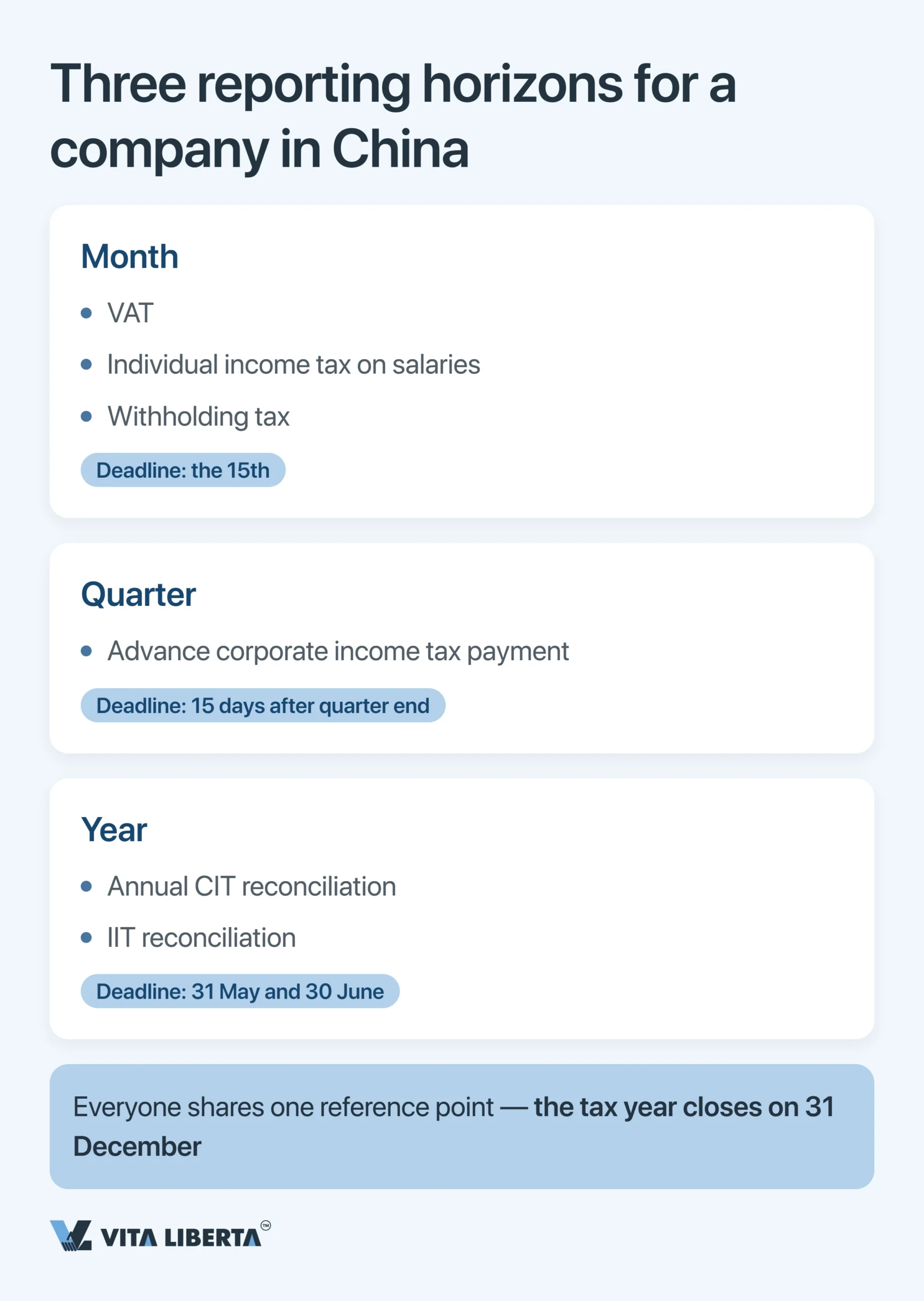
Your mainland company files on three schedules at once, not one. Under the corporate income tax law (中华人民共和国企业所得税法) it counts as a 居民企业, a resident enterprise. Whatever the schedule, everything lands in one window: the platform run by the State Taxation Administration (国家税务总局, STA).
Monthly, Quarterly, Annual: Why Each Tax Has Its Own Rhythm
Think of it as three clocks. VAT and payroll withholding run on the monthly clock. Profit prepayments run on the quarterly one. Once a year, you settle profit tax and individuals reconcile their income tax. Every clock starts from the same moment: 31 December, when the tax year closes. Here is the whole grid on one page:
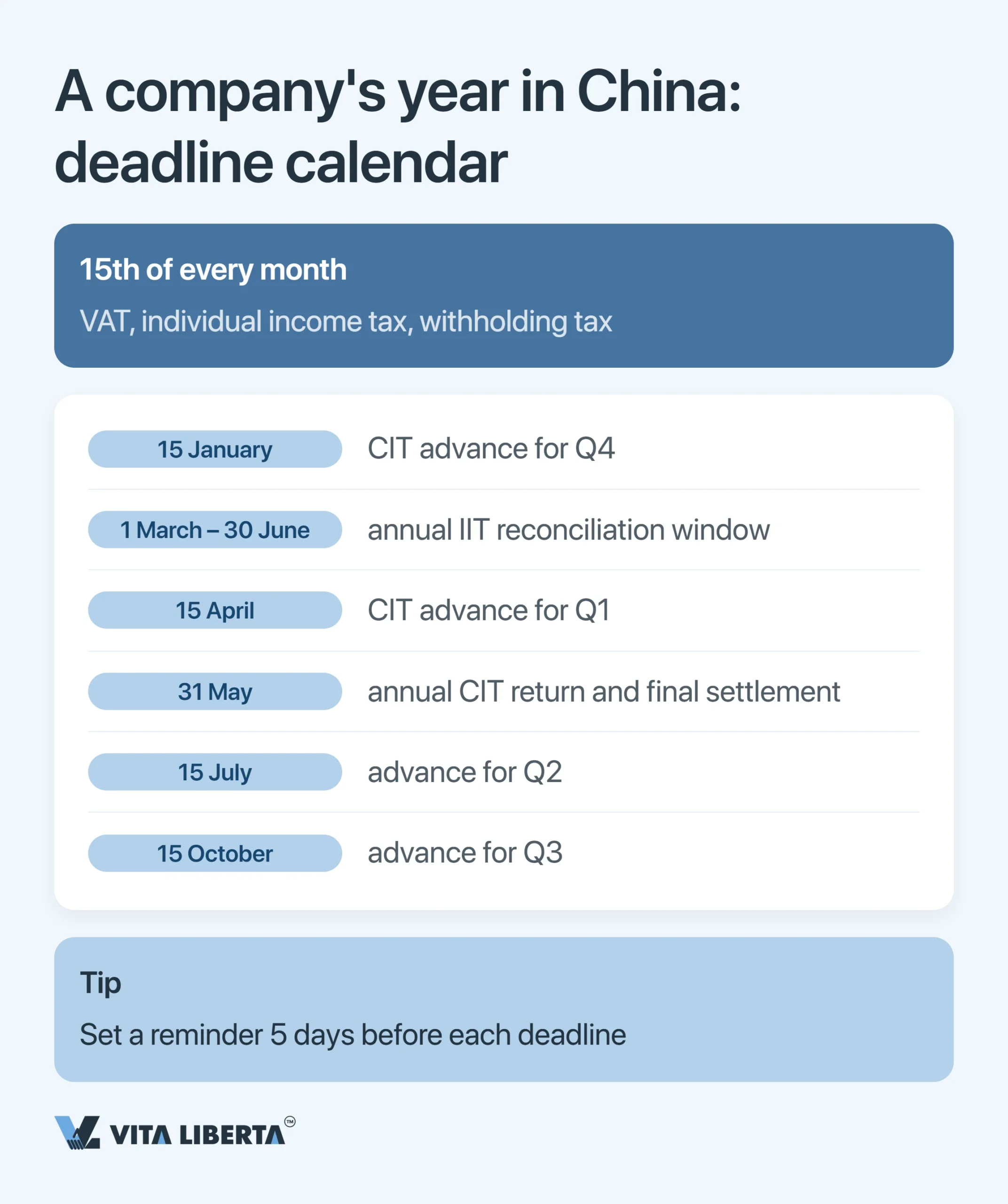
| What you report | When it’s due | Where it goes wrong |
| VAT | The tax bureau assigns you a month or a quarter; the return goes in by day 15 after that period | Customs, banks and other agencies feed your VAT data to the tax bureau too |
| CIT prepayment | Quarterly; payment by day 15 after the quarter is over | Q1 falls due in mid-April, and in 2026 on 20 April. More companies forget this date than any other |
| CIT annual return | Once a year; you have until 31 May, five months after 31 December | Prove your incentive conditions first, then file |
| IIT withheld from pay | Monthly; the withheld sums leave your account by day 15 of the next month | Your company pays and answers for it, not the employee |
| IIT annual reconciliation | Yearly, in the March–June window (1 March – 30 June) | Compulsory in two cases: a refund claim, or more than 120,000 yuan earned in the year combined with more than 400 yuan still to pay |
| Annual enterprise report (年报) | Once a year, 1 January to 30 June, in the 国家企业信用信息公示系统 (the national enterprise credit disclosure system) | Don’t file, and your company goes onto the 经营异常名录, the abnormal operations list |
Does the 15th land on a weekend or a holiday? Then the date slides. Each year the STA puts out a list of these shifts. In 2026 the list came in letter 税总办征科函〔2025〕64号, and three months move: April to the 20th, October to the 26th, November to the 16th.
E-Tax and Golden Tax IV: Why You Can’t Quietly Shift a Deadline
Almost all company filings go online, through your account on 电子税务局, the e-tax portal (E-Tax). By law, you could walk into the tax office or send the return by post. Companies rarely do.
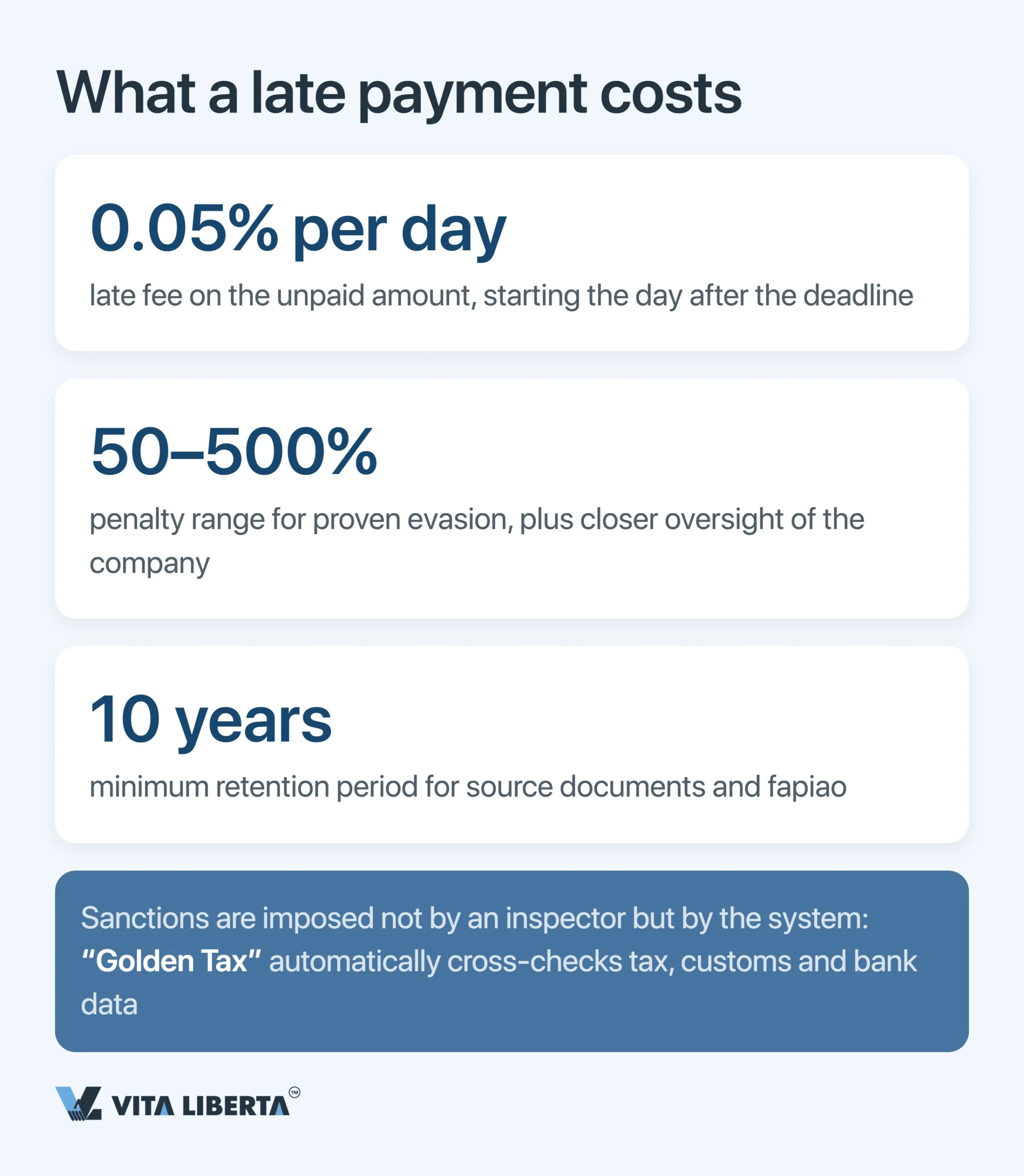
What really matters is what happens to the data next. The tax bureau checks it digitally in the fourth generation of Golden Tax. The VAT Law gives that check its legal base: the tax authorities share data with customs, market regulators, the PBOC and financial regulators. Each deal also has a fapiao attached.
So paying “quietly, later” doesn’t work. When two agencies see different numbers, the cross-check flags it. Firms that brought their home-country routines to China unchanged tend to learn this the hard way, and it costs real money.
VAT in China: The Month Closes on the 15th
Think of the 15th as a line. Once you cross it, last month’s taxable turnover is done. The rules changed on 1 January 2026: VAT now runs under its own law, 中华人民共和国增值税法 (Presidential Order No. 41), plus the 实施条例 issued as State Council Order No. 826.
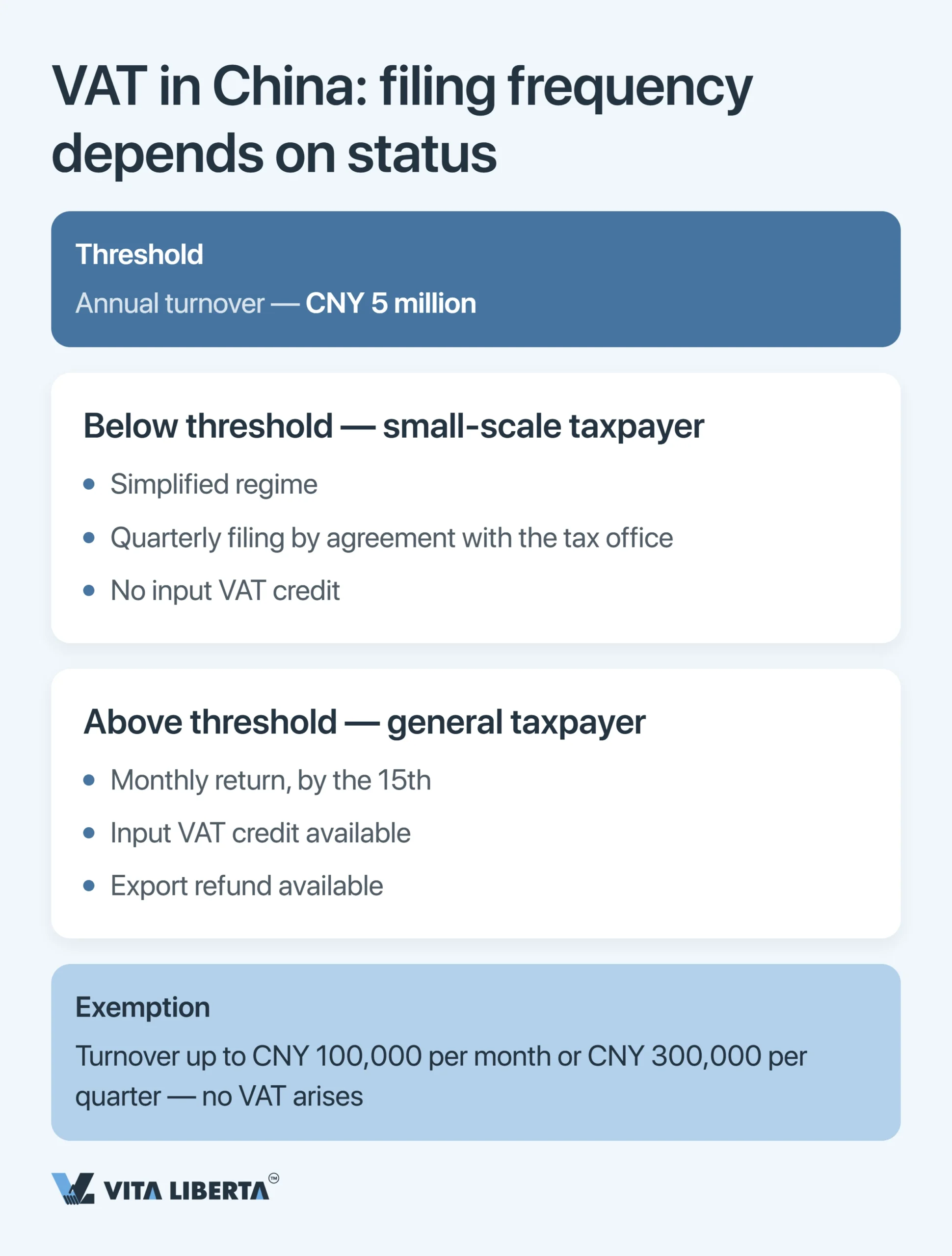
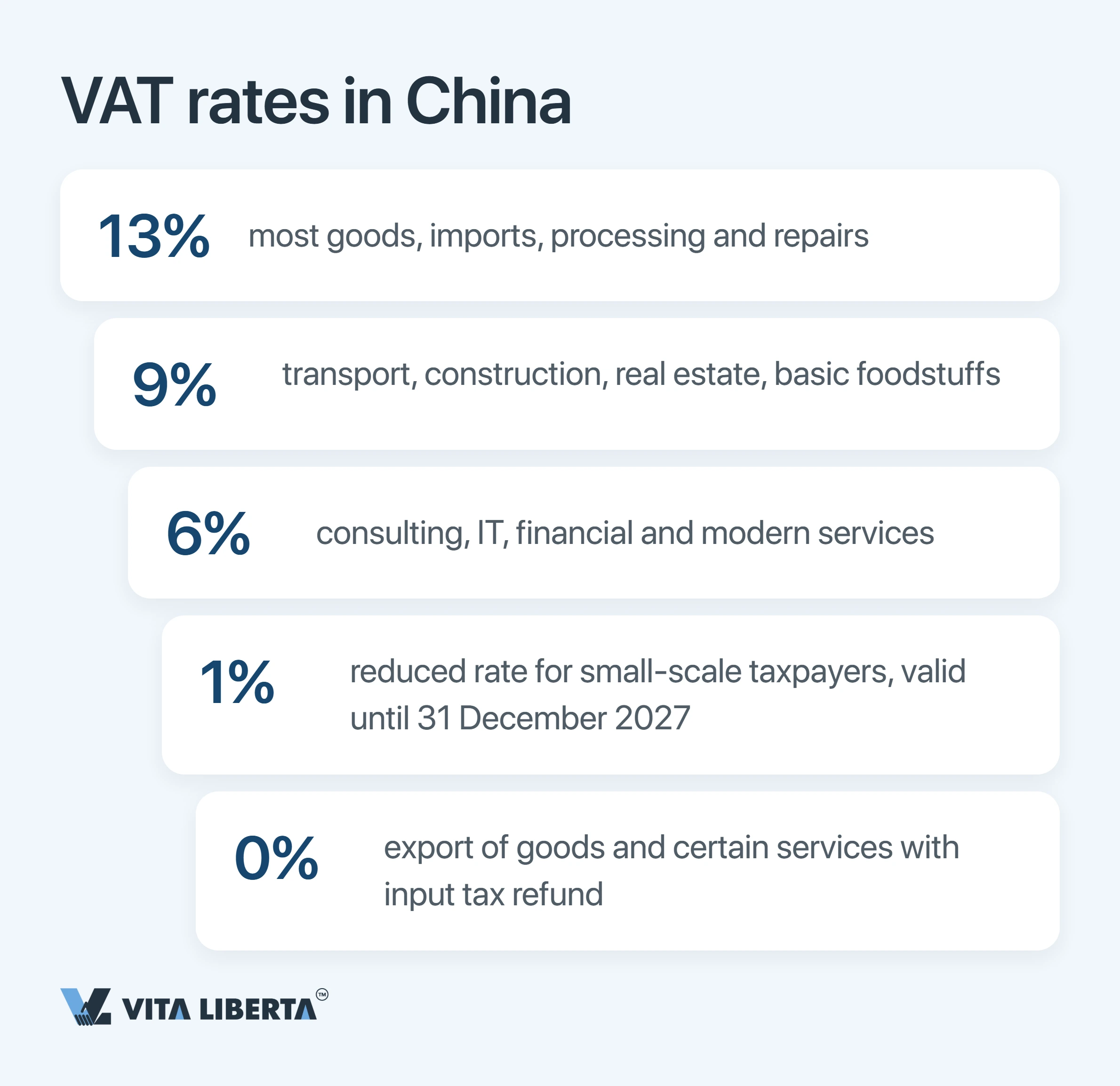
If you are a general taxpayer, the 15th is when you file and pay the net figure: output VAT on your sales, minus input VAT on what you bought. You work with one of three rates, 13, 9 or 6 percent, and goods you export go out at zero.
Small-scale taxpayers have it simpler: a flat 3%. Better still, between 1 January 2026 and 31 December 2027 they pay just 1%. The only exceptions are selling or leasing property and transferring land rights. That cut comes from 财政部 税务总局公告2026年第10号.
General vs Small-Scale Taxpayer: Your Status Sets the Filing Frequency
Your status sets the pace. The dividing line is 5 million yuan of taxable sales in a year. Stay under it and you are small-scale. Go over and you move into the general regime, where input VAT becomes deductible. You don’t have to wait for the line either: with proper books, you can opt into general status early.
Whether you report every month or every quarter isn’t your decision. The tax bureau looks at the size of your tax bill and assigns the period. Small-scale firms also get a threshold (起征点). For 2026–2027 it is 100,000 yuan in a month or 300,000 yuan in a quarter. If your sales stay under it, there’s no VAT to pay, but the return still has to go in. Hit it, and every yuan of turnover is taxed.
Picture a Shenzhen start-up. Once its yearly sales pass 5 million yuan, it switches to the general regime and starts deducting input VAT. How often it files is then up to the tax bureau.
Not sure you’re meeting your China tax deadlines?
- Audit of your tax deadlines
- Set-up of your reporting calendar
- Monitoring of your E-Tax filings

Corporate Income Tax: From Quarterly Prepayments to the 31 May Deadline
Chinese law calls it 企业所得税; English-speaking advisers mostly say CIT. Whatever you call it, the money moves twice: advances while the year is running, then a true-up once it’s over.
Quarterly CIT Prepayment: a 15-Day Window After Quarter-End
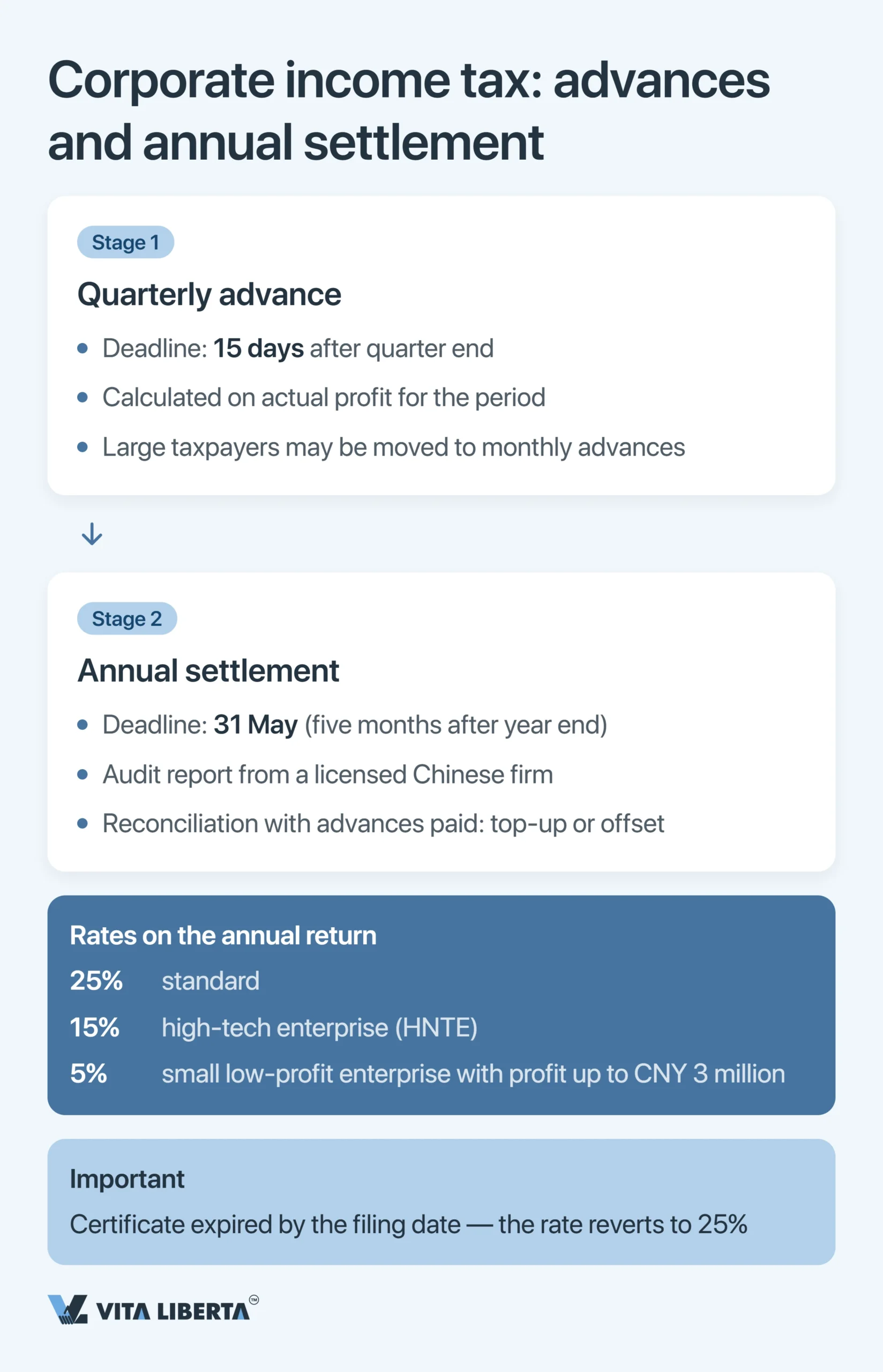
As soon as a quarter is over, you have until day 15 to file the advance return and pay. For Q1 that is normally 15 April, though in 2026 a holiday pushed it to 20 April. Q2 lands on 15 July, and the later quarters work the same way. The advance is based on the profit you actually made in the quarter. The tax bureau can put big taxpayers on monthly advances, but a typical WFOE stays on quarters.
Annual CIT Return: Audit, Incentives and the 31 May Deadline
Then comes the true-up. You have until 31 May, five months after the books close. Your financial statements go in with the return. Must they be audited? China has no national rule saying so, yet local bureaus differ, so ask yours early.
The annual return is also where incentives get checked. Hold HNTE status (High and New Technology Enterprise) and your rate falls to 15%. Qualify as a 小型微利企业, a small business with thin profits, and you effectively pay 5% through 31 December 2027 under 财政部 税务总局公告2023年第12号. The bar for that:
- no more than 3 million yuan of taxable profit;
- a headcount of 300 or fewer;
- total assets no higher than 50 million yuan;
- a line of business outside the restricted and prohibited lists.
Here’s the catch. Fail to show you met the conditions for the whole year — for instance, your HNTE certificate wasn’t valid — and the tax bureau reworks the bill at the full 25%. Back-tax claims very often start exactly here.
Payroll and Withholding in China: IIT, Social Insurance and WHT Every Month
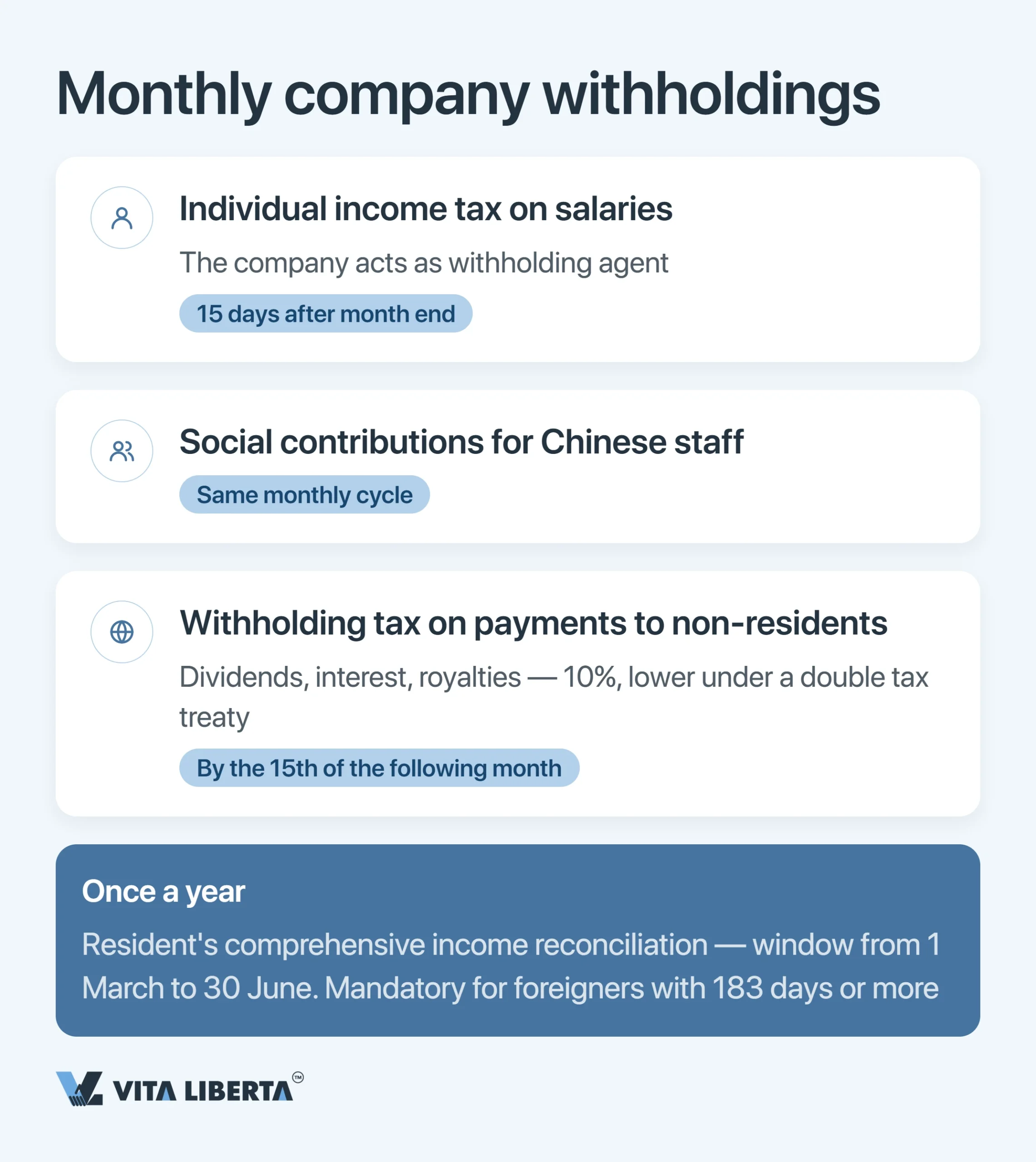
Pay your first salary and your company takes on a new job: it collects tax for the state. Taking individual income tax (IIT) out of wages isn’t up to you; the law puts that duty on the employer. You then have until day 15 of the next month to hand that money to the budget. Social contributions for local staff normally follow the same monthly pattern, but exact dates and bases are set locally, so check them for your city.
Then there’s money leaving China. Send dividends, interest or royalties to a foreign recipient, and you hold back 10% as withholding tax (WHT), or less if a tax treaty applies. You have 7 days from the moment the obligation arises to declare and pay it over. With dividends, the clock starts on the day the money actually goes out (国家税务总局公告2017年第37号). Paying a foreign supplier for services or royalties? Then you, the buyer, also hold back the VAT as tax agent.
Annual IIT Reconciliation: 1 March to 30 June
Once a year, people also settle their own accounts with the tax bureau. They square up the tax on their comprehensive income (综合所得) for the year just ended, in a four-month window that opens on 1 March and shuts on 30 June. This isn’t only for Chinese nationals. A foreigner who stays in China 183 days or longer becomes resident and falls under the same rule.
Not everyone has to take part. You’re in if you are asking for money back. You’re also in if two things are true at once: you earned over 120,000 yuan in the year, and the extra tax owed comes to more than 400 yuan. Legally the filing belongs to the person, not the company, although the employer is allowed to handle it for its staff.
A common slip is mixing this window up with the CIT return. The IIT one stretches from March to June; the CIT one has a single date, 31 May. Keep them in separate rows of your planner.
Late Filing Penalties in China: 0.05% a Day and Fines up to 500%
Nobody sits down to calculate your penalty. The system does it for you. The day after a deadline passes, a surcharge of 0.05% of the unpaid tax starts piling up, and it piles up every single day (art. 32 of the tax administration law, 中华人民共和国税收征收管理法).
Deliberate evasion is another level. If the tax bureau proves it, you face a fine between half and five times the tax you dodged, so 50% to 500% (art. 63), plus closer monitoring from then on. A late return is a separate offence: 2,000 yuan at most, or up to 10,000 yuan if the case is serious. And keep your paper trail: primary documents and accounting records for 30 years, tax returns for 10.
| What went wrong | What it costs | What helps |
| Tax paid late | 0.05% of the arrears added each day | Pay the tax and the surcharge now; every day adds more |
| Return filed late | Up to 2,000 yuan; 2,000–10,000 yuan if serious | Get the return in by the date the tax bureau gives you |
| Tax evaded | A fine of 50–500% of the tax | Fix the return and pay before any inspection starts; the tax bureau may weigh this when setting the fine |
| Records in a mess | No deduction, plus a possible on-site audit | Keep books separately and store primary documents and fapiao for 30 years |
Important: forget to withhold on a payment abroad, and the tax bureau goes after the foreign recipient for the tax. Your company doesn’t escape either: as agent, it is fined 50–300% of what it should have held back (art. 69 of the same law).
Let us take control of your China company’s tax calendar
- VAT, CIT and IIT compliance
- Annual return and audit
- Protection from surcharges and fines

China Tax Calendar: Strategic Takeaways
Here’s the paradox. China has made filing almost effortless, a few clicks in E-Tax. Yet the same digital machinery forgives nothing: when agencies compare notes, every gap shows.
Plan by horizon. VAT: monthly or quarterly. IIT: monthly. CIT advances: quarterly. Yearly: the CIT return by 31 May; the IIT reconciliation and the annual enterprise report by 30 June. WHT works differently: it runs per payment to a non-resident, 7 days each time.
Put a reminder in the diary 5 days ahead of each deadline, and check it against the STA’s yearly list of shifted dates. Missing one is charged by the day.
Look at your HNTE or small-business status before the annual return, not while you are filing it.
Do this, and the tax calendar stops being red tape. It becomes a cash-flow tool: you know when money leaves the account, so you plan for it instead of paying surcharges after the fact.
Frequently asked questions
It all comes down to frequency. Pass 5 million yuan in annual turnover and you become a general taxpayer; a small-scale firm can also switch earlier by choice. The tax bureau picks your period, a month or a quarter, and the return is due by day 15 after it. Our advice: pin down your status from day one, so the team knows whether it works on a monthly or quarterly cycle.
Be late and the surcharge starts. The annual return is due five months after the year closes, on 31 May. Our advice: get your financial statements ready early, since they go in with the return, and ask your tax bureau whether it wants them audited.
The company handles it as tax agent: IIT comes off your salary, and the company pays it over by day 15 of the following month. Our advice: as a resident, you go through the yearly reconciliation between 1 March and 30 June if you want money back, or if two conditions meet — more than 120,000 yuan earned and more than 400 yuan still owed.
It adds up daily: 0.05% of the unpaid tax for each day. If evasion is proven, the fine reaches 50–500% of the tax. Our advice: fix the return and pay on your own before an inspection begins; the tax bureau may take this into account when setting the fine.
Fail to withhold and expect a back-tax claim. Dividends, interest and royalties sent to a non-resident carry 10% WHT, and a tax treaty may cut it. The tax goes to the budget within 7 days of payment. Our advice: get the recipient’s tax residency certificate in advance to claim the treaty rate.