Hongkong
 China
China




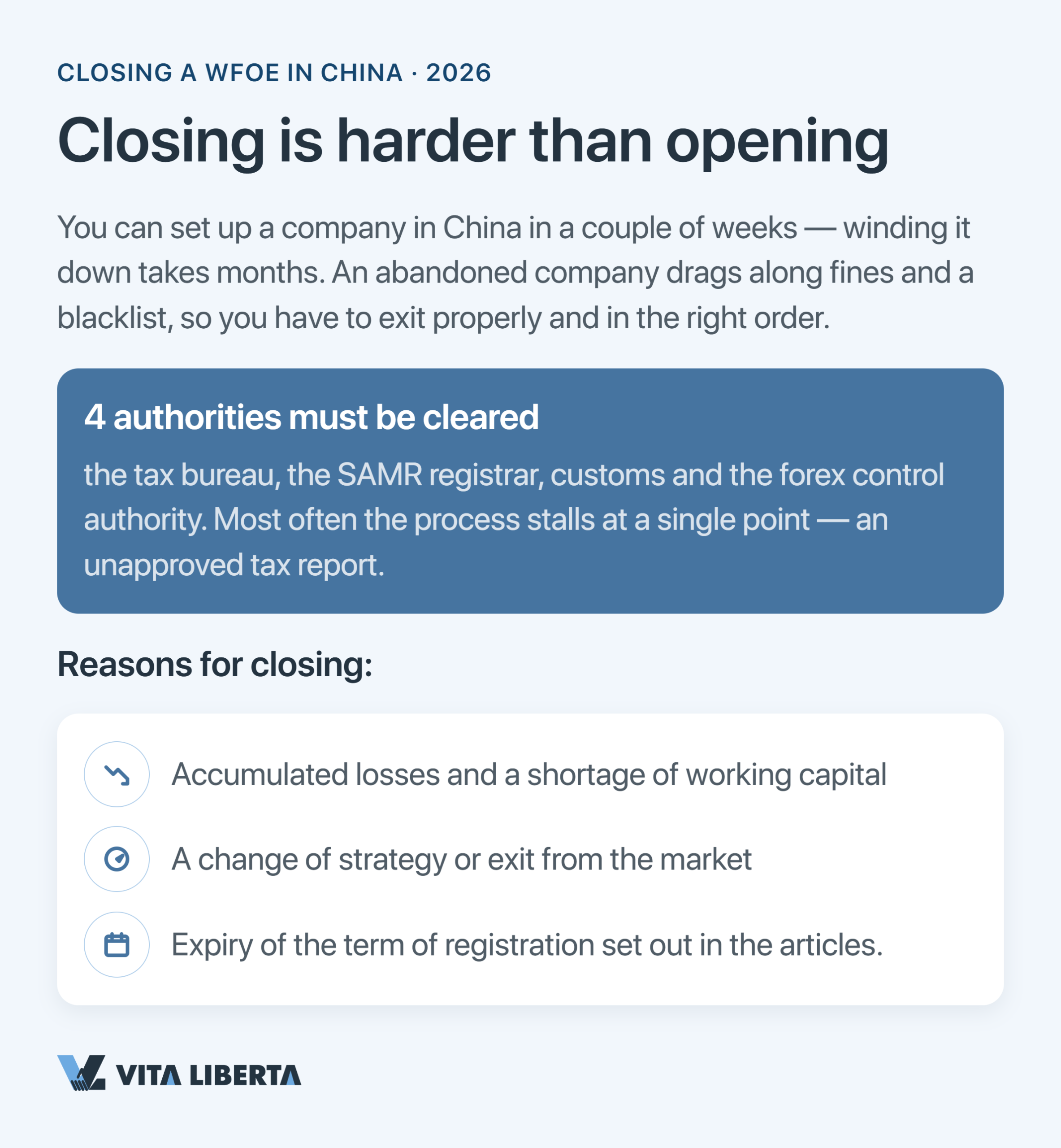
You can set up a company in China in a couple of weeks — but winding one down takes months. And an abandoned entity quietly builds up penalties and blacklist entries. Here is how to exit the right way.
Why closing is harder than registering
Deregistration requires coordinated sign-off from the tax bureau, the market regulator (SAMR), customs, and the foreign-exchange authority. In practice the process usually stalls at a single bottleneck — an unapproved tax report. The reasons for closing vary:
- accumulated losses and a shortage of working capital;
- a change of strategy or a full market exit;
- expiry of the operating term set out in the articles of association.
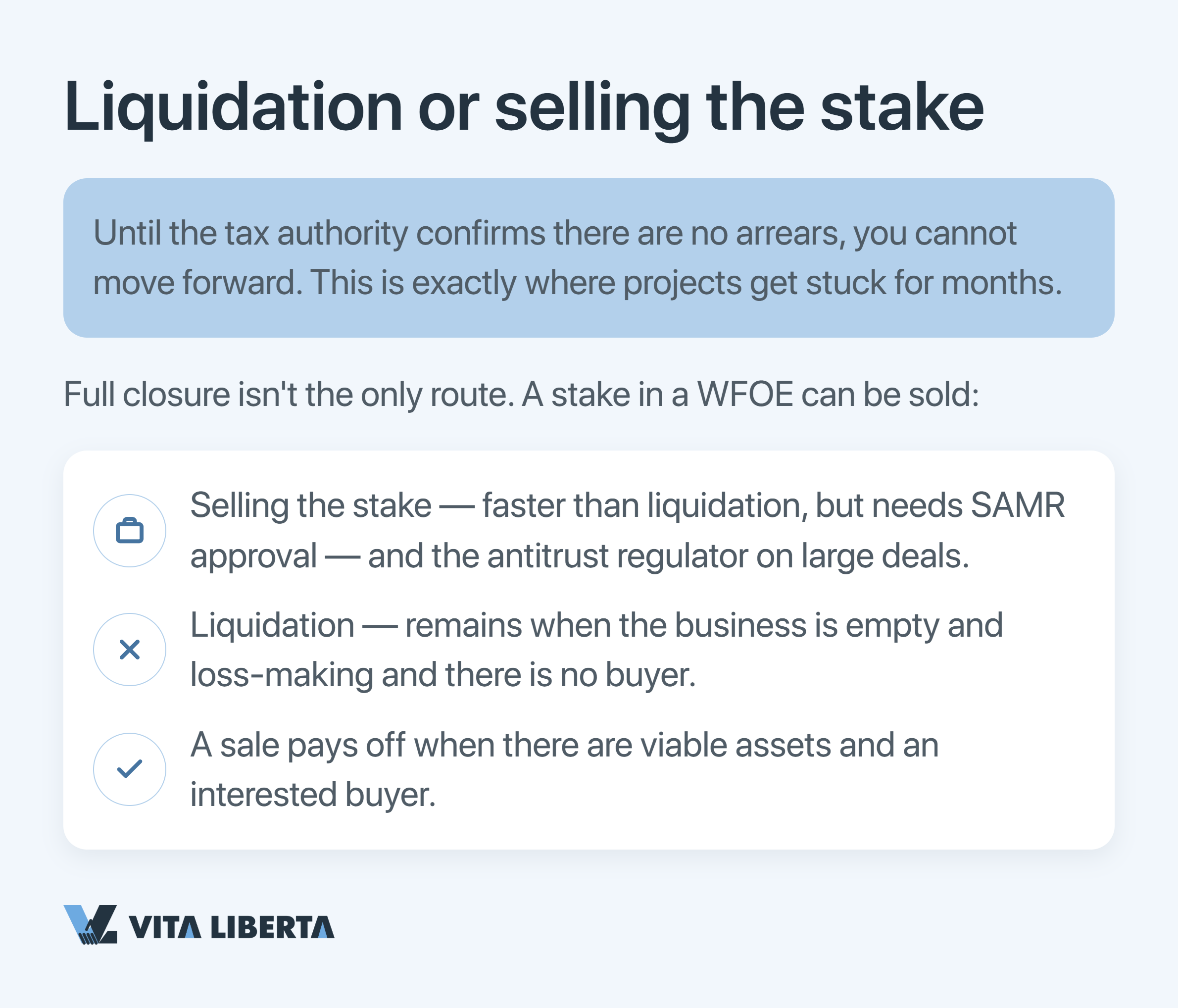
Until the tax authority confirms there are no outstanding liabilities, nothing else can move forward — and this is exactly where projects get stuck for months.
Liquidation or a sale of the equity
Full closure is not the only route. An equity stake in a WFOE can be sold to a Chinese or foreign buyer: this is faster than liquidation, but it still needs SAMR approval and, in larger deals, antitrust clearance. A sale makes sense when the company holds viable assets and there is an interested buyer; if the business is empty and loss-making, liquidation is what remains.
The procedure, step by step
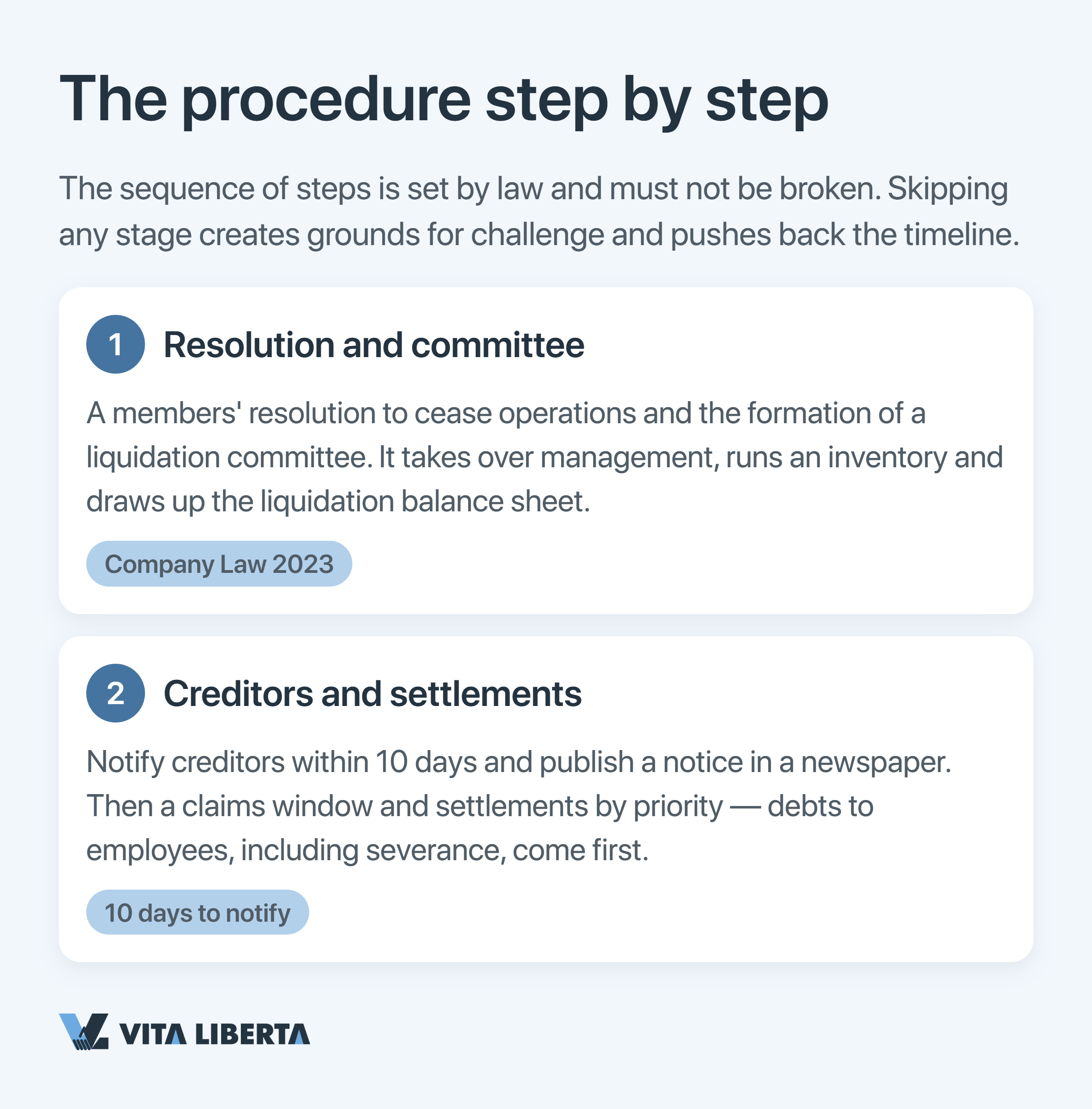
The sequence is fixed by law, and it cannot be reordered.
Resolution and liquidation committee
The starting point is a shareholder resolution to cease operations and the formation of a liquidation committee. The committee takes over management, carries out an asset inventory, and prepares the liquidation balance sheet. Under the 2023 revised Company Law the committee must be established within the prescribed statutory period, and it is the committee that represents the company before every authority from that point on.
Creditors and settlement
Creditors are notified within 10 days of the resolution, and a public announcement is published. A claim window then opens, after which settlements are made in the statutory order of priority — with debts owed to employees, including severance, ranking first. Skipping any step gives grounds for later challenge.
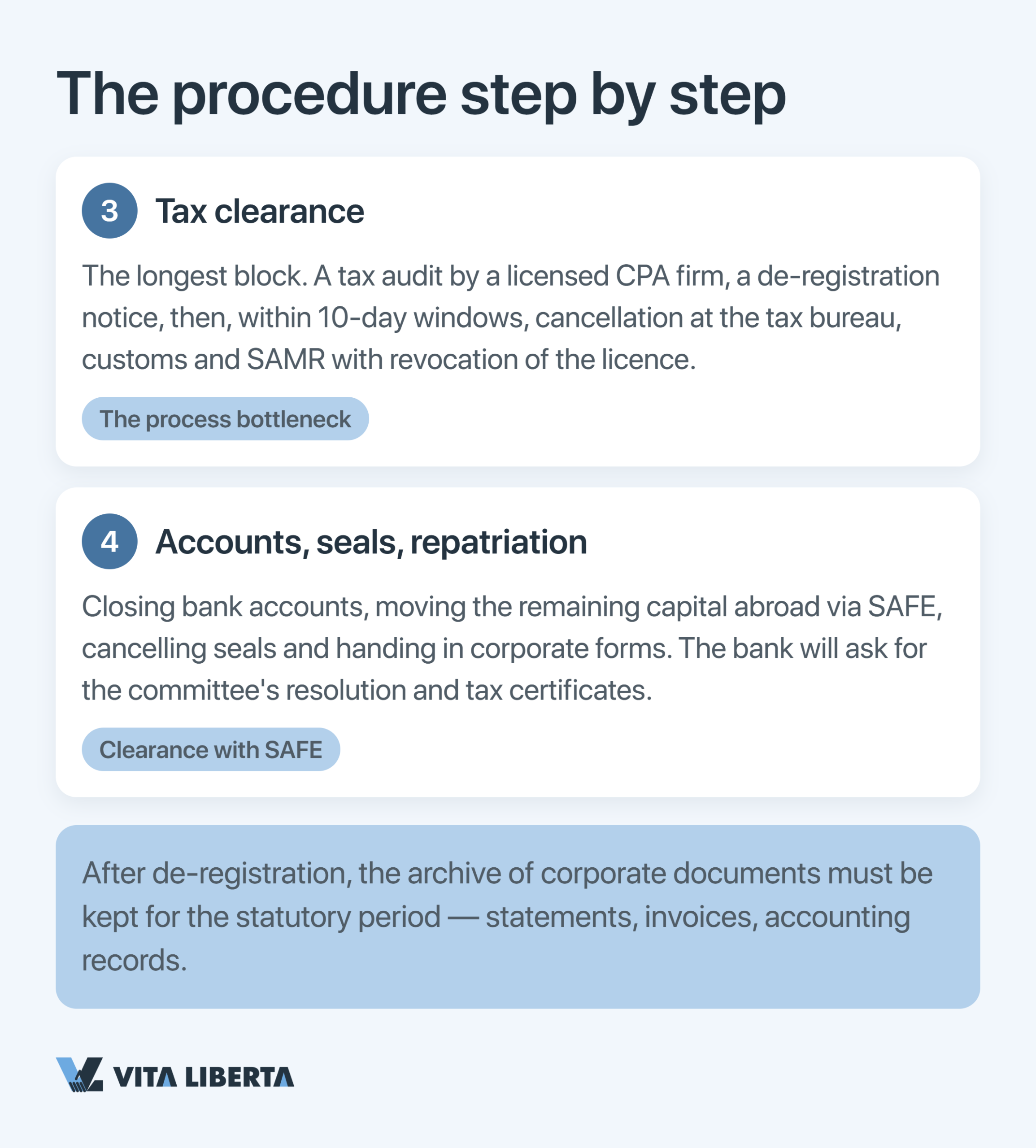
Tax clearance and deregistration
This is the longest block. First comes a tax review supported by an audit report prepared by a licensed CPA firm, ending in a tax clearance certificate. Only then, in successive 10-day windows, are the registrations cancelled at the tax bureau, customs (for trading and manufacturing WFOEs), and SAMR, with revocation of the business license. Without a clean tax report, the entire procedure freezes.
Accounts, chops, repatriation
At the finish, the bank accounts are closed, any remaining capital is remitted abroad through clearance with the foreign-exchange authority (SAFE), the company chops are invalidated, and corporate forms are surrendered. The bank will ask for the committee’s resolution on the distribution of remaining funds and the tax certificates, and the document archive must be retained for the statutory period.
Need to close your China company?
- Assess timelines and steps
- Check debts and obligations
- A clear shutdown plan

How long it takes
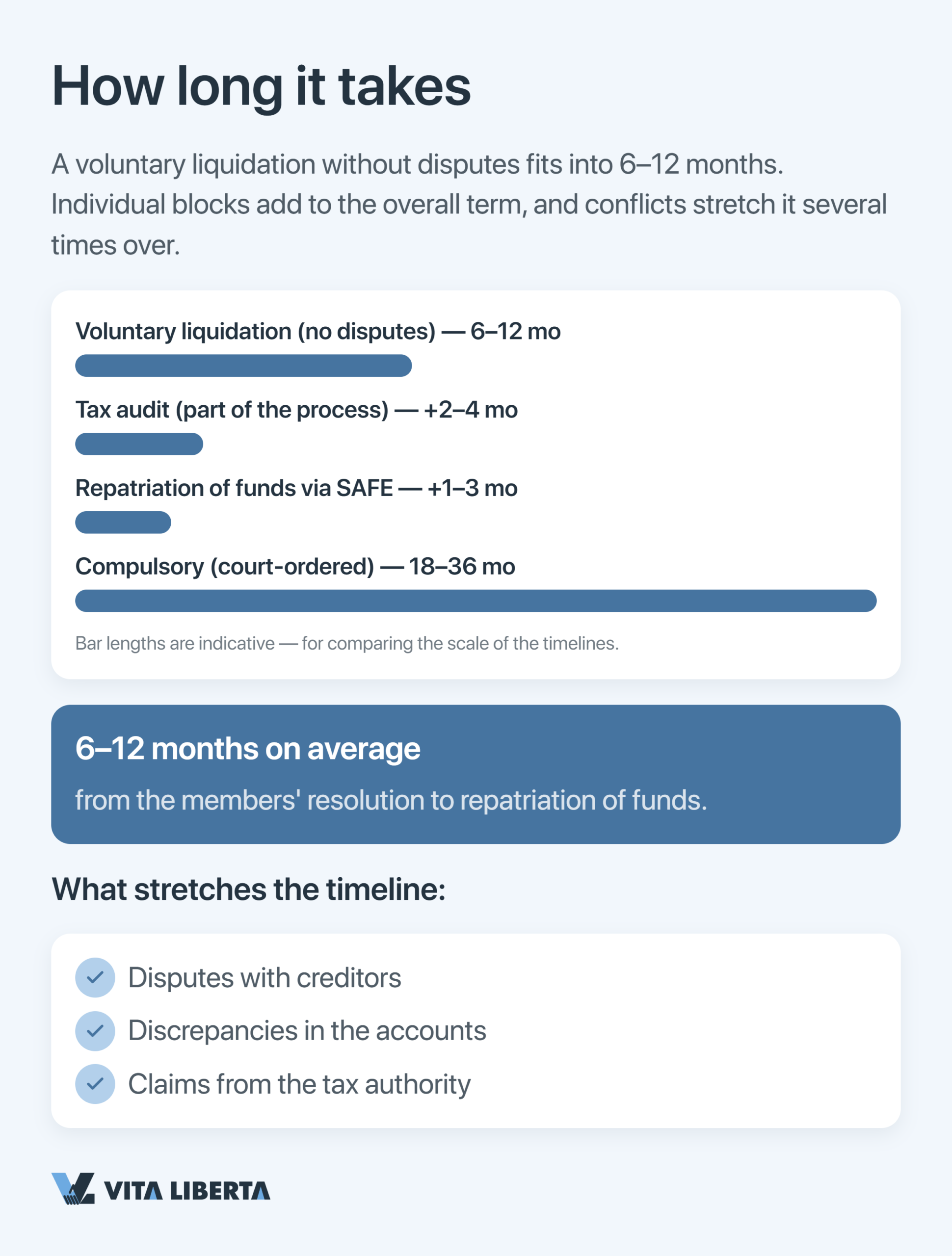
| Scenario | Timeframe |
| Voluntary liquidation (no disputes) | 6–12 months |
| Tax review (part of the process) | +2–4 months |
| Repatriation of funds through SAFE | +1–3 months |
| Compulsory (court-ordered) | 18–36 months |
Timelines stretch out over creditor disputes, discrepancies in the accounts, and tax claims.
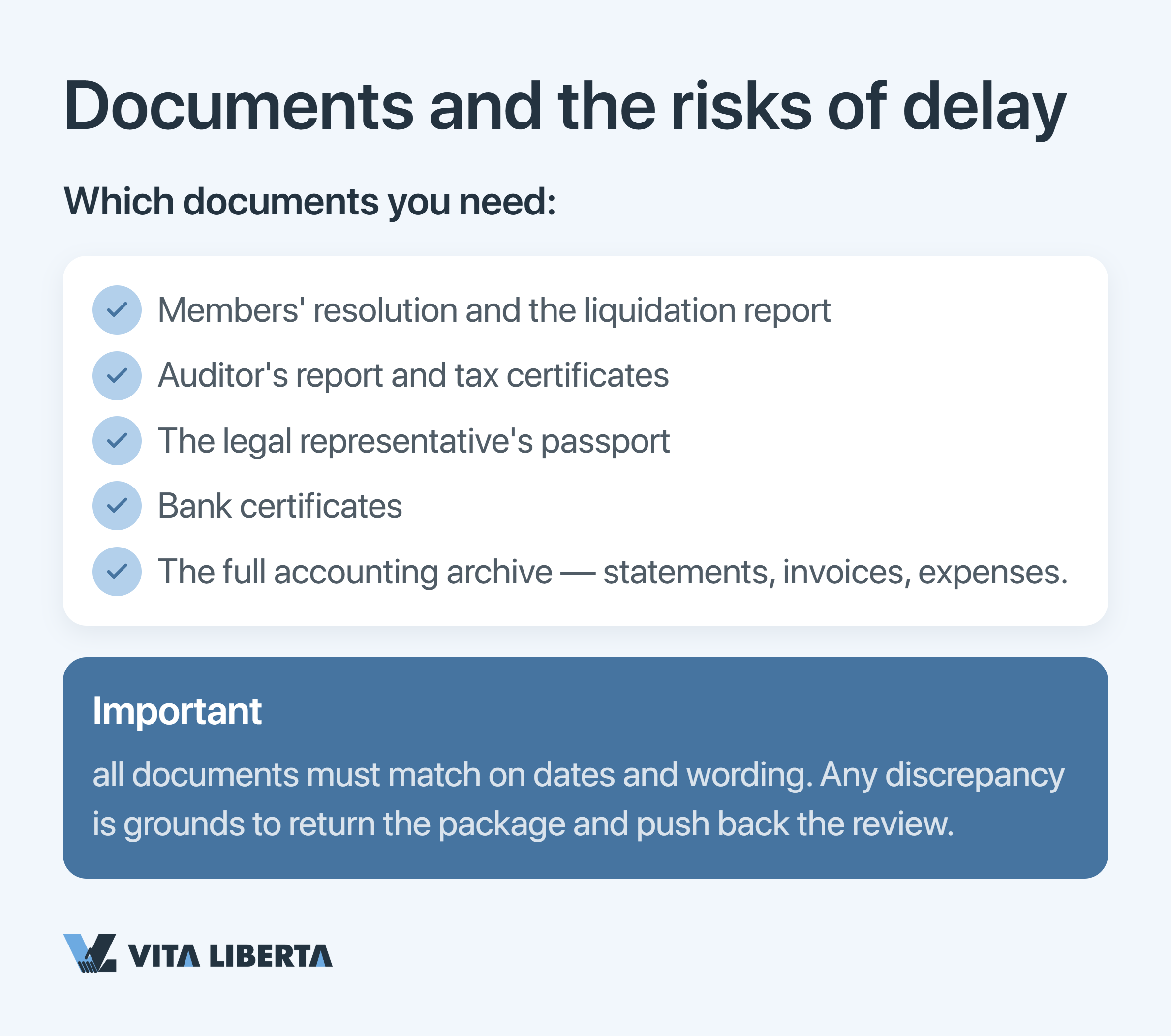
Documents you will need
- the shareholder resolution and the liquidation report;
- the audit report and tax certificates;
- the legal representative’s passport;
- bank certificates;
- the full accounting archive — statements, invoices, expenses.
⚠️ Important: every document must be consistent in dates and wording. Any mismatch between papers is reason enough for a regulator to return the file and push back the review date.
What an abandoned company costs you
If you simply stop running a WFOE without liquidating it, the consequences accumulate:
- fines and late-payment penalties for unfiled reports;
- the director and shareholder added to a blacklist;
- a block on registering new structures in the PRC;
- personal (subsidiary) liability where debts exist.
A proper closure does the opposite — it preserves your reputation and the option to return to the market later.
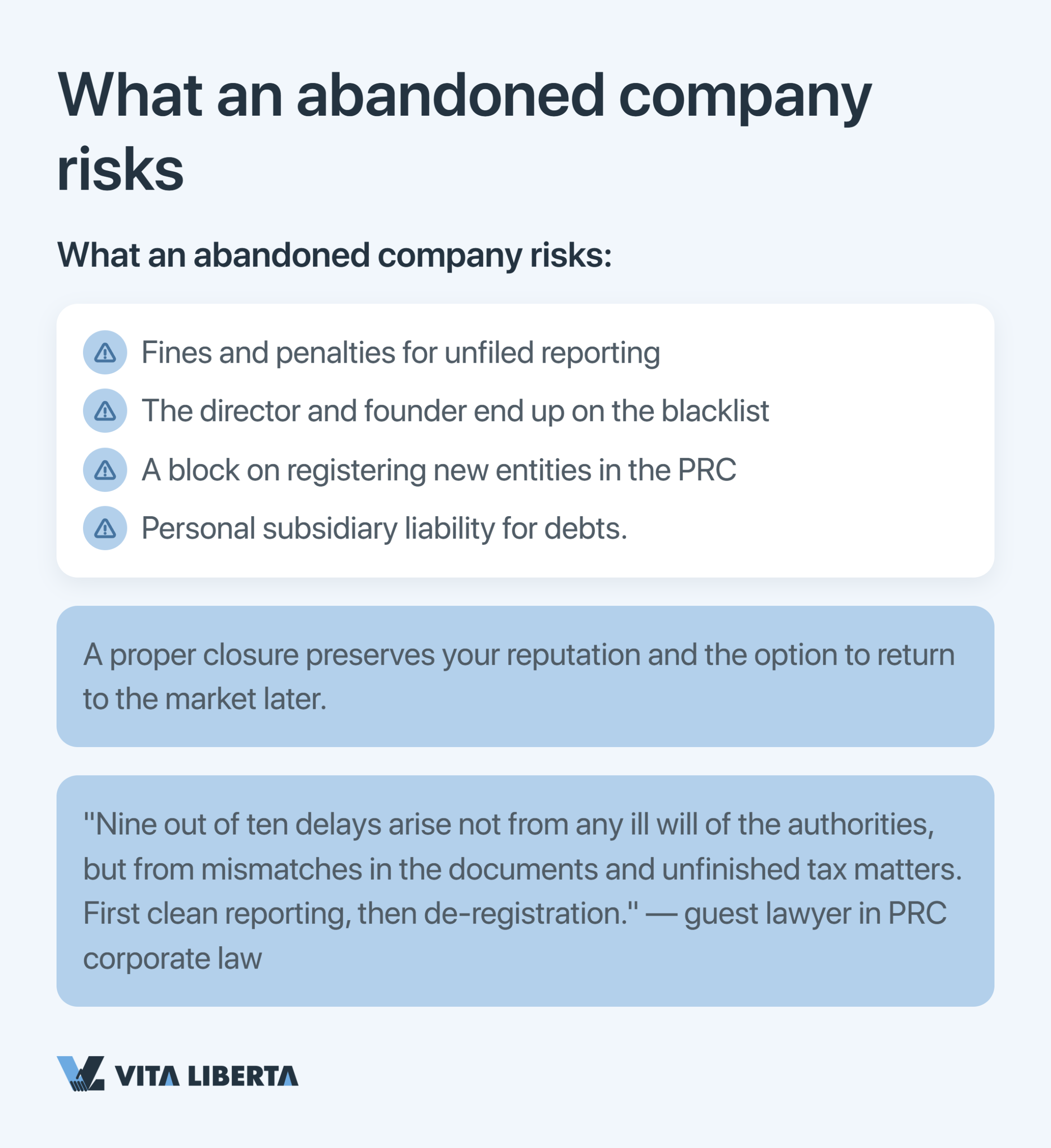
“Closing a company in China without losses comes down to discipline and the order of the steps. Nine delays out of ten arise not from any ill-will on the part of the authorities, but from mismatched documents and unclosed taxes. Clean books first, then deregistration.”
— Sergey Konon, consultant on PRC corporate law
Winding down a WFOE is a manageable but lengthy procedure: shareholder resolution, committee, creditor settlement, tax clearance, and repatriation through SAFE. On average it runs from six months to a year. Follow the order of the stages and keep your documents aligned — then your market exit passes without penalties or delays, and the door stays open for future projects in China.
Note for Hong Kong readers: this covers mainland China WFOEs. Closing a Hong Kong limited company is an entirely separate process — it runs through the IRD’s “Notice of No Objection” (form IR1263) and the Companies Registry, and none of the mainland tax or SAFE rules below apply to it.
Planning a WFOE liquidation?
- Turnkey company liquidation
- Dealing with tax office and bank
- Close with no fines or risks
FAQ
Closure follows an official procedure: the shareholder passes a resolution to wind up, a liquidation committee is formed, the company settles with the tax bureau and creditors, cancels its licenses, closes its accounts, and surrenders its chops. You cannot simply stop operating — the full cycle is required
It is not quick and usually runs for many months, often over a year. The tax review and deregistration take the longest, because the authorities carefully reconcile all reporting for the whole period of operation.
Yes. Tax deregistration is the mandatory and most demanding part. The authority checks the accounts across the entire operating life, and without a clean tax exit the liquidation cannot be completed.
It is highly risky. An abandoned entity ends up blacklisted, and its directors and shareholders face restrictions — from fines to a ban on registering new businesses and visa complications. A proper liquidation is cheaper in the end.
Selling the equity transfers the entity to a buyer and is faster, but it needs SAMR approval (and antitrust clearance in larger deals). Liquidation fully dissolves the company and suits empty or loss-making entities with no buyer.