Hongkong
 China
China




A polished Alibaba profile and a price below market are a shop window, not a guarantee. The only thing that shows the real picture is systematic due diligence — done before the money moves.
Why verification isn’t optional
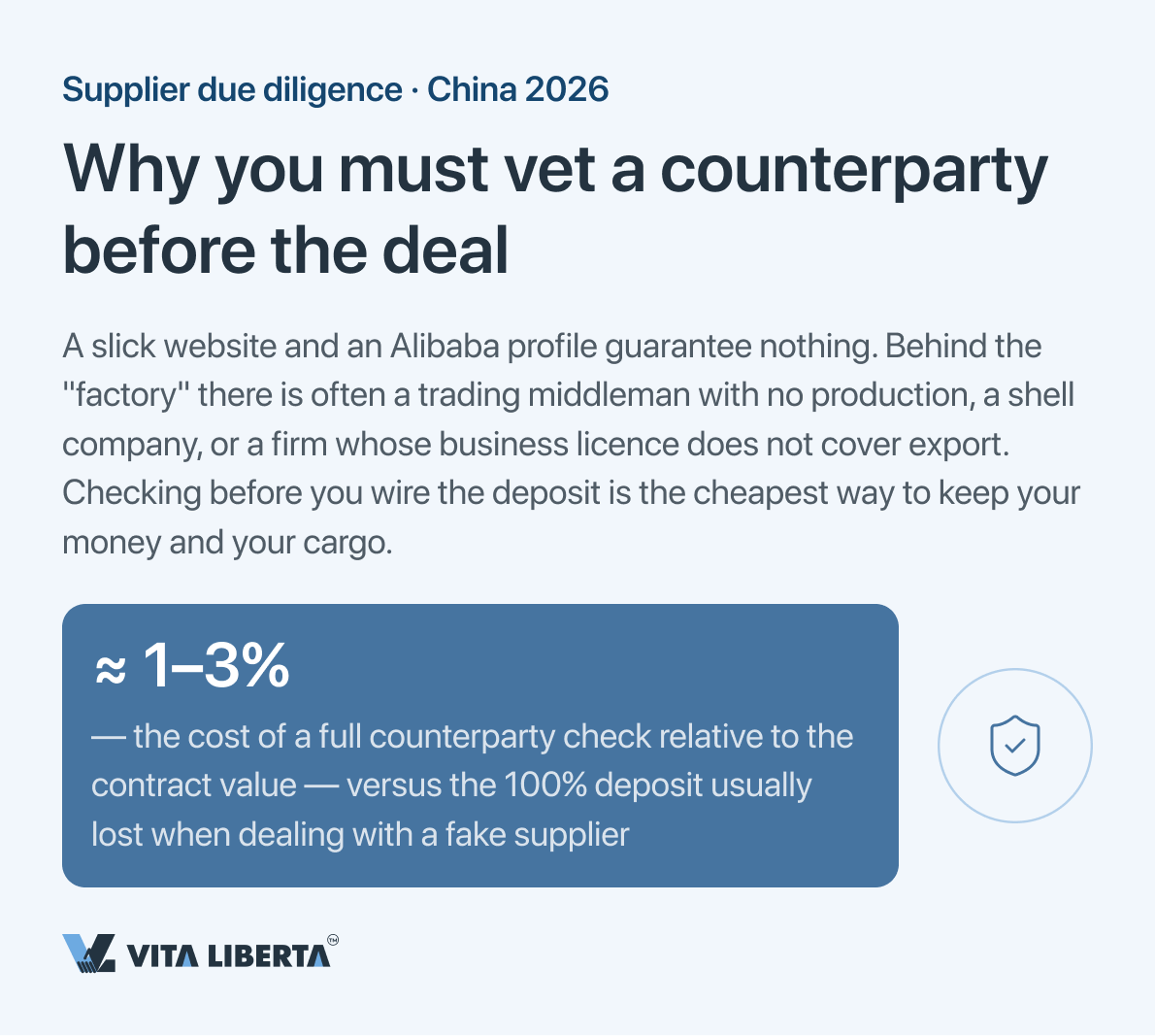
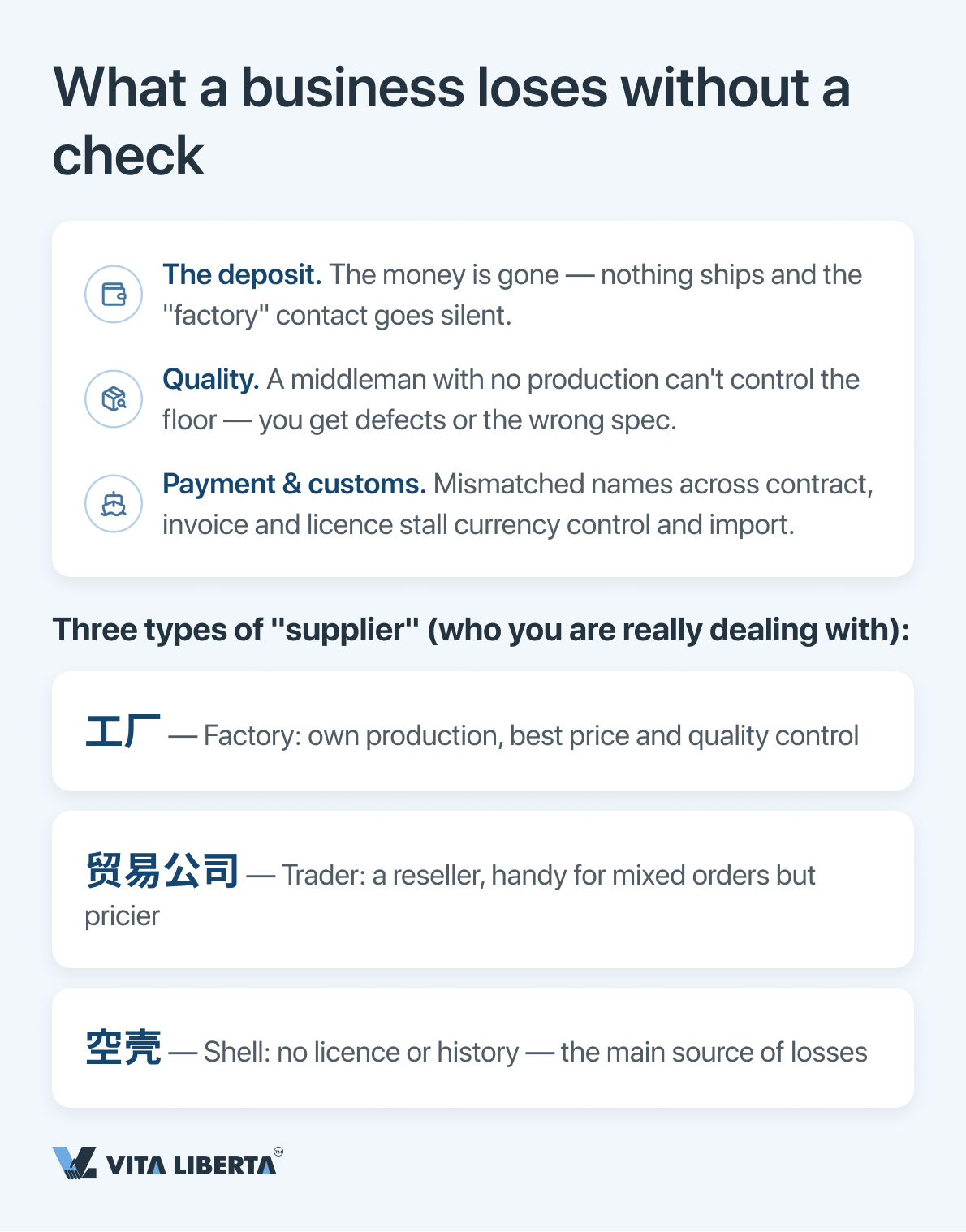
An unvetted counterparty in China exposes you to three distinct failures: a shell company operating under someone else’s registration details, a trader posing as the factory, or a seller who simply vanishes once the deposit clears. By various estimates, more than 40% of companies working with unverified Chinese partners run into problems.
There is also a legal trap that trips up first-timers. Chinese courts and banks reason from the register — from what a company is formally licensed to do — rather than from how active it appears in practice. If a company lacks the licence for what it’s selling, or the contract is signed by someone without authority, no amount of real-world activity fixes that afterwards. In one case, an overseas buyer came within a hair of wiring $160,000 to a “factory” that turned out to have been registered only a couple of months earlier at a mass-registration address.
The three layers of verification
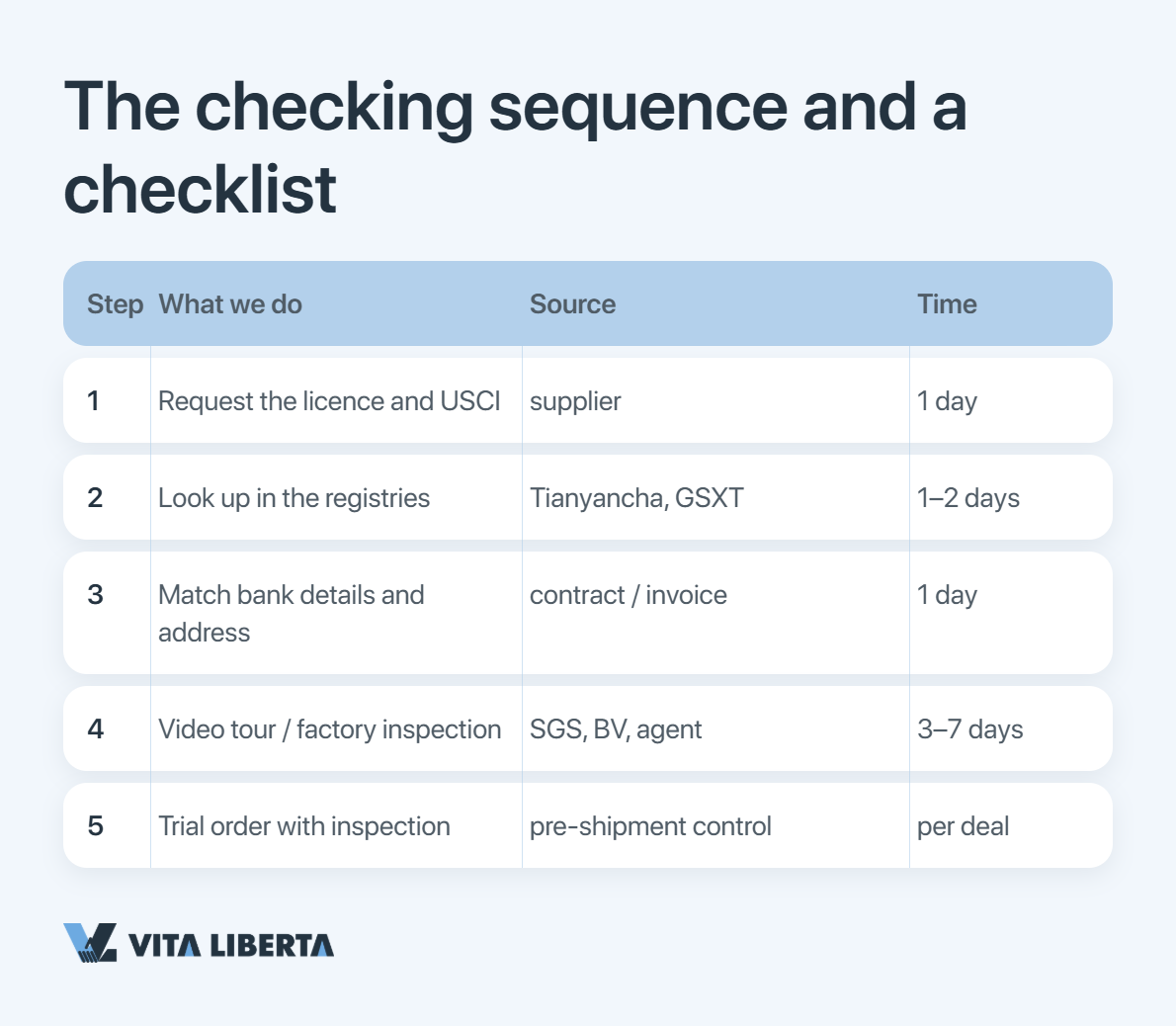
Reliable vetting is sequential: each layer either confirms or overturns the one before it. Skipping to the third is expensive; stopping at the first is how the losses above happen.
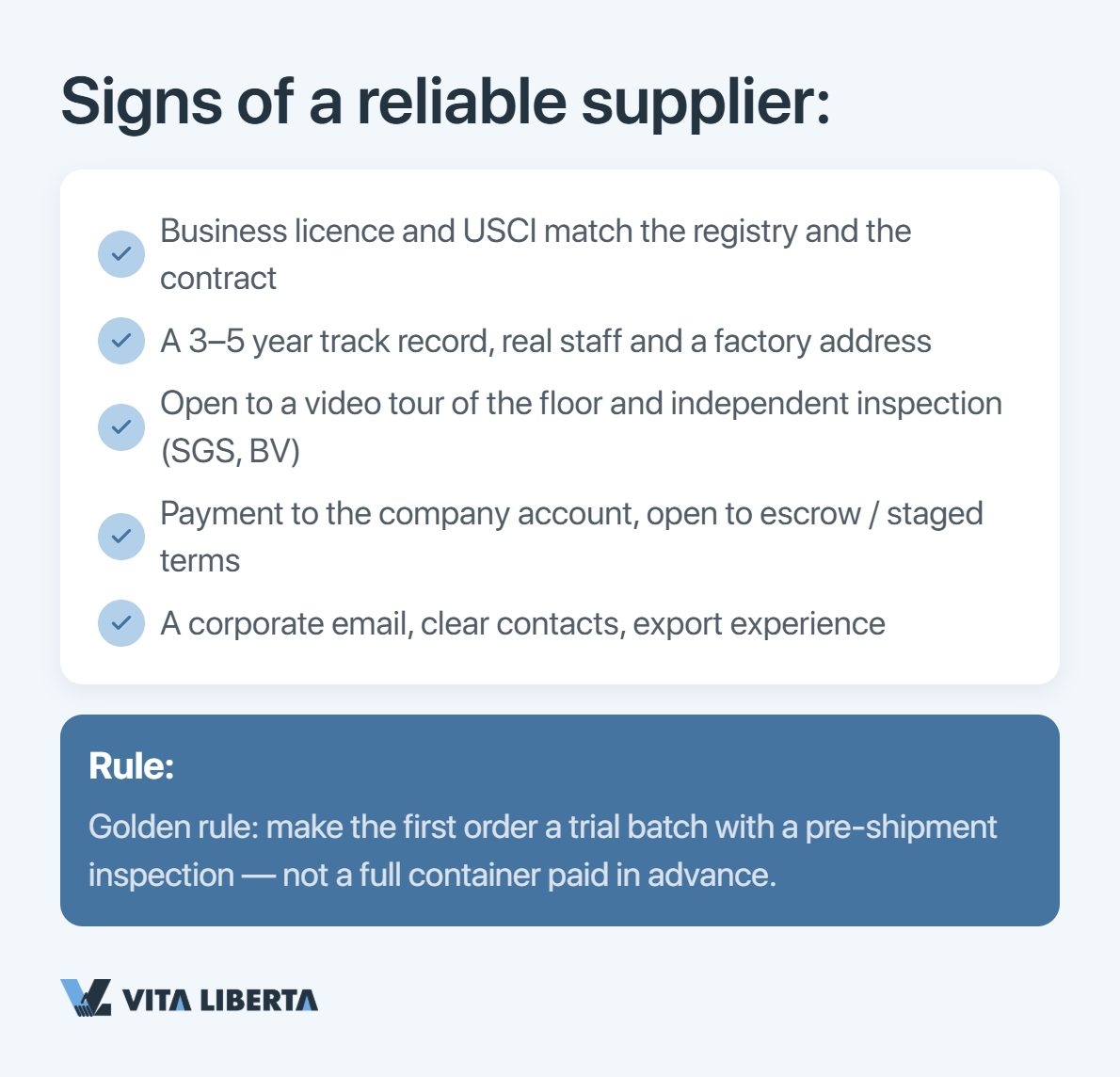
Layer 1 — The digital footprint. On B2B platforms (Alibaba, 1688, Made-in-China), the goal isn’t to pick a supplier — it’s to build a shortlist of 5–7 candidates. Look at account age, how narrow the product focus is, transaction volume and the Verified Information tab. Read the badges for what they are: Gold Supplier signals a paid membership and nothing else. On 1688, a rating of three or more “crystals” is the practical benchmark.
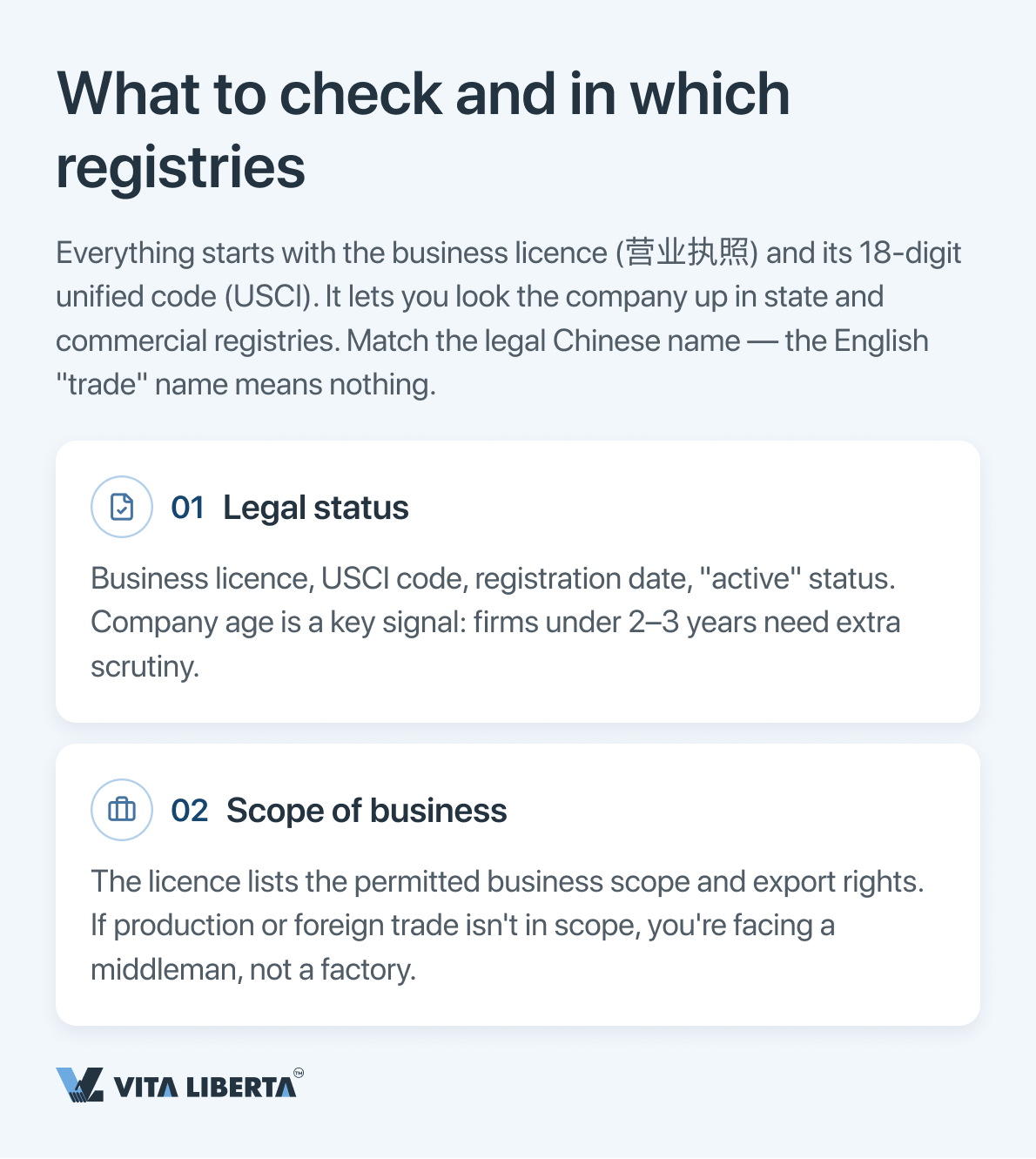
Layer 2 — The paper trail. Ask for the business licence (营业执照) and work from the 18-digit code on it. What you are testing is not whether the document looks official — scans are trivial to fabricate — but whether three specific fields survive contact with the register: the legal name, the business scope, and the incorporation date. Scope is the field that answers the question your sales contact keeps sidestepping, since 生产 (manufacturing) and 贸易 (trade) describe two entirely different counterparties with two entirely different liabilities. And pull the licence twice. Shareholder and director changes reach the register on a 30-day lag, which means a document requested during early talks can be obsolete by signature date — along with the authority of whoever is holding the pen.
Layer 3 — Contact with reality. Everything above is still a hypothesis. Confirming it starts cheap: order samples, then run a live video call and ask to be walked through the premises rather than shown a prepared clip. Above a certain order value, escalate to an independent on-site audit and an AQL inspection of the first production run. The reason is unglamorous — photogenic facilities are occasionally somebody else’s floor space, hired for the afternoon.
⚠️ One habit worth building: run every check against the Chinese legal name, not the English brand on the website. Three things have to name the same entity — the proforma invoice, the receiving bank account and the licence. Where they diverge, you are looking at a substantive risk, not a typo in the paperwork.
Doubts about your supplier’s reliability?
- Verify counterparties in PRC registries
- Spot risks before you sign
- Report with clear recommendations
Which registries answer which question
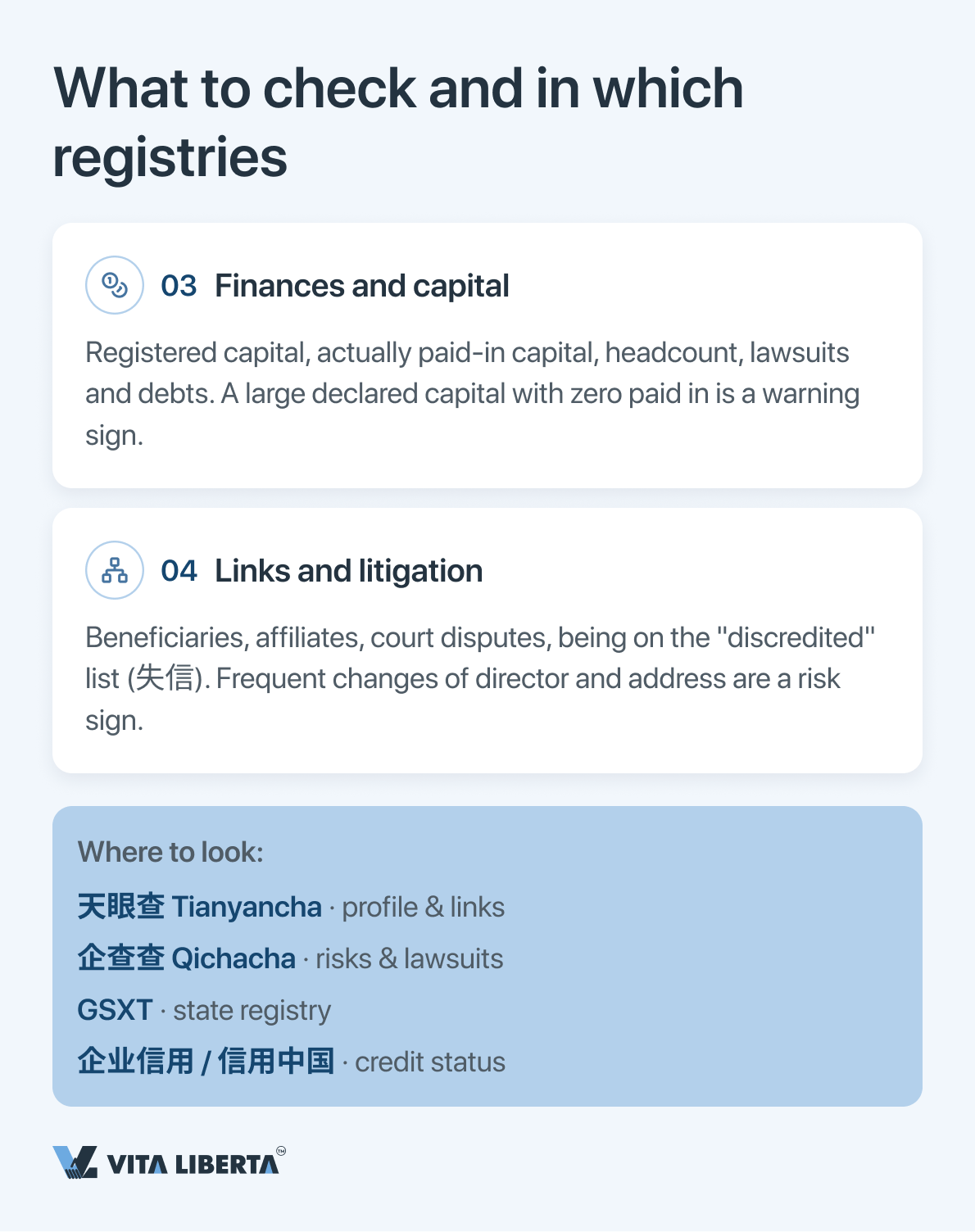
No single lookup settles anything, and that is the operating constraint. China’s registers were built separately and never merged, so the method is triangulation: the official SAMR record via NECIPS (gsxt.gov.cn) establishes existence and scope, the commercial platforms add litigation and ownership, and the court databases tell you how the company behaves when a deal goes wrong. Agreement between two of them is a finding. Agreement with only one is a hypothesis.
| Tool | Access | What it answers |
| NECIPS / GSXT (official) | Open, Chinese-language | Does the entity exist, with what scope, status and legal representative |
| Tianyancha | Works best from a China IP | Registration plus litigation and ownership links |
| Qichacha | Works best from a China IP | Deeper analytics, blacklist entries |
| Aiqicha (Baidu) | Open | Baseline registration data |
| Third-party verification report | Paid, English output | Consolidated file with analyst commentary |
Litigation deserves its own pass rather than a glance. Isolated disputes are ordinary for an active manufacturer; what should concern you is a pattern — repeated contract claims, and above all enforcement proceedings, which typically indicate a company that does not pay when it loses. Where the legal representative turns up on the dishonest judgment debtors register (the “Lao Lai” list), reconsider the relationship rather than the terms.
Factory or middleman?
Getting this wrong is not a labelling error, it is a liability problem. A trader owns no production line and therefore carries no real answer for defects, and claims brought against an intermediary tend to fail. Three signals usually give it away: a catalogue spanning unrelated product families, a business scope with no manufacturing entry, and persistent reasons why a factory visit is inconvenient this month. Buying from the maker strips out a layer of margin and, more importantly, puts quality liability with the party that can actually fix it. A trading company can still be the right partner — but only if you know that is what you have chosen.
Where to walk away
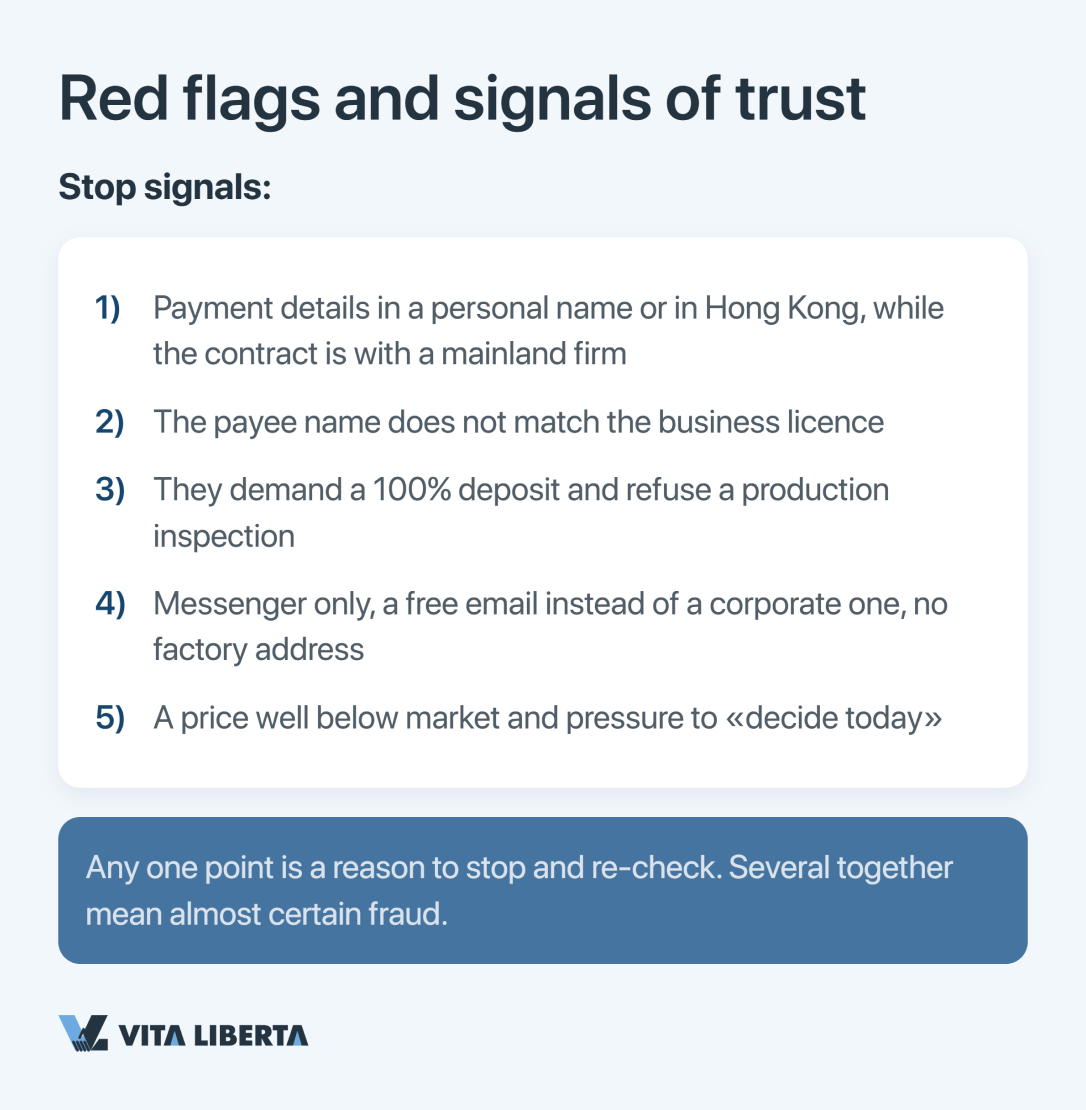
Nothing on the list below is fatal in isolation. Two of them appearing together is your exit signal, and the mistake most buyers make at that moment is trying to price the risk down rather than leave.
- the licence never arrives, or the copy that arrives disagrees with the register;
- the quote sits well under every competing offer;
- the supplier insists on the full amount up front and refuses a 30/70 structure;
- funds are directed to a personal account, requested through WeChat Pay, or routed via undocumented grey shipping;
- the company was incorporated recently, at an address hosting a crowd of other registrations;
- video calls and site visits keep being deferred.
Certificates deserve parallel scrutiny — ISO, CE, RoHS — because a scan proves nothing. For anything moving into or through the EU, note the marking that reads “CE” but stands for China Export; it carries no European conformity value. Confirm export entitlement separately.
Where professional help pays for itself
Enhanced due diligence earns its cost in three situations: large contract values, layered deal structures, and any indication of a politically exposed beneficial owner. Firms with access to closed Chinese databases bring three things you cannot replicate remotely — language, sanctions screening, and people who can stand in the factory. Verification is also not a one-off: repeat it when order volumes step up, when banking details change, and whenever ownership moves.
“A few days spent on verification is cheaper than months of arbitration against a supplier who has stopped existing. A register status of ‘active’ carries almost no information by itself — what carries information is the licences, the litigation history and whether you have found the actual manufacturer.”
— Sergey Konon, foreign-trade consultant, China counterparty verification
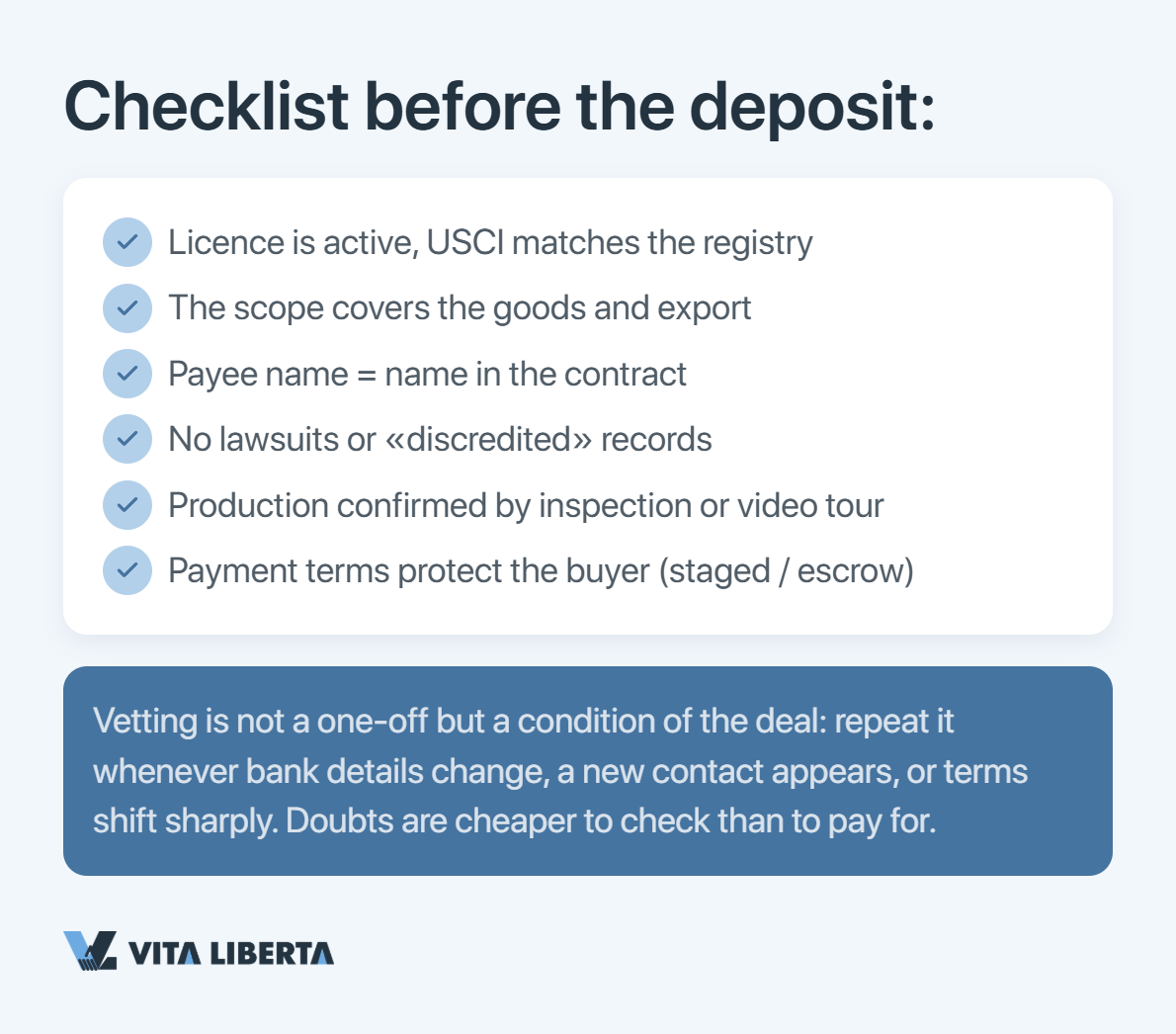
Work through the layers in sequence, treat any single registry entry as unconfirmed until a second source agrees with it, and read warning signs as information rather than friction to be negotiated away. Licence, litigation and the real manufacturer come first; the deposit comes after. Measured against what a failed order costs, that sequence is inexpensive.
Want to deal only with vetted suppliers?
- Full supplier background check
- Protection from fraud and scams
- Fast checks before you pay

FAQ
It is layered rather than a single check. Establish that the legal entity exists by working from its licence, reconcile the registration details against everything the supplier has told you, form a view on whether the production capability is real, look at how the company has behaved commercially, and get samples in hand. Once the sums become material, put someone on site. The whole exercise answers one question: is there a working manufacturer behind this, or a name?
Take the 18-digit code, search it in the state database yourself, and ignore whatever PDF you were sent. Then run the comparison that catches most fraud and takes thirty seconds: licence name, invoice name and bank account name must be one entity. Two out of three is a failed check, not a rounding error. Re-run it before signature, because the register lags real changes by up to a month.
Start with the licence copy, add export authorisation where the product requires it, and insist that banking details belong to the same legal entity rather than to an affiliate or an individual. For regulated goods, request the quality certificates and approvals that category demands. Treat a mismatch between account holder and company name as a stop condition, not a question to raise later.
Resellers reveal themselves through breadth — a product range with no manufacturing logic connecting it — combined with reluctance to open the workshop and, occasionally, a request to route payment through an unrelated party. Three things settle it: a live, unscripted video tour of production, the factory address checked against what the licence records, and an independent visit before the first significant shipment.
It proves the narrow thing — that a legal entity exists and is permitted to do a defined list of activities. It proves nothing about capacity, quality or solvency, which is why a clean licence is the start of due diligence rather than the end of it. Verify it through the Unified Social Credit Code on NECIPS, then move on to what the licence cannot tell you: court records, enforcement history and whether the goods are made by the company you are paying.