Hongkong
 China
China





A tropical resort island has quietly become the testing ground for the boldest fiscal reform in China. Here is what an entrepreneur takes away from it.
The free trade port in brief
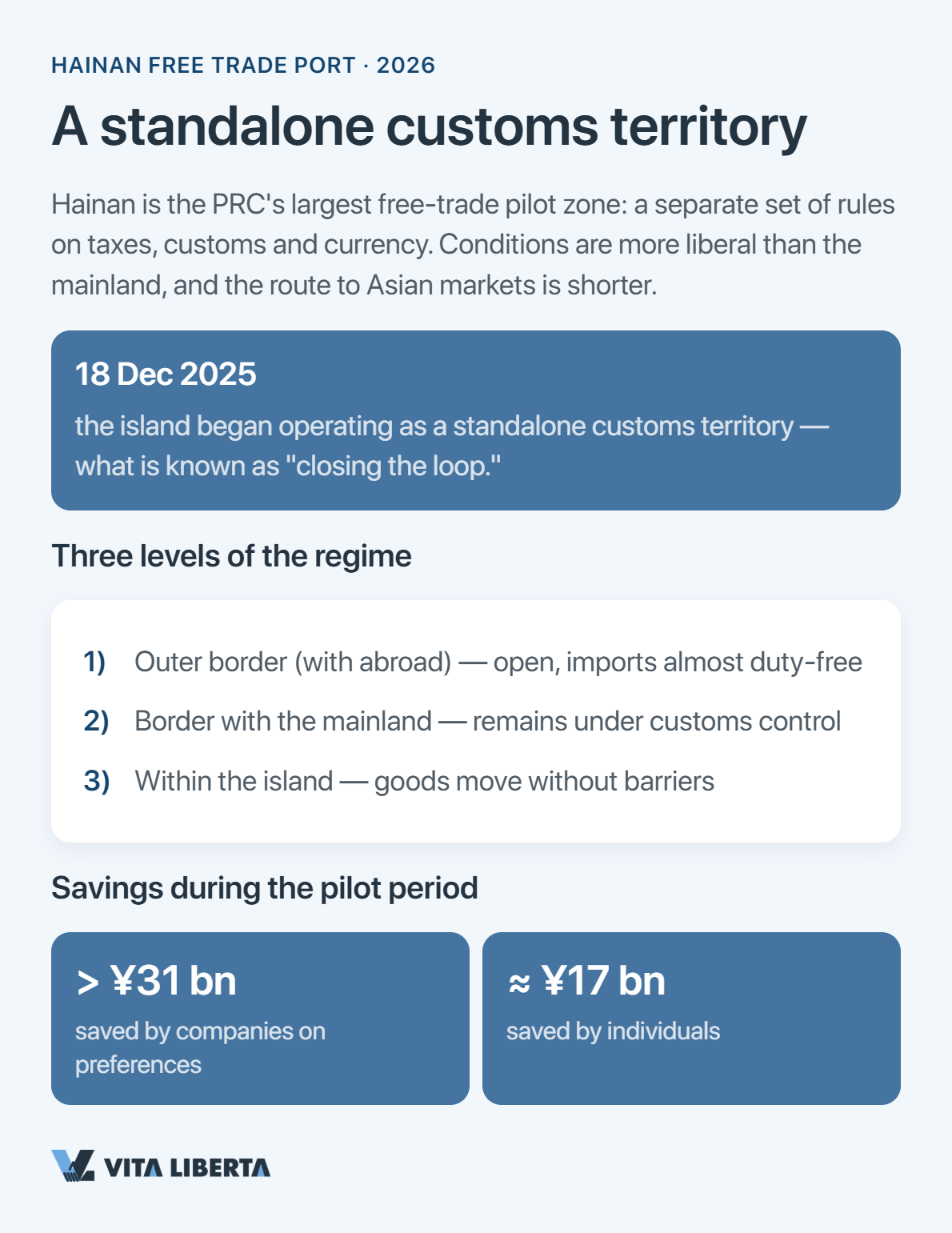
Hainan is China’s most ambitious pilot free trade zone, where companies are offered a distinct rulebook on tax, customs and foreign-exchange operations. Two things make the island attractive to business: conditions here are noticeably more liberal than on the mainland, and the route to Asian markets is shorter. Sitting at the doorstep of ASEAN and inside the RCEP bloc, it works as a low-tax gateway into a market of 1.4 billion consumers.
How the “separate customs territory” regime works
On 18 December 2025 the island switched over to running as an independent customs territory — the move known as the island-wide customs closure. The principle is built on three tiers, officially described as “eased access at the first line, controlled access at the second line, and free flow within the island”:
- First line (with overseas markets) — open; imports enter almost duty-free;
- Second line (with the mainland) — remains under inspection;
- Within the island — goods move without barriers.
Across the pilot phase, official estimates put the savings companies made on these perks at more than RMB 31 billion, with individuals saving around RMB 17 billion.
What the tax regime delivers
The incentives split into two tracks — corporate and personal.
Profits taxed at 15%
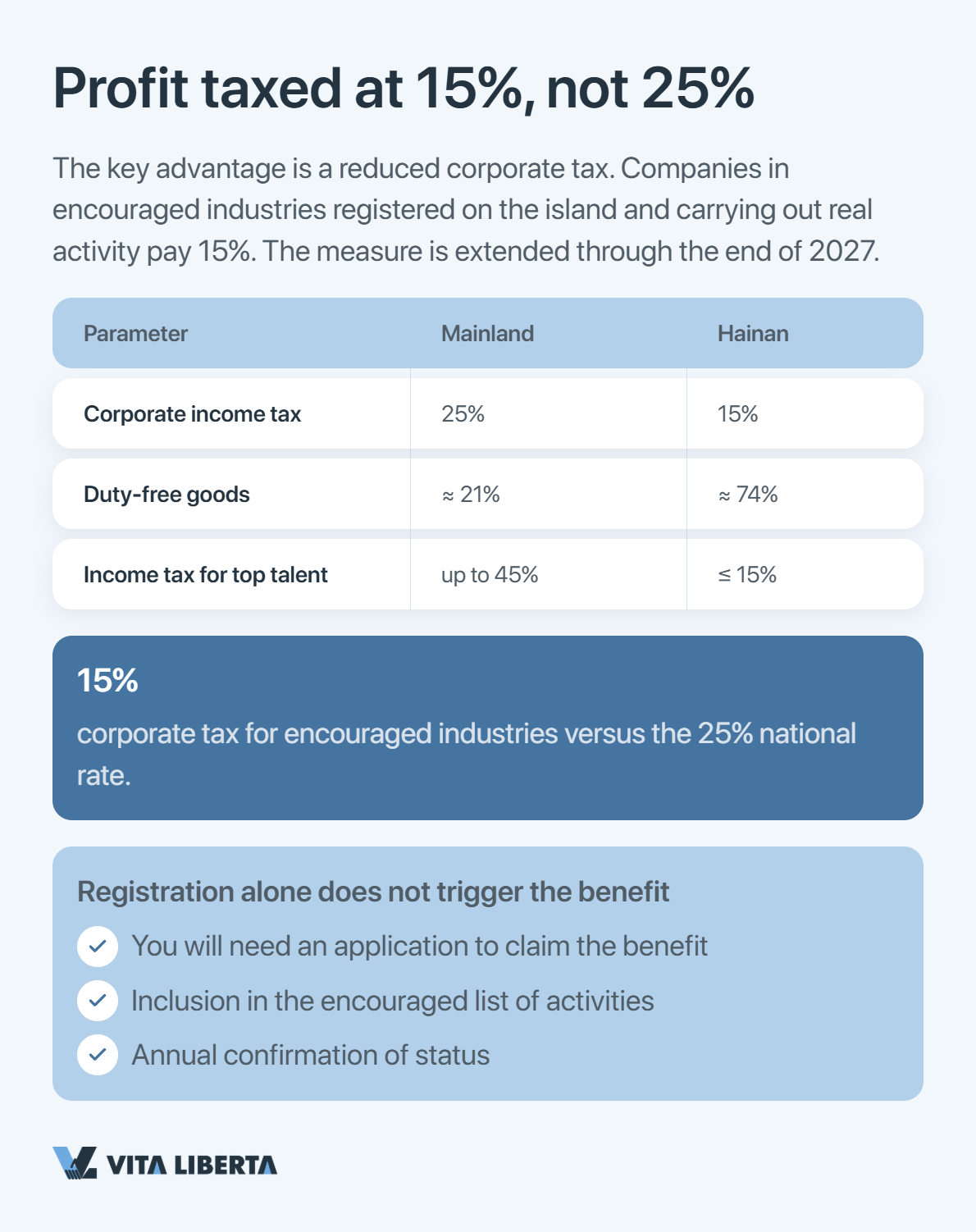
The headline advantage is the reduced Corporate Income Tax (CIT): enterprises in encouraged industries that are registered and substantively operating in Hainan pay 15%, against the national rate of 25%. The measure has been extended through the end of 2027. For context, that undercuts Hong Kong’s 16.5% profits tax and Singapore’s 17%.
| Parameter | Mainland | Hainan |
| Corporate income tax | 25% | 15% |
| Share of goods with zero tariff | ~21% | ~74% |
| Personal income tax for top talent | up to 45% | no higher than 15% |
⚠️ Note: registration alone does not switch the benefit on. You need an application, a place on the Encouraged Industries Catalogue, and annual confirmation of status. The substance test checks that management, personnel, finance and assets are genuinely on the island.
A capped personal income tax and deductions
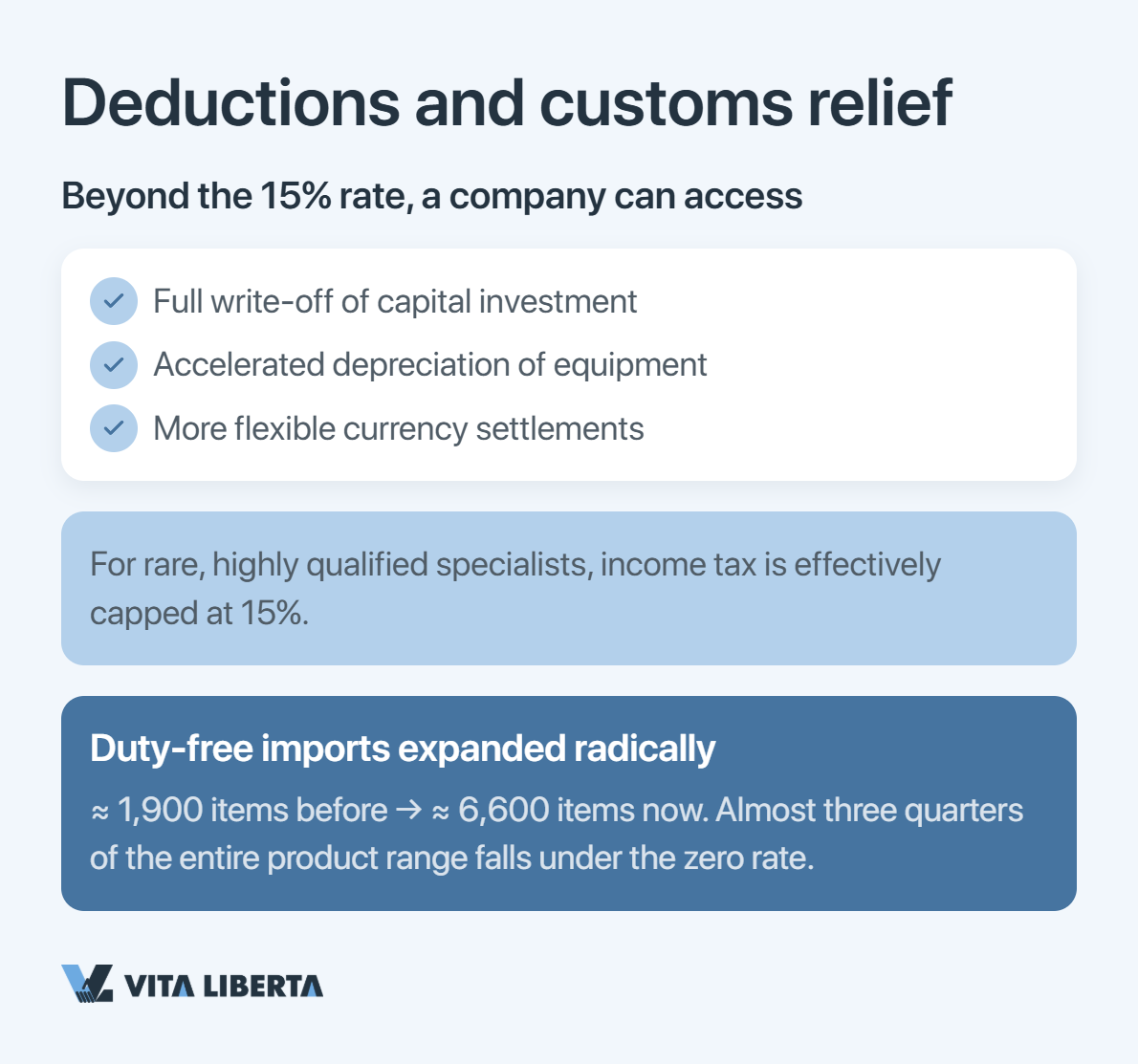
For scarce, high-end talent, individual income tax (IIT) is effectively capped at 15% — anything above that threshold is not levied. On top of that, an enterprise can access:
- full, immediate write-off of qualifying capital investment;
- accelerated depreciation of equipment;
- freer settlement in foreign currency.
Interested in Hainan’s tax breaks?
- Assess the benefits for your business
- Check your 2026 incentive eligibility
- Estimate your tax savings
Customs relief
The zero-tariff list was widened dramatically: instead of roughly 1,900 items, around 6,600 now fall under the zero rate — nearly three quarters of the entire tariff schedule. After closure, the system moved from a positive list to negative-list management: everything outside the taxable-imports catalogue is duty-free.
When shipping to the mainland is duty-free
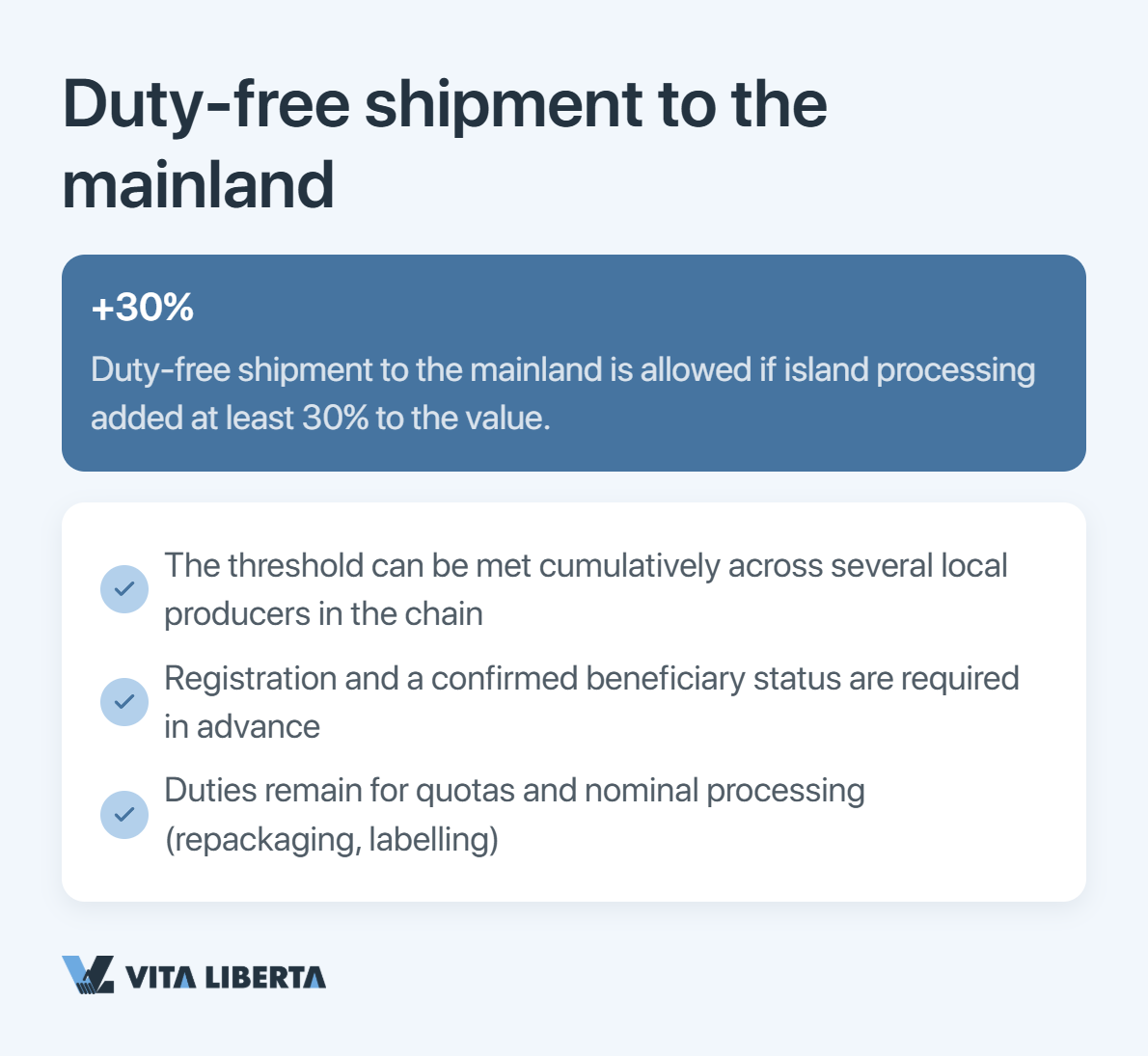
Products may be sent to mainland China without customs duties if processing on the island has added at least 30% to their value. What to watch:
- the threshold can be met cumulatively when several local producers sit in the chain (an upstream-downstream aggregation now permitted);
- prior registration and confirmed beneficiary status are required in advance;
- duties still apply to quota goods and to purely nominal processing — repackaging or slapping on a label alone will not qualify.
Setting up a company on the island
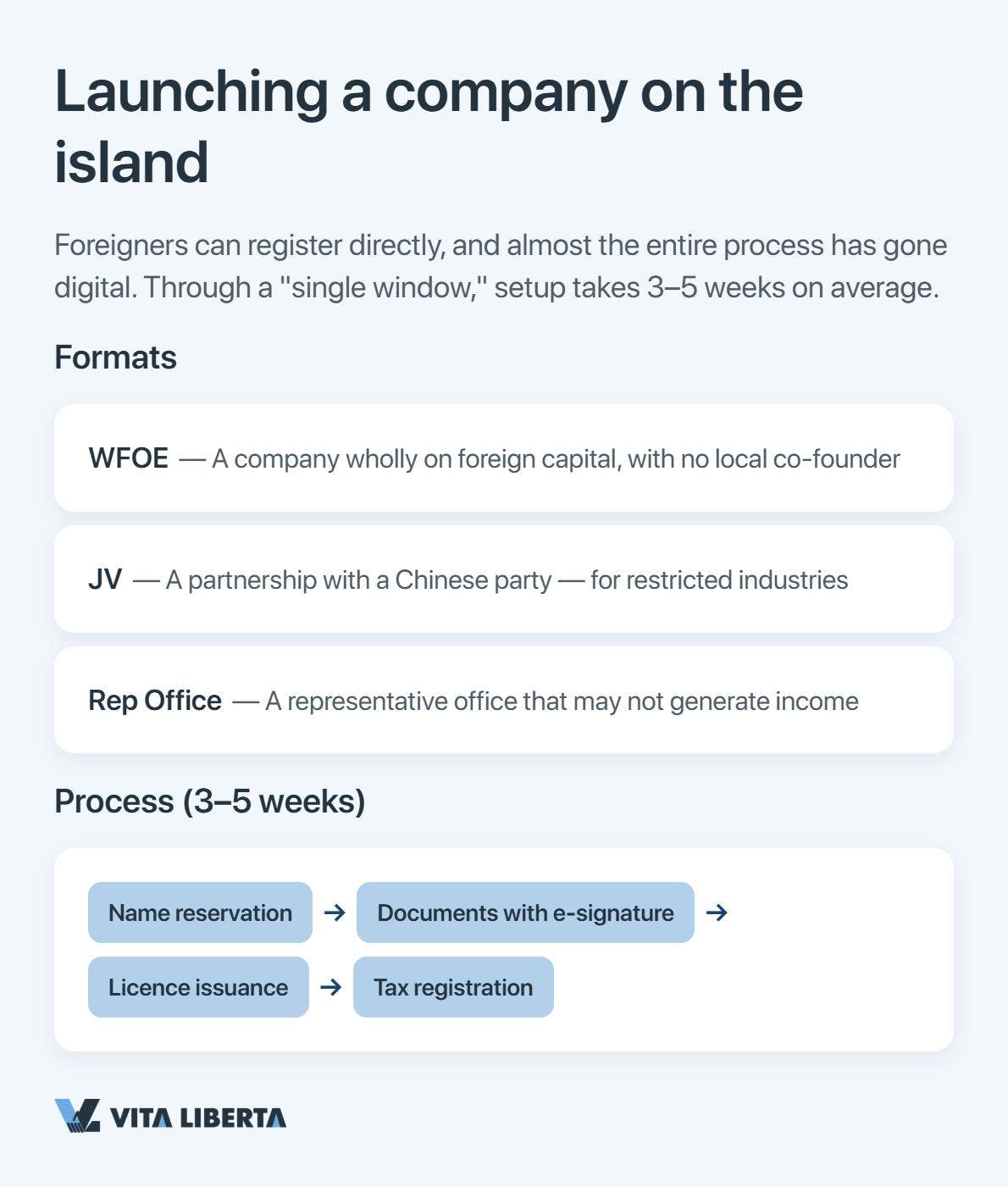
A foreign investor can register directly, and almost the entire process has gone digital.
Structures and the “single window”
Three constructions are on offer:
- WFOE — a wholly foreign-owned enterprise, no local co-founder needed;
- JV — a joint venture with a Chinese partner, required in sectors still on the negative list;
- Representative Office — a liaison presence that may not generate revenue.
Through the unified e-registration platform, setup typically fits into 3–5 weeks: name pre-approval (a reservation held for up to six months) → filing with an electronic signature → business licence issuance → tax registration. Foreign-exchange procedures are simplified, and capital repatriation abroad has become freer.
Who gains most — and where the risks sit
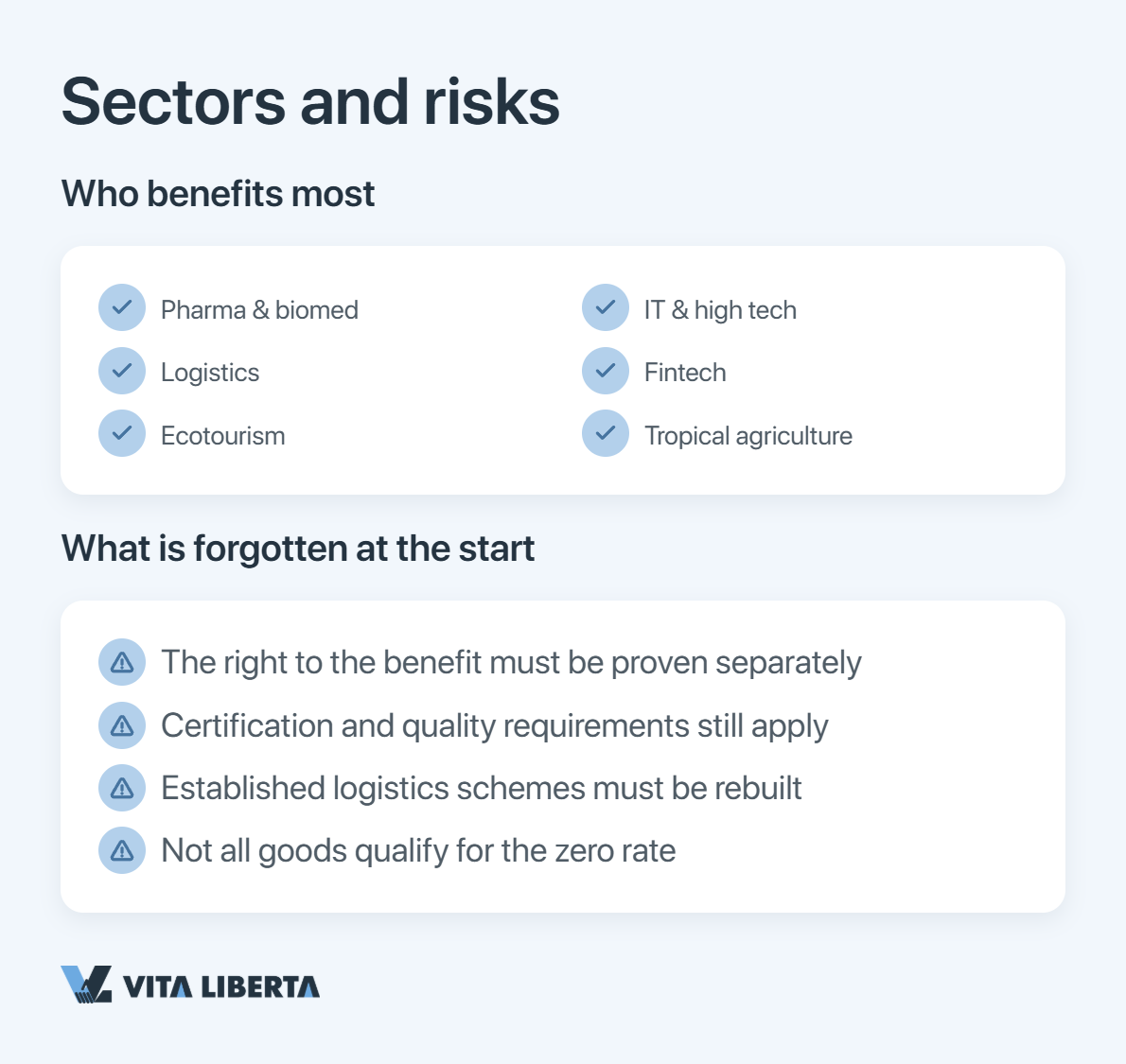
The biggest winners are the priority sectors: pharma and biomed, IT and high tech, logistics, fintech, eco-tourism, and tropical agribusiness.
What founders forget at the starting line:
- entitlement to the benefit has to be proved separately;
- certification and quality requirements have not gone anywhere;
- familiar logistics chains will need to be rebuilt;
- not every product clears the zero rate — there is a restrictive list.
“The island is not an ‘offshore-at-the-push-of-a-button.’ The advantage only becomes systemic for those who build their structure around the right sector in advance and keep meeting the requirements. Otherwise the saving turns out to be a one-off and unpredictable.”
— Sergey Konon, foreign-trade consultant in China
By 2026 Hainan is a genuine working platform both for cutting the tax burden and for entering the Chinese market: 15% on profits, a trimmed IIT, zero duties on most lines and a fast start. Where to begin — check your sector against the encouraged list, choose a structure (WFOE is the usual pick), calculate the processing share needed for duty-free export, and budget for certification.
Want to set up on Hainan?
- Registration in the free port zone
- Tax incentive applications handled
- Full project support
FAQ
The island stacks several perks: a reduced corporate income tax, a capped personal income tax for in-demand talent, zero tariffs on a wide range of goods, and simplified customs clearance. A large share of imported goods is exempt from tariffs, import VAT and consumption tax as long as they stay for use within the island.
From mid-December 2025 the whole island runs as a special separate customs zone. The logic: the outer border is open, the mainland junction is controlled, and goods circulate freely inside. When they cross to the mainland they follow ordinary import rules.
Companies registered and genuinely operating in Hainan within encouraged sectors pay CIT at 15% — the incentive is locked in through 2027, well below the 25% national rate.
Zero-tariff import is open to accredited entities and applies to goods consumed within the island. Products from encouraged industries may be shipped to the mainland duty-free provided the value added through processing in Hainan reaches 30% or more.
It suits foreign-trade companies and tech or service projects that use the island as a gateway to China and a base for cross-border trade. The conditions: register with genuine local-company status and rebuild logistics around routes running through Hainan.