Hongkong
 China





China prices its flagship corporate tax break openly and at a fixed rate. The payout goes to whoever can prove their technology in figures and paperwork, not to whoever merely works on it.
The core problem
“We run a WFOE in Hangzhou with our own development, engineers on payroll and a product sold worldwide. Why do we pay 25% like a trading company while the firm next door in the business park pays 15%? Are we not tech enough?” Your industry alone decides nothing. The thresholds do. Corporate Income Tax (CIT) goes down only after you prove six quantitative indicators and receive High and New Technology Enterprise (HNTE) status. Below: what the package contains, what it costs to get in, and where the status usually breaks.
The HNTE package: a 15% rate plus three more tools
Recognition unlocks two benefits that only high-tech enterprises get: the 15% rate and a longer loss carry-forward. Two other tools, the R&D super deduction and the staff training deduction, are open to ordinary companies as well. Combined with the status, though, they deliver the biggest effect. Each tool works at its own point of the calculation. The super deduction acts first, while the tax base is being formed. The reduced rate comes in at the very end.
From 25% to 15%: RMB 1 million on RMB 10 million of profit
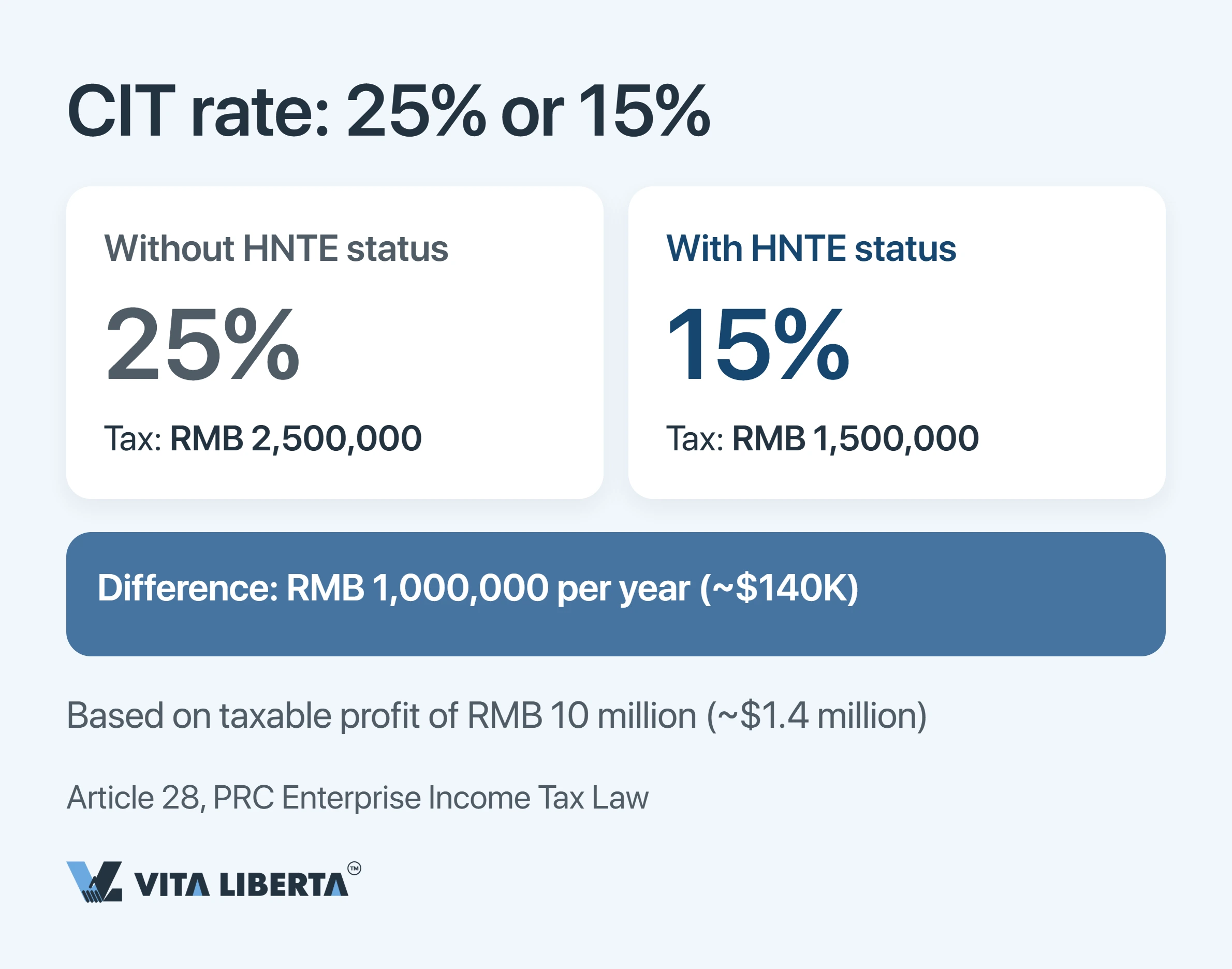
Start from the money. Profit of RMB 10 million (about USD 1.4 million) means RMB 2.5 million of tax under the standard regime. With the status, you pay RMB 1.5 million. That RMB 1 million gap (about USD 140,000) rests on Article 28 of the PRC Enterprise Income Tax Law (中华人民共和国企业所得税法). It takes recognised enterprises out of the 25% base rate and fixes 15% for them. You get 15% from the tax year in which your certificate is issued, and it covers the profit of that whole year (国家税务总局公告2017年第24号). In the year your certificate expires, you can keep paying quarterly advances at 15% until you are re-recognised. If no new certificate arrives by 31 December, you top up that year’s tax to the standard 25%. You apply the incentive yourself and keep the documents for inspection. The tax authority checks your entitlement after you file the return. If it finds you did not meet the recognition conditions, it revokes the status and reassesses tax from the year you stopped qualifying.
R&D super deduction: 200% for all, 220% for two industries
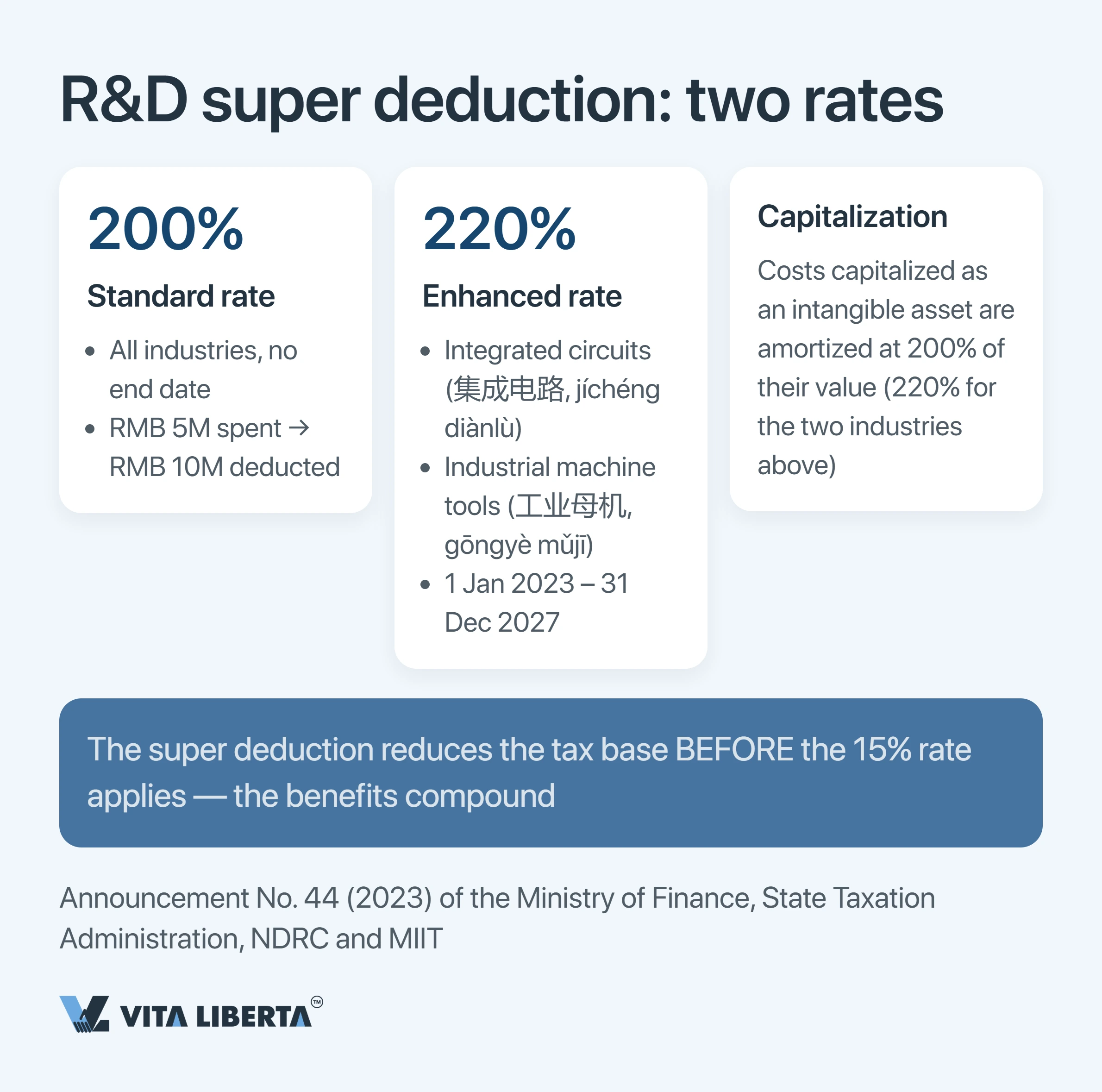
The super deduction shrinks your base first, and only then does 15% apply to what is left. The two incentives multiply each other, and that compound effect is the real reason to pursue the status. Double deduction is the baseline. You take twice your actual research and development (R&D) spend off the base: the cost itself plus another 100%. Spend RMB 5 million on development, and your base drops by RMB 10 million. That is the 200% ratio. Since 1 January 2023 the rule has no end date (财政部 税务总局公告2023年第7号), and you don’t need HNTE status to use it. Some sectors are excluded, though: tobacco, hotels and catering, wholesale and retail, real estate, leasing and business services, and entertainment. 220% for two industries, until the end of 2027. A joint announcement by MOF, STA, NDRC and MIIT (财政部 税务总局 国家发展改革委 工业和信息化部公告2023年第44号, “Announcement 44”) gives the higher ratio to integrated circuit firms (集成电路) and machine tool makers (工业母机, industrial mother machines). From 1 January 2023 to 31 December 2027, they add 120% on top of actual costs instead of 100%. Where list-based administration applies, eligibility depends on an annual list that NDRC and MIIT pass to MOF and STA by the end of March. Capitalising costs changes the method, not the ratio. If R&D costs created an intangible asset, you don’t deduct them in one go. You amortise them from an enlarged base: 200% of the asset’s cost in general, or 220% for integrated circuits and machine tools. No higher “third” ratio appears. A tip with built-in headroom: you don’t have to wait for the annual return. You can claim the super deduction in the Q2 advance payment you file in July, using first-half costs, or in the Q3 payment in October, using nine months of costs (国家税务总局 财政部公告2023年第11号). There is one condition. Your separate (auxiliary) R&D ledger has to run from the first day of the project, not be pieced together in March.
Losses last 10 years, training fits into 8% of payroll
The standard window for carrying losses forward is five years. HNTEs and technology-based SMEs (科技型中小企业) get double: 10 years for losses from the five years before the year in which the company holds the status (财税〔2018〕76号). It sounds like a minor rule. In practice, it is what keeps long-cycle R&D viable. Picture a project that burned cash for four years and turned a profit in year seven. With a five-year window, you would have lost the entire deduction. Staff training costs are deductible up to 8% of payroll, and anything above the cap carries over to later periods. Since 1 January 2018 that limit has applied to every enterprise, not only HNTEs (财税〔2018〕51号). Regional measures sit on top of the national ones. In high-tech industrial development zones, from Shenzhen to Hangzhou, local governments add grants and subsidies. In return, they expect real economic substance: an office, staff and operating accounts.
Six recognition thresholds and 71 points out of 100
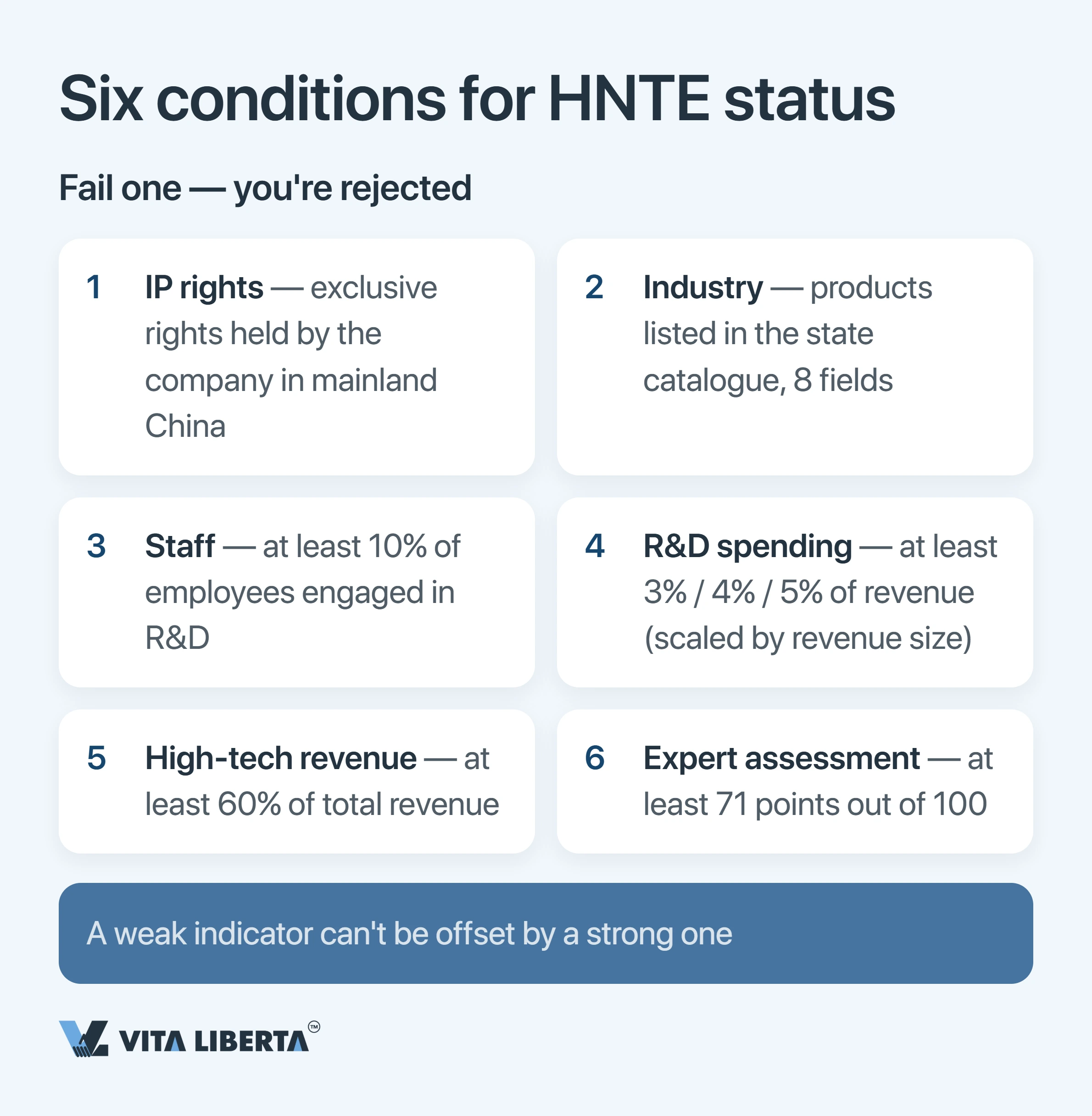
Recognition follows a closed list of conditions in Article 11 of the Administrative Measures for the Recognition of High and New Technology Enterprises (高新技术企业认定管理办法, 国科发火〔2016〕32号, “Circular 32”). The Guidelines that put them into practice (国科发火〔2016〕195号) spell out the details. Six thresholds matter most. Miss one, and the whole application fails. A strong result in one area cannot make up for a weak one in another. Article 11 adds two formal conditions. On the application date, your company must have been registered for at least a year. In the year before you apply, it must have had no major safety accidents, serious product quality violations or environmental breaches. Circular 32 is still in its 2016 version. A revision was announced on 28 July 2025, but as of October 2026 no new text has been published.
| Criterion | Requirement | What to watch |
| IP rights | The enterprise owns the IP behind the core technology of its main products (services). It may have developed, bought or received the rights as a gift, or obtained them through a merger | Only a resident registered in mainland China can hold the status; Hong Kong, Macau and Taiwan companies are outside its scope. Your foreign parent’s patent doesn’t count, and a licence, even an exclusive one, is not ownership: the rights must move to the Chinese entity. Utility models, designs and software copyrights (Class II) can support one application only |
| Industry | The core technology of your main products (services) falls within the Key High and New Technology Fields Supported by the State (国家重点支持的高新技术领域) | 8 fields: electronic information; biotechnology and new medicine; aerospace; new materials; high-tech services; new energy and energy saving; resources and environment; advanced manufacturing and automation |
| R&D staff | Science and technology staff working on R&D and related innovation make up at least 10% of total headcount for the year | You may read that 60% of staff must work in R&D. That is wrong: 60% applies to revenue, not to headcount |
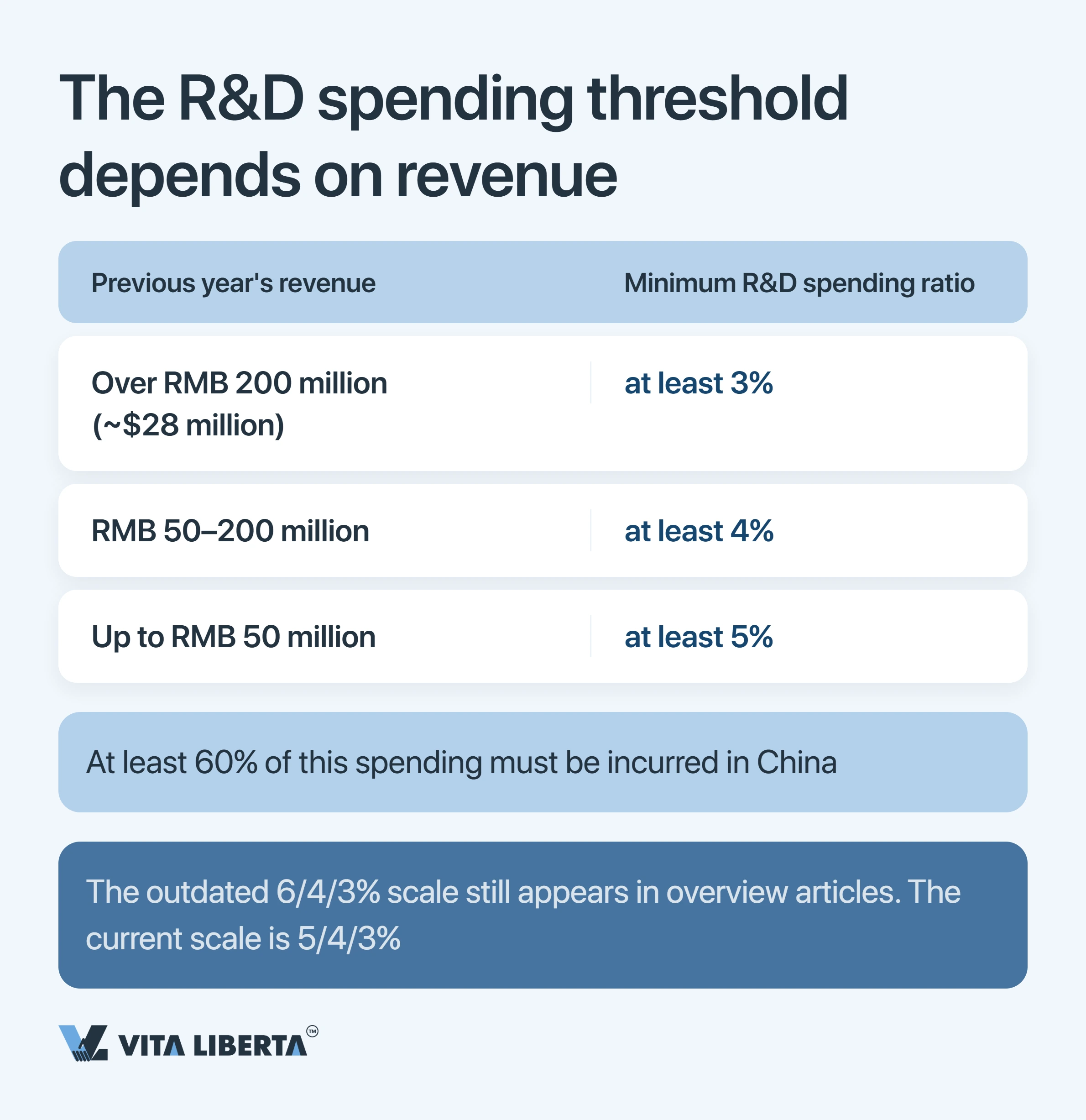
| R&D spend to revenue | R&D costs over the last three fiscal years against sales revenue for the same period: 5% or more if last year’s revenue was up to RMB 50 million inclusive; 4% for RMB 50–200 million; 3% above RMB 200 million | At least 60% of all R&D costs must be incurred in China. A group R&D centre abroad won’t get you over this line |
| High-tech revenue | Revenue from high-tech products (services) in the last year is at least 60% of total income for that year | Total income follows CIT rules (total income minus non-taxable receipts) and includes non-operating income. Reselling someone else’s equipment doesn’t count toward the 60%, however advanced the product |
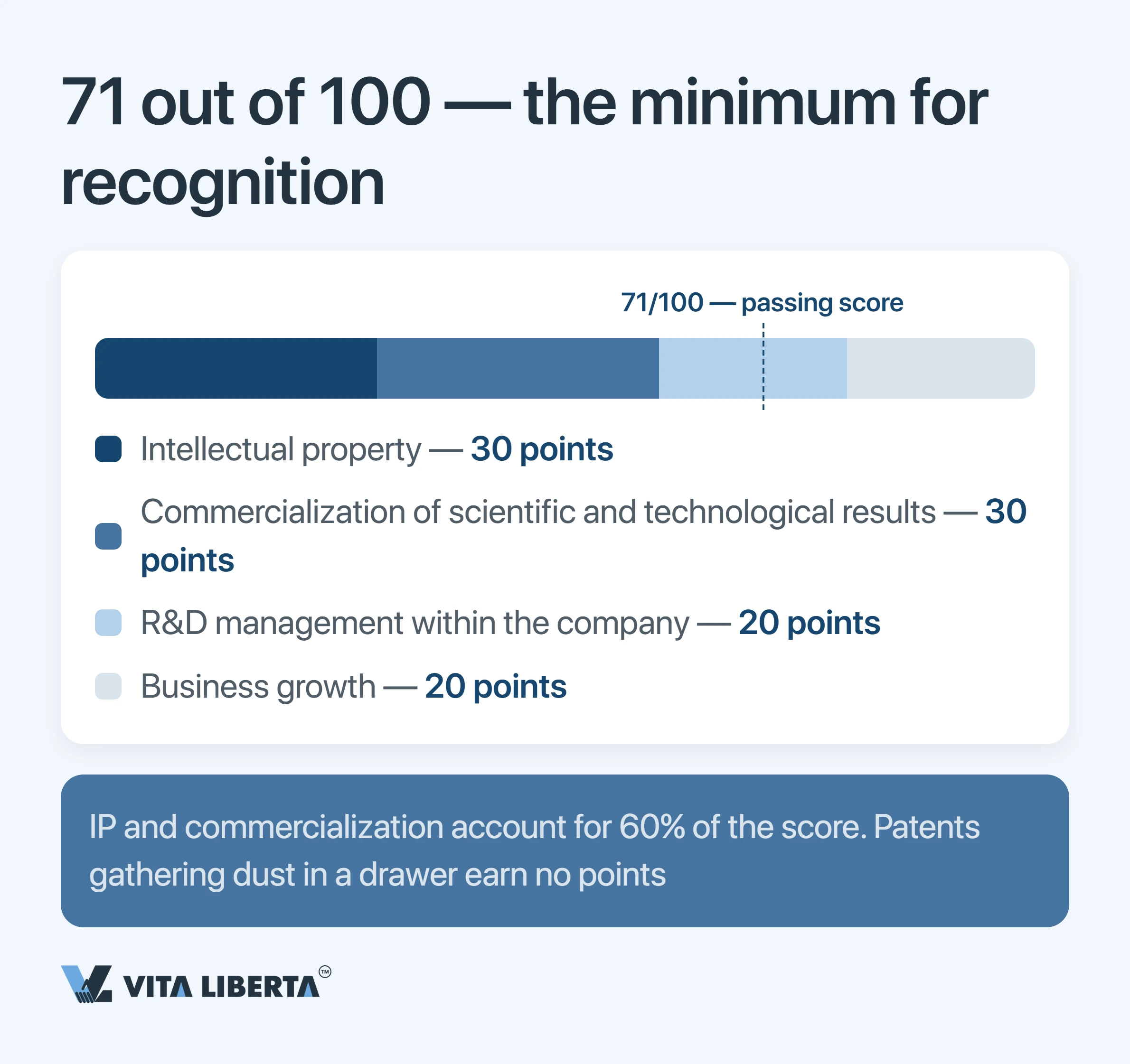
| Expert assessment | Innovation capability scores at least 71 of 100 points across four blocks | The weighting is uneven: IP and commercialisation of R&D results carry 30 points each, R&D management and growth indicators 20 each |
Watch for one more trap if you are working from older guides. Some still quote the 6/4/3% R&D scale from the 2008 rules (国科发火〔2008〕172号). Circular 32 lowered the bar for companies with revenue up to RMB 50 million from 6% to 5%, giving today’s 5/4/3% scale. On RMB 40 million of revenue, that single percentage point equals RMB 400,000 of development budget planned for nothing.
We will get HNTE status in China without rejections on formalities
- Six-threshold check
- File and audit preparation
- Application support

How to get an HNTE certificate: application, review, three ministries
Nothing happens automatically. You apply, and the status follows a multi-level expert review. Your file goes to the certification authority (认定机构) of your province or of a city with separate planning status. Local science and technology, finance and tax bureaus form that body together. At national level, three ministries run the regime: the Ministry of Science and Technology (MOST), the Ministry of Finance (MOF) and the State Taxation Administration (STA).
Where to file and in which window
On the filing date, your company needs at least one year of registration in mainland China. You file through the national platform, the HNTE Recognition Management Network (高新技术企业认定管理工作网, www.innocom.gov.cn). Provinces and cities open their own intake windows, and the calendars differ a lot. In 2026, Beijing took applications in three batches, with deadlines of 15 May, 17 July and 24 September. Shanghai ran a single window that closed on 10 October 2026.
| Stage | Timing | What to submit and where |
| Self-assessment | 2–3 months before the window | Internal check against the six thresholds, inventory of patents and software |
| Platform registration | Before the window opens | Company registration details on 高新技术企业认定管理工作网 (www.innocom.gov.cn) |
| Application | Provincial intake window | File with IP ownership certificates, R&D report, special R&D expense audit, high-tech revenue audit and staffing data, submitted to the provincial certification authority |
| Review and publication | 3–6 months | Expert assessment, publication of the list, issue of the certificate |
| Applying the rate | Annual return | Incentive details go into the CIT return; the file stays with the company for inspection |
A qualified Chinese audit or tax firm prepares the special audit of R&D costs for the last three years and of high-tech revenue for the last year. Every cost in it needs a proper supporting document. For purchases in China, that is usually a fapiao (发票, including electronic 数电票). If a cost has no document behind it, it stays out of the base, both for the super deduction and for the recognition threshold.
Three years of validity: where the status is most often lost
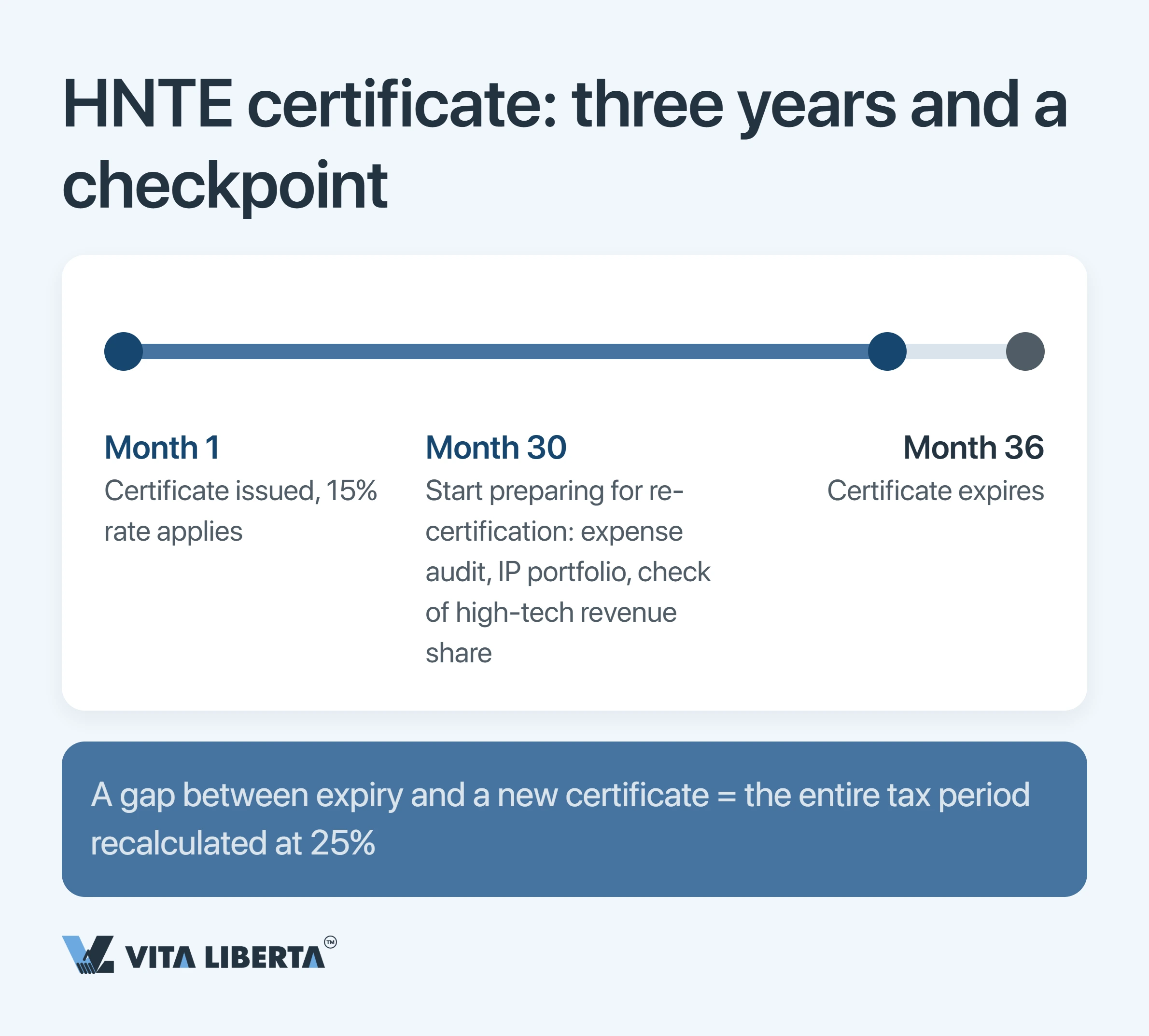
A one-day gap costs you a full year at 25%. The certificate is valid for three years from the date of issue. You file for re-certification in the year it expires, and the workload is close to that of a first application. No new certificate by the end of that year? Then the tax for the whole year is recalculated at the standard 25%, even if you paid advances at 15%. Don’t just “keep an eye on the date”. Set a hard checkpoint six months before expiry. By then you need three things ready: a fresh R&D cost audit, an up-to-date IP portfolio, and a check that a good year in distribution hasn’t pulled your high-tech revenue share below 60%. The status also comes with reporting between re-certifications. Every year, you file an annual development report (年度发展情况报表) on 高新技术企业认定管理工作网. If you rename the company or make material changes linked to the recognition conditions, such as a split, merger, restructuring or new business profile, you notify the certification authority within three months. If the changes mean you no longer qualify, you lose the status from the year in which they happened. Bottom line: the status isn’t a line in a registry. It is a promise to keep six indicators on target for three years straight.
Three mistakes that cost the incentive: an inspector’s checklist
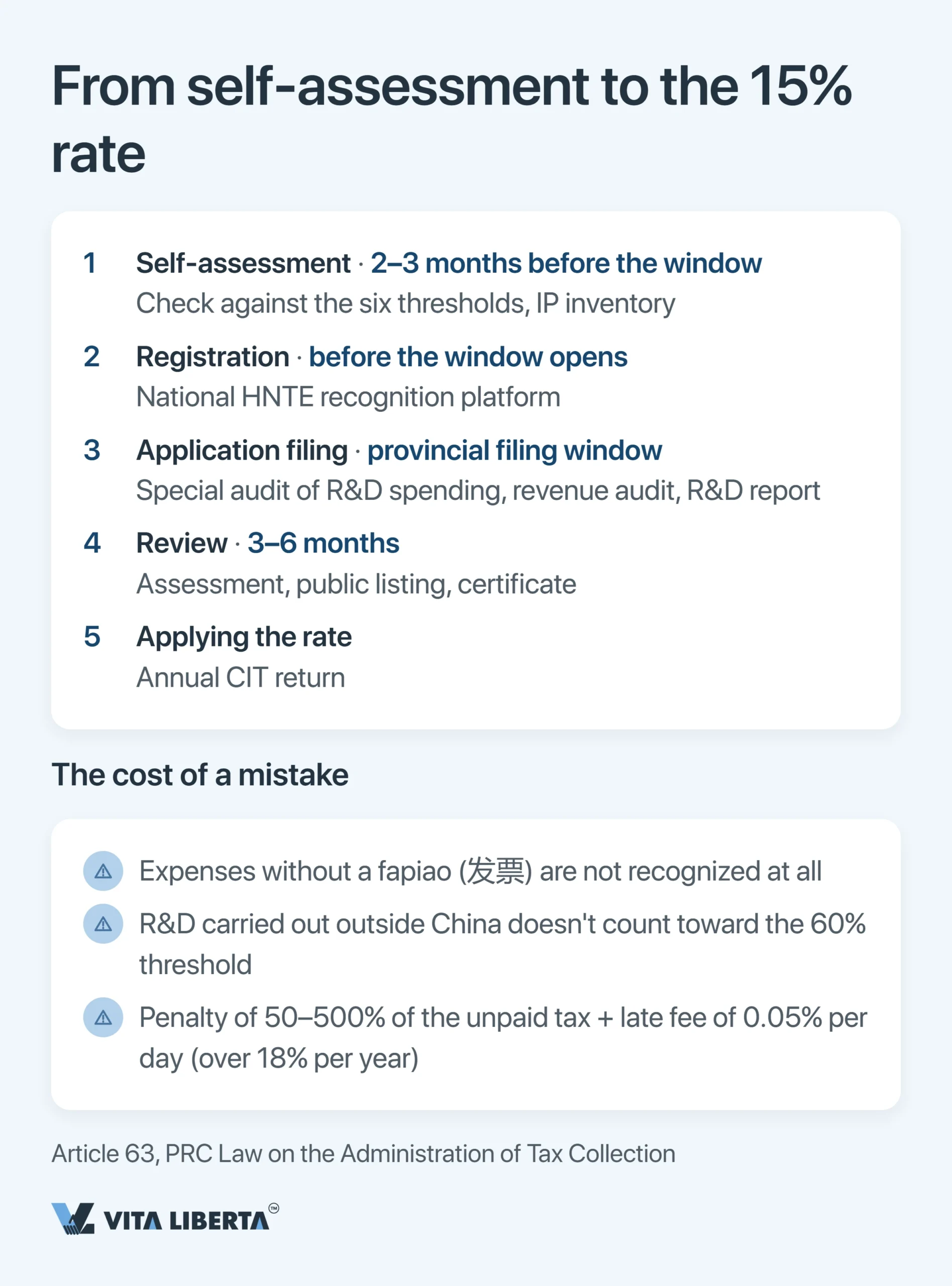
Inspectors look at three points. Each one is a widespread and expensive mistake made by international companies that haven’t adjusted their processes to Chinese practice. No proper document, no expense. For purchases in China, you need a fapiao. For goods and services bought abroad, you need the foreign supplier’s invoice or receipt plus proof that the related taxes were paid (国家税务总局公告2018年第28号). Intra-group cost allocations without primary documents don’t count as expenses. You lose the deduction, and the R&D spend ratio fails. Development outside the PRC. The rule that 60% of costs must be incurred in China breaks the popular “R&D in Europe, production in China” setup. Trying to combine HNTE with the small low-profit enterprise regime. The two don’t stack. You choose one. Important: if the authorities treat an unjustified claim as tax evasion (偷税), Article 63 of the PRC Law on the Administration of Tax Collection (中华人民共和国税收征收管理法) applies, with a fine of 50% to 500% of the unpaid tax. Late-payment surcharges come on top under Article 32 of the same law: 0.05% a day, which is more than 18% a year. Bottom line: the incentive is tested on the way out, not on the way in. The check comes at filing and inspection, when it is too late to rebuild your accounts.
We will keep your 15% rate through HNTE re-certification
- R&D expense audit
- High-tech revenue monitoring
- Defending the incentive in tax inspections
HNTE in China: strategic takeaways
Here is the paradox of the regime. The state pays its most generous rate not for innovation itself but for documenting it. A patent sitting in a safe earns you zero points. Ordinary development backed by clean separate accounting, an audit and fapiao earns you 15% and a 200% super deduction. Run the thresholds before you hire and before you budget. Your R&D spend ratio and high-tech revenue share are both manageable. You manage them while planning the year, though, not in March just before the return. Build the file while you build the product. A separate R&D ledger, fapiao and IP registered to the Chinese entity cost less than a year at 25%. Put a checkpoint at month 30. Re-certification is not a formality. You defend all six thresholds again. Seen this way, the HNTE certificate is more than a line in your tax return. It becomes a strategic asset: for investors, banks and provincial authorities, it serves as official proof that your company is genuinely technology-driven. The CIT cut is a bonus on top of that reputation, not the other way round.
Frequently asked questions
It won’t count. The company set up in mainland China has to own the key IP itself, and Hong Kong, Macau and Taiwan fall outside that scope. What to do: transfer ownership to the Chinese entity before the filing window opens, and allow time to register the transfer. A licence, even an exclusive one, does not count for recognition.
You will miss the threshold. At least 60% of R&D costs must be incurred in the PRC and backed by proper documents, which for purchases in China usually means fapiao. What to do: move into China at least enough work to clear the 60% bar and the required R&D-to-revenue ratio at the same time (5/4/3% depending on revenue).
On RMB 10 million of profit, moving from 25% to 15% saves RMB 1 million a year. The 200% super deduction adds savings on top by shrinking the base itself. You must meet six conditions: IP owned in China, an industry from the state list, at least 10% of staff in R&D, an R&D spend ratio on the 5/4/3% scale, at least 60% high-tech revenue, and a minimum expert score of 71 points. What to do: run a self-assessment against all six before you apply.
You pay a year at 25%. The certificate lasts three years. If no new one is issued by the end of the expiry year, that whole year is taxed at the standard rate, even if advances were paid at 15%, and the tax authority can review your entitlement after you file. What to do: start six months before expiry with an R&D cost audit, a check of your high-tech revenue share and an update of the IP portfolio.
No. The two reduced rates don’t add up; you apply one. The R&D super deduction stays available either way. The small low-profit enterprise regime (小型微利企业) runs until 31 December 2027 (财政部 税务总局公告2023年第12号): 25% of taxable profit is taxed at 20%, an effective 5%. The conditions are annual taxable profit of no more than RMB 3 million, no more than 300 employees and assets of no more than RMB 50 million (based on quarterly averages). HNTE gives 15% on all profit with no size cap, plus a 10-year loss carry-forward. What to do: model both scenarios on your projected profit. While you stay within all three limits, the small enterprise rate is lower. Once taxable profit exceeds RMB 3 million, that regime is closed to you, and HNTE is the better option.