Hongkong
 China
China





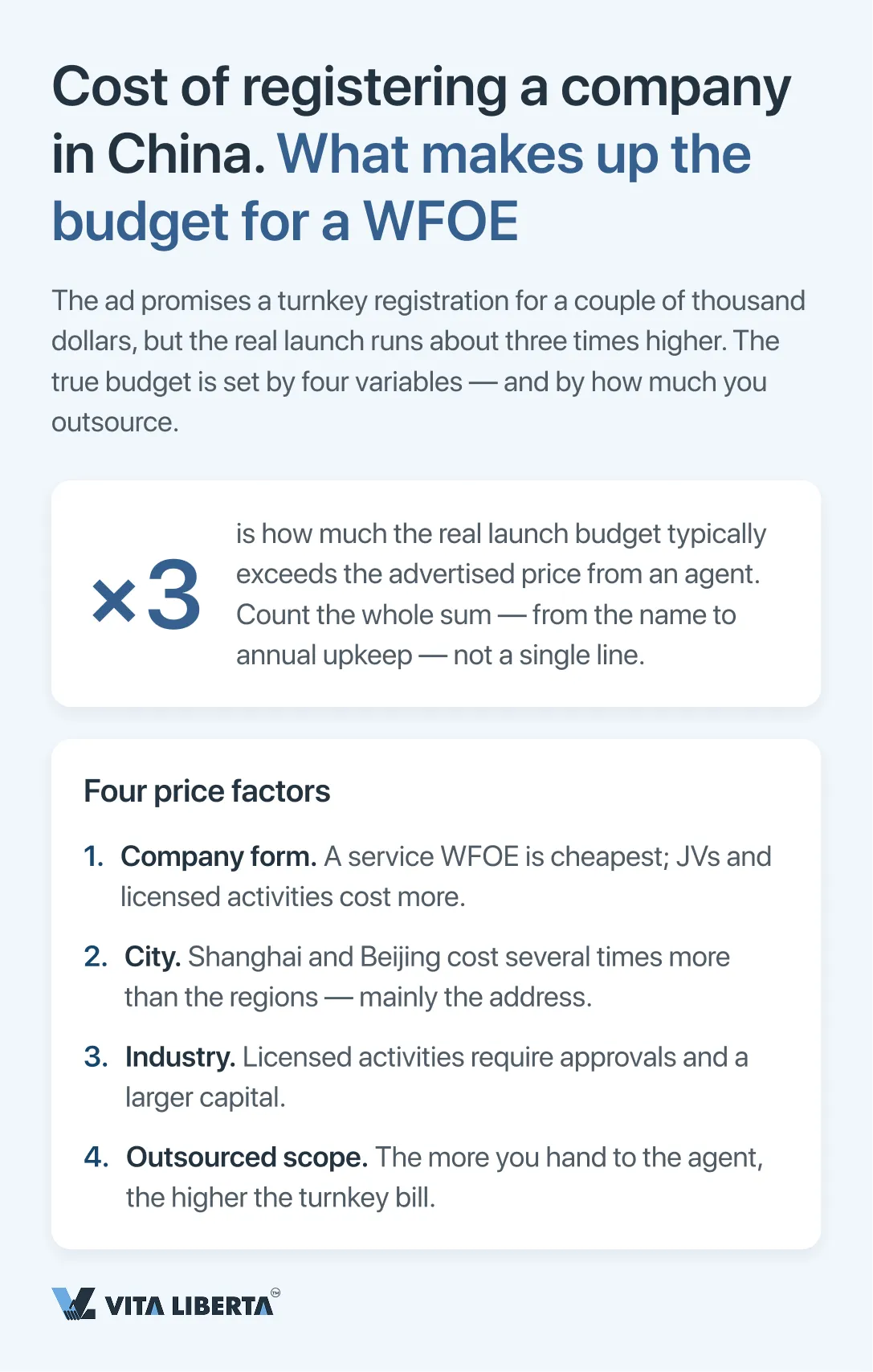
An ad promises a “turnkey” company for a couple of thousand dollars — but by the time you’re operational, the bill is three times higher. Here’s what really makes up a WFOE budget, and where the extra spending hides.
What drives the price
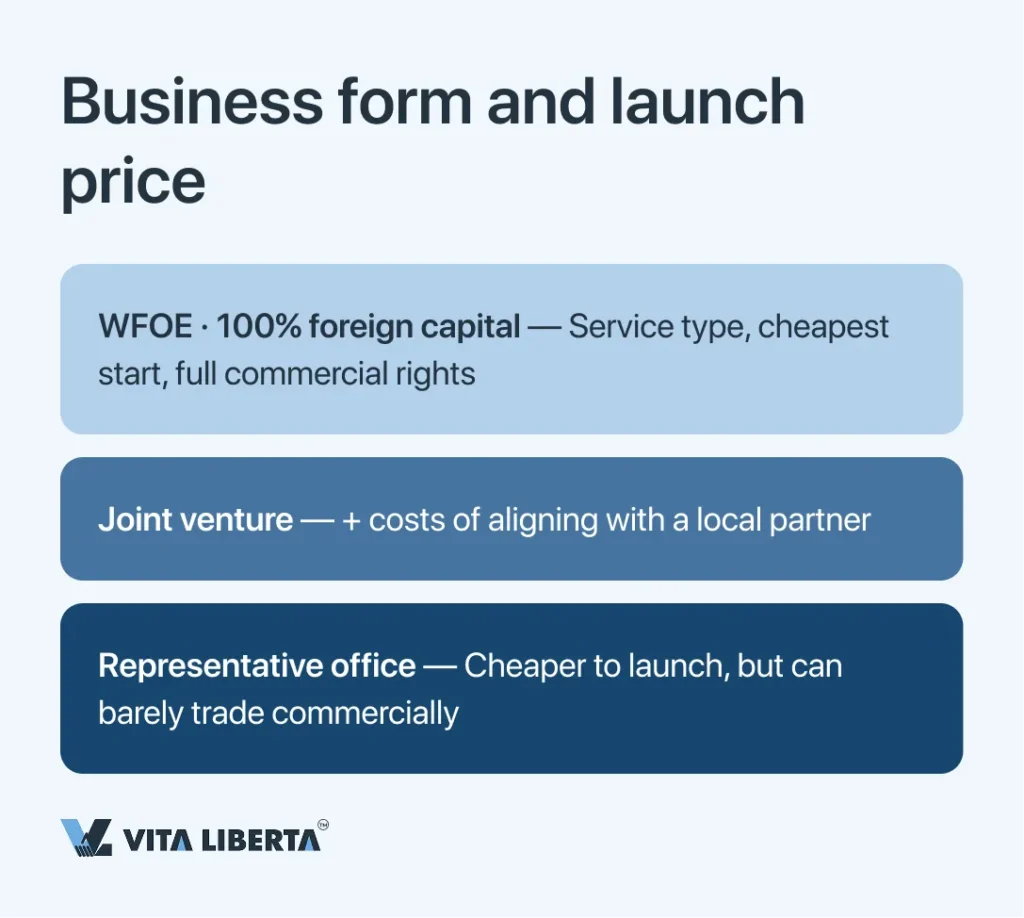
The final figure comes down to four things: which entity type you choose, which city you register in, which industry you operate in, and how much of the work you outsource. A plain service Wholly Foreign-Owned Enterprise is the cheapest to launch; licensed sectors and tier-1 cities like Shanghai and Beijing cost more. A joint venture adds the expense of aligning with a Chinese partner, while a representative office is cheaper to open but can do almost nothing commercially — it can’t invoice clients or trade.
Direct launch costs
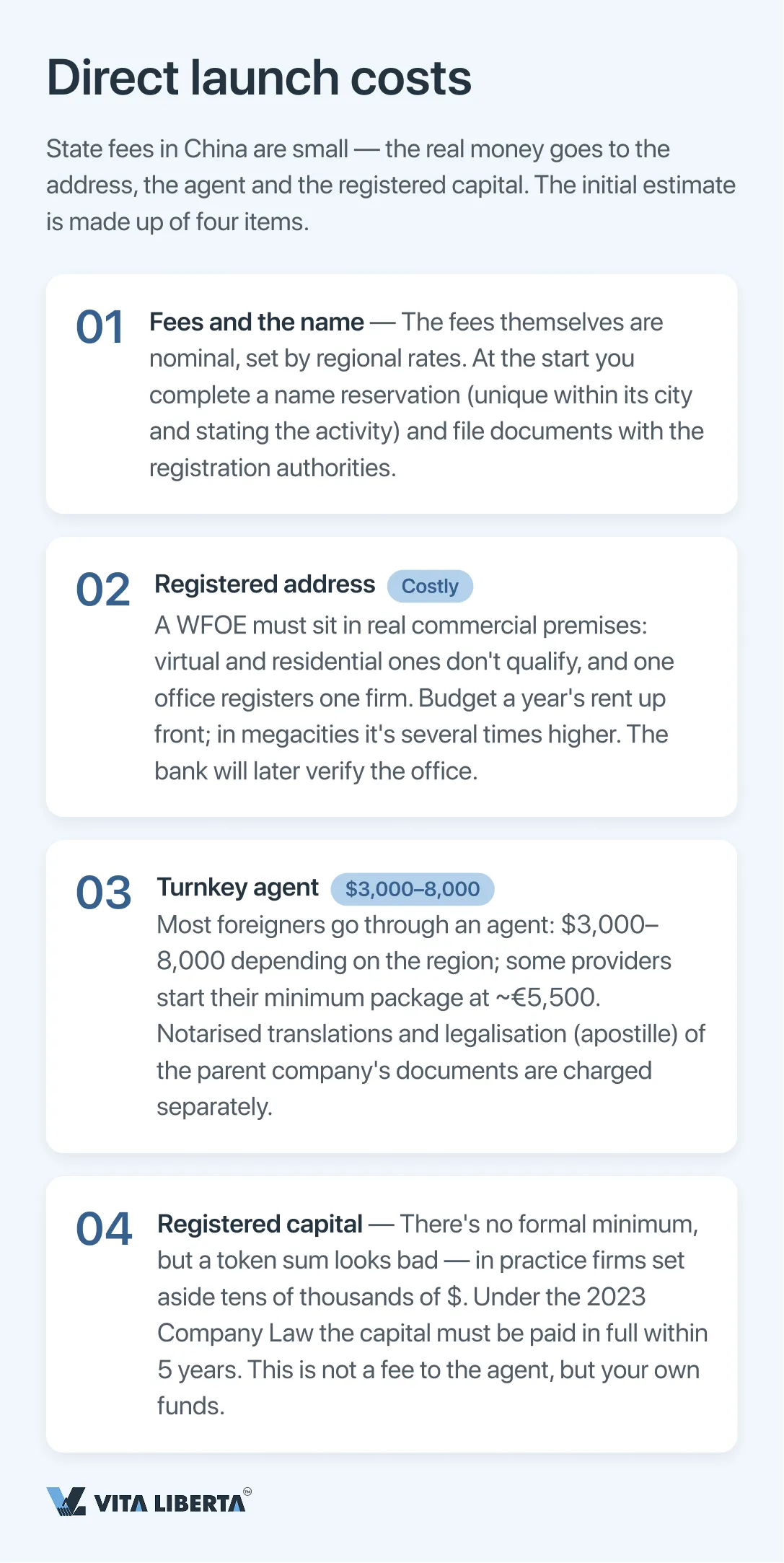
Your upfront spend breaks into a handful of line items.
Government fees and the company name
The state fees themselves are modest in China — sometimes almost token — and are charged at the rates of the specific locality. At the start the company reserves its name (which must be unique within its city and state the type of activity) and files with the registration authority (SAMR). So the real money doesn’t go on official fees.
Registered address
The address, on the other hand, is a real line item. A WFOE must sit in genuine commercial premises: virtual and residential addresses won’t do, and only one company can be registered per office. Budget a full year of the address lease from the outset — in major cities it costs several times more than in the regions. The bank will later verify that the office physically exists.
Agent and documents
Most foreigners go through a turnkey agent — such services typically run USD 3,000 to 8,000 depending on region and complexity, and with some providers the minimum package starts at around EUR 5,500. Notarised translations and legalisation (apostille) of the parent company’s constitutional documents are billed separately.
Not sure what setup will cost you?
- Exact budget for your specific case
- No hidden fees or surprise charges
- Cost estimate in 1 business day
Registered capital
There is no longer a formal minimum, but declaring a token sum is a mistake: banks and counterparties expect a reasonable capital, and for certain licences and visas it matters directly. Under the revised Company Law (Article 47, in force from July 2024), the declared capital must be fully paid in within five years of registration. In practice, to earn trust founders set the equivalent of tens of thousands of US dollars. Important: this is not a fee to the agent — it’s the company’s own money, which you continue to control.
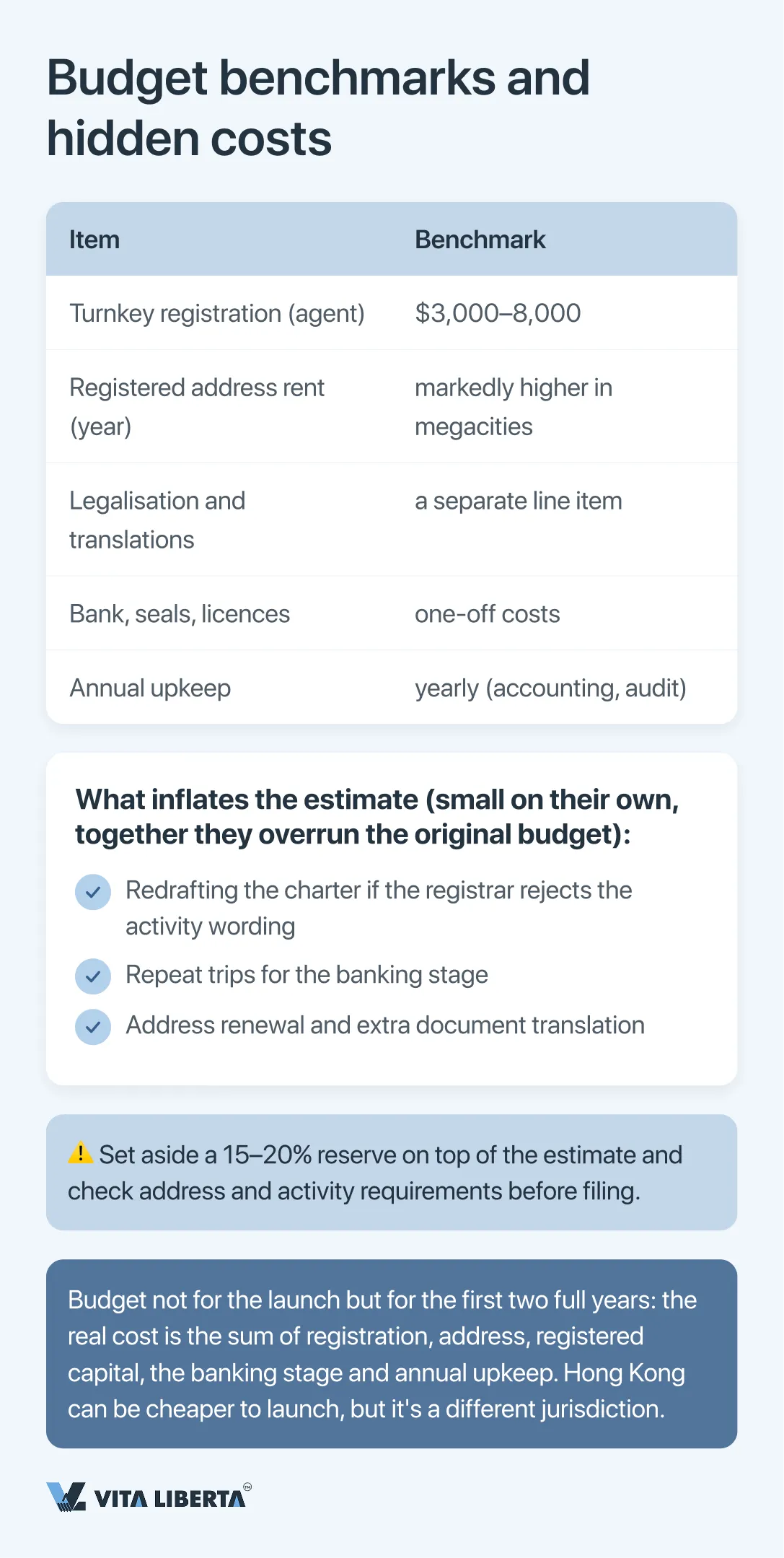
⚠️ Tip: set aside a reserve of 15–20% on top of your estimate, and confirm the address and business-scope requirements before you file. That’s cheaper than redoing the paperwork.
Bank, chops and licences
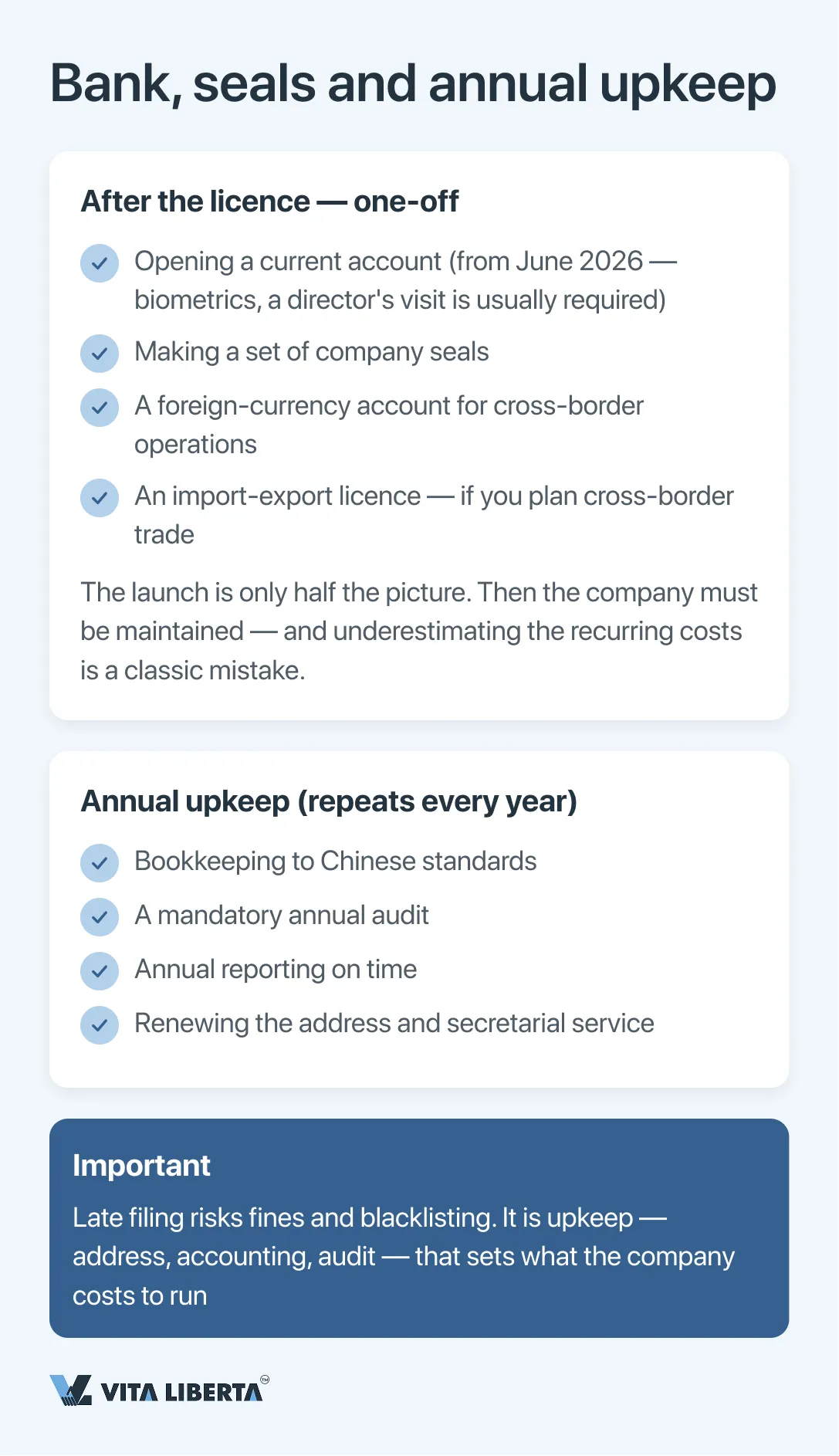
Once the business licence is issued, more costs follow:
- opening the corporate bank account (from June 2026 biometric identification applies, so a director’s in-person visit is more often required);
- carving the set of company chops (seals);
- a foreign-currency account for cross-border transactions;
- an import/export licence if you plan cross-border trade.
Annual maintenance
Launch is only half the picture. After that the company has to be maintained: bookkeeping under Chinese Accounting Standards (PRC GAAP), a mandatory annual audit, and the annual report filed on time. Add address renewal and secretarial service. Underestimating these recurring costs is the classic mistake — a late filing risks fines and a place on the abnormal-operations blacklist.
Budget benchmarks
| Line item | Ballpark |
| Turnkey registration (agent) | USD 3,000–8,000 |
| Registered address lease (year) | markedly higher in tier-1 cities |
| Legalisation and translations | billed separately |
| Bank, chops, licences | one-off costs |
| Annual upkeep (accounting, audit) | recurring |
Figures are indicative: in Hong Kong the launch can be cheaper and faster than on the mainland — but that’s a different jurisdiction with its own rules, and mainland China’s requirements don’t carry over to Hong Kong.
Hidden costs
Budgets are most often inflated by: reworking the articles of association if the registrar rejects the business-scope wording; repeat trips for the banking stage; address renewal; extra document translation. Each of these is small on its own, but together they easily overrun the original estimate.
“Entrepreneurs look at the registration price tag and forget the second year. And it’s the upkeep — address, accounting, audit — that decides what the company costs to run. You shouldn’t be costing the launch; you should be costing the first two years in full.”
— Sergey Konon, cross-border trade consultant
The real cost of a company in China is the sum of registration, address, registered capital, the banking stage and annual maintenance — not one line from an agent’s advert. Fix the entity type and region, provide for capital and a reserve for hidden costs, and budget at least two years ahead. Then the launch won’t spring any financial surprises.
Ready to register your China company?
- Full turnkey company setup
- We optimise your start-up costs
- Save your time and money
FAQ
There’s no single figure — the total is built from several parts: the agent’s fee, the registered address, government charges, carving the chops, opening the bank account and translating documents. Entity type matters a lot: a full WFOE costs more than a non-trading representative office.
The main ones are preparing and legalising the constitutional documents, securing a registered address, the agent’s work, registration with SAMR and the tax bureau, the set of chops and opening the corporate bank account. Bookkeeping is added straight away — it starts in the company’s first month.
For most sectors there’s no hard minimum: you declare a sum based on the business’s real needs. But the declared capital must actually be paid in within the legal five-year window, so inflating the figure for show works against you. Some licensed sectors keep their own thresholds.
Registration is only the start. Then come bookkeeping and filings, the annual audit, mandatory staff contributions, and address and permit renewals. It’s wise to build these recurring payments into the budget at the planning stage.
Yes — they’re separate jurisdictions with their own rules. In Hong Kong the procedure is usually shorter and lighter, with a different cost and tax structure. A mainland WFOE requires more approvals and closer support. Base your choice on where the work will actually be done.