Hongkong
 China
China





From Formal Status to Sustainable Residence
Obtaining a work permit and a residence permit in China is a crucial milestone, marking your formal recognition as a foreign expert. However, this stage should be viewed not as a final goal, but as an entry point into the ecosystem of regulated long-term relations with the government bodies of the People’s Republic of China.
After receiving the documents, a period of active interaction with the system begins, within which your legality ceases to be a static fact and becomes a dynamic process requiring constant confirmation. The risks at this stage are predominantly administrative and predictable: they arise not from ignorance of the rules, but from a lack of understanding of the depth and interconnections of the requirements, as well as from the false assumption that the issued documents have a “permissive” rather than a “declaratory” nature in the long term.
The key challenges are associated with the need to continuously demonstrate:
- The economic viability of your stay for the Chinese economy.
- Full tax and regulatory compliance, both for you personally and for the sponsoring company.
- Actual and continuous integration into the country’s legal framework, including adherence to immigration deadlines.
In Zhejiang Province, as in other developed regions, these requirements are formalized in clear, but not always publicly advertised procedures. Consequently, the strategy for successful long-term residence lies in transitioning from a reactive response to authorities’ requests to the proactive formation of one’s administrative dossier, anticipating the logic of the inspecting bodies.
Risk of Losing Residence Permit Due to Prolonged Absence from China
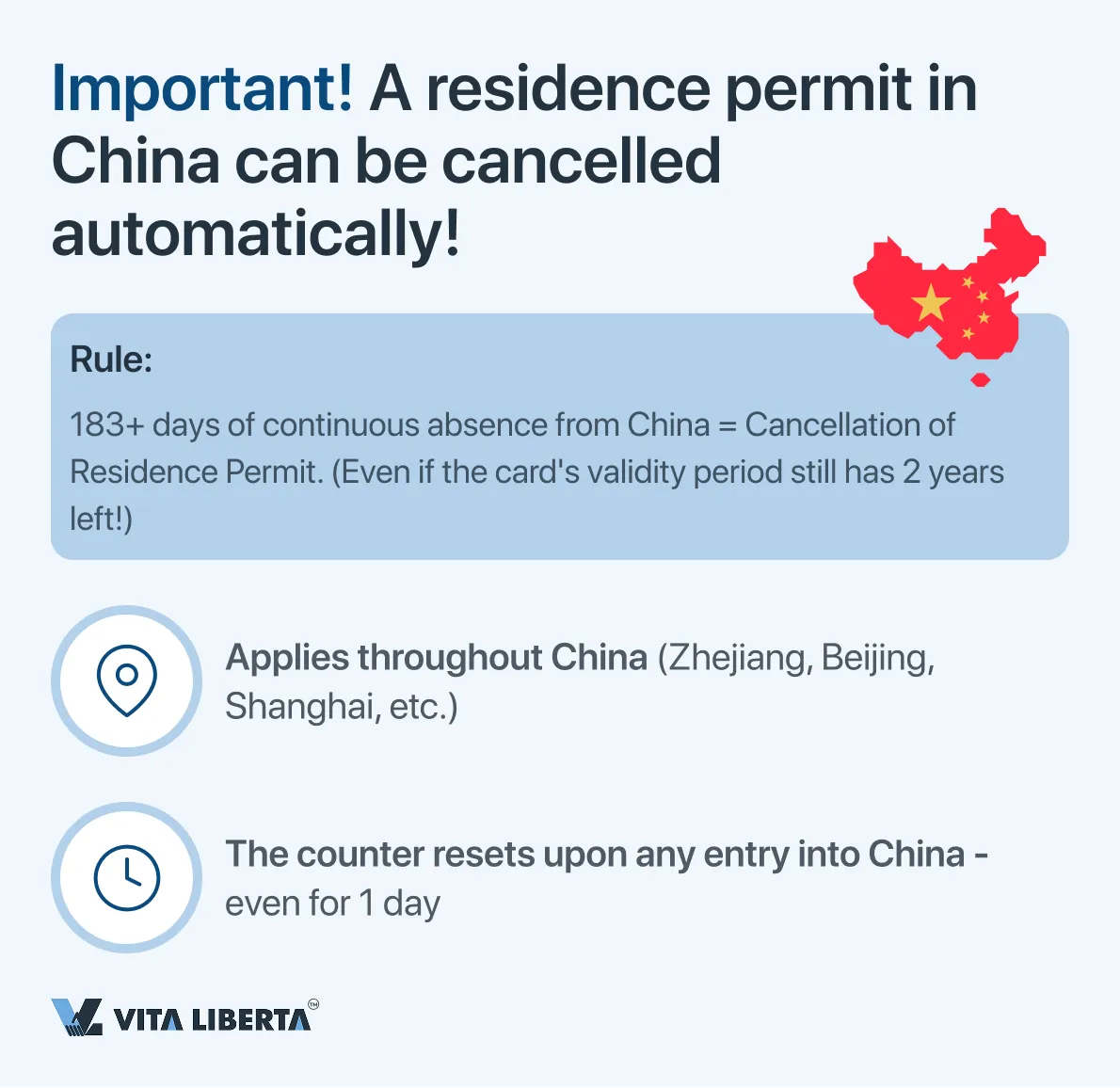
Holders of a work-type residence permit must consider the most important immigration rule concerning the continuity of residence. According to clause XVI.3 of the typical guidelines of Zhejiang Province (as well as similar provisions in other regions), continuous stay outside of China for more than 183 days leads to the automatic cancellation of the residence permit by the registration system.
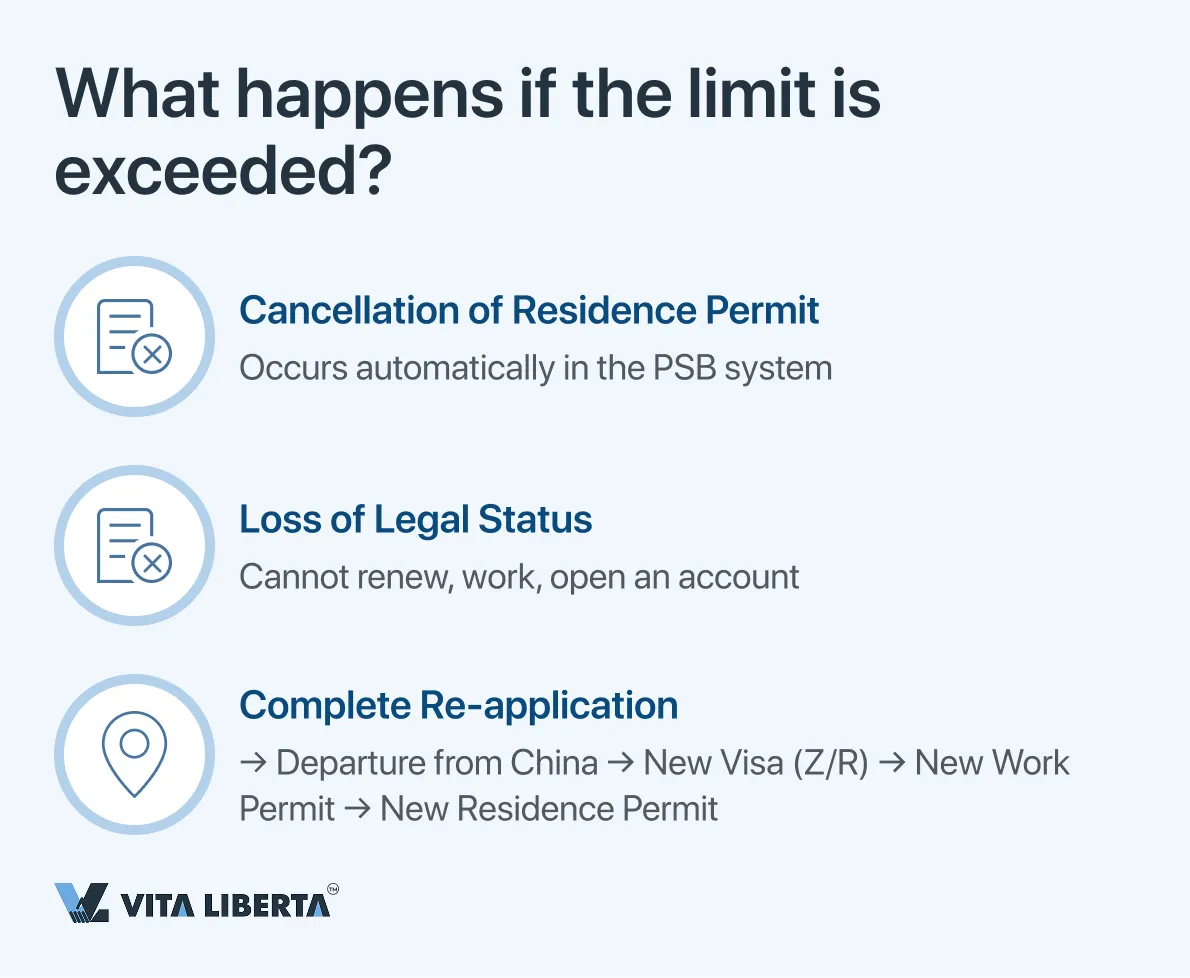
After cancellation, it is impossible to restore the previous residence permit. The foreign specialist will need to go through the procedure of obtaining a visa (Z or R) abroad again, followed by applying for a new residence permit in China, which involves significant time and financial costs.
To eliminate the risk of losing status due to a long business trip, work on a remote project, or personal circumstances, the following steps must be taken:
1. Strict Control of Absence Periods (Basic Measure)
Set a reliable reminder in your calendar that triggers on the 175th day of continuous stay abroad. This creates the necessary buffer (about a week) for a trouble-free return to China before the critical limit expires.
The count is based precisely on days of continuous absence. Short-term visits to China (even for 1-2 days) interrupt this counter, and the count starts anew from the date of the last departure.
2. Obtaining Official Permission for Temporary Exit (Guaranteed Measure)
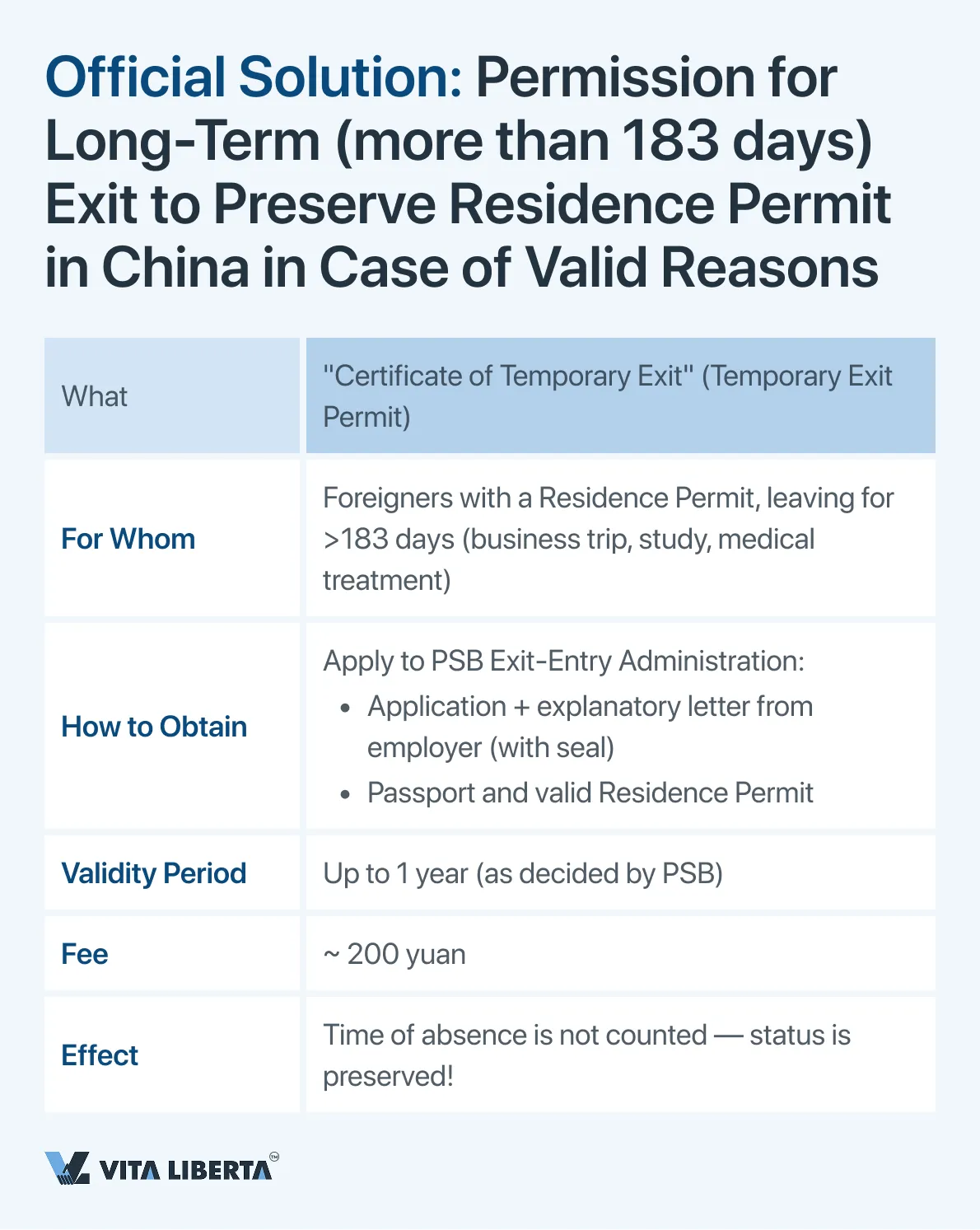
If the planned absence exceeds 183 days and is unavoidable (e.g., long-term overseas training, implementation of an international project), it is necessary to obtain a special document in advance from the Exit-Entry Administration of the Public Security Bureau (PSB).
Name: “Certificate of Temporary Exit” or “Permission for Long-Term Absence” (Temporary Exit Record / Permit for Residence Permit Holders).
Procedure for Obtaining:
- Submission of a personal application indicating valid reasons (medical treatment, study, performing company work tasks abroad).
- Provision of an official explanatory note from the employing company on a letterhead with a company seal, confirming the business necessity of the long business trip.
- Presentation of a valid residence permit, passport, and other documents as required by the inspector.
Validity Period: The permit can be issued for a period of up to 1 year (the maximum term is determined at the discretion of the PSB body).
The administrative fee is generally 200 yuan.
With this permit, stamped in the passport or issued as a separate document, the period of continuous stay abroad is not counted for the purposes of canceling the main residence permit.
Practical Example:
A foreign General Director of a technology company in Ningbo must head a branch in Germany for a period of 10 months. Two weeks before departure, the company submits a package of documents to the PSB and obtains a “Certificate of Temporary Exit” for him valid for 10 months. Upon returning to China after this period, his residence permit remains fully valid, allowing him to avoid the complex restoration procedure.
Conclusion: The rules of continuous residence are a strict and automatically applied condition. Compliance requires a high level of discipline from the foreign specialist in tracking days or timely application to the immigration authorities to obtain official deferral, which is the only legal way to preserve status during a prolonged absence.
Risk of Tax Audit in Case of Formalized Employment Relationships Being Recognized
Within the framework of tax supervision over the activities of companies with foreign participation, the tax authorities of the People’s Republic of China pay special attention to analyzing the compliance of the employment contract terms of key managers (in particular, founding general directors) with economic reality and market standards. A situation where the official salary of a company’s sole executive body is, for example, 10,000 yuan per month, while the legal entity’s net annual profit reaches 10 million yuan, will most likely be assessed as a scheme with signs of “sham employment”.
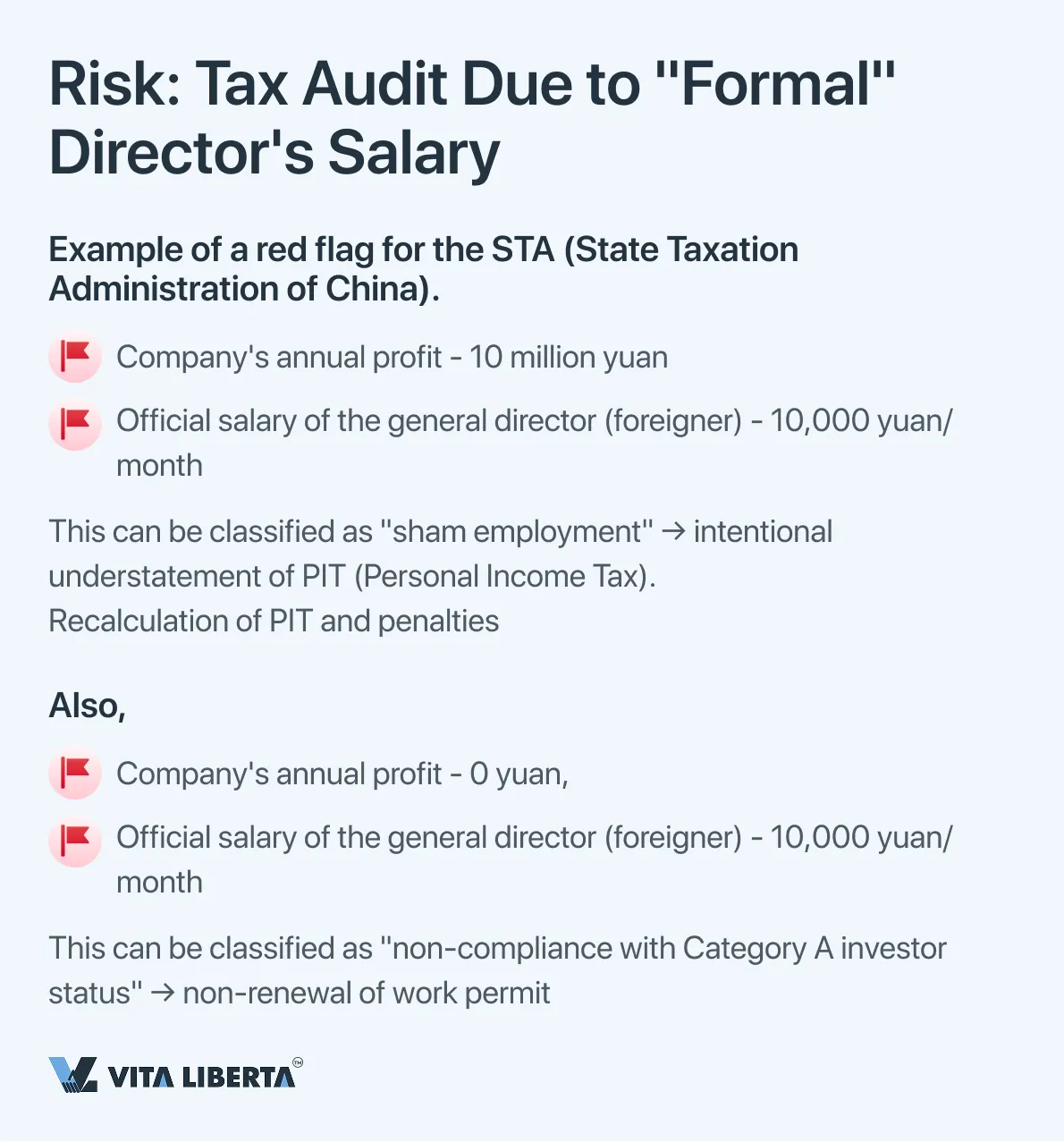
This practice can be classified by inspectors as “intentional understatement of the taxable base for personal income tax” in accordance with Article 63 of the Tax Administration Law of the People’s Republic of China. Consequences can include tax recalculations, significant fines (from 50% to 500% of the unpaid tax amount), and even administrative liability.
A set of correct countermeasures to minimize risks:
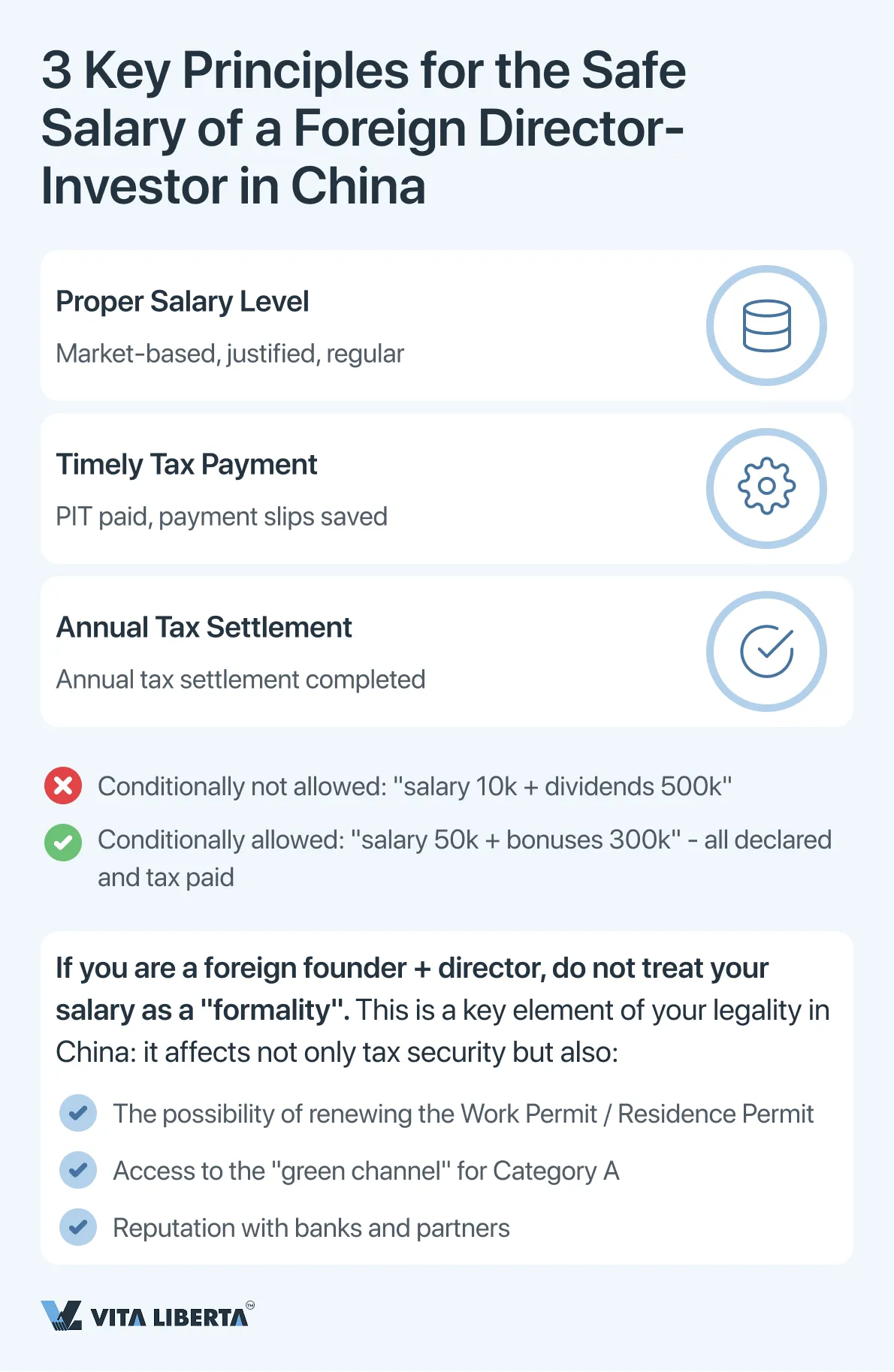
- Establishing a Market-Based Level of Remuneration
The salary level of a general director (a foreign highly qualified specialist) must be adequate to their function, experience, industry, and regional labor market. For example, for the high-tech sector in Hangzhou city, the market salary range for such a position may start from 35,000–50,000 yuan per month.
Recommendation: Prepare an internal justification (market analysis, description of area of responsibility) confirming the established salary level.

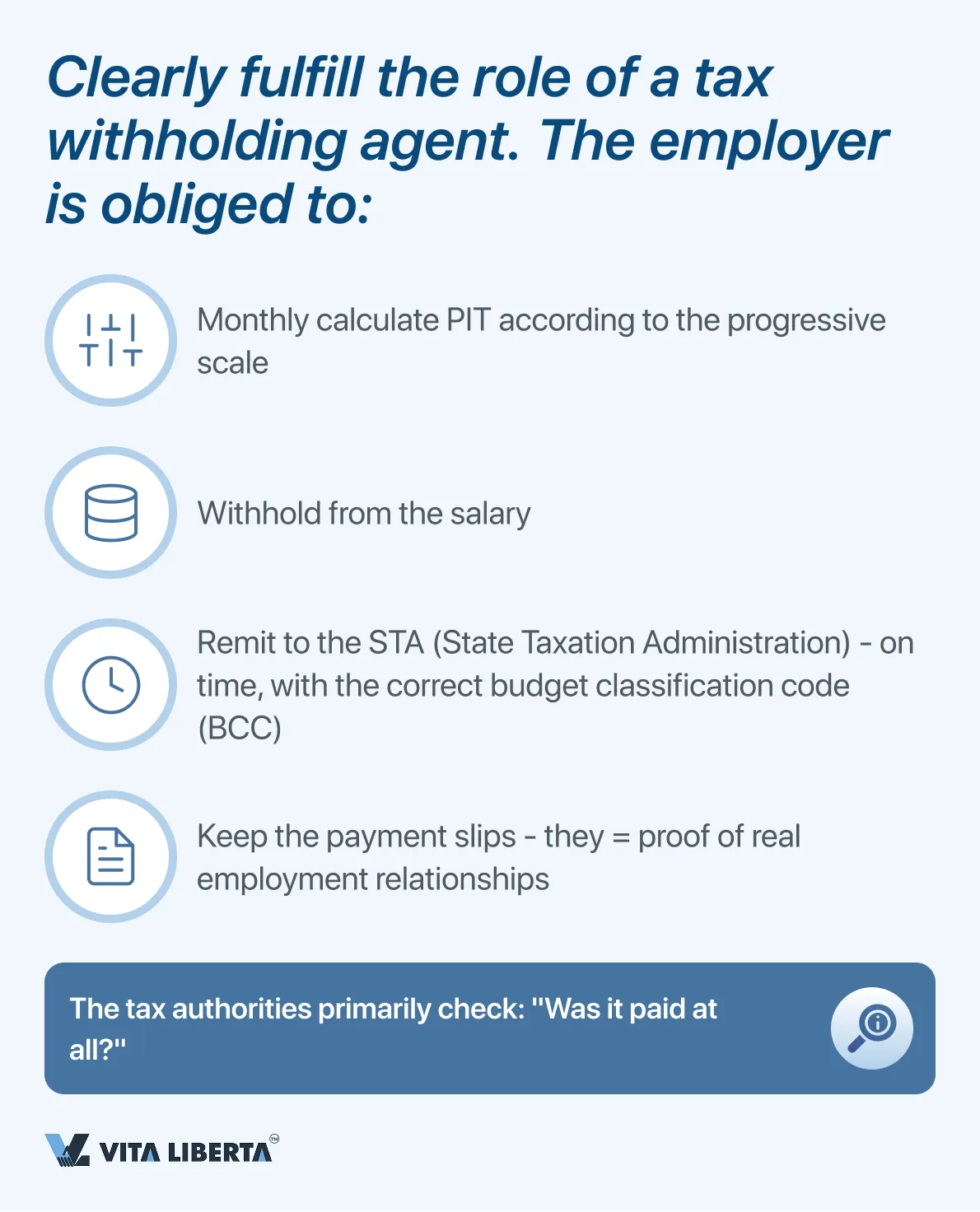
2. trict Adherence to the Procedure for Withholding and Remitting Taxes by the Withholding Agent.
The employing company, acting as a tax withholding agent, is obliged monthly and in full to calculate, withhold from the salary, and remit to the budget the Personal Income Tax (PIT) at a progressive rate of up to 45%.
Critically Important: Having documentary confirmation (tax payment orders) of regular PIT payment is for the inspection a primary proof of the reality of the employment relationship.
- Annual Tax Settlement (Annual Tax Settlement)
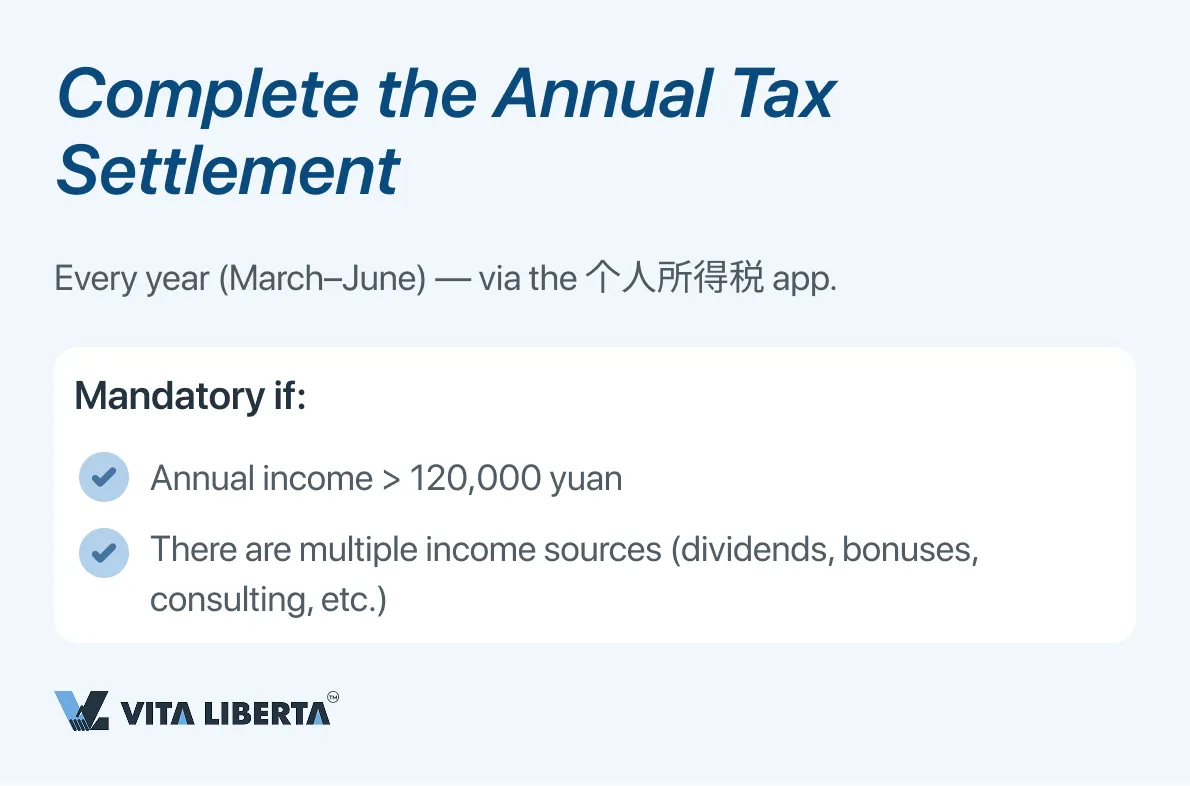
At the end of the calendar year, the general director (like any tax resident receiving income from multiple sources or with an annual total income exceeding 120,000 yuan) must undergo the final tax settlement procedure (Annual Tax Settlement) through the “个人所得税” platform (Personal Income Tax App).
As part of this procedure, all income received is declared, prepaid tax amounts are reconciled, and a final settlement with the budget is made. The fact of successfully completing this procedure serves as final proof of full tax discipline and income legitimacy.
For a foreign investor-director, it is unacceptable to view their formal salary as a technical expense item. Its size must be economically justified, and all related tax obligations must be fulfilled systematically and transparently. This approach not only eliminates the risks of tax recalculations and fines but also forms an impeccable business reputation for the company in the eyes of the regulatory authorities of the People’s Republic of China.
Keep Your Work Permit & Residence Permit in China Risk-Free
- Status risk assessment
- Migration compliance monitoring
- Document renewal support
Risk of Limited Educational Opportunities for Children of Work Permit Holders
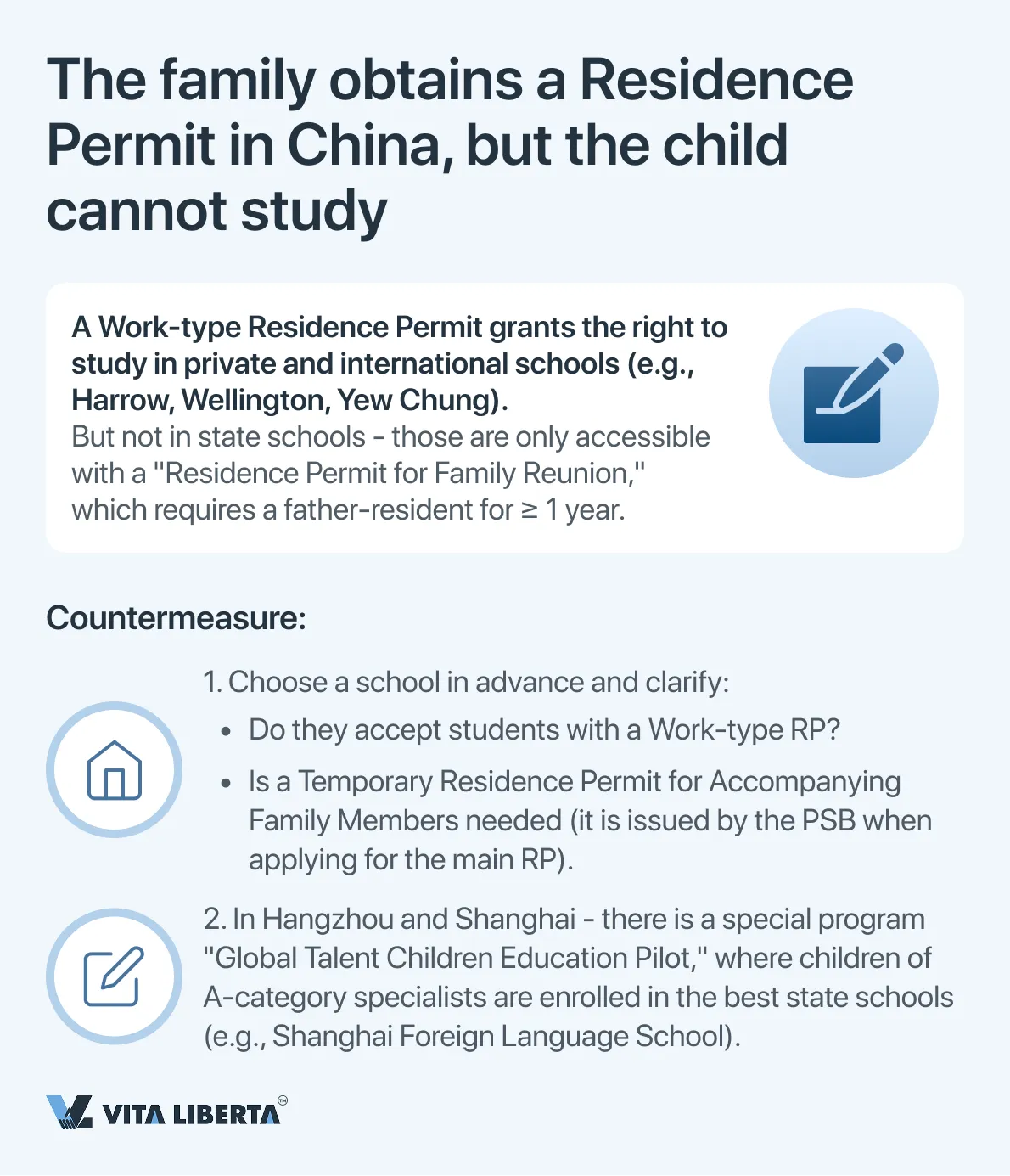
Obtaining a work-type residence permit (Work-type Residence Permit) by a foreign specialist and registering similar permits for family members (Family Member Residence Permit) on its basis does not guarantee automatic access to the general state school education system of the People’s Republic of China for children. This type of residence permit is intended primarily for legalizing stay in connection with the work activity of the main applicant.
The essence of the problem:
A Work-type Residence Permit grants children the right to study primarily in private international or bilingual schools (such as Harrow, Wellington, Yew Chung, and similar), where instruction is conducted in English or other foreign languages according to foreign curricula.
Enrollment in a state or municipal Chinese school generally requires the registration of a special “Residence Permit for Family Reunion” (Reunion-type Residence Permit). Its acquisition is often associated with stricter conditions, such as confirmation of long-term (e.g., from 1 year) stable residency of one parent, ownership of one’s own housing, and other criteria that may be unattainable for newly arrived specialists.
A comprehensive approach to ensuring children’s education
- Strategy of preliminary planning and coordination:
Choosing a school at the preparation stage for relocation: Before moving to China, it is necessary to identify several potential educational institutions for the child and directly request official information from their administrations:
Do they accept students based on the Work-type Residence Permit of the primary parent?
Is it required for enrollment to provide a “Temporary Residence Permit for Accompanying Family Members,” which is processed at the Exit-Entry Administration (PSB) simultaneously with the main work residence permit.
An official confirmation letter from the school should become part of the document package when applying for visas and residence permits.
- Utilizing special regional programs for children of highly qualified specialists:
In a number of developed megacities and provinces of China, targeted pilot programs operate, aimed at attracting global talents by providing their children with access to elite educational resources.
Examples:
In Shanghai and Hangzhou, the “Global Talent Children Education Pilot” initiative is implemented. Within the framework of this program, children of foreign specialists classified as Category A have priority rights for enrollment in leading state schools with in-depth study of foreign languages or special international departments within them (for example, Shanghai Foreign Language School, Hangzhou Foreign Languages School).
For this, the employer or an authorized government agency (for example, the Foreign Experts Bureau) must issue a special recommendation letter or certificate confirming the parent’s status. This document is submitted along with the application to the school and to the education authorities.
- Alternative path: long-term planning through changing the type of residence permit.
After the foreign specialist has worked in China for the required period (often 1-2 years), paid taxes, and obtained a renewed residence permit, the family gains grounds to transition from a work-type to a family reunion-type residence permit. This status finally removes restrictions and opens full access to the local education system, including state schools and universities on a general basis.
Conclusion: The issue of children’s education should not be secondary. Its solution requires no less careful planning than the registration of one’s own work documents. Active use of special programs for Category A and prior coordination of conditions with educational institutions allows for completely mitigating this risk and ensuring children’s quality education in China.
Risk of Being Asked to Confirm Economic Contribution When Renewing a Work Permit
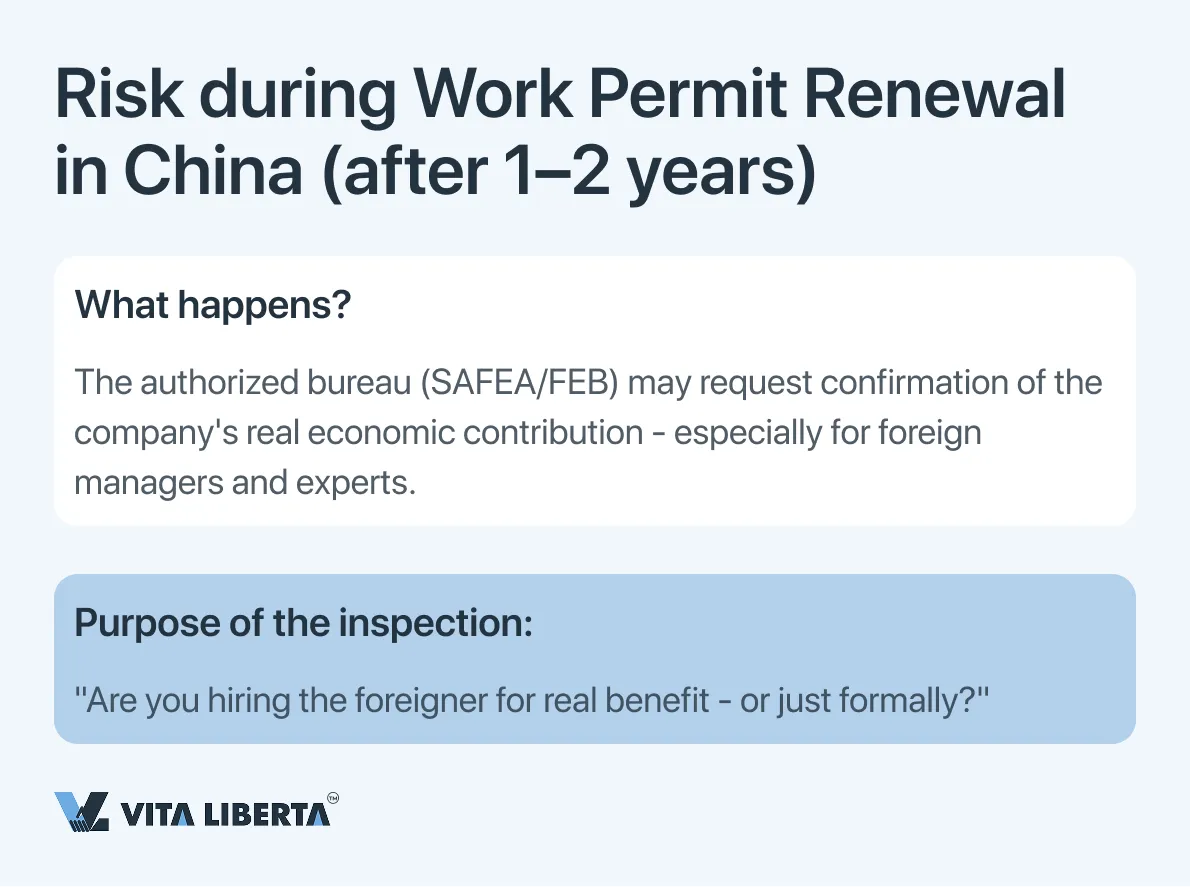
One to two years after the initial registration, during the process of renewing the “Work Permit for Foreigners,” the authorized bureau for foreign expert affairs (FEB/SAFEA) may initiate an in-depth inspection of the actual economic activity of the employer-company and the expediency of the foreign manager’s further stay. The purpose of the inspection is to confirm that the engagement of foreign personnel brings tangible benefit to the local economy.
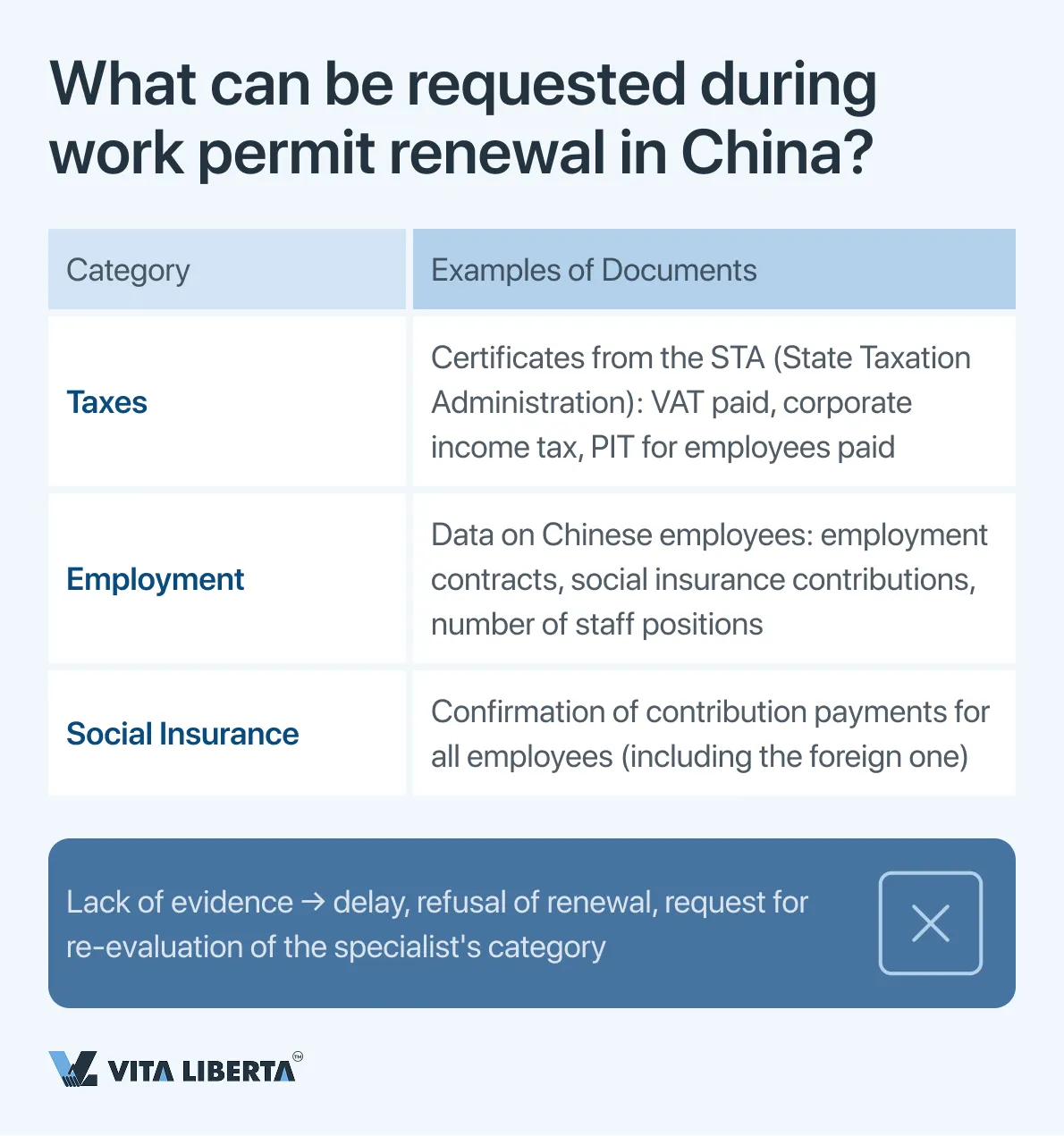
As part of such an inspection, the authorities may request the following evidence:
- Confirmation of the legal entity’s tax payments for the reporting period.
- Data on the creation of jobs for local specialists (the number of hired Chinese employees, registered in accordance with the Labor Law of the People’s Republic of China).
- Documents on the payment of contributions to mandatory social insurance funds for the foreign and Chinese employees.
Strategic countermeasure: Obtaining an official “Contribution Certificate”
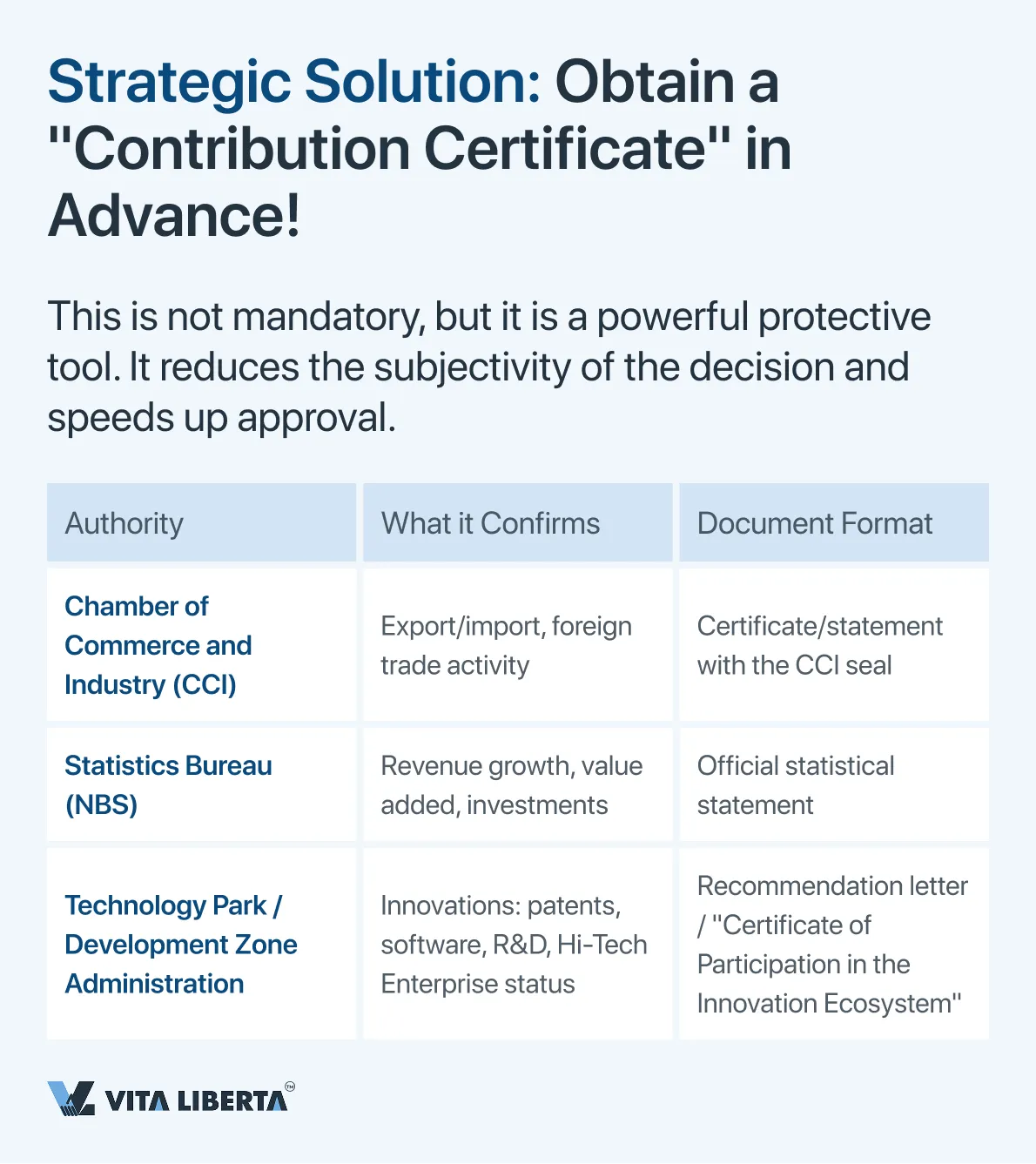
To simplify the renewal procedure and form an impeccable dossier, it is recommended to obtain in advance one or several official documents confirming your company’s contribution to the region’s economy. Such certificates serve as substantial objective evidence, minimizing the inspector’s subjective assessment.
Key authorities for obtaining supporting documents:
- Chamber of Commerce and Industry or Foreign Trade Association. What it confirms: The real volume of export-import operations, the company’s entry into international markets. Document format: Official statement or certificate, certified by the Chamber’s seal.
- Local Statistics Bureau (National Bureau of Statistics, NBS Branch). What it confirms: Stable revenue growth, added value, and other positive macroeconomic indicators of the company. Document format: A statistical statement of the established form based on the financial reports you provided.
- Administration of a technology park or development zone. What it confirms: Innovative activity, including the filing and registration of patents, software development, obtaining the status of a “High-Tech Enterprise.” Document format: A recommendation letter or certificate confirming the company’s participation in the region’s innovation ecosystem.
Example of a Successful Practice
Consider an information technology company registered in Hangzhou.
Over two years of operation, it has:
- Created 3 jobs for Chinese IT specialists with a full social benefits package.
- Paid total taxes (VAT, corporate income tax) amounting to 180,000 yuan.
- Registered 1 national invention or software product patent.
By providing the Foreign Expert Bureau with a “Contribution Certificate” from the technology park administration and a tax certificate, the company receives a positive assessment. In a number of regions, such a company may qualify for participation in “green channel” programs (informally referred to as a “Green Certificate”), which allows for the renewal of the work permit for the key foreign specialist through a simplified procedure, often without additional inspections and within compressed timeframes.
Conclusion: Systematic work on documenting the company’s economic and social contribution not only protects against renewal risks but also builds a positive business reputation, opening access to privileged modes of interaction with government bodies.
Obtaining a work permit and a residence permit in China signifies not the end of the journey, but the beginning of a new stage – the stage of confirming one’s value and legitimacy. The key risks arising after the successful registration of the documents clearly indicate the philosophy of Chinese immigration and tax policy: the status of a resident is not an unconditional privilege, but a mutual obligation requiring constant compliance with established economic, tax, and social criteria.
The main conclusions drawn from the risk analysis boil down to several systemic principles:
- Legality is active, not passive. It must be constantly confirmed through real economic activity, full tax transparency, and adherence to immigration rules. The automatic cancellation of a residence permit after an absence of over 183 days is the most vivid example that status can be lost automatically, without warning, if the resident fails to meet the basic condition of actual presence.
- All elements of the system are interconnected. A low official salary of a director calls into question not only their tax discipline but also their real qualifications as a Category A specialist, which can lead to problems both with the tax inspection (STA) and with the foreign expert bureau (FEB) during renewal. Similarly, the successful renewal of a work permit directly depends on the documented contribution of the company to the local economy.
- There are proactive strategies for each risk. The system is not closed – it offers legal mechanisms for preserving status:
- The 183-day rule: It can be complied with by not exceeding the limit, or by obtaining an official temporary exit permit from the PSB.
- Tax inspections: The risk is mitigated by establishing a market salary, flawless fulfillment of tax withholding agent duties, and completing the annual tax settlement.
- Children’s education: Access to the best educational resources is ensured through advance planning and utilizing special regional programs for Category A.
- Permit renewal: The process is simplified thanks to the preliminary collection of a portfolio of documents confirming the contribution (tax certificates, certificates from the CCI, technology parks, etc.).
Thus, the long-term and successful stay of a foreign specialist, especially one acting in the dual role of investor and manager, depends on a strategic approach to administering their status. What is required is not merely a reaction to authorities’ requests, but the proactive formation of an evidentiary base that, at every stage—from the annual tax declaration to the renewal of the residence permit—demonstrates your value, lawfulness, and integration into the socio-economic fabric of China. This constitutes the transition from possessing formal documents to achieving sustainable and secure legality.
Avoid Problems After Getting Your China Residence Permit
- Tax & HR risk review
- Status renewal preparation
- Foreign director support
5 Key Questions and Answers About Key Risks After Obtaining a Work Permit and Residence Permit in China
Answer: If you stay outside of China continuously for more than 183 days, your Residence Permit will be automatically canceled by the registration system of the immigration service (PSB), even if the card’s validity period has not yet expired. To restore your status, you will have to go through the entire process of applying for a work visa and residence permit again.
Solution: Either strictly monitor your period of absence and return before the 183-day limit, or obtain a “Certificate of Temporary Exit” (Temporary Exit Permit) from the PSB in advance, which “freezes” this counter for a period of up to 1 year.
Answer: Yes, this is one of the main risks. If the official salary of a key foreign manager (for example, 10,000 yuan) is disproportionate to the company’s profit (for example, millions), the tax authorities (STA) may consider this as sham employment for the purpose of evading PIT (Personal Income Tax). Consequences include tax recalculations, substantial fines, and problems with renewing the Work Permit.
Solution: Set a market salary appropriate for the position, industry, and region (for example, starting from 35,000 yuan/month in IT in Hangzhou). The employer must reliably pay PIT, and the director must annually complete the Annual Tax Settlement in the “个人所得税” (Personal Income Tax) app.
Answer: No, a work-type Residence Permit does not automatically grant the right to study in state schools. It primarily allows for study in private international schools.
Solution: 1) Negotiate in advance with the chosen school and obtain a Temporary Residence Permit for Accompanying Family Members. 2) Inquire about regional programs for highly qualified specialists (Category A), for example, the Global Talent Children Education Pilot in Shanghai/Hangzhou. 3) In the future, transition to a family reunion-type Residence Permit (Reunion-type), which grants full access.
Answer: After 1-2 years, the authorities (FEB/SAFEA) may inspect your company’s economic contribution: taxes paid, jobs created for Chinese citizens, social insurance contributions.
Solution: To simplify the renewal, proactively compile a portfolio of documents in advance: certificates from the tax office (STA), employment data, as well as “Contribution Certificates” from the Chamber of Commerce and Industry, the Statistics Bureau, or a technology park administration. This creates an impeccable dossier and may grant access to the “green channel.”
Legality is an active and continuous process, not a one-time acquisition of documents. Your status requires constant confirmation through real economic activity, full tax transparency, and adherence to immigration rules. Proactivity is the key to success: do not wait for requests from the authorities, but proactively build an evidence base of your value and lawfulness at every stage.