Hongkong
 China
China





Your goods roll off a production line in China under your familiar logo — yet the name has long belonged, on paper, to a stranger. For trademark squatters, that isn’t a glitch; it’s a business model.
China remains the world’s manufacturing hub and one of its deepest consumer markets, but legal protection for your brand only switches on once you complete the official procedure. Skip it, and exclusive rights go to whoever filed first — your logo becomes someone else’s asset, and your own product is technically the fake. Below is the practical route from idea to certificate: how brand protection actually works at China’s National Intellectual Property Administration (CNIPA), where applicants most often stumble, and what the whole path costs.
Why register a trademark in China — and who needs to
Securing rights to a mark in China isn’t a box-ticking formality. It’s real control over your distribution channels, your reputation, and your basic right to sell under your own name.
The risk of operating with an unregistered brand
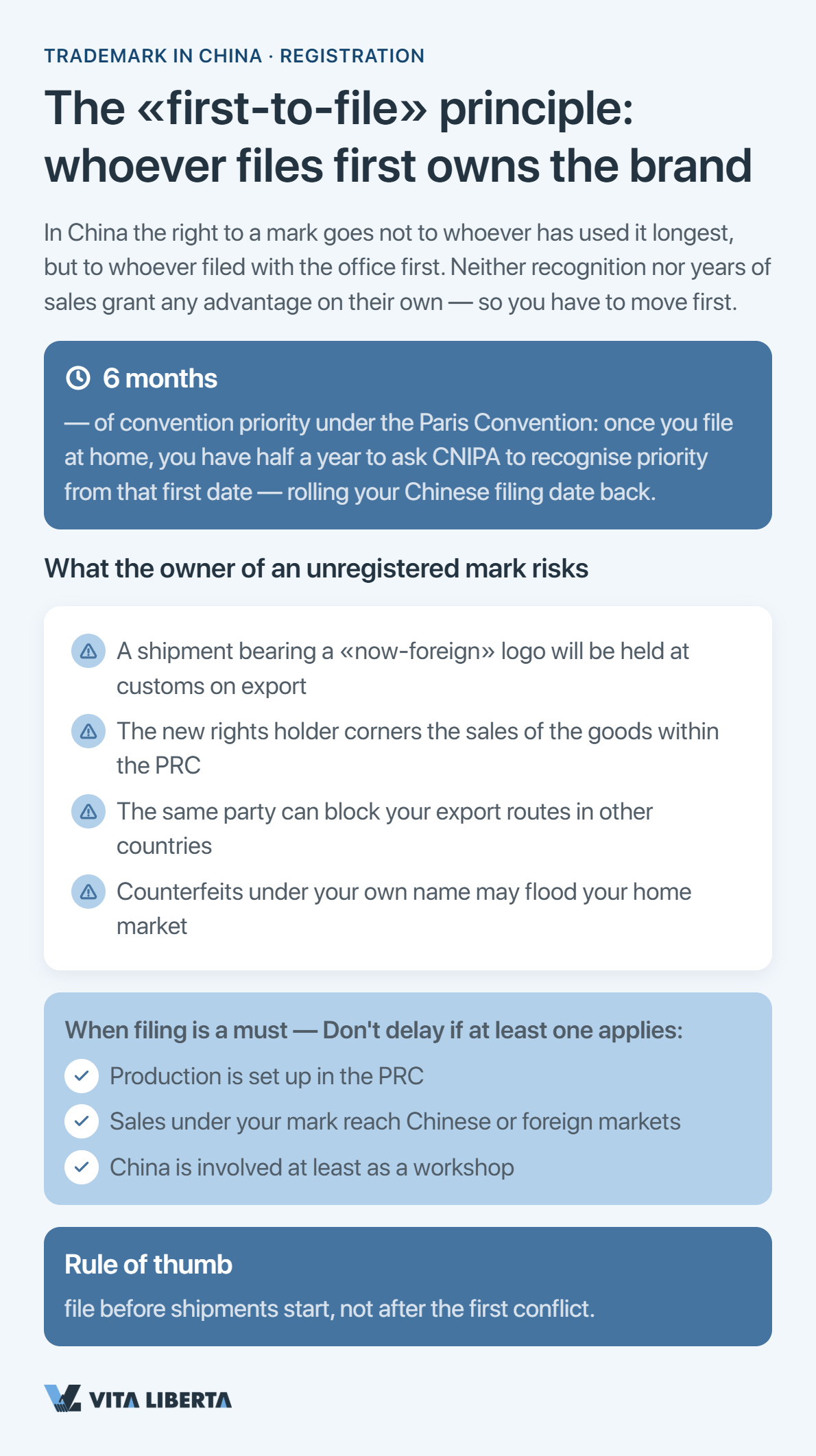
While a sign is legally nobody’s, anyone can get there first — your contract factory, a distributor, or a complete stranger. Chinese law backs the first to file, and for you that means a chain of problems:
- a shipment carrying a “now-someone-else’s” logo can be held at customs on export;
- the new rights holder corners domestic sales of that product;
- they can register the mark in other countries and block your export routes;
- counterfeits bearing your own sign may flow back into your home market.
The script is painfully common: a manufacturer spots a client’s marketable brand, quietly files it in their own name, then either renegotiates on tougher terms or squeezes out the original owner. Untangling that after the fact is slow, costly, and far from guaranteed.
When registration is urgent, and when it can wait
Don’t delay if you manufacture in China and sell under your own mark — whether into China or abroad. Conversely, if your goods carry no brand of yours and you have no plans beyond your home market, registration can be deferred — but keep the risk in view.
Rule of thumb. Putting your brand on a product and tied to China at least as a workshop? File before shipments start, not after the first conflict.
The “first-to-file” principle: China’s core rule
Here lies the key departure from the logic many businesses assume. Priority in China is set not by how long you’ve used a brand, but by filing date: whoever reaches CNIPA first gets the rights. Recognition, years of sales, brand heritage — none of it counts on its own.
That makes hesitation the main danger. While you weigh whether to register, someone else files, and the law sides with them. You have to move first.
Convention priority under the Paris Convention
The rule has a lawful escape hatch. If you file your first application in a Paris Convention member state, a six-month window opens during which you can ask CNIPA to recognise priority from your original filing date.
A concrete example: in July you file at home; in September a stranger grabs a similar mark in China; you only file in China in October. By invoking priority, you roll your Chinese date back to July — and the mark stays yours. To use this lever, you submit a separate priority claim with the application, together with documents proving the first filing.
What signs can be registered
China protects several types of mark, each with requirements — and for foreign brands there’s a language catch.
Types of trademark and their requirements
You can register:
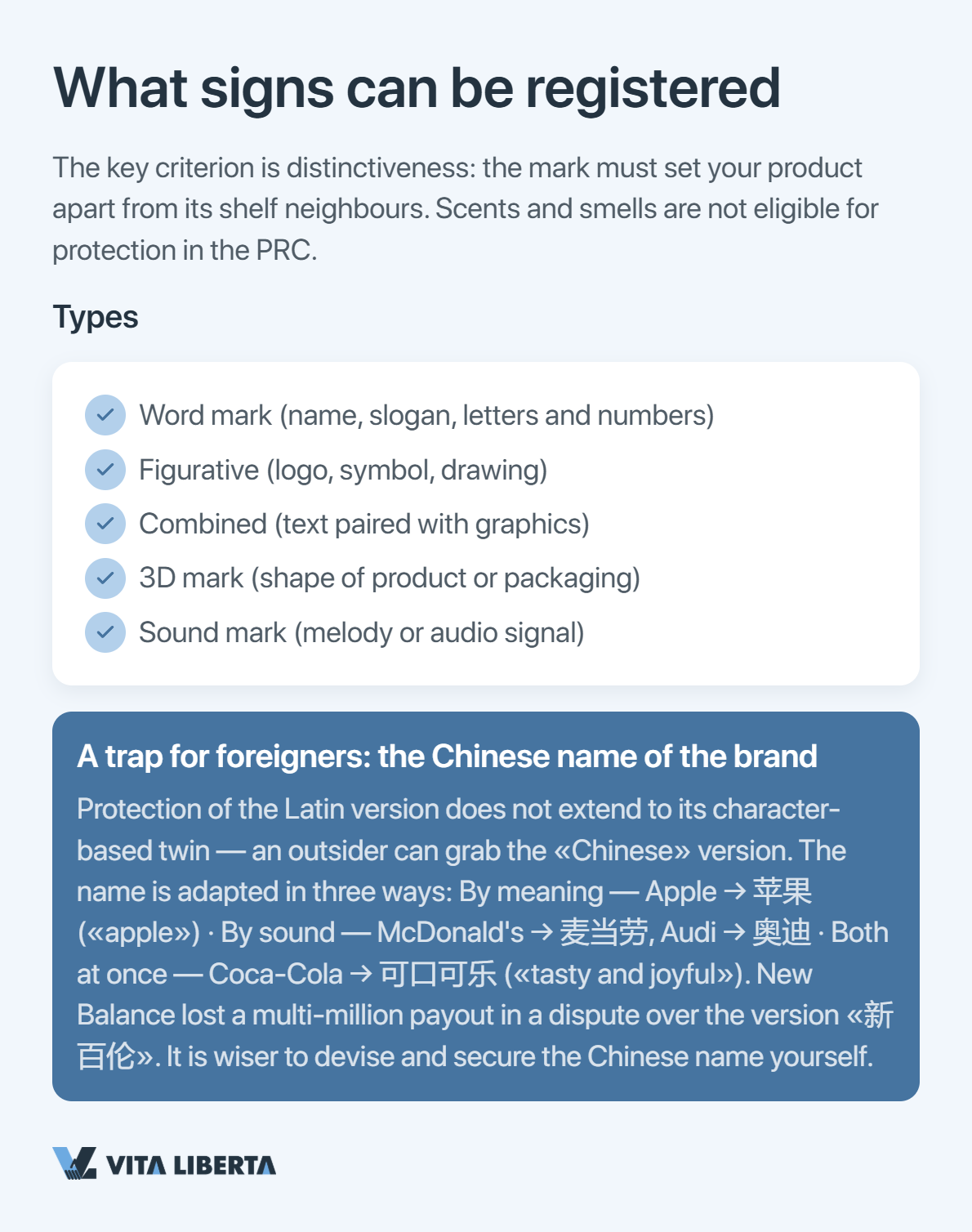
- a word mark — a name, slogan, or a string of letters and numbers;
- a figurative mark — a logo, graphic symbol, or design;
- a combined mark — text paired with graphics;
- a 3D mark — a recognisable product or packaging shape;
- a sound mark — a distinctive melody or audio signal.
The key criterion is distinctiveness: the mark must set your goods apart on the shelf. Scents and smells cannot be registered in China, and some categories are closed to registration. Before filing, the mark is checked for availability against the CNIPA database — the goal is to avoid an identical or confusingly similar sign.
Your trademark in Chinese characters
Here’s the trap for foreigners: protecting the Latin-script version of your brand does not automatically cover its character-based twin. An outsider can grab the “Chinese” version of your mark. Brands are adapted three ways: by meaning (Apple became 蘋果, “apple”), by sound (McDonald’s → 麥當勞, Siemens → 西門子, Audi → 奧迪), or by combining both (Coca-Cola → 可口可樂, which reads as “tasty and joyful”).
Cautionary tales abound. Ralph Lauren was for a while nicknamed “three-legged horse” in China because the public transliterated the name on its own. And New Balance’s dispute over the Chinese version 新百倫, which a third party had registered first, cost the company a multi-million payout. The moral is clear: design and secure your Chinese brand name yourself rather than leaving it to the market or to competitors.
“Characters aren’t an alphabet, where a sign carries over from Latin to Cyrillic almost intact. A Chinese brand name has to be engineered deliberately and registered alongside the main mark — otherwise you leave a gap for whoever files it in your place,” note IP-protection specialists working in China.
Nice classes and subclasses: getting the list right
The foundation is the same Nice Classification used elsewhere, but with a Chinese twist: classes are split into subclasses. An application specifies class, subclass, and the exact wording of each item. A slip here directly undermines protection — your mark may end up covered for something other than what you actually sell.
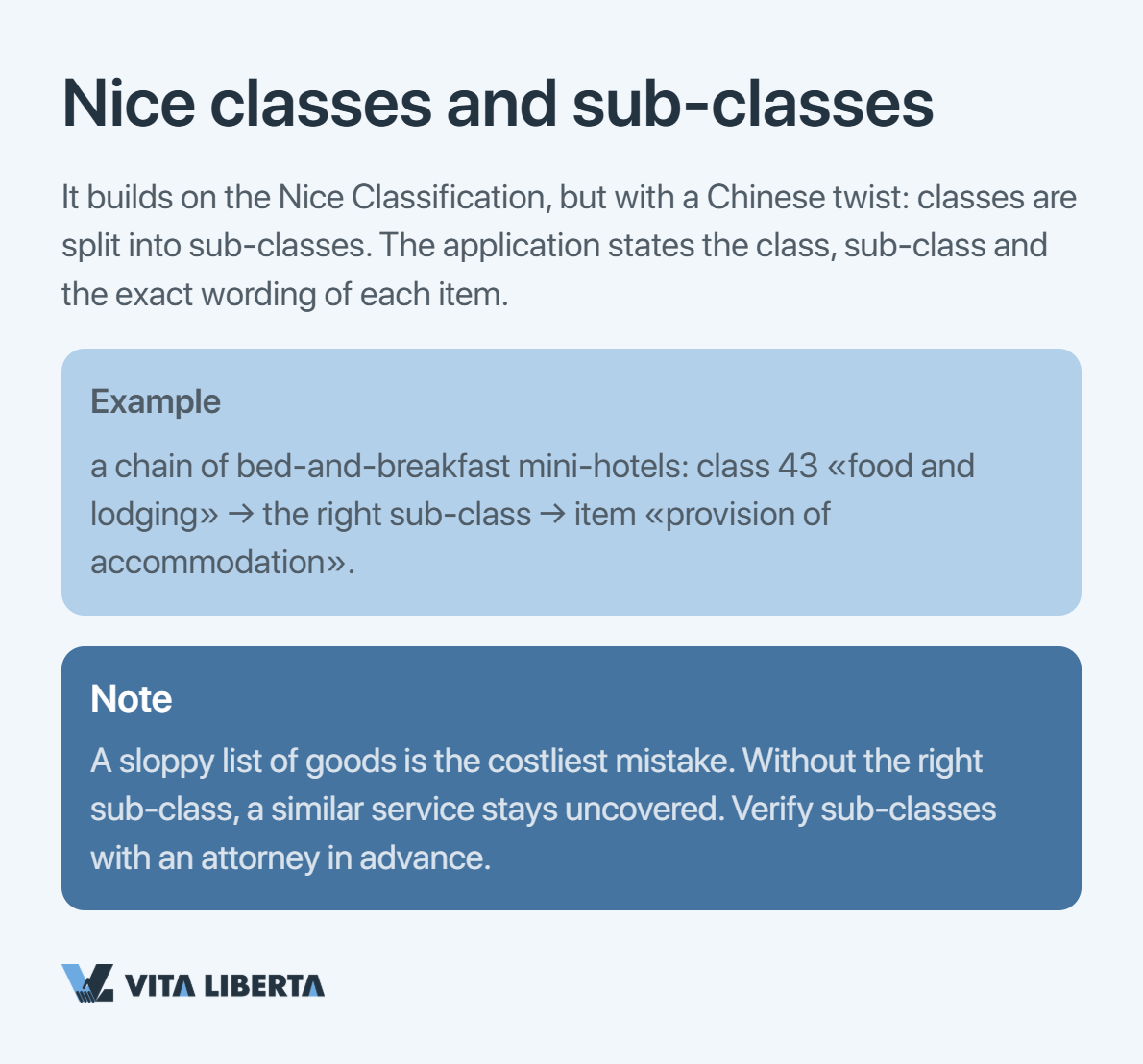
Take a chain of bed-and-breakfast inns: it uses Class 43 (“services for providing food and accommodation”), picks the relevant subclass, and enters a specific item — say, “rental of accommodation.” Without the right subclass, a seemingly similar service can easily be left unprotected.
Watch out. The most common and costly mistake among foreign applicants is a sloppy goods-and-services list. Verify subclasses with your attorney in advance — don’t patch gaps once a refusal is already in hand.
Want to protect your brand in China?
- Trademark availability check
- Trademark classes selected
- Registration odds assessed

Two routes: national filing and the Madrid System
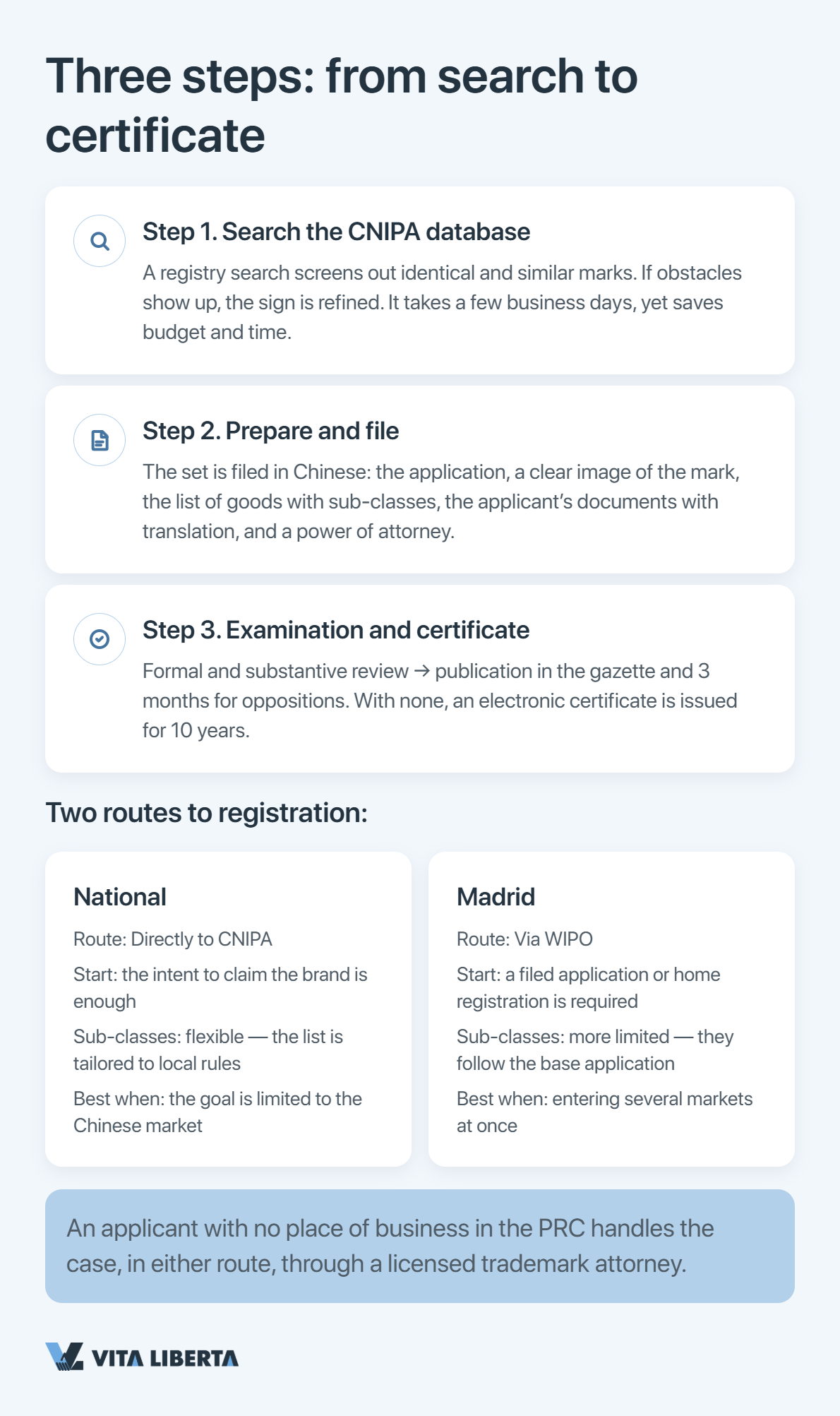
You can secure a mark in China along one of two tracks — file the package directly with CNIPA, or extend an international registration already underway to China through the Madrid Protocol. In either case, anyone without a place of business in the country must act through a licensed trademark agent.
| Criterion | National route (CNIPA) | Madrid System (via WIPO) |
| What you need at the start | Just the intent to secure the brand in China | A pending application or home registration in hand |
| Where it’s filed | Directly with CNIPA via an agent | From your home country, naming China among the territories |
| Flexibility on subclasses | Greater: the list is tailored to local rules | More limited — it trails the base application |
| When it suits | When the goal is the Chinese market only | When you launch in several countries at once |
| Cost | More transparent for a single jurisdiction | More economical when one filing covers a cluster of countries |
The national route is preferable when China is the main or only target. The Madrid System comes into its own when you launch across several markets at once and want to manage the portfolio from one point.
Step-by-step registration in China
At a high level, the path splits into three stretches: clearing the sign, preparing and filing documents, examination and certificate. Let’s walk through each.
Step 1. Search the CNIPA database
Start with a search of the CNIPA register — the aim is to rule out identical and confusingly similar marks in advance. China’s register is enormous, so obstacles surface regularly. If conflicts appear, the sign is refined: change a detail, strengthen the distinctive element, adjust the list. This check takes a few business days but protects what matters most — the budget and time an outright refusal would otherwise burn.
Step 2. Prepare documents and file the application
The CNIPA package typically includes:
- the application, drawn up in Chinese;
- a clear, high-resolution image of the mark;
- a goods-and-services list mapped to subclasses;
- applicant documents (a company registration extract or a passport copy), translated;
- a power of attorney for the representative;
- materials on the first filing, if you’re claiming convention priority.
A foreign applicant reaches the office only through a licensed agent, and all documentation is filed in Chinese — the procedure isn’t workable without a native speaker and a competent representative.
Step 3. Examination, publication, and the certificate
CNIPA then runs two checks: formal (completeness and accuracy of the package) and substantive (distinctiveness plus clashes with existing marks). If there are no barriers, the sign is published in the official gazette, with a three-month window for third-party opposition. A negative decision, whole or partial, can be appealed. If no opposition is filed, the applicant receives an electronic certificate: it locks in exclusive rights for a decade and is renewable thereafter.
Cost and timeline
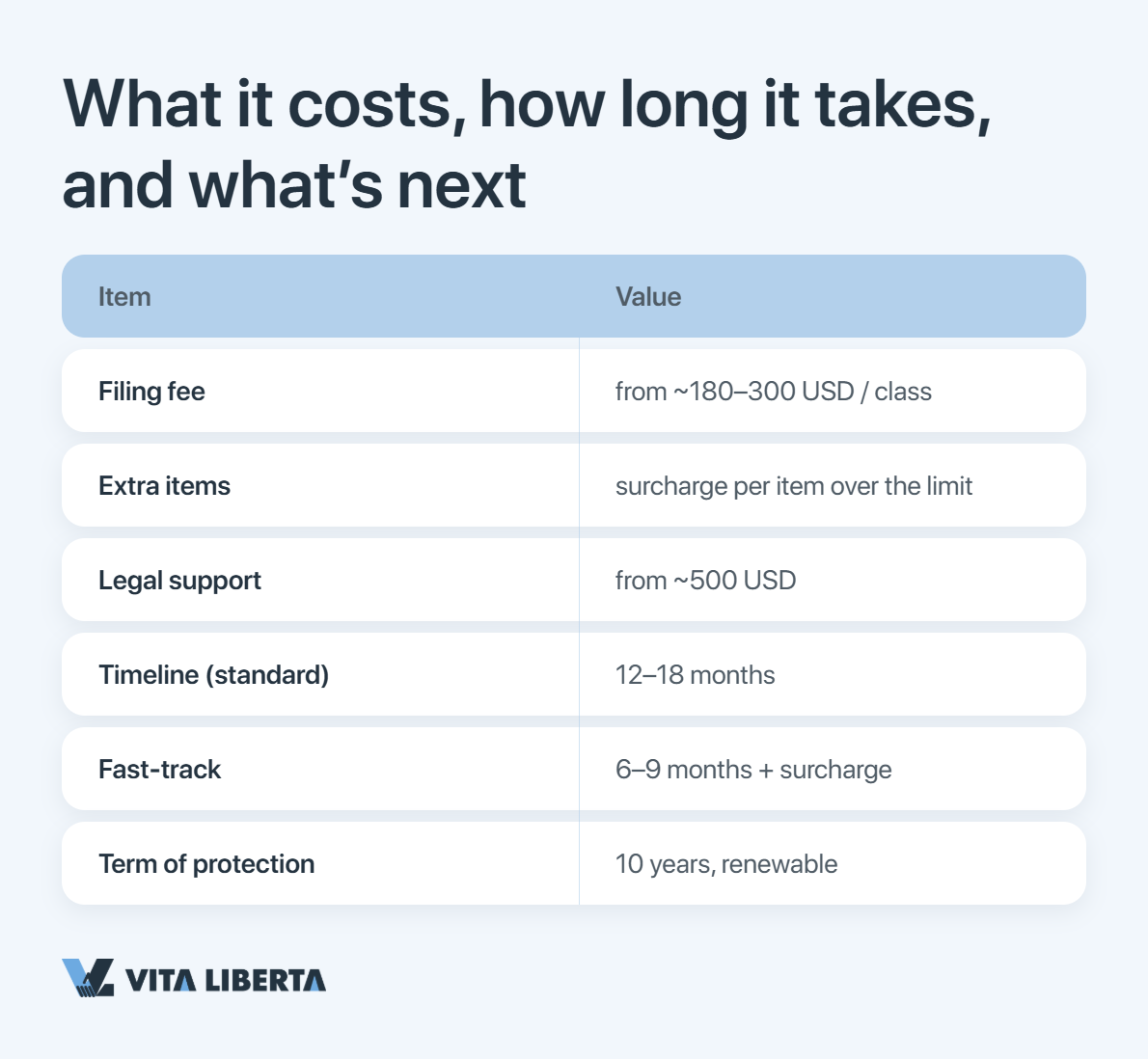
The final figure depends on the number of classes and items in the list, plus the scope of legal support. Timelines split into standard and expedited.
| Item | Ballpark |
| Government filing fee | roughly from ~180–300 USD per Nice class |
| Additional items | a small surcharge for each beyond those included |
| Legal support | from ~500 USD, depending on complexity |
| Registration time (standard) | about 12–18 months |
| Expedited route | roughly 6–9 months for a surcharge |
| Term of protection | 10 years, renewable |
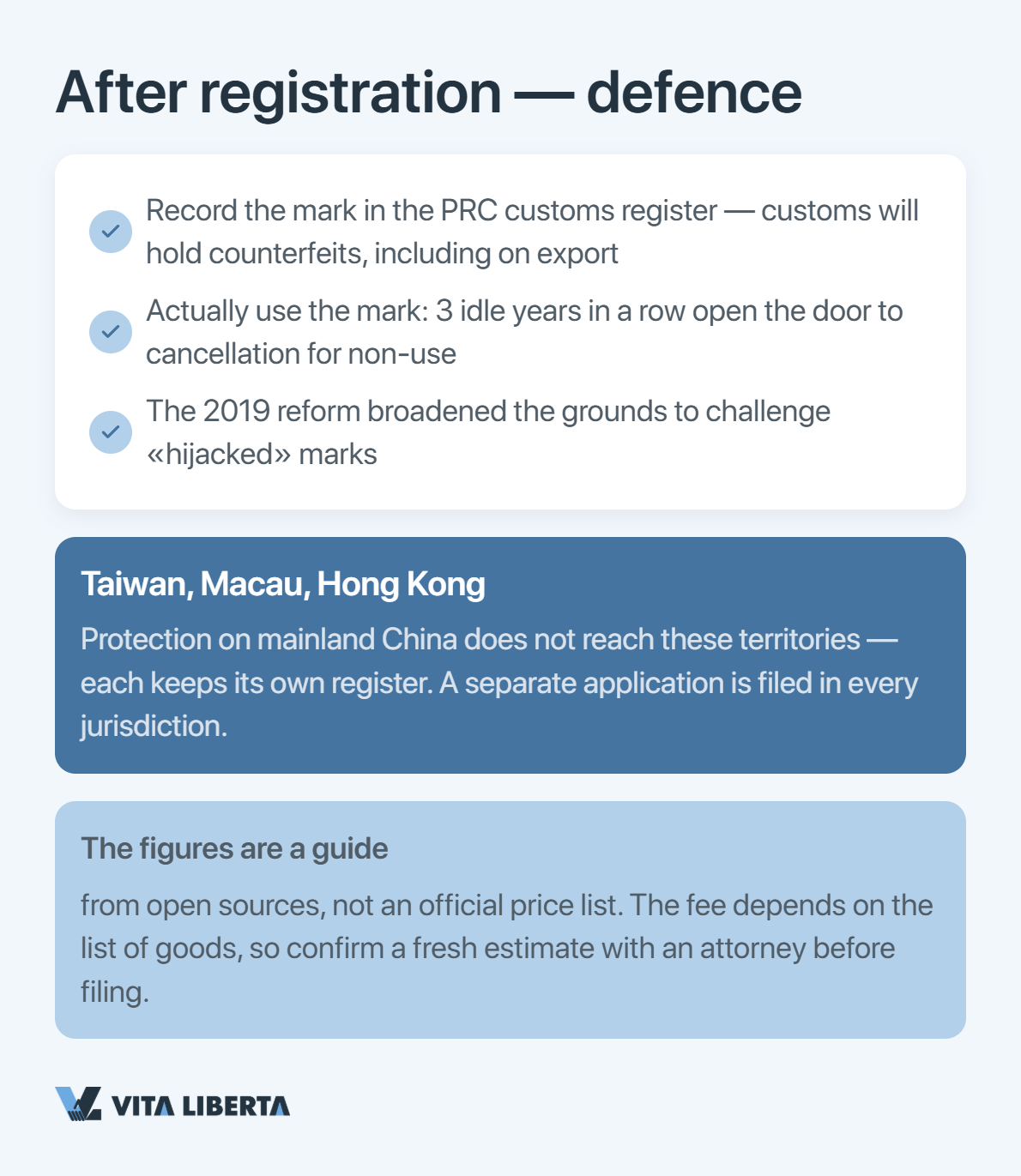
Important. These figures are only a guide from open sources, not an official price list. The fee depends on the goods list, so confirm a current quote (including possible surcharges if the office raises queries) with your attorney before filing.
After registration: customs recordal and enforcement
Getting the certificate doesn’t close the matter — it opens the defence. To intercept counterfeits at the border, the mark is entered into the China customs recordal: on that basis customs can detain shipments bearing your sign, including those leaving on export. At the same time, you must watch over the mark and genuinely use it — three consecutive years of dormancy lets any interested party seek cancellation for non-use.
Keep the 2019 reform in mind too: the authorities explicitly moved against bad-faith registration, widening the grounds for both opposition and challenges to “hijacked” marks. That eased life for legitimate owners considerably — yet the “first to file, first to own” principle is still very much in force.
Taiwan, Macau, and Hong Kong: why separate filings are needed
Protection secured in mainland China simply doesn’t reach Taiwan, Macau, or Hong Kong — each territory runs on its own body of law and keeps its own register. So the only way to cover a brand on every front is to file a standalone application in each such jurisdiction.
In Hong Kong, for instance, the application goes to the local Intellectual Property Department and follows its own rules and timelines. A company that keeps a Hong Kong entity or routes foreign-trade operations through Hong Kong is wise to close both zones at once — mainland and Hong Kong — leaving no gaps in the defence.
The Chinese system rewards the quick: the mark goes to the first to file, not the longest user. For protection to actually work, three things must come together — a well-considered Chinese brand name, a sound list with the right subclasses, and the support of a licensed agent. After that it’s the familiar track: a CNIPA search, filing, examination, and a ten-year certificate, followed by customs recordal and use monitoring. Delay here almost always costs more than the procedure itself — so file early, before someone else does.
Ready to file with CNIPA?
- Turnkey trademark registration
- Support up to the certificate
- Guard your brand from copycats

FAQ
No. A foreign company or individual can file, but strictly through a licensed trademark agent in China — a foreign applicant cannot approach CNIPA directly.
No, legally these are two separate signs. The Chinese-character version must be developed and registered separately, or an outsider may grab it.
Three consecutive years of non-use let any interested party request cancellation. So you must genuinely use the mark and keep evidence of that use.
The certificate is valid for 10 years from registration and renews for further ten-year periods on a timely application and fee.
No. Hong Kong, Macau, and Taiwan are separate jurisdictions, each requiring its own application to the relevant register.