Hongkong
 China
China





An offer letter from a Chinese employer quotes gross. What reaches the bank account is a different figure — and a surprising share of that gap is negotiable if you set things up correctly.
Who pays, and on what
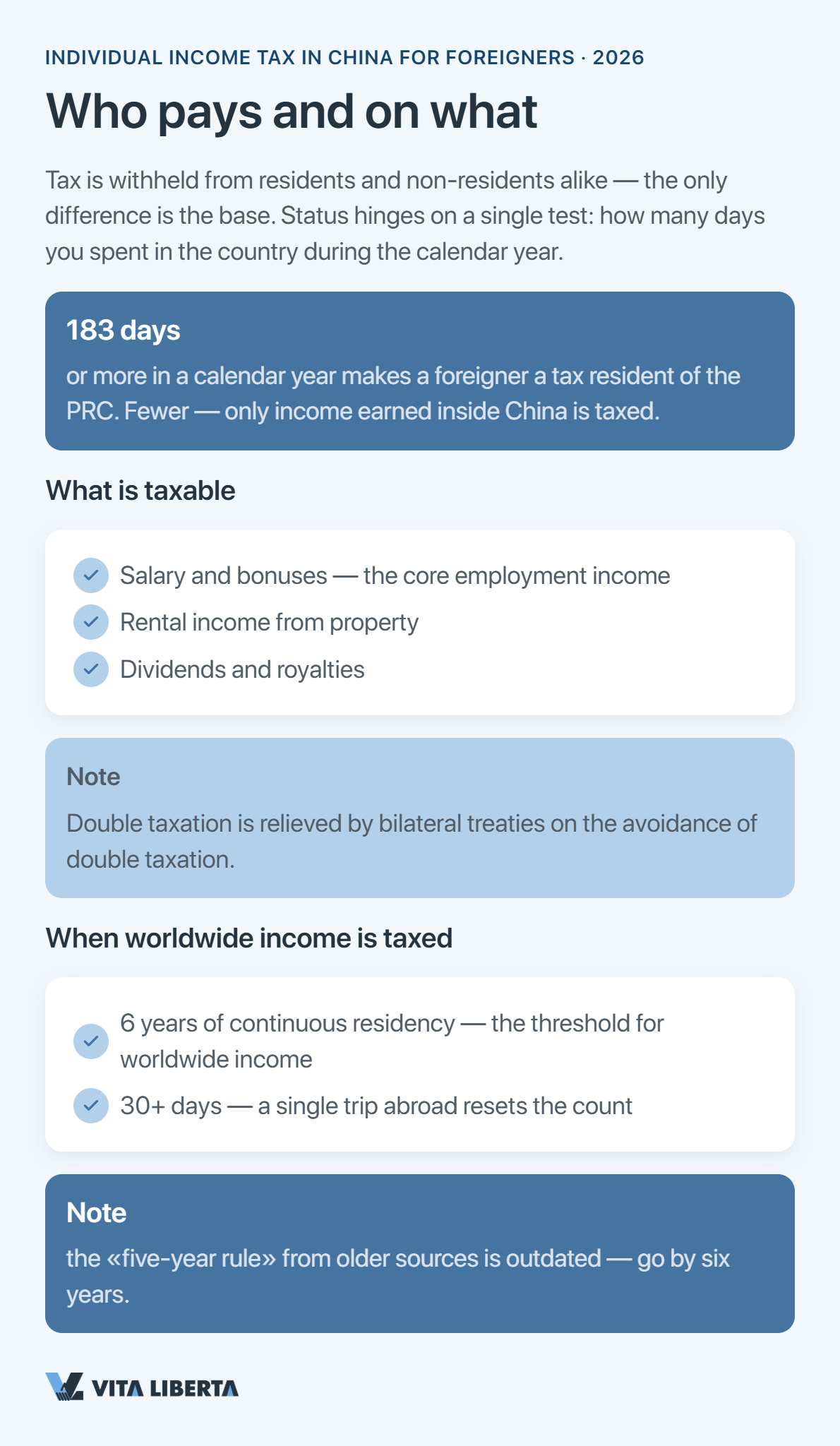
Nobody escapes the tax by holding a foreign passport. Residents and non-residents alike are assessed in mainland China; what separates them is the scope of income the authority can reach.
Resident or non-resident
The dividing line is 183 days inside the country across a calendar year. Cross it and you are a tax resident, assessed on what you earn in China. Reaching your income outside China takes far longer: six consecutive years of residency, and the clock is wiped clean by any single absence exceeding 30 days. Older guides that still describe a “five-year rule” are simply behind the times. Once liability attaches, it covers wages and bonuses alike, plus rent received, dividends and royalties — with bilateral treaties there to stop the same money being taxed twice.
The rates: a progressive scale
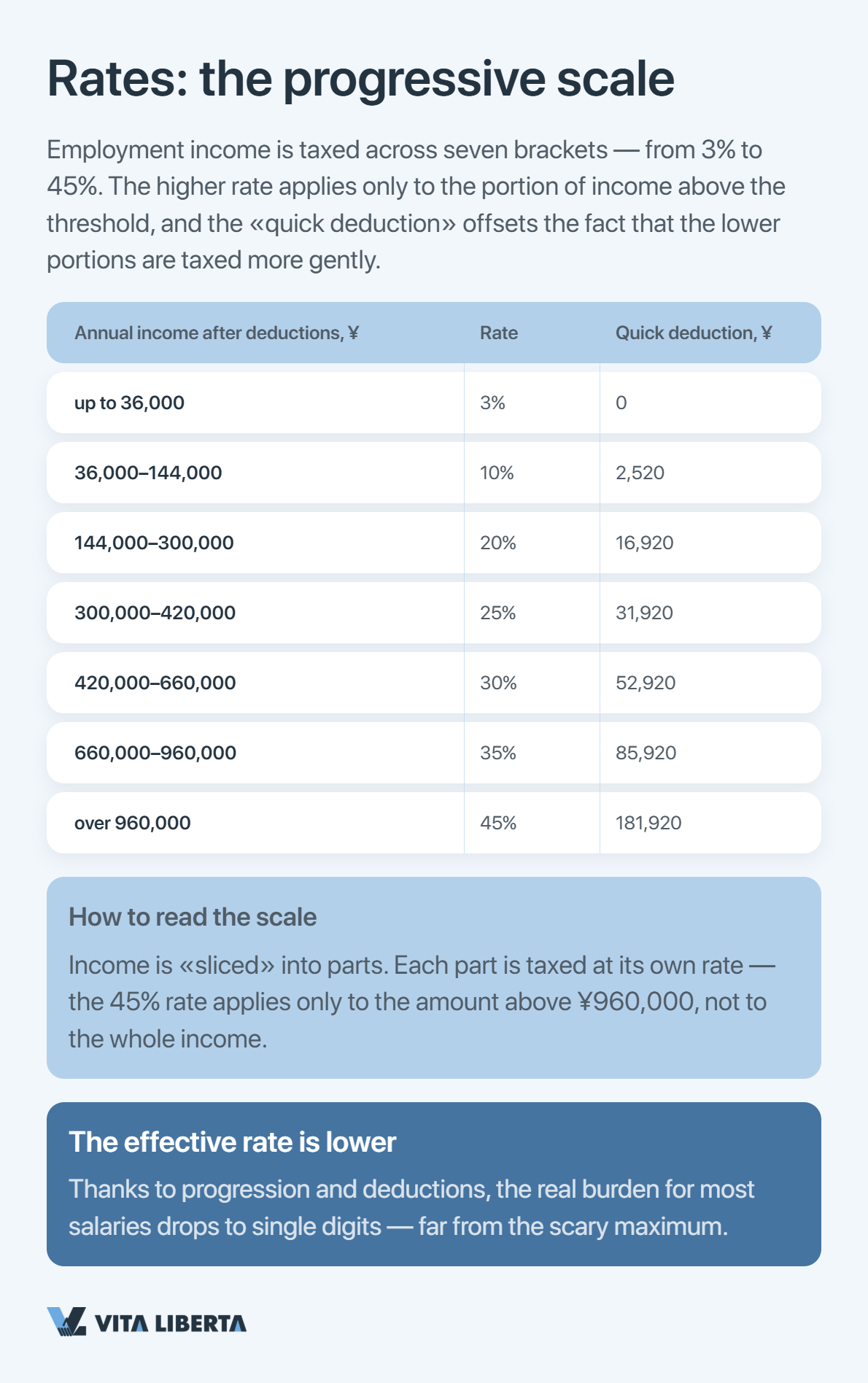
Seven bands govern employment income, opening at 3% and topping out at 45%. Each rate bites only into the portion of income sitting above its own threshold, which is why the headline 45% almost never describes anyone’s real bill.
| Annual income after deductions (RMB) | Rate | Quick deduction |
| up to 36,000 | 3% | 0 |
| 36,000–144,000 | 10% | 2,520 |
| 144,000–300,000 | 20% | 16,920 |
| 300,000–420,000 | 25% | 31,920 |
| 420,000–660,000 | 30% | 52,920 |
| 660,000–960,000 | 35% | 85,920 |
| over 960,000 | 45% | 181,920 |
Confused by China’s IIT rates?
- Calculate tax for your employee
- Factor in deductions and reliefs
- Check your tax residency status

How the tax is calculated
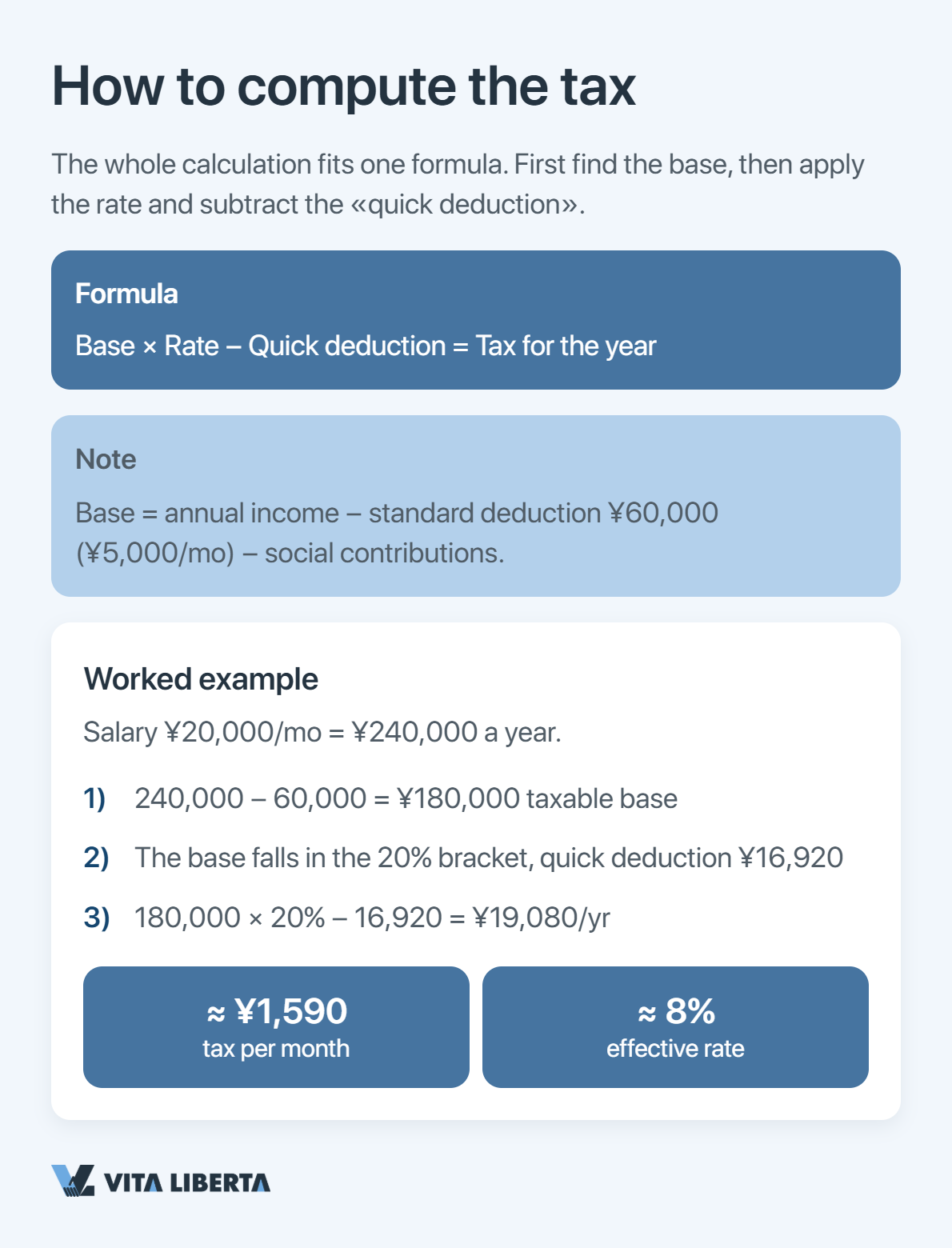
One formula does the whole job.
Standard deduction and quick deduction
Strip out two things before any rate is applied: RMB 60,000 for the year (booked as RMB 5,000 monthly) and whatever went to social contributions. Apply the band rate to what remains, then subtract the quick deduction sitting alongside that band. That last figure exists purely to correct for the lower slices having already been taxed at gentler rates — without it, the arithmetic would overcharge everyone above the first band.
Run the numbers. Take RMB 20,000 monthly, or RMB 240,000 across the year. Knock off the 60,000 and the base becomes 180,000 — squarely inside the 20% band, whose quick deduction is 16,920.
180,000 × 20% − 16,920 = RMB 19,080 for the year — roughly RMB 1,590 a month, an effective rate near 8%. The nominal band was 20%; the actual bite is less than half that.
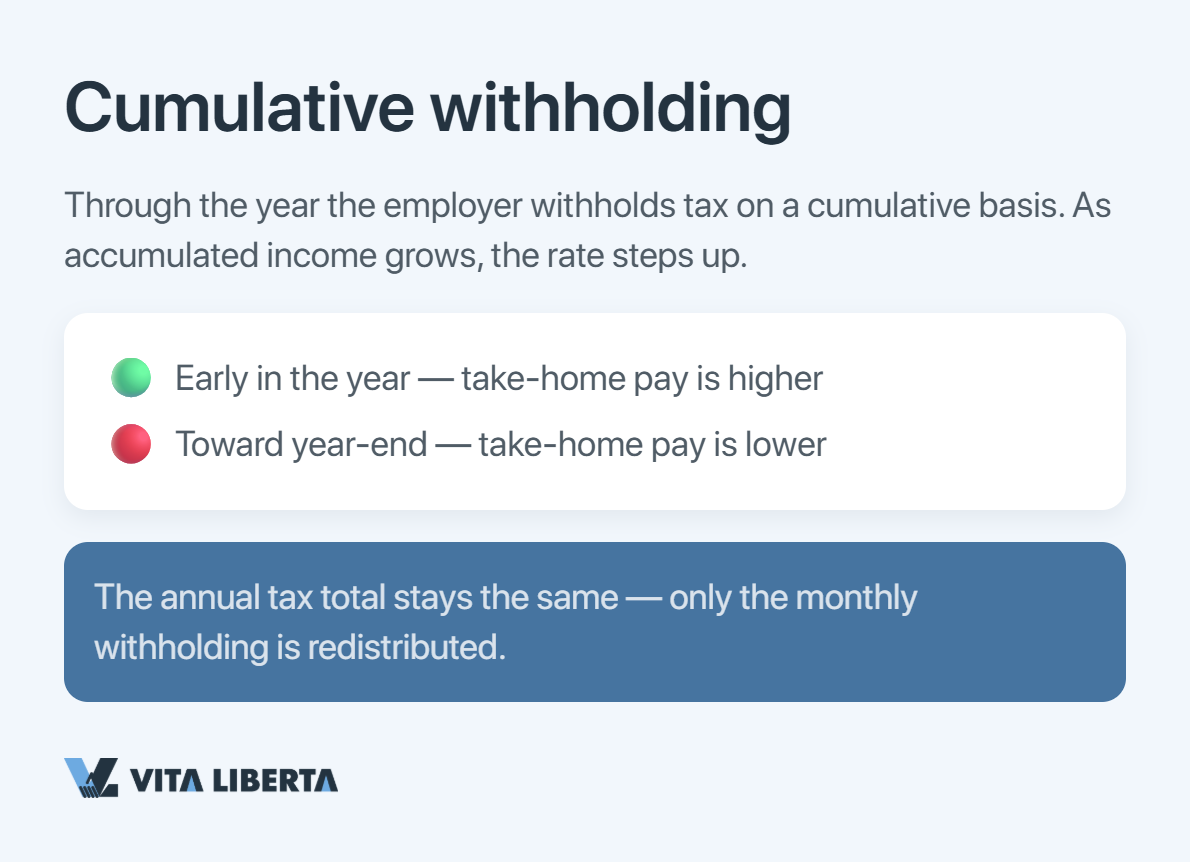
Withholding runs cumulatively rather than in equal monthly slices, so net pay quietly shrinks as the year progresses. January feels generous; November rarely does.
Deductions and reliefs for foreigners
There is more room to compress the base — but taking it means committing to one route and closing off the other.
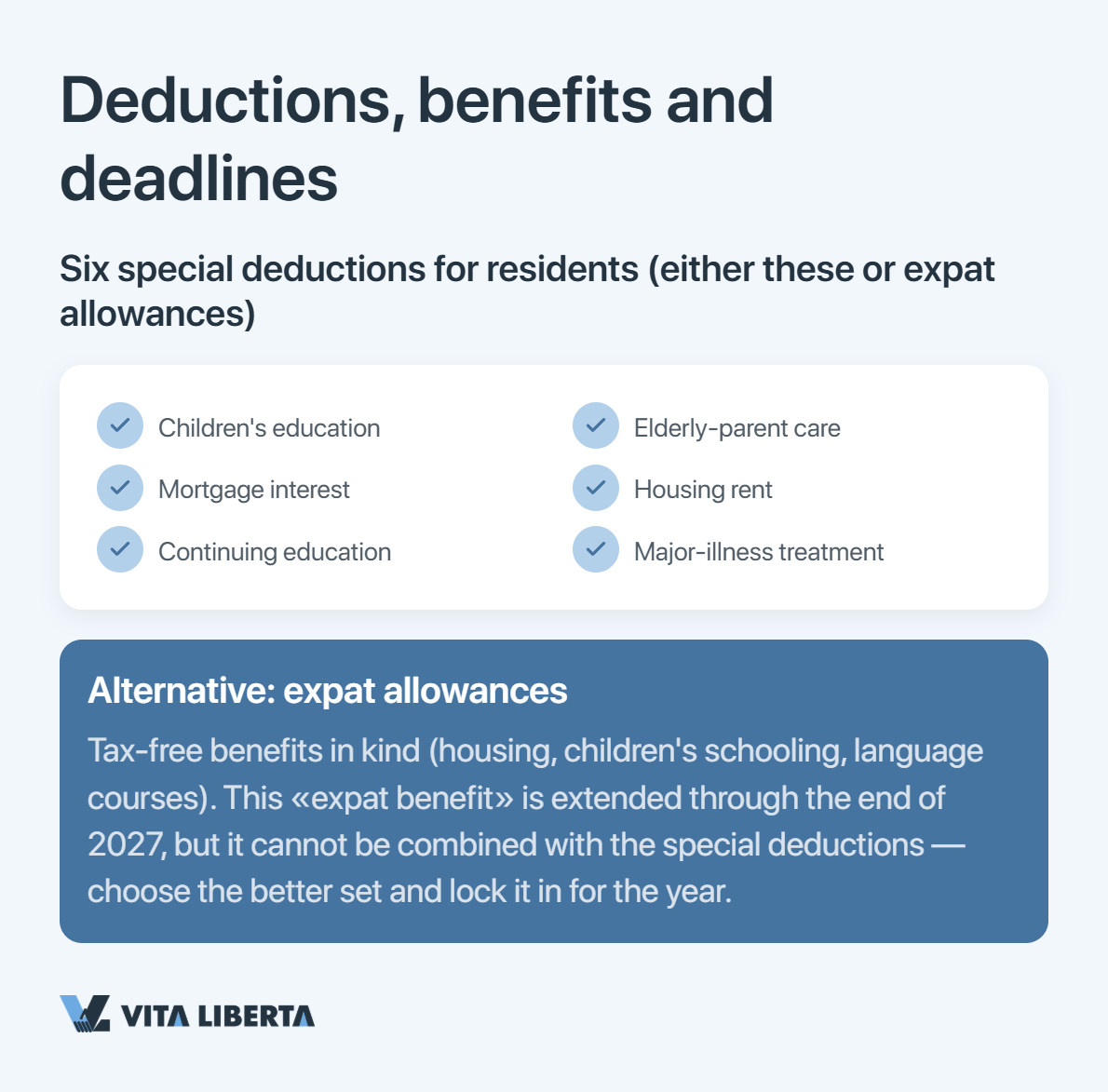
Special deductions or expat allowances
One route is the itemised relief available to residents, covering children’s education, elderly parent support, mortgage interest, housing rent, continuing education, and treatment of serious illness. The other is the older arrangement built for foreign hires, under which benefits delivered in kind — accommodation, school fees, language tuition — stay outside the tax base entirely. That expat-facing option now runs to the end of 2027. What you cannot do is mix them: the choice is annual, made once, and locked for the twelve months that follow, which makes the comparison worth running properly before the year opens.
Contributions and withholding
Payroll handles the mechanics. The employer is the withholding agent, computing and remitting each month, so most foreign employees never file anything monthly themselves. Social contributions are compulsory for foreigners across many cities — budget in the region of RMB 1,650, though the figure moves with the locality — while housing-fund contributions are typically not demanded of them. One practical consequence worth noting early: renewing a residence permit means producing evidence the tax was actually paid.
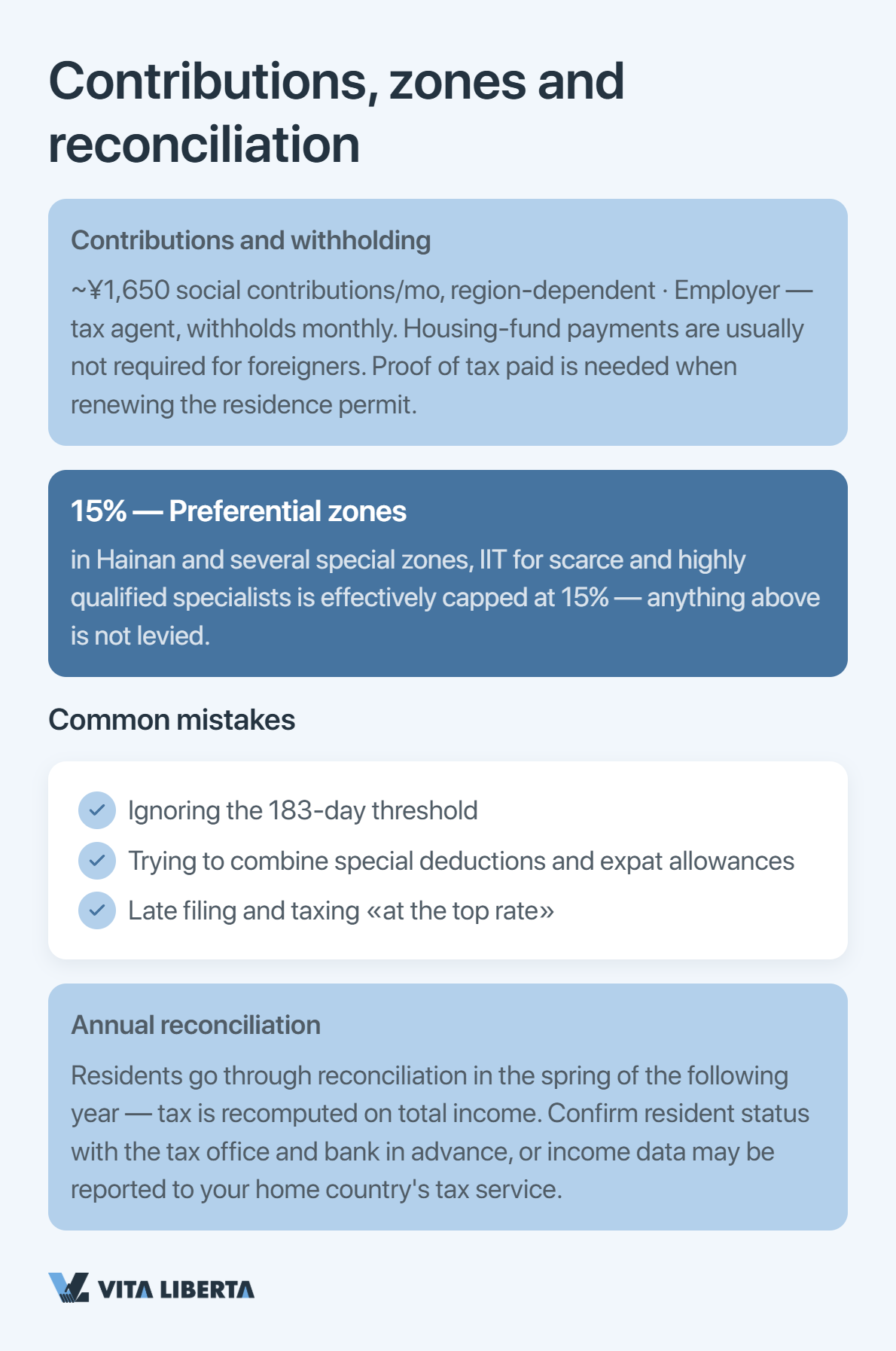
Preferential rates and zones
Geography changes the answer. Hainan and several designated zones cap individual income tax at an effective 15% for foreign specialists classed as scarce or highly qualified — anything the calculation produces above that ceiling simply is not collected. Hong Kong talent working across the border reaches a comparable result by a different mechanism, through Greater Bay Area subsidies rather than a rate cap.
Deadlines and pitfalls
⚠️ Important: Get your resident status confirmed with both the tax authority and your bank before it matters. Leave it ambiguous and your income details may travel to the revenue service back home.
Spring brings the annual reconciliation for residents, when the year’s total income is reassessed as a whole and any shortfall or overpayment surfaces. Three failures account for most problems: miscounting days against the 183-day line, attempting to claim itemised relief and expat allowances together, and missing the filing window.
“The biggest mistake newcomers make is eyeballing their tax at the top rate. In reality, the progressive brackets and deductions often pull the effective rate down to single digits, and choosing the right reliefs saves a meaningful sum over the year.”
— Sergey Konon, China tax consultant
Progression plus deductions is why mainland income tax rarely resembles its own maximum. The rate schedule reaches 45%, but it applies to a base already reduced, in bands, and the effective figure for a mid-level salary often lands in single digits. Three things decide where you end up: how carefully you track residency, which relief package you commit to, and whether the spring reconciliation is handled on time. Build the base first, choose the reliefs second, judge the take-home last.
Need help with employee taxes?
- Tax bureau registration
- IIT calculation and payment
- Avoid penalties and overpayments
FAQ
Seven progressive bands apply, from 3% up to 45%, and nationality makes no difference — residents and non-residents run through the same schedule. Higher earnings simply reach further up it.
At 183 days of presence within a single calendar year. Below that line, only China-sourced earnings are assessed. Income from outside China enters the picture only after residency has run six consecutive years.
RMB 5,000 a month comes off as a matter of course. Residents can go further, using children’s education, rent, mortgage interest, medical costs and elderly relative support to compress the base. The alternative package of tax-exempt allowances for foreigners has been extended through the end of 2027.
The employer, acting as withholding agent. It calculates the amount, deducts it from salary, and pays it over directly — the employee is not the one making the transfer.
They are three separate tax systems, not variations on one. The mainland schedule climbs to 45%; Hong Kong operates at markedly lower rates; Macau runs its own scale entirely. Layered on top, zones including Hainan and Shenzhen hold valued specialists to a 15% ceiling.