Hongkong
 China
China





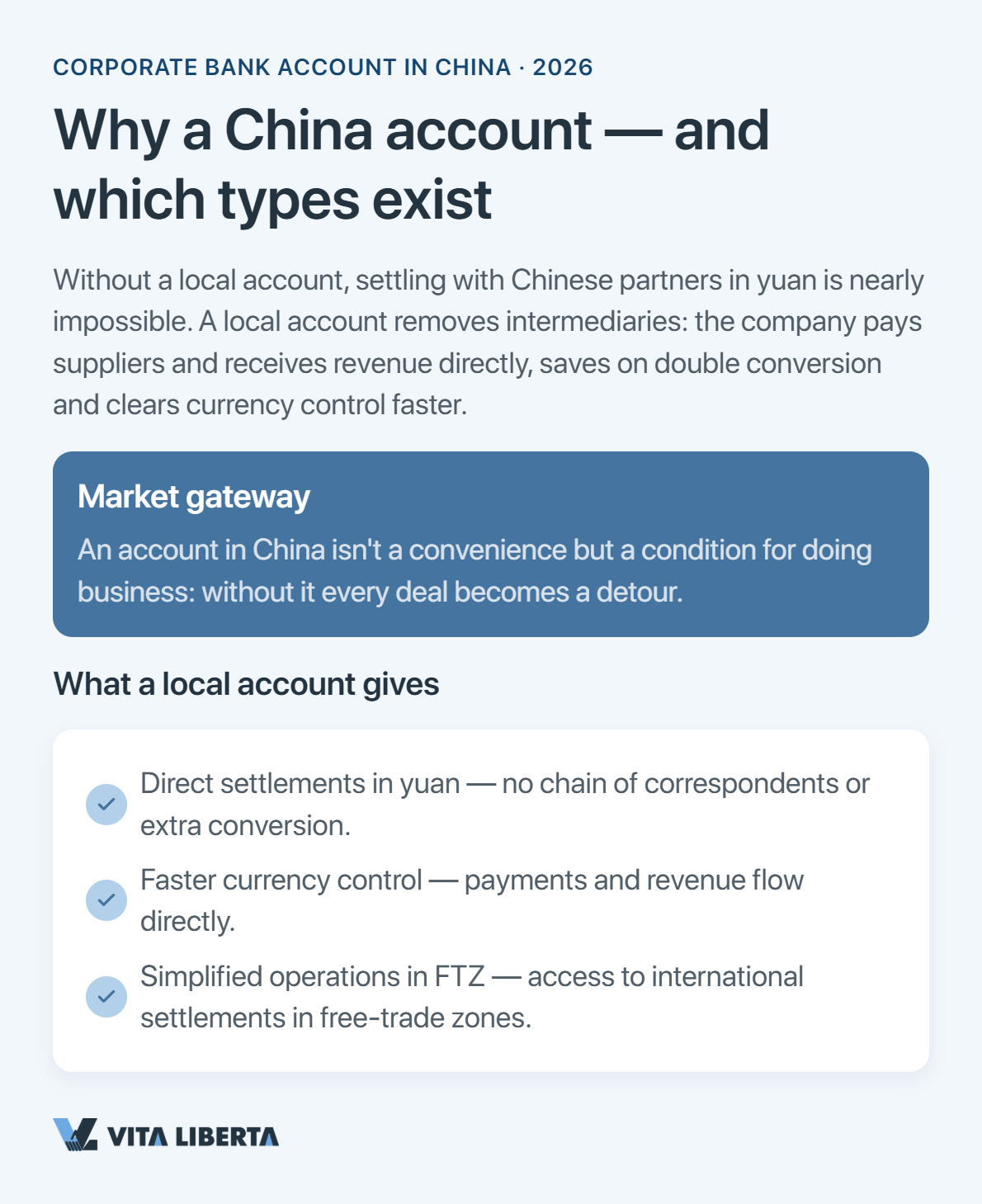
Settling in renminbi with mainland partners without an onshore account is, in practice, barely workable — and the screening at the front door has grown noticeably tougher over the past few years. This guide walks through what Chinese banks examine, which account types are on the table, and where applications tend to fail.
The case for an onshore account
An account inside the mainland strips intermediaries out of the payment chain. Suppliers get paid in RMB directly, revenue lands in RMB directly, one conversion step disappears from the cost line, and foreign-exchange clearance moves faster. Companies based in a free trade zone gain something extra on top: access to a lighter regime for cross-border transactions.
Treat the mainland account as market access rather than convenience. Without one, every transaction has to travel the long way round.
Worth flagging separately: several banks remain comparatively workable for beneficial owners on Russian passports. The condition is a clean, readable ownership structure and a business purpose the bank can follow — on that footing, settlement with overseas counterparties behaves predictably.
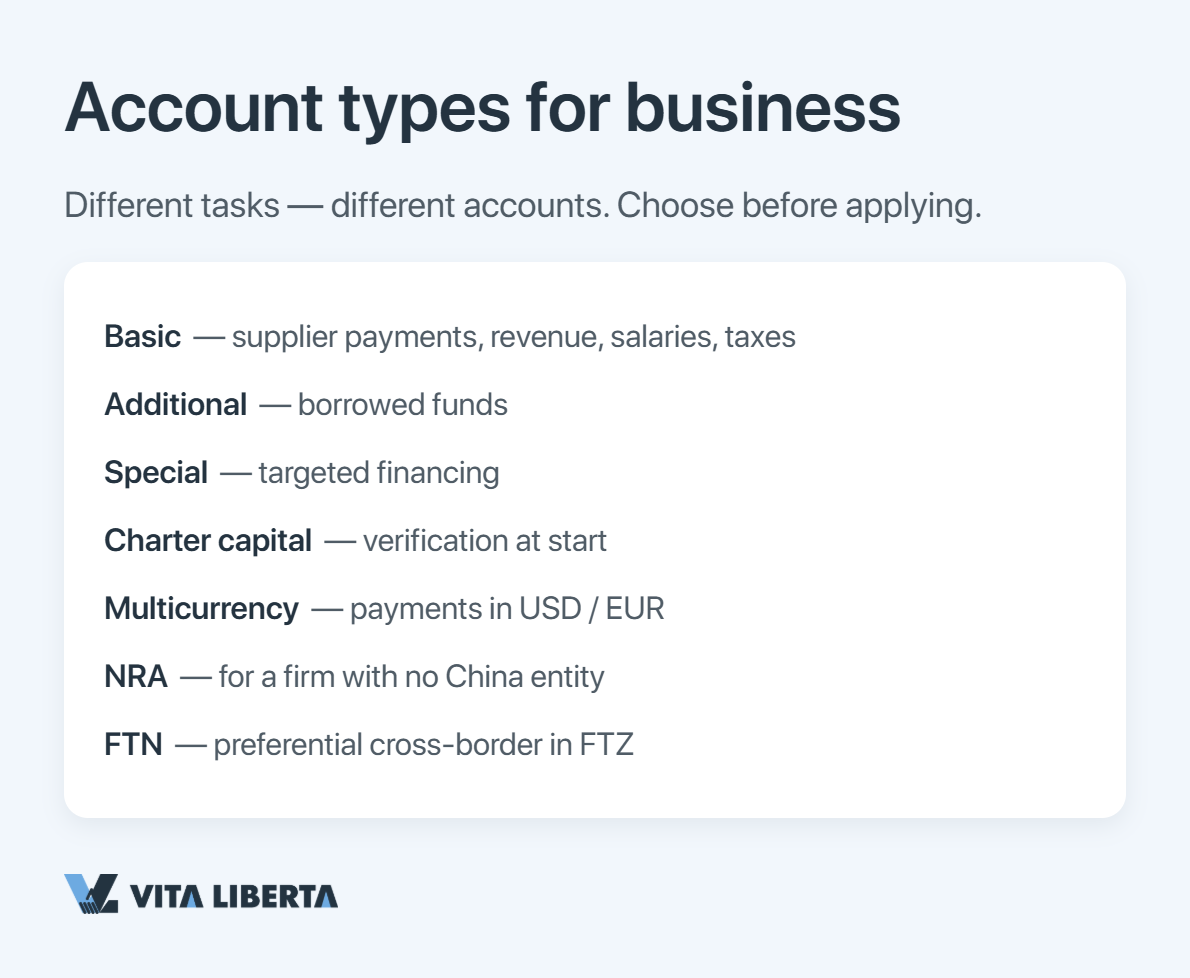
Account types available to a business in China
Different functions map to different accounts, so the structure deserves thought before anything is filed.
Basic account plus the layers above it
Everyday operations run through the basic deposit account — supplier settlements, incoming revenue, payroll, tax payments. Growth usually brings additions:
- general accounts, which service borrowed funds;
- special-purpose accounts, reserved for earmarked financing or discrete projects;
- a capital verification account, used at the launch stage.
Sharper cash-flow forecasting on your side translates directly into a cleaner servicing structure on the bank’s side.
Multi-currency and NRA accounts for offshore entities
Dollar or euro settlement calls for a multi-currency account. Where no mainland legal entity exists yet, the NRA route — Non-Resident Account — remains open. Hong Kong companies find these easiest to obtain; Singapore, UAE and UK entities also qualify in practice.
Economic substance gets a harder look in this scenario, and trade or logistics profiles pass most smoothly. Free trade zones add a further option, the FTN account, with relaxed handling of cross-border flows.
Three regulators, three mandates: PBOC, SAFE, NFRA
Oversight is split. General rules and RMB settlement fall to the People’s Bank of China (PBOC). Foreign-exchange transactions and cross-border capital movement belong to the State Administration of Foreign Exchange (SAFE). Prudential supervision of the banks themselves rests with the NFRA.
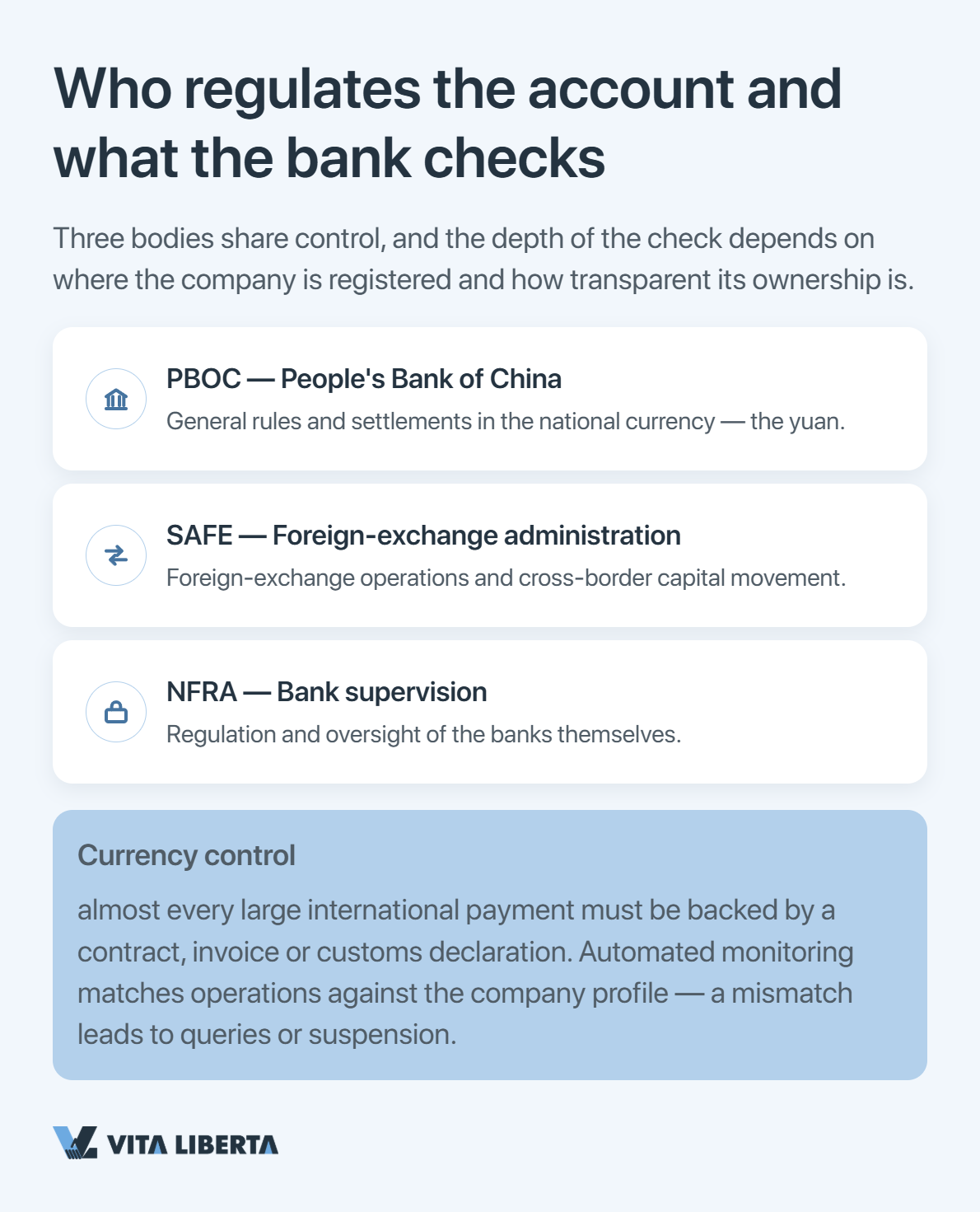
Foreign-exchange control has a practical consequence: substantial international payments generally need backing — a contract, an invoice, a customs declaration. Monitoring systems compare each transaction against the profile the company declared, and divergence produces queries or a freeze.
How requirements shift with company type
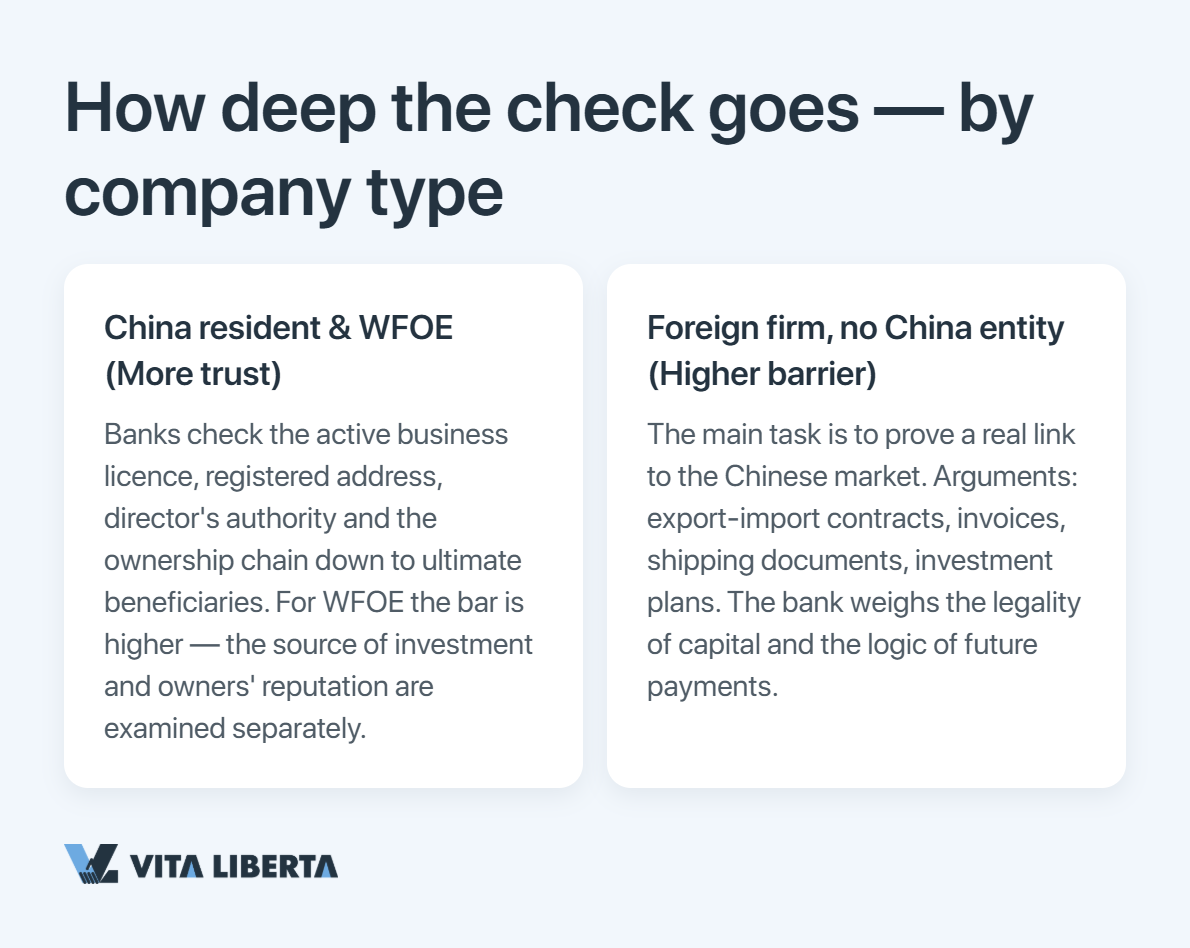
Two variables set the depth of the review: the company’s place of registration, and how legible its ownership chain is.
Mainland-resident entities and WFOEs
Confidence runs highest with PRC-resident companies, wholly foreign-owned enterprises (WFOEs) included. Reviewers concentrate on a live business license, the registered address, how far the authority of the director and legal representative extends, and the shareholding chain traced through to ultimate beneficial owners. WFOEs face an additional layer: where the investment originated and what reputation the owners carry are assessed on their own terms.
Offshore companies with no PRC entity
The steepest scenario. Everything hinges on demonstrating a real anchor in the Chinese market — export and import contracts, invoices, shipping paperwork, investment plans. Decisions are made application by application, balancing the legality of the capital against the commercial sense of the payments being planned.
Struggling to open a bank account?
- Right bank for your business
- Full document package prepared
- Non-resident rules covered
Document package and legalization
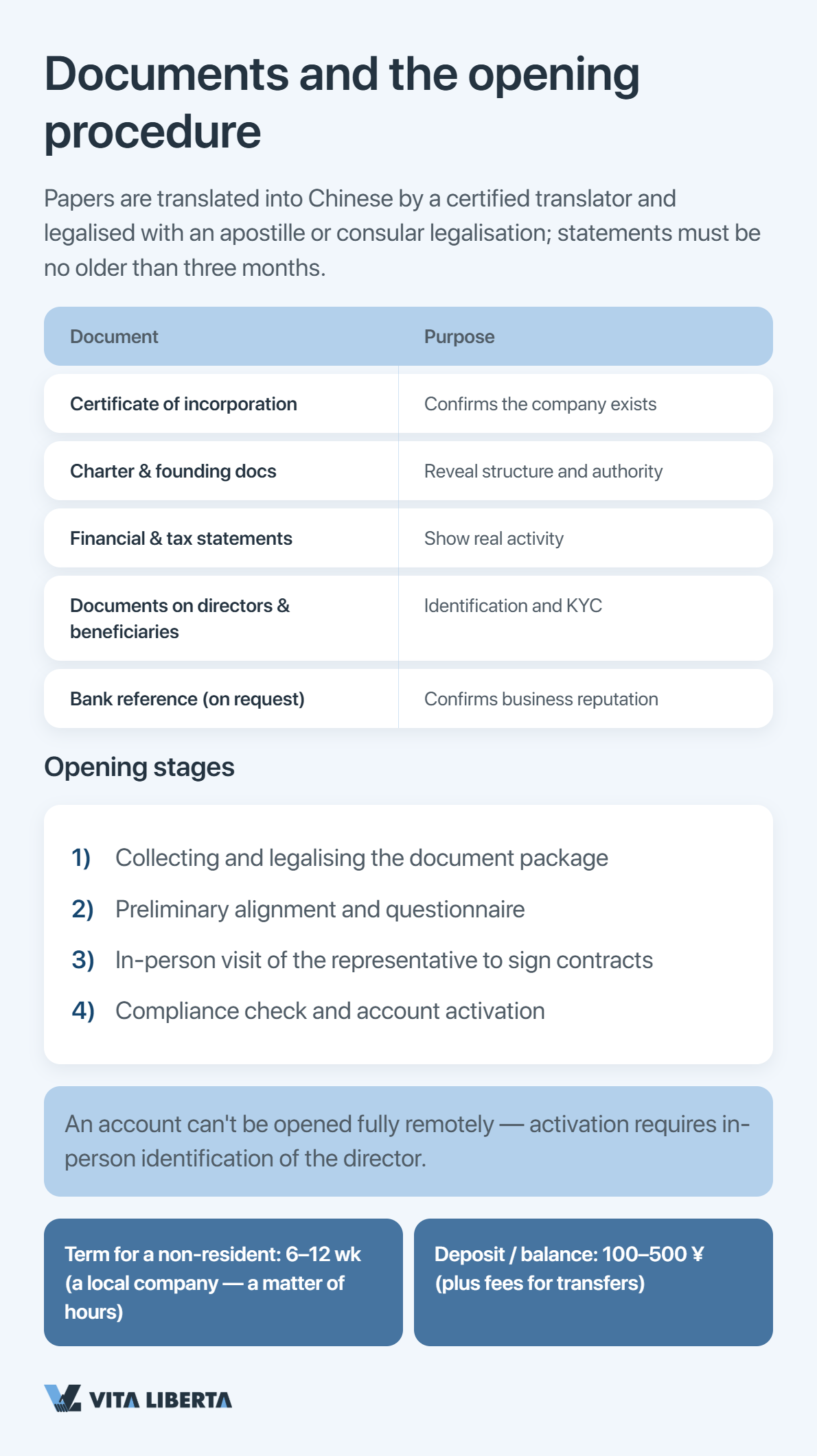
A standard file combines incorporation and constitutional documents, accounting and tax filings, a written description of the business, and — for directors and beneficial owners — passports with address confirmation. Everything goes into Chinese via a certified translator and is legalized either by apostille or, for jurisdictions outside the Convention, through consular channels. Extracts need to be fresh; three months is the usual ceiling.
| Document | Purpose |
| Certificate of incorporation | Confirms the company exists |
| Articles of association | Reveal structure and authority |
| Financial and tax filings | Show real activity |
| Director and UBO documents | Identification and KYC checks |
| Bank reference (on request) | Confirms business standing |
Walking through the procedure: steps, timing, attendance
Scans can often go in ahead of time, but no corporate account in China activates without someone appearing in person for identification. The sequence:
- Assemble and legalize the document package.
- Pre-clear the profile with the bank and complete the application form.
- The legal representative attends to sign the agreements.
- Compliance review, then activation.
Attendance by the director is the norm; a proxy under power of attorney is accepted only occasionally. Non-resident applications typically sit in review for six to twelve weeks. A local company, by contrast, can be through in a matter of hours.
Pricing: opening versus running the account
The opening fee itself is modest. What matters more is that most banks handling foreign clients ask for a deposit and a maintained minimum balance. Market reference points sit at 100 to 500 RMB for the deposit, with charges layered on top for interbank and foreign-currency transfers. Because each bank sets its own figures and its own balance threshold, tariffs are worth confirming before filing.
Rejection triggers — and how to defuse them
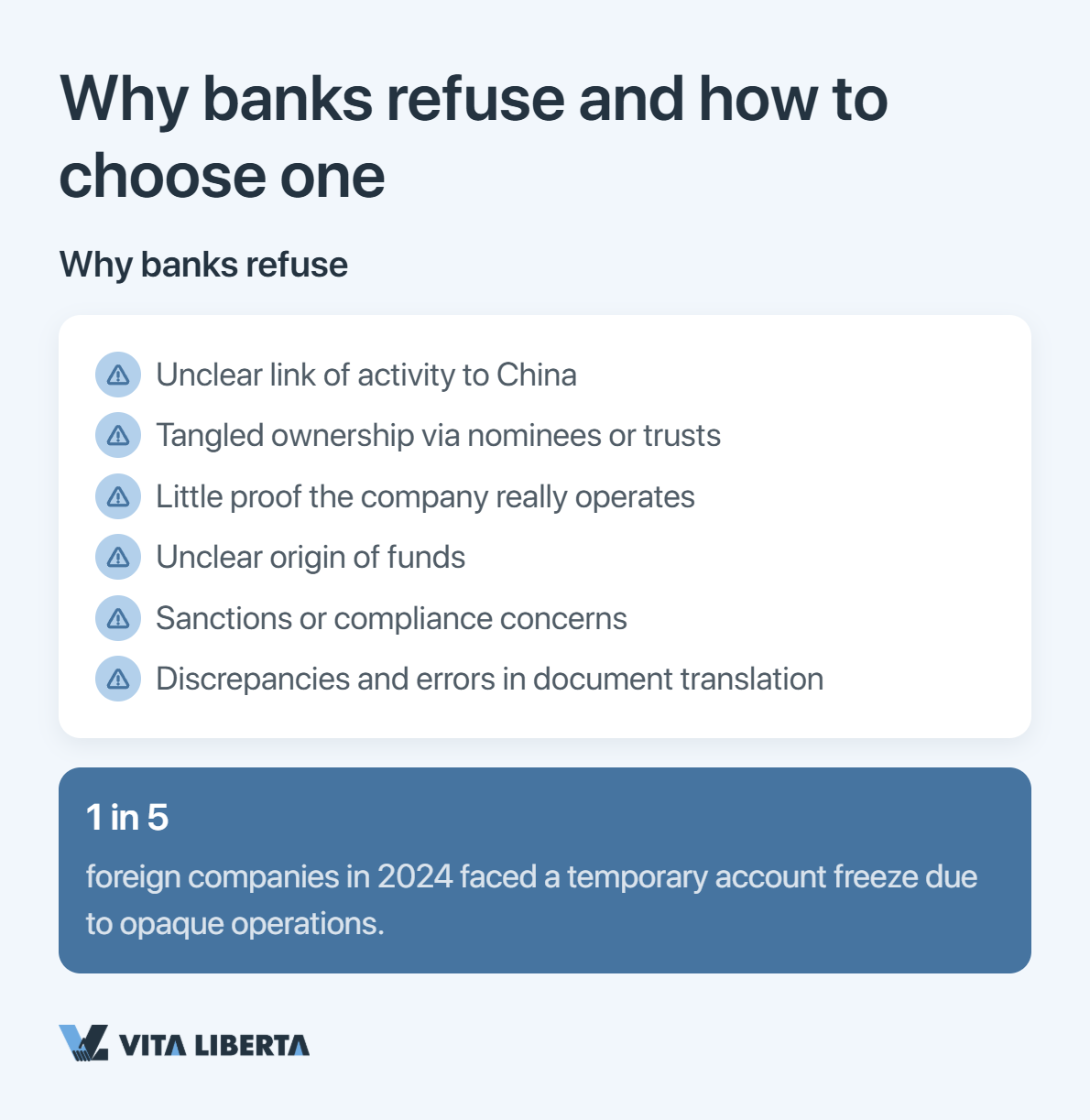
A refusal rarely traces back to one absent document. Far more often, the bank has simply concluded the risk isn’t worth taking. The recurring weak points:
- no obvious operational link to China;
- ownership obscured behind nominees or trust structures;
- thin evidence of genuine trading activity;
- funds whose origin can’t be established;
- sanctions or compliance exposure;
- discrepancies or sloppy work in the translated paperwork.
“A bank doesn’t approve a document package — it approves a clear business logic. When the applicant explains upfront where the money comes from and why they need an account here specifically, the review speeds up several times over,” notes Andrey Lagutin, partner in the China business-support practice.
Market estimates put roughly one in five foreign companies through a temporary account freeze during 2024, triggered by transactions the bank couldn’t read. The lesson for the post-opening period: refresh documents on schedule and be ready to evidence the purpose behind large payments.
Picking the right bank
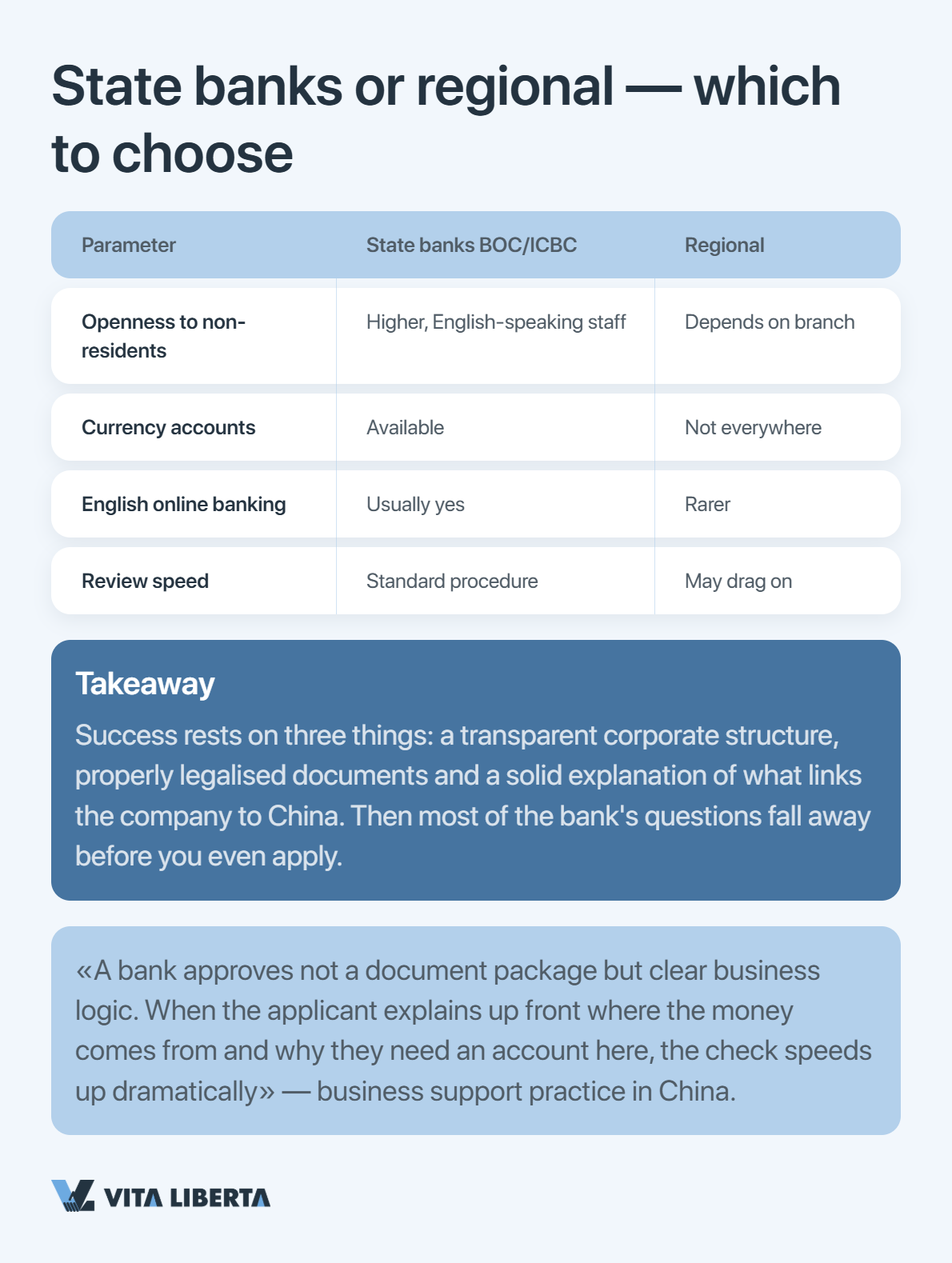
Institutions diverge on three fronts — appetite for non-resident clients, breadth of foreign-currency products, and how quickly applications move. Starting with the large banks that have already built up a foreign client base is the lower-risk approach.
| Parameter | Large state banks (BOC, ICBC) | Regional banks |
| Openness to non-residents | Higher; English-speaking staff available | Depends on the branch |
| Foreign-currency accounts | Available | Not everywhere |
| English online banking | Usually yes | Less often |
| Processing speed | Standard procedure | May drag on |
Match the bank to your company’s jurisdiction and transaction profile — brand recognition alone is a poor selection criterion.
Takeaways
An account is achievable, but plan for a project rather than a formality. Three factors carry the outcome: an ownership structure the bank can read, documents legalized without gaps, and a persuasive account of what ties the company to China. Audit your own file and articulate the commercial purpose beforehand, and most of the bank’s questions never need to be asked.
Need a corporate account in China?
- Account opening support
- Handling foreign-exchange control
- Faster compliance approval

FAQ
Not entirely. Some banks will accept an application form and scans online, but the account can only be activated after the representative is identified in person at a branch.
Not always. A foreign company without a registration can open an NRA account, but it must prove a real connection between its activity and the Chinese market.
The usual reference is 100 to 500 RMB. The specific figure and the minimum-balance threshold are set by the chosen bank and account category.
Typically one and a half to three months once you factor in document legalization and compliance; a resident company moves through the process far faster.
The decision turns on the risk profile: no link to China, an opaque ownership structure, or questions about the source of funds outweigh formal completeness.