Hongkong
 China
China




Hiring a specialist in mainland China means more than a salary. The moment an employment contract is signed, the company takes on the duty to contribute for that person — and those contributions can add roughly a third on top of payroll. Here is how social insurance for foreigners in China actually works, and where employers most often lose money.
When a foreign employee formally starts work in mainland China, their salary immediately enters the orbit of mandatory contributions. In logic these work much like payroll taxes: the employer calculates and remits them, and the amount is tied to the wage. A miscalculation or a missed registration leads not only to back-payments, but to real trouble when the work permit comes up for renewal. One clarification up front: this concerns mainland China only — Hong Kong and Macao run their own, lighter systems, and mainland rules do not extend to them.
What the Chinese social insurance system (Shebao) is
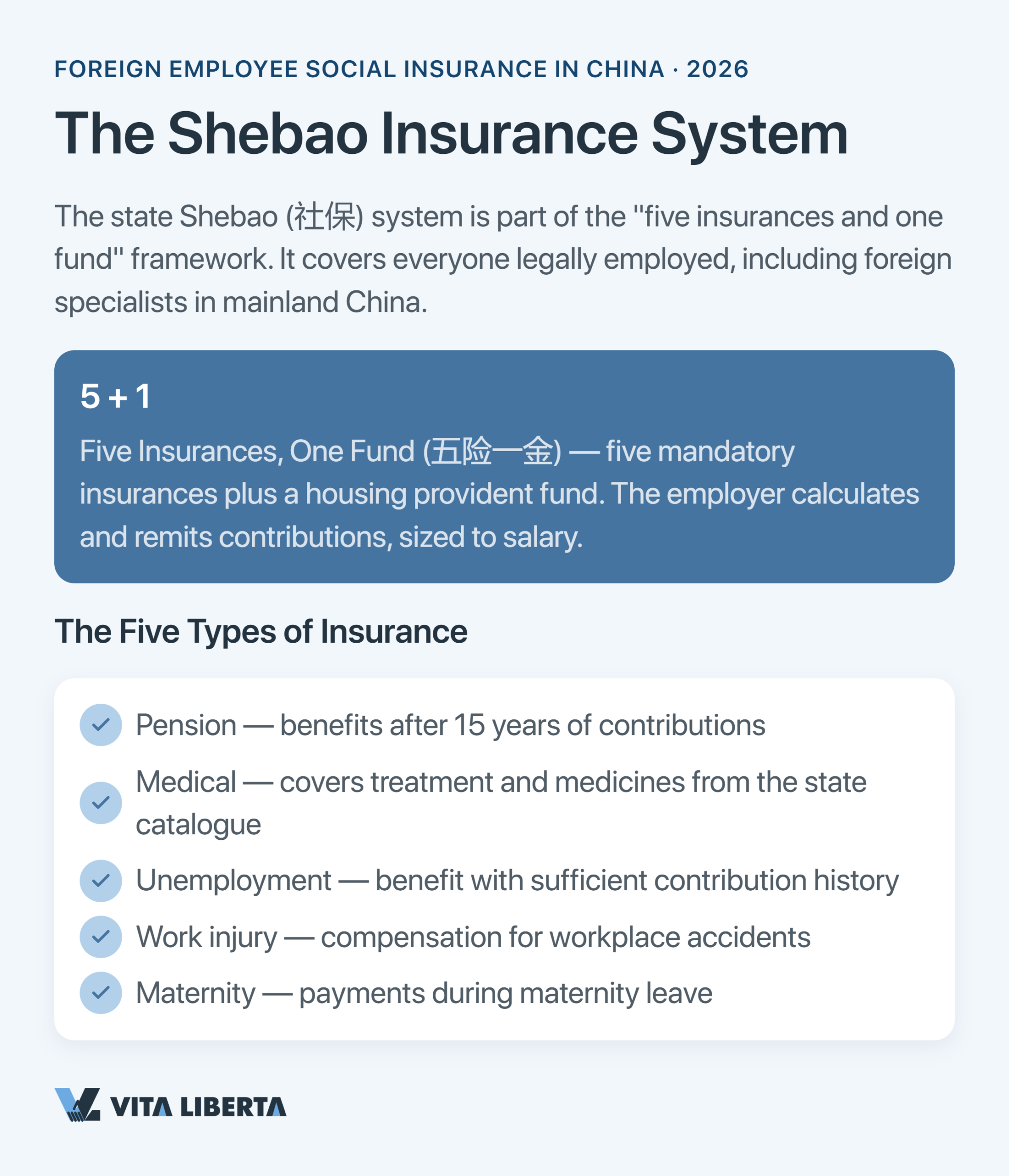
The state scheme is known as Shebao (社保) and sits inside the broader framework of the “Five Insurances and One Fund” (五险一金). It is the basic backbone of social protection, and everyone legally employed — foreign hires included — is plugged into it.
The five insurances and the housing fund
The system covers five mandatory strands:
- Pension insurance — builds the future pension, payable after 15 years of contributions.
- Basic medical insurance — partially covers treatment and drugs from an approved catalogue.
- Unemployment insurance — entitles the holder to a benefit given sufficient contribution history.
- Work-related injury insurance — compensation for workplace accidents.
- Maternity insurance — payments and cost coverage during maternity leave.
The sixth element is the Housing Provident Fund (公积金) — and here is an important nuance.
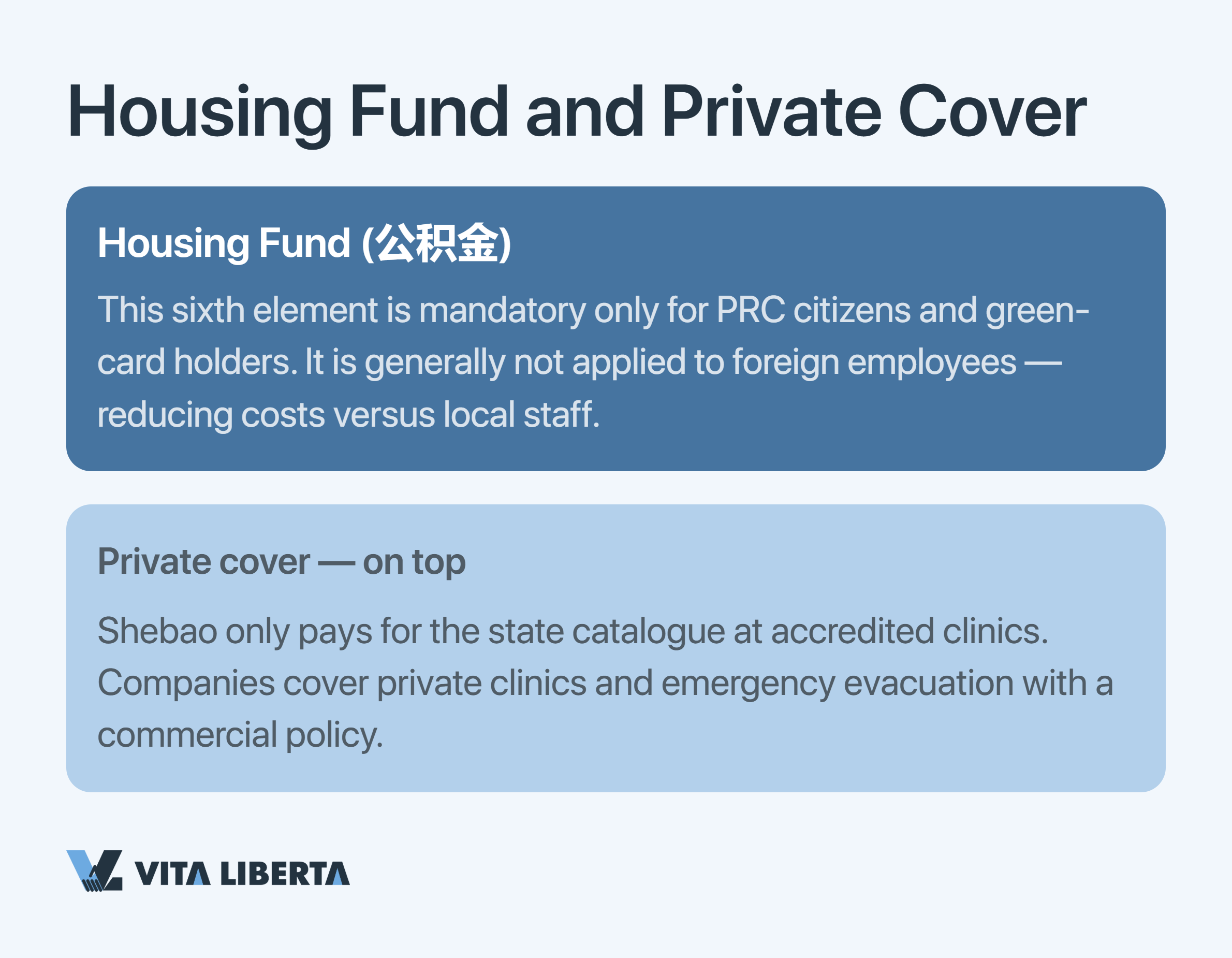
⚠️ Contributions to the Housing Provident Fund are mandatory only for PRC nationals and “green card” holders. A foreign employee is generally not enrolled in it — which lowers the total load compared with local staff.
Unclear on contributions for expats?
- Check if contributions are due
- Totalization treaties factored in
- Contribution amounts calculated

How Shebao differs from voluntary private cover
Shebao is a compulsory state mechanism, rigidly tied to salary and administered by local authorities. A private policy is voluntary and closes the gaps the state system does not pay for. For a foreigner this matters most on the medical side: reimbursement works only through the public catalogue and at accredited institutions; private clinics and emergency evacuation are usually excluded, and many procedures require upfront payment. That is why companies frequently add a commercial health policy on top of mandatory medical insurance for their staff.
Are foreigners obliged to pay contributions in China?
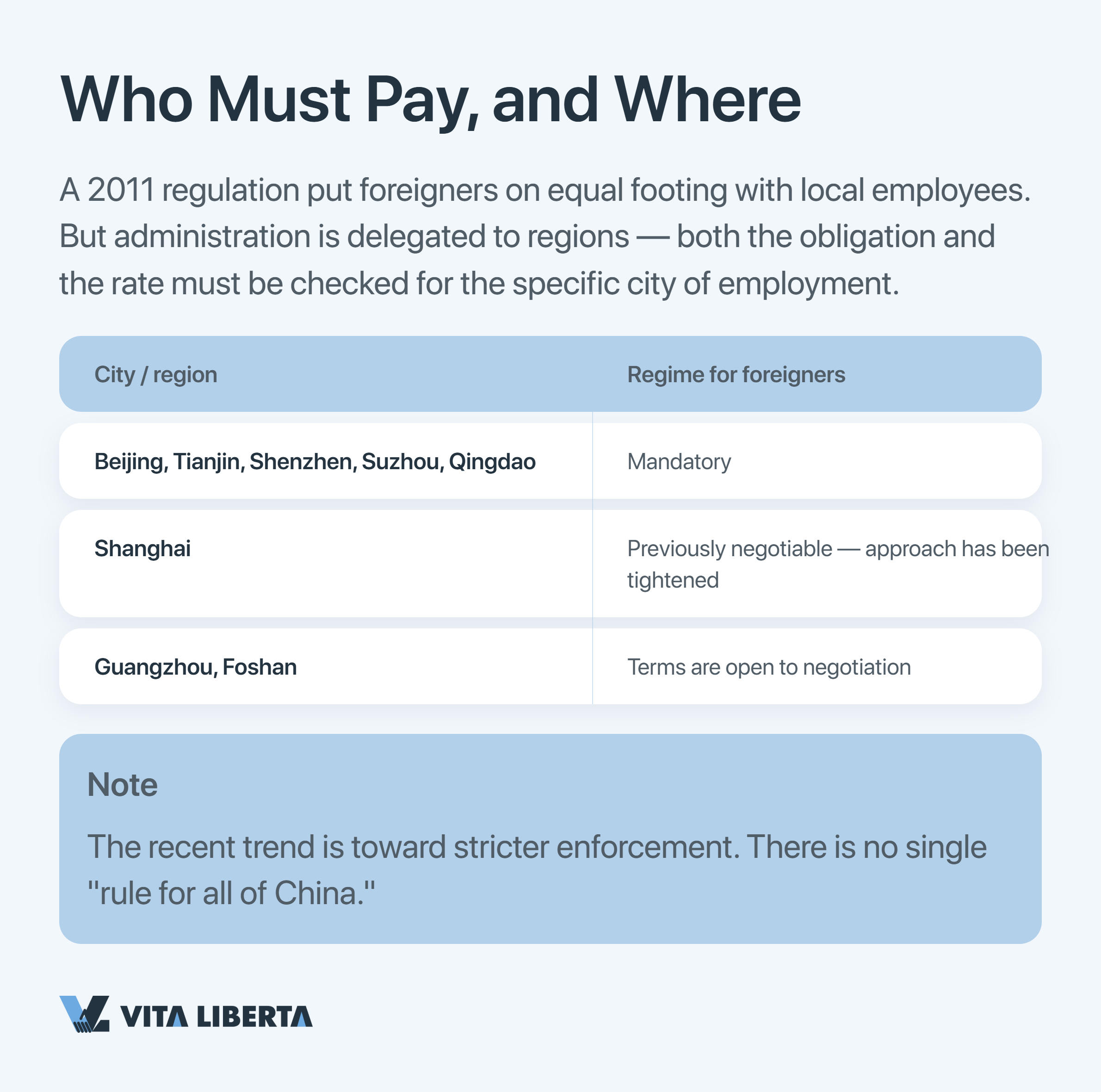
The question was settled in principle by a 2011 decree of the relevant ministry (the Interim Measures for Foreigners Employed in China to Participate in Social Insurance): foreign employees who sign a labour contract with an employer in the PRC join the system on the same footing as locals. But administration of contributions is devolved to the regional level — and that is where the discrepancies begin.
Regional differences: Beijing, Shanghai, Guangzhou and other cities
In practice, cities fall into two groups. In some, foreign participation is strictly mandatory; in others, authorities allow flexibility — though the trend of recent years is toward tightening. Rates also vary from province to province.
| City / region | Regime for foreigners |
| Beijing, Tianjin, Shenzhen, Suzhou, Qingdao | Contributions mandatory |
| Shanghai | Formerly by arrangement, since tightened |
| Guangzhou, Foshan | Terms may be discussed |
The takeaway is simple: check both the obligation and the rate against the specific city of employment, never against a “general rule for China.”
Bilateral totalization agreements
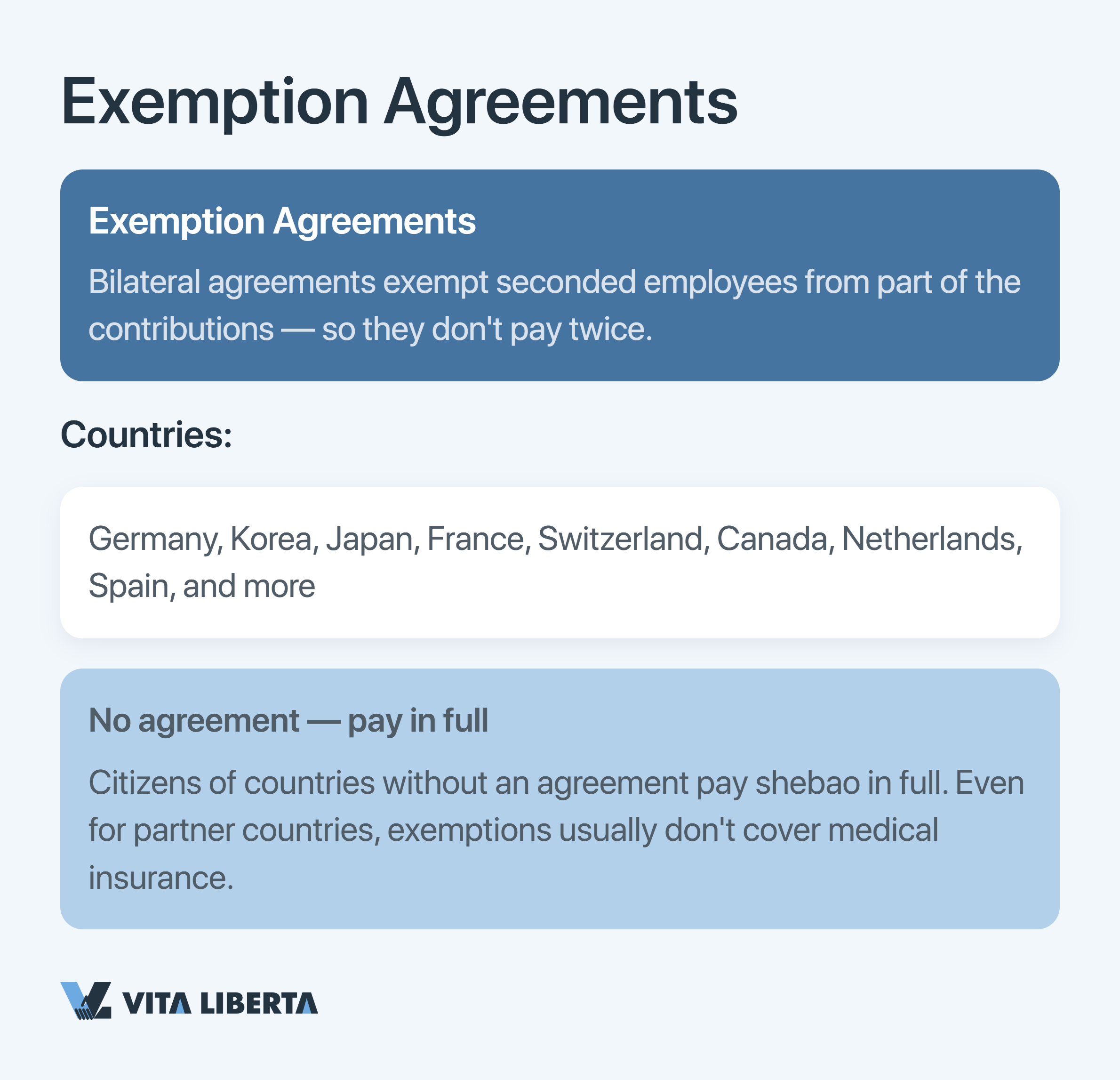
China has bilateral social security agreements that relieve seconded staff of part of the contributions, so a person does not pay twice — at home and in the PRC. Partner countries include Germany, South Korea, Denmark, Canada, Finland, Switzerland, the Netherlands, France, Spain, Japan, Serbia, Luxembourg and several others.
The exemption typically applies to secondment and not to every branch: under the agreement with Germany, for instance, pension and employment support fall under the exemption, but medical does not.
Rates and calculation for a foreign employee
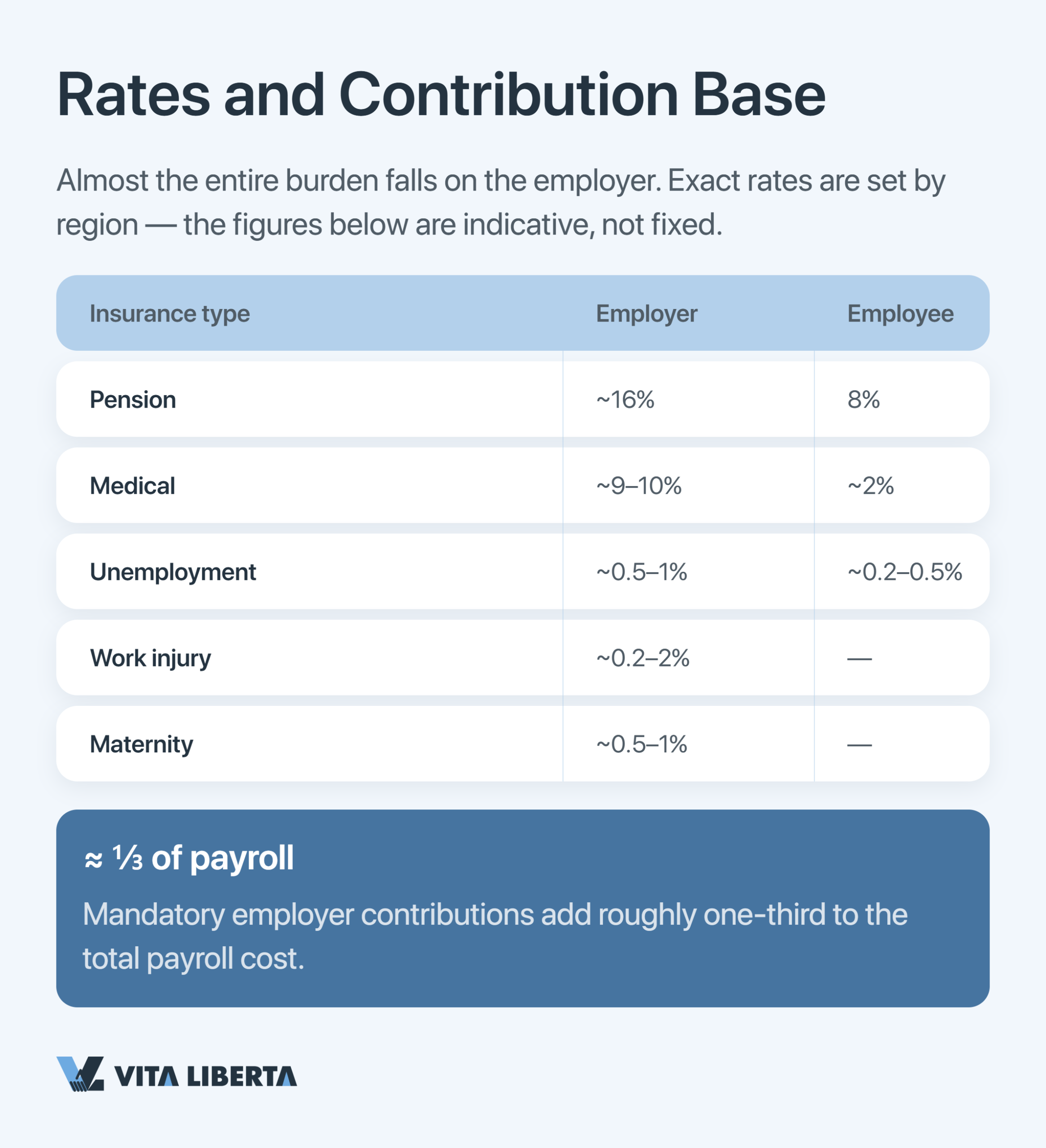
The combined load is significant, and almost all of its weight lands on the employer. Exact rates are set regionally, so the figures below are benchmarks, not fixed values.
What the employer and employee pay
| Insurance type | Employer | Employee |
| Pension | ~16% | 8% |
| Medical | ~9–10% | ~2% |
| Unemployment | ~0.5–1% | ~0.2–0.5% |
| Work injury | ~0.2–2% | — |
| Maternity | ~0.5–1% | — |
In aggregate, the mandatory employer contributions add roughly a third to payroll. The numbers are indicative: each region sets its own percentages, and some strands may be merged.
Contribution base, floor and ceiling
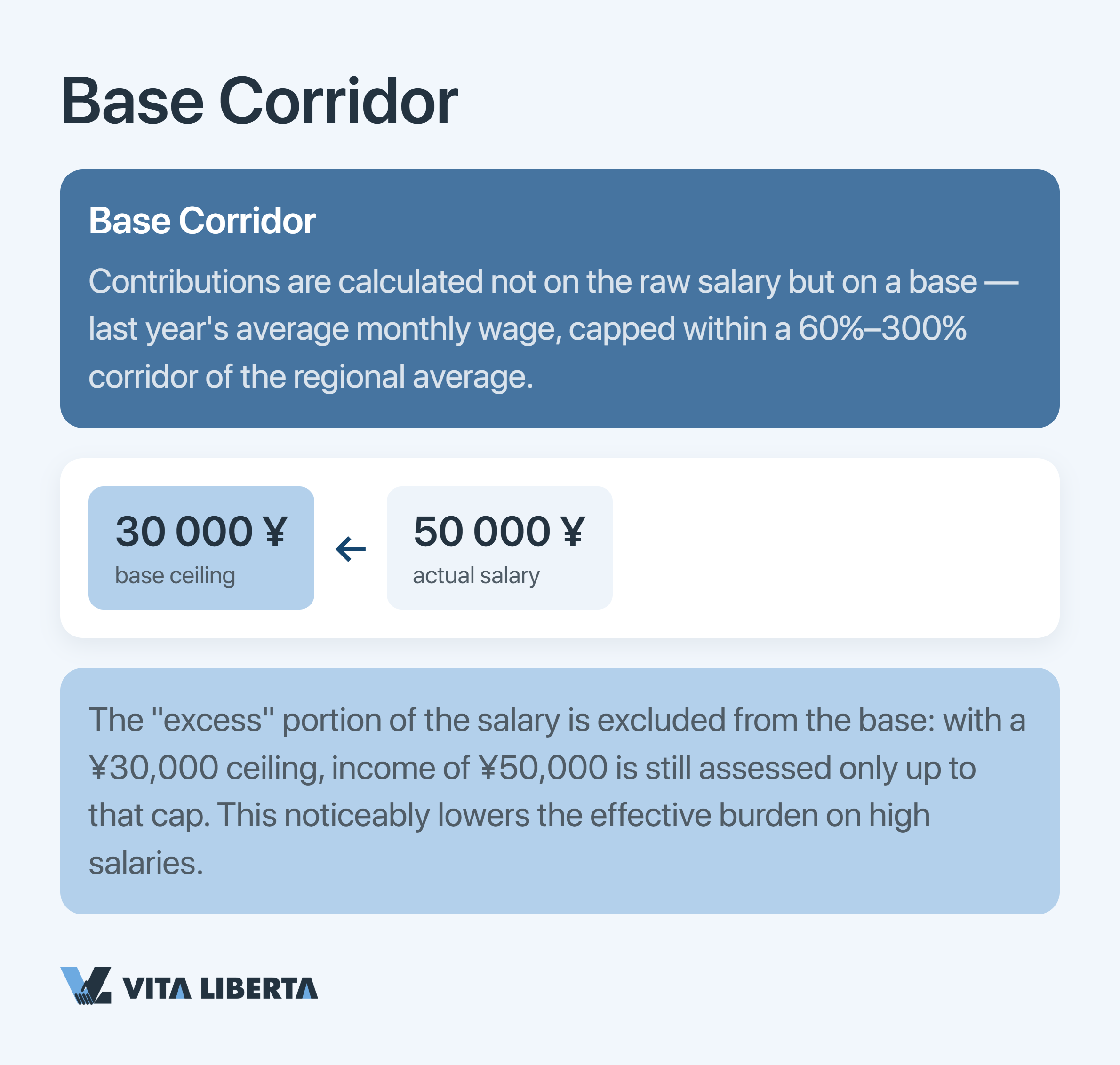
Contributions are calculated not from the bare salary but from a base — the previous year’s average monthly wage, held within a corridor. The floor is about 60% of the regional average wage, the ceiling about 300%. If someone earns a great deal, the “excess” above the ceiling drops out of the base: with a cap of, say, RMB 30,000, an income of RMB 50,000 is still charged only up to the line. This noticeably softens the effective load on high salaries.
Registration and deadlines
A hard deadline applies here. The usual order is:
- obtain the work permit for the foreign employee;
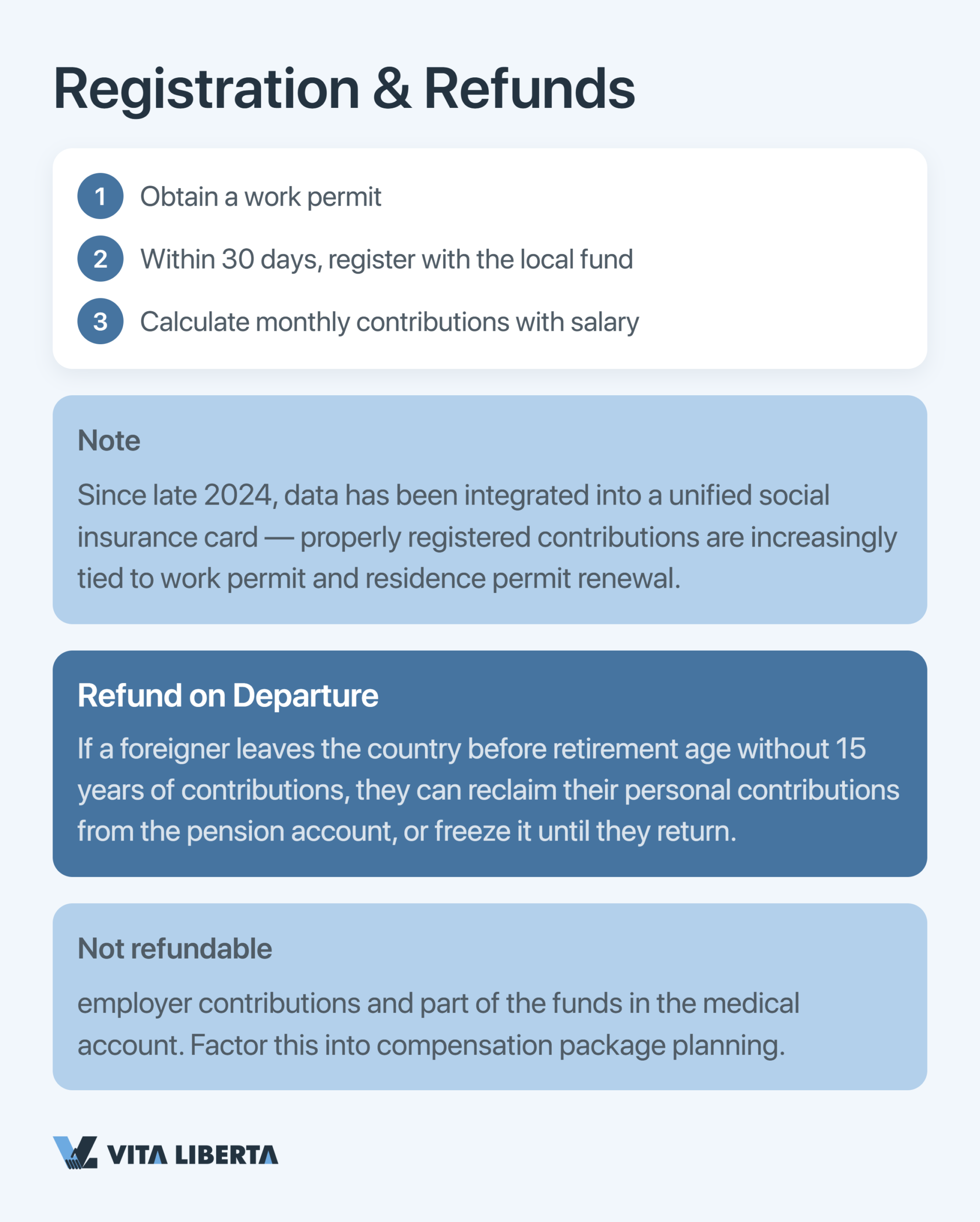
- within 30 days, register them with the local social insurance fund;
- begin monthly accrual and remittance of contributions alongside salary.
Since late 2024, foreign employees’ employment records have been integrated into a unified-format social insurance card, and the very existence of properly filed contributions is increasingly tied to work permit and residence renewal. In other words, a missed registration hits not only the company but the worker’s own status.
What each insurance covers
The benefit is genuinely practical, though with caveats for foreigners:
- Pension — available after 15 years of cumulative contributions; with less, a departing specialist usually claims a refund of the personal portion.
- Medical — pays for treatment and drugs from the state catalogue at accredited institutions.
- Unemployment — a benefit given the required continuous history.
- Work injury — compensation for occupational injury or disease.
- Maternity — cost coverage and payments during leave.
“A foreigner pays into the system on the same rules as a local employee, but doesn’t always see the return: drawing a pension or building up a benefit entitlement needs long tenure in the country. So a company should explain to the worker in advance exactly what they are contributing for,” notes Sergey Konon, foreign-trade consultant.
Refunding contributions when you leave China
If a foreigner leaves the country for good before reaching pension age and without 15 years of history, they may reclaim the personal contributions from their individual pension account. The alternative is to freeze the account and preserve the accrued period against a possible return to China.
⚠️ Only what the person paid out of their own salary comes back. Employer contributions and part of the medical account are not repatriable — worth building into any compensation-package planning.
Employer liability and common mistakes
For non-payment or late registration, a company risks back-payments, late fees and administrative penalties; the employee risks refusal of a permit renewal. Employers most often trip on the same things:
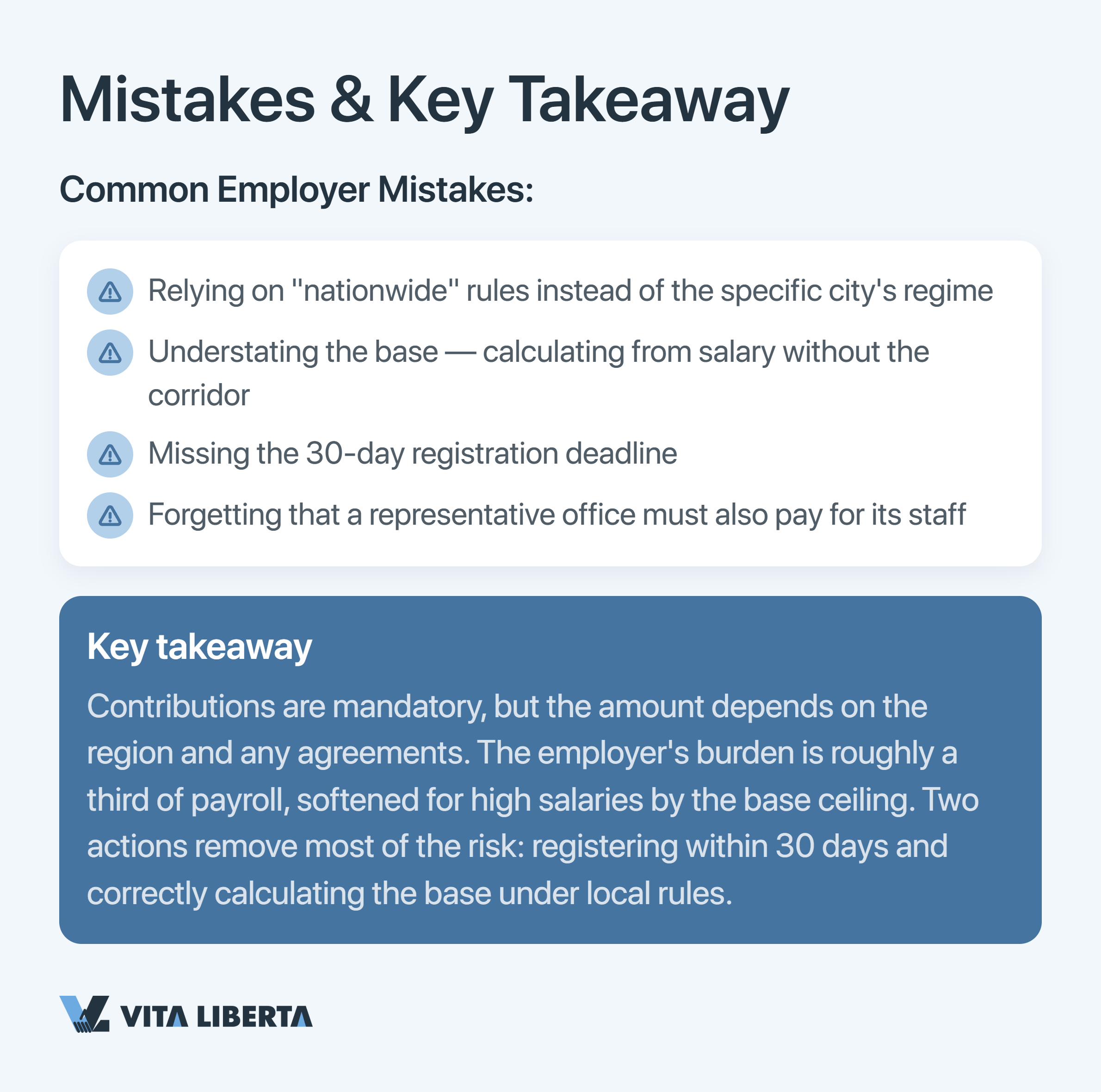
- following “all-China” rules while ignoring the specific city’s regime;
- understating the base by calculating from salary without the corridor;
- missing the 30-day registration window;
- forgetting that a foreign company’s representative office must also contribute for its staff.
Special attention goes to representative offices and small headcounts: that is exactly where accrual and withholding are most often done “by eye,” which creates the main risk.
The essentials on contributions for foreigners in the PRC
Social insurance for foreign employees in China is mandatory, but its size — and the obligation itself — depend on the region and on whether a bilateral agreement applies. The employer’s load is around a third of payroll, while the base ceiling softens the hit on high salaries. Most of the risk is removed by two actions: timely registration within 30 days, and a correct base calculation under the rules of the specific city.
Need help with PRC social insurance?
- Register staff in the system
- Contribution calculation and payment
- Avoid penalties for breaches
FAQ
Yes. If the home country is not among those covered by a bilateral totalization agreement, full Shebao is paid for that employee under the rules of the city of employment.
As a rule, no. The Housing Provident Fund (公积金) is mandatory only for PRC nationals and green-card holders; a foreign employee is not enrolled in it.
Within 30 days of the employee obtaining their work permit. Missing this brings penalties and complicates renewal of work documents.
On a permanent departure before pension age with under 15 years of history, the personal share of pension contributions is refunded. Employer contributions are not repatriated; the account can alternatively be frozen.
No. Both the rates and whether foreigners must participate differ by city and province, so terms are checked against the specific place of employment.