Hongkong
 China
China





Where employment law in most markets tries to balance the two sides, mainland China’s tilts toward the worker by design. The practical consequence for a foreign employer is blunt: paperwork that slips by a few weeks converts into a wage bill twice the size. This guide walks through what the law expects of you, in the order you will actually encounter it.
Who is allowed to put staff on payroll
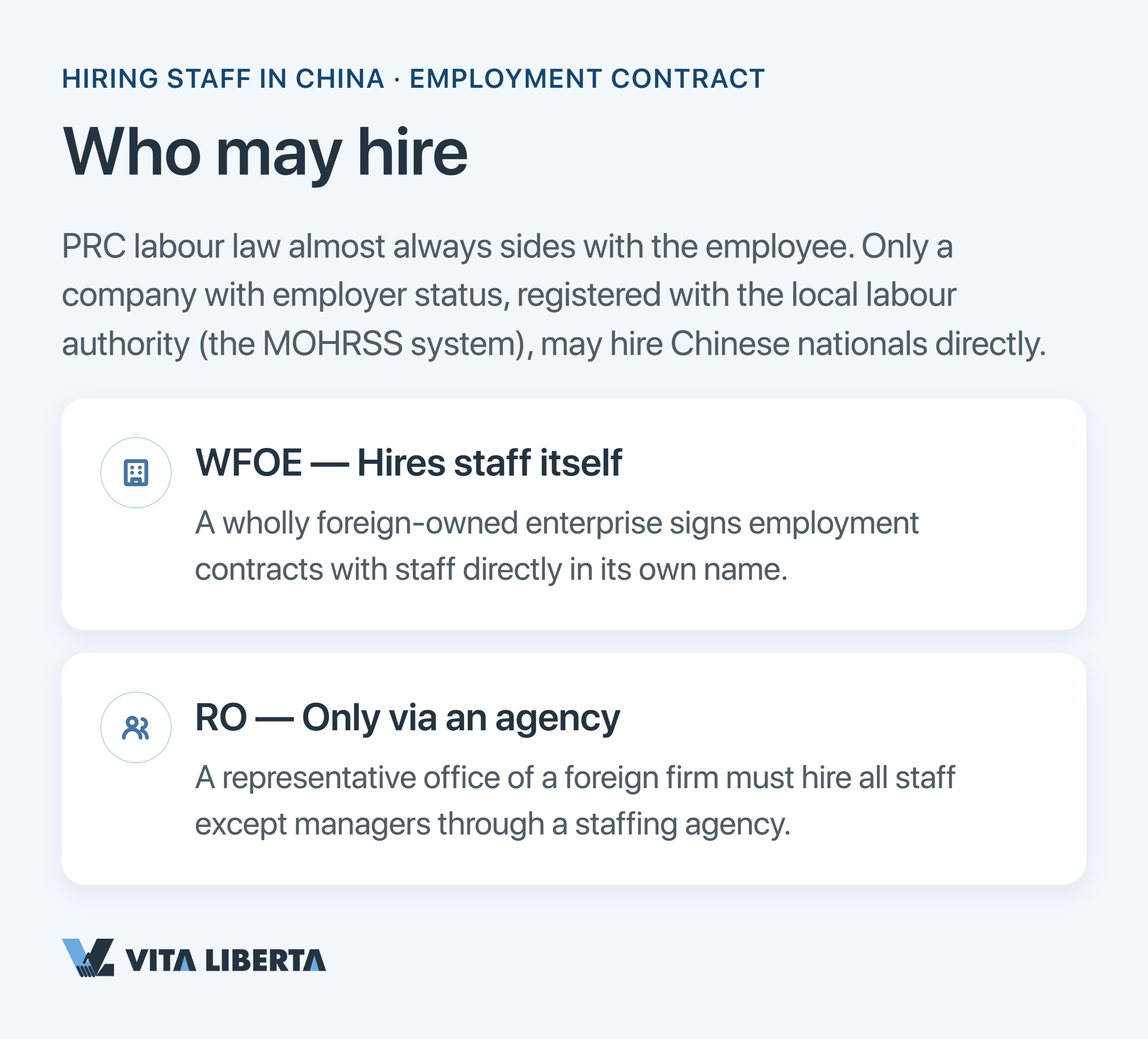
Hiring a mainland Chinese national directly requires employer status — and not every foreign presence has it. A Wholly Foreign-Owned Enterprise (WFOE) qualifies once it is registered with the labour bureau in its city under the MOHRSS system. A representative office does not. Beyond its own chief representatives, an RO cannot sign a single employment contract; every hire has to sit on the books of a licensed HR or labour-dispatch provider instead. The distinction is worth internalising early, because it shapes the entire hiring model: WFOE means direct employment, RO means an intermediary in every arrangement.
Getting the contract right
No employment relationship in mainland China can exist without a contract behind it — and the form you pick carries consequences years down the line.
The three formats
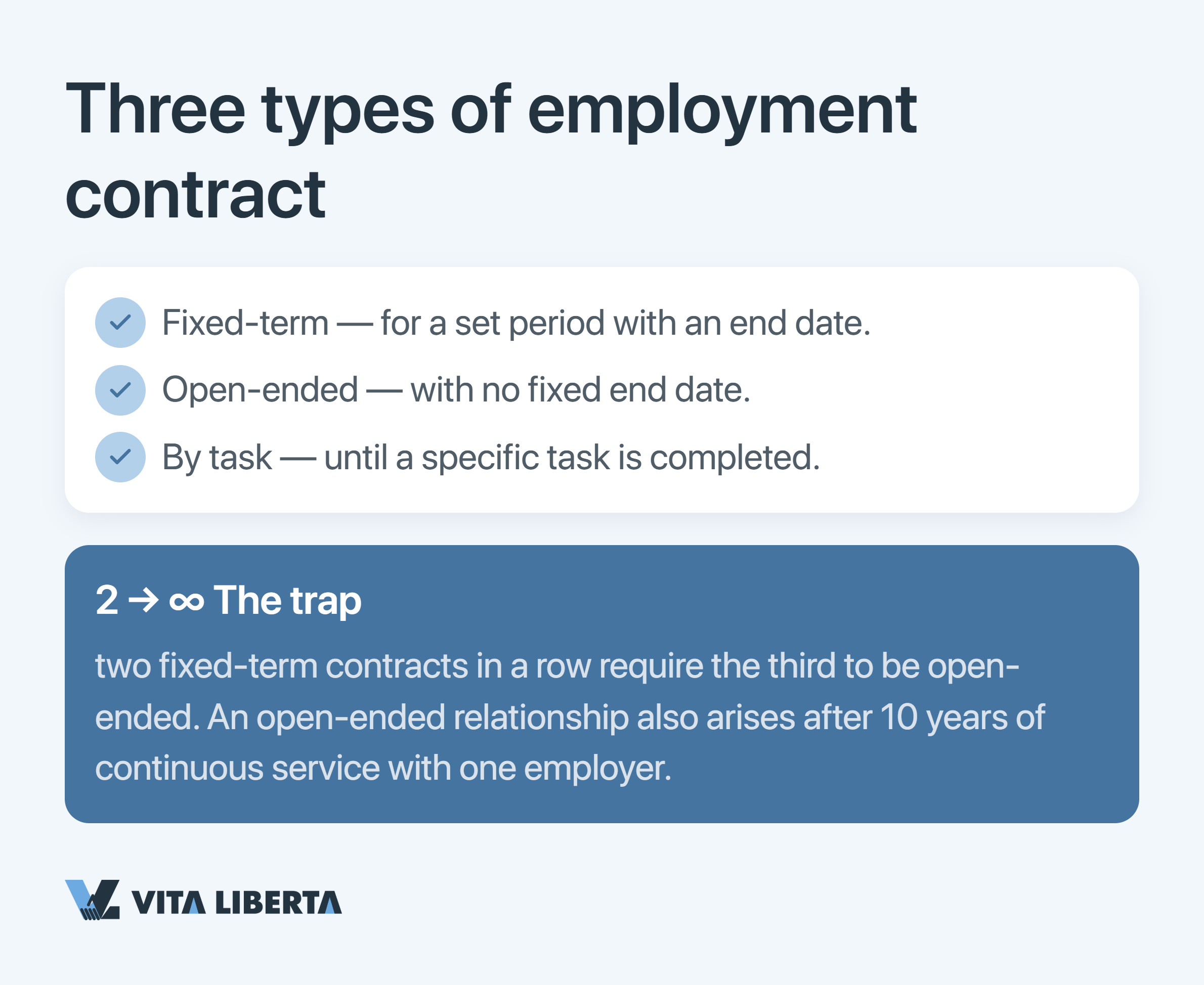
Three options are available: a fixed-term contract, an open-ended one, and a project-based contract that runs until a defined body of work is finished. Watch what happens on renewal. Sign a fixed-term contract with the same person twice in a row, and the law removes your choice on the third — it must be open-ended. The same outcome arrives automatically after ten years of unbroken service with a single employer. Neither trigger requires the employee to ask for it.
What the document must contain
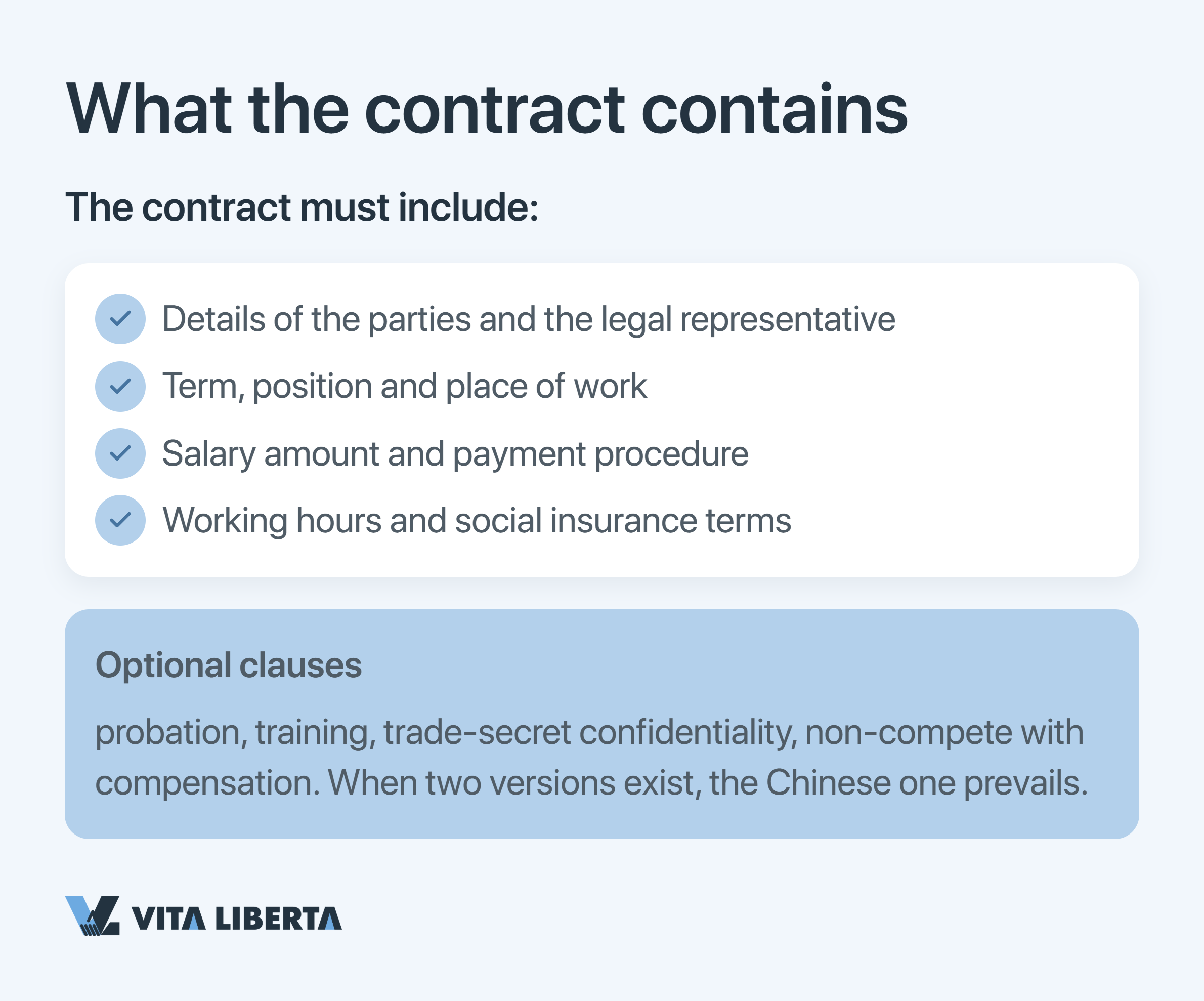
Four blocks are non-negotiable:
- identification of both parties, including the company’s legal representative;
- duration, job title and place of work;
- the salary figure and how it will be paid;
- working hours and social-insurance arrangements.
Beyond that, employers commonly add probation terms, training obligations, trade-secret confidentiality and a non-compete — bearing in mind that a non-compete only bites if the company pays compensation after the employee leaves. One more point that decides disputes: when English and Chinese texts sit side by side, the Chinese wording usually governs. Review that version, not the one your head office finds easier to read.
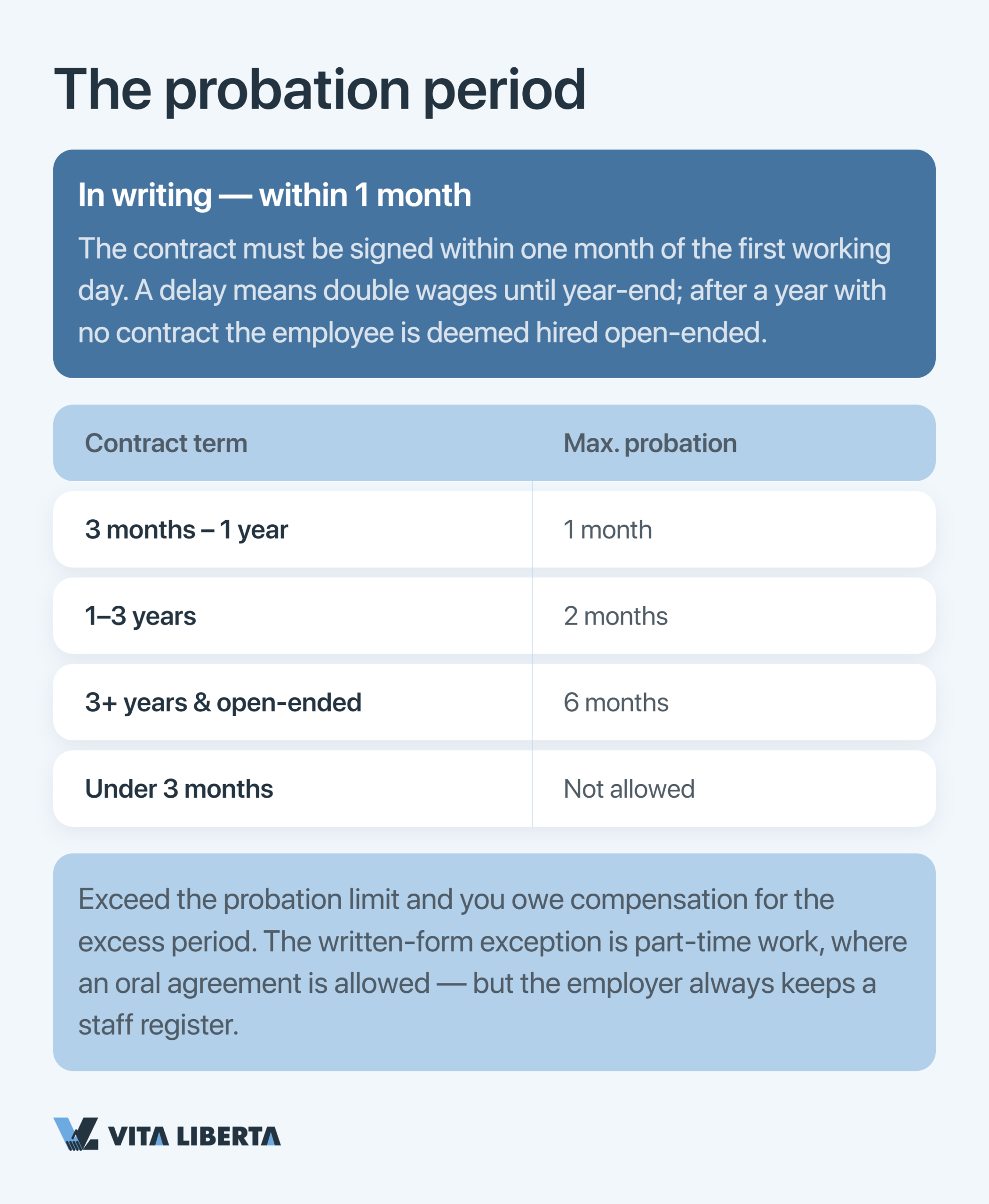
⚠️ The deadline that costs the most: you have one month from day one on the job to get a signed written contract in place. Overshoot it, and double wages are owed for the remainder of the first year. Let a full year pass with nothing signed, and the employee is treated as having been on an open-ended contract all along. Part-time engagements are the sole carve-out — there, a verbal arrangement holds. Separately, an employee register has to be maintained throughout.
Planning to hire staff in China?
- Contract compliant with PRC law
- Mandatory contributions calculated
- Employer duties covered

How long probation can run
Probation is not a matter of negotiation; it scales with the length of the contract.
| If the contract runs for… | Probation cannot exceed |
| 3 months to 1 year | 1 month |
| 1 to 3 years | 2 months |
| 3 years or more, or open-ended | 6 months |
| Less than 3 months | None permitted |
Where an employer stretches probation past the cap, compensation is due for every day served beyond it.
What lands on payroll every month
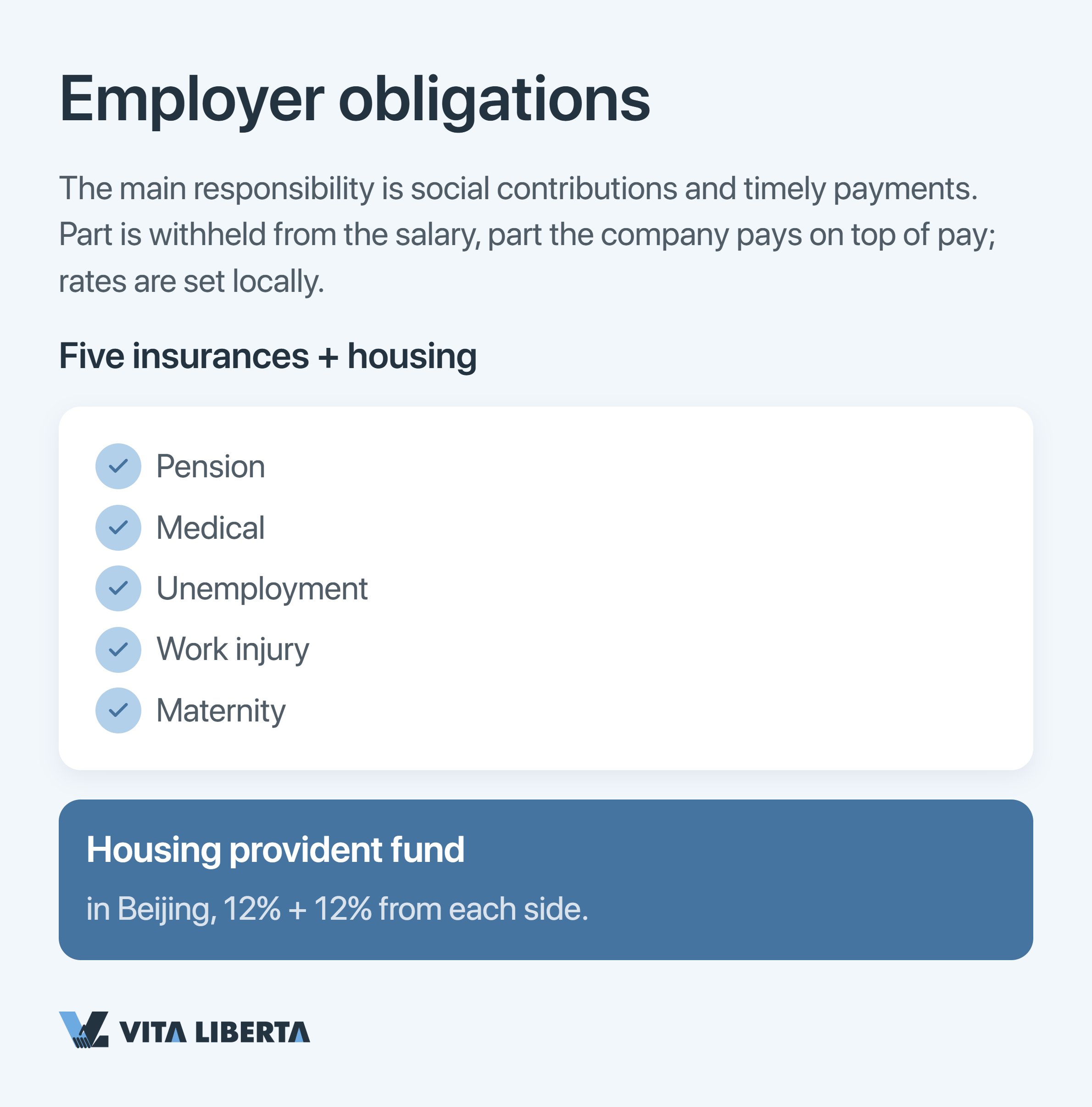
Six line items attach to every salary. Five are insurance — retirement, healthcare, unemployment cover, injury-at-work and maternity — and the sixth is the housing provident fund. Beijing splits that fund evenly at 12% per side, which is a useful benchmark but not a national figure: each municipality publishes its own rates and its own contribution floor and ceiling. Employees carry part of the burden through payroll deduction, employers carry the rest as a cost sitting above the headline salary. Budget for the spread — the same hire costs materially different amounts in Shanghai and Chengdu.
What an employee actually costs
The salary you negotiate is not the salary you pay. Employer-side contributions typically add somewhere between a quarter and just over 40% on top, depending on the city and on how the housing fund percentage is set. On a CNY 20,000 monthly salary, that is roughly the difference between a CNY 25,000 and a CNY 28,000 monthly outlay — enough to change a hiring plan for a team of ten.
Three variables drive the number:
- The contribution base, not the salary. Contributions are calculated on a base derived from the employee’s average monthly income over the previous calendar year, subject to a local floor and ceiling. A high earner stops accruing contributions once the ceiling is reached; a low earner is assessed on the floor even if actual pay sits below it. First-year hires are generally assessed on their starting salary.
- The city. Beijing, Shanghai and Shenzhen all run their own rate schedules and their own base limits, revised annually. Shenzhen has historically sat at the lighter end for employers, Beijing and Shanghai at the heavier end — but the ordering shifts as local rules are updated, so verify current figures with the relevant municipal bureau rather than working from a table found online.
- The housing fund percentage. This is the one genuinely adjustable component. Municipalities set a permitted band, and companies choose where inside it to sit. Some foreign employers deliberately contribute above the minimum, because a higher housing fund is one of the more effective retention levers in first-tier cities.
⚠️ Do not try to engineer the base down. Structuring part of the pay as reimbursements, or agreeing a lower contribution base with the employee, is a standard finding in labour inspections. The employee’s written consent does not make it valid: arrears, late-payment interest and — where the employee resigns over it — severance all remain payable. Underpayment discovered during due diligence for financing or an acquisition has also derailed more than one deal.
Wages, hours, time off
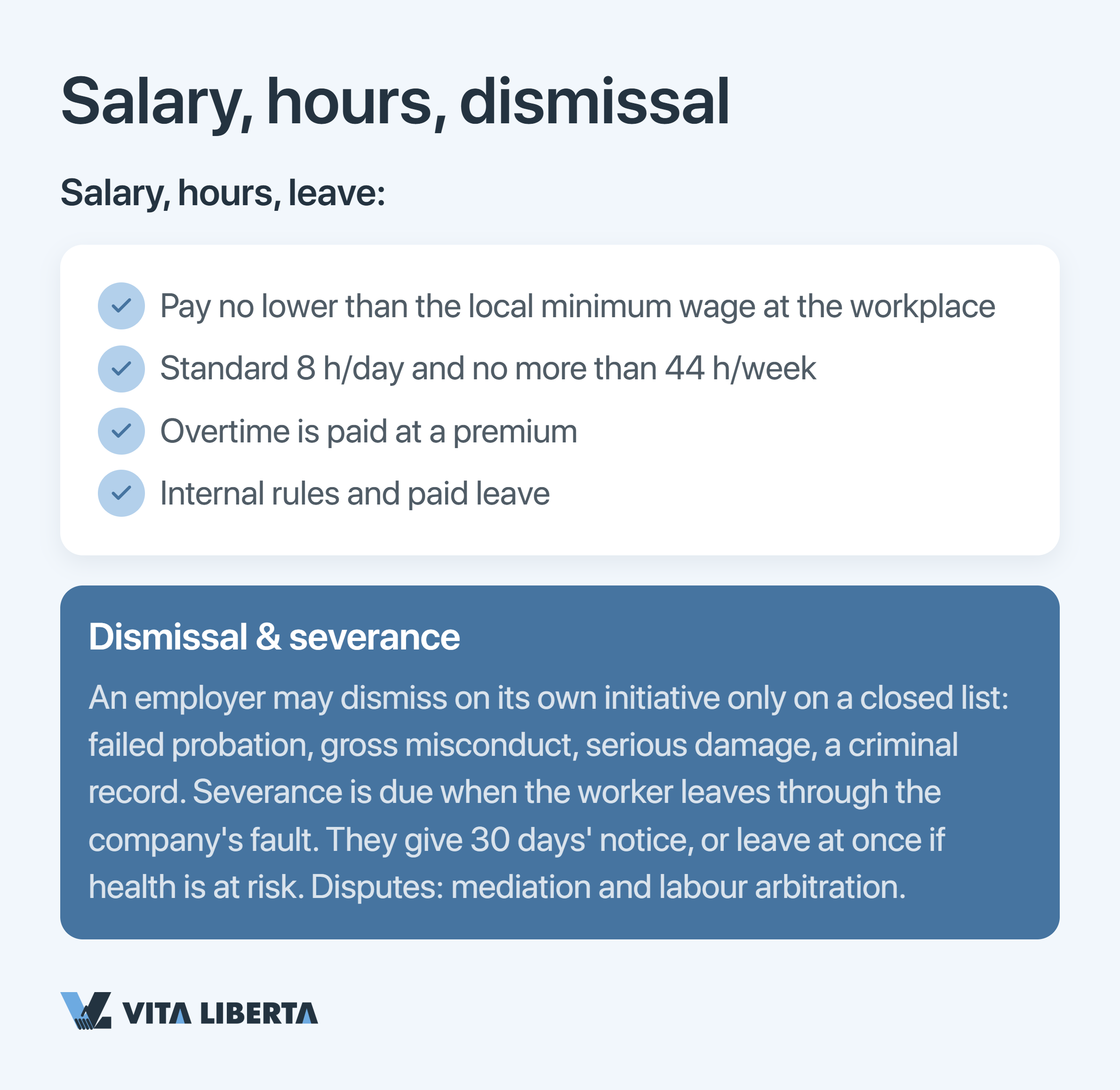
Pay cannot dip below the minimum wage set for the location where the work is performed. The default working pattern is eight hours a day and a ceiling of 44 hours a week, with overtime paid at a premium. Employers are also expected to issue internal work rules and provide paid annual leave.
Ending the relationship
Employer-initiated termination is confined to a closed list of grounds — failed probation, serious breach of discipline, substantial damage caused to the company, or a criminal conviction. Nothing outside that list qualifies unilaterally.
Severance is where foreign managers most often misread the statute. It is not limited to dismissals: an employee who walks out because the company defaulted — unpaid salary, contributions never remitted, conditions that endangered them — leaves with severance owed. A voluntary resignation on ordinary terms runs on a 30-day notice period, but that period disappears the moment forced labour or a health risk is in play; the employee can stop working the same day. Unresolved cases go to mediation first, then to labour arbitration.
Using a dispatch provider instead
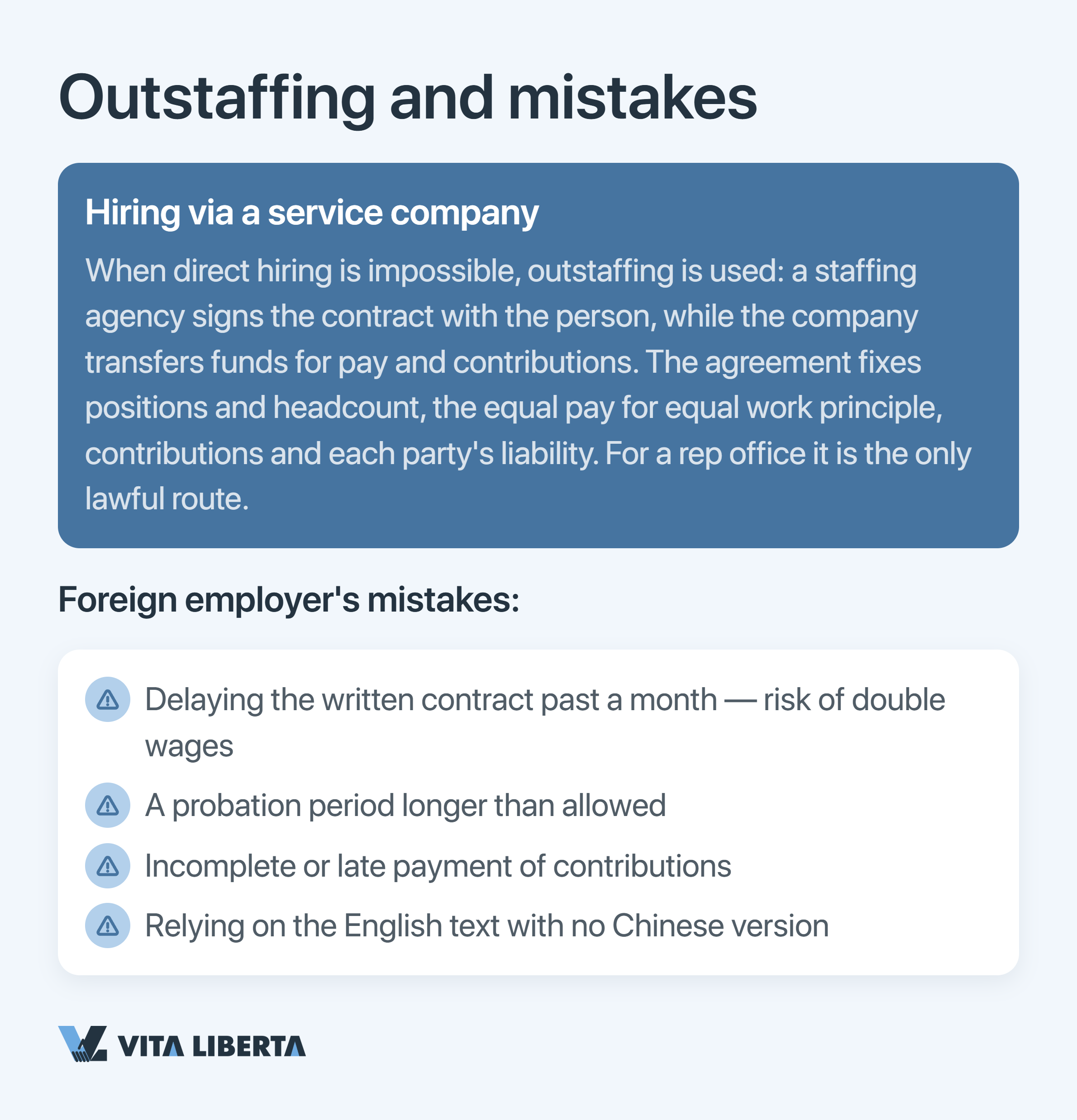
When direct employment is off the table or simply impractical, labour dispatch fills the gap. The agency becomes the contractual employer; your company transfers the money covering salary and contributions. The service agreement should nail down headcount and positions, equal pay for equal work, who remits which contributions, and how liability is split. For a representative office, this is not one option among several — it is the only lawful route to rank-and-file staff.
Where foreign employers usually slip
- letting the written contract drift past the one-month mark, and inheriting the double-wage exposure;
- writing a probation period longer than the contract length permits;
- underpaying or late-paying social contributions, or assessing them on an artificially low base;
- treating the English draft as the operative text, with no controlling Chinese version behind it.
“Foreign companies rarely lose labour cases in China because they acted in bad faith. They lose because nobody read the fine print. The default assumption favours the employee — sign late and you pay twice. Get the file finished before anyone starts work, not after.”
— Sergey Konon, China labour-law consultant
Four things carry the whole structure: a signed contract inside the first month, probation within the cap, contributions paid in full on the correct base, and dismissal only on listed grounds. Miss one and the outcome is fairly predictable — the law leans the other way. Have the Chinese contract drafted, the HR file assembled and the true monthly cost modelled before the start date, and none of this turns into a surprise.
Note on jurisdiction: everything above governs mainland China. Hong Kong and Macau run separate legal systems — Hong Kong employment falls under the Employment Ordinance, with a different set of mandatory contributions (MPF, not the mainland’s five insurances and housing fund). Build the terms around wherever the person actually works.
Ready to put staff on payroll?
- Turnkey HR support
- Payroll and contribution calc
- Protection from labour disputes
FAQ
Sign it in writing within one month of the employee’s first working day. Record the job title, pay, term, working hours and grounds for termination. Missing the written contract exposes the employer to penalties and back-pay owed to the worker.
The company must conclude the contract, pay at least the local minimum wage, remit social contributions, withhold individual income tax and observe working-hour limits. Breaches lead to fines and disputes.
Yes. Social insurance and the housing fund are an unavoidable part of the cost of an employee, and the amount depends on the city. For foreign employees the participation rules can differ, so confirm them for the specific province.
Not directly — official employment requires a registered structure such as a WFOE. As a workaround, local providers take the worker onto their own payroll and second them to your project (labour dispatch / EOR).
No, they are different legal systems. Mainland legislation regulates contracts and social contributions in detail, whereas Hong Kong’s rules are more flexible with a different structure of mandatory contributions. Build hiring terms around the jurisdiction where the staff work.