Hongkong
 China





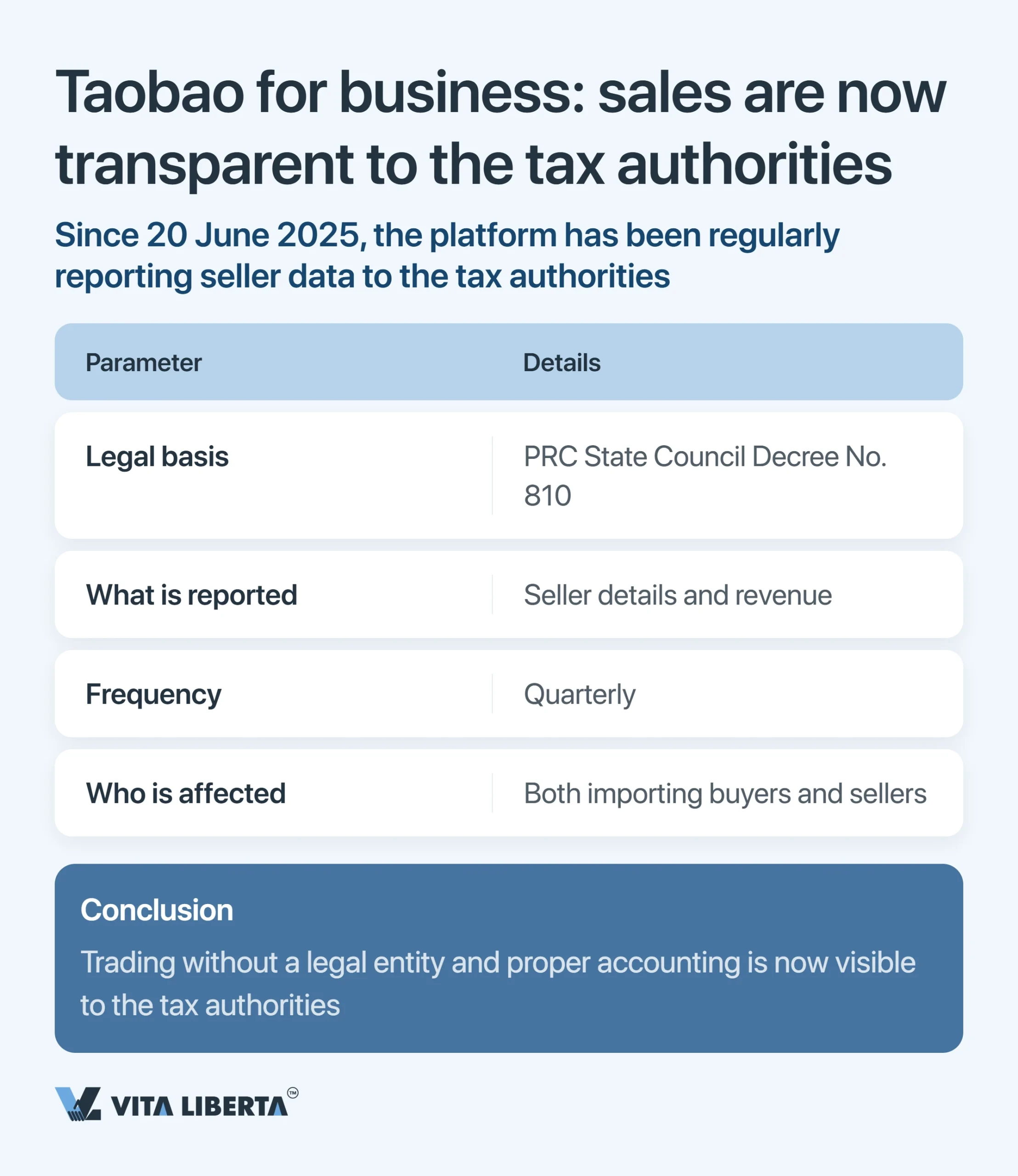
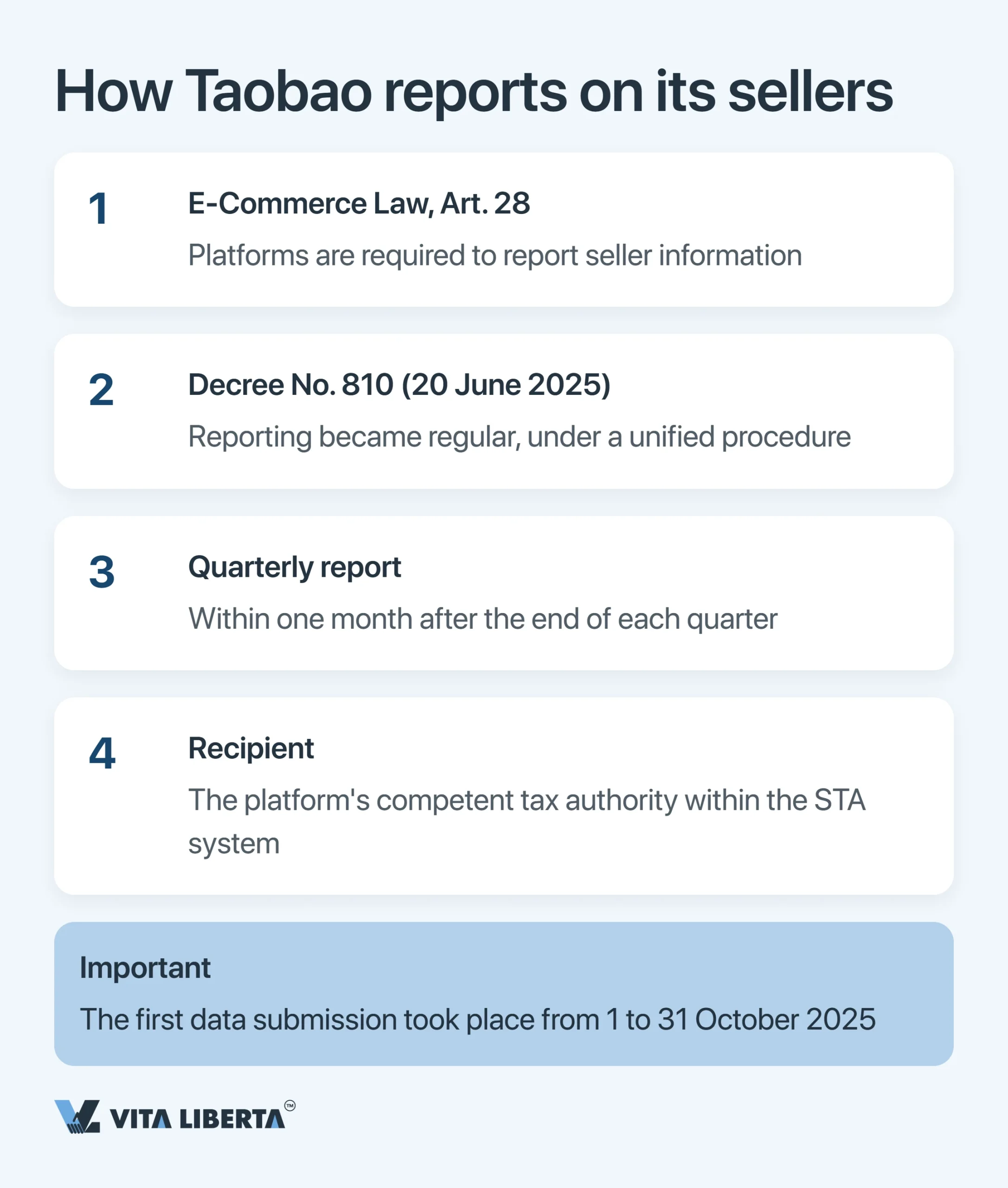
The duty itself isn’t new. Article 28 of the PRC E-Commerce Law (电子商务法) already told platforms to pass seller information to the tax authorities. Until mid-2025, though, there was no single procedure and no fixed schedule. State Council Order No. 810 on tax information reporting by internet platforms (互联网平台企业涉税信息报送规定, 国务院令第810号), in force since 20 June 2025, made it routine. Within one month after a quarter closes, the platform sends its tax office, which sits under the State Taxation Administration (STA, 国家税务总局), each seller’s identity details and revenue for that quarter. The first upload ran from 1 to 31 October 2025, under the procedure set by 国家税务总局公告2025年第15号. You can deal with Taobao from either side, as a buyer or as a seller. Either way, the tax office can now see a set-up that runs without a legal entity or bookkeeping.
Taobao, Tmall or 1688: Matching the Platform to the Job
All three belong to Alibaba Group, headquartered in Hangzhou, Zhejiang province. They work differently, though, depending on whether you’re buying or selling. Don’t pick the cheapest storefront. Pick the one whose model fits the size of your batch.
| Platform | Model and batch size | In practice / risk |
| Taobao (淘宝) | C2C retail, no minimum order | Good for samples. Check who you’re dealing with: many sellers resell rather than manufacture. |
| 1688 | B2B wholesale for the domestic market, orders from one pack | Lower prices, but goods usually ship only within the mainland, so you’ll need a forwarder. |
| Tmall (天猫) | B2C, official brand stores | Lowest risk of fakes. For sellers, the highest entry bar. |
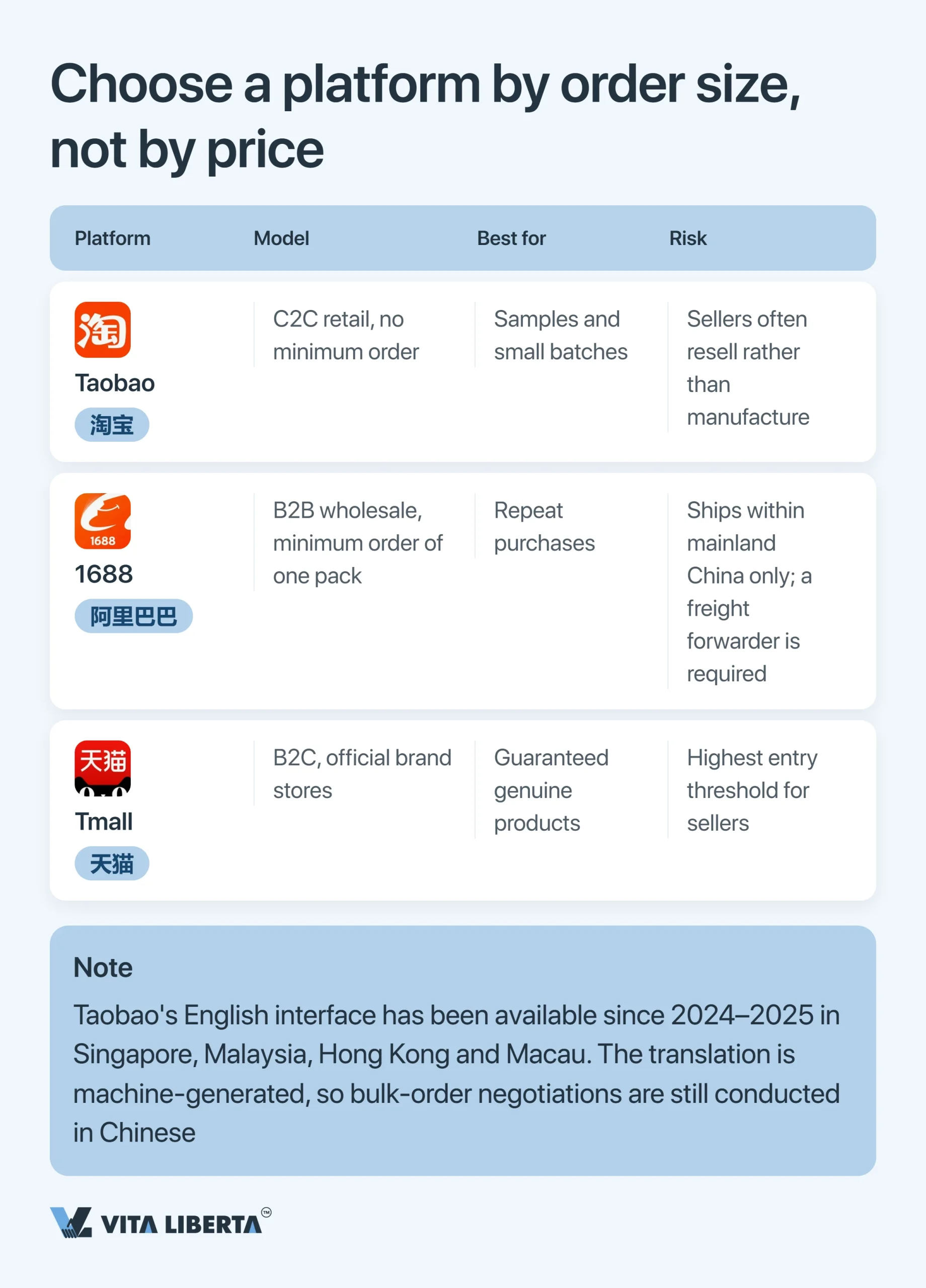
The language barrier is getting lower. In September 2024 the Taobao app added an official English interface in Singapore and Malaysia, and in February 2025 it reached Hong Kong and Macau. The translation is machine-generated, including product descriptions and reviews. That isn’t good enough for negotiating a batch, so those talks still happen in Chinese.
Bottom line: use Taobao to check a product and buy small lots, and 1688 for repeat orders.
Buying on Taobao: Where Your Margin Leaks
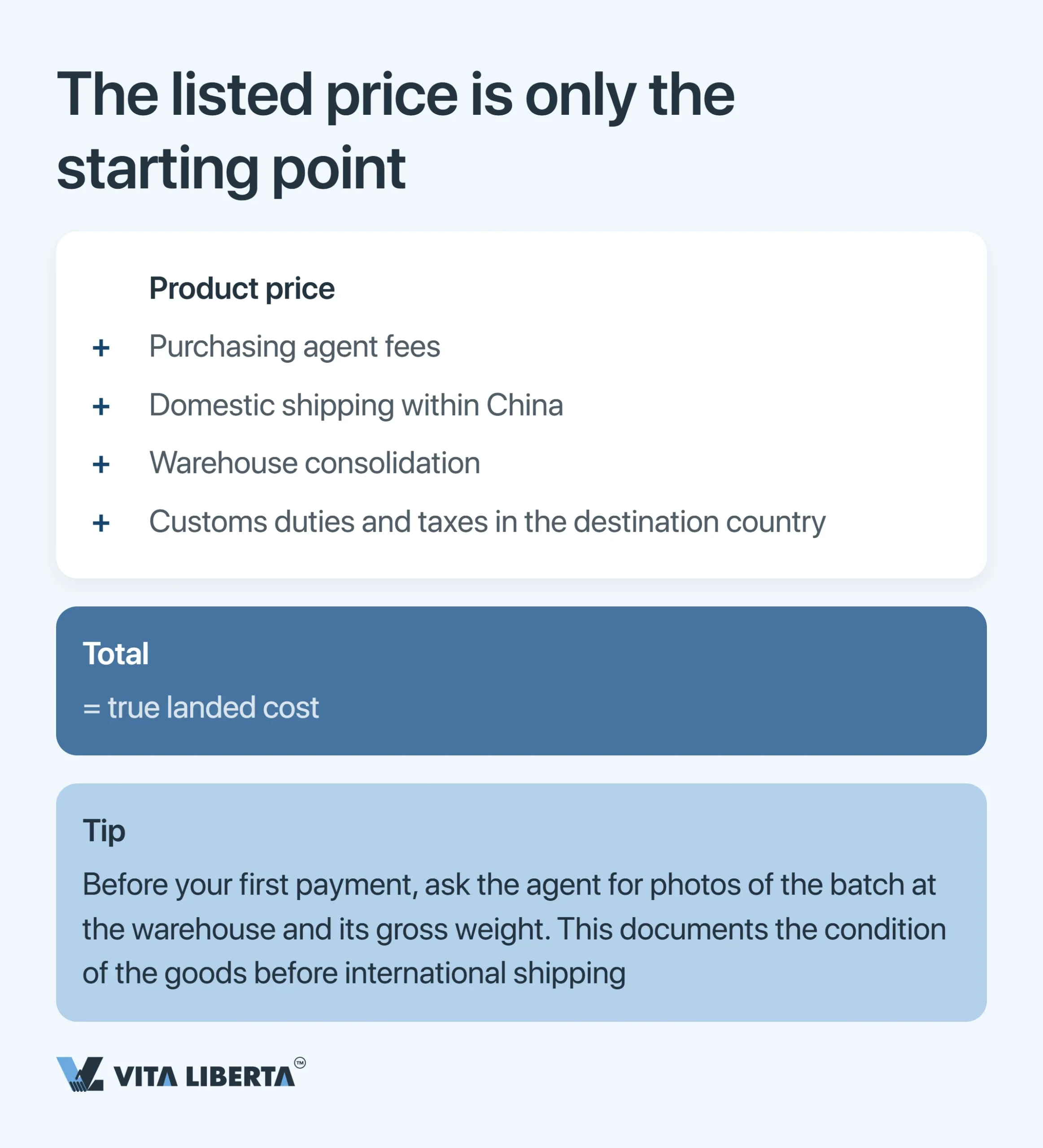
The listing price is a floor, not your real cost. You also pay the agent’s fee, domestic delivery, consolidation and import charges in the destination country.
Agents and Consolidation: What You Pay on Top
Most sellers ship only inside the mainland. If you’re overseas, you’ll need a Taobao agent or a consolidation warehouse (集运). The agent buys the goods and checks them. The warehouse combines parcels from different sellers into one shipment. Quick tip: before your first payment, ask the agent for photos of the batch in the warehouse and its gross weight. That fixes the state of the goods before international transit, because once they’re in transit you can no longer win a dispute about defects.
Fapiao: Why a Taobao Receipt Won’t Lower Your Tax
If your company is registered in China, a purchase without a fapiao (发票) is an expense you can’t prove. Article 14 of the E-Commerce Law makes the seller issue one, on paper or electronically, and both forms have equal legal force. You need that document to reduce your corporate income tax base: Article 5 of the rules on pre-tax deduction vouchers (企业所得税税前扣除凭证管理办法, 国家税务总局公告2018年第28号) says so. Article 6 gives you until the annual reconciliation ends on 31 May of the following year to get it. Foreign companies often make a costly mistake here. They buy materials for their WFOE on Taobao without settling the fapiao before paying. Once the order is closed, the seller may delay the fapiao or never issue it.
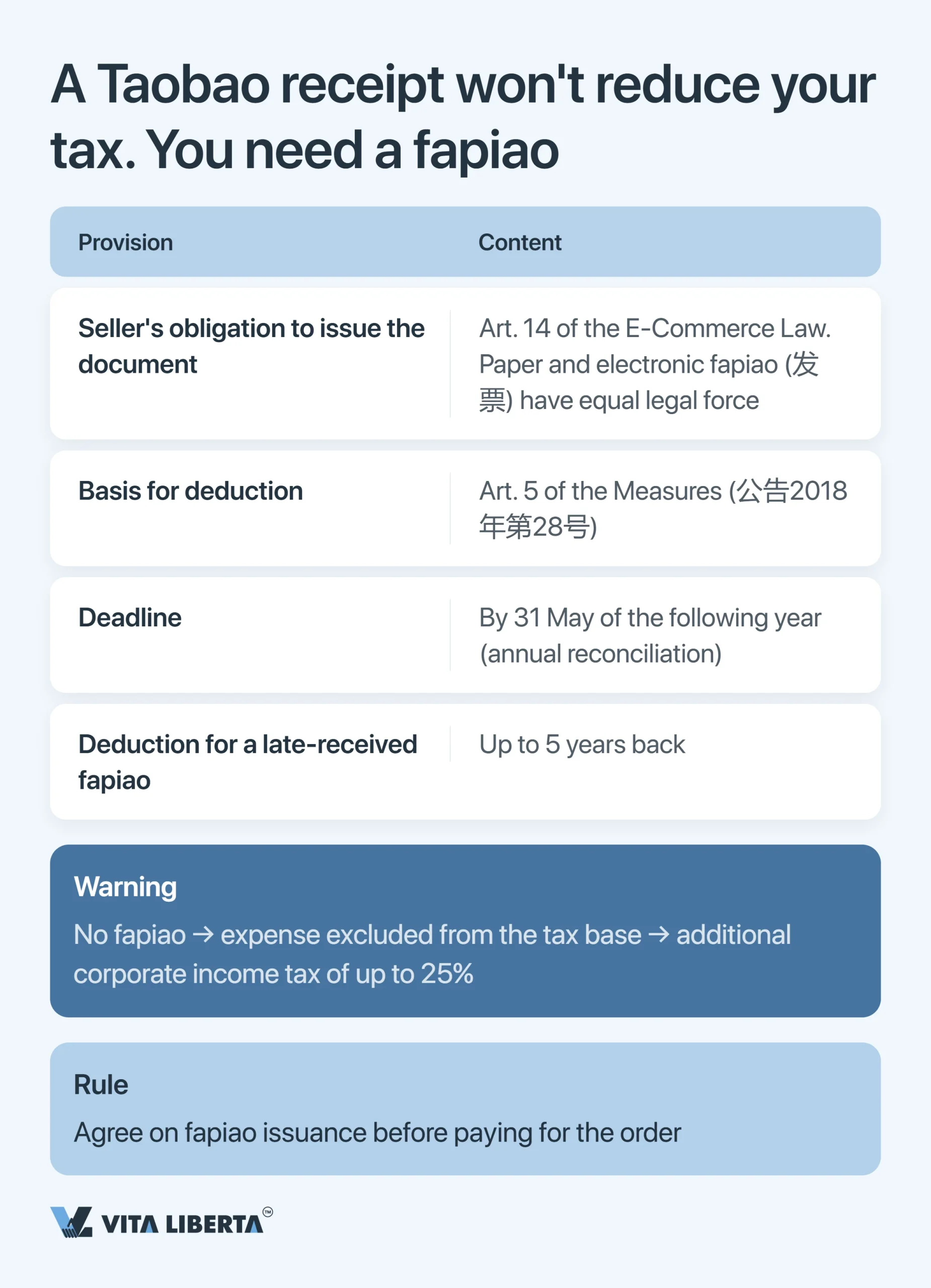
Important: the fapiao may not arrive before reconciliation ends, or within the deadline the tax office gives you during an audit (Article 15 of the same rules). In that case the expense comes out of your tax base, and what you saved on the purchase comes back as extra corporate income tax. That tax is charged at the standard 25%, or at the reduced rate if your company uses the small-enterprise regime. A fapiao that arrives later lets you claim the deduction back in the year of the expense, but no more than five years back (Article 17).
We will check your China sourcing setup
- Supply chain audit
- Fapiao and deduction control
- Choosing the right platform

A Taobao Store Starts With a Chinese Entity
A foreign passport opens a buyer account, not a corporate storefront. To sell, you register as a market entity, and the exceptions to that rule are narrow.
Personal or Corporate Store: What the Platform Checks
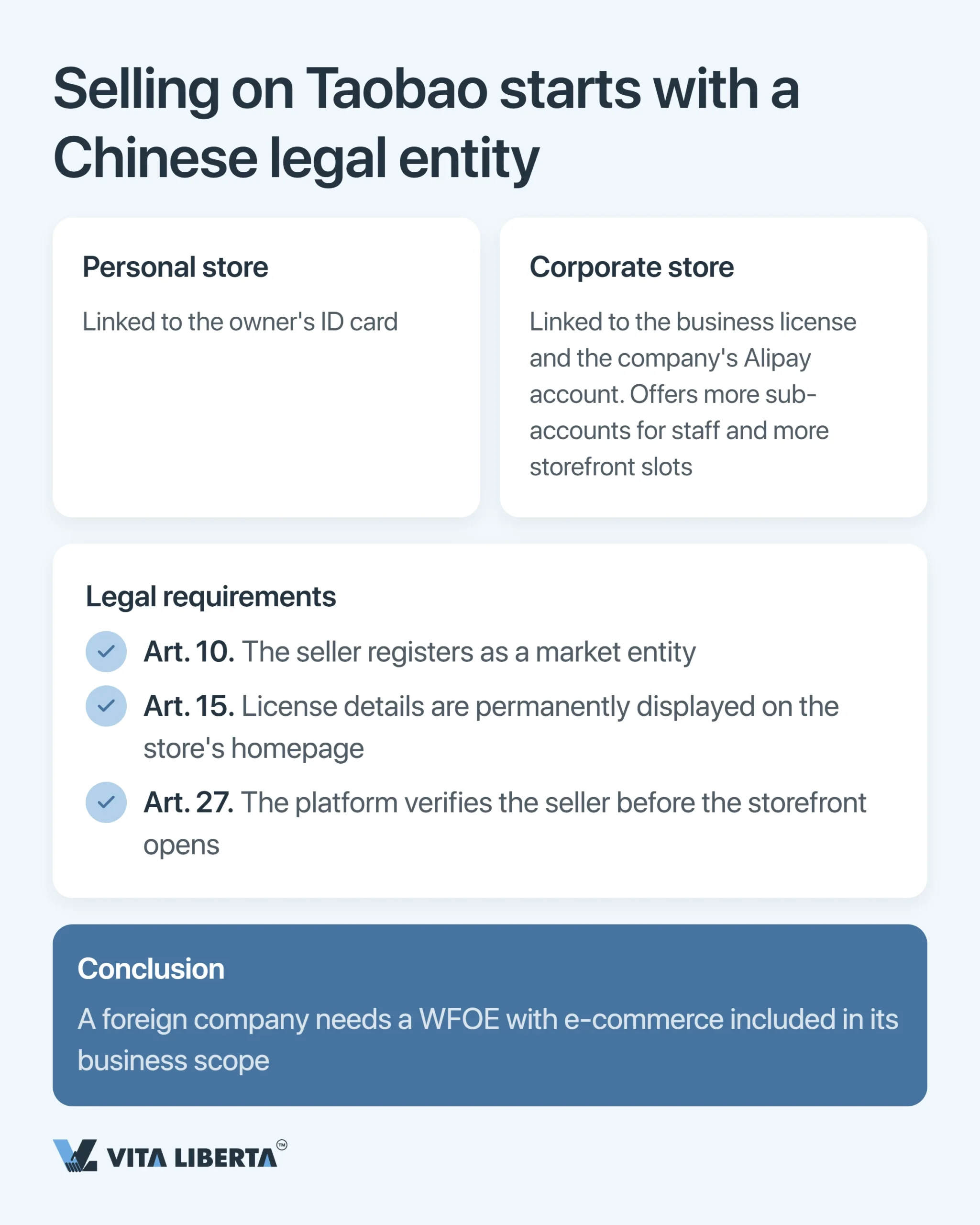
A personal store is linked to the owner’s ID card. A corporate store (企业店铺) is linked to the business licence (营业执照) and the company’s Alipay account. Corporate status gives you more sub-accounts for staff and more storefront slots. Under Article 15 of the law, your licence details must be shown on the store’s homepage at all times.
A WFOE as Seller: What Article 10 Requires
Under Article 10, everyone who trades online must register as a market entity. Individuals don’t have to if they sell their own farm produce or handicrafts, provide household services or make occasional small sales. Nor does anyone whom laws and administrative regulations exempt from registration. A foreign company qualifies for none of these exceptions, so as a seller you need a WFOE (Wholly Foreign-Owned Enterprise). Under the PRC Foreign Investment Law, in force since 1 January 2020, this means a company with 100% foreign capital (外商投资企业), and its business scope must include e-commerce. This isn’t paperwork for its own sake. It decides whether you get in: under Article 27, the platform asks for your seller details before your storefront goes live.
Tmall Global: A Storefront Without a Mainland Entity
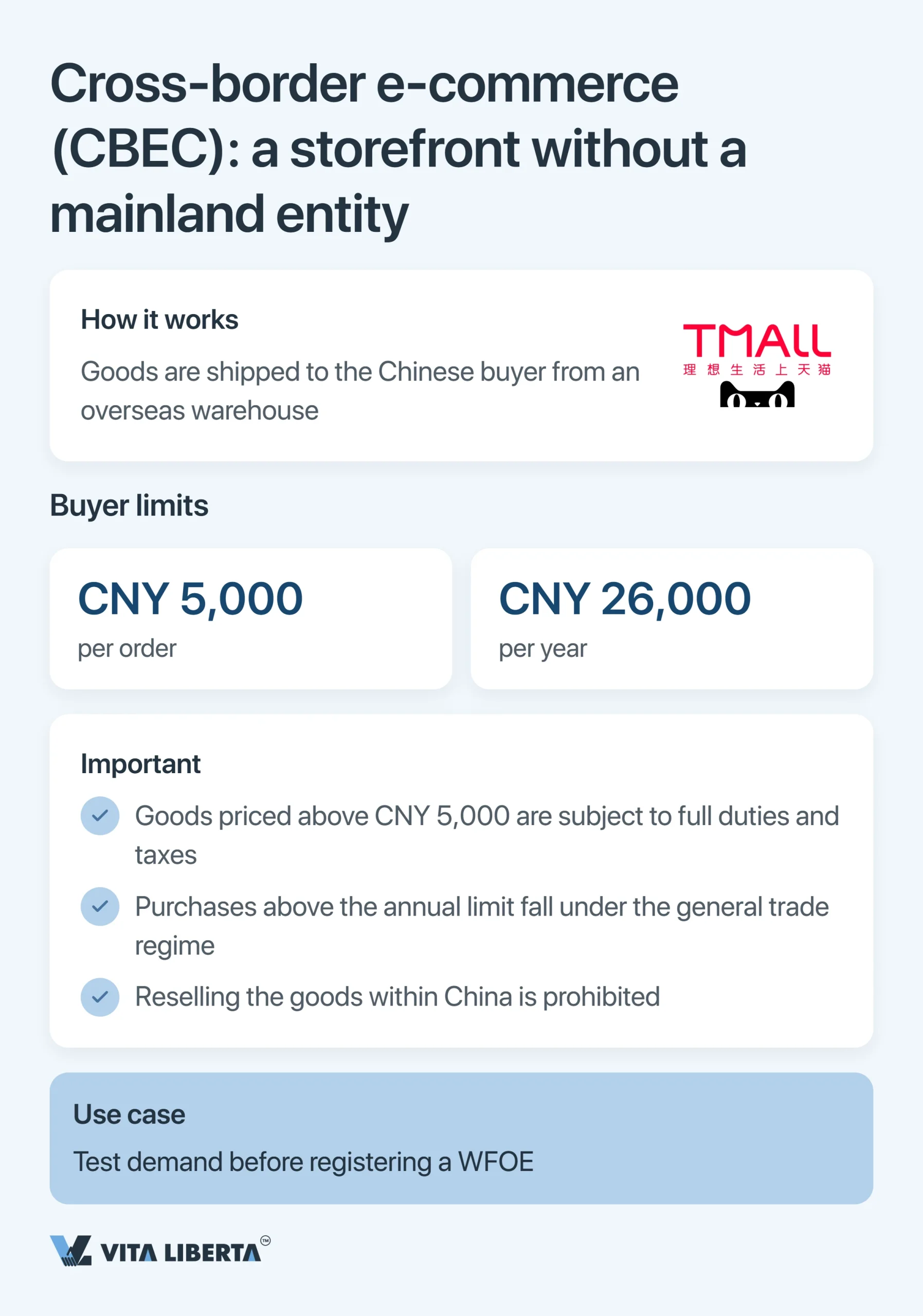
Cross-border e-commerce (CBEC) lets you sell to Chinese consumers from a warehouse abroad. The limits apply to the buyer. Under 财关税〔2018〕49号, they are RMB 5,000 per order and RMB 26,000 a year. A single-item order over RMB 5,000 can still go through CBEC if it fits the annual limit, but then full duties and taxes apply. Once the buyer goes over the annual limit, the purchase is treated as general trade. Goods bought this way can’t be resold on the domestic market.
Seller Taxes: From 25% Down to 5%, With Your Revenue on Record
Once you open a WFOE for your store, you can use the tax breaks for small businesses. The condition is that the revenue the platform reports matches what you declare.
| Obligation | Rule and deadline | Cost of a mistake |
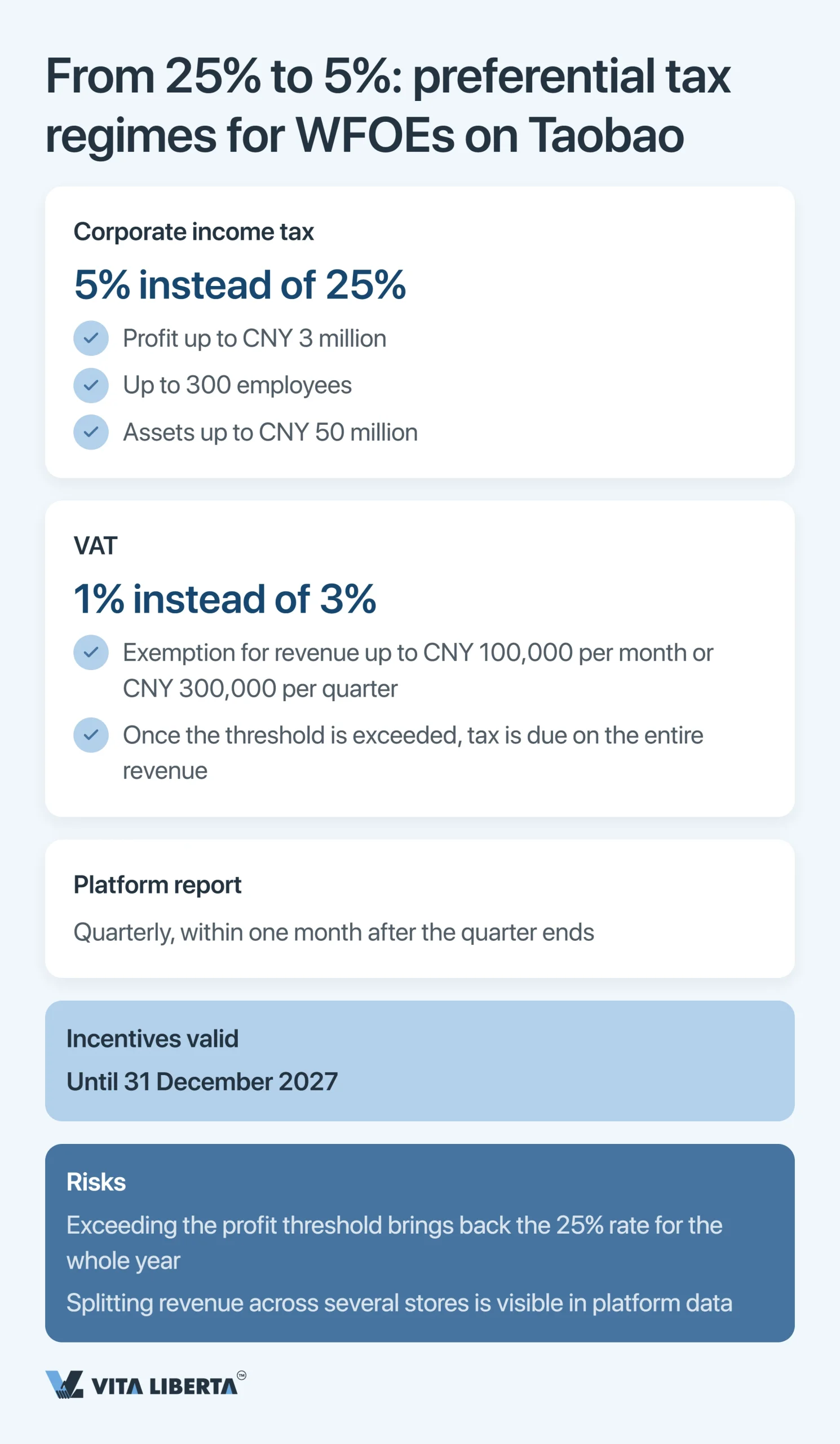
| Corporate income tax (CIT) | Small and low-profit enterprise: effectively 5% on profit up to RMB 3 million, provided you have no more than 300 employees, assets of up to RMB 50 million and work in a non-restricted industry; until 31 December 2027 (财政部 税务总局公告2023年第12号) | Go over the threshold and the standard 25% applies to the whole year’s profit |
| VAT for small-scale taxpayers | 1% instead of 3% until 31 December 2027 (sale and lease of real estate excluded). In 2026–2027 the exemption threshold is RMB 100,000 a month or RMB 300,000 a quarter; reach it and VAT is due on all revenue (PRC VAT Law, 中华人民共和国增值税法, in force since 1 January 2026; 财政部 税务总局公告2026年第10号) | If you split revenue between several stores, the platform data will show it |
| Platform report | Quarterly, within one month after the quarter ends (国务院令第810号) | A gap between it and your return gives the inspector grounds to send a query |
We will open a WFOE for Taobao
- Registration with e-commerce scope
- The right tax regime setup
- Getting ready for platform checks
Taobao for Business: Strategic Takeaways
The key paradox: Taobao is still the easiest way into Chinese retail, and that same ease has made it the most closely tax-monitored of all sales channels.
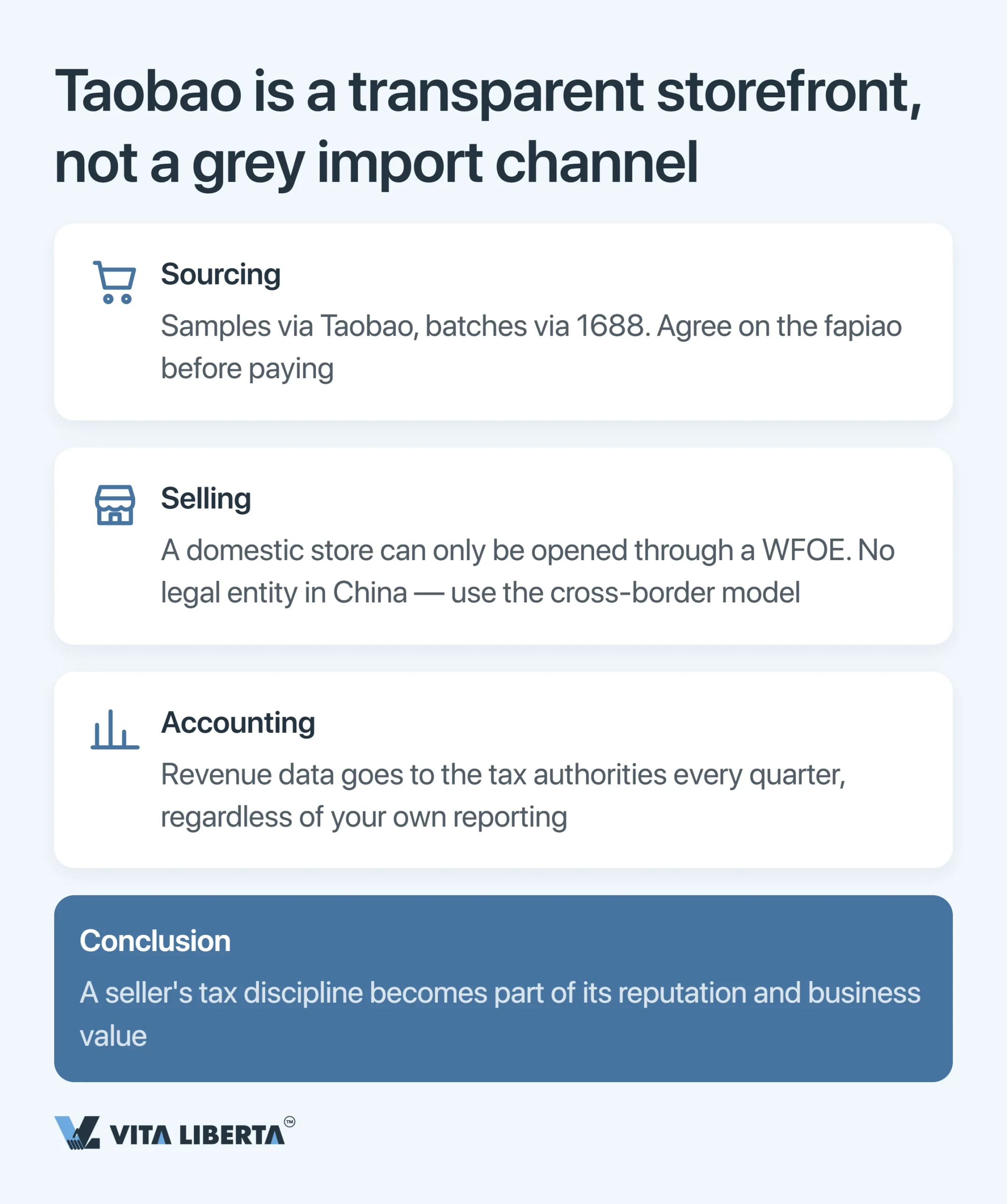
Buying. Samples through Taobao, batches through 1688. Settle the fapiao before you pay. Selling. A domestic store only through a WFOE. Without a mainland entity, use the cross-border model. Bookkeeping. From the first quarter on, your revenue data goes to the STA whatever your own reports say.
So Taobao isn’t a channel for grey imports. It’s a transparent storefront, where a seller’s tax discipline becomes part of its reputation and of what the business is worth.
Frequently asked questions
No, a passport won’t open a corporate storefront. The E-Commerce Law requires sellers to register as a market entity. The Article 10 exceptions cover only individuals who sell their own farm produce or handicrafts, provide household services or make occasional sales, plus cases where the law requires no registration. A foreign company needs a WFOE with e-commerce in its business scope, and it’s best to register it before you apply to the platform.
Yes. Since 20 June 2025 the platform itself has sent its tax office, which reports to the STA, your identity details and revenue every quarter, within a month after the quarter ends. The first upload happened in October 2025. Any gap between that data and your tax return can trigger a query. Check your store’s revenue records against the seller dashboard every quarter.
Without a fapiao the expense can’t be deducted, and what you saved on price comes back as extra corporate income tax. That tax is charged at the standard 25%, or at the reduced rate if your company uses the small-enterprise regime. Article 5 of 国家税务总局公告2018年第28号 requires the document, and you must get it before the annual reconciliation ends on 31 May of the following year. A fapiao that arrives later lets you claim the deduction back for no more than five years. Ask the seller for the fapiao before you pay, not after delivery.
Yes, through the cross-border model on Tmall Global, where goods ship to the buyer from a warehouse abroad. The buyer’s limits are RMB 5,000 per order and RMB 26,000 a year. A single-item order over RMB 5,000 goes through with full duties and taxes, and anything above the annual limit is treated as general trade. These goods can’t be resold inside China. The model lets you test demand before you register a WFOE.
A small and low-profit enterprise (up to 300 employees, assets up to RMB 50 million) pays an effective 5% corporate income tax on profit up to RMB 3 million. A small-scale taxpayer pays VAT at 1%, and pays none while revenue stays below the threshold of RMB 100,000 a month (RMB 300,000 a quarter), which is set under the PRC VAT Law. Both regimes run until 31 December 2027. If profit goes over the threshold, the standard 25% applies to the whole year, so check your profit forecast before the end of the third quarter.