Hongkong
 China
China





A verbal deal and an invoice pasted into a chat app hold up perfectly — right until the first problem. Once defective goods land or the ship date slips, there’s suddenly nothing to argue over. Here’s how to build an agreement that actually works for you.
Why the contract matters at all
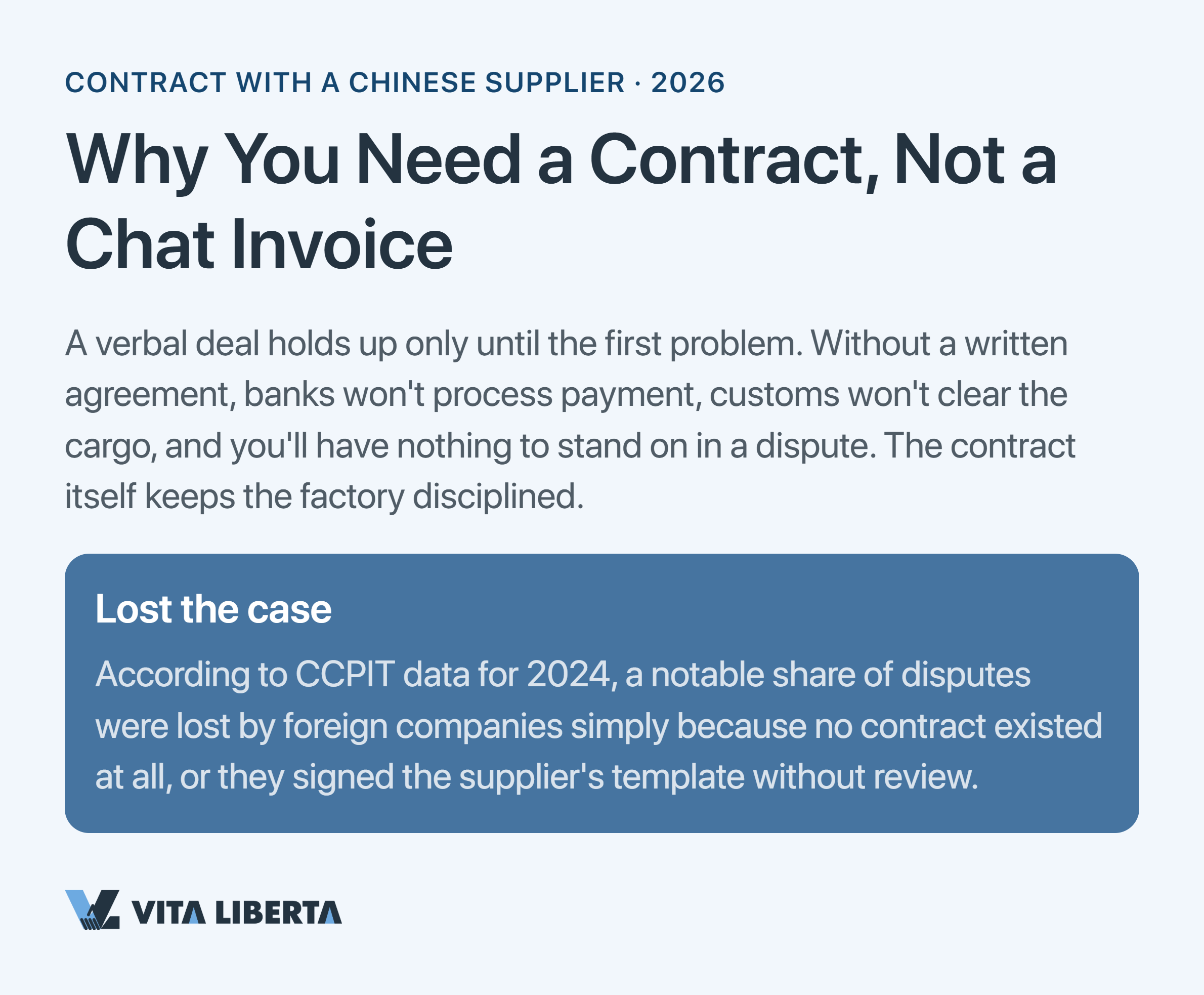
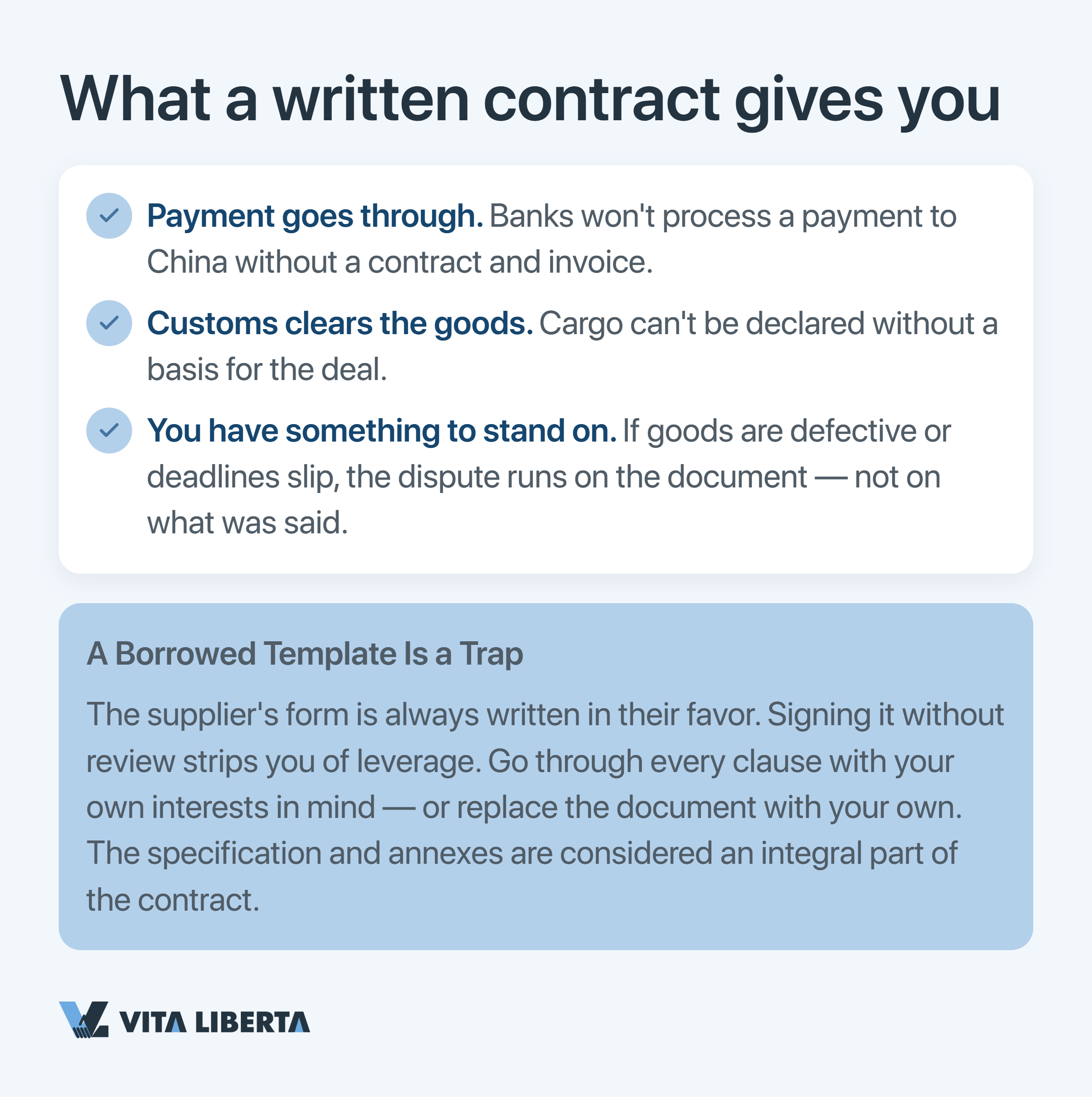
A written agreement isn’t a formality. Without one your bank won’t process payment, customs won’t clear the shipment, and if things go wrong you have nothing to stand on. The document also disciplines the factory in its own right. The numbers back this up: according to the China Council for the Promotion of International Trade (CCPIT), a sizeable share of 2024 disputes were lost by foreign buyers for one of two reasons — there was no contract at all, or they signed the supplier’s ready-made template without reading it. Someone else’s form is always written in favour of the party who handed it over.
What every solid contract needs
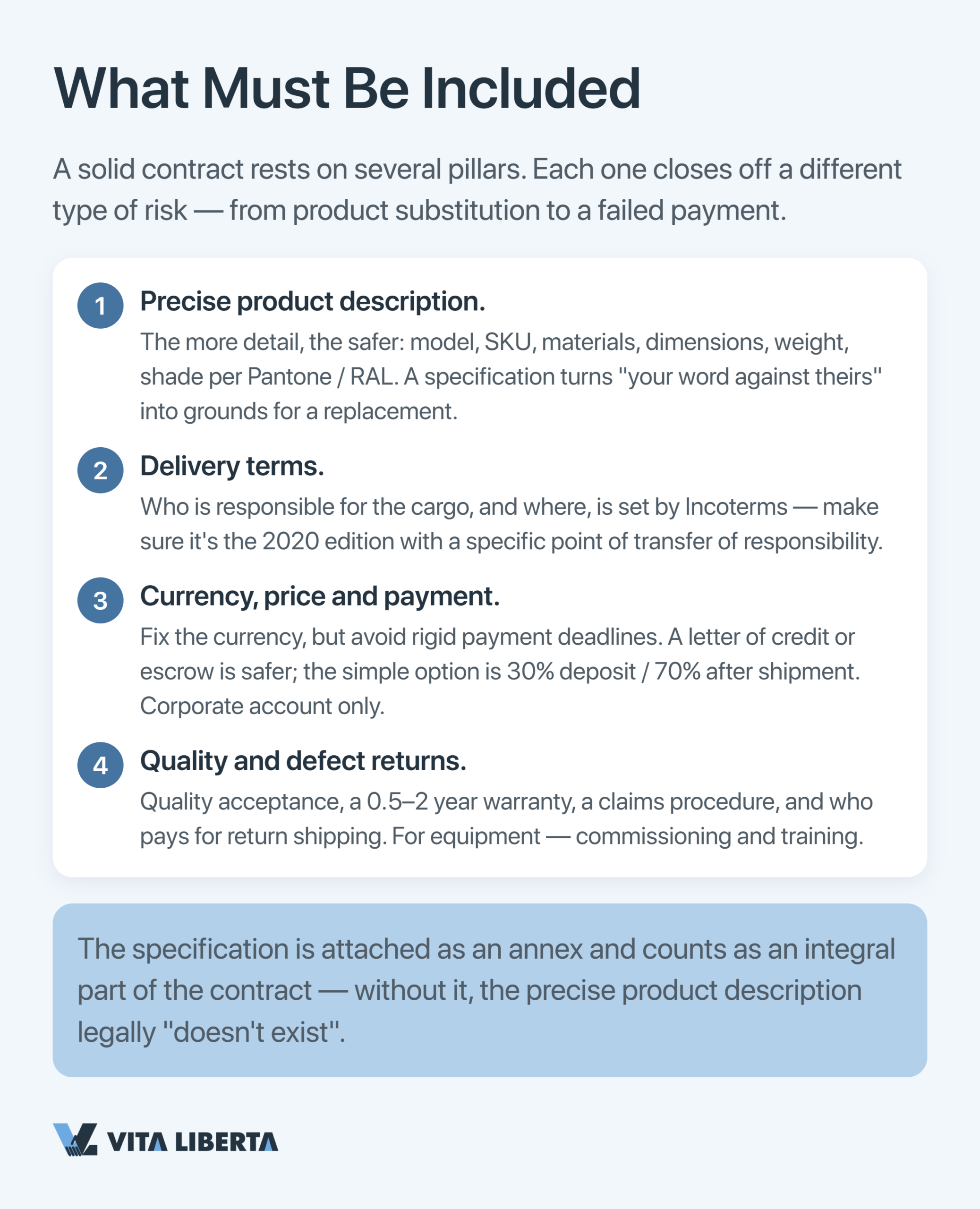
A durable contract stands on several load-bearing clauses.
A precise product description
The rule is simple: the more detail, the safer you are. Spell out the model, SKUs, materials, dimensions, weight, and colour by Pantone or RAL reference — everything that separates the product you want from something that merely resembles it. The classic failure: you order 100% cotton blouses and a poly-cotton blend arrives. A signed specification turns that from “your word against theirs” into grounds for replacement or refund. The bill of materials (BOM) matters just as much — a precise BOM stops the factory quietly swapping in cheaper components. The specification travels as an annex and counts as an inseparable part of the contract.
Drafting a supplier contract?
- Contract risk review
- Your interests written in
- PRC law and arbitration covered

Delivery terms
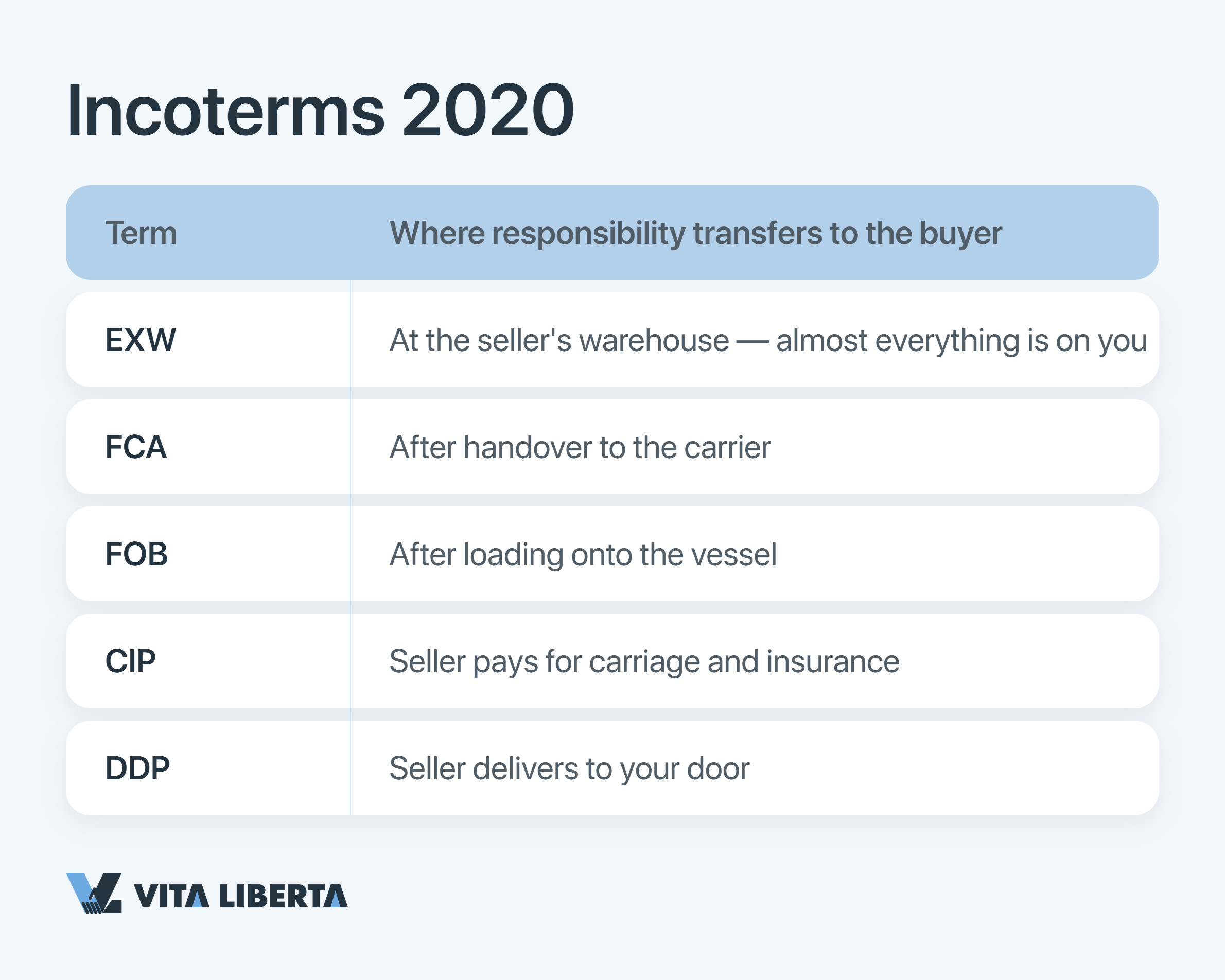
Who bears the goods and where responsibility passes is set by your chosen Incoterms rule — always cite the 2020 revision and the exact named place.
| Term | Where risk passes to the buyer |
| EXW (Ex Works) | at the seller’s premises — almost everything is on you |
| FCA (Free Carrier) | once handed to the carrier |
| FOB (Free On Board) | once loaded on board the vessel |
| CIP (Carriage and Insurance Paid To) | seller pays carriage and insurance |
| DDP (Delivered Duty Paid) | seller delivers to your door |
Currency, price and payment
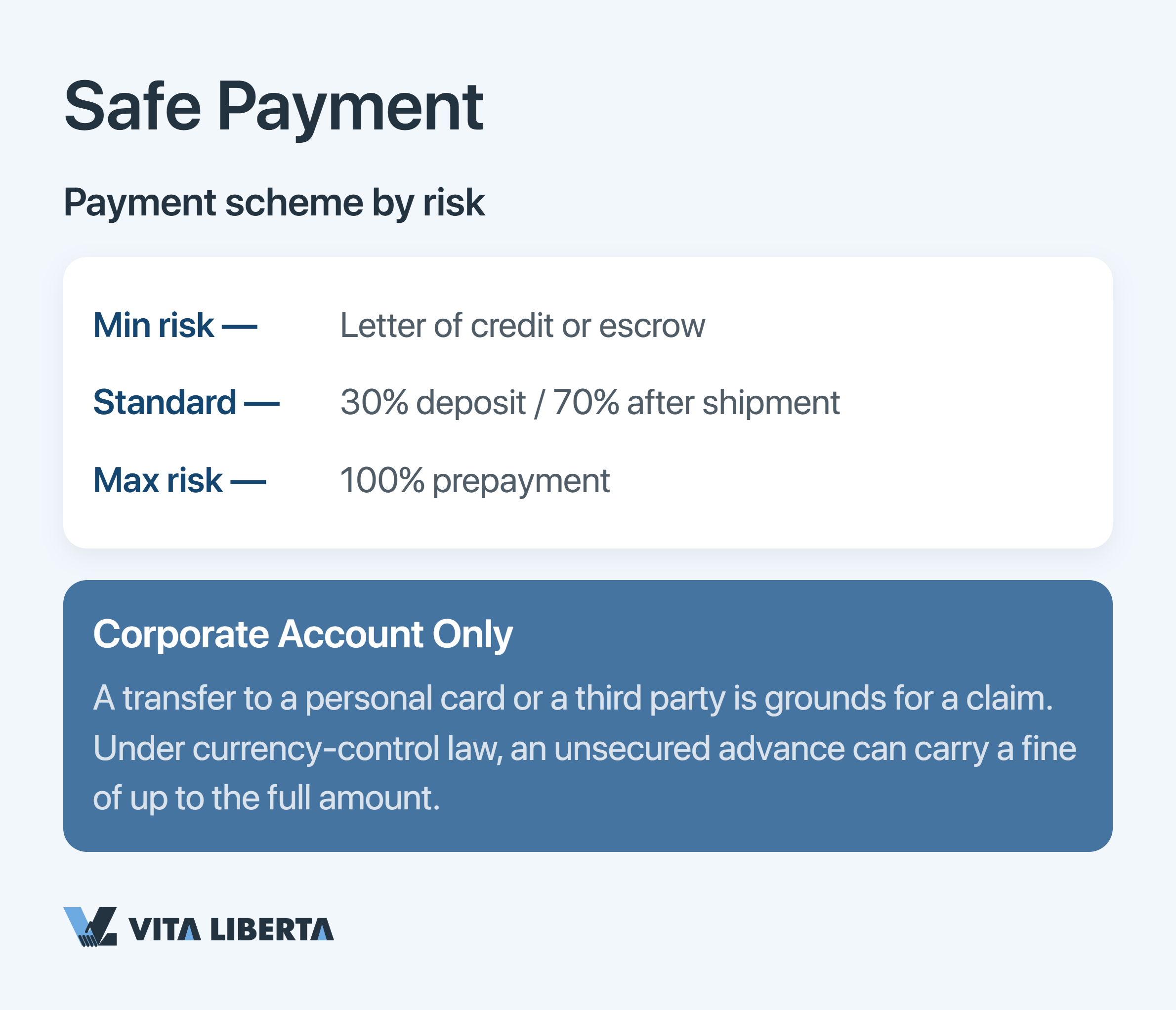
Fix the currency, but don’t box yourself into rigid payment deadlines: cross-border transfers still stall from time to time, and an inflexible clause is easy to breach through no fault of your own. On method, a letter of credit or escrow is safest; the simple workhorse is 30% deposit and 70% after shipment. A 100% prepayment is the maximum-risk position. And pay only into the supplier’s registered corporate account — a transfer to a personal card or a third party is both a red flag for fraud and a headache for your own bank’s compliance and customs paperwork later.
Quality and defect returns
Set out, as its own block, how goods are accepted on quality, the warranty period (typically six months to two years), how a claim is filed, and who pays for return shipping. For machinery, add commissioning and staff training here too. Without these lines, demanding compensation for non-conformity is close to impossible — with them, buyers really do get their money back.
Penalties and force majeure
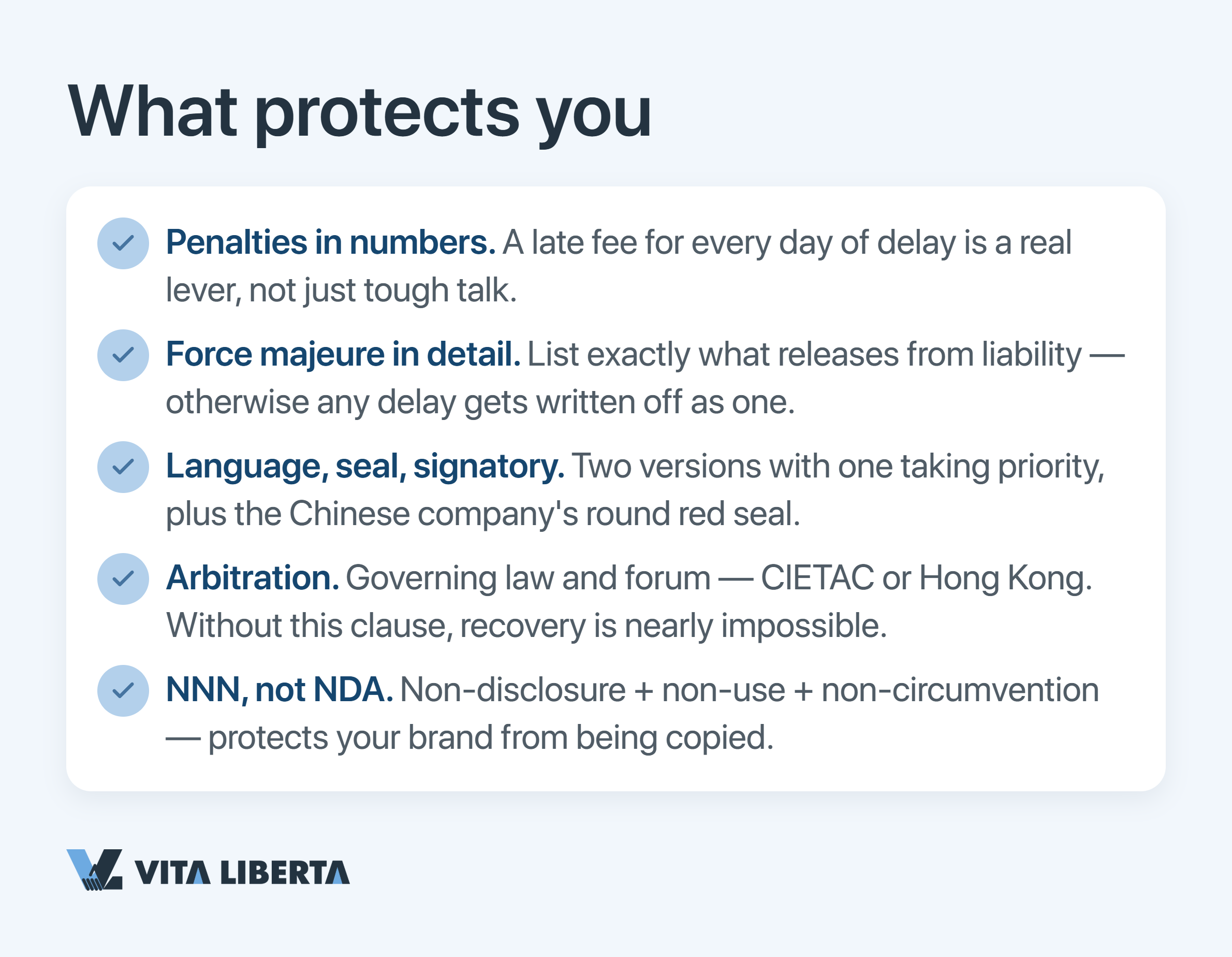
Chinese counterparties respect a hard number far more than a stern paragraph. Write in liquidated damages for each day of delay and how they accrue — that’s your working lever. Describe force majeure in detail and list exactly what excuses performance, or the supplier will try to file every hiccup under it.
Language, seal, signatory
Draft the document in two languages and state explicitly which version prevails in case of conflict. On the PRC side, the signature must be accompanied by the round red company chop — without it the paper is worth almost nothing. While you’re at it, verify the supplier’s full registered Chinese name and the signatory’s authority: paying “the wrong legal entity” surfaces at the worst possible moment.
Where you’ll litigate, if it comes to that
Set the governing law and the arbitral body in advance. The usual choices are China’s CIETAC or arbitration in Hong Kong under the HKIAC — each with its own trade-offs on speed and enforceability. CIETAC awards are enforced directly by mainland courts and are typically faster and cheaper for smaller matters; a Hong Kong seat (HKIAC) is often the neutral compromise for higher-stakes contracts, and interim measures can be sought from mainland courts under the Mainland–Hong Kong arrangement. Whichever you pick, name the institution explicitly — a clause that offers a choice between arbitration and litigation, or that names no institution, can be struck down as invalid.
Brand protection: NNN
If you manufacture under your own brand, an NDA alone won’t cut it — in China the NNN agreement is more effective. It bars the factory not only from disclosing your IP (non-disclosure), but from copying your product (non-use) and from going around you to sell directly to your customers (non-circumvention). That’s what shields your design and technology from being cloned or from unaccounted overruns being dumped on the market.
The mistakes importers keep making
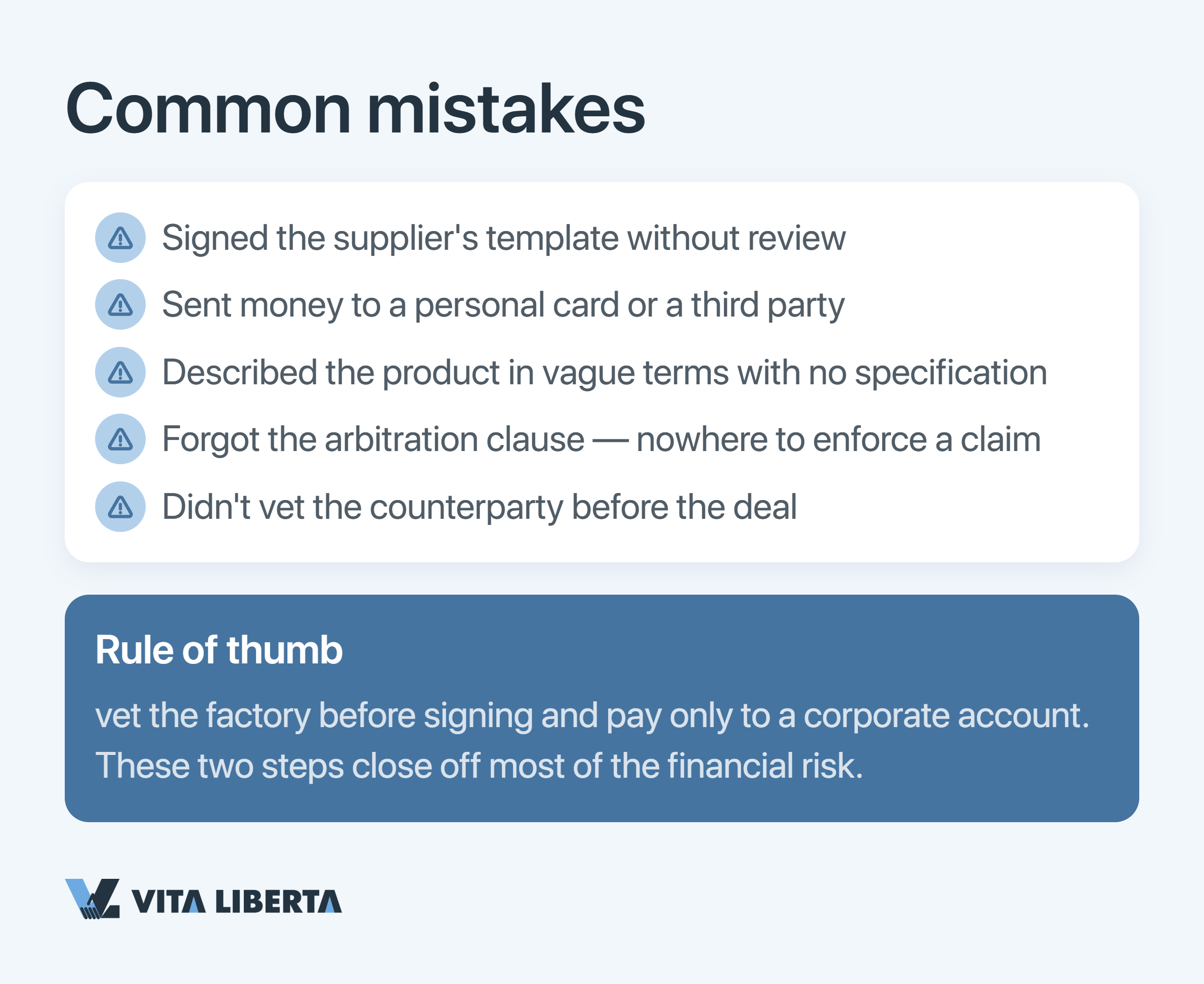
⚠️ The rule: vet the factory before you sign, and pay only into a corporate account. Those two steps close most of your financial risk.
- signing the supplier’s template with no legal review;
- wiring money to a personal card or a third party;
- describing the goods in vague terms with no specification;
- forgetting the arbitration clause — leaving nowhere to enforce;
- not running due diligence on the counterparty before the deal.
“A contract with a factory isn’t bureaucracy — it’s a risk map. Importers don’t lose money where they’re outfoxed by some clever scheme; they lose it where they left the hole themselves: a loose phrase, someone else’s template, a payment to a card. Closed clauses save you months of proceedings.”
— Sergey Konon, China foreign-trade consultant
A working contract with a Chinese supplier rests on a detailed specification, correctly chosen Incoterms, a safe payment structure, warranties, quantified penalties and an arbitration clause. Vet the counterparty before signing, don’t economise on the precision of your wording, and pay only into the official account — then the document becomes a shield rather than a stack of paper.
Want to secure your China deal?
- Turnkey contract drafting
- Protection from supply failures
- Legal review of the terms
FAQ
The essentials: subject matter and product specification, price and currency, payment terms and schedule, delivery basis and lead time, quality requirements, liability for breach, and a dispute-resolution mechanism. Vague wording is the seed of future conflict.
Use a bilingual document — English (or your language) and Chinese — and state up front which version controls if they diverge. Because mainland courts work from the registered Chinese name and Chinese text, a clear Chinese version is what makes the contract enforceable on the ground.
Due diligence on the counterparty, staged payments instead of 100% prepayment, independent pre-shipment inspection, and liquidated damages written into the text. The more precisely the obligations are set out, the easier they are to enforce.
CIETAC is well understood by Chinese parties and its awards are enforced directly by mainland courts, which is efficient for smaller, faster matters. A Hong Kong seat under the HKIAC is a common neutral compromise for larger contracts, with strong enforceability and access to interim measures. Name one institution explicitly.
For branded or custom manufacturing, yes. An NDA only covers disclosure; NNN adds non-use (no copying your product) and non-circumvention (no selling to your customers behind your back), which is where most factory IP losses actually happen.