Hongkong
 China




When does a WFOE’s year actually close? Not when the bank account settles. Each year the company has to produce three things: an audit report, a tax reconciliation and a filing to the public register. That applies even in a year with zero sales, when the licence is kept alive only on paper.
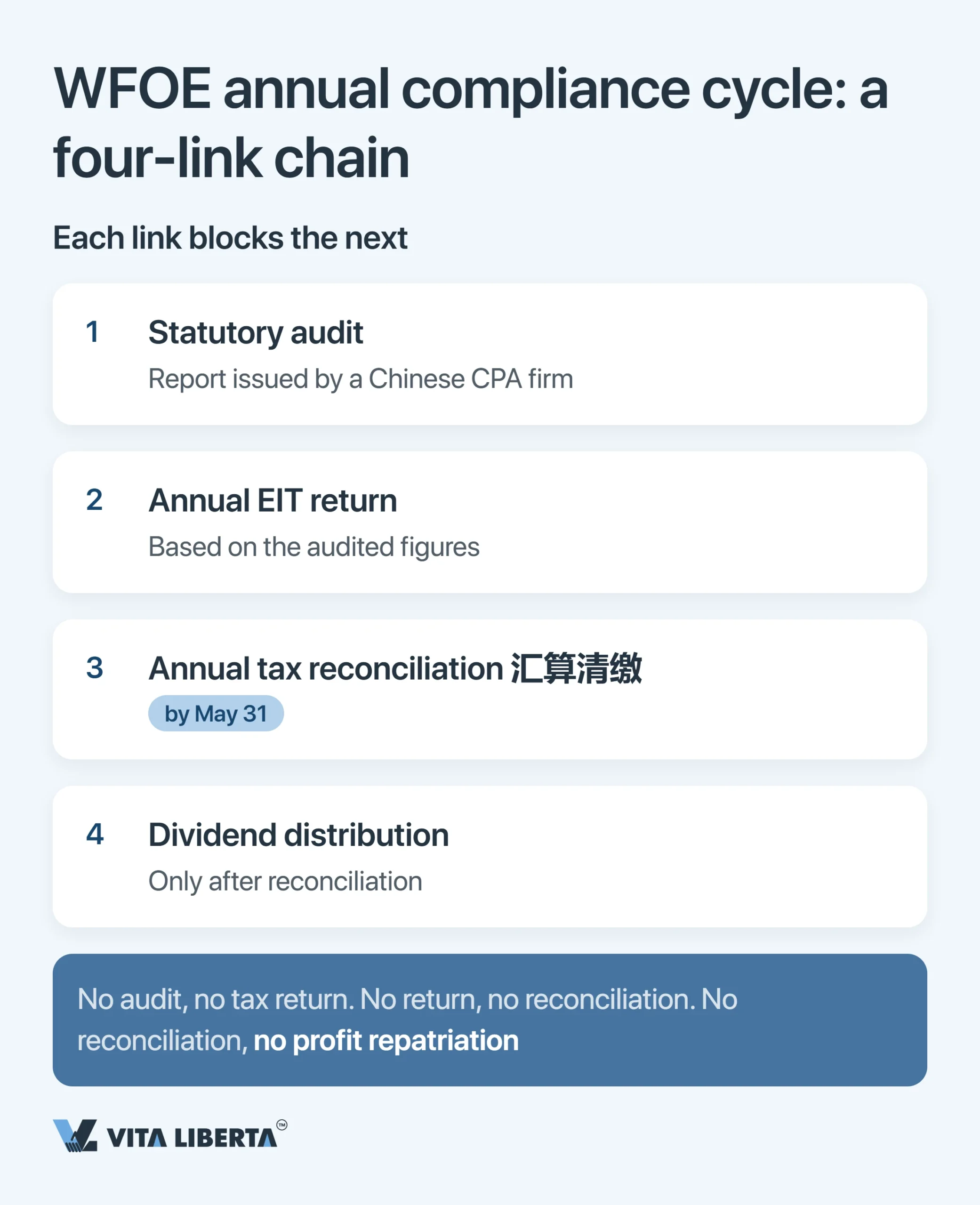
The three steps feed each other in a fixed order, with two hard dates on the calendar. Audited numbers go into the tax return. The return goes into the reconciliation. Profit can leave the company as dividends only after both the reconciliation and the audit report are signed off.
The typical problem
“We opened a WFOE, sold all year and paid our advance tax. In April the auditor said there was nothing to build a report on. The fapiao didn’t tie to the bank, and part of the money had gone to another account. A month to go until 31 May. What did we miss?”
Foreign owners on the mainland bring us this question more often than almost any other.
The WFOE annual cycle: three duties, one loop
The Foreign Investment Law (中华人民共和国外商投资法) has been in force since 1 January 2020. With it, the special corporate regime for foreign-funded firms disappeared. Your WFOE now answers to the same Company Law (中华人民共和国公司法) as a Chinese-owned business. Companies set up before 2020 had time to adapt, and that window shut on 31 December 2024.
The result is three duties that hang together. If you drop one, the others fail too.
Who can audit you: a Chinese CPA firm, two signatures
Company Law says the yearly financial statements need an auditor’s review. In China that means a locally licensed accounting firm (会计师事务所). A report signed abroad carries no weight with Chinese authorities.
You draw up the statements in Chinese, following CAS: Chinese Accounting Standards (企业会计准则), sometimes called PRC GAAP. A small enterprise may opt for the small-business standards (小企业会计准则).
Two Chinese CPAs put their signature and seal on the result: the partner in charge and one more auditor on the team. Your tax return, your bank’s next service renewal and your register data are all built from these numbers. So the audit sits at the bottom of the stack, not at the top.
Why everything comes down to 31 May
Corporate income tax follows the calendar year. Its official name is EIT, and in everyday use it is called CIT. The base rate is 25% (中华人民共和国企业所得税法).
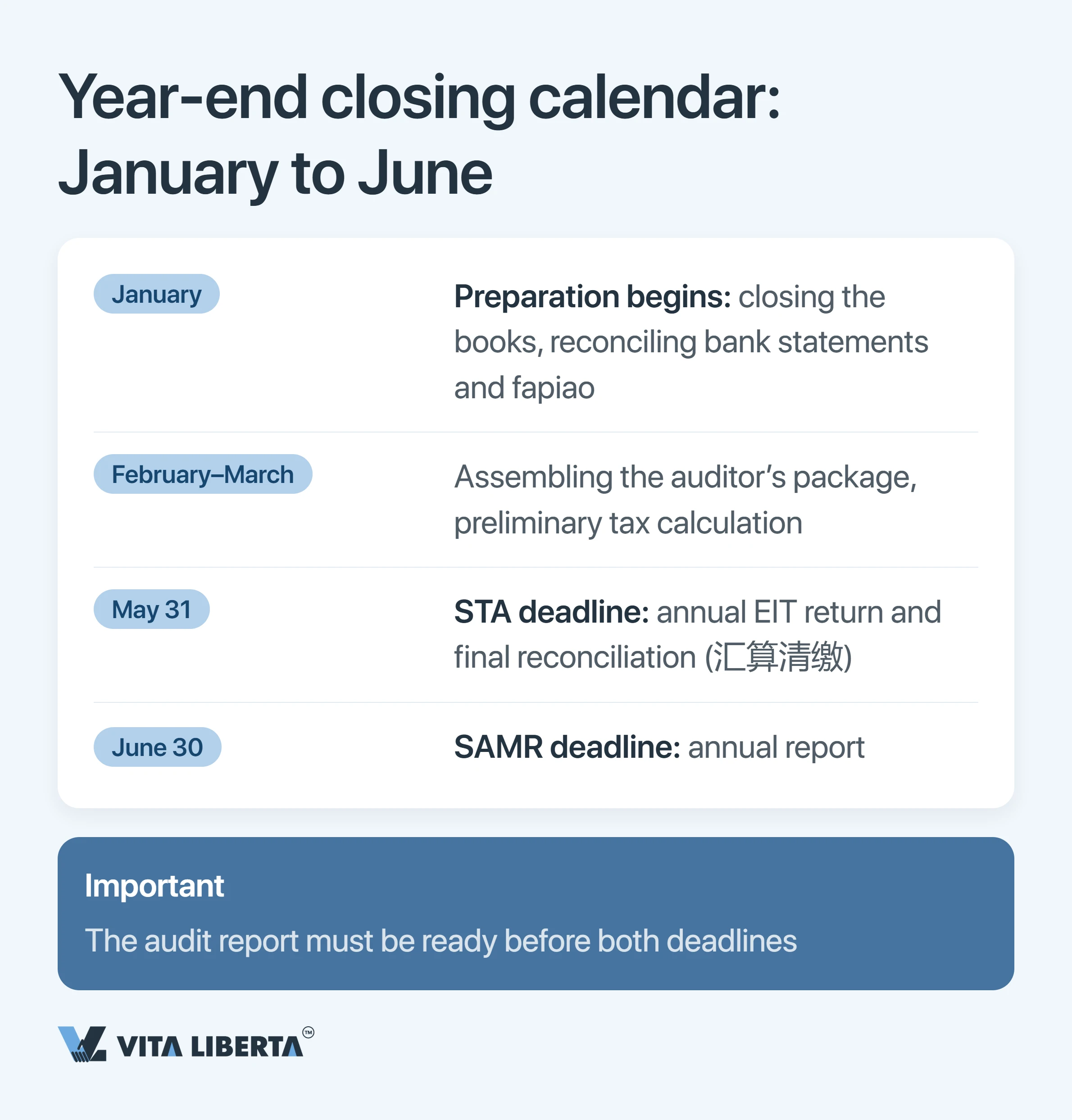
You don’t wait until year-end to pay. Advance amounts go in monthly or quarterly, each within 15 days of the period closing. Then comes the annual settlement, 汇算清缴, which combines the return and the reconciliation. You have five months to complete it, so the deadline is 31 May.
Each day of late payment adds 0.05% of the amount owed (中华人民共和国税收征收管理法). If the books were falsified, revenue was hidden or no return was filed, the penalty grows. It ranges from half to five times the unpaid tax, and it is charged on top of the daily surcharge.
SAMR annual report: 1 January to 30 June
The market regulator, SAMR (国家市场监督管理总局), sets the third date. Article 8 of the disclosure regulation (企业信息公示暂行条例) opens the filing season on 1 January and closes it on 30 June. You file online at gsxt.gov.cn, China’s enterprise credit publicity system (国家企业信用信息公示系统).
A foreign-invested company files a combined report, known as 多报合一 or “many-in-one”. You log in once and cover three obligations:
- your annual report to SAMR;
- the yearly foreign investment report for MOFCOM, required by the 2019 reporting measures (外商投资信息报告办法, 商务部、市场监管总局令2019年第2号);
- the yearly figures SAFE expects.
You disclose who your investors are, who ultimately controls them and how capital moved during the year. Only SAMR’s part goes public. What you give MOFCOM and SAFE stays closed. Some fields fill in automatically from tax and social-insurance records, and you enter the rest yourself.
What the auditor tests and what you receive at the end
You receive a set of statements, not a one-page letter. The set includes the balance sheet, profit and loss, cash flows, changes in equity and explanatory notes. To produce it, the auditor goes through primary documents in five areas at once.
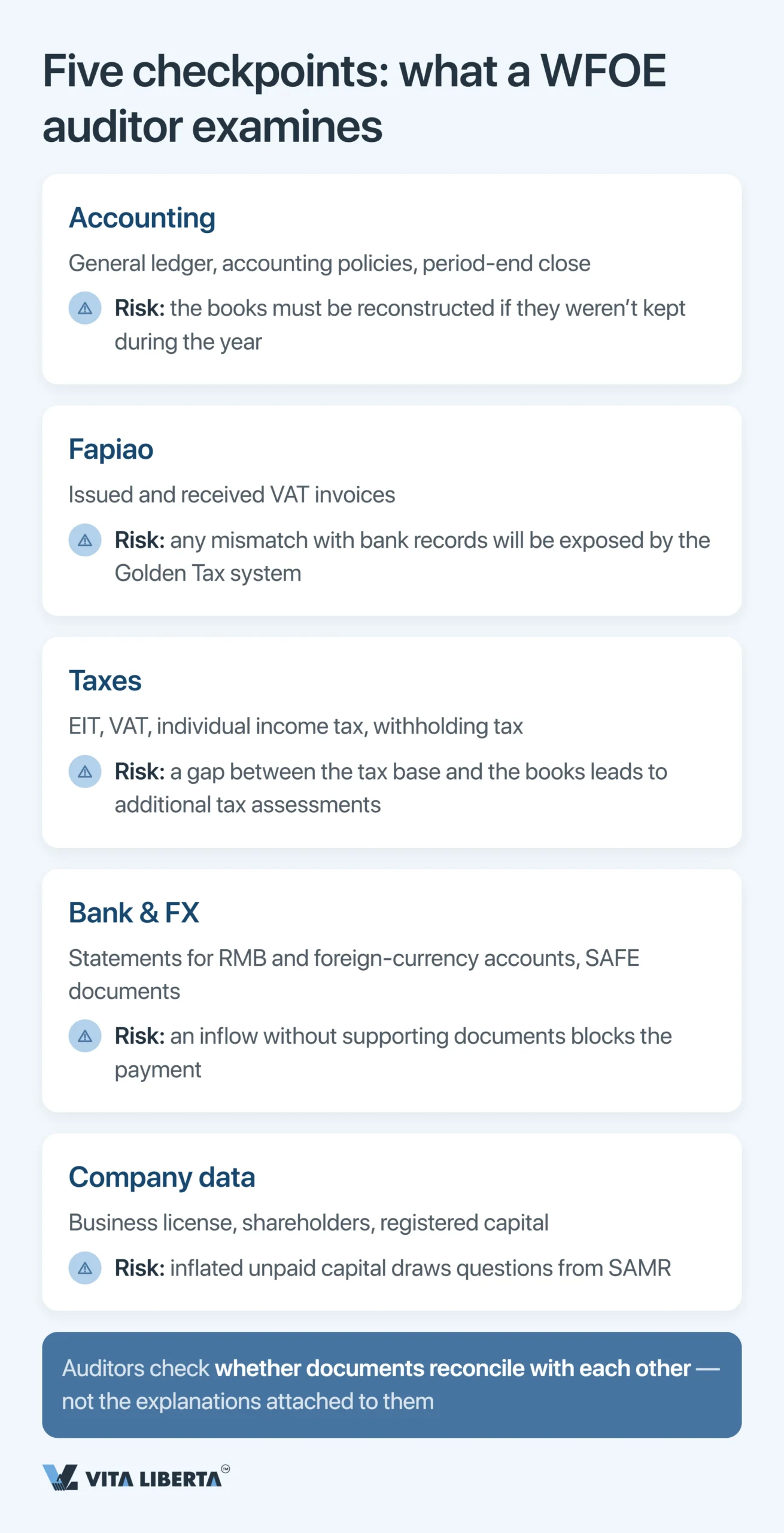
| Area | Auditor’s focus | If it’s weak |
| Ledger and closes | General ledger, accounting policy, period-end closing | Records not kept along the way must be reconstructed |
| Fapiao | Invoices issued and received, checked against payments | Golden Tax quickly picks up any gap between fapiao and bank |
| Taxes | EIT, VAT, staff IIT, tax withheld at source | Books and return disagree, so extra tax is assessed |
| Accounts and FX | RMB and currency statements, SAFE paperwork | A currency inflow with no documents delays the transfer |
| Company data | Licence, shareholders, registered capital | Capital declared high but never paid draws SAMR’s attention |
Inspectors don’t argue with your explanations. They compare figures. Golden Tax Phase IV (金税四期) matches fapiao, bank movements and returns automatically. Any fapiao with no money behind it soon comes back to you as a query.
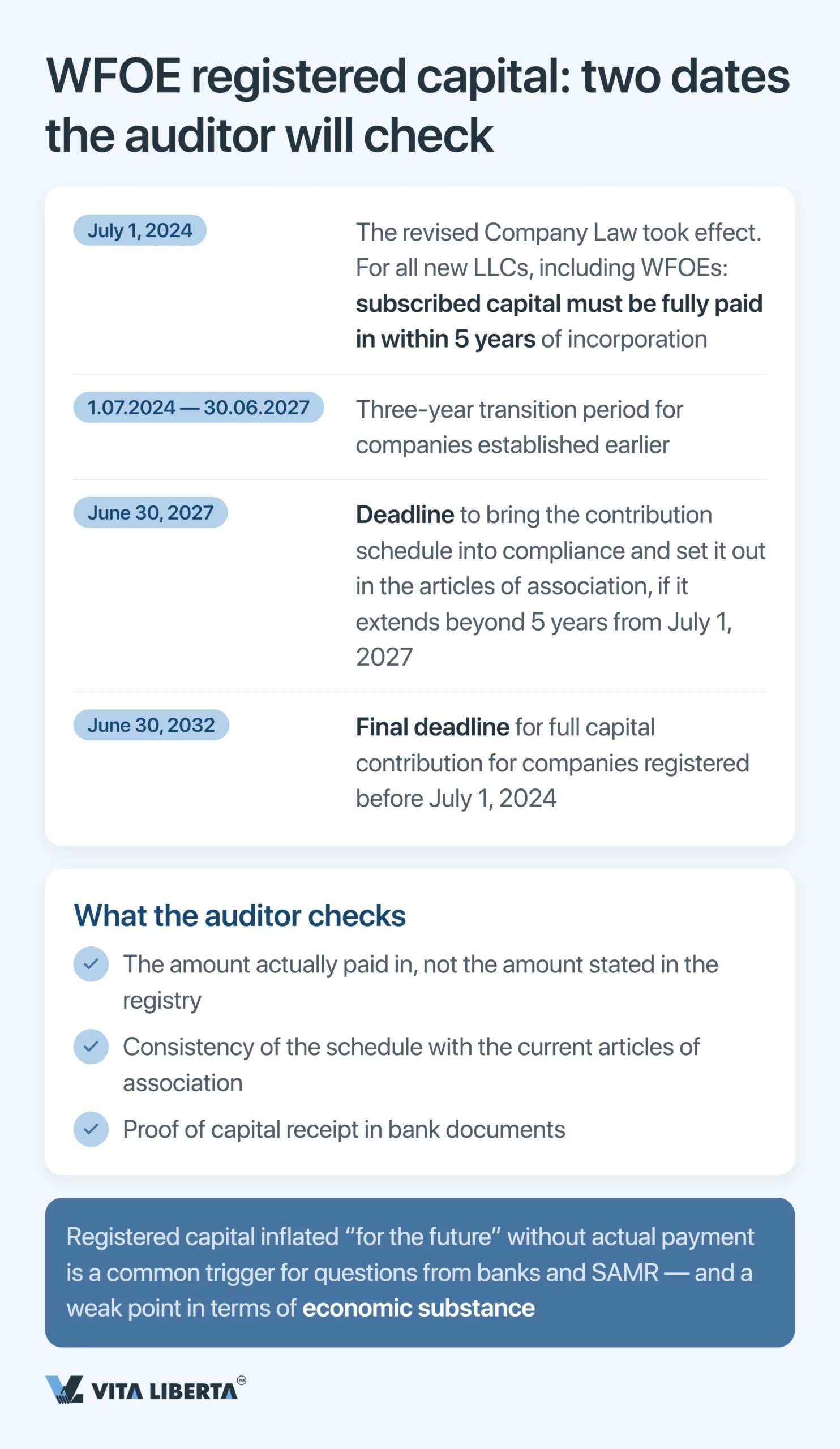
Registered capital is the other pressure point. Since 1 July 2024, the revised Company Law has given shareholders five years to pay in full what they subscribed. Companies registered before 30 June 2024 follow a State Council transition rule (国务院令第784号, referred to below as Order 784).
To apply Order 784, check your contribution date against 1 July 2027. If the date falls more than five years after that day, you must bring it within five years and amend your articles by 30 June 2027. In practice, the capital must be fully paid by 30 June 2032 at the latest. The auditor will look at the cash that actually arrived, not at what the articles promise.
Get through your WFOE annual audit without missing a deadline
- Readiness check for 31 May
- Fapiao-to-bank reconciliation
- Support with the STA and SAMR
Three regulators, three clocks: STA, SAMR, SAFE
Each of the three agencies runs its own calendar, and confusing them gets expensive.
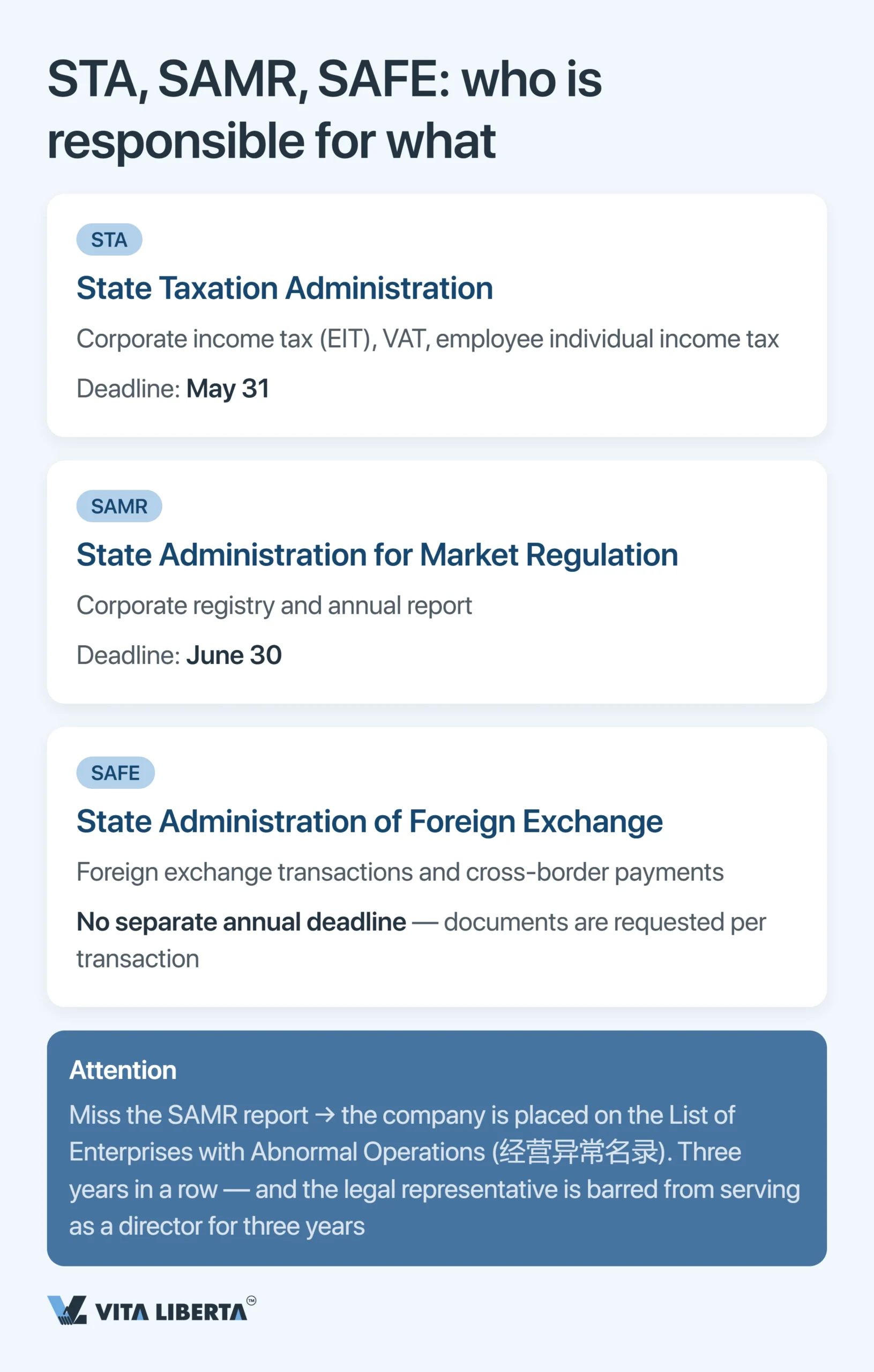
- STA (国家税务总局, the State Taxation Administration) collects EIT, VAT and staff IIT. Its date is 31 May, for the annual return.
- SAMR keeps the company register. Its date is 30 June, for the annual report.
- SAFE (国家外汇管理局, the State Administration of Foreign Exchange) watches money crossing the border. Your auditor needs the same FX account documents that SAFE does.
The yearly equity registration for foreign investors (存量权益登记) is not a separate step. It goes inside the same gsxt.gov.cn report, due by 30 June.
Most mix-ups involve two dates. 31 May belongs to the tax bureau, for the return and reconciliation. 30 June belongs to SAMR, for the annual report. The audit report has to be ready before both.
Important: If you miss the annual report, the company goes onto the public abnormal operations list (经营异常名录) and receives an administrative sanction. Banks and partners tend to treat that flag as worse news than a tax arrear.
If two years pass without a report and nobody answers at the registered address, the licence is revoked. This is set by Article 18 of the regulation as amended by Order 777 (国务院令第777号), effective 1 May 2024. Seriously falsified published data brings a fine of CNY 50,000 to 200,000 and a listing as a serious violator. For three years after that, the company’s legal representative cannot hold the same role at any other enterprise.
How long the audit runs and why the first year costs more
The timeline depends on how clean your accounting is, far more than on company size. With steady bookkeeping through the year, the review goes smoothly and little or no extra tax is assessed. With patchy bookkeeping, the auditor first has to rebuild the records. That ends up costing more than a monthly service would have.
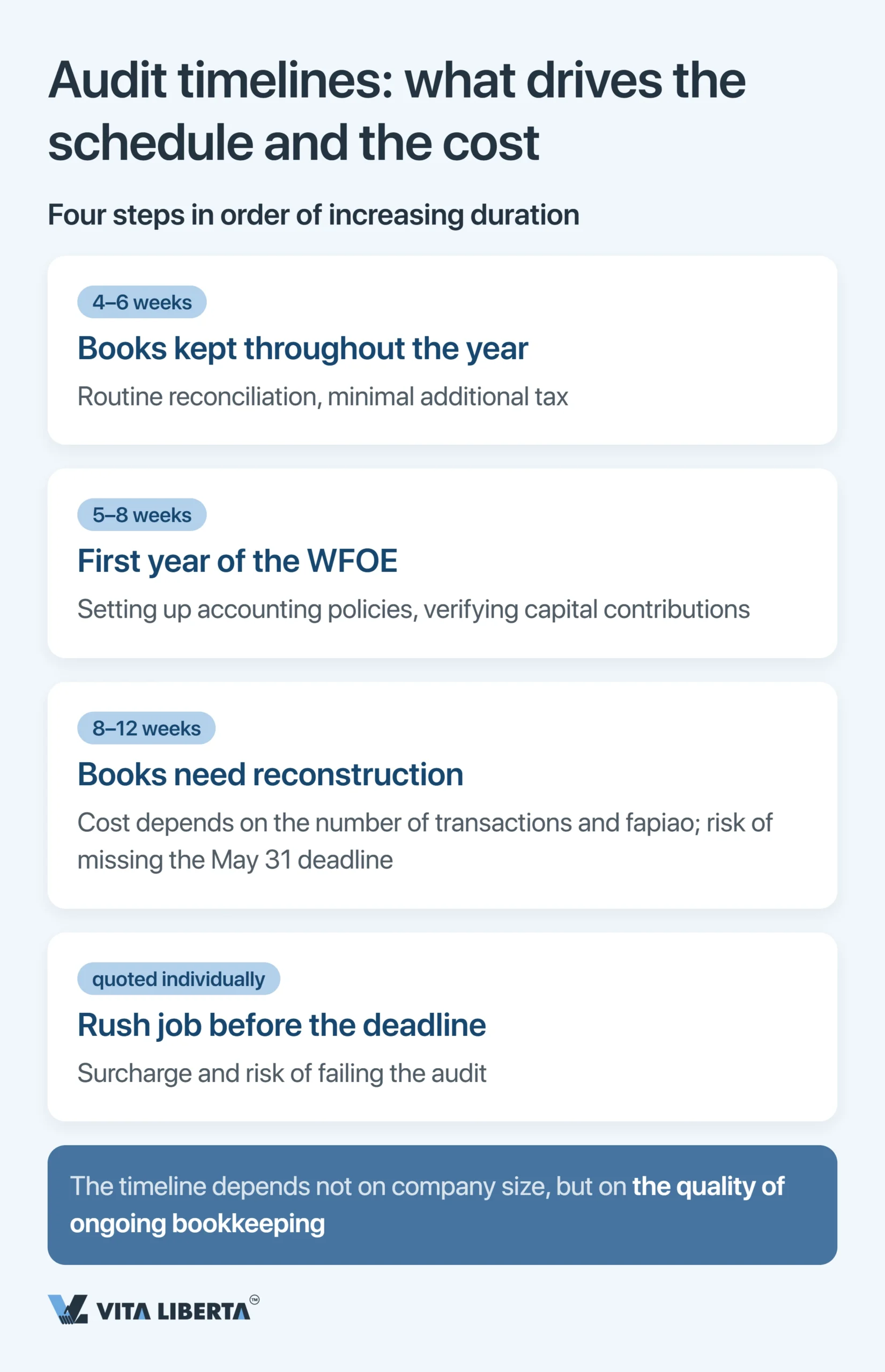
| Your books | Audit time to plan for | What drives cost and risk |
| Maintained all year | 4–6 weeks | Routine review; extra tax is minor |
| First year of the WFOE | 5–8 weeks | Accounting policy to approve, capital payments to verify |
| Reconstructed retroactively | 8–12 weeks | Number of transactions and fapiao; 31 May may slip |
| Brought in just before the deadline | Agreed case by case | Urgency surcharge; the review may not pass |
So start in January, not May. Close every month promptly and match your fapiao before you file the return. Then year-end stays a routine close instead of a rescue job on the books.
Costly mistakes foreign owners keep making
The most common and most expensive mistake is English-only bookkeeping. China’s Accounting Law (中华人民共和国会计法) requires records in Chinese. A foreign language is allowed only as a parallel version. If you hand the tax bureau a package with no Chinese original, it comes straight back.
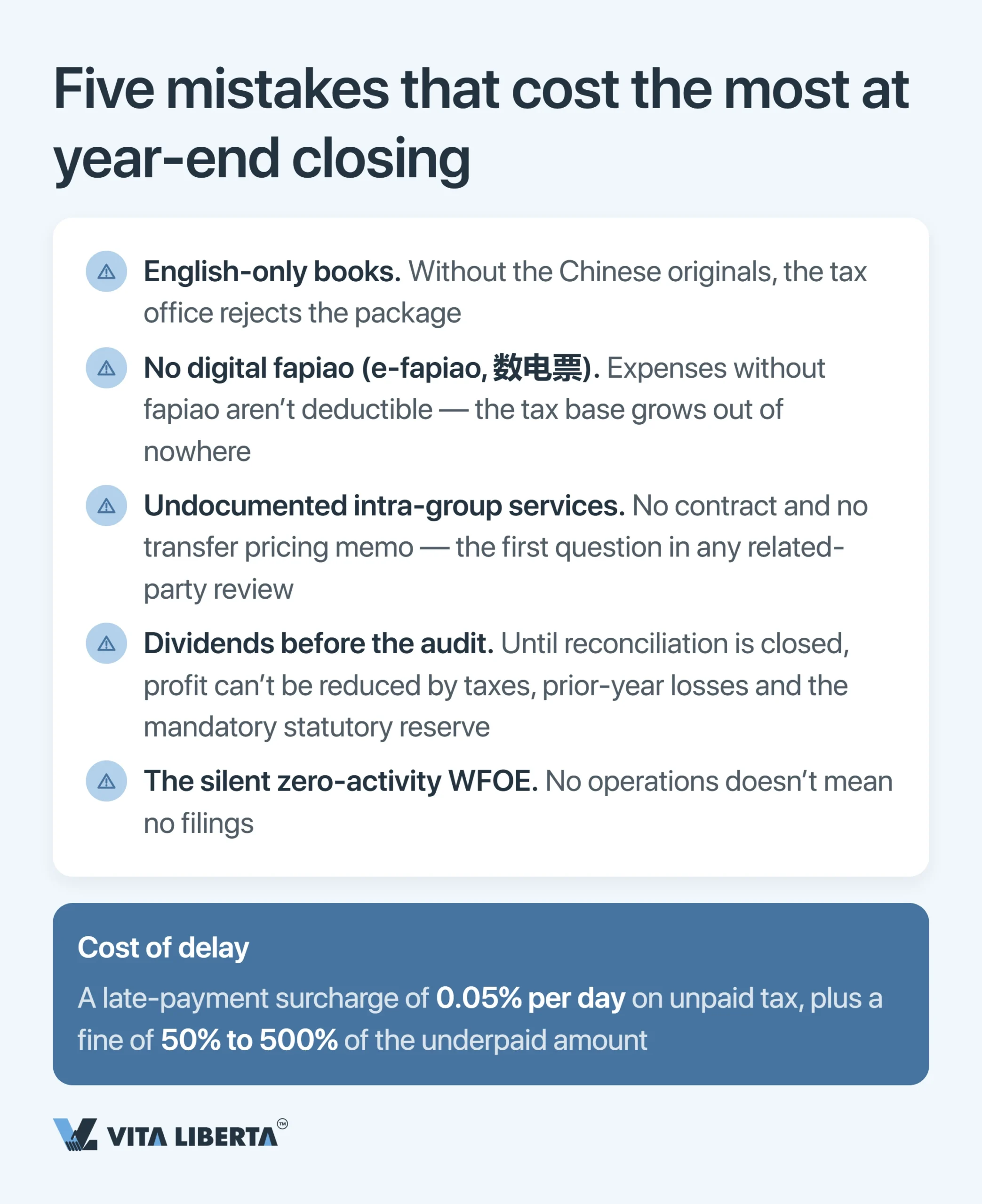
The other mistakes, ranked by cost:
- Expenses with nothing to back them. A cost reduces taxable profit only if a valid pre-tax deduction voucher supports it (税前扣除凭证, STA Announcement 2018 No. 28). Usually that voucher is a fapiao, on paper or electronic. Fully digital fapiao (数电票) have been in use nationwide since 1 December 2024 (STA Announcement 2024 No. 11). You need the voucher before the annual reconciliation closes. Otherwise your tax base grows for no reason.
- Group services on a handshake. In a related-party review, the first things requested are the contract and how the price was set. You submit a related-party report (关联申报) together with the annual EIT return. Above certain thresholds, you also need transfer pricing files (同期资料), under STA Announcement 2016 No. 42.
- Paying dividends before the audit. Until the audit and reconciliation are closed, you can’t subtract taxes, earlier losses and the compulsory reserve from profit.
- The quiet dormant WFOE. A year without deals still requires returns. “We had no business” is not the same as “we have nothing to file.”
Get your WFOE’s books in order before the audit
- Bookkeeping reconstruction
- CAS accounting setup
- Audit package for the CPA firm
WFOE audit and annual reporting in China: what it adds up to
The system looks rigid: two deadlines, two signatures and automated Golden Tax checks. Yet that rigidity is what gives you freedom later. With a clean audit, your preferential rates and R&D deductions are harder to challenge, and taking profit out becomes straightforward.
- The audit and reconciliation depend on current bookkeeping. Reconstructing the year in April costs many times more.
- 31 May and 30 June are two windows run by two agencies. The audit report has to be ready before both.
- Dividends, your bank and your record in the register all rest on a single document: the audit report.
Treat the annual audit as a way to manage company value, not as paperwork at the finish line. The cleaner the report, the cheaper and quicker every step that follows it.
WFOE annual audit and reporting in China: 5 key questions
Not quite, because 31 May is the deadline for something else. It is the last day for the annual EIT return and the 汇算清缴 settlement, five months after the tax year closes. The audit report has to come before that, since the return takes its numbers from it. Plan the audit for February or March.
Yes. The audit obligation applies whether or not the company had revenue. An inactive WFOE still keeps books, even if every line is zero. It also files its tax returns and submits the annual report. Without that report it ends up on the public 经营异常名录 list, whether or not it did any business.
No. Only local firms holding a Chinese licence can perform China’s statutory audit. The report is in Chinese, follows CAS and carries the signatures of two Chinese CPAs. Your group’s IFRS accounts are for your head office’s internal management and cannot replace the Chinese report.
A Chinese bank servicing your company looks beyond the account statement. It also checks the tax you paid, your fapiao, your FX paperwork and your business licence. The audit report is the shared base that the tax bureau, the bank and the register all work from. Weak year-end accounts make it harder to extend your banking relationship and to get an FX payment through.
Two things must be finished before any dividend: the audit and the annual tax reconciliation. After that, profit is cleared in stages. Tax comes out first, then losses carried over from earlier years, then the compulsory reserve. Each year you set aside 10% of profit for the reserve until it equals half of registered capital. If the shareholder is a non-resident, 10% is withheld at source on the payout. A tax treaty with the investor’s home country can lower that rate, provided you meet its conditions (国税函〔2009〕81号). If you send more than USD 50,000 (or the equivalent) abroad, the bank will ask for three documents (汇发〔2017〕3号): the decision to distribute profit; the original tax record-filing form for the payment; the audited accounts. Schedule the payout after 31 May rather than alongside the year-end close.