Hongkong
 China




The money has landed in your Shanghai account. Yet you can’t use it until the foreign exchange control system lets it through.
Mainland China is not a free harbour for capital. The yuan here is only partly convertible, and the state manages that line. Trade flows move freely; capital flows are policed closely. The regime is run by the State Administration of Foreign Exchange (SAFE). It is SAFE registration that turns a company that exists on paper into one that actually operates.
The core problem: “I paid in the registered capital of my WFOE. A supplier in Europe invoiced us for equipment, and the bank accepted the transfer — then froze it and asked for a bill of lading. The company exists, the money exists, but nothing moves. What did I miss?”
Foreign entrepreneurs ask this more often than almost anything else. What they underestimated: in China, you build your currency setup together with the company, not after it.
SAFE and how China’s FX control is built
SAFE works under the People’s Bank of China (PBOC). It oversees every foreign-currency operation by Chinese residents. The whole system stands on two supports. Operations are split into two tracks. And the actual checking is handed to commercial banks.
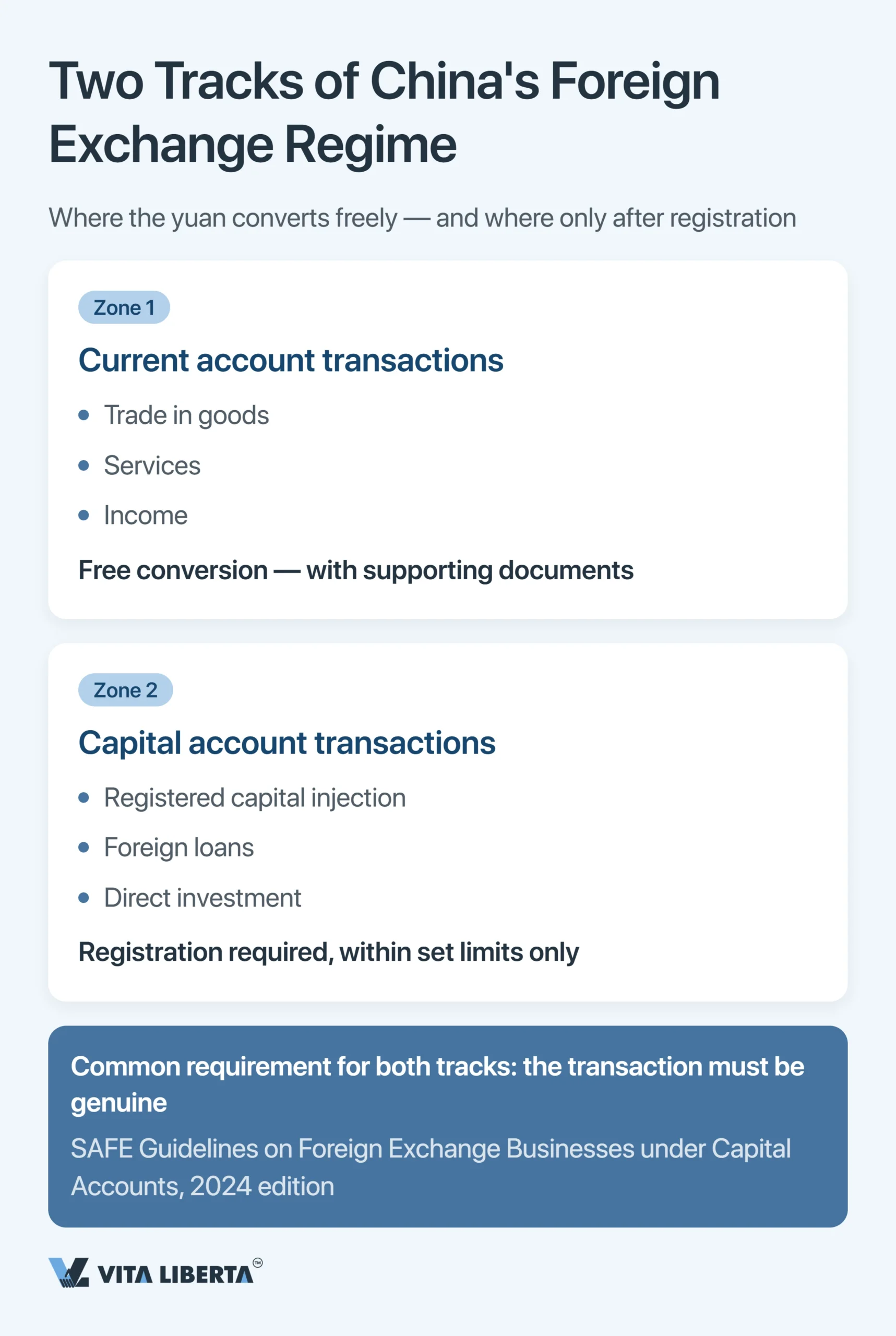
Current account vs capital account: where convertibility stops
This split is not a technical detail. It tells you what you can take out of the country.
If your payment is for goods, services or income, it belongs to the current account. You can convert it freely — as long as you have documents behind it. If you are bringing in registered capital, taking a foreign loan or making a direct investment, that is the capital account. Here money moves only after registration, and only within limits.
The freedom is illusory if you can’t prove the deal. Banks have to confirm that a real business transaction sits behind each cross-border payment. That duty comes from SAFE’s rules on how banks review clients and transactions (银行外汇展业管理办法(试行), SAFE Announcement No. 1 of 2023). Capital account procedures are spelled out step by step in SAFE’s capital account guidelines (资本项目外汇业务指引(2024年版), 汇发〔2024〕12号), in force since 6 May 2024. Some steps became simpler from 15 September 2025 under 汇发〔2025〕43号 (Circular 43). The bank does not ask why you pay. It asks whether the deal behind the payment is real.
Your bank, not a SAFE counter, does the registration
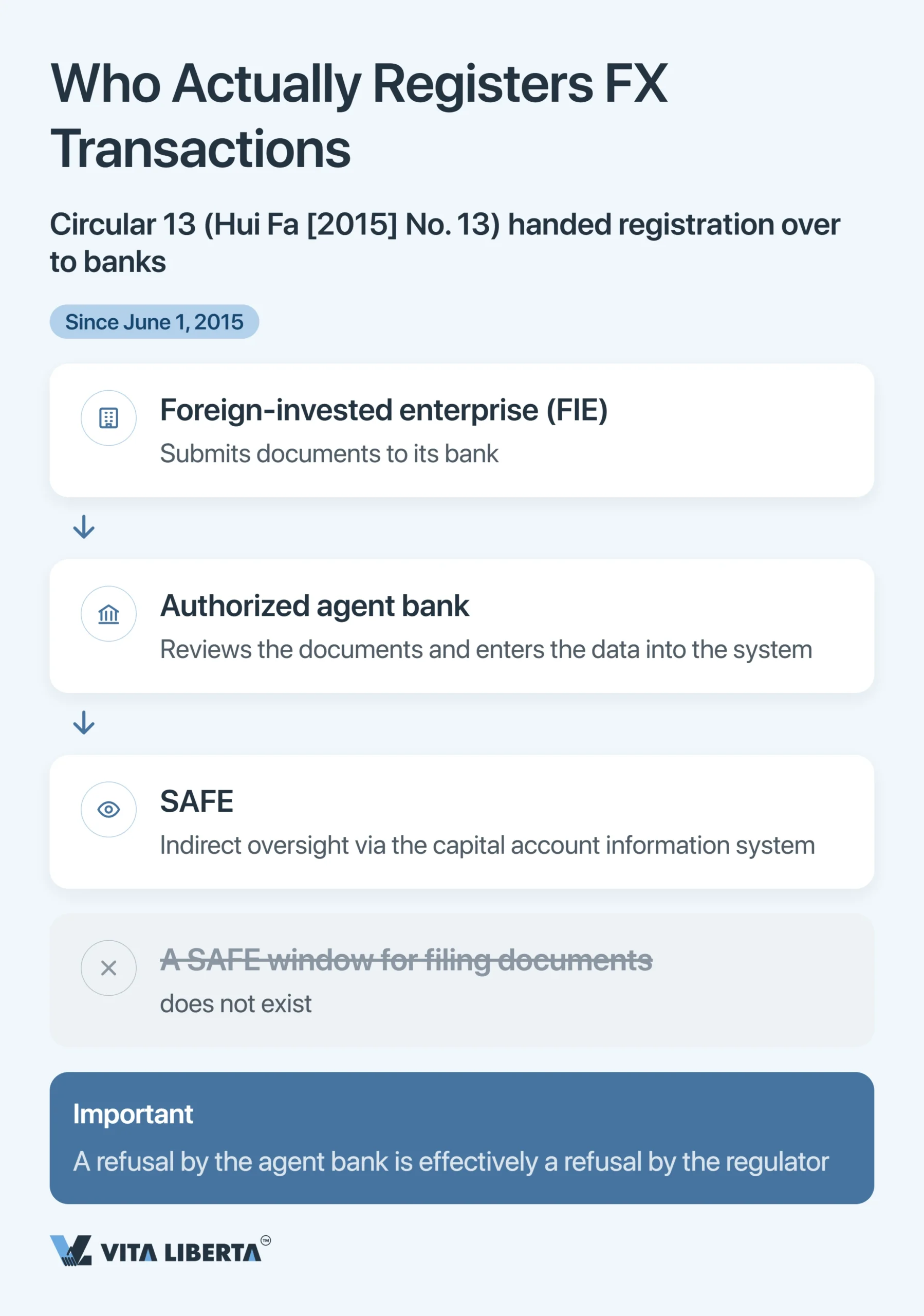
Newcomers often look for a SAFE office where they can hand in FX registration papers. That counter closed long ago. Circular 13 (国家外汇管理局关于进一步简化和改进直接投资外汇管理政策的通知, 汇发〔2015〕13号) moved FX registration for direct investment to designated banks from 1 June 2015. SAFE now supervises indirectly, through its capital account information system.
In practice, this changes everything. Your first FX regulator is a bank, not a government agency. The bank enters your data into the SAFE system, checks your documents and decides what happens to each payment.
Important: if your designated bank says no, treat it as the regulator saying no. Going to SAFE directly to challenge it is pointless — agreeing the transaction with the bank in advance is far easier.
Registration at entry: the capital account and registered capital
Your first FX registration does not happen “some time later”. It happens when you open the capital account and pay in registered capital. Under the reformed PRC Company Law (中华人民共和国公司法, 2023 revision, effective 1 July 2024), you have 5 years from incorporation to pay it in full. If your company was registered before 30 June 2024 and its remaining payment period runs longer than 5 years, you must shorten it to 5 years by 30 June 2027.
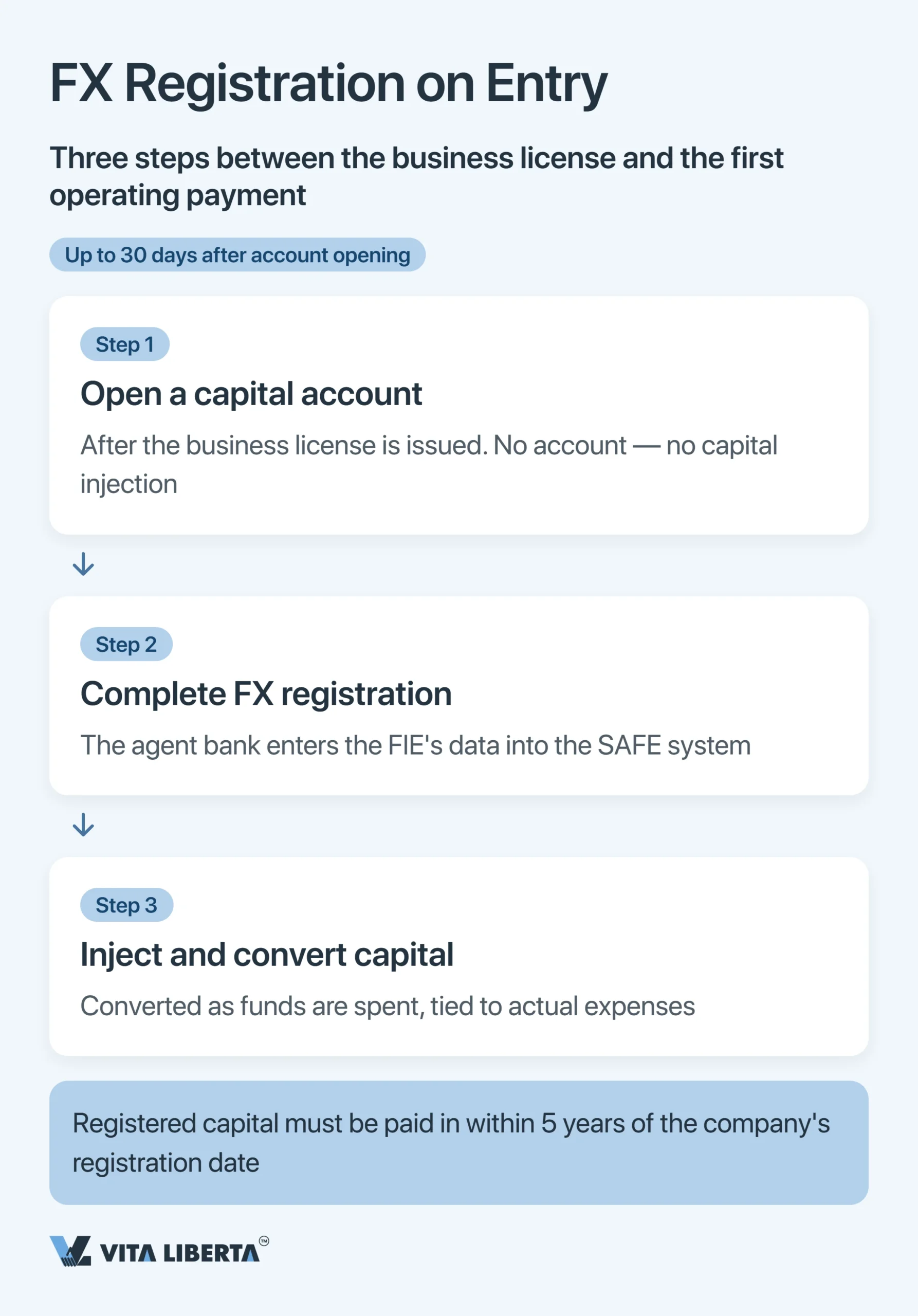
| Stage | What is registered and where | Practical timing and risk |
| FIE registration at the bank | The designated bank records the FIE’s basic information (外商投资企业基本信息登记) in the SAFE system | Happens after you get the business licence and before the capital account opens; skip it and no account will be opened |
| Opening the capital account | A dedicated account at a designated bank to receive capital | Opened on the strength of the FIE registration; without it you cannot bring capital in |
| Injecting and converting capital | Foreign currency is credited; since 1 June 2015 you may convert it into RMB whenever you choose (discretionary settlement, 意愿结汇, Circular 19 — 汇发〔2015〕19号), and the RMB waits in a separate account until you pay it out | The freedom covers conversion only: the bank checks every spend from capital against documents, and banned uses sit on a “negative list” (Circular 16 — 汇发〔2016〕16号, shortened from 15 September 2025 by Circular 43) |
Shareholder loans and the thin capitalization limit
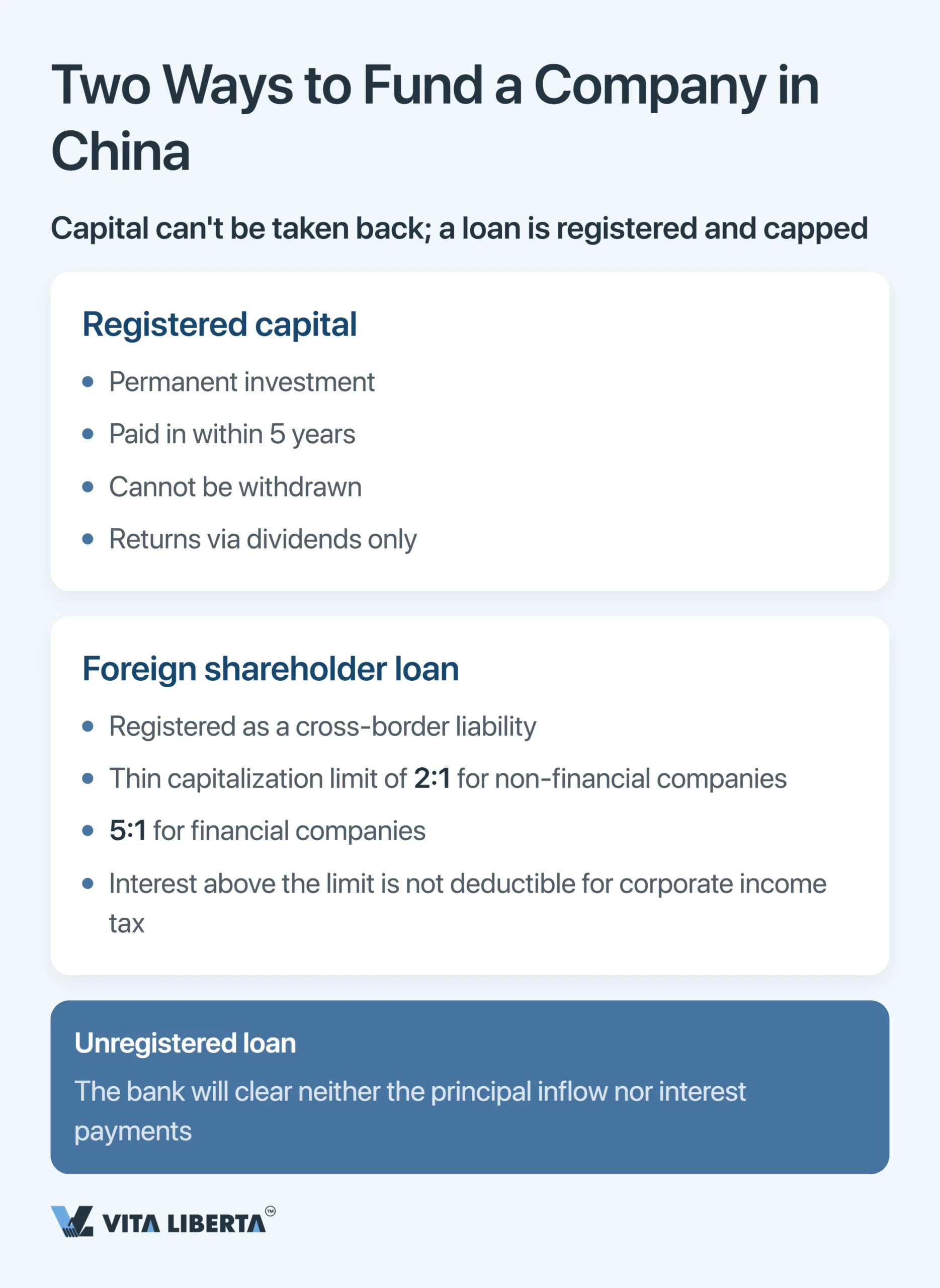
You can also fund the company with a loan from its shareholder. But this is not a free transfer to “your own” company. It is foreign debt that must be registered and stays under an FX quota. The interest, in turn, falls under a tax cap on thin capitalization.
Debt-to-equity (tax rule). Interest on related-party loans lowers corporate income tax only while the debt stays within 2 times equity for a non-financial company, or 5 times for a financial one (财税〔2008〕121号). You may borrow more. You just won’t get a tax deduction for interest on the excess. How much you can borrow from abroad is a separate FX question. An FIE picks one of two models: the “total investment gap” (投注差 — total investment minus registered capital) or the macro-prudential model (银发〔2017〕9号).
Registering the debt. The loan goes on record as a cross-border liability (外债登记管理办法, 汇发〔2013〕19号). SAFE rules require this no later than 3 working days before you draw the funds; in some regions your bank handles it. If you skip it, the bank will block both the principal coming in and the interest going out.
On-the-ground practice. Consultants in Ningbo (Zhejiang province) note that inspectors first compare the loan purpose you declared with what actually moves through the account.
Complete FX registration in China without frozen payments
- Capital account opening
- SAFE registration
- Pre-clearing transactions with the bank

Current account: how trade and service payments are checked
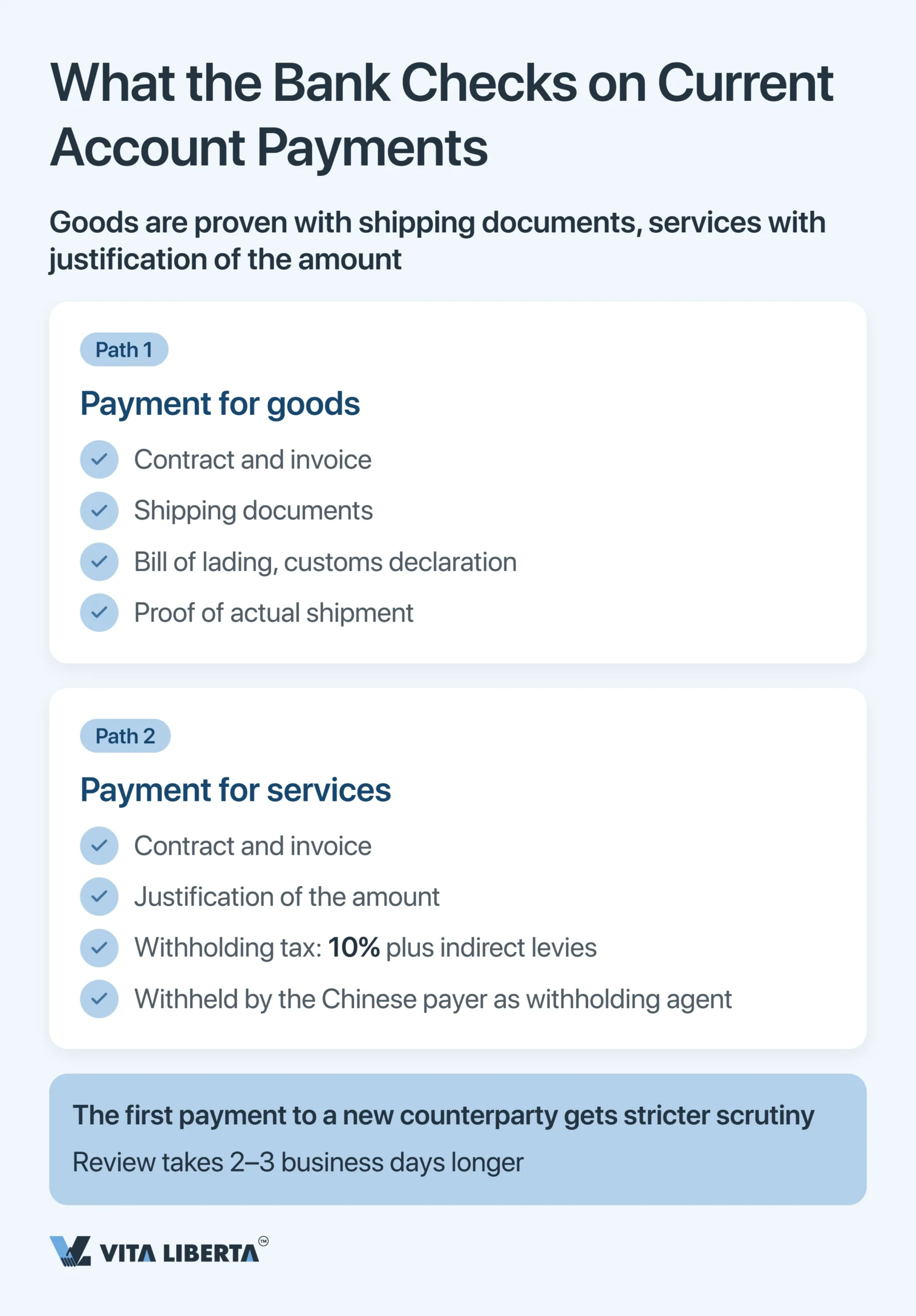
For current account items, money in the account is not enough. The bank releases a payment once you have shown the deal is real. For goods, expect requests for shipping documents and proof of export: invoice, contract and, where needed, a bill of lading and customs declaration. For services, you justify the amount. Your first payment to a new counterparty always gets a harder look: checks on incoming export proceeds take an extra 2–3 working days.
Paying for services: the Chinese payer withholds tax
This is where foreigners who never adjusted their pricing to China lose money. When a Chinese company pays a foreign service provider, it acts as the withholding agent. It deducts tax from the payment before sending it.
VAT is the main tax here. Under the PRC VAT Law (中华人民共和国增值税法, in force from 1 January 2026) and its implementing regulations (国务院令第826号), a service a foreign supplier sells to a buyer in China counts as consumed in China. The only exception is a service consumed entirely on the spot outside China. Since 1 September 2021, no surcharges — urban construction tax or education surcharges — apply to this VAT (财政部 税务总局公告2021年第28号).
Corporate income tax depends on where the work is done. If you render the service entirely outside China, it is out of scope. If your specialists work in China, you may end up with a permanent establishment, taxed under its own rules. The 10% withholding rate does not hit services at all. It applies to passive income: royalties (software licences included), interest, rent and dividends.
Bottom line: if the contract doesn’t say who bears the tax, the supplier gets less than planned — and learns about it only after the money arrives.
Profit repatriation: four conditions before dividends leave China
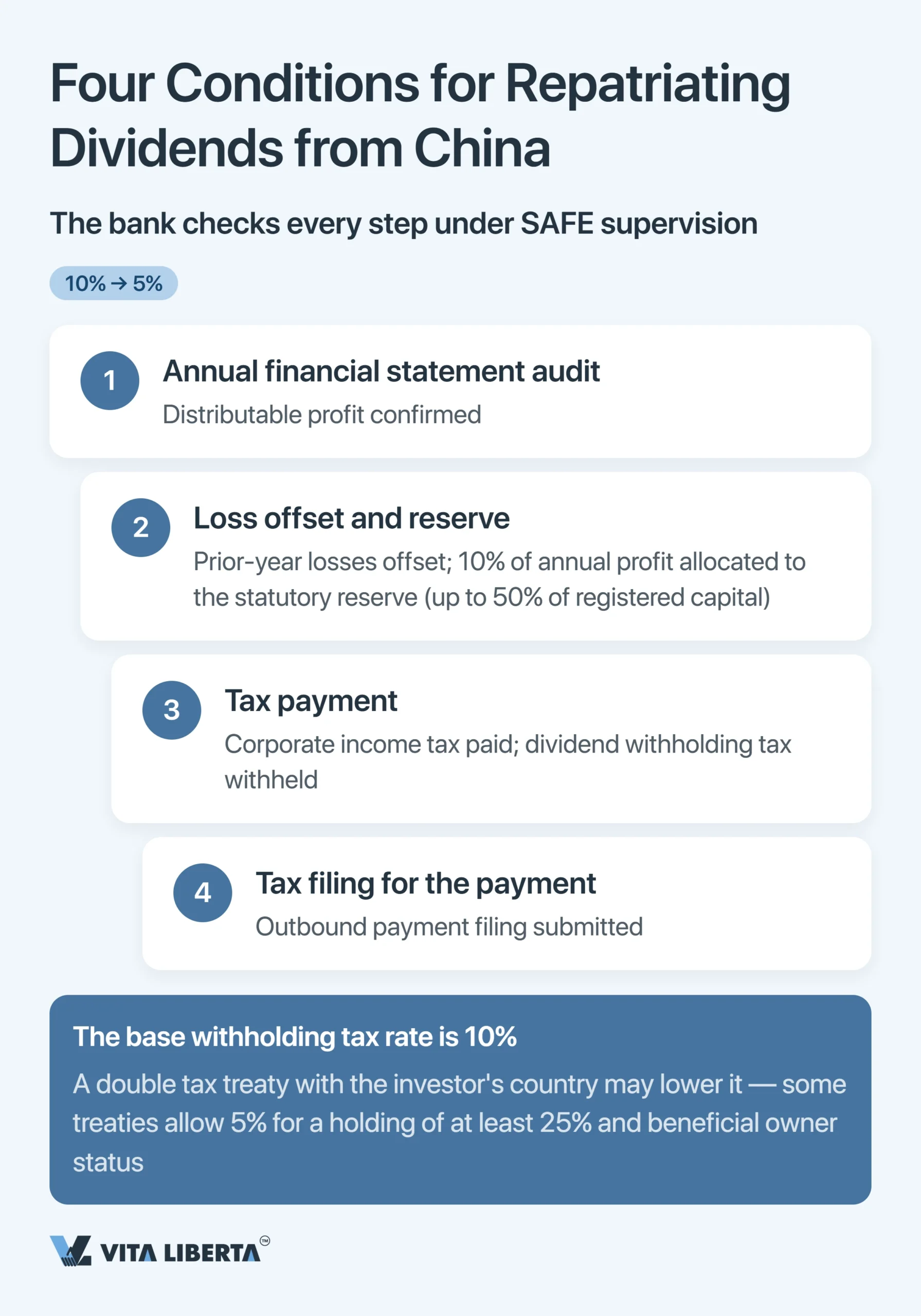
Taking profit out of China is where all this FX discipline leads. You can pay dividends only once four conditions are met, and the bank checks each one under SAFE oversight.
| Condition | What you prove | What a mistake costs |
| Annual audit | That the audit shows distributable profit; if you transfer more than USD 50,000 equivalent, the bank reviews the audited statements and the profit distribution resolution (汇发〔2017〕3号) | No audit — the bank won’t take a transfer above the threshold |
| Losses covered, reserve funded | That past losses are made good and 10% of annual profit went to the reserve (until it reaches 50% of registered capital) | Paying out while losses remain is an unlawful distribution |
| Taxes paid | That corporate income tax is paid and dividend tax withheld | Without the tax settlement, the transfer won’t be released |
| Tax filing of the payment | For a single payment above USD 50,000 equivalent — an outbound payment tax filing (对外支付税务备案, 国家税务总局 国家外汇管理局公告2013年第40号); once per contract, before the first payment | Your first payout is held up for weeks or months |
Bottom line: dividends are not a till you open whenever you like. They come out at the end of a tightly documented chain.
Withholding tax rate and DTA relief
10% is the base withholding tax on dividends paid to a non-resident. Every preference is measured from that figure. A double tax agreement (DTA) between China and your country can bring it down — in some treaties to 5%. The usual conditions: the recipient is a company, it holds at least a set stake (often 25%), and it qualifies as the beneficial owner of the income.
You don’t get this automatically. The recipient decides for itself whether it meets the treaty terms. It then claims the benefit through the Chinese withholding agent by handing over the form 《非居民纳税人享受协定待遇信息报告表》. Proof of tax residence and beneficial ownership stays with the recipient in case the tax authority checks later (国家税务总局公告2019年第35号; beneficial owner criteria — 国家税务总局公告2018年第9号). The exact rate and threshold depend on your treaty. No form — and the agent withholds the standard 10%.
The alternative to taking money out is to reinvest it. Say you put dividends from a Chinese company into direct investment in China between 1 January 2025 and 31 December 2028. You can then credit 10% of the reinvested amount against tax withheld on your later Chinese income, and withholding tax on the reinvested profit is deferred (财政部 税务总局 商务部公告2025年第2号). The FX side got simpler from 15 September 2025: you can reinvest foreign-currency profit inside China directly, crediting it to the capital account of the company you invest in (Circular 43).
Repatriate profits from China without overpaying tax
- Repatriation conditions check
- Withholding tax file
- Beneficial owner proof for DTA relief

China FX control: strategic takeaways
China’s regime holds a paradox. Tight control over capital sits right next to free conversion for current account items. The same system that slows your dividends waves through payment for real exports. The winner is not the one who tries to get around it, but the one who builds the FX setup from the start.
- Register FX operations as you open accounts — not after the first payment gets stuck.
- Keep capital and current flows apart in your books: conversion and taxes both depend on it.
- Prepare the profit repatriation file early: audit, reserve, taxes and proof of beneficial ownership.
So SAFE registration is not a bureaucratic barrier at the entrance. It is the frame that makes your cash flow predictable. A duty to the regulator becomes a tool for managing the company’s money, and FX control stops being an obstacle — it becomes a map of safe routes for your funds.
Frequently asked questions
No separate visit to SAFE is needed. Since 1 June 2015 (Circular 13, 汇发〔2015〕13号), a designated bank handles FX registration for direct investment, and SAFE supervises indirectly through its system. What to do: plan the FX registration for the same step as opening the capital account — that saves weeks.
Yes. Since 1 June 2015, an FIE may convert foreign-currency capital into RMB at any time (discretionary settlement, 意愿结汇, 汇发〔2015〕19号); the RMB sits in a special account until you pay it out. The control has moved to spending: the bank checks each payment from capital against documents, and banned uses are on the “negative list”. What to do: time the conversion around the exchange rate, and have documents ready for every expense (rent, salaries, purchases) in advance.
As withholding agent, the Chinese payer deducts VAT if the service is consumed in China; no surcharges apply to that VAT. Corporate income tax arises only if the services were performed in China and created a permanent establishment. The 10% withholding applies to royalties, interest and other passive income, not to service fees. What to do: state in the contract who bears the tax, and build it into your price.
You can remit dividends only after the audit, after covering losses and putting 10% into the reserve fund, and after paying taxes. For transfers above USD 50,000 equivalent, the bank reviews the profit distribution resolution, the audited statements and the stamp confirming the payment’s tax filing. What to do: start assembling the file right after year-end — don’t wait until the moment of transfer.
Many of China’s DTAs allow 5% instead of the base 10%, but usually only for a company holding at least 25% and qualifying as beneficial owner of the income. What to do: check the exact threshold and rate in your country’s treaty and collect proof of residence and beneficial ownership early. These documents aren’t filed in advance — you keep them in case of an audit; the form to claim the benefit goes to the withholding agent.