Hongkong
 China




Ask a sourcing agent what China’s export VAT rebate is worth and you will usually hear “thirteen per cent off cost.” The treasury sees it differently. It pays out exactly what it banked on that particular consignment, and not one yuan on top.
A popular mental picture is the tax-free desk at an airport: hand over a receipt, walk off with cash. A truer one is two databases checked line against line, where a single stray letter in a product description can park your money for months.
The core problem:
“Our purchases in Guangzhou run to about RMB 3 million a year. The factory kept telling us it recovered 13% VAT and had priced that in. So I opened a Chinese company of my own and shipped through it. The refund came to 3%. Where did the remaining 10% disappear to?”
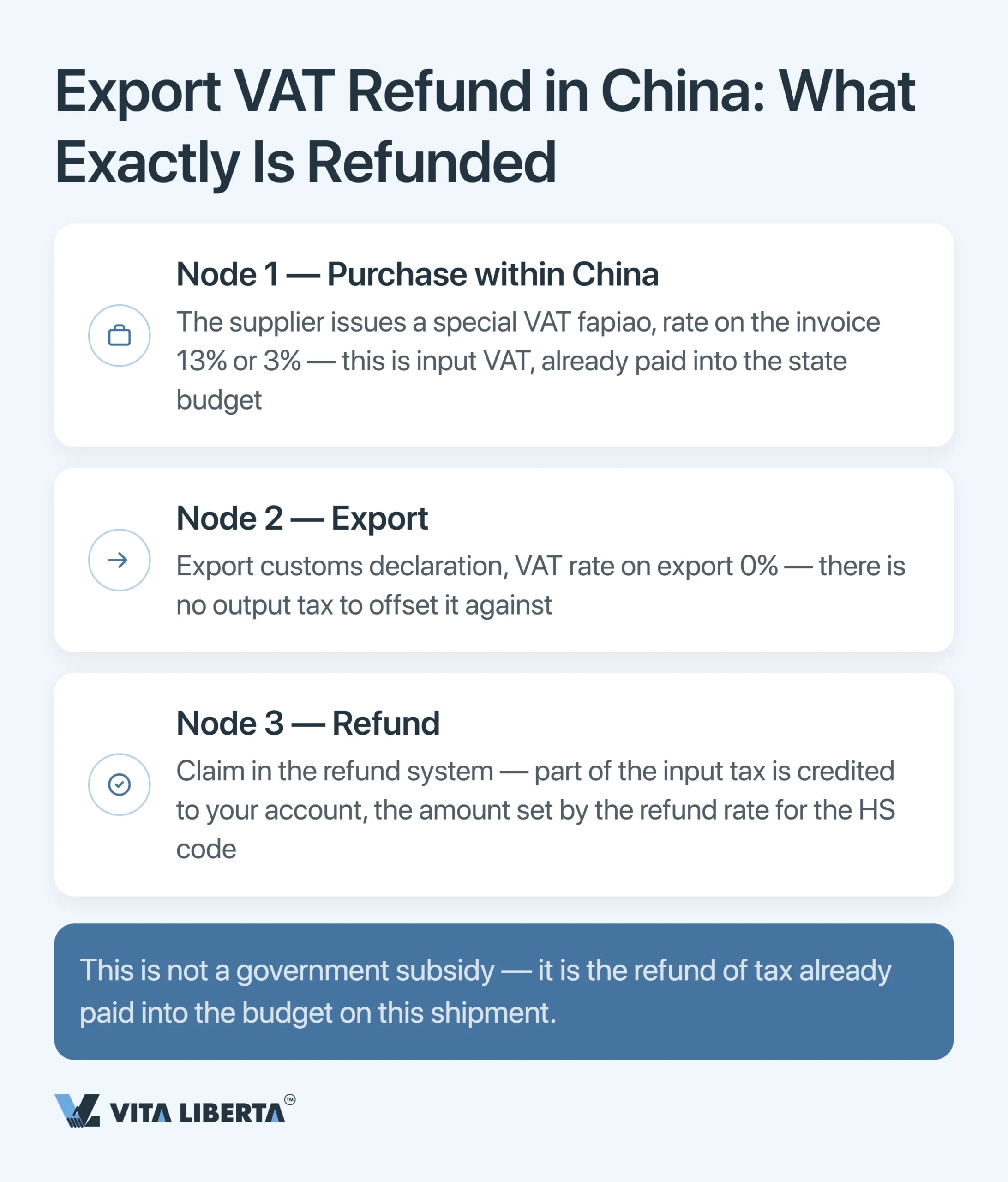
Foreign owners of trading companies in China put this question to us more often than almost any other. The explanation lies in how the system is wired: what goes back is what came in. An export tax rebate returns input VAT. It is not a grant.
The legal plumbing was replaced on 1 January 2026. The old Provisional VAT Regulations (中华人民共和国增值税暂行条例) dropped away. In their place stand the PRC VAT Law (中华人民共和国增值税法, Presidential Order No. 41, passed 25 December 2024) and its Implementing Regulations (中华人民共和国增值税法实施条例, State Council Order No. 826). Goods leaving the country still carry a zero rate. Refund mechanics now live in two national instruments in force from that same date: MOF/STA Ann. 11/2026 (财政部 税务总局公告2026年第11号) and the STA’s administrative rules, Ann. 5/2026 (国家税务总局公告2026年第5号). The engine underneath is the one exporters already knew.
Three Levers: Status, Code, Formula
Whether money comes back hinges on three things at once: who the exporter is in tax terms, what rate its product code carries, and which formula applies. Miss on any one and the whole benefit evaporates.
Status: Only a General Taxpayer Sees Cash
Entitlement attaches to the Chinese company that exports, never to whoever happens to own the cargo. That company can ship in its own name. It can also hand shipping to an agent under an entrustment arrangement (委托出口) and claim as principal on the strength of the agent’s certificate (《代理出口货物证明》). An overseas business with no Chinese entity has no claim whatsoever.
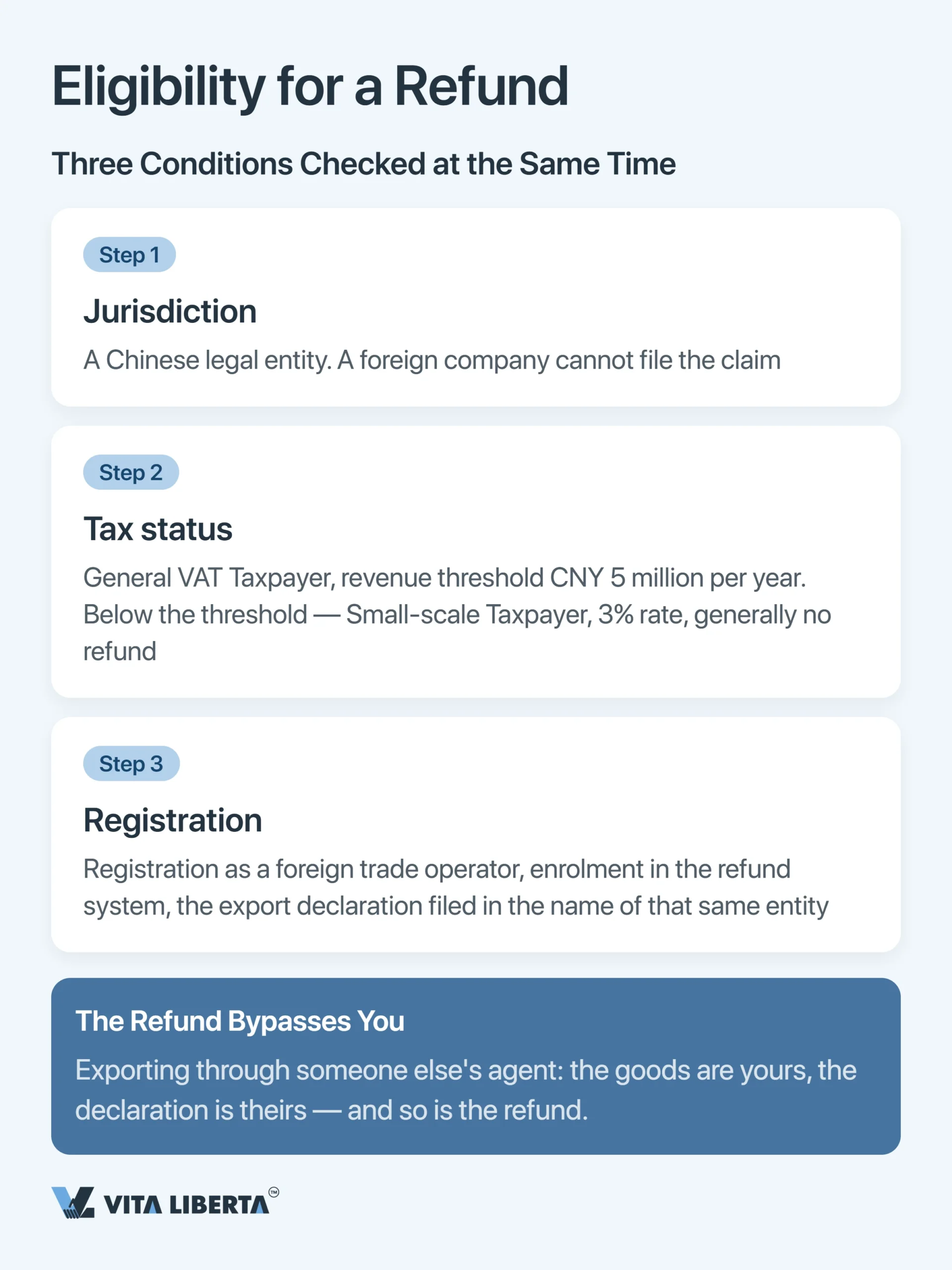
Your exporter needs general VAT taxpayer standing. Under the VAT Law, firms whose taxable sales stay at or below RMB 5 million a year count as small-scale. A company keeping sound books may still opt into general status voluntarily, long before it crosses that line. Small-scale firms pay a deemed 3%; as of 10 October 2026, a concessionary 1% applies until 31 December 2027. Their exports go out VAT-free but carry no refund of tax paid upstream.
Two administrative points complete the picture:
- Export refund record-filing (出口退(免)税备案) has to be in place no later than your first claim.
- Foreign trade operator registration vanished on 30 December 2022, when the PRC Foreign Trade Law was amended, so nothing needs filing there.
This explains an expensive habit among overseas buyers: shipping on someone else’s licence. When a supplier or middleman exports in its own name on its own contract, the refund is theirs to keep. It gets worse if an exporter simply rents out its name for another party’s deal. Today’s rules then strip the refund and tax the consignment as though it had been sold inside China.
Rate: The HS Code Decides, the Fapiao Caps
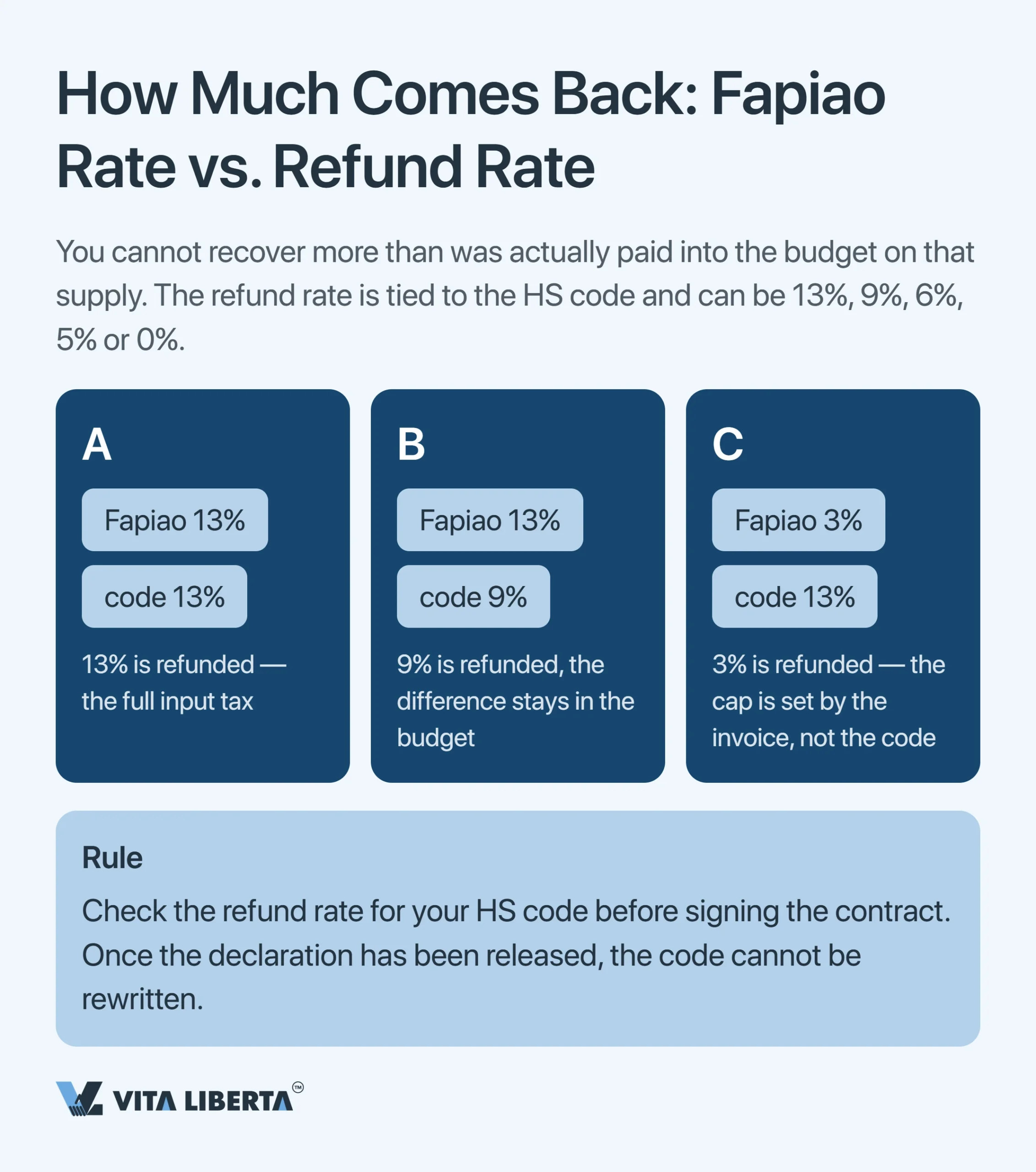
Seeing 13% on an invoice tells you nothing about what reaches your account. The rebate rate (出口退税率) belongs to the customs code. Normally it mirrors the product’s VAT rate, but MOF and STA have trimmed it for some lines, to 9% or 6% for instance, and wiped it out for others. Each code’s live figure sits in the rebate rate library (退税率文库).
On top of that sits a cap. Suppose a trading exporter’s supplier issued its special VAT fapiao at a rate under the rebate rate. The exporter is then refunded at whichever of the two is lower (Ann. 11/2026, §III). Buy from a small-scale supplier on a 3% fapiao, and 3% is your ceiling even for a code rated at 13%. A fapiao showing the concessionary 1% leaves you with 1%. That is the whole story behind the ten missing points in the quote above.
Quick tip: look the code up before you sign. Once customs releases the declaration, the code is fixed for good.
Formula: Traders and Factories Do Different Maths
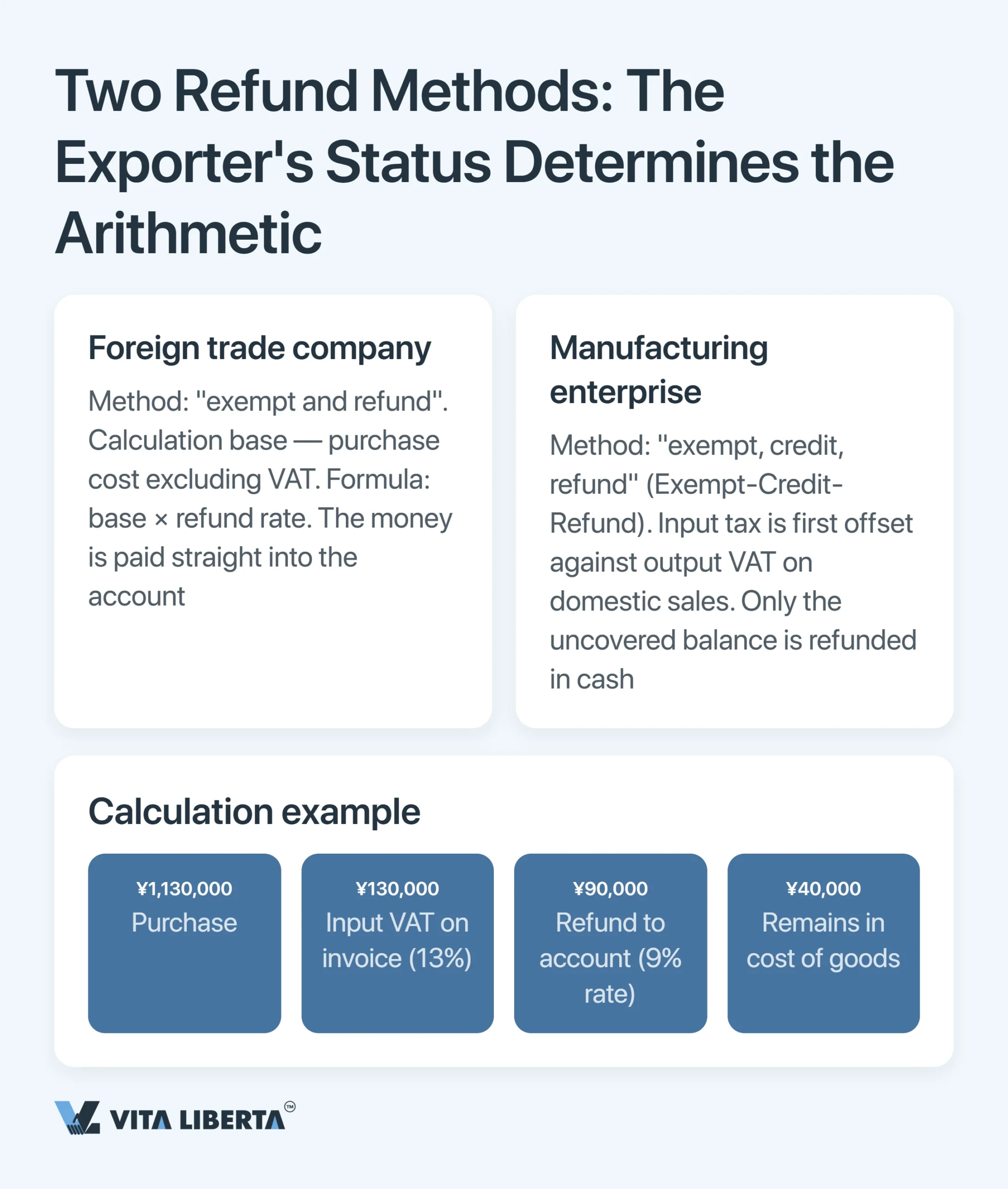
A trading company works on “exempt and refund”: take the VAT-exclusive purchase price and multiply it by the rebate rate. A manufacturer works on “exempt, credit, refund” (Exempt-Credit-Refund): its input tax first offsets output VAT from domestic sales, and only what remains uncovered is paid out in cash.
Here is how it works out. Buy goods for RMB 1,130,000 on a 13% fapiao and you are carrying RMB 130,000 of input tax. If the code’s rebate rate is 9%, RMB 90,000 comes home and RMB 40,000 stays buried in cost for good.
So the rebate is no 13% entitlement. It is the output of three variables, and only one of them is directly in the exporter’s hands: picking a supplier registered as a general taxpayer.
Claim Your China Export VAT Rebate Without Rejections
- Rebate rate check by HS code
- Document package audit
- Support until the refund is paid

Paperwork and Timing: Where Claims Fall Apart
Claims rarely collapse over an arguable point of law. They collapse because one document says something slightly different from another.
The File: When One Character Costs the Refund
What you lodge. With the claim itself, a trading company lodges:
- the supplier’s special VAT fapiao (增值税专用发票);
- the export declaration, or the agent’s 《代理出口货物证明》 for agency exports;
- electronic purchase and export registers.
The tax office then cross-checks everything against customs’ own data.
What you keep instead. A second tier of papers stays with you rather than the tax office:
- purchase and sales contracts;
- the bill of lading or other carriage documents;
- freight fapiao for the domestic and international legs;
- the agreement with your customs broker.
You must gather and index them within 15 days of claiming and hold onto them for a decade (Ann. 5/2026, arts 44–45).
What has to match. Product name and unit must read identically on the declaration and the fapiao. Sharper mismatches do more than sink the refund: the shipment ends up taxed as a domestic sale (same rules, arts 23 and 57). That happens when:
- the fapiao’s name or quantity drifts from the supplier’s dispatch papers; or
- the declaration’s name, quantity or weight drifts from the carriage documents beyond normal shrinkage.
Price. Nothing in the current instruments says that selling abroad below cost triggers rejection by itself. What does bite is an obviously inflated purchase or export price with no justification behind it. That shipment is moved out of the refund regime into plain exemption, and its input VAT is lost (Ann. 11/2026, §IX).
Timing: Three Stages and a Tougher First Round
No official rule promises “three months.” Realistically, months can separate shipment from payout, and that gap belongs in your cash-flow model rather than a footnote.
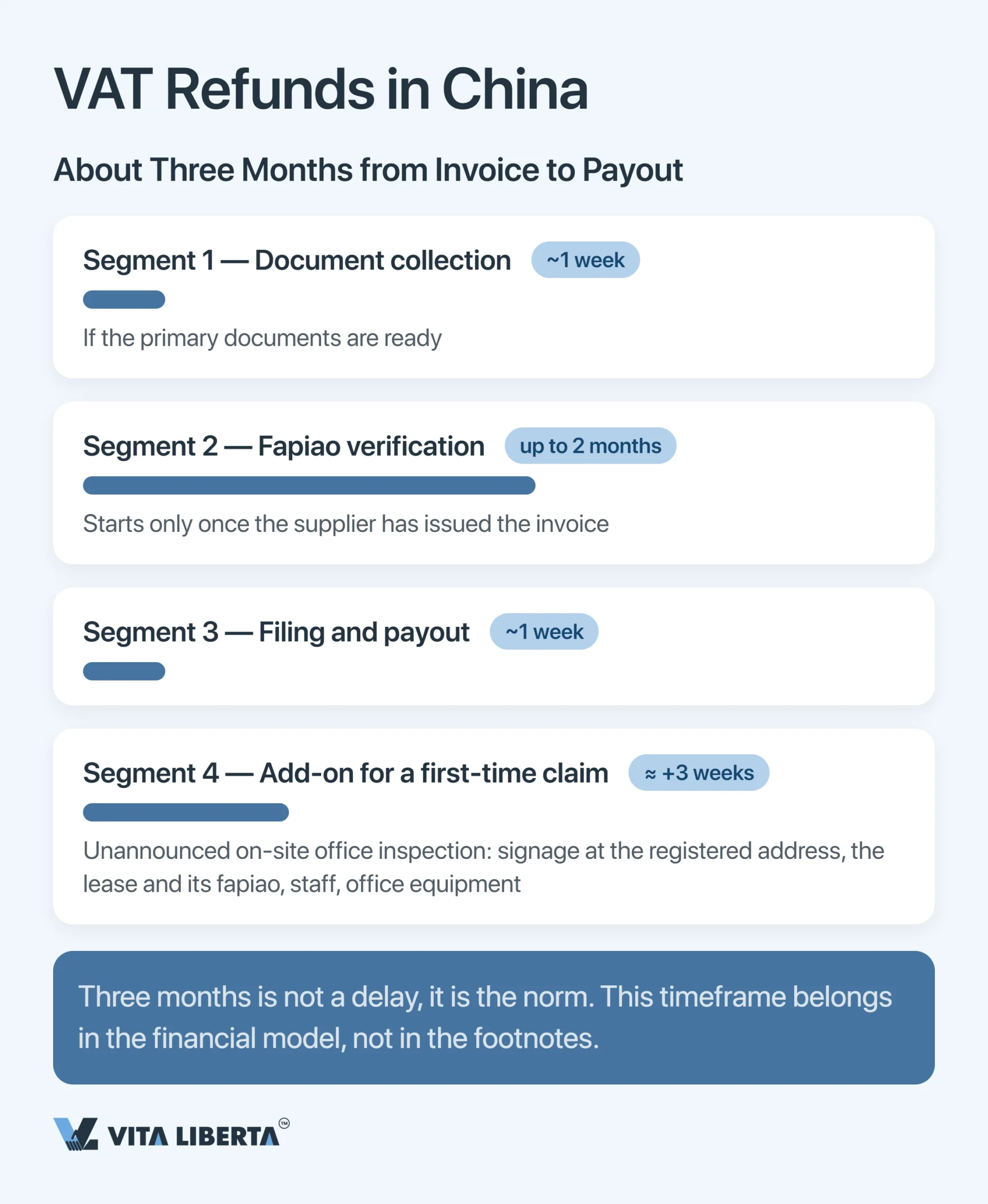
- Pulling the documents together takes about a week if the primary paperwork already exists.
- Waiting for the fapiao is the slow, unpredictable part: the supplier has to issue it and it has to clear the electronic system. Nothing moves until that invoice exists.
- Filing and payout go faster when the inspector raises no queries.
Some limits are fixed:
- You may file from the month after export up to 30 April of the next year, and your foreign-currency proceeds must have arrived by then too.
- Miss that and a route remains: file late with proof of proceeds, but only within 36 months of the export date.
- Beyond that point, any consignment shipped from 1 January 2026 onward is reclassified as a domestic sale and VAT falls due (Ann. 11/2026, §IX; Ann. 5/2026, art. 48).
Treat the first claim as a project of its own. In situations on the STA’s approved list, the tax office may send inspectors on site (实地核查), and the exporter has to take part (Ann. 5/2026, art. 52). They look for proof the business is real: a sign at the registered address, a lease plus its fapiao, people at desks and office equipment.
| Checkpoint | What the rules provide | How it plays out |
| Fapiao confirmation | Claims rest on the supplier’s special VAT fapiao; the tax office accepts one only when its data agrees with supplier and customs records held electronically (Ann. 5/2026, arts 18, 26) | The longest wait in the chain, so plan for it in working capital from day one, not as a closing formality |
| Rate lock-in | Which rate you get follows the export date (出口日期) printed on the declaration (Ann. 11/2026, §III) | Contract date, payment date, declaration filing date: none of them count; in a changeover month the export date alone settles it |
| Currency proceeds | Proceeds are due by 30 April of the year after export; the exporter holds the evidence, and a fixed list of situations qualifies as deemed receipt (视同收汇) (Ann. 5/2026, arts 48–51) | No money in and no deemed-receipt ground means no refund, and a refund already paid gets clawed back |
| Exporter grading | Four management categories (出口企业管理类别), assigned with reference to tax credit grade (A, B, M, C, D) | Lower grades draw more manual review; a Category 4 exporter attaches currency evidence to every single claim (Ann. 5/2026, art. 49) |
2026: What Shifted
Pulling back export support in chosen sectors is now settled policy rather than a one-off. Lists get rewritten faster than suppliers can reprint their price sheets.
9%, Then 6%, Then Nothing: The Reach of Ann. 2/2026
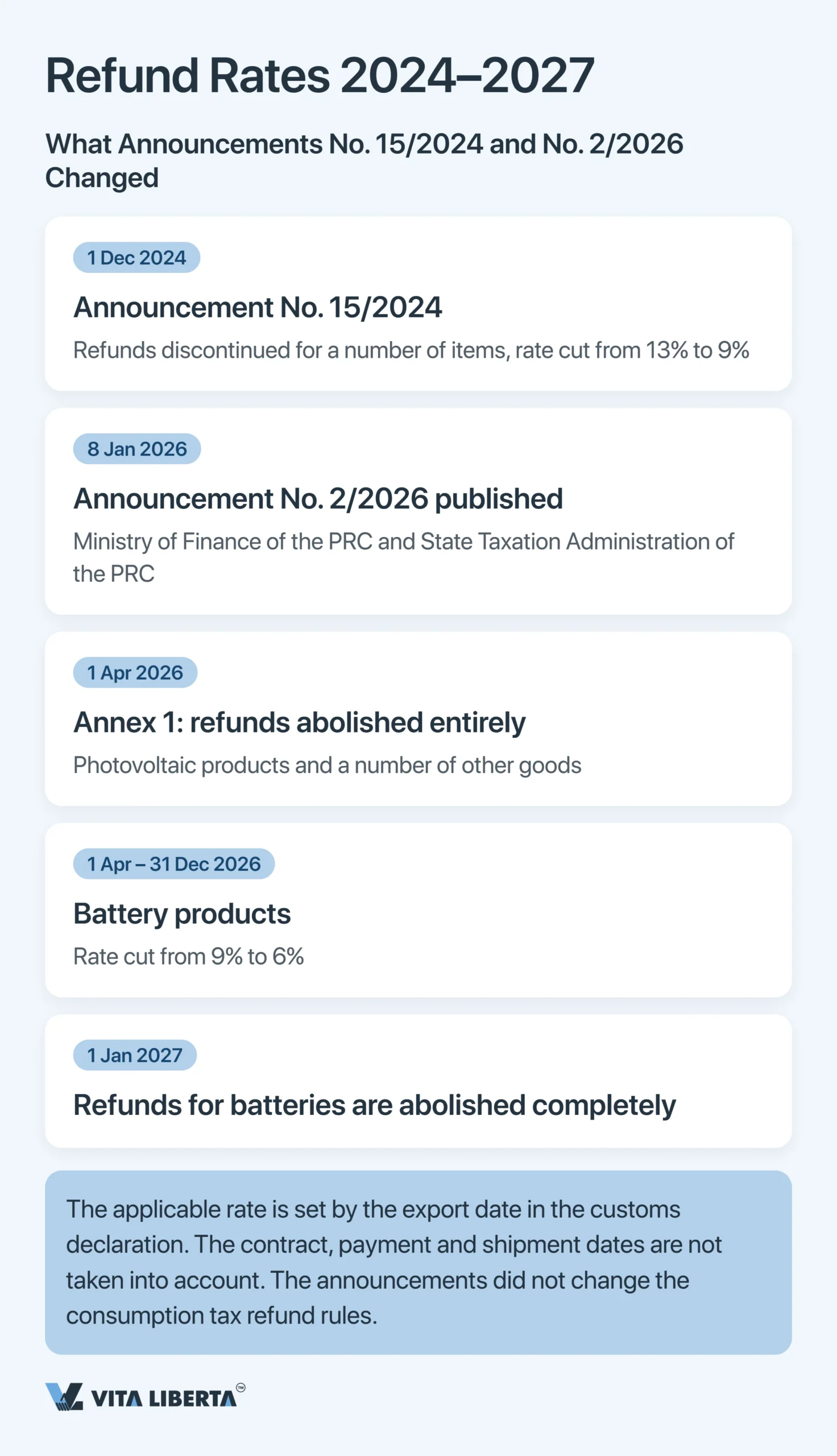
From 1 April 2026, a solar module exporter collects nothing. That flows straight from Ann. 2/2026 (财政部 税务总局公告2026年第2号), signed on 8 January 2026 by China’s Ministry of Finance jointly with the State Taxation Administration (STA, 国家税务总局). Three points are worth keeping in view.
- Annex 1 drops to zero. Photovoltaic products and the other goods listed there lost the refund from 1 April 2026.
- Batteries get a glide path. Between 1 April and 31 December 2026 they earn 6% rather than 9%. From 1 January 2027 they earn nothing.
- The deal date is irrelevant. The export date (出口日期) on the declaration fixes the rate. The date the declaration was filed (申报日期) and the date money changed hands play no part.
None of this came out of nowhere. Ann. 15/2024 (财政部 税务总局公告2024年第15号) took effect on 1 December 2024 and:
- ended refunds on aluminium and copper products and several other items;
- pushed some refined oil products, photovoltaics, batteries and certain non-metallic mineral products down from 13% to 9%.
Ann. 2/2026 also spells out that, for excisable goods on its lists, the way consumption tax is refunded or exempted on export stays exactly as before.
Worth stressing: losing the refund is not an export ban. It pushes 9–13% of tax into the factory gate price. A supplier that blames a “general VAT cancellation” without naming the code in the annex owes you proof before you touch your purchasing budget.
The Economics: Loss Prevention, Not Extra Margin
On a plain resale, the refund earns you nothing. It recovers tax you already paid inside the purchase price, and leaving it unclaimed amounts to gifting the treasury 9–13% of the shipment’s value. Genuine upside shows up in just two cases:
- A supplier that does not export, runs clean books and must issue a special fapiao. That input tax now flows to you instead of dissolving into the price.
- A small or mid-sized factory that never files refunds itself. Big exporters reclaim everything on their own and have nothing left to pass on.
Net effect: the procedure is about not losing rather than earning. Annual purchases of RMB 3 million on 13% fapiao embed roughly RMB 345,000 of input tax. A file that never gets completed throws all of it away at a 13% rebate rate, and around RMB 239,000 at 9%.
Set Up Your Export Company in China the Right Way
- General taxpayer status
- Choosing the model: exporting in your own name or through an agent
- Export rebate record-filing

China Export VAT Rebate: Strategic Takeaways
The regime’s central paradox: the state has built a near-perfect machine of fapiao, codes, electronic checks and end-to-end customs reconciliation. Yet it has kept a manual lever on it, in annex lists that a single announcement can redraw overnight.
- Treat the rebate rate as a variable. Check it per HS code in the rebate rate library (退税率文库) before contracting. It normally equals the VAT rate, but some lines are cut or sit at zero.
- The entitlement belongs to the exporter. Your own Chinese company, registered as a general taxpayer, is the only way the tax lands with you rather than a middleman. It can export directly or through an agent under an entrustment agreement.
- Budget for the delay. Waiting on the supplier’s fapiao and its confirmation stretches things over months, while both the claim and the currency proceeds are bounded by 30 April of the following year. That is a working-capital question, not bookkeeping trivia.
In short, China’s export VAT rebate should be settled when you choose the supplier and the product code, not tidied up once the deal is done. Companies that price the rebate rate in before signing control their landed cost. Those who remember it after customs release are simply writing down losses.
Frequently asked questions
You cannot claim it yourself. Only a Chinese legal entity holding general taxpayer standing can process the refund. It must ship the goods in its own name, or entrust the export to an agent and receive the agent’s certificate (《代理出口货物证明》). Solution: either set up your own export company in China, or contract with an exporter in a way that writes the transfer of the rebate benefit into the price.
Never more than the rate on the supplier’s special fapiao: 3%, or 1% where the concessionary rate is applied (available until 31 December 2027). A higher rate on the HS code will not lift that ceiling. Solution: if your volumes are steady, the 3%-versus-13% gap usually more than pays for moving to a supplier registered as a general taxpayer.
April’s rate counts. Filing in March protects nothing on its own: the inspector reads the export date field (出口日期), not the date the declaration was lodged (申报日期). Whoever took on that risk in the contract absorbs the gap. Solution: in changeover months, agree in writing who pays if the export date slips, and keep the declaration under close control.
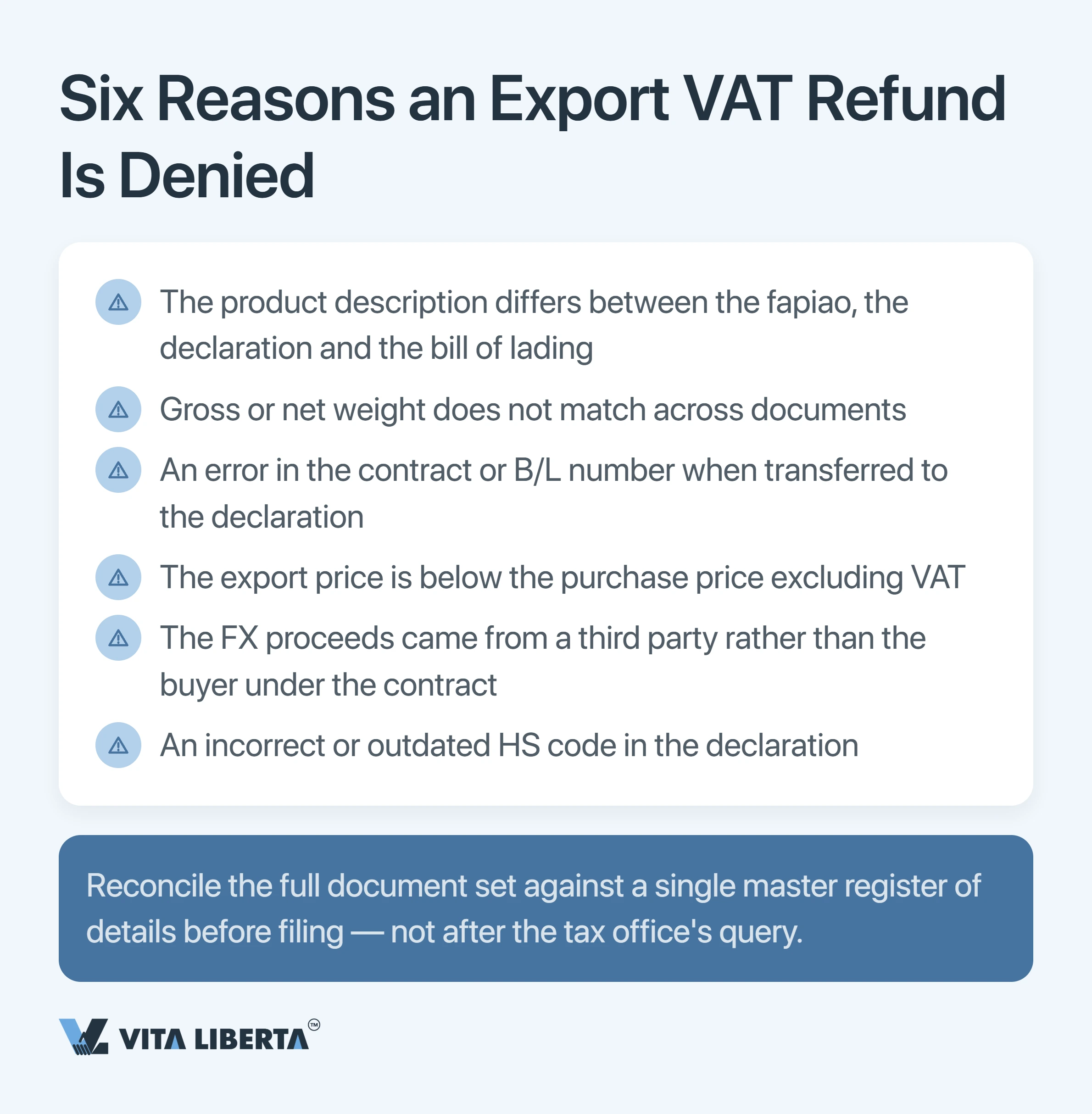
The usual culprits: product name or unit differing between fapiao and declaration; name, quantity or weight differing between declaration and carriage documents; currency proceeds that arrived late; a purchase or export price that is plainly inflated without a reason. Several of these mismatches go further than a refusal and leave you paying VAT as if the goods had been sold domestically. Solution: reconcile the whole file against one master register of details before you lodge it, not after the tax office starts asking questions.
Expect the price to climb by exactly the amount the factory used to collect from the treasury. Annex 1 goods lost their refund on 1 April 2026. Batteries hold at 6% instead of 9% through 31 December 2026 and lose the refund entirely from 1 January 2027. Solution: insist on the HS code and match it against the list. “Our VAT got cancelled” with no code attached is a bargaining move, not a reason to accept a price rise.