Hongkong
 China




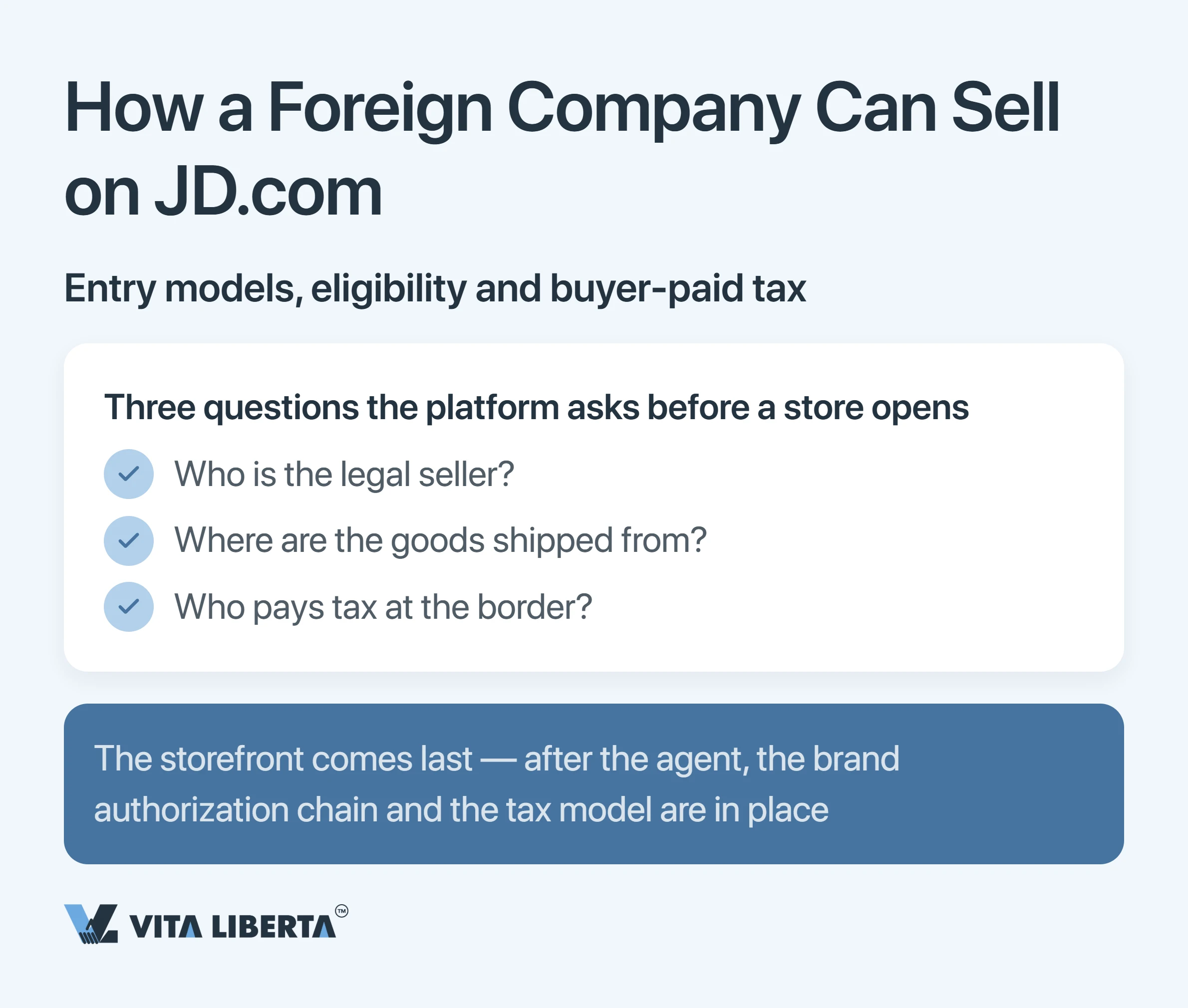
Getting onto JD.com is less like opening an online shop and more like being admitted to a closed market. Your storefront comes last — after the agent, the trademark rights chain and the tax model are in place.
The core problem:
“Our company is in Hong Kong and our warehouse is in Europe. Some people say JD won’t let us in without a Chinese company, others tell us to hand our stock straight to the platform on consignment. Which is true, and where do we start?”
Foreign manufacturers ask us this more than almost anything else. The answer starts with the model you pick, because it decides your costs, your tax and how much control you keep over pricing.
Three Routes onto JD.com for a Foreign Brand
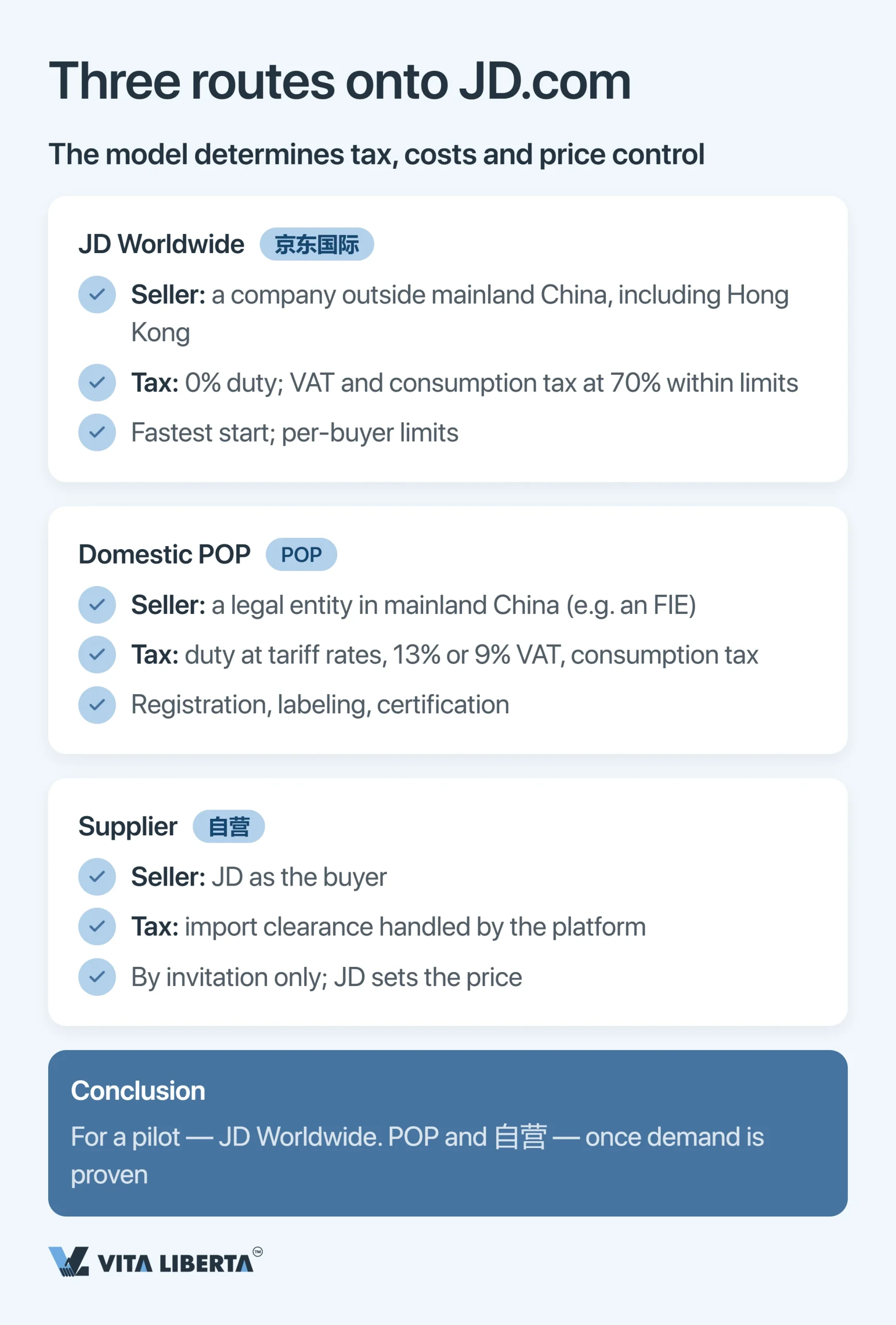
Jingdong (京东) is a retailer and a marketplace at the same time. That is why there are three routes — and they split at the very first question: whose name goes on the contract as the seller.
| Route | Who sells | Tax model | In practice |
| JD Worldwide (京东国际) | A company registered outside mainland China, Hong Kong included | Cross-border retail: within the limits, 0% duty; VAT and consumption tax at 70% of the statutory amount | Confirmed: the fastest start, but with per-buyer limits |
| Domestic POP | An entity registered in mainland China (e.g. an FIE) | General trade import: duty at the tariff rate, VAT of 13% or 9%, consumption tax where applicable | Needs preparation: registration, labelling, certification |
| 自营 supplier | JD buys from you | The platform handles the import | Needs clarification: invitation only, JD sets the price |
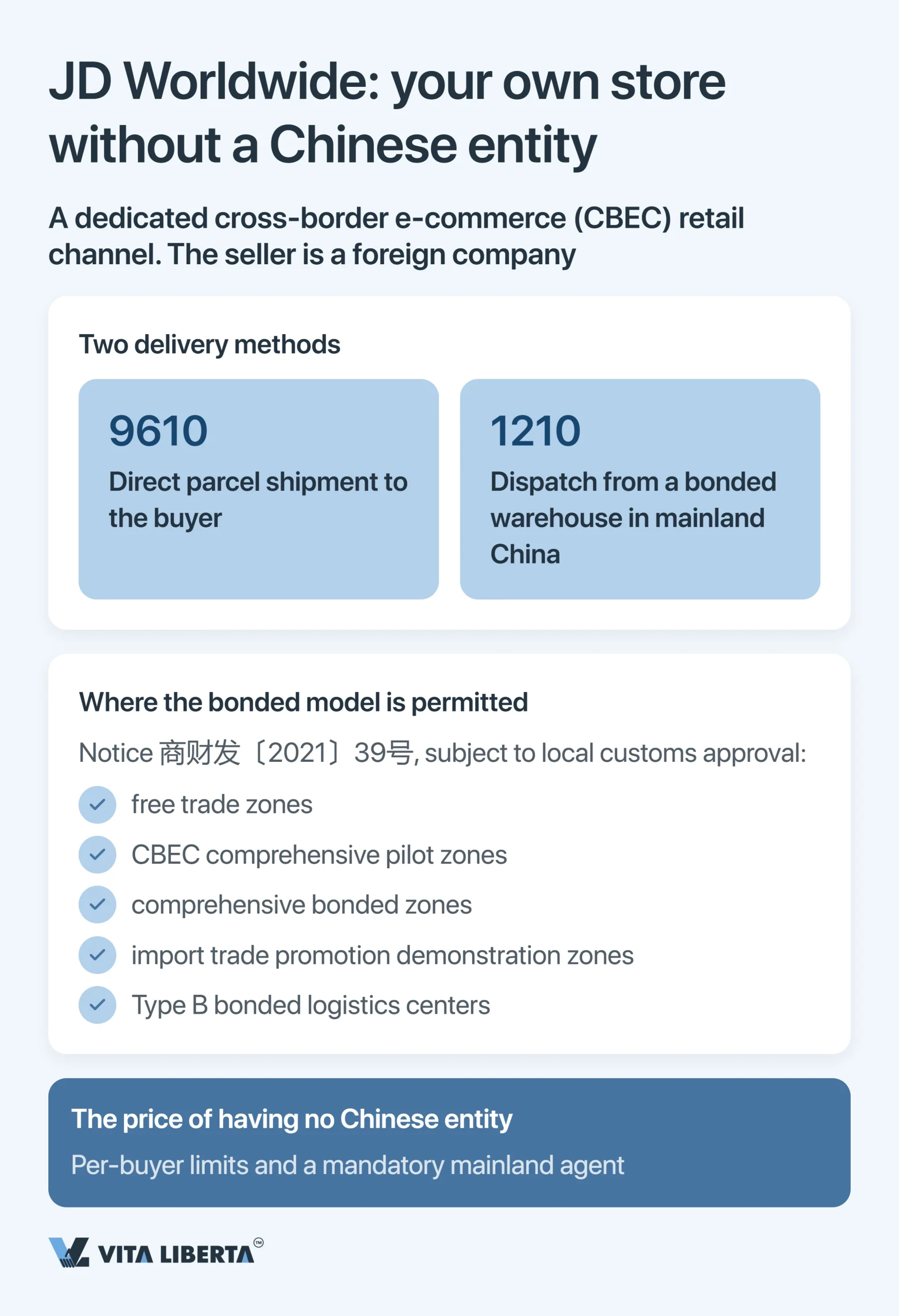
Your Own Storefront without a Chinese Entity
Don’t think of JD Worldwide as a lighter JD.com. It is a separate cross-border e-commerce (CBEC) retail channel, and your overseas company stays the seller of record. Goods either travel by direct mail (customs code 9610) or ship from a bonded warehouse in mainland China (code 1210).
The bonded option is not available everywhere. A notice issued jointly by six ministries, 商财发〔2021〕39号 (关于扩大跨境电商零售进口试点、严格落实监管要求的通知, on expanding the CBEC retail import pilot), allows it in cities and districts that host a free trade zone, a comprehensive CBEC pilot zone, a comprehensive bonded zone, an import promotion demonstration zone or a Type B logistics centre — once local customs signs off.
What you pay for skipping a Chinese structure: limits per buyer and a mandatory agent on the mainland.
自营 Supplier and Domestic POP
Under the 自营 (self-operated) model, JD buys your batch outright, tags the listing as its own sale and sets the retail price itself. JD picks suppliers to fit its purchasing plans, so you cannot simply apply.
Domestic POP (Platform Open Plan) needs a Chinese entity, Chinese-language labelling and full customs clearance. The deposit begins at RMB 30,000 and climbs as the brand’s turnover grows.
Bottom line: for a pilot, JD Worldwide makes sense. Save 自营 and POP for the conversation after demand is proven.
Getting Approved on JD Worldwide: Agent, Brand, Store Type
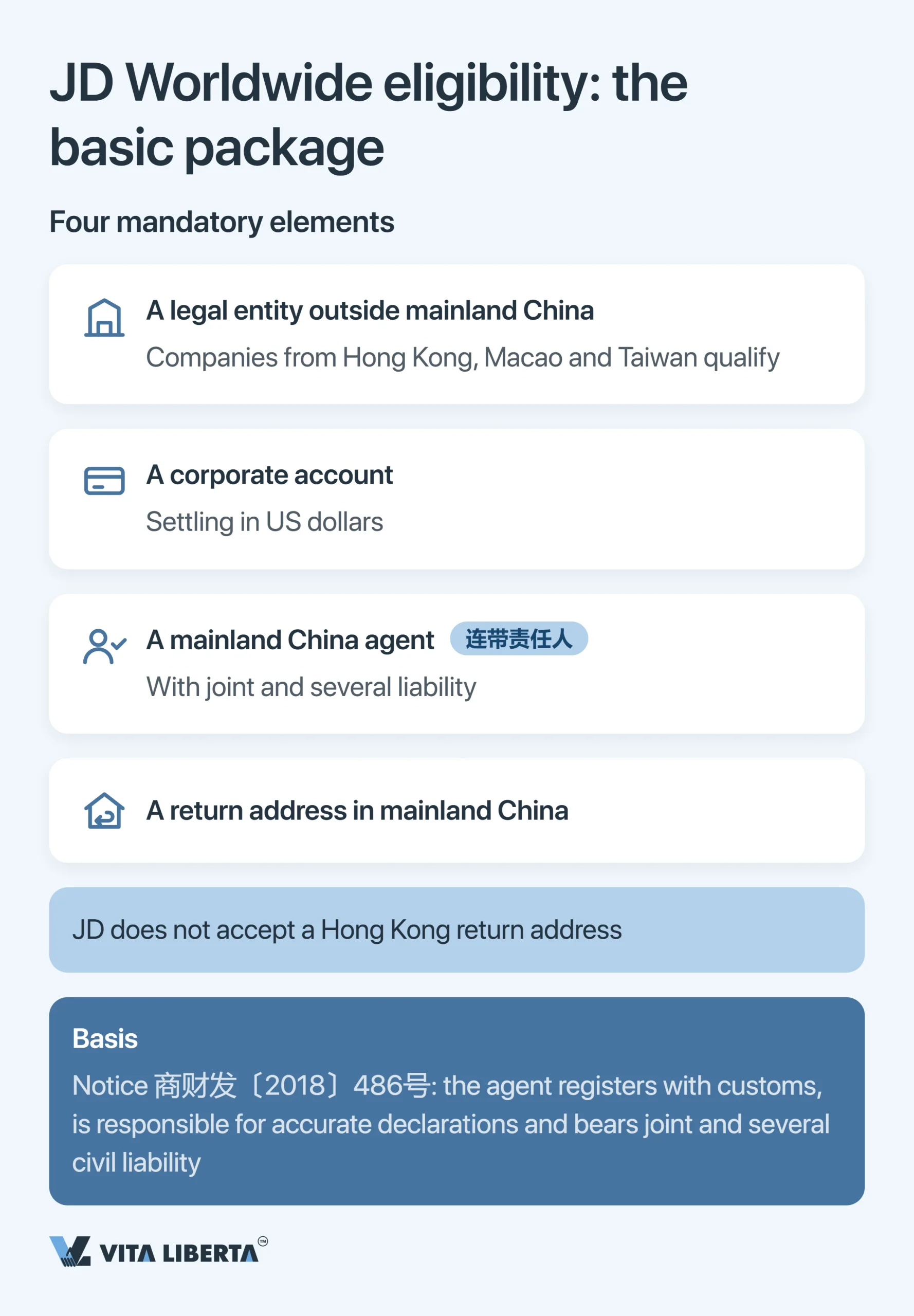
The core package is short. You need:
- an entity registered outside mainland China (companies from Hong Kong, Macao and Taiwan qualify);
- a corporate account that settles in US dollars;
- an agent in mainland China who accepts joint and several liability (连带责任人);
- a returns address on the mainland.
A Hong Kong returns address won’t be accepted — and sellers usually find that out only after approval.
The agent requirement doesn’t come from the platform alone. Under another six-ministry notice, 商财发〔2018〕486号 (关于完善跨境电子商务零售进口监管有关工作的通知, on improving supervision of CBEC retail imports), the overseas seller appoints a company registered in China to handle customs registration and truthful declarations. That company then shares civil liability with you.
The Brand Authorization Chain
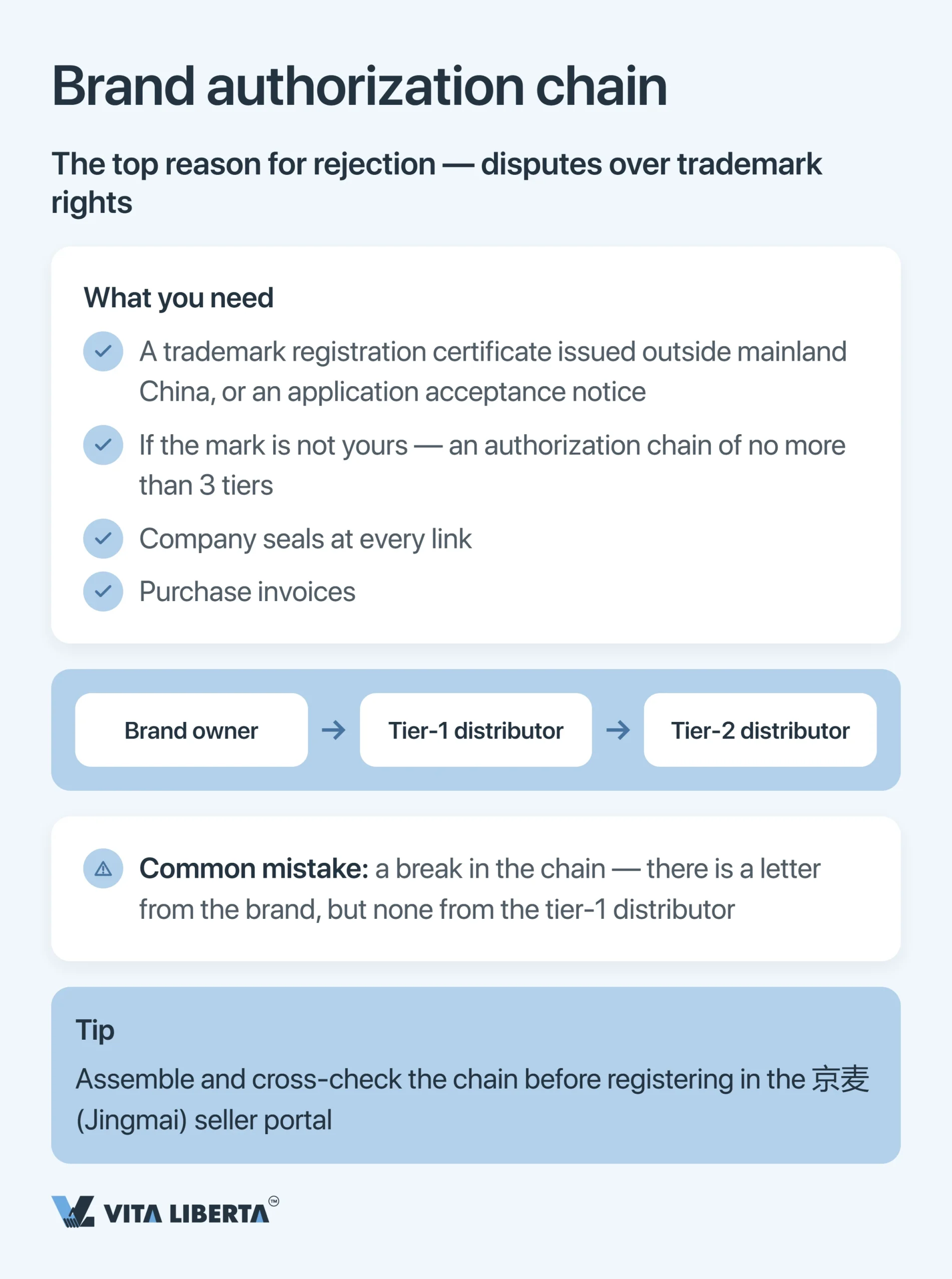
Most rejections come from disputes over trademark rights. You’ll need a trademark registration certificate issued outside mainland China, or an application acceptance notice.
If you don’t own the mark, prove your authorization with a chain of no more than three levels, stamped at every link, plus purchase invoices.
One mistake foreign sellers often make, and pay for, is a broken chain: a second-tier distributor attaches the brand’s letter but leaves out the letter from the first-tier distributor. Our advice — collect the full chain and check every link before you register in the 京麦 (Jingmai) seller backend.
Flagship, Exclusive or Specialty Store
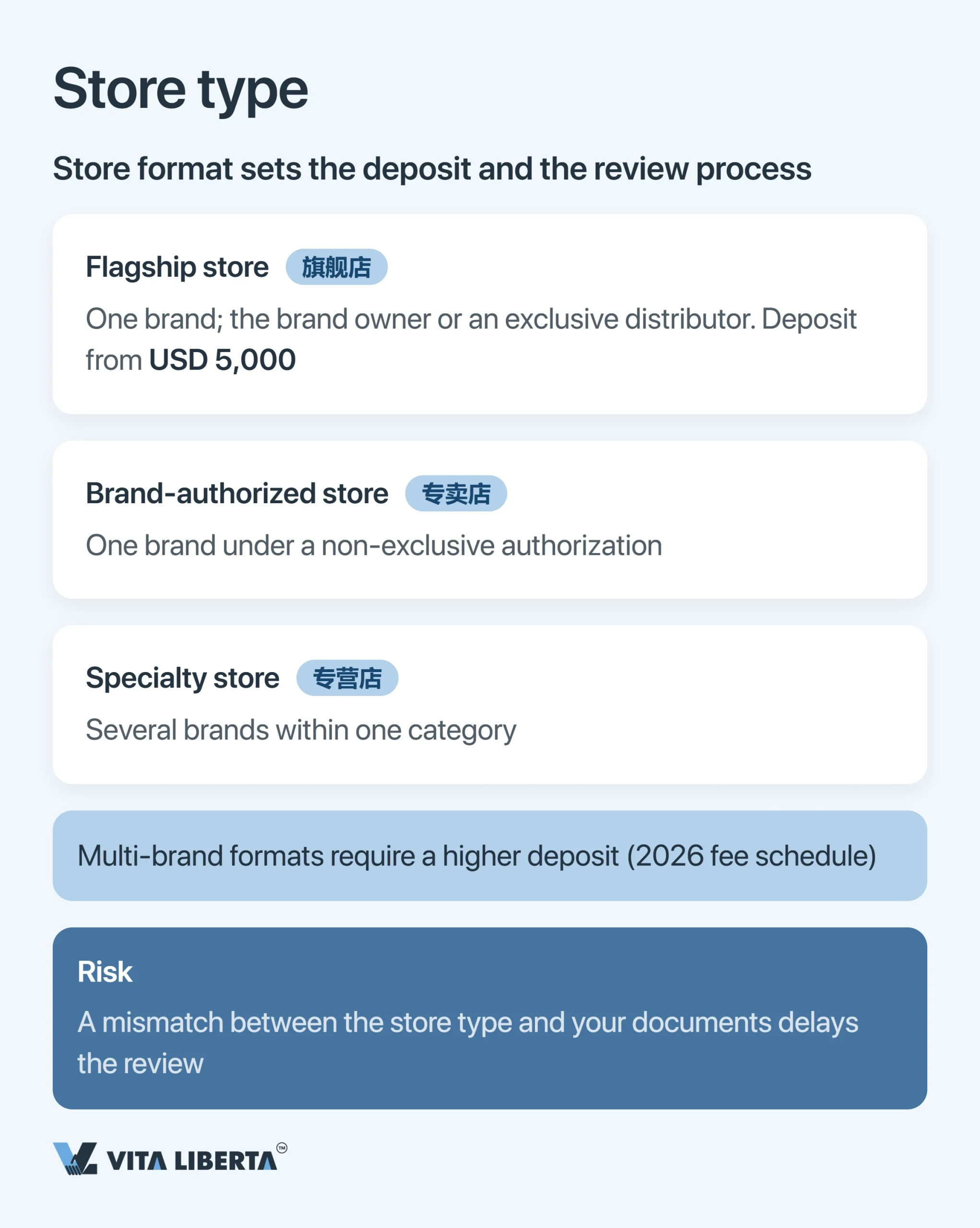
- Flagship store (旗舰店): a single brand, run by the owner or an exclusive distributor.
- Exclusive store (专卖店): a single brand under a non-exclusive authorization.
- Specialty store (专营店): several brands within one category.
Your store type sets your deposit. On the 2026 scale, a flagship starts from USD 5,000, and multi-brand formats pay more. Pick a type that your documents don’t support, and review typically drags on.
Open Your JD.com Store without a Moderation Rejection
- Brand authorization chain check
- Finding an agent on the mainland
- Choosing your store type

RMB 5,000 and RMB 26,000: The Tax Your Buyer Pays
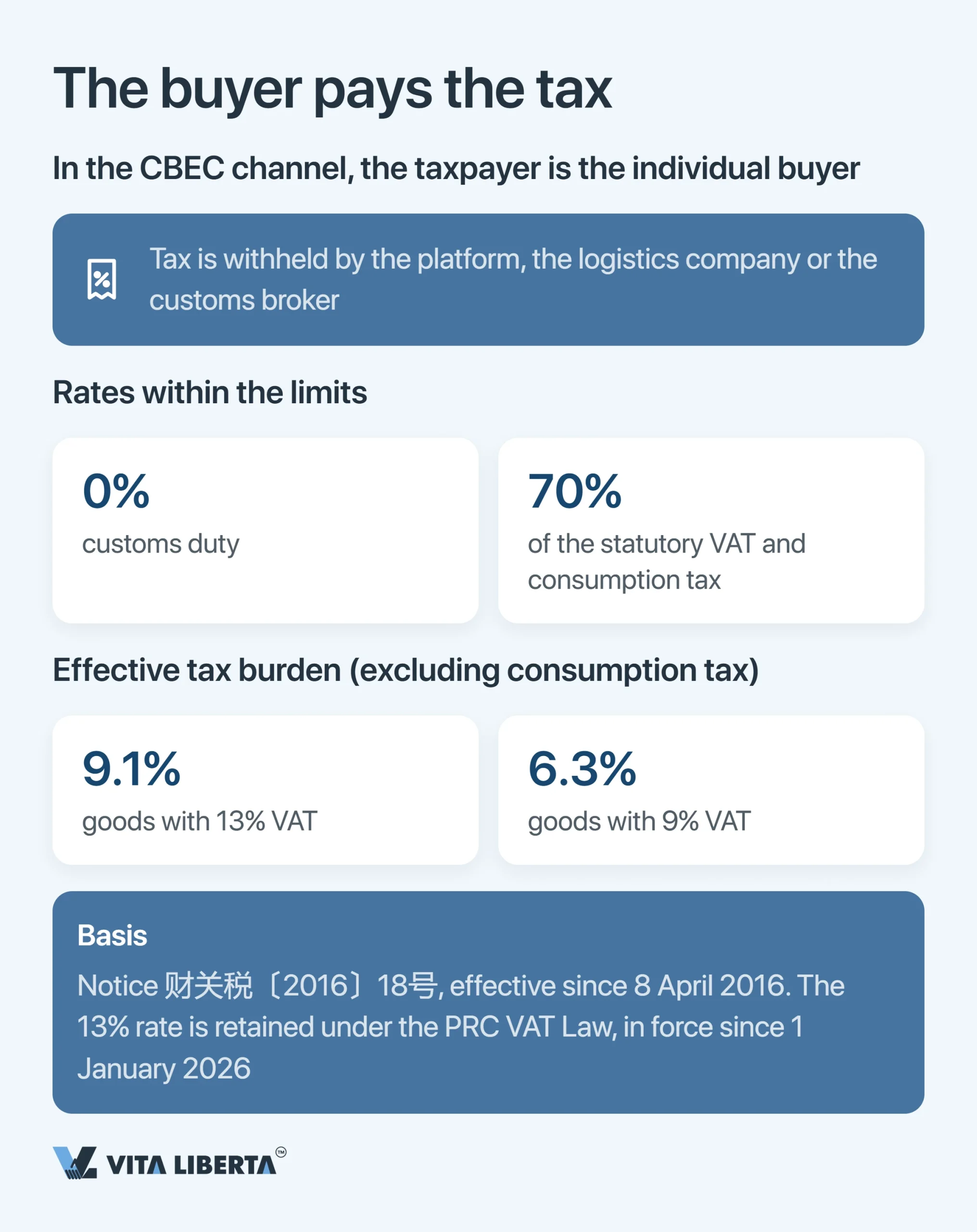
In the CBEC channel, the taxpayer isn’t you — it’s the individual shopper. The platform, the logistics company or the customs broker withholds the tax as a withholding agent.
Inside the limits, duty is 0%, and VAT and consumption tax are charged at 70% of the statutory amount. This comes from a joint notice by the Ministry of Finance (MOF, 财政部), the General Administration of Customs (GACC, 海关总署) and the State Taxation Administration (STA, 国家税务总局): 财关税〔2016〕18号 (关于跨境电子商务零售进口税收政策的通知, on tax policy for CBEC retail imports), dated 24 March 2016 and in force since 8 April 2016.
The 13% VAT rate survives under the PRC VAT Law (中华人民共和国增值税法), adopted on 25 December 2024 and effective from 1 January 2026. So a product with 13% VAT and no consumption tax carries a 9.1% load; at 9% VAT, it’s 6.3%.
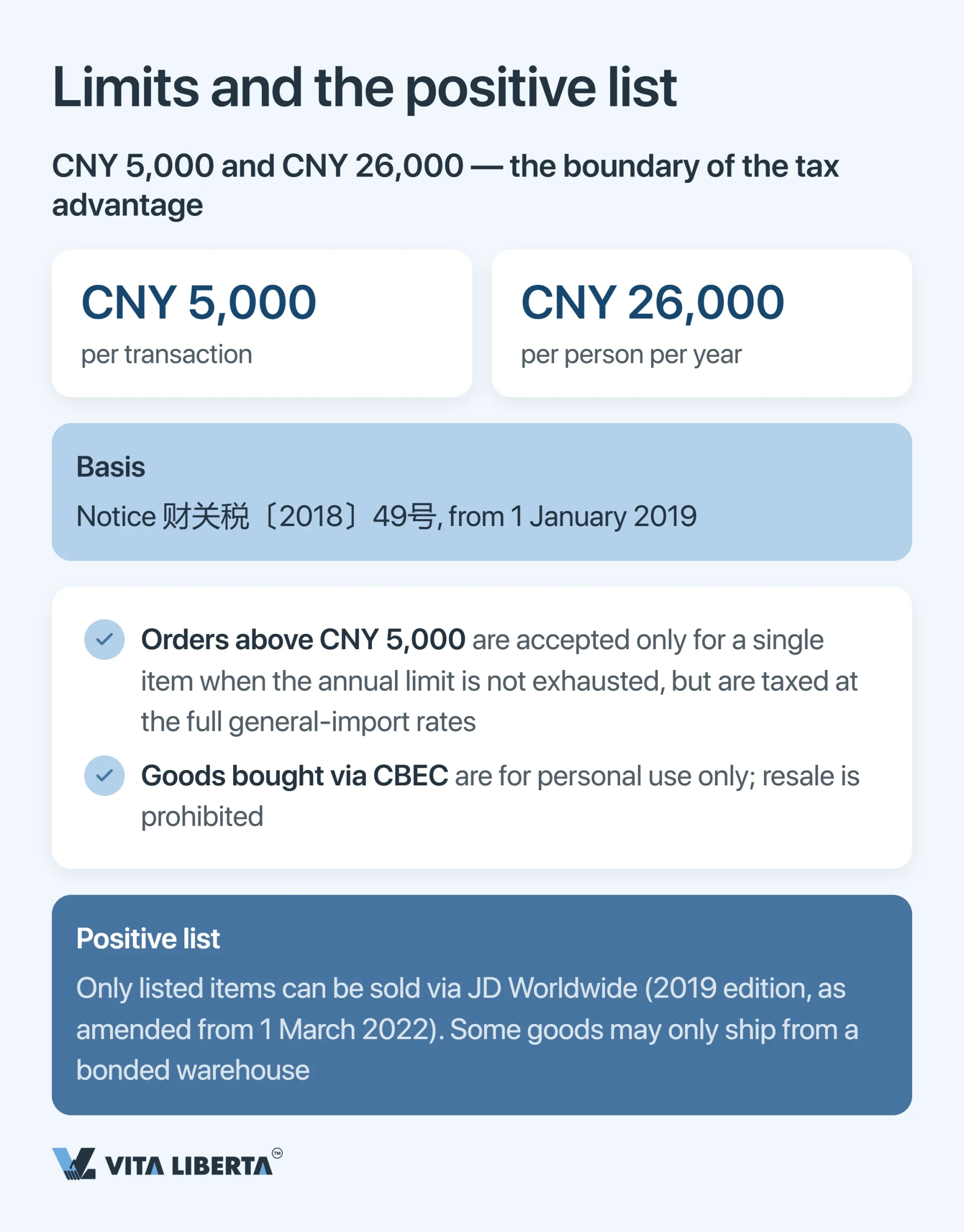
The limits come from Notice 财关税〔2018〕49号, in force since 1 January 2019. It replaced the earlier RMB 2,000 and RMB 20,000 caps of Notice 18 with these:
- RMB 5,000 per purchase;
- RMB 26,000 per person per year.
An order above RMB 5,000 still goes through the channel if it holds a single item and the buyer’s annual allowance isn’t used up — but then it’s taxed in full, at general trade rates. Anything bought via CBEC counts as goods for personal use and can’t be resold inside China. Both Notice 49 and Notice 486 say so.
Important: JD Worldwide sells only items on the positive list (跨境电子商务零售进口商品清单) — the 2019 edition, as adjusted by joint announcement No. 7 of 2022 (公告2022年第7号) from eight agencies, in effect since 1 March 2022. If your product isn’t on the list, the channel won’t take it at any price. Some entries also carry restrictions: certain goods, for example, may ship only from a bonded warehouse (仅限网购保税商品).
What Entry Costs and What JD Expects after Launch
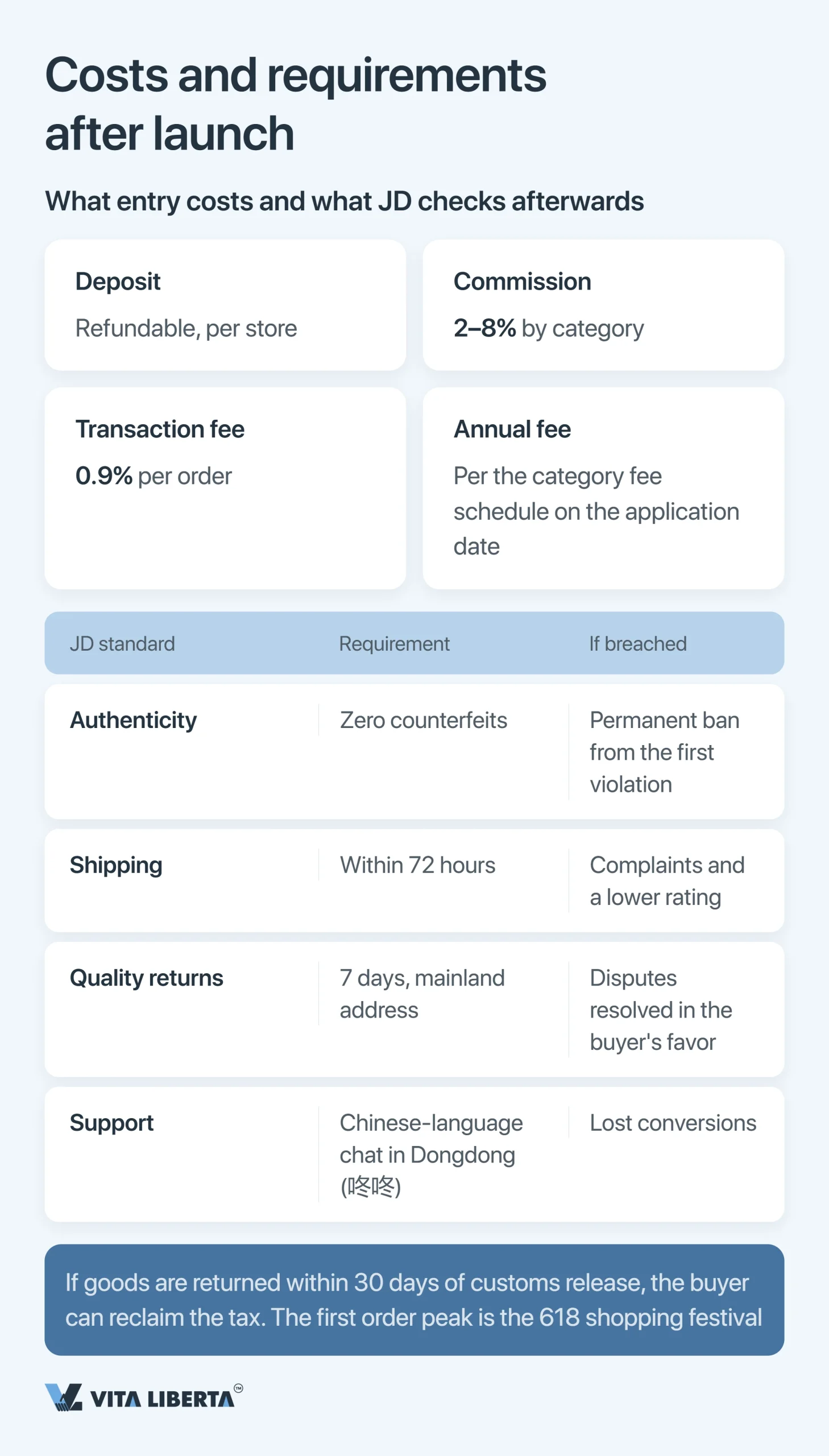
Your costs fall into three lines: a refundable store deposit, a category commission of 2–8%, and a 0.9% transaction fee on every order. The annual platform fee differs between editions of the rules, so pin the figure down from your category’s fee schedule on the date you apply.
72 Hours and Chinese-Language Chat
| Requirement | JD standard | What a breach costs you |
| Product authenticity | Zero counterfeits | Permanent ban from the first case |
| Dispatch | 72 hours from the order | Complaints and a falling rating |
| Quality returns | 7 days, mainland address | Disputes go the buyer’s way |
| Support | Chinese in the Dongdong (咚咚) chat | Lost conversion |
Separate from JD’s own rules, there’s a tax provision: if the goods come back within 30 days of customs release, the buyer can reclaim the tax paid, and their annual allowance is adjusted (clause 4 of Notice 18).
Consultants in the field note that new stores lose rating mainly on dispatch times. The first order peak lands on 618 — the festival JD created to mark its founding date.
Start Selling in China through JD Worldwide
- Registration in the 京麦 (Jingmai) backend
- Returns and logistics setup
- Product listing localisation
Selling on JD.com: Strategic Takeaways
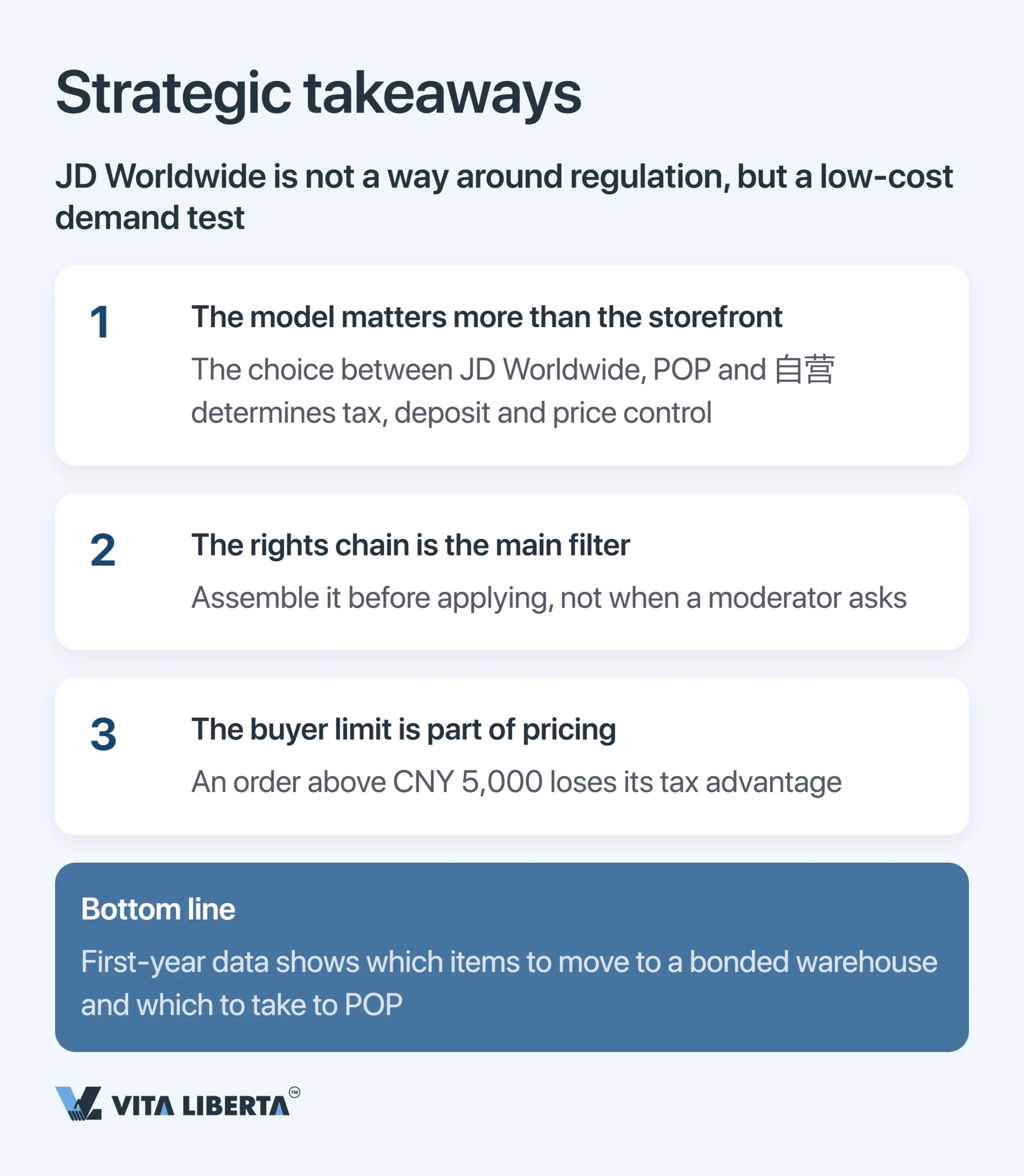
Here’s the paradox of JD Worldwide. To shoppers, it sells ease — imported goods in a couple of clicks. To you, it offers one of the most formalised channels in Chinese retail: brand paperwork, an agent, a positive list and per-buyer limits.
The model matters more than the storefront. Choosing between JD Worldwide, POP and 自营 decides your tax, your deposit and your grip on pricing.
The rights chain is the main filter. Assemble it before you apply, not when the moderator asks.
The buyer’s limit is part of your pricing. Products over RMB 5,000 per order lose the channel’s tax advantage.
So JD Worldwide isn’t a way around Chinese regulation — it’s a cheap test of demand. A year of data turns market entry from a bet into a calculation: which items to move to a bonded warehouse, and which to take into POP.
Frequently asked questions
Yes. JD Worldwide accepts companies from Hong Kong, Macao and Taiwan as sellers registered outside mainland China. You’ll need an account that settles in US dollars, a mainland agent with joint and several liability, and a returns address on the mainland — a Hong Kong address doesn’t count. Line up the agent and the address before you apply, not after approval.
The buyer pays, and the platform, logistics company or customs broker withholds it. Within the limits, duty is zero and VAT and consumption tax apply at a 70% factor. That means a 9.1% surcharge on the price for a product with 13% VAT and no consumption tax, and 6.3% for one at 9%. Build this into your retail price, or your store will lose the comparison with domestic sellers.
You can, as long as the order holds one item and the buyer hasn’t used up their RMB 26,000 annual limit. But the preferential factor disappears: duty, VAT and consumption tax are charged in full at general trade rates. For premium products, compare your CBEC price with domestic POP in advance.
Yes, if you can prove your rights with an authorization chain running from the trademark owner to you, with no missing links and stamps at every level. You’ll also need a trademark registration certificate issued outside mainland China and purchase invoices. A gap in the chain is the most common reason for rejection, so check the letters from every level before you register.
No — the channel only handles items on the positive list. The current version is the 2019 edition with the adjustments approved by announcement 公告2022年第7号, in effect since 1 March 2022. Check your product code against the list, and the note on that entry, before you apply: anything off the list won’t clear customs under the cross-border scheme.