Hongkong
 China
China





Long before anyone signs off on a factory or a trading entity, the careful route into China looks like this — boots on the ground, but no cash register.
Very few overseas companies enter mainland China by writing a large cheque first. The usual opening move is smaller: a foothold that reads the demand, keeps manufacturers honest and lets the brand earn some local credibility. The structure that does this job is the representative office, and it buys legal standing in the country without much capital behind it. What follows is the practical side — the file you have to build, how the calendar tends to run, and what the tax authorities will want from an office that, on paper, earns nothing.
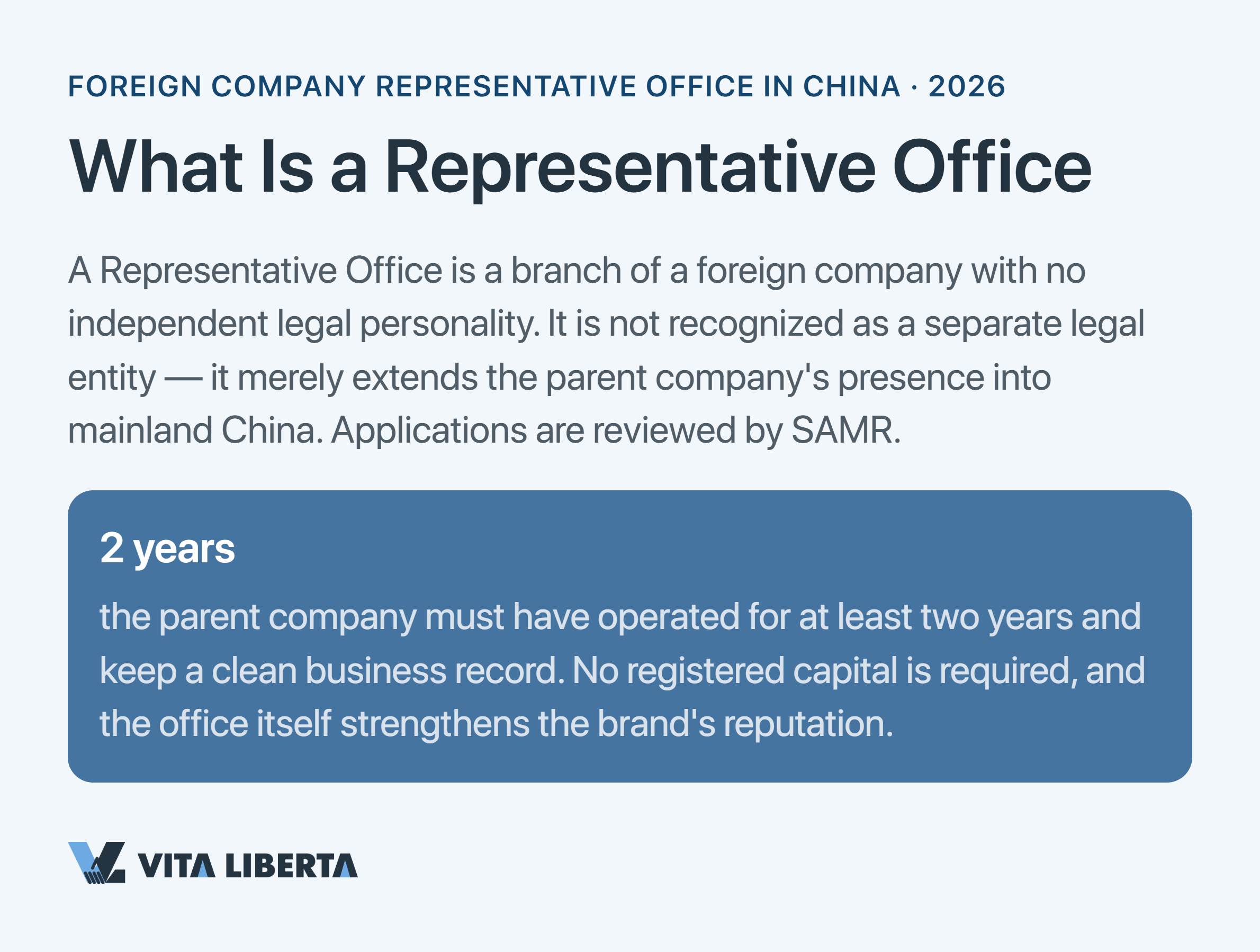
The legal shape of a China representative office
An RO is an outpost of an overseas firm, and it carries no legal personality of its own. Nothing about it stands alone: it borrows the identity of the parent company and stretches that identity across the Chinese border. The filing goes to the State Administration for Market Regulation (SAMR), and the certificate that comes back is the document everything else hangs on — bank accounts, payroll arrangements, tax registration.
There is a gate on the way in. The parent has to show at least two years of trading behind it, plus a clean commercial record. Newly formed companies run straight into that wall, which is why group structures aimed at China are often set up with a couple of years of runway deliberately built in.
Where the format helps, and where it stops
Ease of launch is the whole selling point. The catch is how tightly the permitted activities are drawn. Both halves deserve attention.
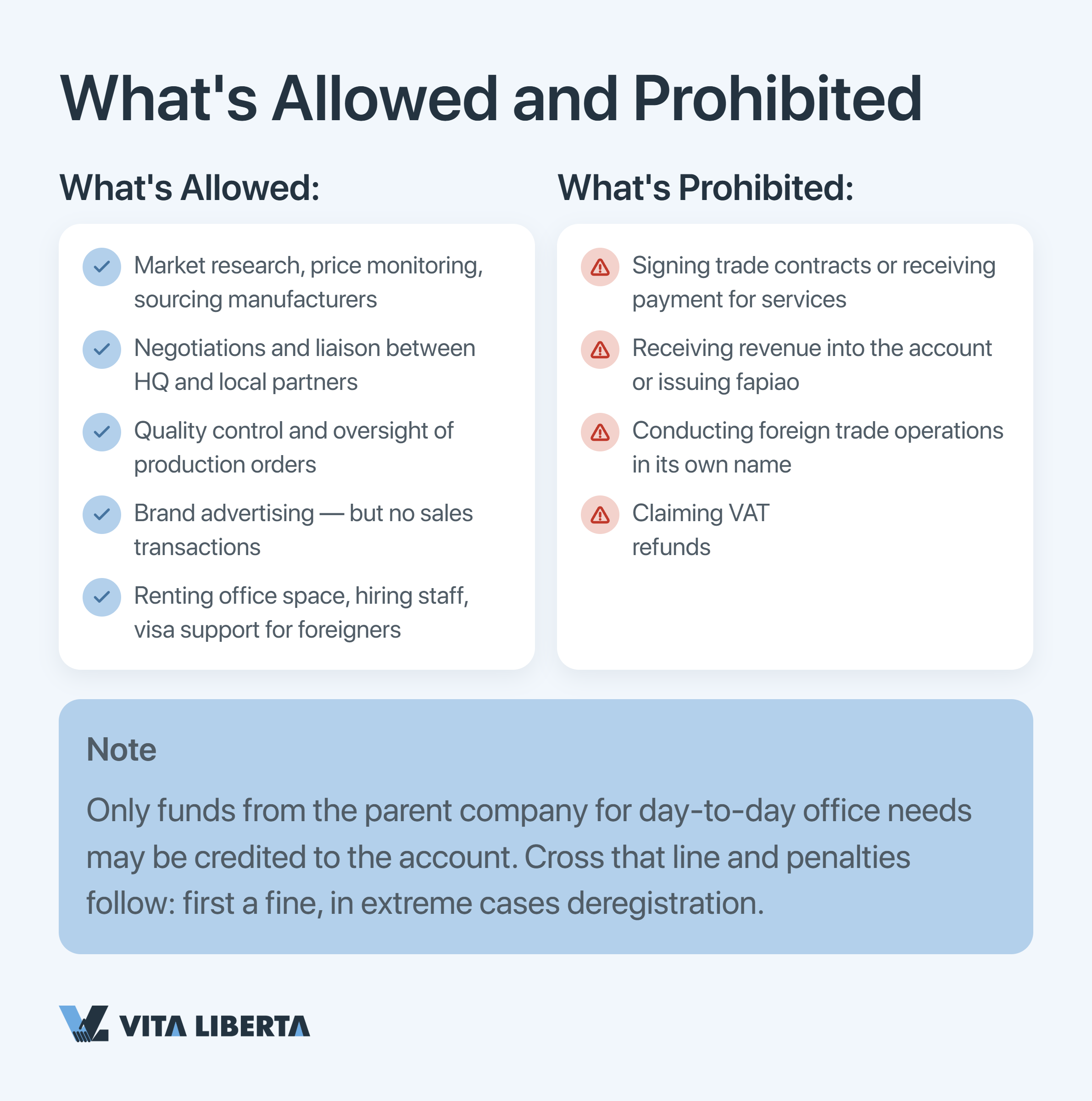
Activities that sit inside the rules
An RO may study the market, track pricing and shortlist manufacturing partners. It may negotiate and act as the channel between head office and Chinese counterparties. It may inspect goods and keep watch over how orders are being fulfilled on the factory floor. It may push the brand — advertising, exhibitions, relationship-building — provided the sale itself closes elsewhere. And it may take a lease, put people on the payroll and sponsor visas for foreign nationals.
Two further points in its favour: registered capital is not required at all, and a physical office reads to Chinese counterparties as commitment rather than tourism.
Activities that are off-limits
The office may not put its name to commercial agreements, nor invoice for services it has performed. Trading income cannot land in its account and it has no authority to issue fapiao. Import-export operations in its own name are excluded, and it has no route to VAT recovery.
⚠️ Watch the account. The only money that belongs in an RO’s bank account is funding from the parent, earmarked for running the office. Step past that boundary and the response escalates quickly — a monetary penalty first, and deregistration where the breach is serious.
Building the registration file
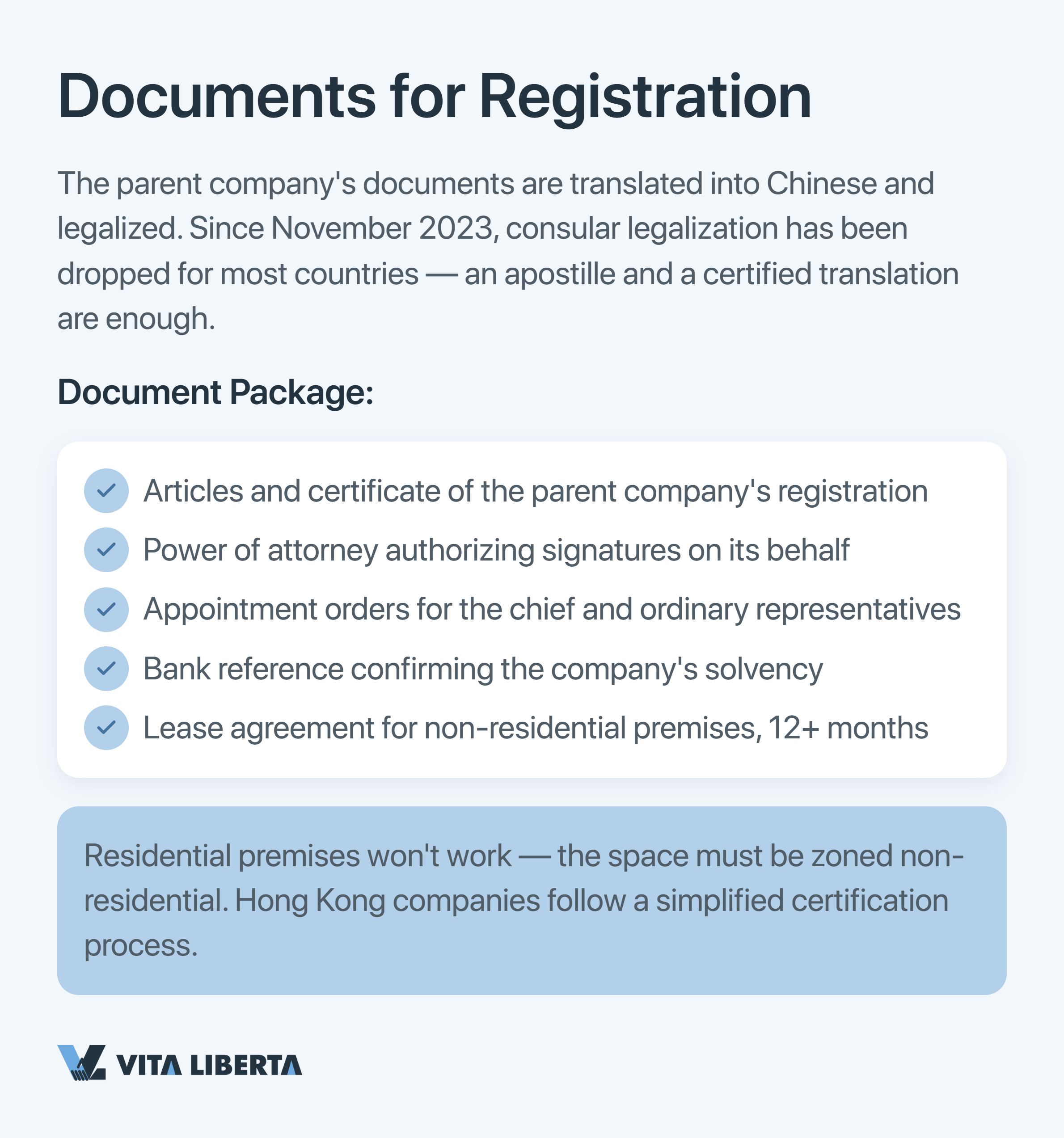
This is the fiddly part, and the part that delays most applications. Reviewing officers test each certificate for authenticity, so the parent company’s paperwork has to be rendered into Chinese and put through legalisation ahead of time — not while the clock is running.
Expect to produce, as a minimum:
- the parent’s constitutional documents alongside its certificate of incorporation;
- a power of attorney covering signature on the company’s behalf;
- board resolutions naming the chief representative and the other representatives;
- a reference letter from the parent’s bank speaking to its financial standing;
- a twelve-month-plus lease over commercially zoned premises.
One reform genuinely changed the workload here. China joined the Hague Apostille Convention, and from November 2023 consular legalisation dropped out of the process for most countries — an apostille with a certified translation now carries the file. Hong Kong entities follow a lighter certification path of their own. Worth flagging separately: residential property is rejected outright, so the address has to be zoned for commercial use before it goes anywhere near the application.
Thinking of opening a rep office?
- See if an RO suits you
- Compare with a WFOE by goals
- Format limits explained

How registration unfolds, step by step
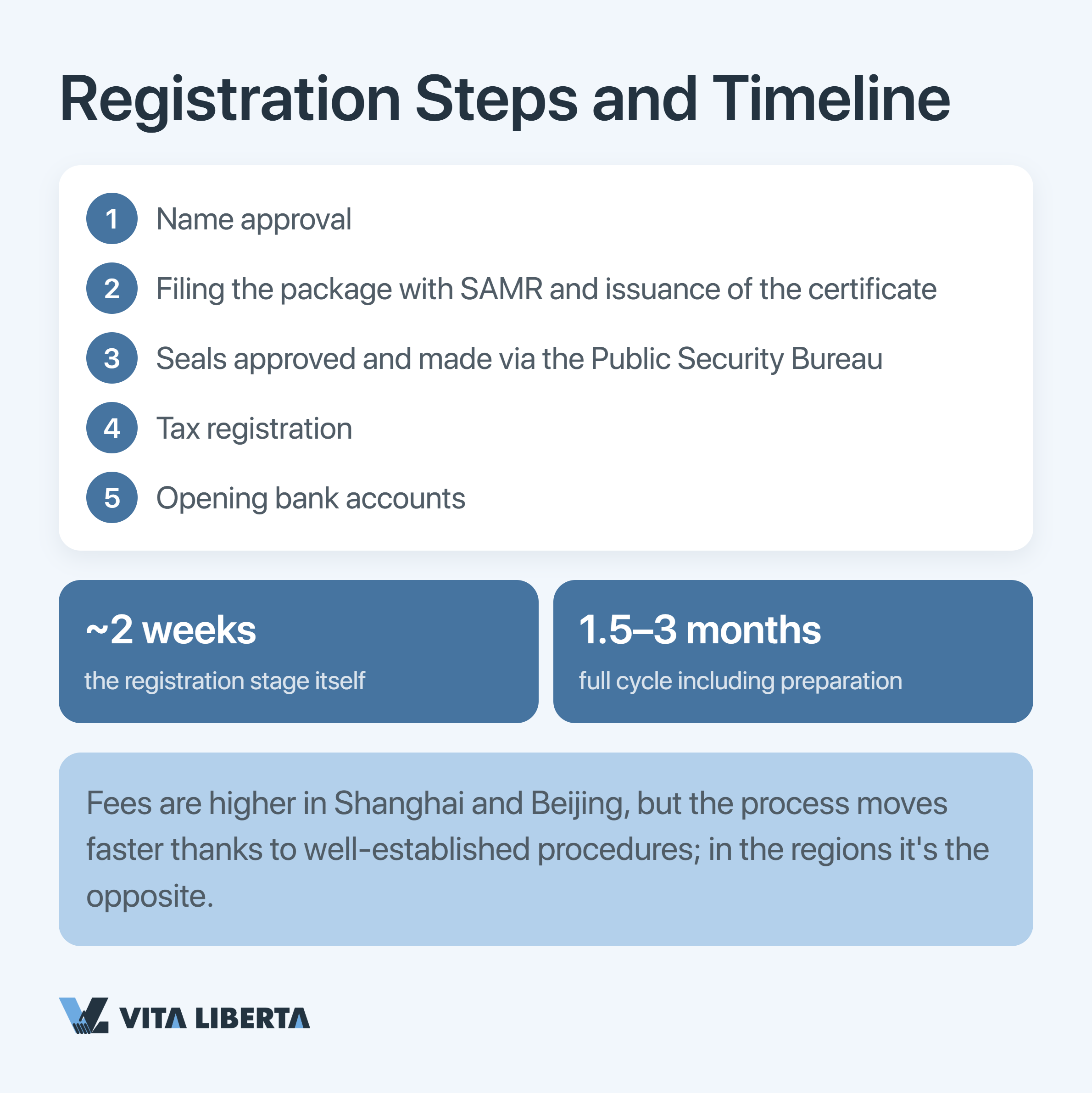
The sequence runs roughly as follows:
- Name clearance — the approved format strings together the country, the parent’s Chinese name and the “Representative Office” tag.
- Filing with SAMR, followed by issue of the certificate.
- Chop production, cleared and registered through the Public Security Bureau.
- Tax registration.
- Bank account opening.
Registration proper occupies something like a fortnight. The trailing formalities absorb about as long again. Add document preparation and most projects land somewhere between six weeks and three months end to end. A quirk worth planning around: Shanghai and Beijing charge more, yet move faster, because their procedures are heavily rehearsed. Smaller cities invert that trade-off.
What it costs to open and to keep running
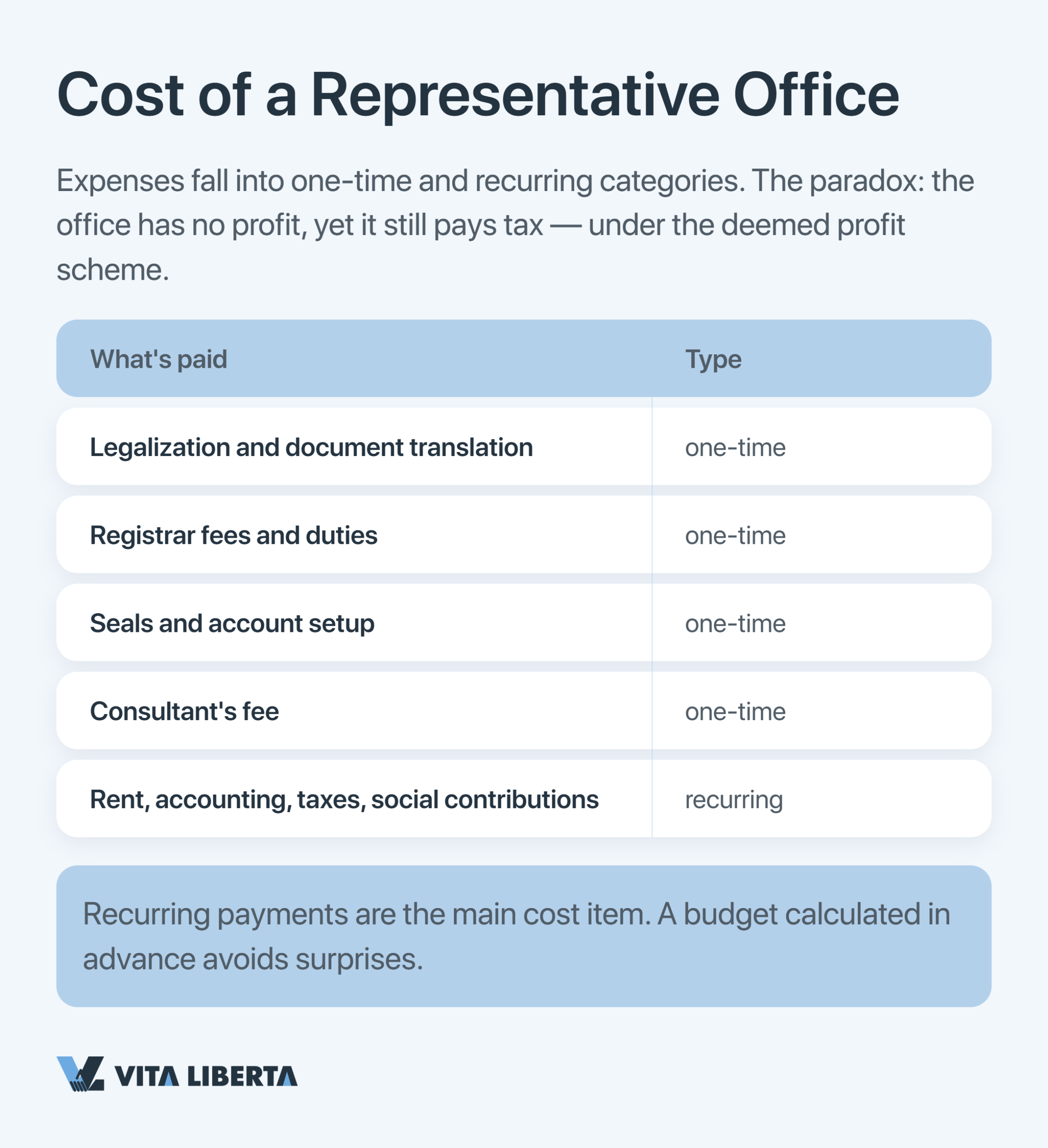
Two buckets — money you spend once, and money you spend every month.
| Cost item | Frequency | Comment |
| Legalisation and translation | one-off | scales with the size of the file |
| Registry fees and duties | one-off | modest |
| Chops and account opening | one-off | modest |
| Advisory fees | one-off | region-dependent |
| Rent, bookkeeping, taxes, social contributions | ongoing | where the real money goes |
Costing this out in advance matters most when the parent sits overseas and everything on the ground runs through a local representative — that is precisely the setup in which unbudgeted line items surface late.
Taxing an office that makes no profit
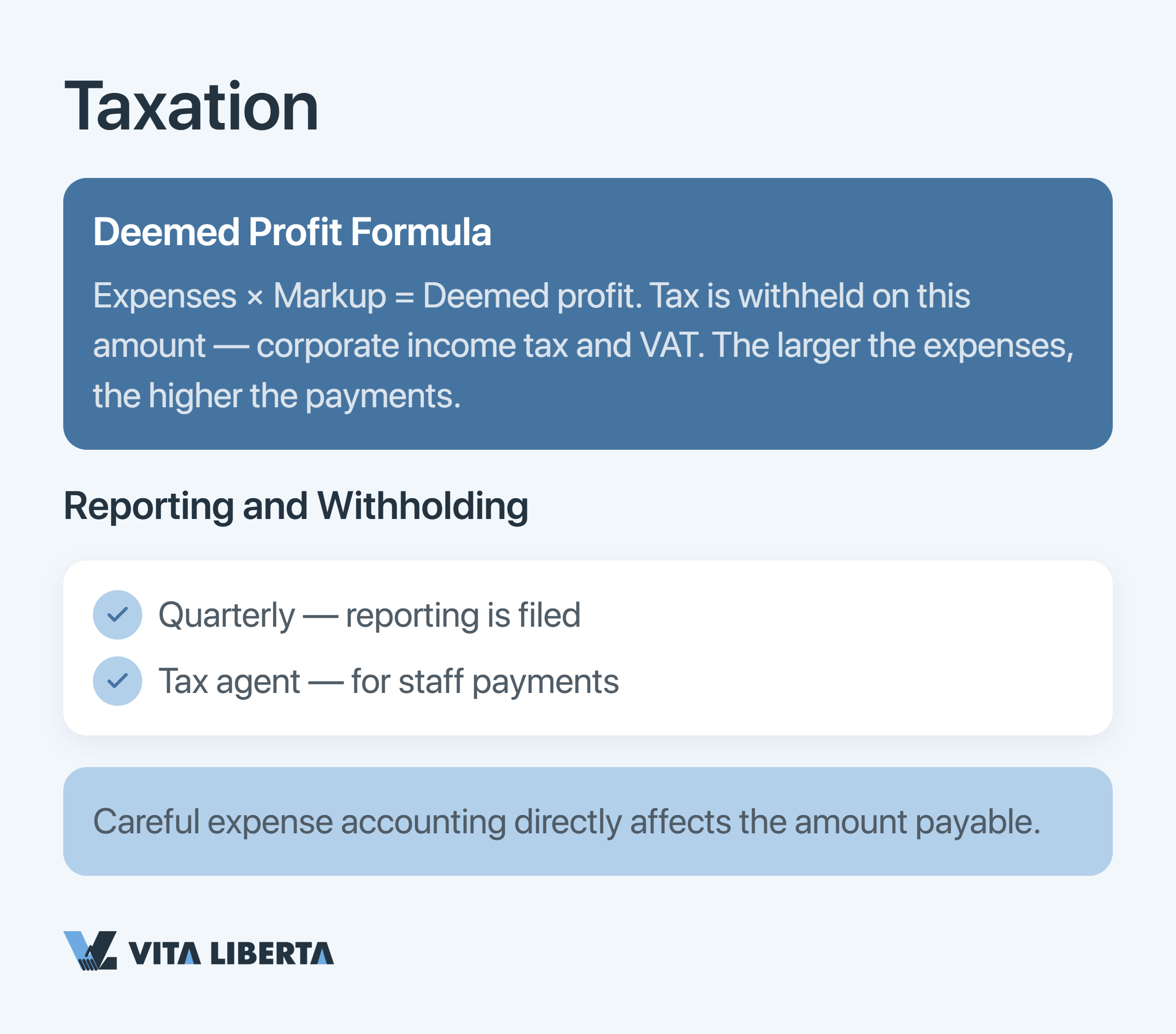
Here is the counterintuitive part. No revenue, and still a tax bill. China applies the deemed-profit approach to ROs: the taxable base is built from what the office spends rather than what it earns. Expenditure is grossed up by a set mark-up, the resulting figure is treated as profit, and corporate income tax and VAT attach to it.
The incentive structure follows directly — the bigger the cost base, the bigger the liability. Filings are quarterly. On payments to staff the office carries withholding-agent duties. Which is why expense classification is not a bookkeeping detail here; it feeds straight into the number you pay.
Headcount, work permits and how hiring actually works
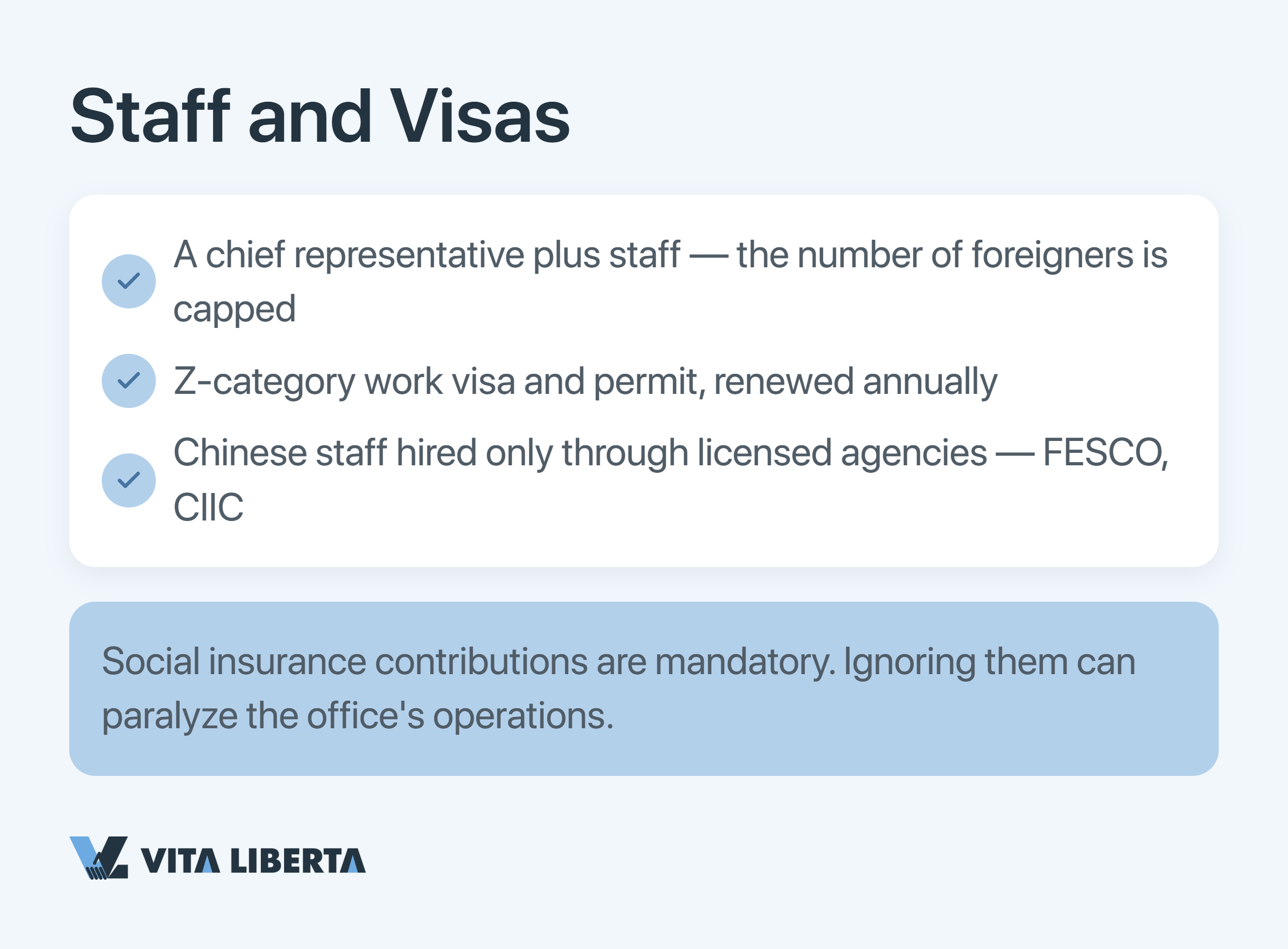
Staffing is capped and structured. One chief representative sits at the top, with a limited number of additional representatives beneath, and the number of foreign nationals is restricted. Those foreign hires need a Z work visa and a work permit, both of which come up for renewal annually.
Chinese nationals cannot be employed by the office directly. Recruitment is routed through licensed dispatch agencies — FESCO, CIIC and comparable providers — which hold the employment relationship and administer payroll. Social insurance contributions are not optional. Regulators treat shortcuts in this area as a serious violation, and enforcement can bring the office to a standstill.
Ongoing filings, the annual check and eventual closure
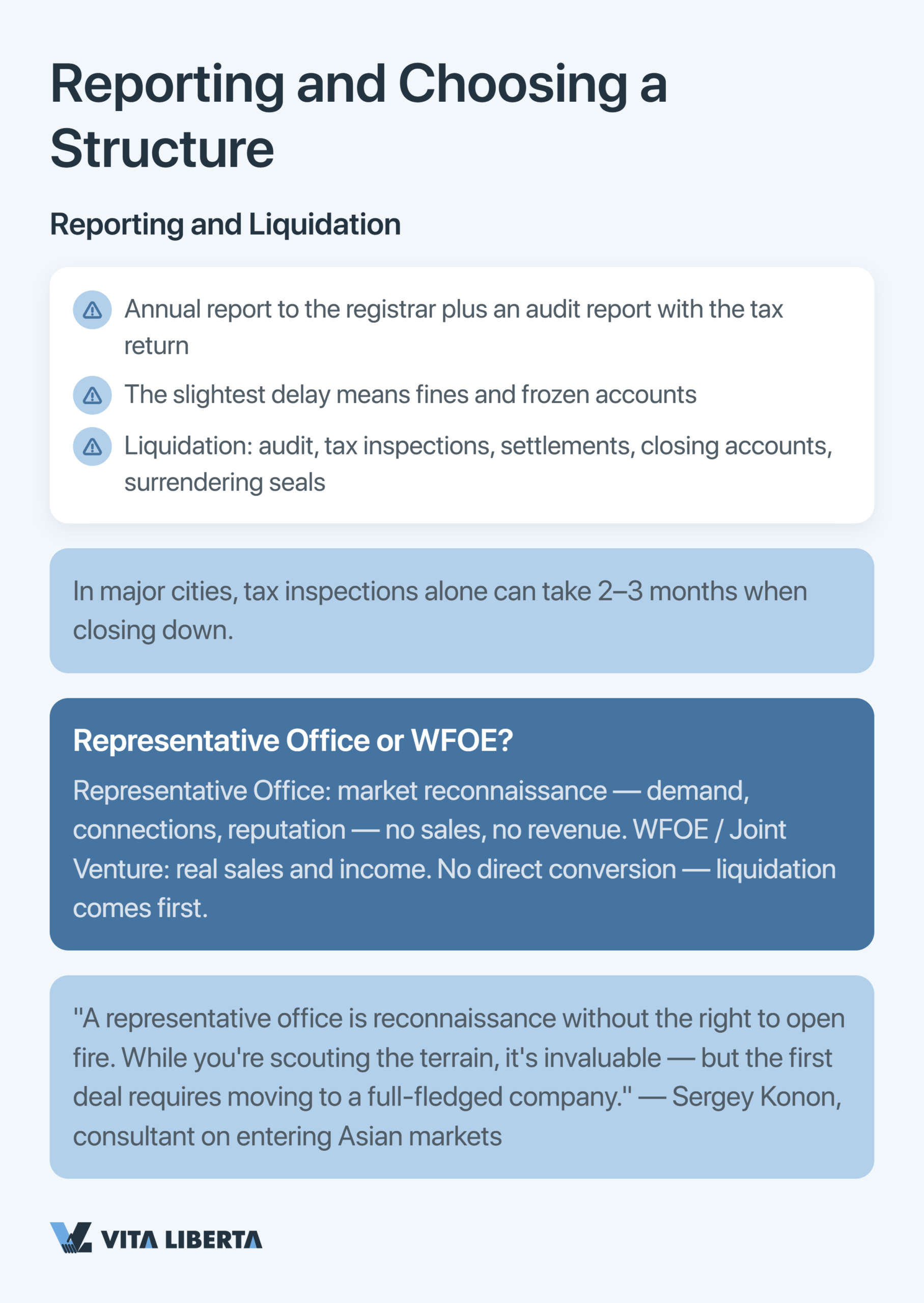
Books have to be maintained, an annual submission goes to the registration authority, and an audit report accompanies the tax return. Deadlines are unforgiving: late filings attract penalties and can leave accounts frozen.
Closing an RO is slower than opening one. The exit runs through an audit, tax-bureau review, settlement of outstanding obligations, account closure and surrender of the chops. In tier-one cities the tax review alone commonly stretches across two to three months. That workload is worth pricing in at the outset, not discovering at the end.
Representative office or WFOE?
For testing appetite, validating demand and building a network, the RO answers the brief completely. The moment actual sales and receipts enter the picture, you need a wholly foreign-owned enterprise (WFOE) or a joint venture instead.
“A representative office is reconnaissance without permission to open fire. While you’re reading the terrain, nothing beats it — but the first signed deal forces the move to a full company,” says Sergey Konon, adviser on Asian market entry.
One structural detail catches people out: there is no conversion path from RO to WFOE. The office is liquidated first, and the new entity registered separately afterwards.
Taken as a whole, the RO stays what it has always been — a low-friction, reversible way to be present in China. No capital injection, a legal lease, a real team, but no trading and no income of its own. It suits companies that can live with administrative process and recurring filings. Get the document file right, and lean on someone who has run the process before, and the odds of rejection and drift shorten considerably.
Ready to open an RO in China?
- Turnkey RO registration
- Accreditation and registration
- Full launch support
FAQ
Yes. Registration will not proceed without a live commercial address evidenced by a signed lease — virtual addresses are not accepted.
Six to ten weeks in most cases. The variables are the city you file in and how fast the apostilled documents come back.
Only through a licensed dispatch agency, which formally employs them and handles payroll and social insurance. Direct hiring by the RO is not permitted.
Through the deemed-profit method. Corporate income tax and VAT are calculated from the office’s expenditure plus a mark-up, not from revenue.
Yes — an RMB account at minimum, for the office’s official transactions.