Hongkong
 China


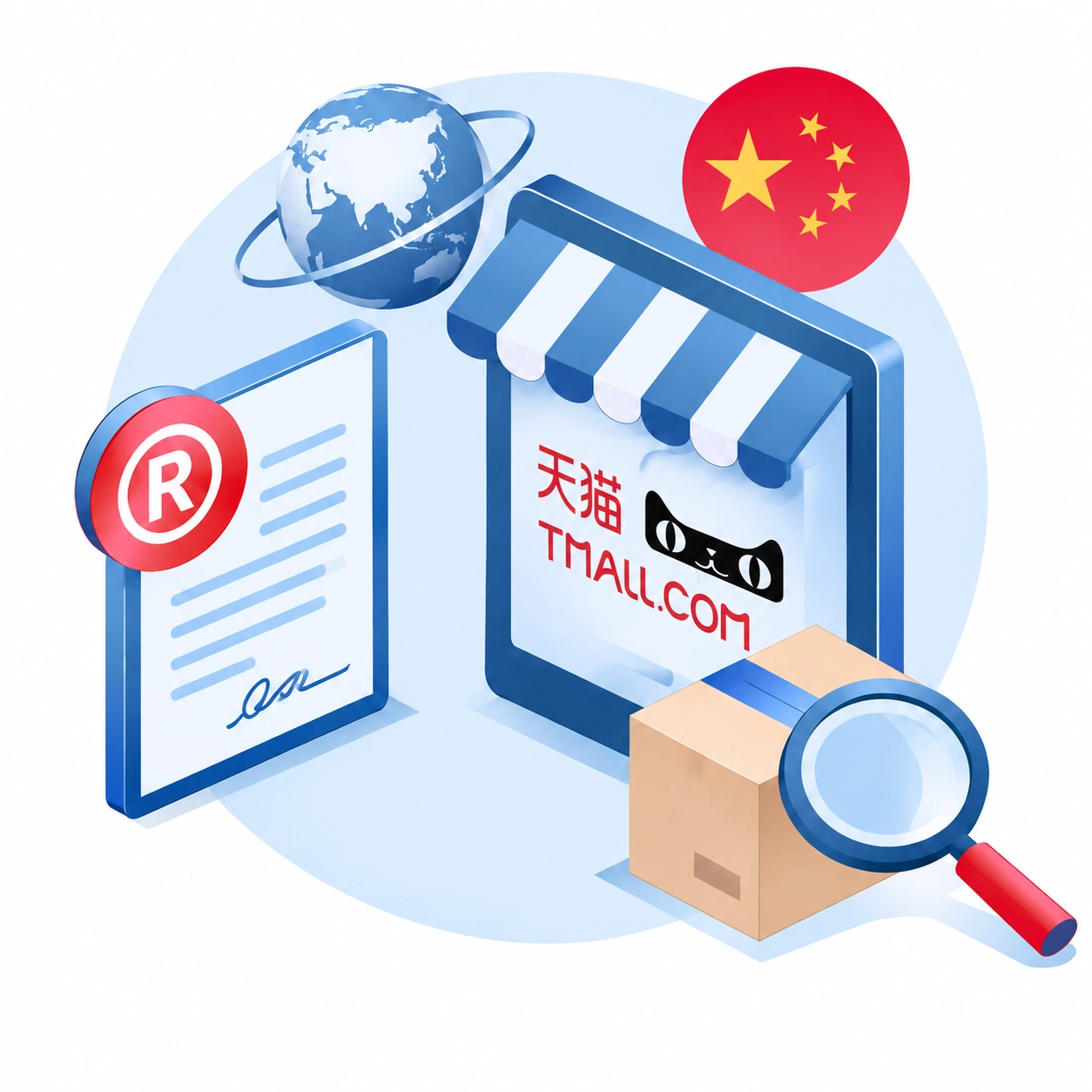


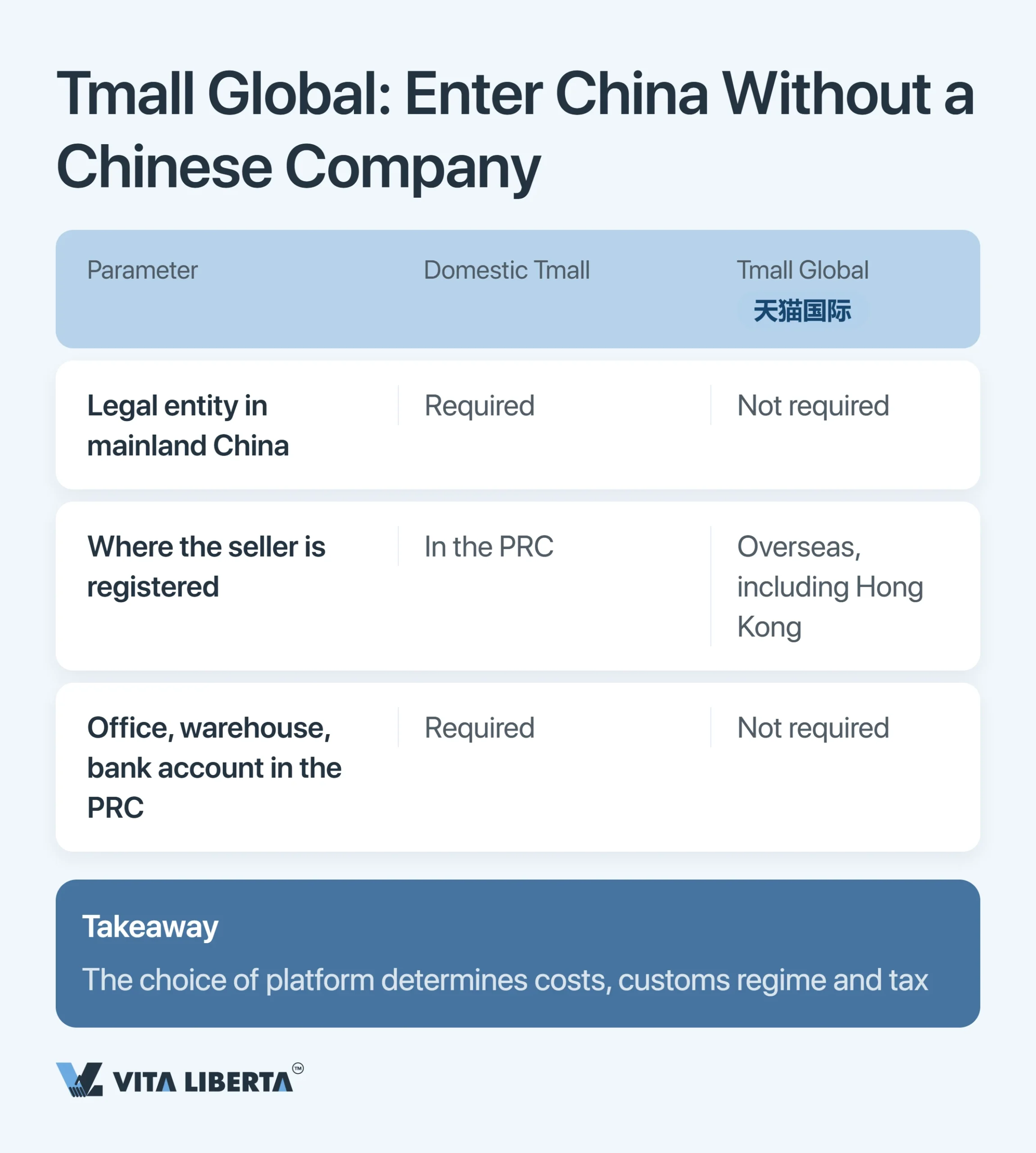
Think of a cross-border store on Tmall.hk as a sales office with no local address. Legally, you remain the seller abroad, yet your storefront already sits inside Alibaba’s largest ecosystem. The core problem: “We have a brand, a warehouse in Europe and not a single employee in China. Some consultants tell us Tmall is closed to us without a Chinese company; others say the opposite. Who is right?” Foreign manufacturers ask us this more often than almost anything else. Both camps are right. Domestic Tmall needs a mainland Chinese entity; Tmall Global (天猫国际) does not. That one difference drives everything else: your costs, your customs regime and your tax.
Who Can Sell on Tmall Global
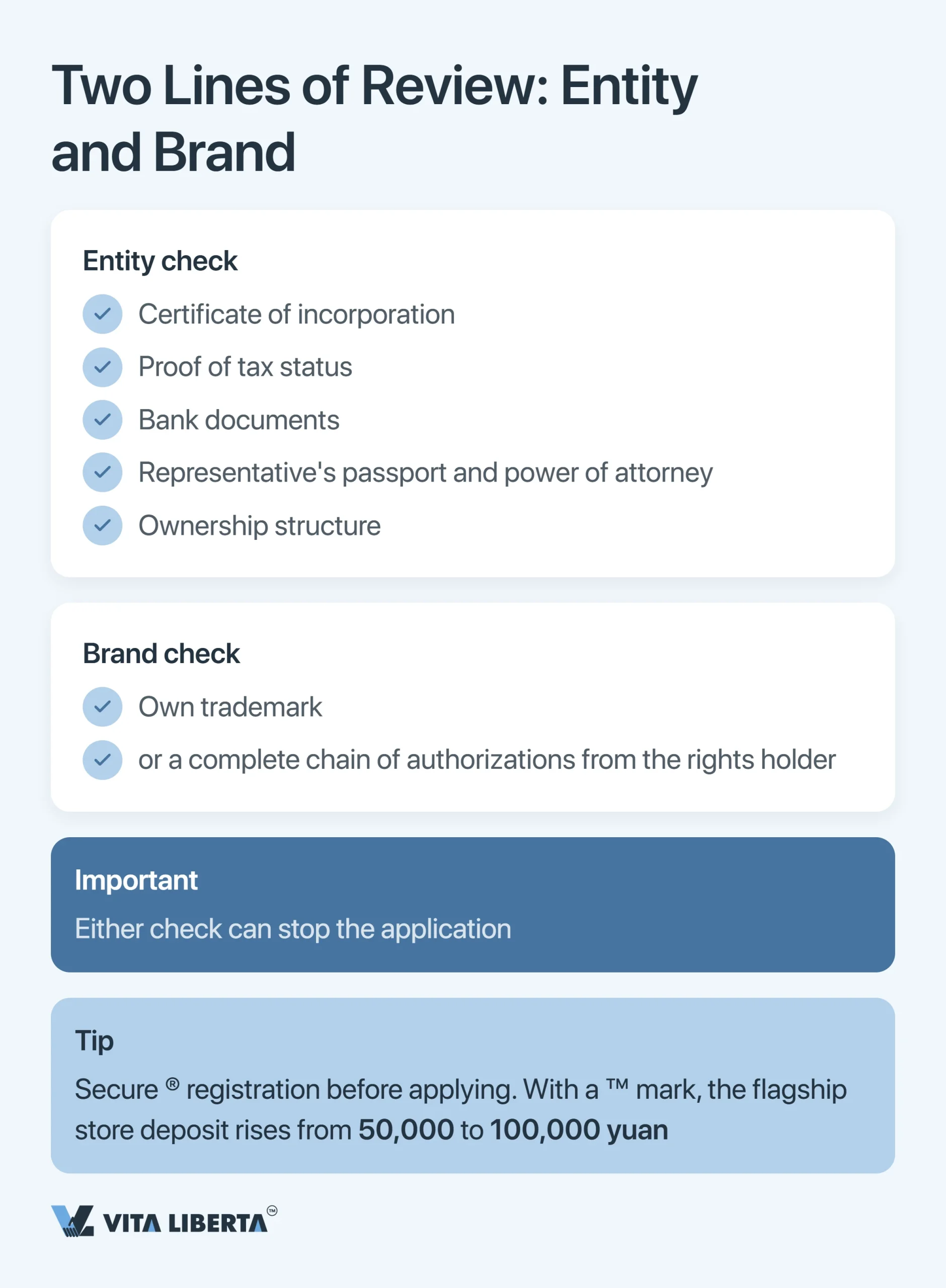
You sell through a company registered outside mainland China, and a Hong Kong company qualifies. The platform reviews two things, the entity and the brand. Either one can block your application.
Your Overseas Company and Your Trademark
For the entity, you file a certificate of incorporation, proof of tax status, bank documents, your representative’s passport and power of attorney, and details of the ownership structure. You need no Chinese bank account, office or warehouse in the PRC. For the brand, you either own the trademark or hold a complete authorization chain from the owner. A common and costly mistake is applying while your mark still shows ™. Do that, and the flagship deposit doubles from RMB 50,000 to RMB 100,000. Secure the ® registration first, and you keep half of that frozen sum free.
Your Documents Decide the Store Type
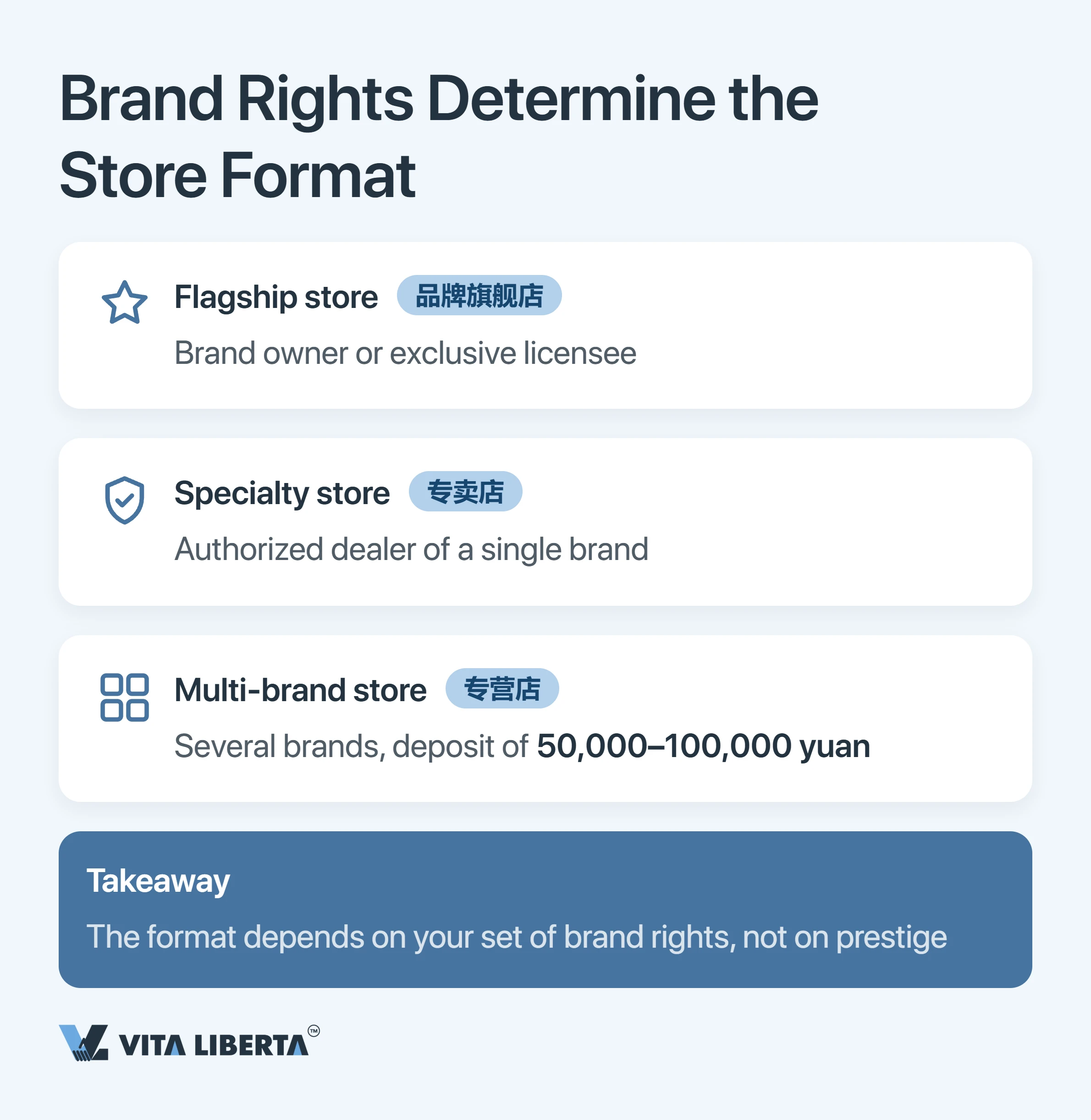
A flagship store (品牌旗舰店) belongs to the brand owner or an exclusive licensee. A specialty store (专卖店) is run by an authorized dealer of one brand. A multi-brand store (专营店) carries several labels but needs a deposit of RMB 50,000–100,000. Prestige plays no part here. The set of trademark rights you hold picks the format for you.
What It Costs to Get In: Deposit, Annual Fee and Commission
You pay the platform three charges, and only one of them moves with your revenue.
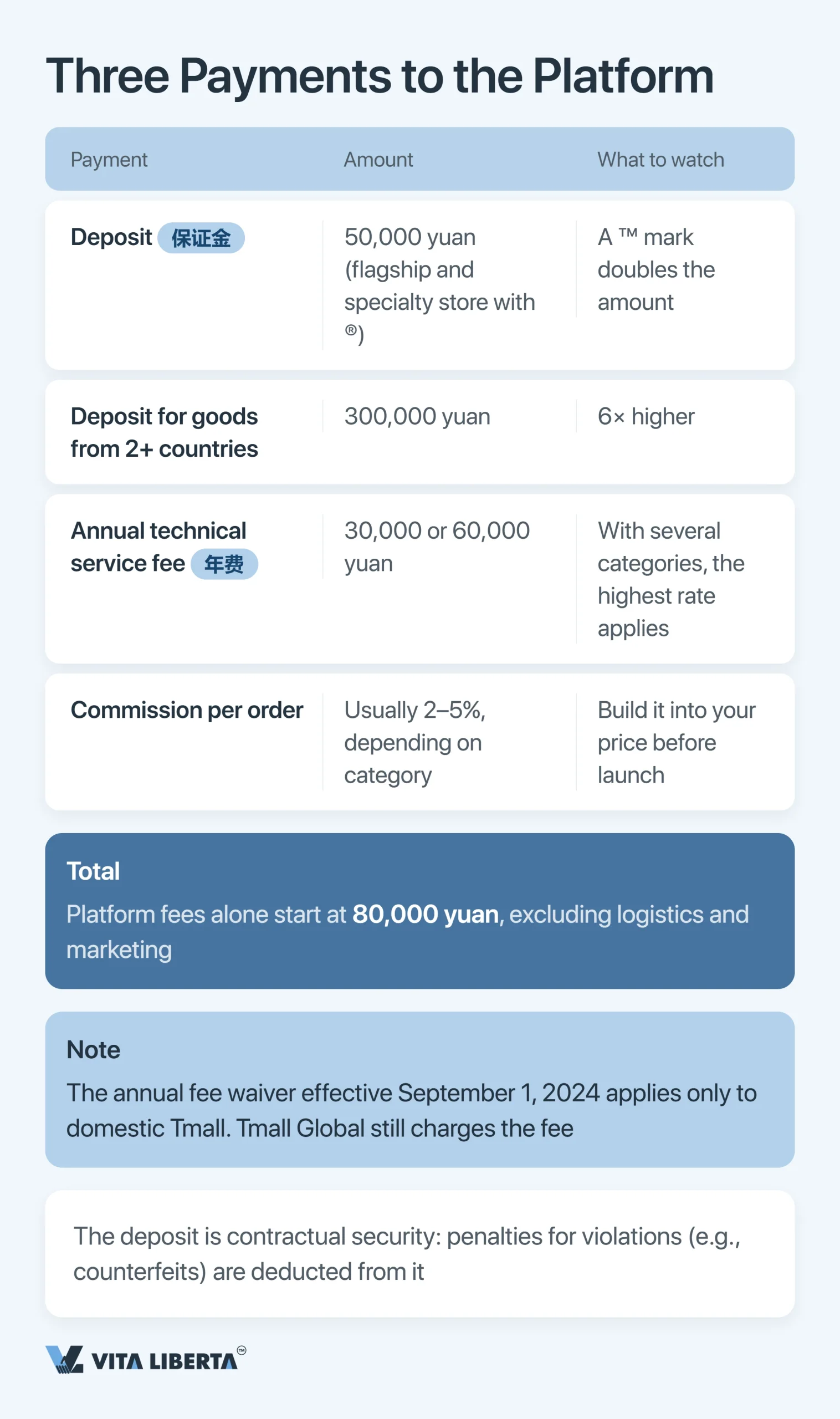
| Cost item | What the rate card says | In practice / risk |
| Security deposit (保证金) | RMB 50,000 for a flagship or specialty store with a ® mark | Confirmed. A ™ mark doubles it |
| Deposit for goods from 2+ countries | RMB 300,000 | Check this carefully: a multi-country range costs six times as much |
| Annual technical service fee (年费) | RMB 30,000 or 60,000, by main category | With several categories, you pay the highest tier |
| Commission per order | A category percentage, usually 2–5% | Build it into your prices before launch, not after the first sales |
A common mistake by foreign sellers: domestic Tmall dropped its annual fee from 1 September 2024. That change covers the domestic platform only, not all of Alibaba. On Tmall Global, the RMB 30,000 / 60,000 grid still applies. Important: the deposit secures your contract with the platform. If you break the rules, for example by selling counterfeits, the penalties come out of that deposit. Bottom line: platform charges alone start at RMB 80,000, before logistics and marketing.
Open your Tmall Global store without mistakes
- Brand and document check
- Choosing your store format
- Deposit and fee calculation
Customs and Tax: Each Parcel Counts as a Personal Purchase
Tmall Global goods do not enter China as a batch for resale. Each one enters as a specific person’s purchase. That is where both the tax breaks and the tight limits come from.
Models 1210 and 9610
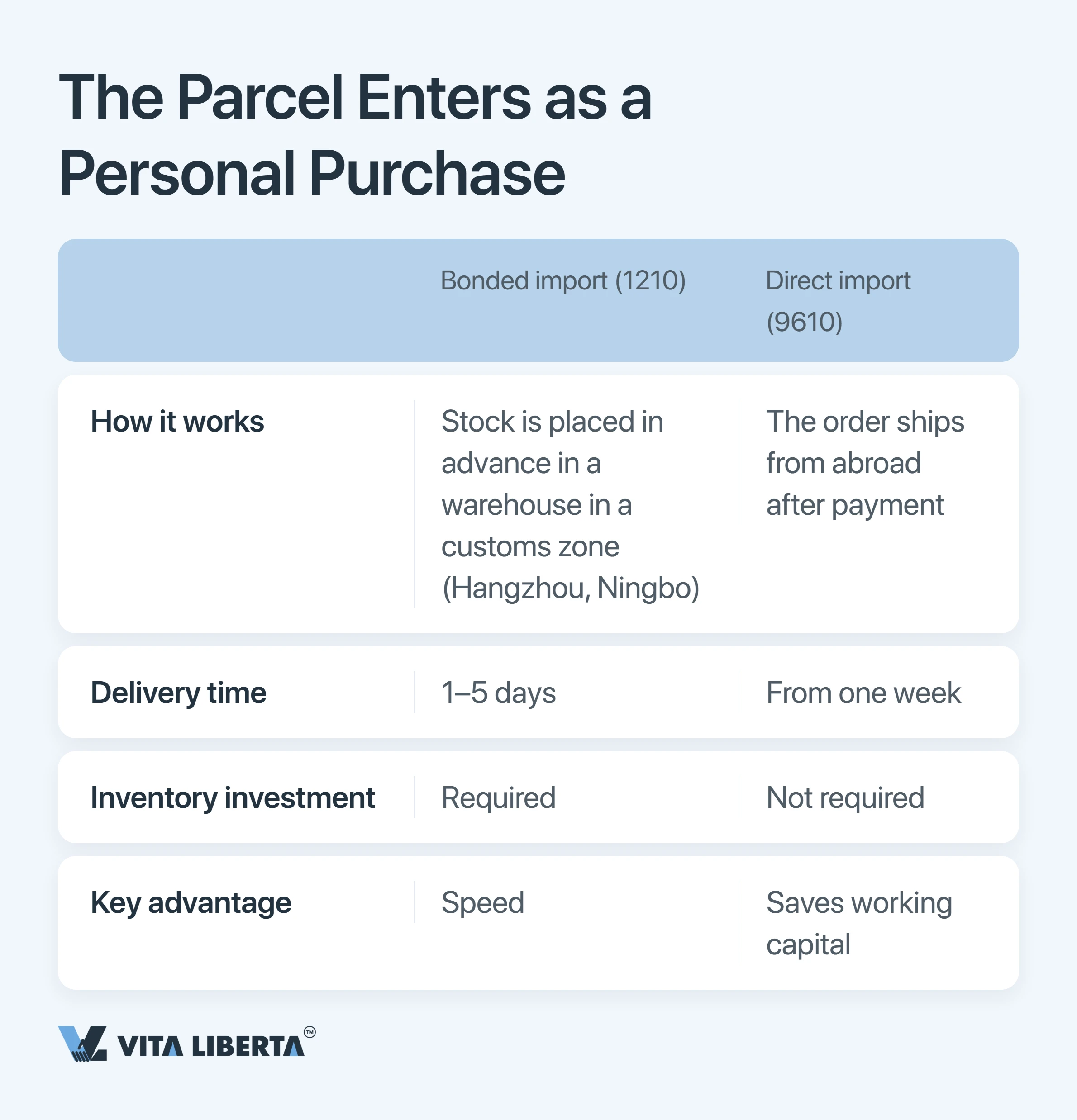
Under bonded import (网购保税进口, code 1210), you ship a batch in advance to a warehouse in a customs-supervised zone, such as Hangzhou or Ningbo, and buyers receive orders in 1–5 days. Under direct import (直购进口, code 9610), the order leaves from abroad after payment. You tie up no money in stock, but delivery takes a week or longer.
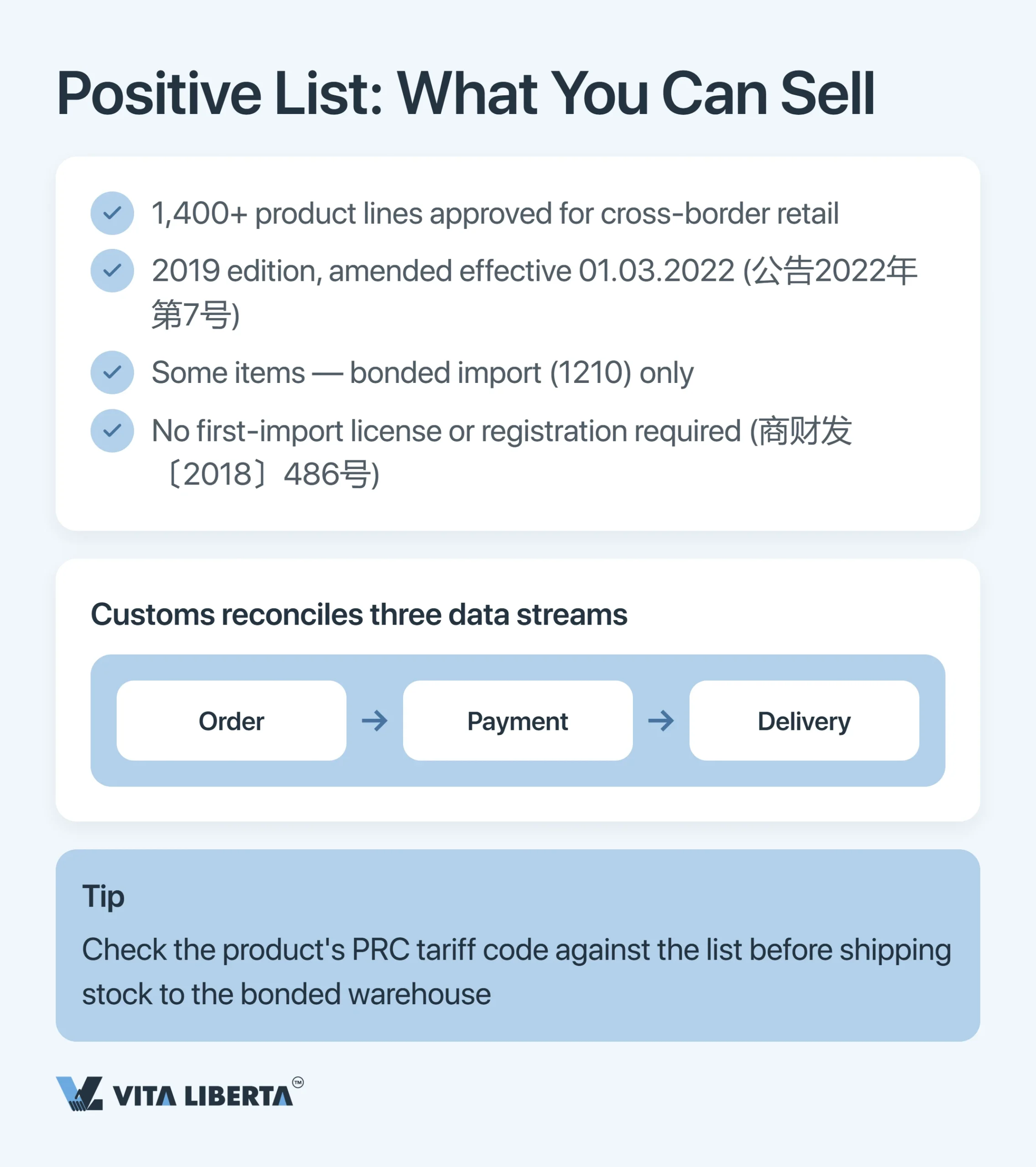
Both models rely on the Positive List, the List of Cross-Border E-Commerce Retail Import Goods (跨境电子商务零售进口商品清单). The current version dates from 2019. It was amended from 1 March 2022 by Announcement No. 7 of 2022 (公告2022年第7号), which China’s Ministry of Finance issued jointly with seven other agencies. More than 1,400 tariff lines on the list may be sold at retail. Some lines carry a “bonded import only” flag (仅限网购保税商品), so you cannot ship them under 9610. Under Circular 486 (商财发〔2018〕486号), listed goods need no first-import licence or registration. Customs still matches three data streams: the order, the payment and the delivery. Check your product’s tariff line under China’s customs tariff (税则号列) against the list before the batch heads to the bonded warehouse, not after it arrives.
The RMB 5,000 Limit and the 9.1% Rate
From 1 January 2019, Circular 49 (财关税〔2018〕49号) raised the ceiling to RMB 5,000 per purchase and RMB 26,000 per person per year. As of November 2026, these limits still apply. Within them, customs duty is 0%, and VAT and consumption tax are charged at 70% of the statutory amount. Point 3 of Circular 18 (财关税〔2016〕18号) sets this rule. Since 1 January 2026, the base VAT rate has come from the PRC VAT Law (中华人民共和国增值税法). For a non-excise product at the 13% rate, you get 13% × 70% = 9.1%. For goods at the 9% rate, it is 6.3%.
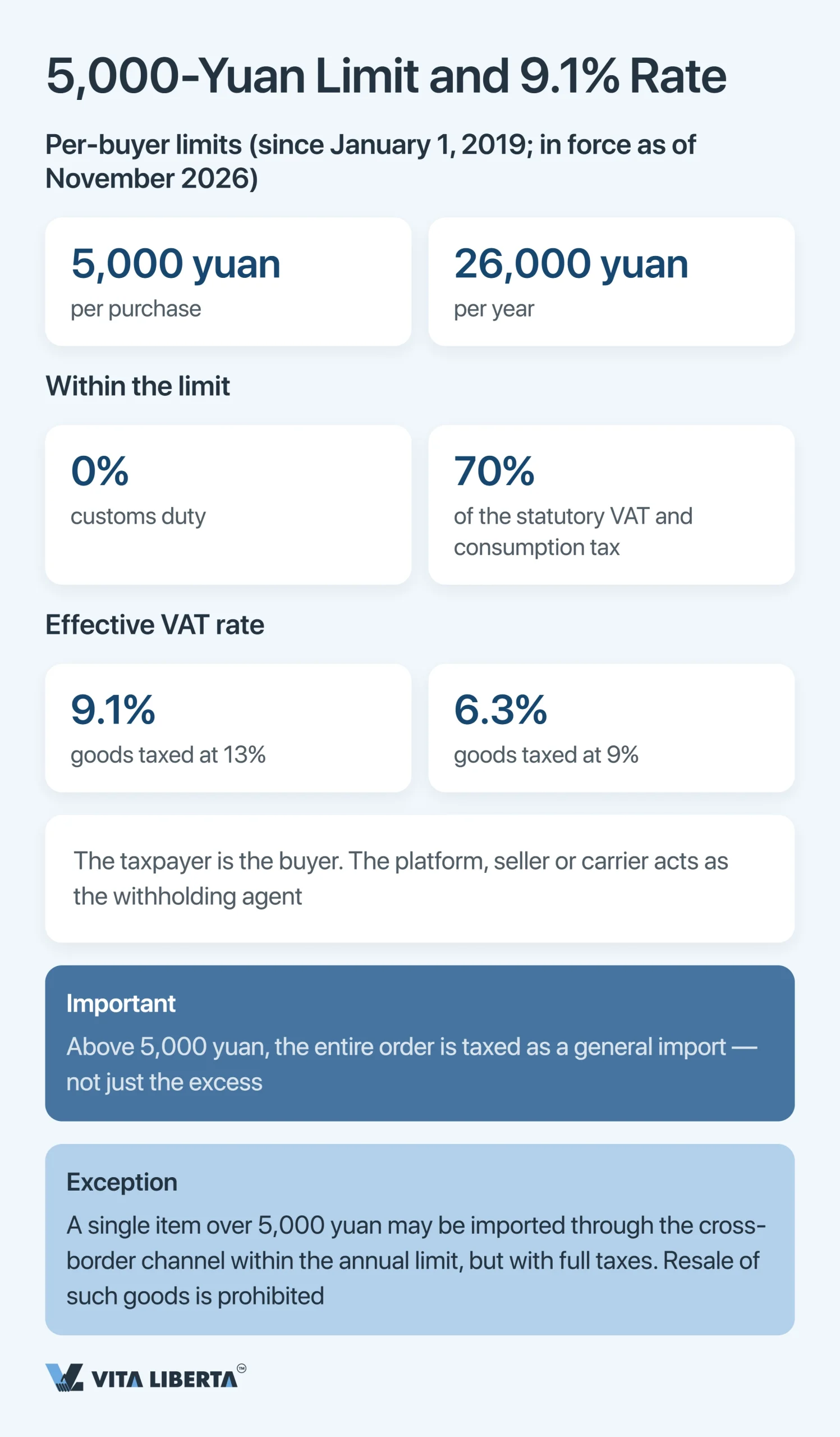
The buyer is the taxpayer. The platform, the seller or the carrier collects the tax as withholding agent (代收代缴义务人), under point 1 of Circular 18. If an order goes over RMB 5,000, the whole order is taxed as an ordinary import, not just the excess. Point 2 of Circular 49 makes one exception. If the order contains a single item priced above RMB 5,000 but within the RMB 26,000 annual limit, it can still come in through the cross-border channel. In that case, duty, VAT and consumption tax are charged in full at goods rates, and the amount counts toward the annual limit. Point 3 of Circular 49 bans reselling such goods inside China. Bottom line: price your listings so that a typical basket stays within RMB 5,000.
Launching the Store: Steps and the Role of a TP
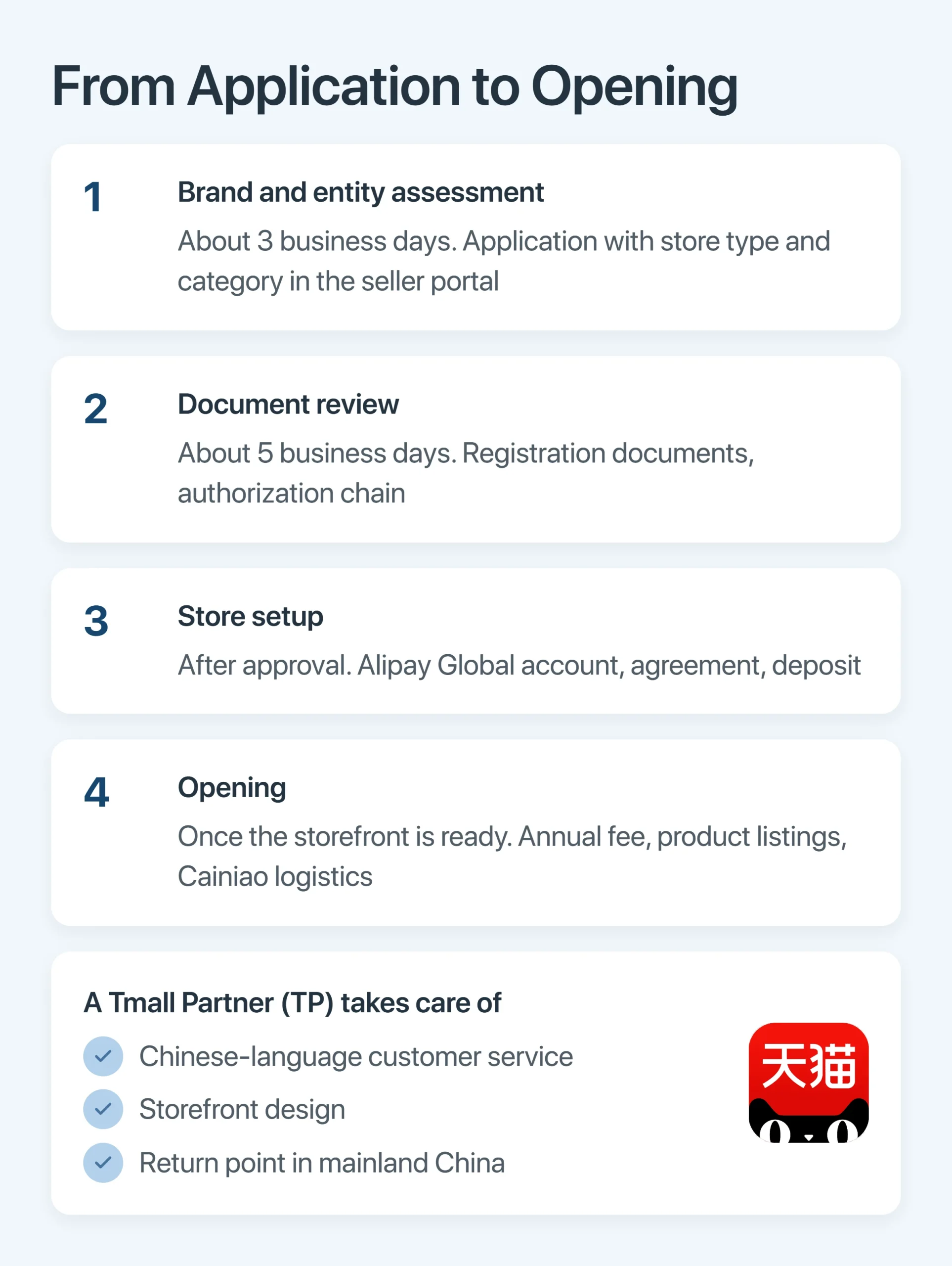
From 2015, you could only get in by invitation through a platform partner (Tmall Partner, TP). Today you can apply on your own. A TP still covers what foreign teams find hardest: Chinese-language customer service, store design and a returns address in mainland China.
| Stage | Timing | What to submit and where |
| Brand and entity assessment | about 3 working days | Application with store type and category, via the seller portal |
| Document review | about 5 working days | Registration documents, authorization chain |
| Store setup | after approval | Alipay Global account, agreement, deposit |
| Opening | once the storefront is ready | Annual fee, product listings, choice of Cainiao logistics |
Start selling to China through Tmall.hk
- Preparing your document package
- Setting up model 1210 or 9610
- Support until your store opens

Tmall Global: Strategic Takeaways
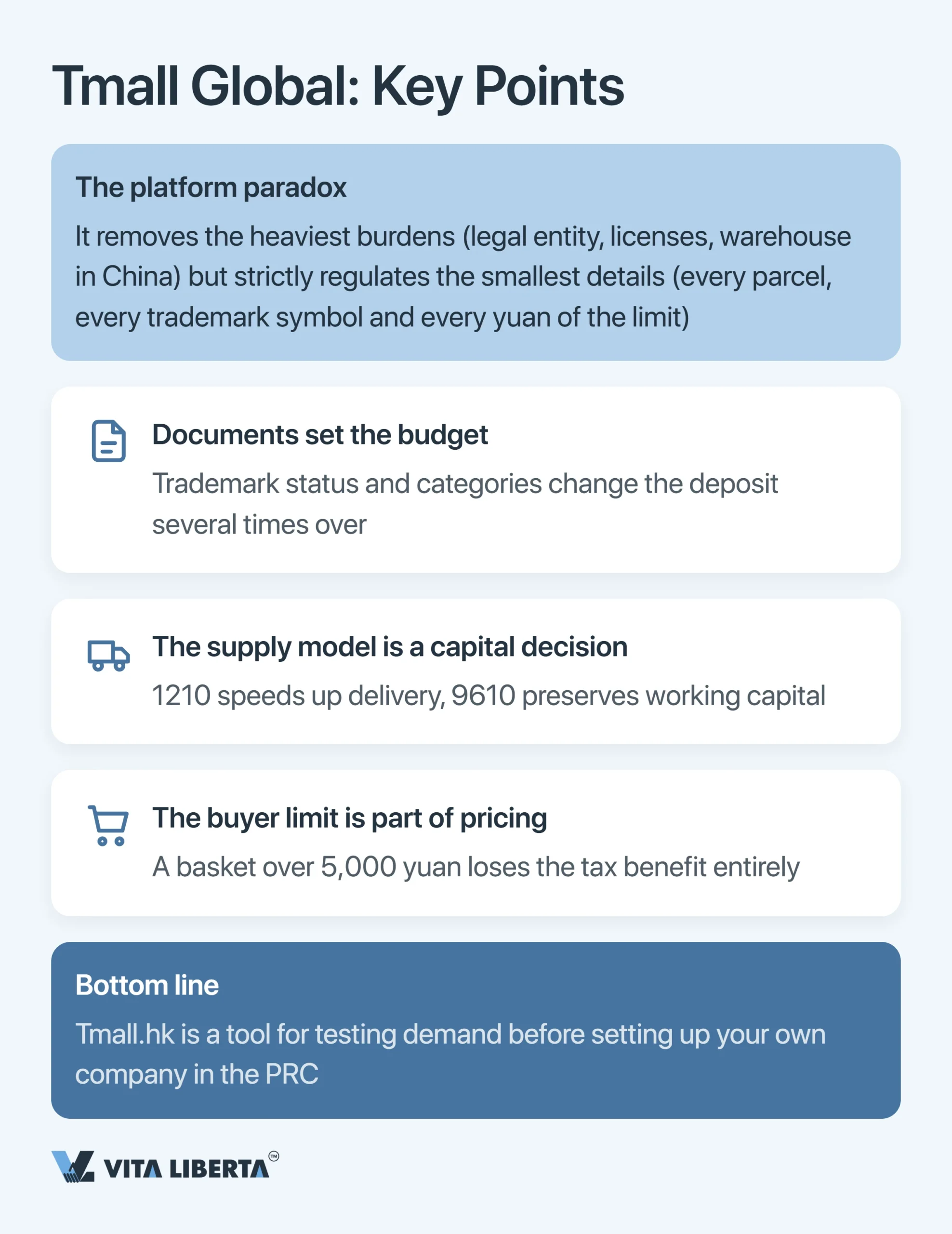
The platform’s central paradox: it lifts the heaviest burdens off a foreign brand (a Chinese entity, licences, a warehouse in China), yet it tightly polices the smallest details: every parcel, every trademark and every yuan of the buyer’s personal limit. Your documents set your budget. Trademark status and your mix of categories can change the deposit several times over. Your supply model is a capital decision. Model 1210 speeds up delivery; 9610 protects your working capital. The buyer’s limit is part of your pricing. A basket above RMB 5,000 loses the tax break in full. So a Tmall.hk store is not the paperwork finish line of your China entry. It is a way to test demand before you decide on your own company in the PRC.
Frequently asked questions
No. For Tmall Global, a company registered outside mainland China is enough, and a Hong Kong one counts. You need no Chinese bank account, office or warehouse in the PRC. Domestic Tmall works differently and requires a mainland Chinese company. That makes the cross-border format the sensible choice while you test demand, before you invest in your own structure.
Yes, but the deposit for a flagship store rises from RMB 50,000 to RMB 100,000. The difference stays frozen for as long as the store operates. If you expect the ® registration within the next few months, it is cheaper to apply once you have it.
If the order contains several items, the break disappears for the whole purchase, not only the excess. The order is taxed as an ordinary import, with full duty, VAT and consumption tax. If the RMB 6,000 is a single item, it can still come in through Tmall Global. Duty, VAT and consumption tax are then charged in full at goods rates, and the amount counts toward the buyer’s RMB 26,000 annual limit. You may not split an expensive set into several parcels to fit under the limit. Plan your range and bundles so that a typical receipt stays within RMB 5,000.
Direct shipping under 9610 needs no stock investment in China, but delivery takes a week or more. A bonded warehouse under 1210 cuts delivery to 1–5 days, but you must bring the batch in advance and pay for storage. During a test phase, sellers usually start with direct shipping and switch to bonded once turnover becomes predictable.
No. You can now apply on your own, although entry used to be by invitation through platform partners only. In practice, a TP handles Chinese-language service, store and listing design, and returns in mainland China. Without your own Chinese-speaking team, you will have to hand these tasks to someone anyway.