
- Home
- Calculators
- Individual income tax in China
Individual income tax in China
Enter salary, bonus and deductions — the calculator works out the tax step by step for a resident or non-resident, the employee contributions and the net pay.
- 3–45%tax scale on salary
- ¥60,000resident basic deduction a year
- 183 daystax residence threshold
Vita Liberta — licensed company secretary in Hong Kong · TCSP TC007080Rates checked: November 2026
How much individual income tax an employee pays in China
Step 1 · The employee
Step 2 · Income, ¥
Employee contribution rates — if your city differs
Step 3 · Special deductions — residents only
Rent — if neither the employee nor the spouse owns a home in the city of work. The amount depends on the city:
· ¥1,500 — Beijing, Shanghai, Tianjin, Chongqing, provincial capitals, Shenzhen, Ningbo, Xiamen, Qingdao, Dalian;
· ¥1,100 — other cities over 1 million;
· ¥800 — cities up to 1 million.
- Tax
- On salary—
- On bonus—
- The employee receives
- Employee contributions—
- Net for the year—
- Net a month, excl. bonus—
Enter the salary to see the tax step by step.
Indicative, at the rates and deductions known in November 2026, for 2027: the PRC Individual Income Tax Law, MOF/STA Announcements No. 29 and No. 30 of 2023 (foreigner allowances and separate bonus taxation — to 31.12.2027), child and parent deductions at the amounts in force since 2023. Not included: foreign income and the 6-year rule, the 90/183-day treaty exemptions, tax in the country of citizenship, medical expenses, deductions on service and royalty income. The China tax administration sets the final amount.

*How individual income tax works in China
How the tax is worked out
- Status
Resident — in China 183 days or more in the calendar year: annual scale and all deductions. Non-resident — monthly scale, ¥5,000 a month deduction.
- Deductions
Basic ¥60,000 a year, employee social insurance and housing fund, special deductions for children, parents, housing and education, private pension up to ¥12,000.
- Bonus
Until 31.12.2027 the annual bonus can be taxed separately: the rate is set by the amount ÷ 12. The calculator shows which is better.
- Foreigners
Allowances for housing, children’s school, language and home leave are exempt to 31.12.2027 — instead of special deductions.
Legal basis: PRC Individual Income Tax Law (2018): Art. 1 — residence at 183 days a year, Art. 3 — 3–45% rates, Art. 6 — ¥60,000 basic deduction and special deductions; MOF/STA Announcement No. 30 of 2023 — separate taxation of the annual bonus to 31.12.2027; No. 29 of 2023 — exempt foreigner allowances to 31.12.2027; State Council Circular No. 13 of 2023 — ¥2,000 per child and ¥3,000 for parents.
We run payroll and individual income tax in China
Payroll, tax withholding, contributions and annual returns for your staff through our team in Hangzhou.
Questions about individual income tax in China
Does a foreigner pay tax on income abroad?
Only after 6 consecutive years in China. A foreign resident is taxed on foreign income if in each of the 6 preceding years they spent 183 days or more in China and never left for more than 30 days in a row. If any of those years was different, only China-source income is taxed and the 6-year count restarts. Years count from 2019. This calculator covers China salary only.
Can allowances and special deductions be combined?
No. A foreigner chooses one: exempt housing, children’s school and language allowances, or special deductions. The choice holds for the year.
Bonus — separately or with salary?
It depends on the amount: separately the bonus is taxed on the monthly scale, together it is added to annual income. The calculator works out both and shows the difference.
Does the employee pay tax and contributions or does the company?
The company does. As withholding agent it deducts income tax and the employee’s social insurance and housing fund shares from salary and remits them itself. The employee receives salary net of these amounts and pays directly only a top-up in the annual return, if any.
How does the employee pay their housing fund share?
They don’t — the company withholds it from salary. Within 5 days of paying salary the company transfers both the employee’s and its own share to the employee’s personal housing fund account. Both belong to the employee and can be withdrawn to buy, repair or rent a home. Rates are usually the same for both, at least 5% each.
Who withholds the tax and when is it paid?
The employer withholds tax from each salary payment and remits it by the 15th of the following month; if the 15th falls on a weekend or holiday the deadline moves — the tax administration publishes the yearly calendar. For a resident tax is calculated cumulatively from the start of the year, so monthly withholding can rise towards year-end.
How are the 183 days counted?
Days in China are added up over the calendar year. A day spent in China for less than 24 hours — such as the day of arrival or departure — does not count.
Is salary paid abroad taxable?
If it is paid for work in China it is China-source income wherever it is paid. The exception is a short stay of up to 90 days (or 183 days under a treaty) if a foreign employer pays and the cost is not recharged to a Chinese company.
Is an annual return needed?
For a resident — if too little or too much tax was withheld over the year, there is income without withholding, or deductions the employer did not apply need claiming. The window is 1 March to 30 June of the following year, filed through the tax administration’s app.
How to avoid double tax if income is also taxed in the home country?
Double tax agreements apply: tax paid in China is credited in the other country under its rules. A Chinese tax payment record and income documents are needed for the credit.
How does it differ for a PRC national?
Residence depends on home, not the passport. A PRC national who lives in China permanently (household record, family, economic ties) is generally resident: tax on worldwide income and all special deductions. A PRC national living permanently abroad becomes resident only after 183 days or more in China in the year. Foreigner allowances do not apply to PRC nationals.
Other calculators
 HKStamp duty on a share transferWhat the buyer and the seller payCalculate →
 HKProfits tax and provisional taxTwo-tier rates, 75% and 25% instalmentsCalculate →
 HKSalaries taxSalary, bonuses, director’s fees — 2–17%Calculate →
 HKMPF and employee costEmployer and employee contributions, insuranceCalculate →
 HKFinancial year and corporate filingsFirst and later years, IRD, annual return, BR, AGMCalculate →
 HKCompliance calendarAll deadlines from incorporation and penaltiesCalculate →
 HKLate filing penaltiesAnnual return, BR renewal, taxCalculate →
 HKOffshore claim testCould the exemption apply to your profits?Calculate →
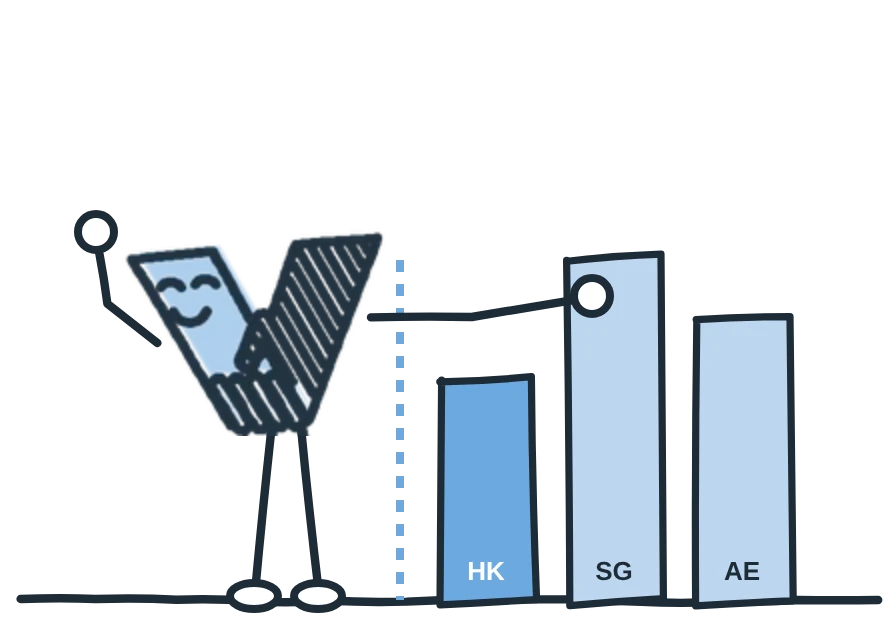 HKHong Kong, Singapore or UAEIndicative tax burdenCalculate →
 PRCExport VAT refundHS code or product — refund and marginCalculate →
 PRCDividends from China to Hong Kong10% or 5% withholding taxCalculate →
 PRCTax burden in ChinaVAT, surcharges, corporate tax, contributions, dividendsCalculate →
 PRCNegative List and licencesOpen to foreign capital and which licencesCalculate →
 PRCShare capital in ChinaPayment deadline and what the start needsCalculate →
 PRCWork permit in ChinaPoints and Category A, B or CCalculate →
 PRCHow to work with ChinaWFOE, representative office or Hong KongCalculate →PRCCompliance calendar in ChinaTaxes, annual report, audit, SAFE reportingCalculate →