




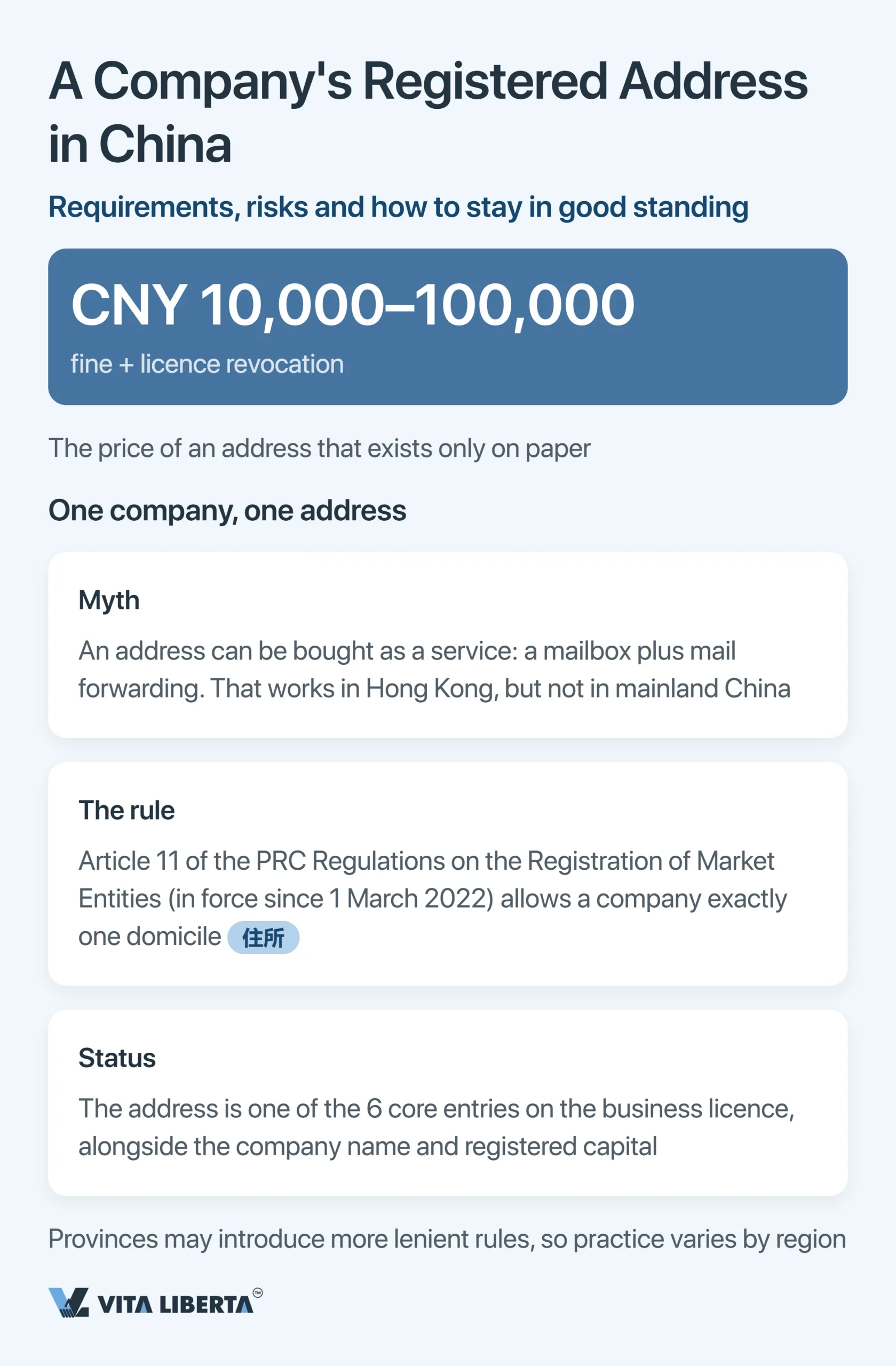
Founders used to Hong Kong often assume that a China registered address can be bought as a service, meaning a mailbox with mail forwarding. On the mainland it does not work that way. Article 11 of the PRC Regulation on the Administration of Registration of Market Entities (市场主体登记管理条例, State Council Order No. 746) has applied since 1 March 2022, and it allows a company exactly one domicile (住所). The same article lets provinces set more relaxed address rules, so practice differs a lot between regions. The address is not a postal detail. It is one of six core entries on the licence, along with the name and registered capital. So when you rent an office in China, the lease has two jobs: it gets you through the registration review, and it shows that the company can be found at a real place.
What the Registrar Writes into Your Business Licence
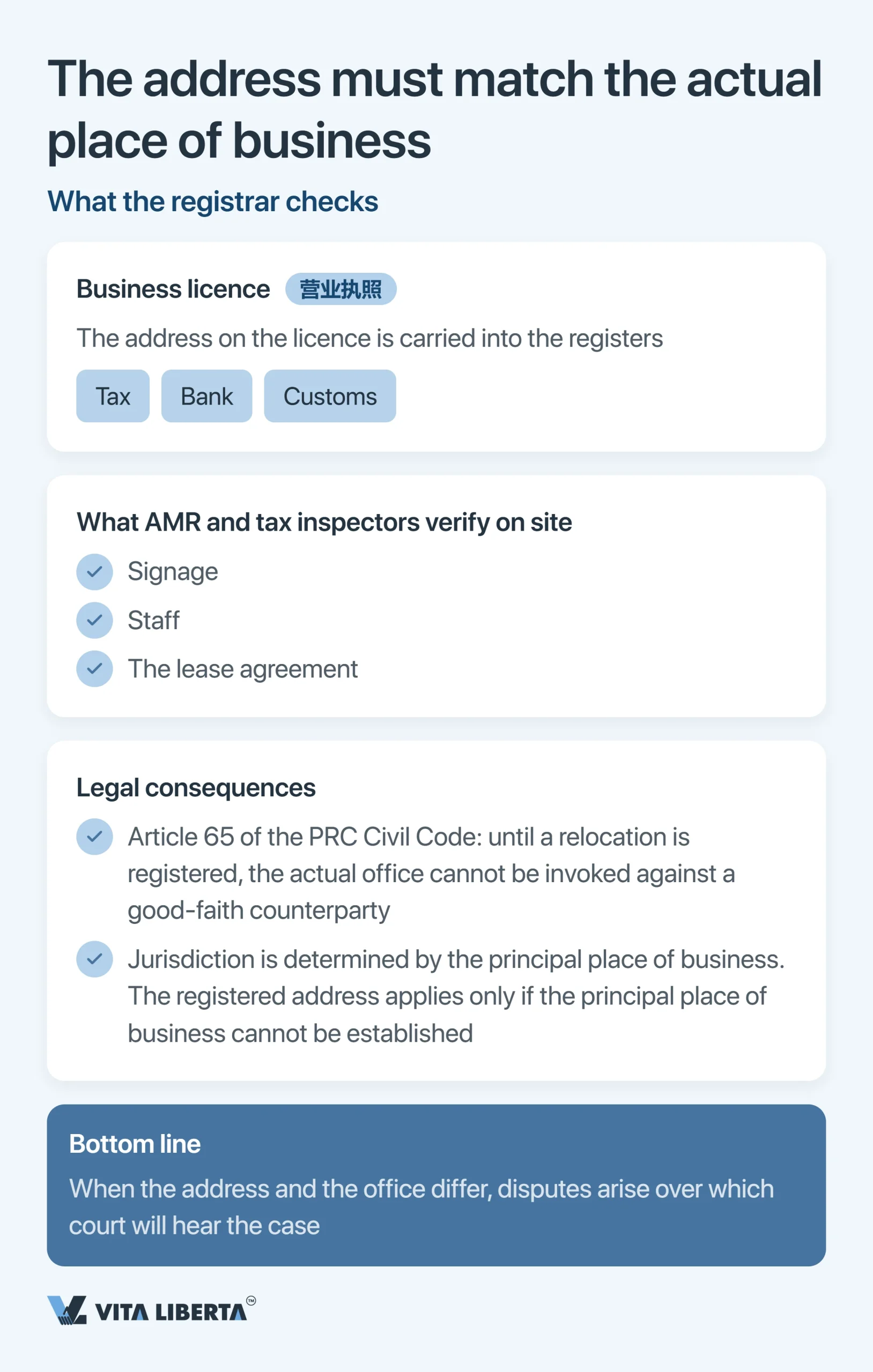
The address goes onto the business licence (营业执照), and from there it is copied into every other register: tax, banking and customs. That is why the Administration for Market Regulation (AMR) checks two things when you file.
One Address, and It Must Be Where You Actually Work
The registered address cannot be a front that is separate from where the business really runs. AMR and tax inspectors visit and compare the signage, the staff and the lease. The law points the same way. Until you register a move, you cannot use your actual office as an argument against a counterparty acting in good faith (Article 65 of the PRC Civil Code). For court jurisdiction, judges look at the company’s principal office. They use the registered address only if the principal office cannot be identified (Article 3 of the Supreme People’s Court Interpretation on applying the Civil Procedure Law). In practice, official notices arrive at the registered address, and if it differs from your real office you can end up arguing over which court hears the case.
Lease, Title Certificate and Permitted Use
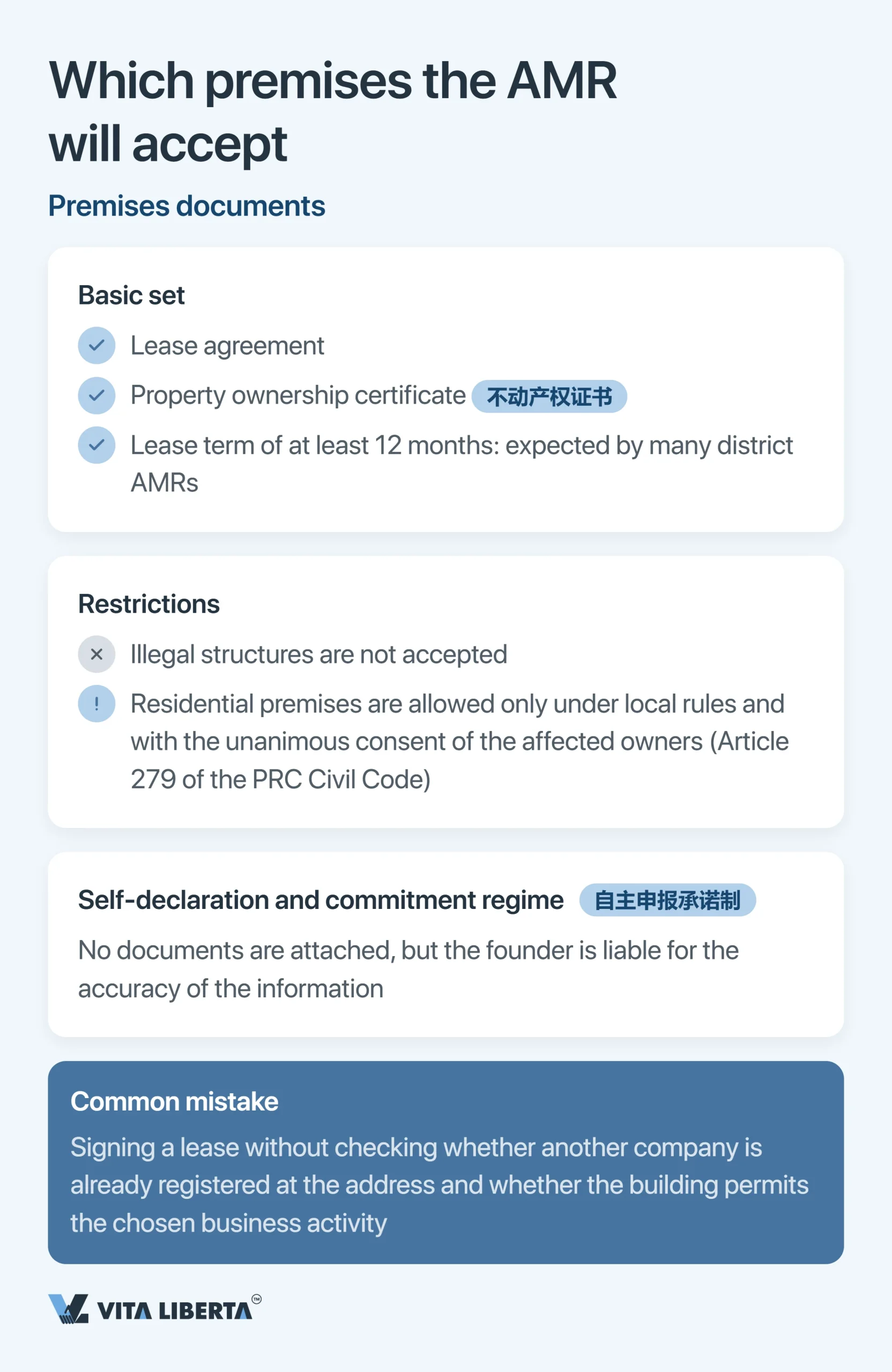
The usual set of documents is the lease and a copy of the owner’s real estate title certificate (不动产权证书). Many district AMRs expect a lease of at least 12 months. The deciding factor is the property’s designated use. Illegal structures are rejected. A flat can be used only where local rules allow it, and only if all owners whose interests are affected agree (Article 279 of the Civil Code). Some regions now use a self-declaration and commitment system (自主申报承诺制). You attach no documents, but the founder is responsible for the accuracy of what is declared. A common and expensive mistake by foreign investors is to sign a lease before checking whether another company is already registered at the address and whether the building allows the planned business.
Virtual Office, Cluster Registration or Your Own Lease
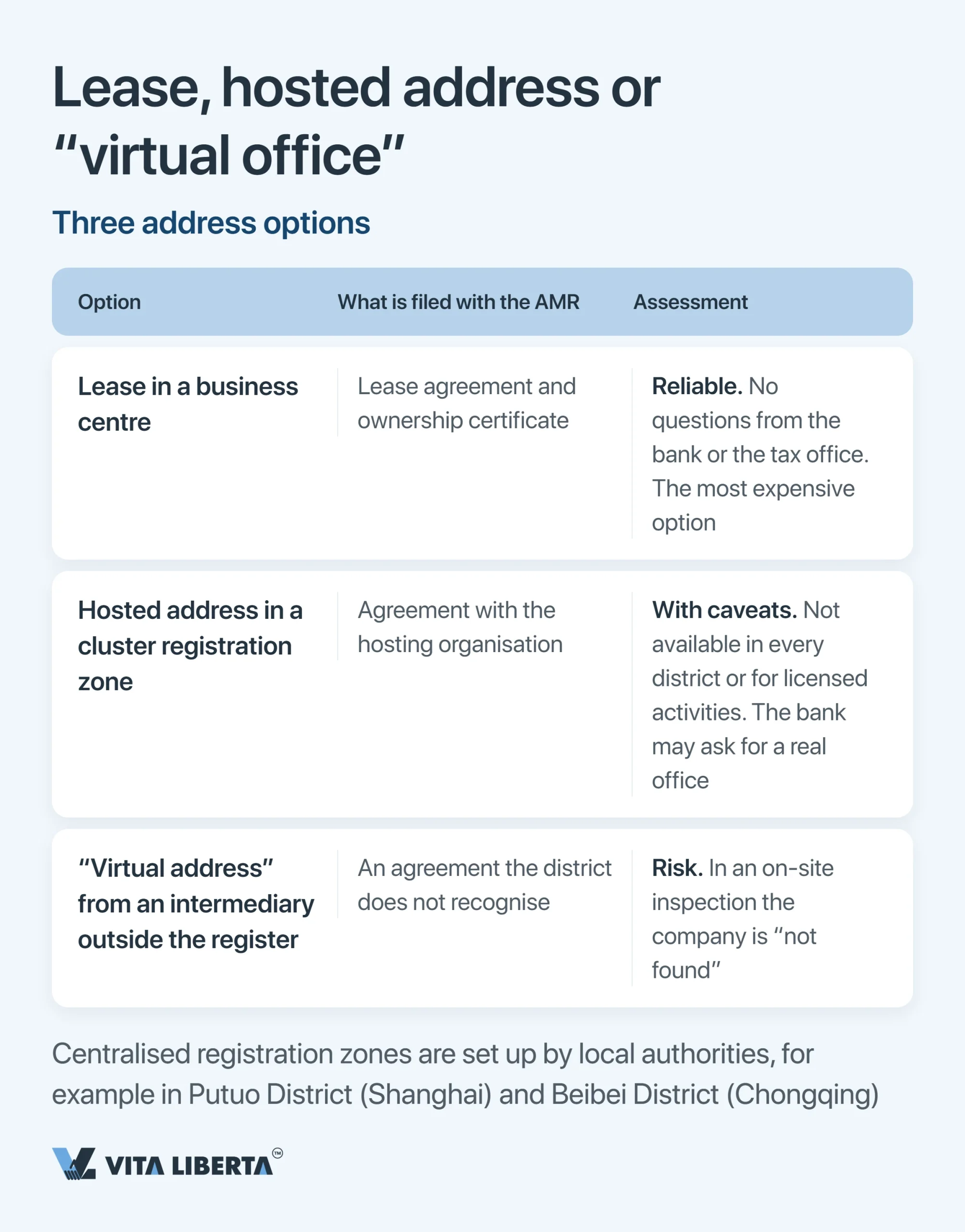
In China, a virtual office does not mean a mailing-address service. It means a place in a centralised registration area created by the local authorities. The address of the hosting organisation (托管机构) is entered in the district register, and the host is responsible for receiving official mail. In Shanghai, district rules designate “centralised registration sites” with an address-hosting arrangement. Putuo is one example (普府规范〔2024〕1号, built on the citywide procedure 沪府办规〔2024〕2号). Hosting is not available for activities that the law prohibits or that need special premises. In Chongqing, cluster registration (集群注册) is run by individual districts such as Beibei, using sites the district authorities have approved.
| Address option | What you file with the AMR | Practice and risk |
| Lease in a business centre | Lease and owner’s title certificate | Confirmed. Banks and the tax bureau ask no questions. This is the most expensive option |
| Hosted address in a cluster registration zone | Agreement with the hosting organisation | Check carefully. It is not available in every district or for licensed sectors, and the bank may still ask to see a real office |
| An intermediary’s “virtual address” outside the register | An agreement the district does not recognise | Needs fixing. At an on-site inspection the company is “not found” |
Find an Address That Passes the AMR Check
- Premises check before you sign
- Hosted address or your own lease
- Lease review

Office Lease: 30 Days to File and 0.1% Stamp Duty
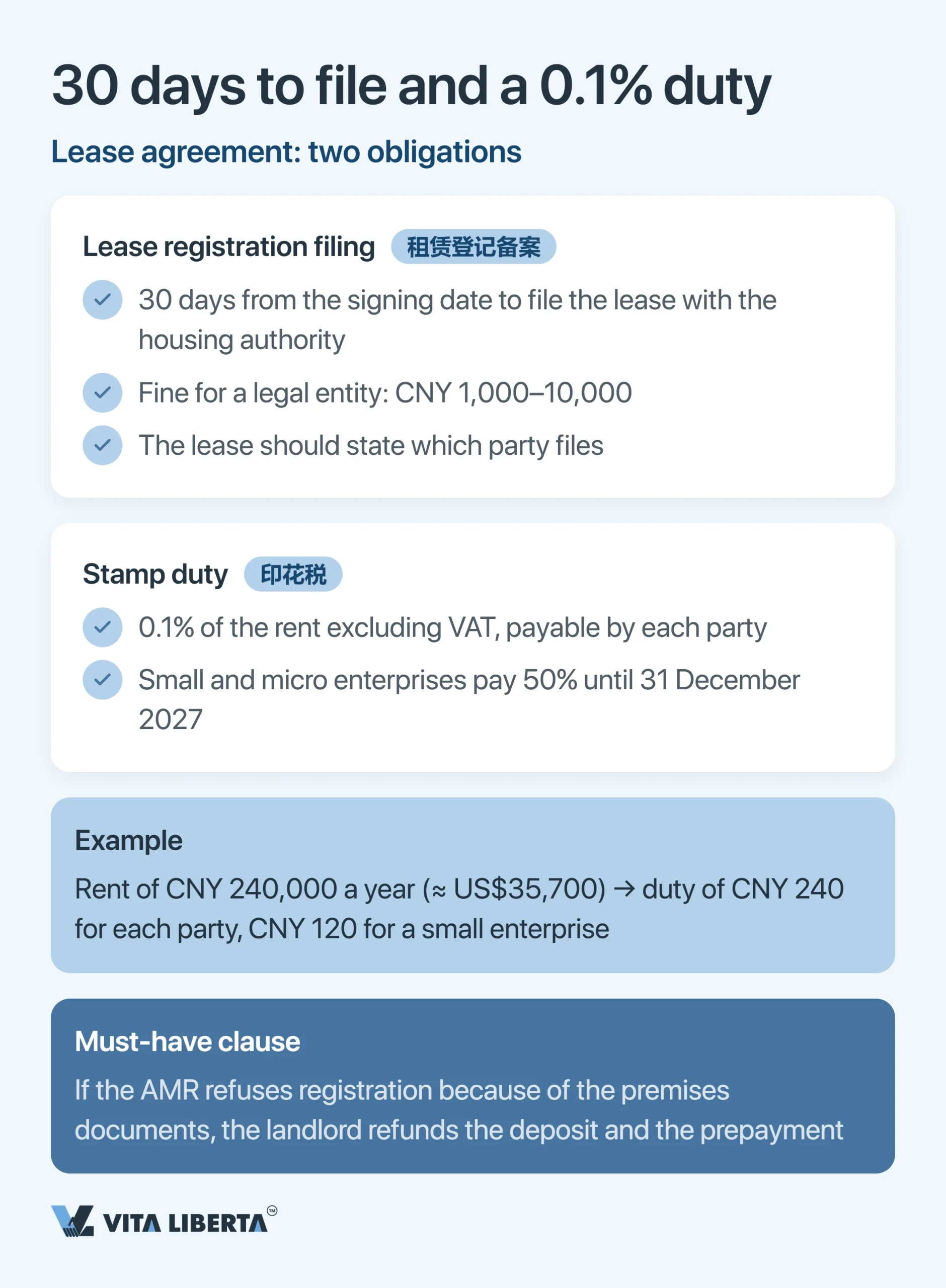
Signing the lease creates two obligations that intermediaries rarely mention.
Lease Registration Filing (租赁登记备案)
The parties have 30 days from signing to file the lease with the city or district housing authority. This is required by Article 14 of the Administrative Measures for Commercial Housing Leasing (商品房屋租赁管理办法, MOHURD Order No. 6), in force since 1 February 2011. If a company ignores an order to file, it is fined RMB 1,000–10,000 under Article 23. This duty is often passed to the tenant without discussion, so the lease should say clearly who does it.
Stamp Duty and Protective Clauses
Stamp duty (印花税) on a lease is 0.1% of the rent in the contract, not counting separately stated VAT. The PRC Stamp Duty Law (中华人民共和国印花税法, Presidential Order No. 89) has applied since 1 July 2022, and each party pays 0.1% of that amount. Small low-profit enterprises (小型微利企业) pay half the duty from 1 January 2023 to 31 December 2027 (MOF/STA Announcement No. 12 of 2023). With rent of RMB 240,000 a year (about USD 35,700 at the PBOC rate of RMB 6.7180 per USD on 4 November 2026), each party pays RMB 240, or RMB 120 if it is a small enterprise. The amount is small, but an unpaid duty shows up in a tax audit. Clause you must include: if the AMR refuses registration because of the premises documents, the landlord refunds the deposit and any prepaid rent.
RMB 10,000 to 100,000: What a “Lost” Address Costs
Address penalties build on each other, and it starts with a letter that never reaches you.
| Breach | Sanction | How to clear it |
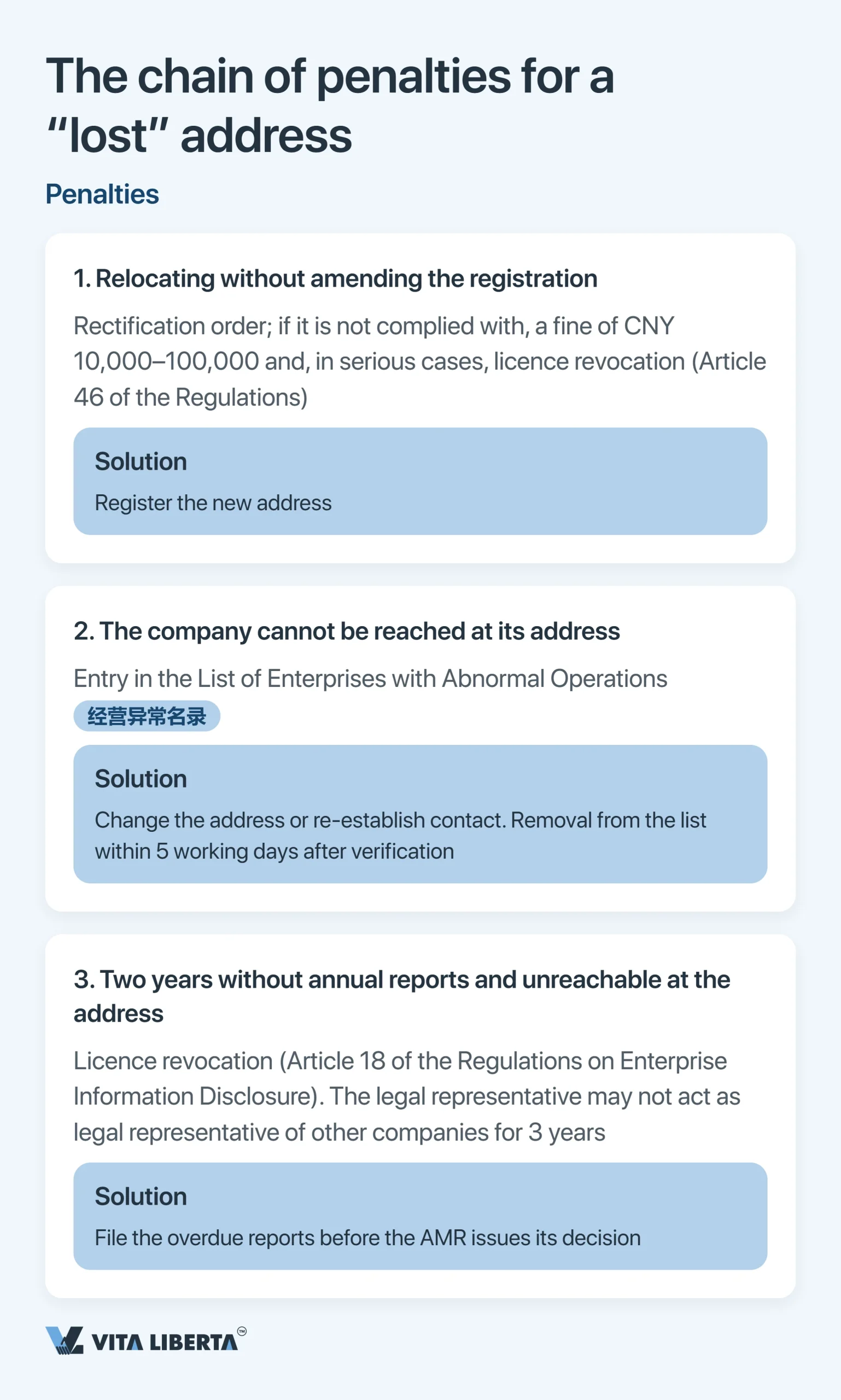
| Moving without updating the registration | An order to correct it. If you refuse, RMB 10,000–100,000, and the licence can be revoked in serious cases (Art. 46 of the Regulation) | Register the new address. Several regions impose no fine if you correct it yourself |
| Company cannot be reached at its address | Added to the List of Enterprises with Abnormal Operations (经营异常名录) | Change the address or confirm you can be reached. Removal is decided within 5 working days after review |
| No annual reports for two years and unreachable at the address | Licence revoked (Art. 18 of the Interim Regulation on Enterprise Information Disclosure). A legal representative who is personally responsible cannot be legal representative of any other company for 3 years (Art. 12 of the Regulation) | File the missing reports and restore contact before the AMR decides |
Important: if a company files no annual report for two years in a row and cannot be reached at its registered address, the AMR can revoke its licence (Article 18 of the Interim Regulation on Enterprise Information Disclosure, 企业信息公示暂行条例, as amended by State Council Order No. 777, effective 1 May 2024). The company then loses the right to do business.
A Public List and On-Site Checks
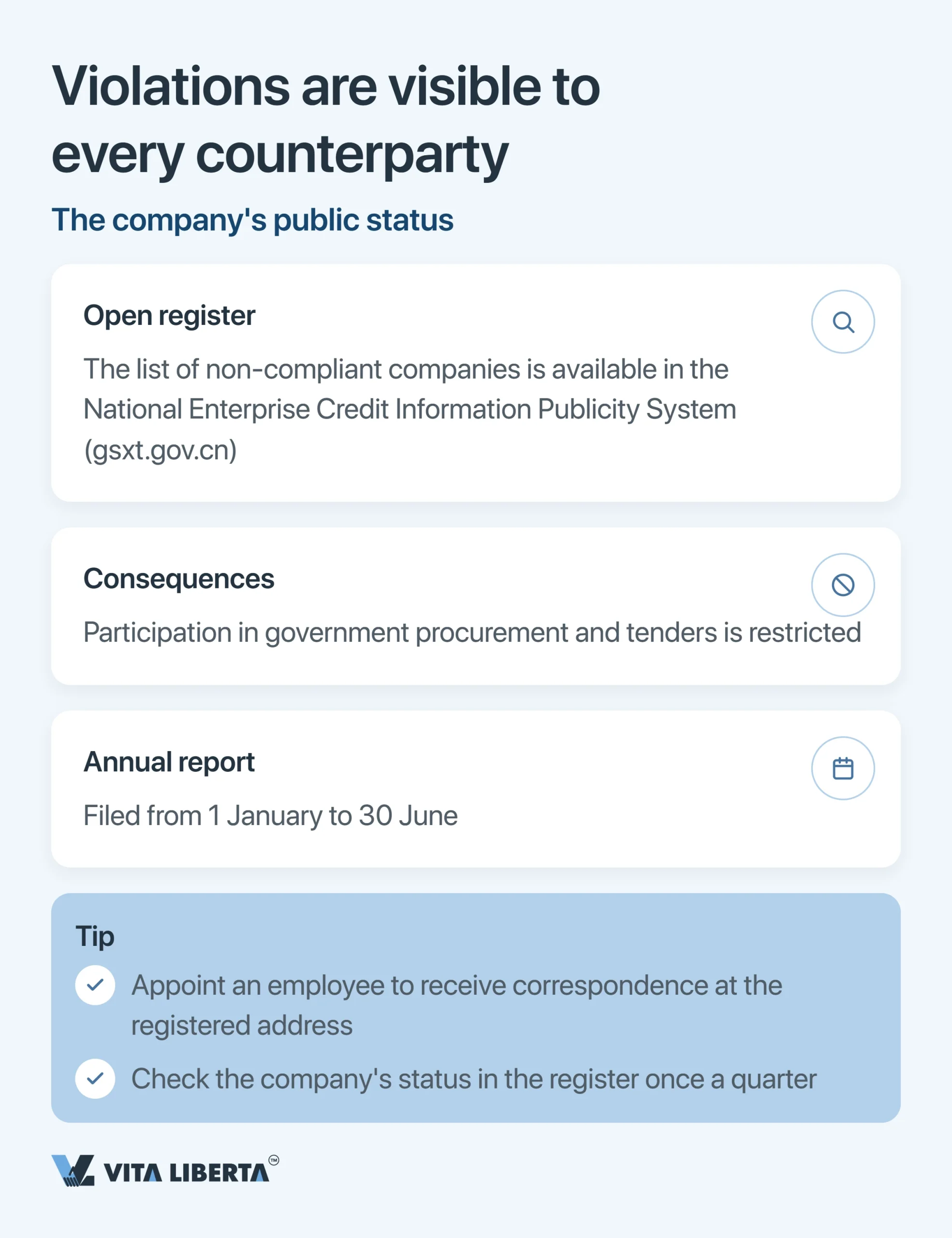
Any counterparty can look up the abnormal operations list in the National Enterprise Credit Information Publicity System (国家企业信用信息公示系统, gsxt.gov.cn). Companies on the list are restricted from government procurement and tenders. Annual reports are due between 1 January and 30 June. Quick tip: make one employee responsible for mail sent to the registered address, and check the company’s status in the register every quarter.
Relocating: File Before You Move In
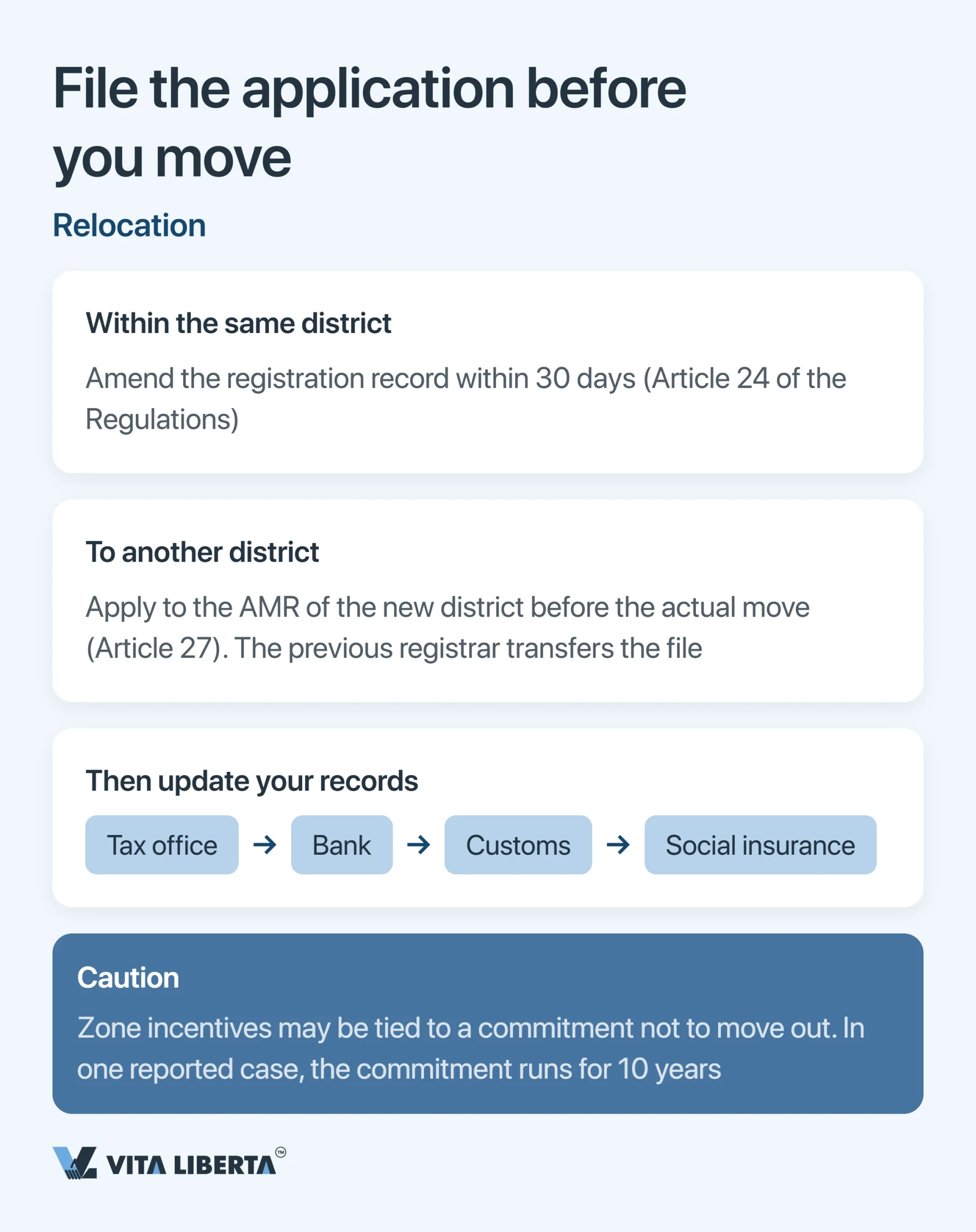
If you move within the same district, you amend the registration within 30 days (Article 24 of the Regulation). A move to another district follows a different procedure. Under Article 27, you apply to the AMR of the new district before you actually move, and the old registrar then transfers the file. After that, you update your details with the tax bureau, bank, customs and social insurance. Also check any zone incentives. They can come with a commitment not to leave the zone, which in one reported case lasted 10 years.
Get Your China Registered Address Without the Risk
- Address registration with the AMR
- Lease filing
- Support with address changes

Registered Address in China: Strategic Takeaways
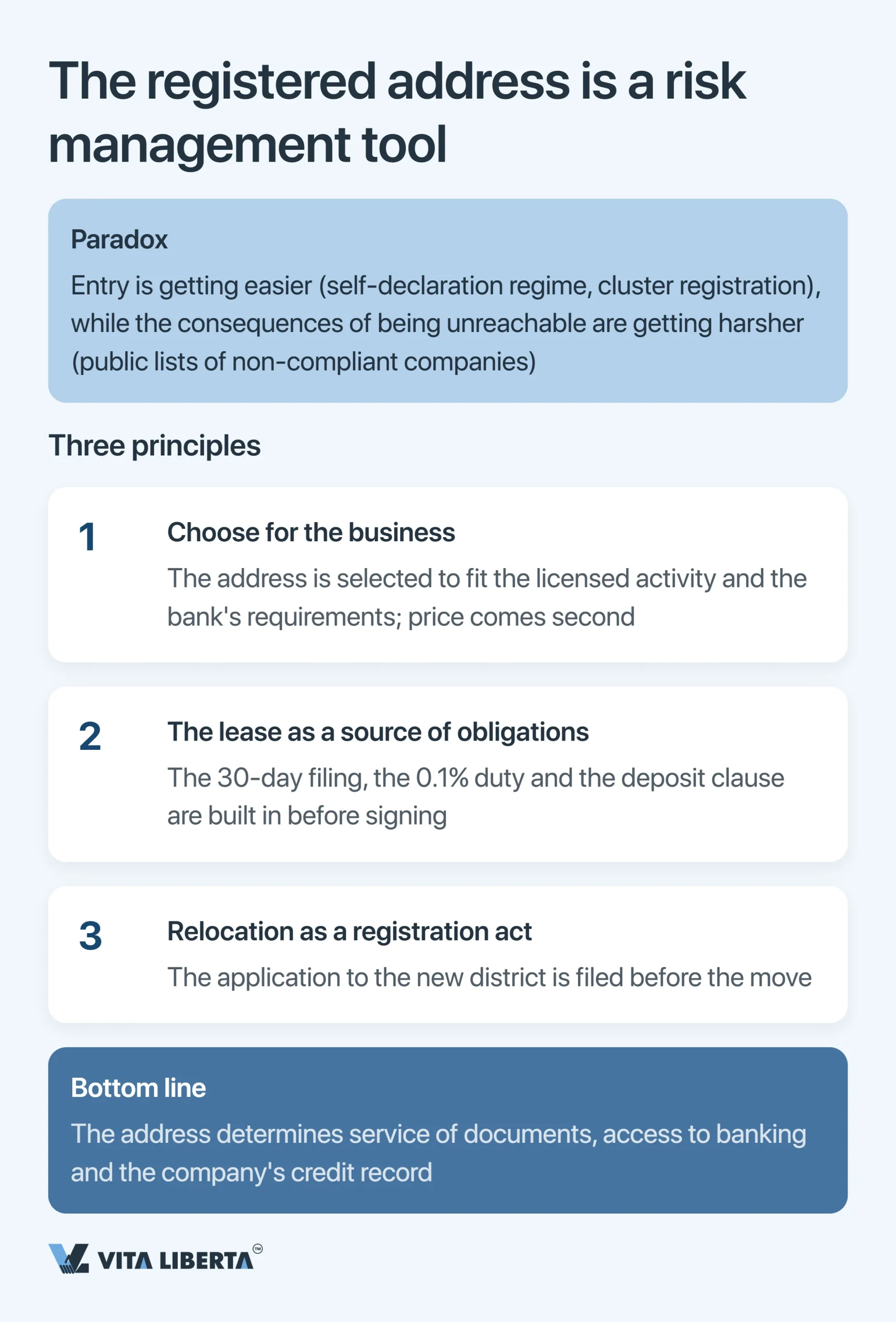
The central paradox is that the state is making it easier to register, with self-declaration, cluster registration and, in several provinces, several companies allowed at one address. At the same time, it is making it more costly to be unreachable, through public lists of violators.
- Choose the address for your business. Match it to your licensed sector and your bank’s requirements. The price of registration matters less.
- Treat the lease as a set of obligations. Plan for the 30-day filing, the 0.1% duty and the deposit-refund clause before you sign.
- Treat a move as a registration step. The application to the new district goes in before the movers arrive.
In short, a registered address is more than a line on the licence. It is a way to manage risk, because it decides whether official documents reach you, whether you can use your bank, and what credit record the company has.
Frequently asked questions
Only if the address is in a centralised registration zone listed in the district register and is provided by a hosting organisation. If the district does not recognise the intermediary’s address, the company will be “not found” at the first on-site inspection and will go onto the abnormal operations list. Check the provider’s status before you pay.
Yes. The address change must be registered within 30 days. If you move to another district, you apply to the new district’s AMR before you move in. Ignoring an order to correct this costs RMB 10,000–100,000, and in serious cases the licence. It makes sense to start the registration steps while you are still looking for premises.
Some regions allow residential property, but only where local rules clearly permit it and only if all affected owners agree. Since 15 September 2025, the landlord files a residential lease free of charge. If the landlord has not done so, the tenant can file it (Housing Rental Regulation, State Council Order No. 812). This option rarely suits a trading or manufacturing WFOE because of its business scope, so decide only after checking the rules of the specific district.
The lease is filed with the housing authority within 30 days of signing. A company that ignores an order to file pays RMB 1,000–10,000. Each party also pays stamp duty of 0.1% of the rent. The lease should say which party handles the filing.
You can be removed once you register a new address or confirm that you can be reached at the old one again. The decision is made within 5 working days after review. While you are on the list, counterparties can see the entry in the public register and your access to government procurement is restricted. Delaying the fix costs more than doing it straight away.


