

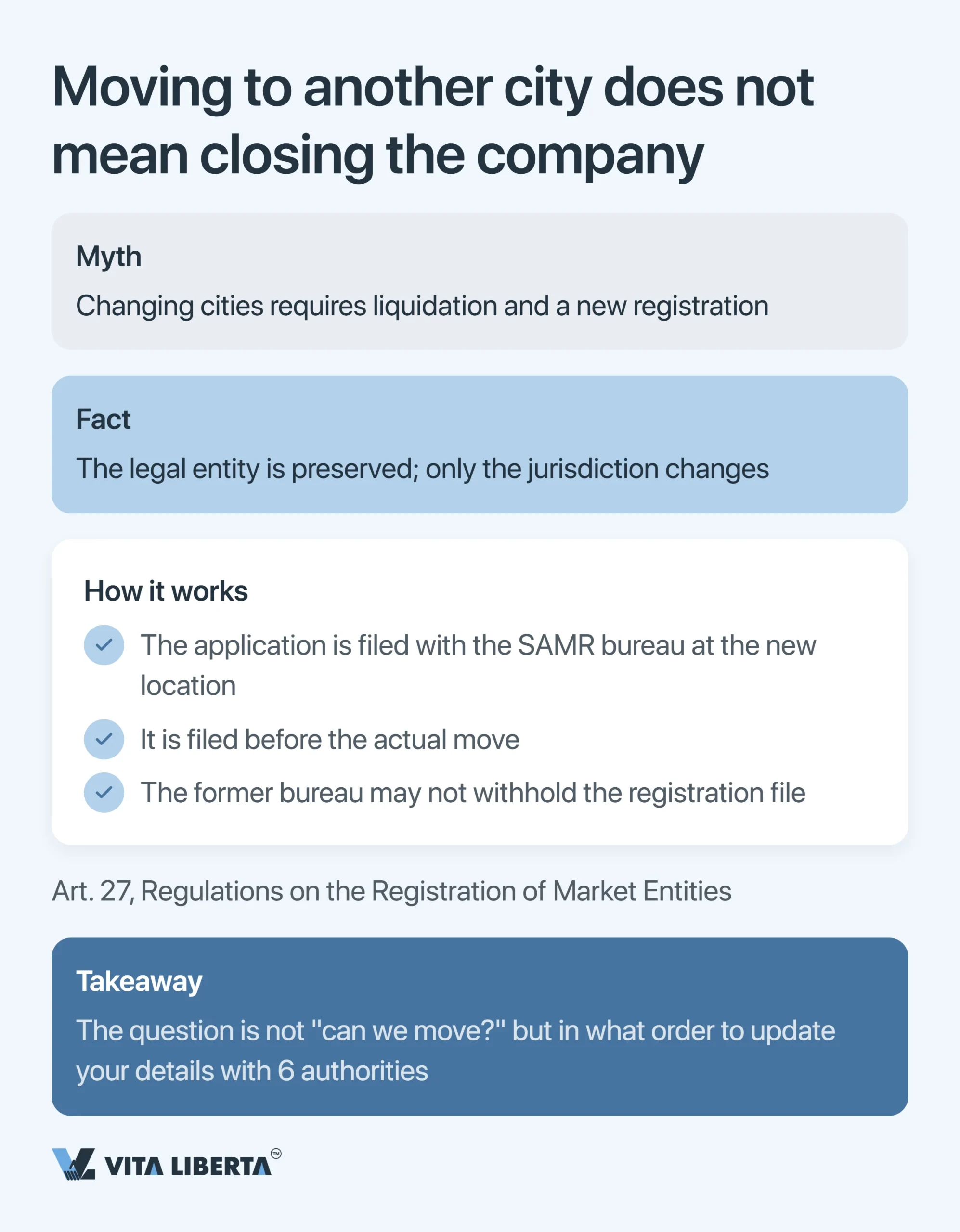
Many foreign founders assume that moving to another Chinese city means closing the company and registering a new one. The law works differently. Article 27 of the Regulations on the Registration of Market Entities (市场主体登记管理条例, State Council Decree No. 746), in force since 1 March 2022, requires you to apply to the registration authority at the new location before you move. The old authority cannot hold back your registration file without a lawful reason. The legal entity carries on and only the jurisdiction changes. So the question isn’t whether you can move without closing down. It’s the order in which you update your details with six authorities.
Company Details That Go Through SAMR: the 30-Day Clock
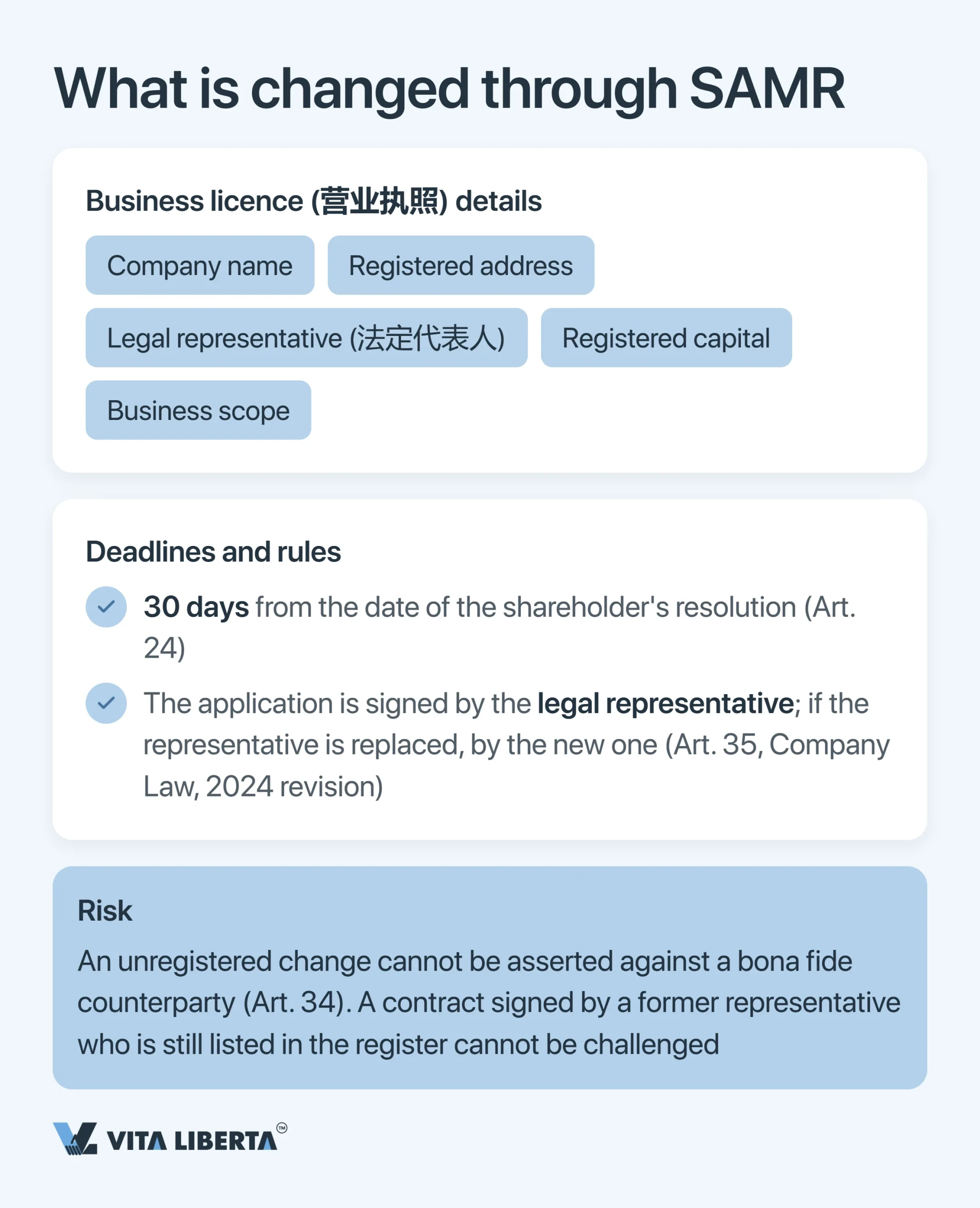
Your business license (营业执照) shows the company name, registered address, legal representative (法定代表人), registered capital and business scope. You change any of them through the local bureau of the State Administration for Market Regulation (SAMR, 国家市场监督管理总局).
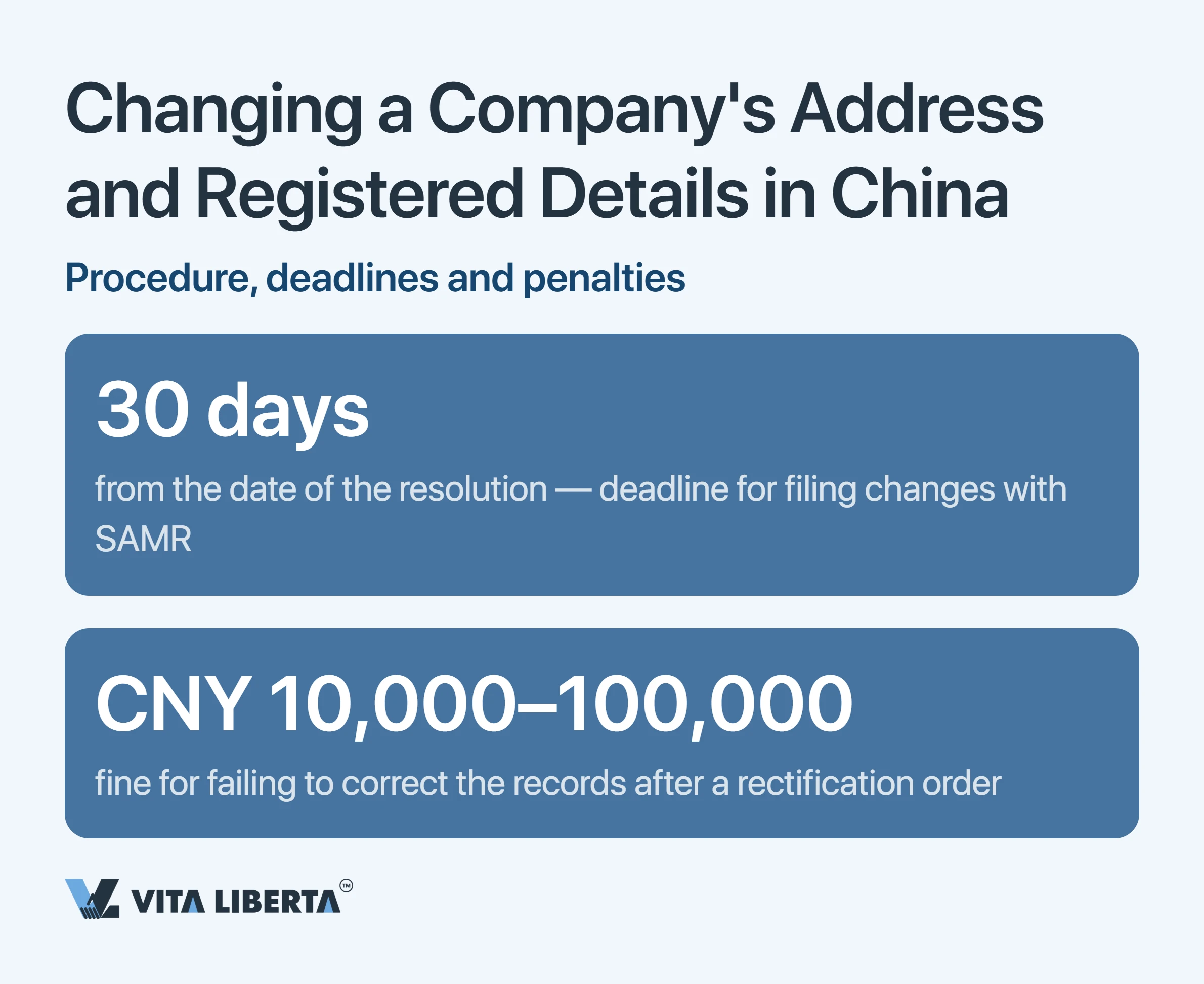
Under Article 24 of the Regulations, the clock starts on the day the shareholder makes the decision, and you then have 30 days to file. Article 35 of the PRC Company Law (中华人民共和国公司法), as amended from 1 July 2024, says the legal representative signs the application. If you are replacing the legal representative, the new one signs.
Article 34 is the one that matters most for your deals. You cannot rely on an unregistered change against a bona fide counterparty (善意相对人). Suppose a representative you have removed is still on the register and signs a contract. You cannot void that contract just by pointing to his removal.
Bottom line: the clock starts on the day the resolution is signed, so prepare the SAMR package at the same time.
Changing the Registered Address: Same District or Further Afield
What decides the procedure is which SAMR bureau has jurisdiction over the new address. Moving to the building next door and moving to another province follow different rules.
New address under the same SAMR bureau
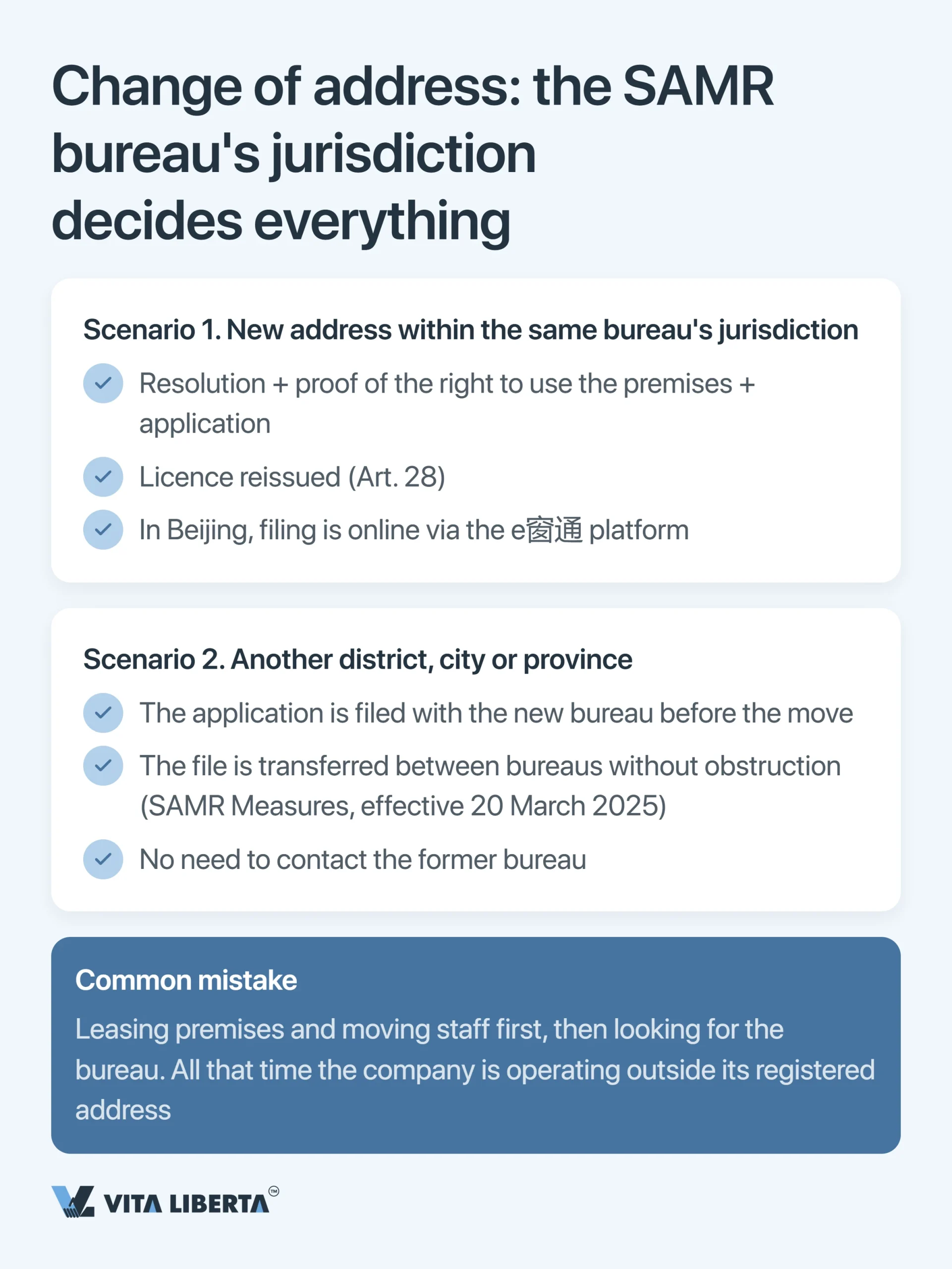
Here the general rule in Article 24 applies. You need a resolution, proof that you have the right to use the premises and an application, and then the license is replaced under Article 28. In Beijing you file online through the city’s enterprise service platform, 北京市企业服务e窗通平台 (ect.scjgj.beijing.gov.cn). The premises documents you need depend on whether the company owns, rents or uses the space free of charge, and the city’s market-entity registration guide lists what each case requires.
Moving to another district, city or province
Article 27 reverses the usual logic. You apply where you are going, not where you are leaving, and you do it before the physical move. Foreign companies often make a costly mistake here: they sign the lease and move staff first, and only then look for the bureau at the new location. For that whole period, the company is operating away from its registered address.
Since 20 March 2025, the Measures for the Administration of Market Entity Registration Archives (经营主体登记档案管理办法) add to this rule. SAMR issued them jointly with the National Archives Administration. You no longer have to apply separately to the bureau at your old location. Bureaus must transfer the file without obstruction. If the new bureau can pull the archive online, registration actions during the move are handled at the new location.
Tax Migration Under STA Circular No. 38
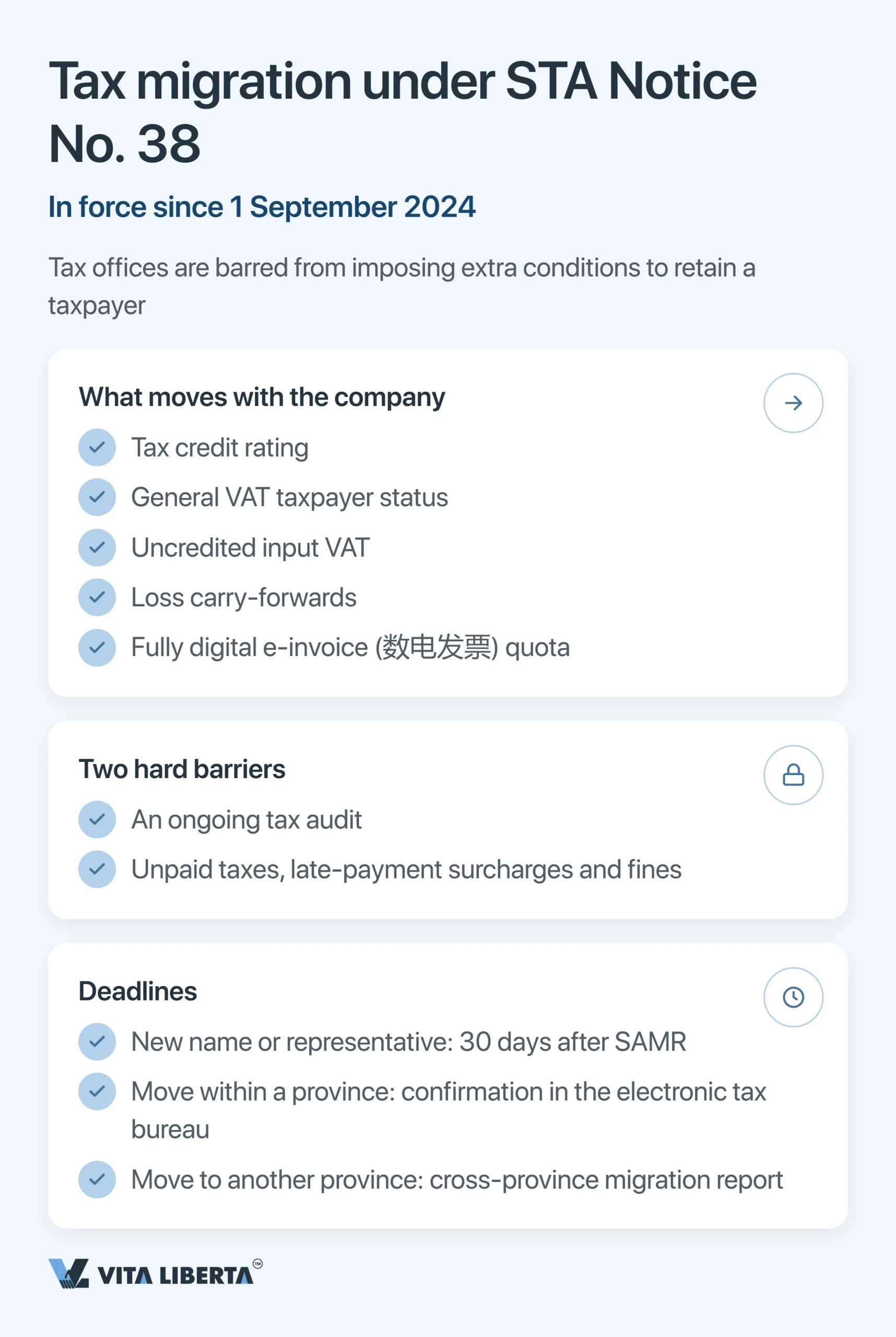
From 1 September 2024, a circular from the State Taxation Administration (STA, 国家税务总局) applies: 国家税务总局关于进一步便利纳税人跨区迁移 服务全国统一大市场建设的通知 (Shuizong Zhengkefa [2024] No. 38, dated 29 July 2024), referred to below as Circular 38. Tax offices may not add conditions or start risk reviews to stop a taxpayer from leaving.
Your company keeps its tax credit rating, general VAT taxpayer status, uncredited input VAT and tax losses carried forward. Your quota for fully digitalized e-invoices (数电发票) also moves to the new region automatically. A low-risk taxpayer migrates straight away. A medium- or high-risk taxpayer migrates once the flagged issues are resolved within the set deadline.
Two hard barriers remain: a tax audit in progress, and unpaid tax, late-payment surcharges or fines. These conditions are set out in tax authorities’ internal procedures, for example those of the Jiangsu Provincial Tax Service as revised on 31 December 2025.
The deadline depends on what you are changing. A new name or legal representative must be recorded in your tax profile within 30 days of SAMR registration, under Article 17 of the Administrative Measures for Tax Registration (税务登记管理办法, STA Decree No. 7). If the move also changes your tax office, the migration procedure applies. Within the same province, you confirm the new address in the e-tax system and the system reassigns your tax office automatically. For a move to another province, you file a cross-provincial migration report (跨省(市)迁移涉税事项报告表) with your current tax office.
Note: if your company opened a matter on its own application, it can close that matter, and the tax office cannot delay migration because of it. If the tax office opened a matter itself, it must close it within the prescribed time.
Change your company address in China without downtime
- Address check before you sign the lease
- SAMR filing at the new location
- Tax migration without delays

New Name or Legal Representative: Obligations Beyond the License
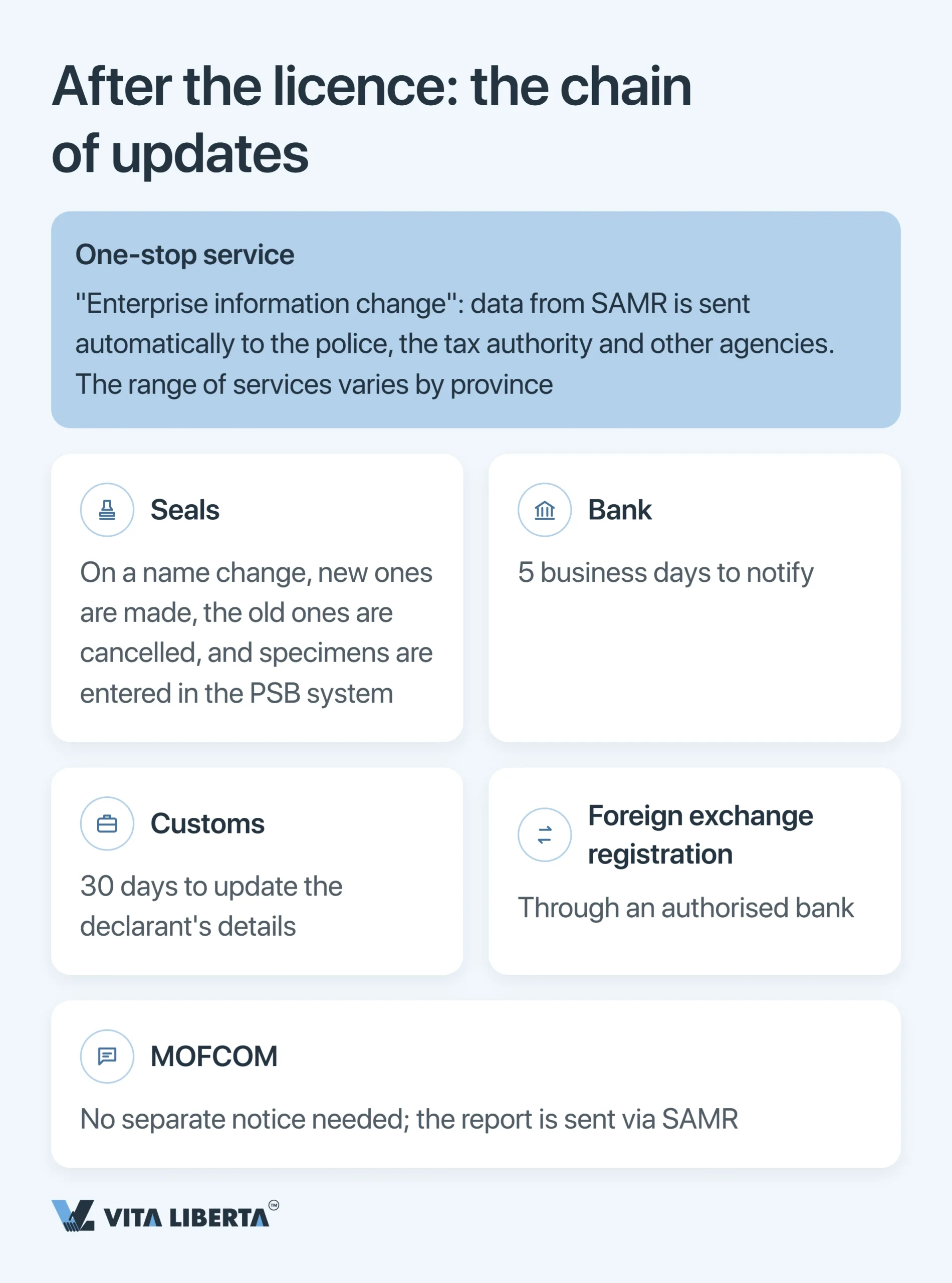
A new license starts a chain of further updates. Your bank, customs, foreign exchange records and company chops each have their own deadline. Since 2024, a single nationwide “enterprise information change” service (企业信息变更”一件事”) has operated under the “高效办成一件事” reform (Guofa [2024] No. 3; procedure: Guoshijian Zhufa [2024] No. 57). Once SAMR registers the change, the data goes automatically to public security, the tax authority and other agencies. The linked services (medical insurance, bank, housing provident fund) vary from province to province.
Company chops and the bank: 5 working days
If the name changes, you have new chops made and the old ones cancelled. Specimens of the new chops go into the chop registry of the Public Security Bureau (PSB, 公安机关). The bank has the shortest deadline. The PBOC Measures on RMB Bank Settlement Accounts (人民币银行结算账户管理办法, PBOC Order [2003] No. 5) give you 5 working days to apply for a name change. You have the same 5 working days to notify the bank in writing of a new address or legal representative.
Customs, foreign exchange and MOFCOM
If you import or export, you have 30 days to update your declarant record. The deadline comes from the General Administration of Customs (GACC, 海关总署) rules on customs declarant filing, 中华人民共和国海关报关单位备案管理规定 (GACC Order No. 253). If the move puts you under a different customs office, you apply to the new one. Since 1 June 2015, foreign exchange registration for direct investment (国家外汇管理局关于进一步简化和改进直接投资外汇管理政策的通知, Huifa [2015] No. 13) has been handled through authorised banks. You don’t need to notify MOFCOM (商务部) separately. Since 1 January 2020, the change report goes through SAMR’s registration system (外商投资信息报告办法, MOFCOM–SAMR Order 2019 No. 2).
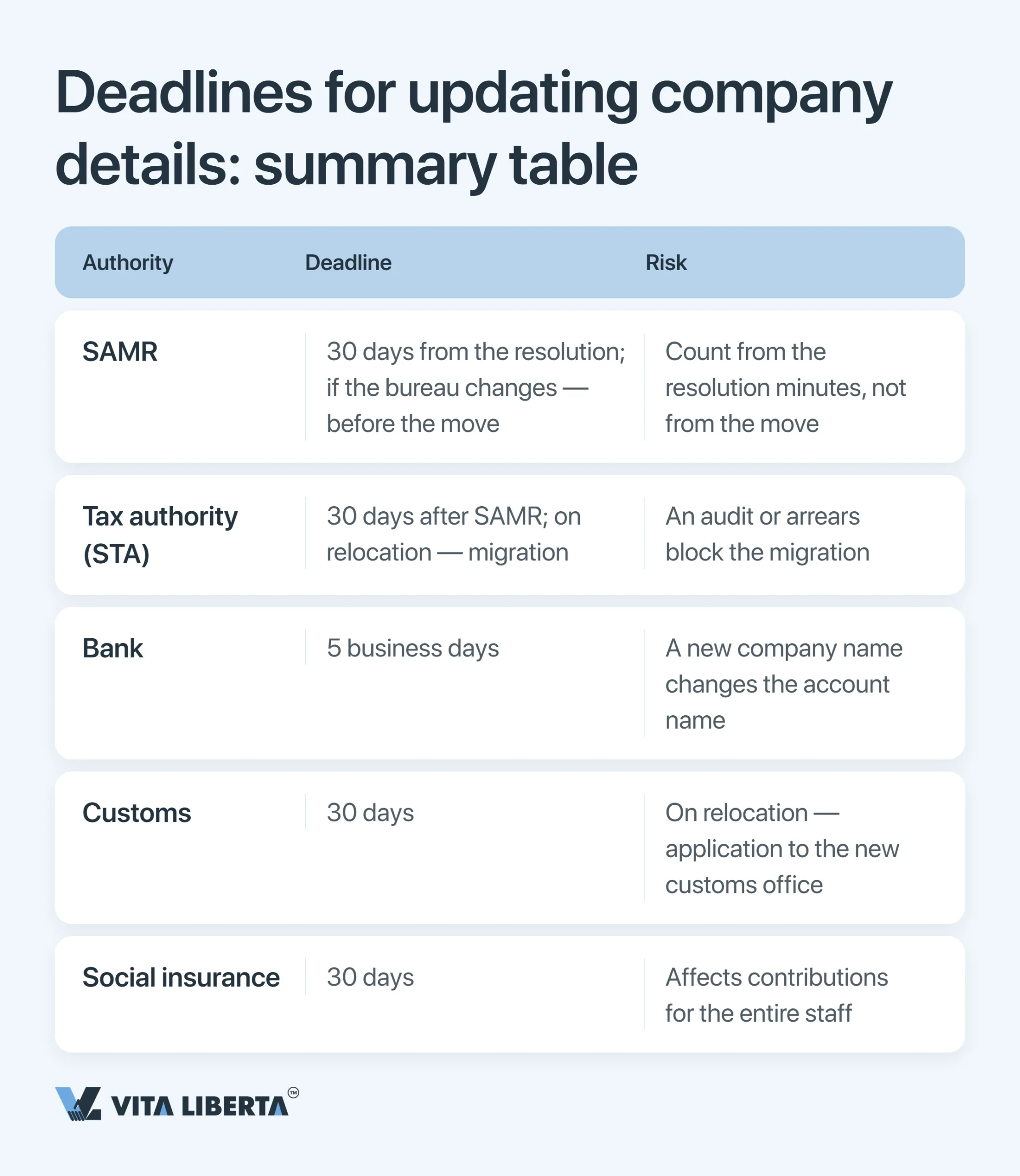
| Area | Deadline | Legal basis | Practice and risk |
| SAMR | 30 days from the decision; if the bureau changes, before the move | Arts. 24 and 27, Regulations on the Registration of Market Entities (State Council Decree No. 746) | Count from the resolution, not from the move |
| STA | 30 days after SAMR for changed details; for a relocation, the migration procedure | Art. 17, 税务登记管理办法 (STA Decree No. 7); Circular 38 | An audit or unpaid tax blocks migration |
| Bank | 5 working days | 人民币银行结算账户管理办法 (PBOC Order [2003] No. 5) | A new company name means a new account name |
| Customs | 30 days | Art. 9, 海关报关单位备案管理规定 (GACC Order No. 253) | If you relocate, apply to the customs office at the new location |
| Social insurance | 30 days | Art. 57, PRC Social Insurance Law (社会保险法) | Affects contributions for your entire workforce |
The Cost of Delay: From a Correction Order to Losing the License
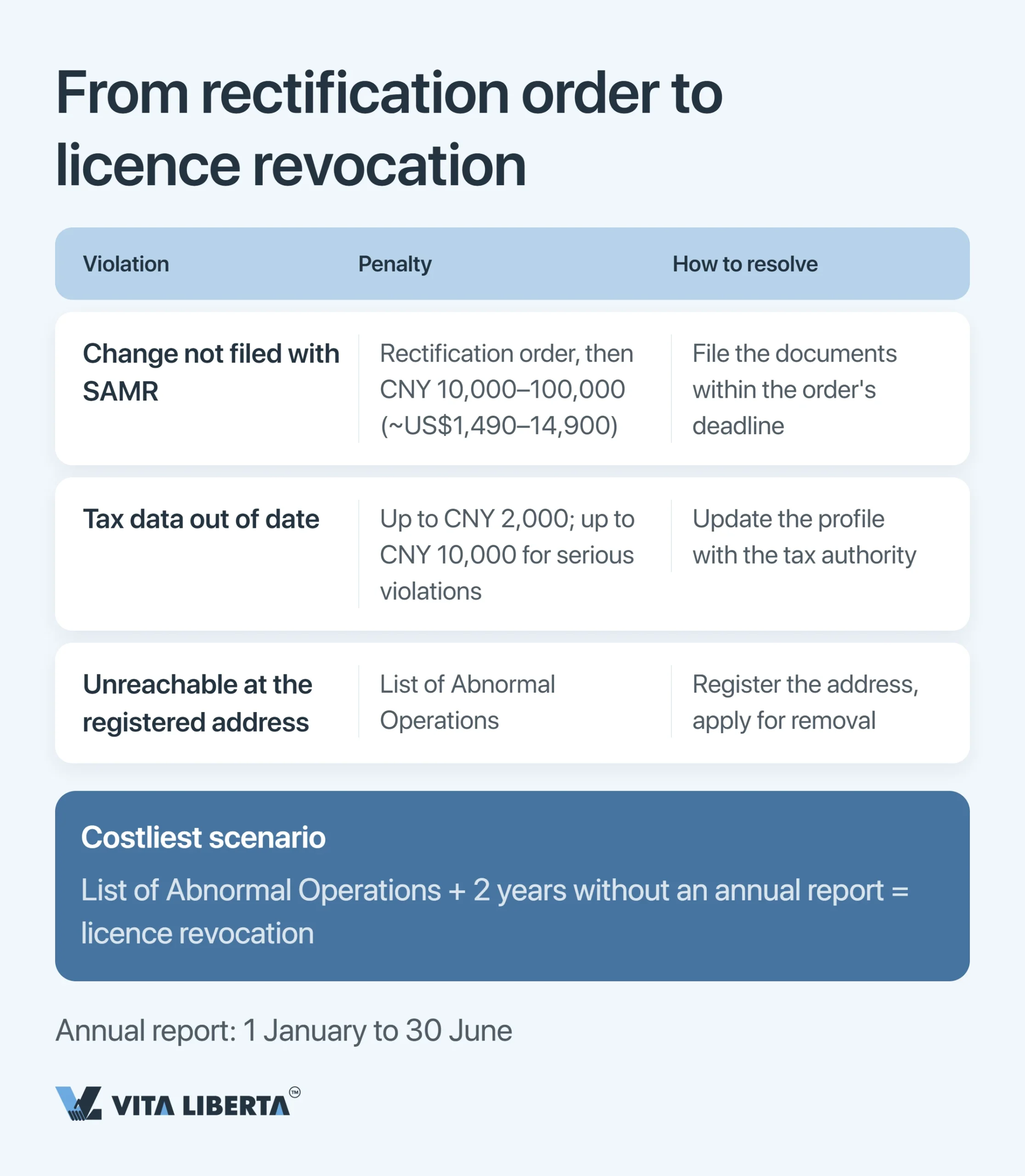
Under Article 46 of the Regulations, you face a fine of RMB 10,000–100,000 if you refuse to correct your details after a SAMR order. That is about USD 1,490–14,900 at the central parity rate of 6.71 yuan per dollar on 2 November 2026. In serious cases the license is revoked. For late tax registration, Article 60 of the PRC Law on the Administration of Tax Collection (中华人民共和国税收征收管理法) sets a fine of up to RMB 2,000, or RMB 2,000–10,000 for serious violations. A draft revision of that law (修订草案) went to the NPC Standing Committee for first reading on 2 November 2026 and was published for public comment on 6 November. The current fines apply until it is adopted.
The address carries the highest risk. If the company cannot be reached at its registered address, it is placed on the Abnormal Operations List (经营异常名录). If it also misses two years of annual reports, which are filed between 1 January and 30 June, the license can be revoked. The legal basis is Article 18 of the Interim Regulations on Enterprise Information Disclosure (企业信息公示暂行条例, as amended from 1 May 2024).
| Violation | Sanction | How to fix it |
| Change not filed with SAMR | Correction order, then RMB 10,000–100,000 | File the package within the period set in the order |
| Tax data out of date | Up to RMB 2,000; serious cases up to RMB 10,000 | Update your tax profile |
| Unreachable at the registered address | Abnormal Operations List | Register the address and apply for removal |
Bottom line: set a checkpoint for day 20 after the resolution. By then the SAMR package should already be filed, which leaves time to deal with any comments from the bureau.
Update your China company details in one cycle
- Resolution and SAMR package
- Tax migration and bank
- Customs, chops, social insurance

Updating Company Details in China: Strategic Takeaways
Here is the paradox. The procedure is now down to one application and online filing, but a gap between the register and reality costs as much as it always did.
Start with the resolution and an address check. Sign the lease only after the SAMR bureau confirms the address.
A move to another district goes through the new bureau. Tax migration under Circular 38 comes next, and you keep your VAT status and losses.
The bank, customs and chops run on a separate schedule. The bank’s five working days are the shortest deadline in the chain.
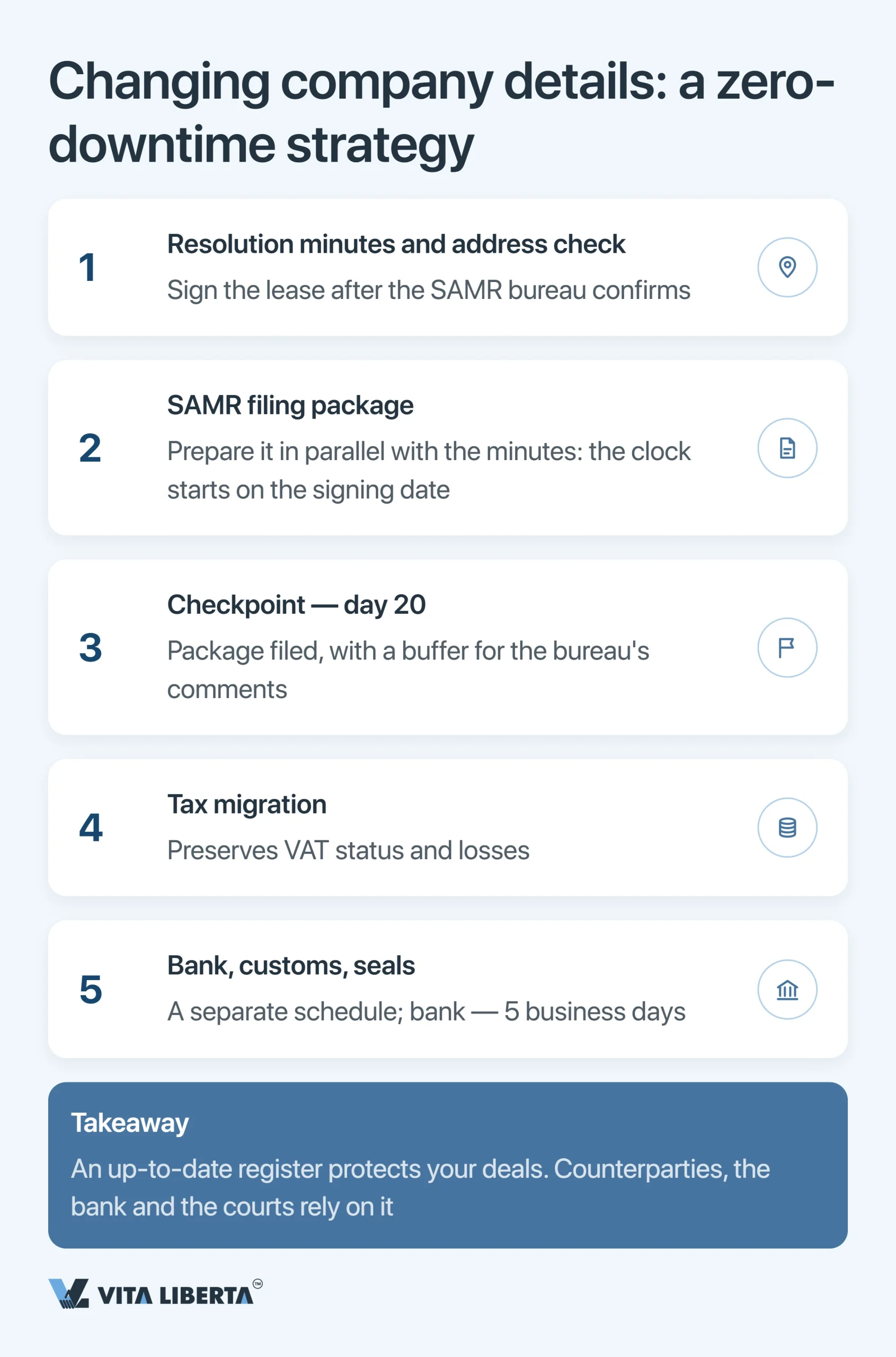
Keeping your details current isn’t just paperwork. It protects your deals, because counterparties, banks and courts all rely on the register being up to date.
5 Key Questions About Changing a Company’s Address and Details in China
No, you don’t have to close the company. If the new district falls under a different SAMR bureau, you file with that bureau before the move, and the legal entity carries on. Under STA Circular 38, your tax statuses move with the company, including general VAT taxpayer status and losses carried forward. Your first step should be checking the new address with the bureau, not signing the lease.
The RMB 10,000–100,000 fine is not automatic. It applies only if the company ignores a SAMR correction order. Your deals are already at risk, though. The former representative is still on the register, and a bona fide counterparty can enforce anything he signs. If the former representative resigned, the Company Law gives the company 30 days to appoint a successor. Have the new representative sign the application and file it right away. Don’t wait for an inspection.
Yes. Since 1 September 2024, they transfer to the new tax office along with your credit rating and uncredited input VAT. The digital invoice quota also moves automatically. Two things block migration: a tax audit in progress, and unpaid tax, surcharges or fines. If an audit has already started, schedule the move for after it ends, and pay any arrears before you file.
You don’t need to go to MOFCOM. Since 1 January 2020, the change report goes through SAMR’s registration system. Since 2015, authorised banks have handled foreign exchange registration for direct investment, so you update it at your authorised bank. Your settlement bank also expects the name-change application within 5 working days, so plan the bank visit for right after you receive the new license.
The entry is removed once you register your actual address with SAMR, or once the company can again be reached at its registered address. You then apply to be removed from the list. Don’t put this off. Two years without an annual report while unreachable at the address are grounds for revoking the license under Article 18. Annual reports are filed between 1 January and 30 June, and you should file yours even before the address change is complete.