


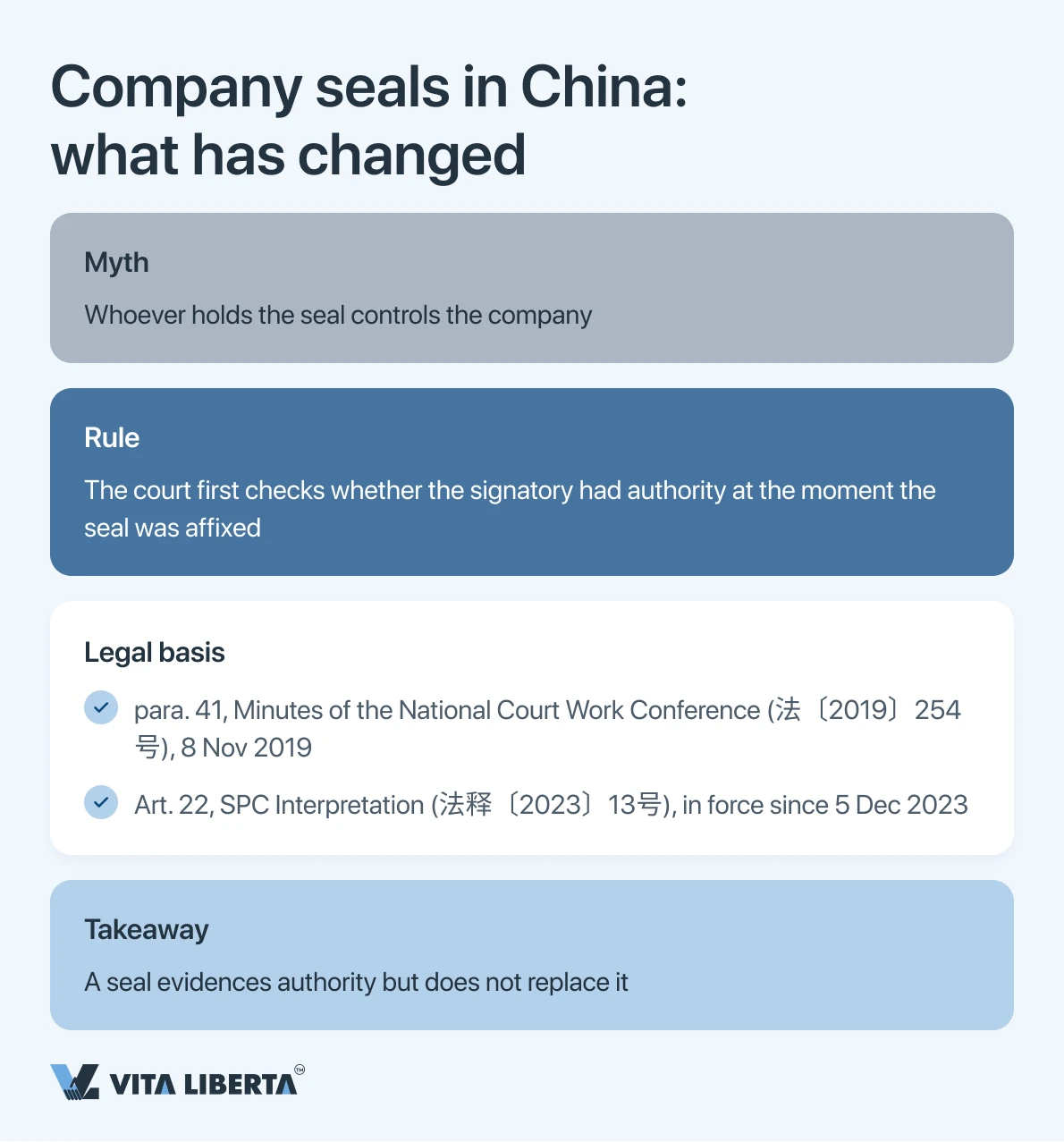
Many foreign founders assume that whoever holds the chop runs the company, and that any impression automatically binds it. The law works differently. Paragraph 41 of the Minutes of the National Courts’ Civil and Commercial Trial Work Conference (全国法院民商事审判工作会议纪要, the “Ninth Minutes”, Fa [2019] No. 254, 8 November 2019) tells judges to find out whether the signatory had authority at the moment the chop went on the page. The Minutes are guidance from the Supreme People’s Court (SPC), not a judicial interpretation. Article 22 of the SPC Interpretation on the general provisions of the Civil Code’s contracts book (最高人民法院关于适用《中华人民共和国民法典》合同编通则若干问题的解释, Fa Shi [2023] No. 13, in force since 5 December 2023) codified that approach. A chop is evidence of authority. It does not replace it.
WFOE chops: the required minimum and your own choices
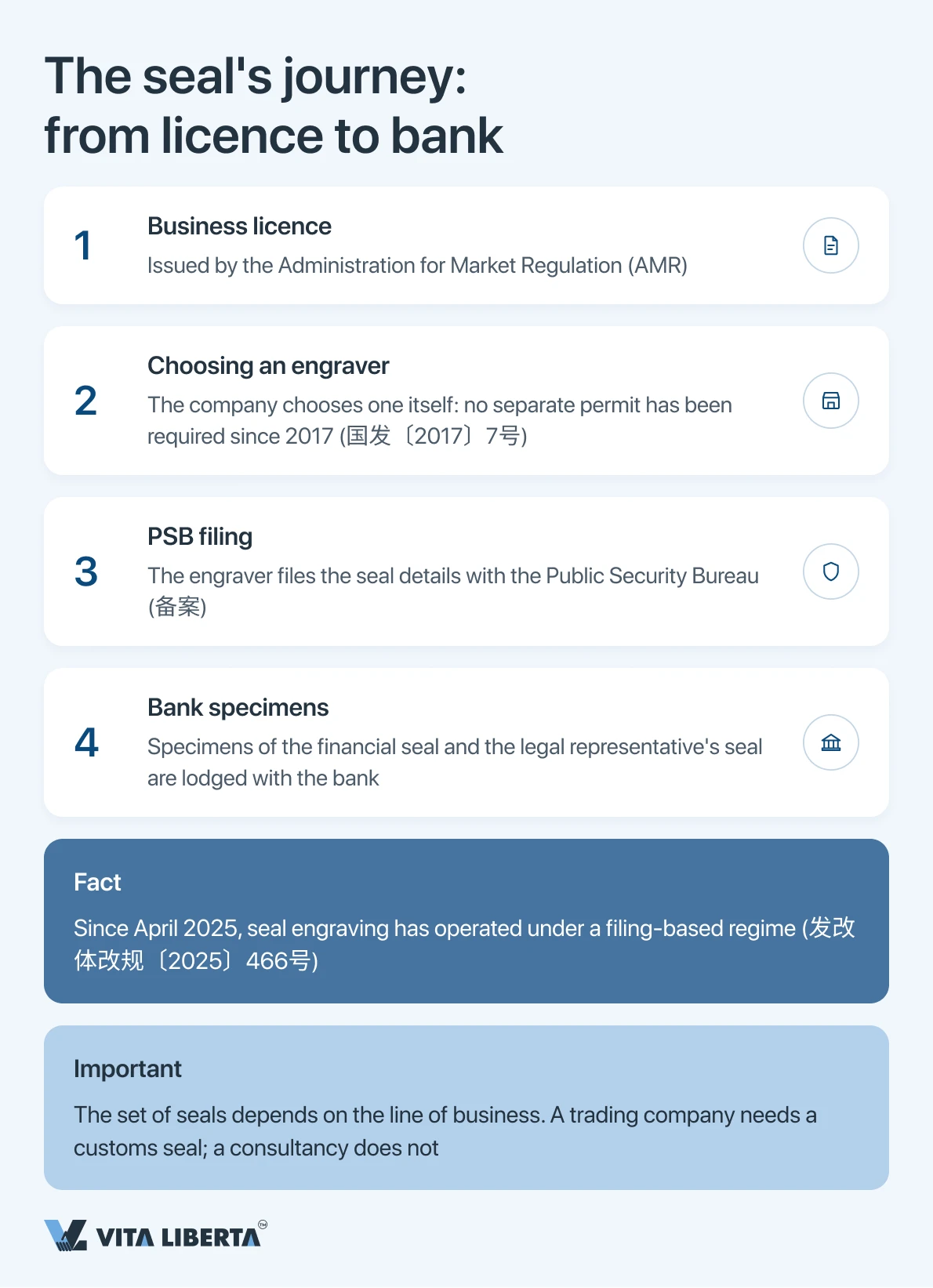
Your line of business decides which chops you need. A trading company needs a customs chop, and a consulting firm doesn’t. Chops are made only after the Administration for Market Regulation (市场监督管理局, AMR) has issued your business licence. You choose the engraving shop yourself, because no separate approval to make a chop has been needed since 2017 (Guo Fa [2017] No. 7). The shop then sends the chop details to the Public Security Bureau (公安局, PSB) as a notification filing (备案). From April 2025, chop engraving as a trade also moved from licensing to notification under the 2025 Market Access Negative List (Fa Gai Ti Gai Gui [2025] No. 466).
Company chop: the widest authority
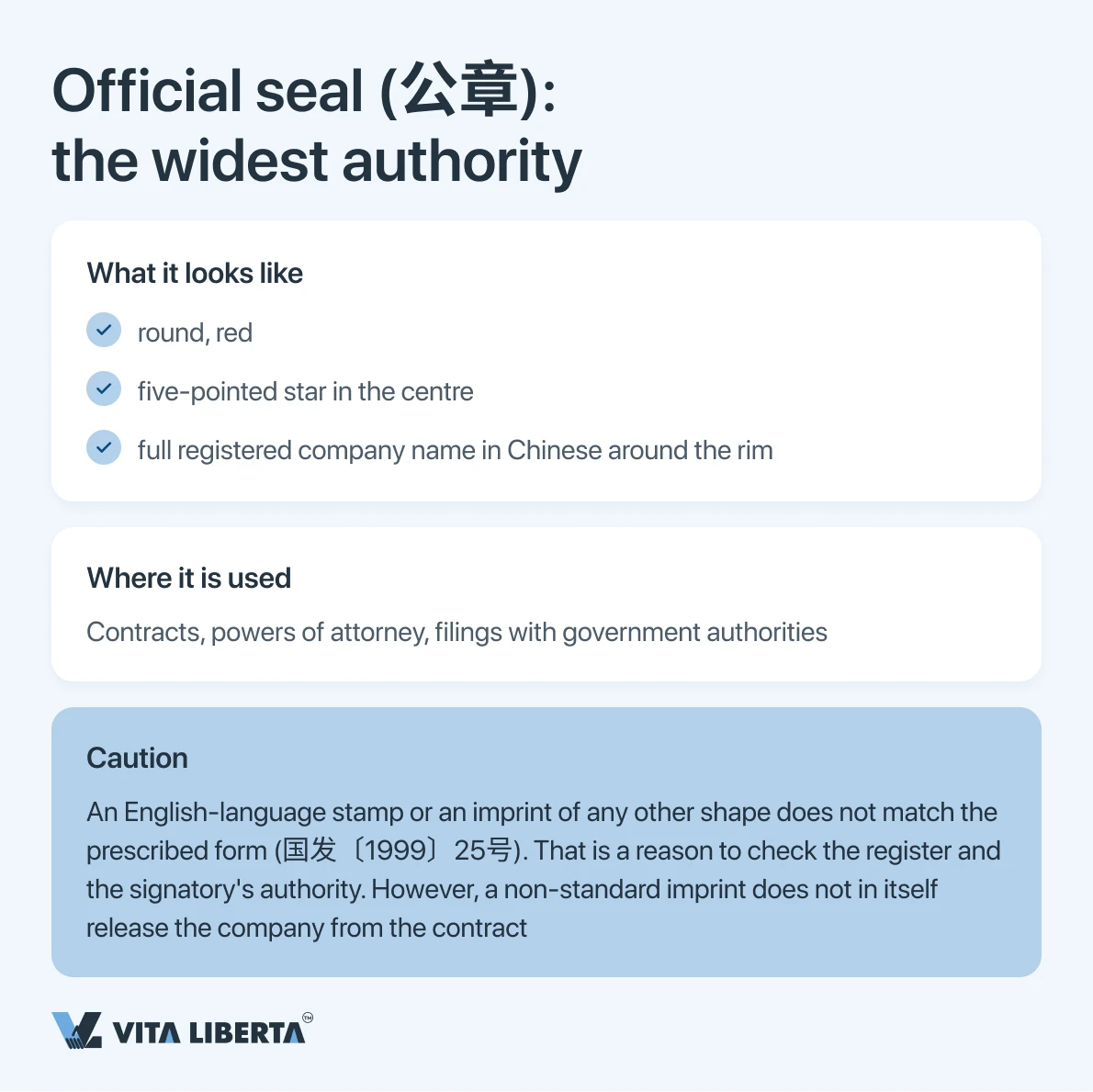
The company chop (公章) is round and red. It has a five-pointed star in the centre and the company’s full registered Chinese name around the edge. You use it on contracts, powers of attorney and submissions to government bodies. A stamp in English, or of any other shape, does not match the prescribed design (Guo Fa [1999] No. 25). If a counterparty uses one, ask for its registry details and check who signed. An odd-looking impression does not, by itself, let the company walk away from the contract (Article 22 of the SPC Interpretation).
Finance chop and legal representative chop: the banking pair
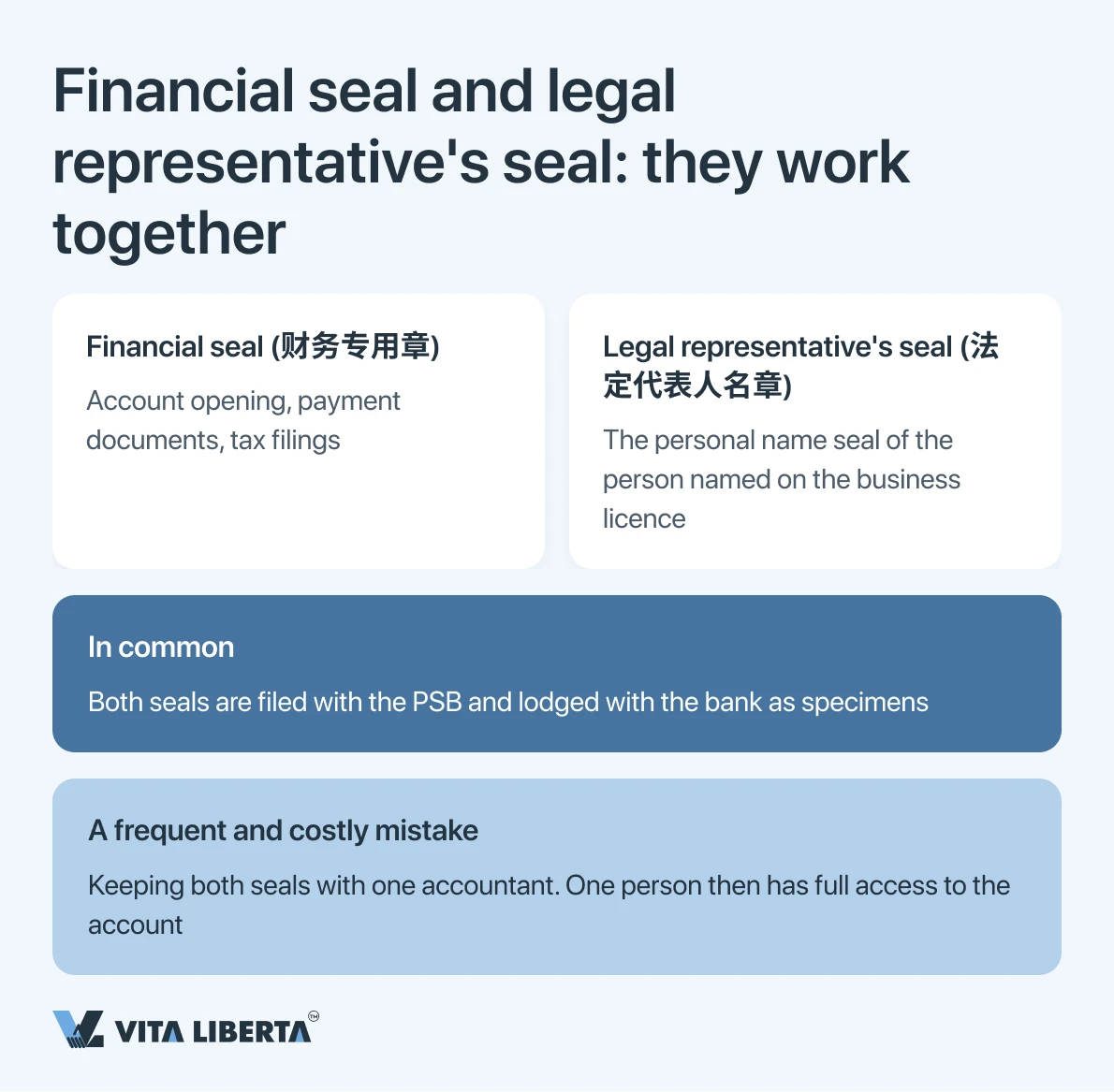
You need the finance chop (财务专用章) to open a bank account, sign payment documents and file tax returns. The legal representative chop (法定代表人名章) is a name stamp for the one person named on the business licence. The engraving shop notifies the PSB about both, and the bank keeps both as specimen seals. Foreign-owned companies often let one accountant keep both, which is a common and expensive mistake: that one person gets full access to the account.
Fapiao chop after 1 December 2024
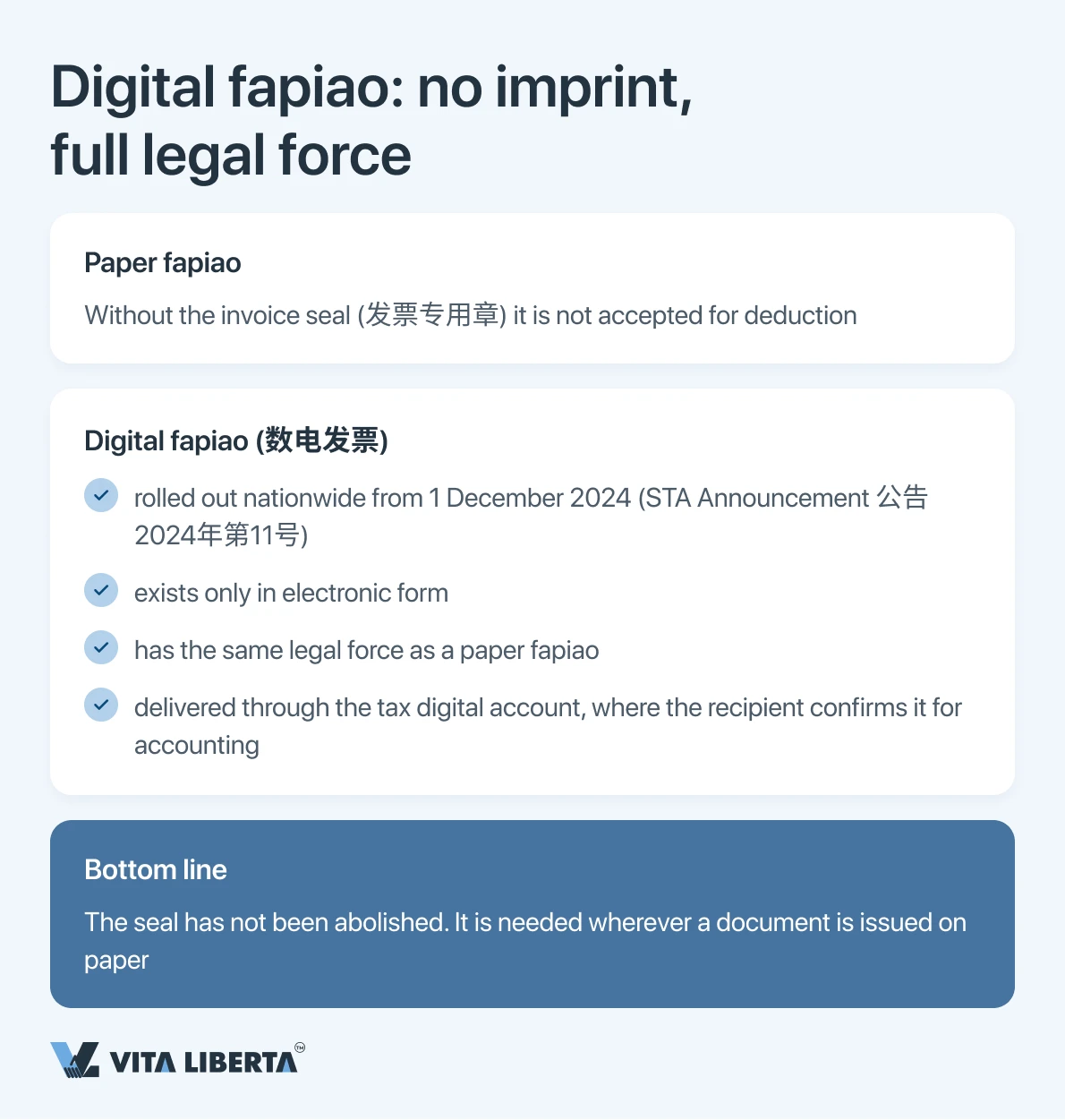
A paper fapiao without the fapiao chop (发票专用章) can’t be used for a tax deduction. From 1 December 2024, the State Taxation Administration (国家税务总局, STA) extended digital fapiao (数电发票) to the whole country under its announcement on the nationwide rollout of fully digitalised e-fapiao (STA Announcement [2024] No. 11, 12 November 2024). A digital fapiao exists only in electronic form and carries the same legal force as a paper one. It goes through the digital tax account (税务数字账户), where the recipient marks whether it has been booked. Nobody stamps it. The chop itself has not been abolished, and you still need it whenever a document is issued on paper.
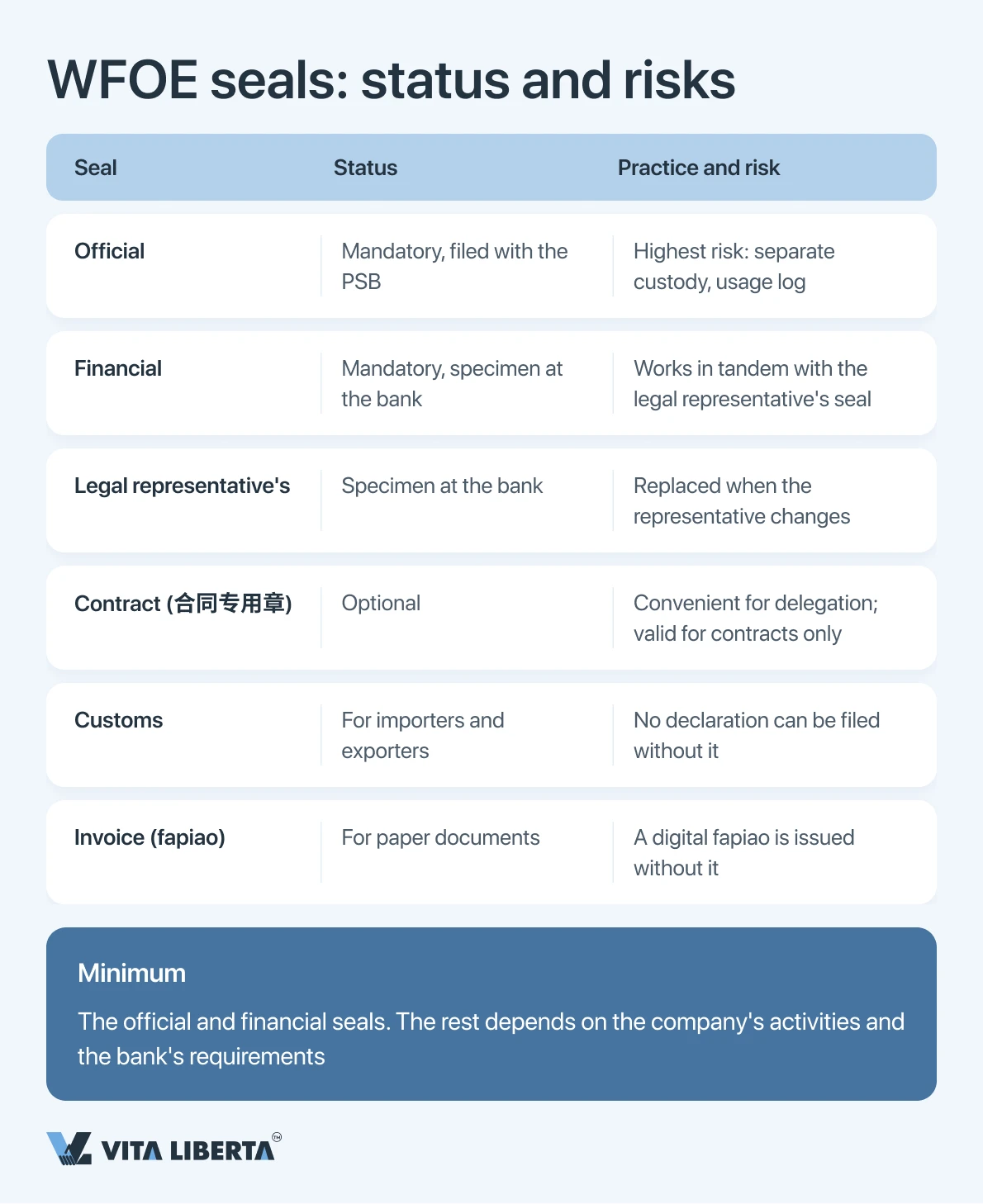
| Chop | Status and registration | Practice and risk |
| Company | Mandatory; PSB notified via the engraving shop | Highest risk: keep it apart from the others and log every use |
| Finance | Mandatory; specimen at the bank | Works together with the name chop, and both are bank specimens |
| Legal representative | Specimen at the bank | Must be replaced when the legal representative changes |
| Contract (合同专用章) | Optional | Handy for delegation, since it is valid for contracts only |
| Customs | For importers and exporters | You can’t file a customs declaration without it |
| Fapiao | For paper documents | A digital fapiao goes through without it |
Bottom line: the mandatory minimum is the company chop and the finance chop. Your activities and your bank’s requirements decide the rest.
Legal effect of a chop: from the Civil Code to the SPC
The value of an impression is set by three things: the statute, SPC guidance and a criminal penalty.
Civil Code Article 490: three equal ways to consent
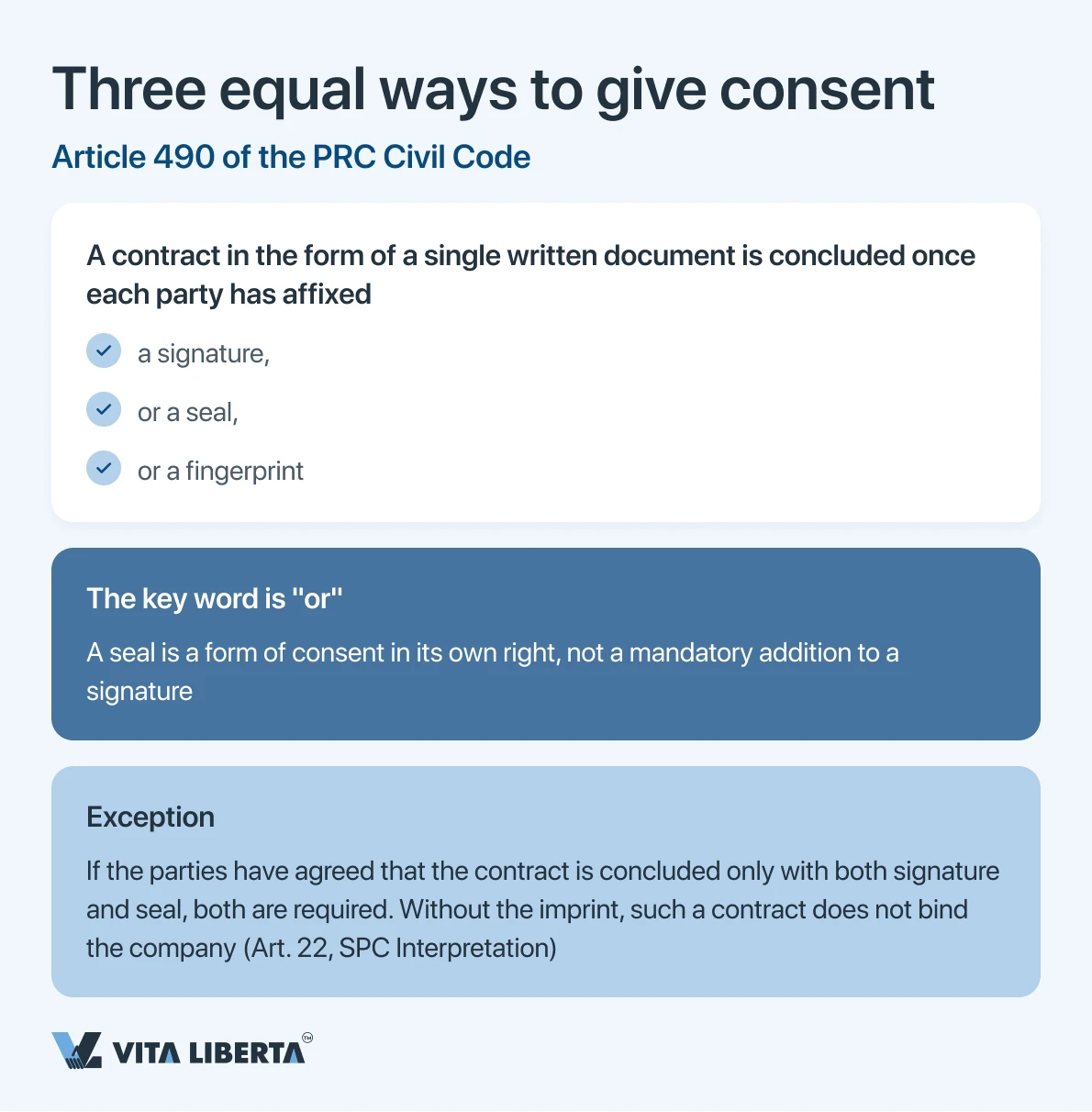
When a contract is a single written document, it is concluded once each party has signed it, chopped it or put a fingerprint on it (Article 490 of the PRC Civil Code, 中华人民共和国民法典). The word “or” matters. A chop is not an add-on to a signature but a separate way of giving consent. The reverse is also true: if you and your counterparty agreed that the contract exists only once it is both signed and chopped, you need both. Article 22 of the SPC Interpretation spells this out. A contract with no chop does not bind the company if the parties made the chop a condition of signing.
Authority comes before the impression: Paragraph 41 and Article 22
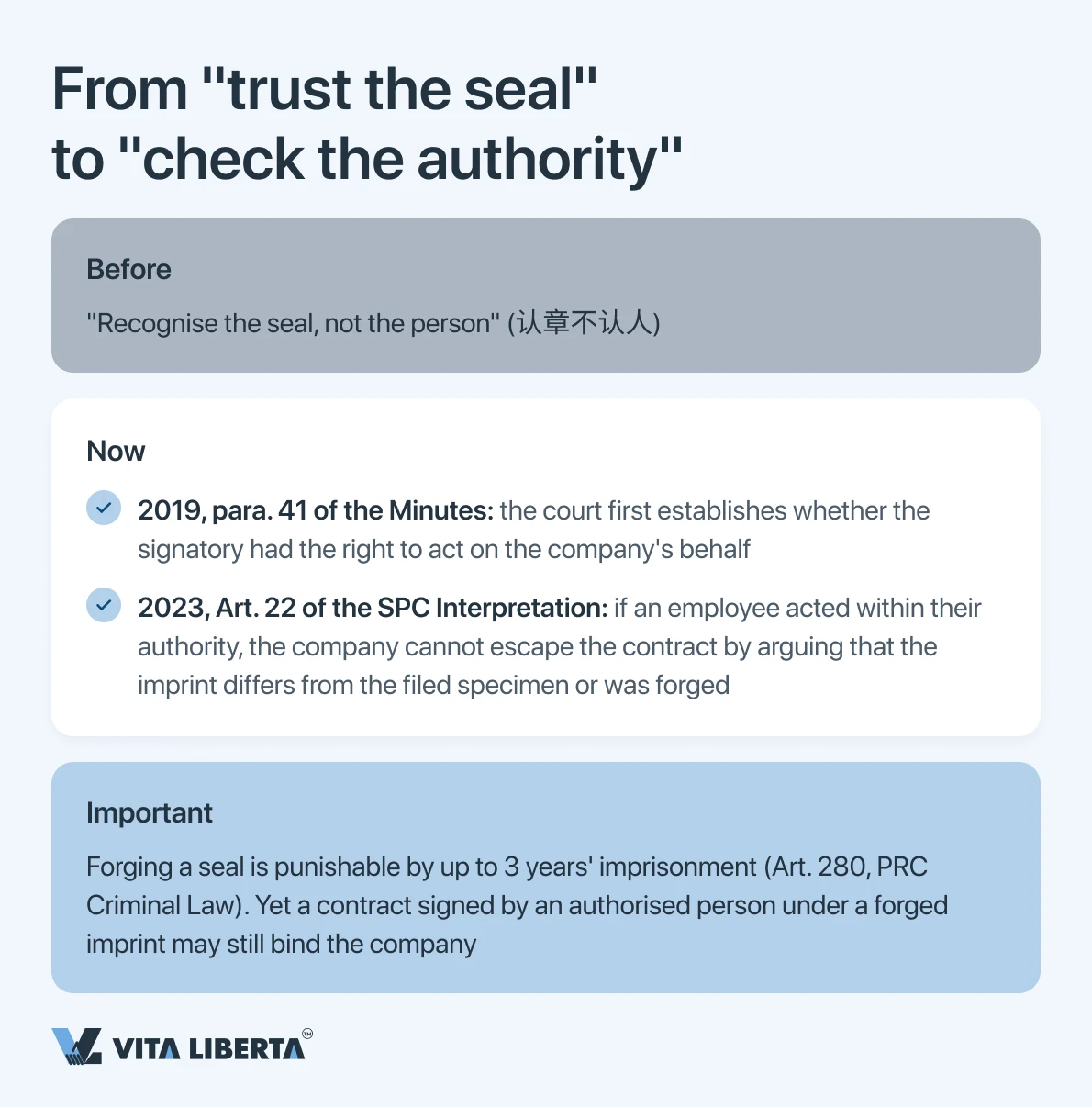
Chinese business practice long followed the maxim “trust the chop, not the person” (认章不认人). Paragraph 41 of the 2019 Minutes reversed it: the court first asks whether the signatory had the right to act for the company. Article 22 of the SPC Interpretation finished the job. If an employee acted within their authority, the company can’t get out of the contract just by saying the impression differs from the registered one or is a fake.
Important: forging a company chop can lead to up to 3 years in prison under Article 280 of the PRC Criminal Law (中华人民共和国刑法). Even so, a contract signed by an authorised person under a forged impression can still bind the company.
We check your counterparty’s authority before you sign
- Chop checked against the registry
- Legal representative check
- Review of signing clauses

Electronic chop: equal force if four conditions are met
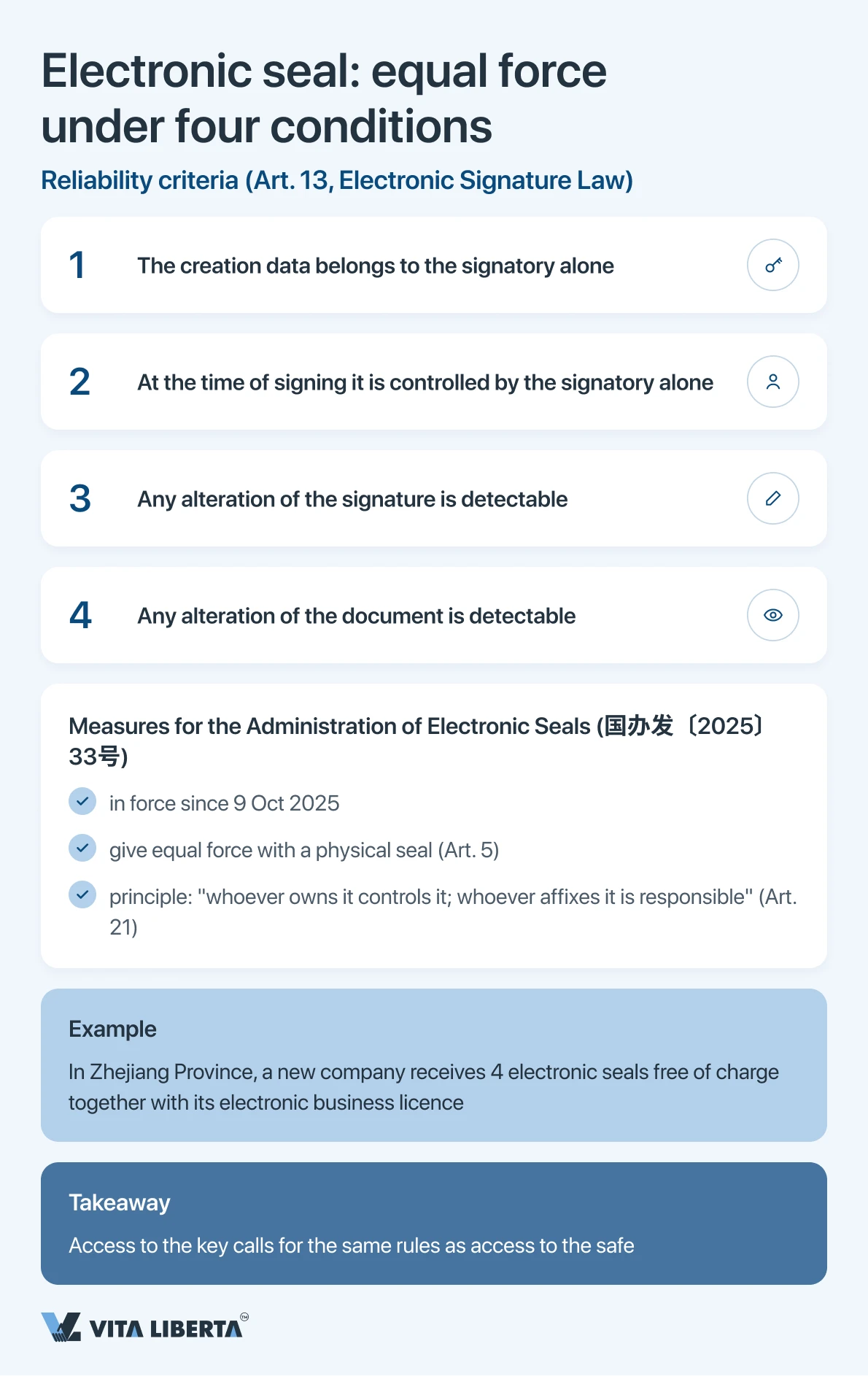
Article 14 of the PRC Electronic Signature Law (中华人民共和国电子签名法), as amended on 23 April 2019, puts an electronic chop on the same footing as a handwritten signature and a seal, as long as it is “reliable” under Article 13. Four tests apply. The data used to create it belong only to the signatory. Only the signatory controls that data at the moment of signing. Any later change to the signature can be detected. Any later change to the document can be detected. In Zhejiang Province, a new company gets four electronic chops free of charge, issued together with its electronic business licence: company, finance, fapiao and legal representative (a provincial rule, Zhe Shi Jian Zhu [2020] No. 21).
Since October 2025, nationwide Measures for the Administration of Electronic Seals (《电子印章管理办法》) have been in force. The State Council General Office approved them by circular Guo Ban Fa [2025] No. 33 of 27 September 2025. They were published on 9 October 2025 and apply from the date of issue. An e-chop that complies with the Measures has the same legal force as a physical one (Article 5). The rule for using it is “whoever holds it controls it, whoever applies it answers for it” (Article 21).
Bottom line: an e-chop is a tool in its own right, not a simplified copy of the physical one. Access to its key needs the same rules as access to the safe.
Chop control: where companies lose money
Most chop disputes start when staff change and nobody completes the paperwork in time.
| Situation | Legal consequence | How to remove the risk |
| The legal representative left but kept the chop | Until the change is registered, their acts may bind the company: an unregistered change can’t be raised against counterparties acting in good faith (Art. 34 of the PRC Company Law, 中华人民共和国公司法, as amended 29 December 2023, in force since 1 July 2024) | Take the chop back against a handover record and notify the bank and key counterparties |
| The legal representative resigned | A new one must be named within 30 days (Art. 10 of the Company Law) | Prepare the resolution and the AMR filing pack in advance; the new representative signs the application (Art. 35) |
| A forged impression turns up | The forger faces up to 3 years in prison (Art. 280 of the Criminal Law) | Report it to the PSB and review every contract that bears that impression |
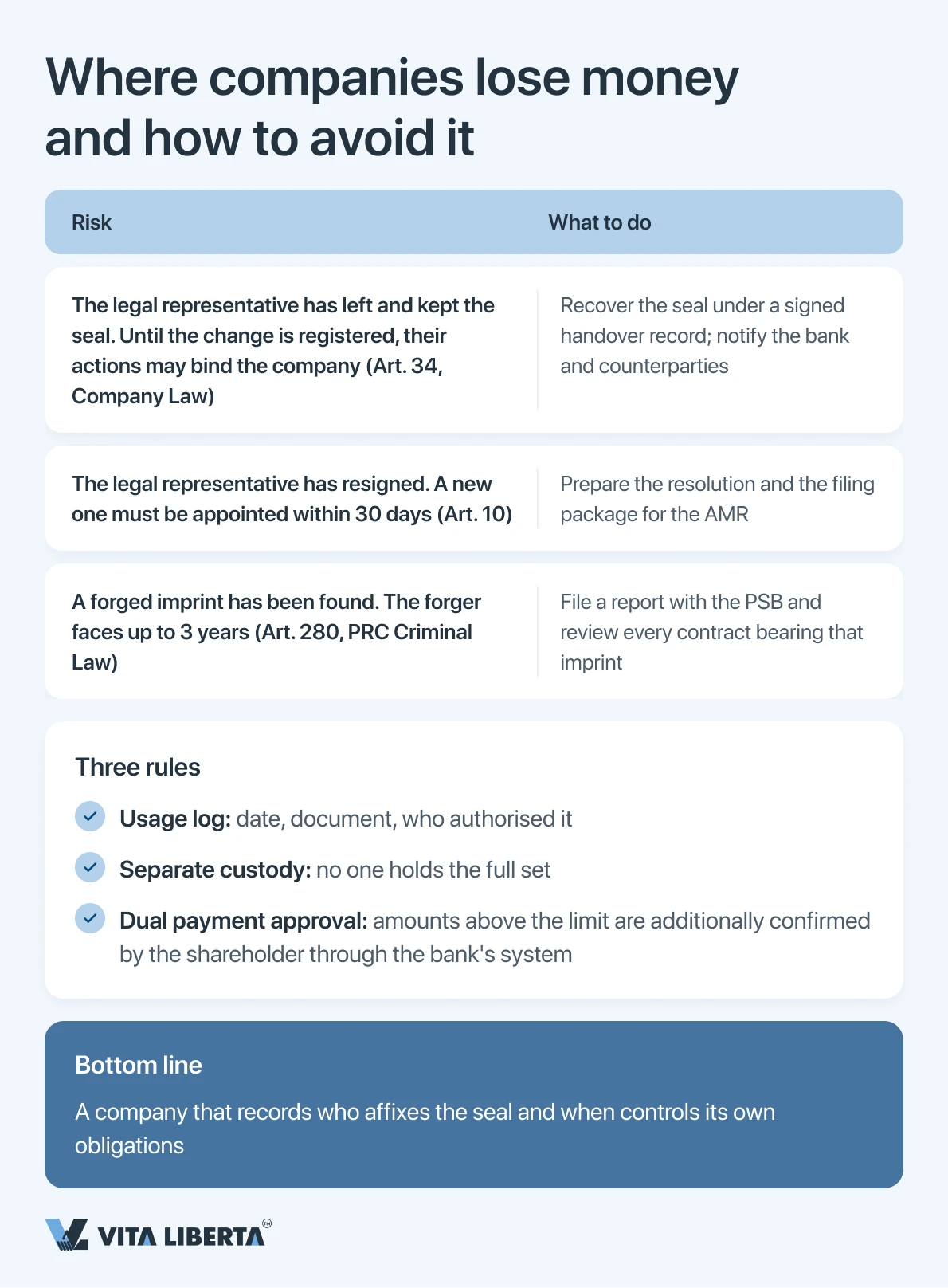
Usage log. Record every use of a chop: the date, the document and who approved it. The log is your main evidence if an impression is ever disputed.
Separate custody. Give the company chop to one person and the finance and name chops to two others, so nobody holds the full set.
Dual approval of payments. Above an internal limit, you as founder confirm the payment through the bank’s system as well as the chop being applied.
We build chop control for your WFOE
- Custody and usage policy
- Chop handover when the director changes
- Electronic chop setup

Company chops in China: strategic takeaways
The paradox is this. Making a chop is tightly formalised (engraving shop, PSB notification, bank), yet in court the look of an impression matters less than the signatory’s authority.
Without chops, a company can’t open a bank account or file a customs declaration.
Whether an impression is genuine is no longer the deciding argument. What counts is who applied it and on what authority.
Digital fapiao and e-chops shift control from the safe to managing access keys.
A corporate chop is therefore no longer a symbol of power over the company. It is one part of a system of authority, and a company that records who applies a chop and when stays in control of its own obligations.
Frequently asked questions
It can be bound. Article 490 of the Civil Code treats a signature as a separate form of consent. Article 22 of the SPC Interpretation states plainly that if the signatory acted within their authority, the contract binds the company even without an impression. The exception is when the parties agreed that the chop is a condition of signing. Your risk is proof: without a chop you will have to show separately that the signatory was authorised. For large deals, it makes sense to require both a signature and the company chop.
A digital fapiao needs no impression. Since 1 December 2024, a digital fapiao exists only in electronic form, carries the same force as a paper one and is booked through the digital tax account without a chop (STA Announcement [2024] No. 11). Keep the chop anyway, because you will need it if a document ever has to be issued on paper.
No single person should hold the full set. The company chop goes to one person and the finance and name chops to two others, and every use is recorded in a log. You can add control from abroad with dual approval of large payments through the bank’s system, which doesn’t depend on physical access to the chops.
The company must name a new legal representative within 30 days of the resignation (Article 10 of the Company Law), and the new representative signs the application to change the registration. Until the change is registered, the former representative’s acts may still bind the company. Notify the bank and key counterparties straight away rather than waiting for the procedure to finish.
A genuine company chop is round and red, with a star and the full Chinese company name. A stamp in English or of another shape is a signal to request the company’s registry details. A forged impression does not, by itself, release the counterparty from the contract if the signatory acted within their authority (Article 22 of the SPC Interpretation). Check the signatory’s authority first.