


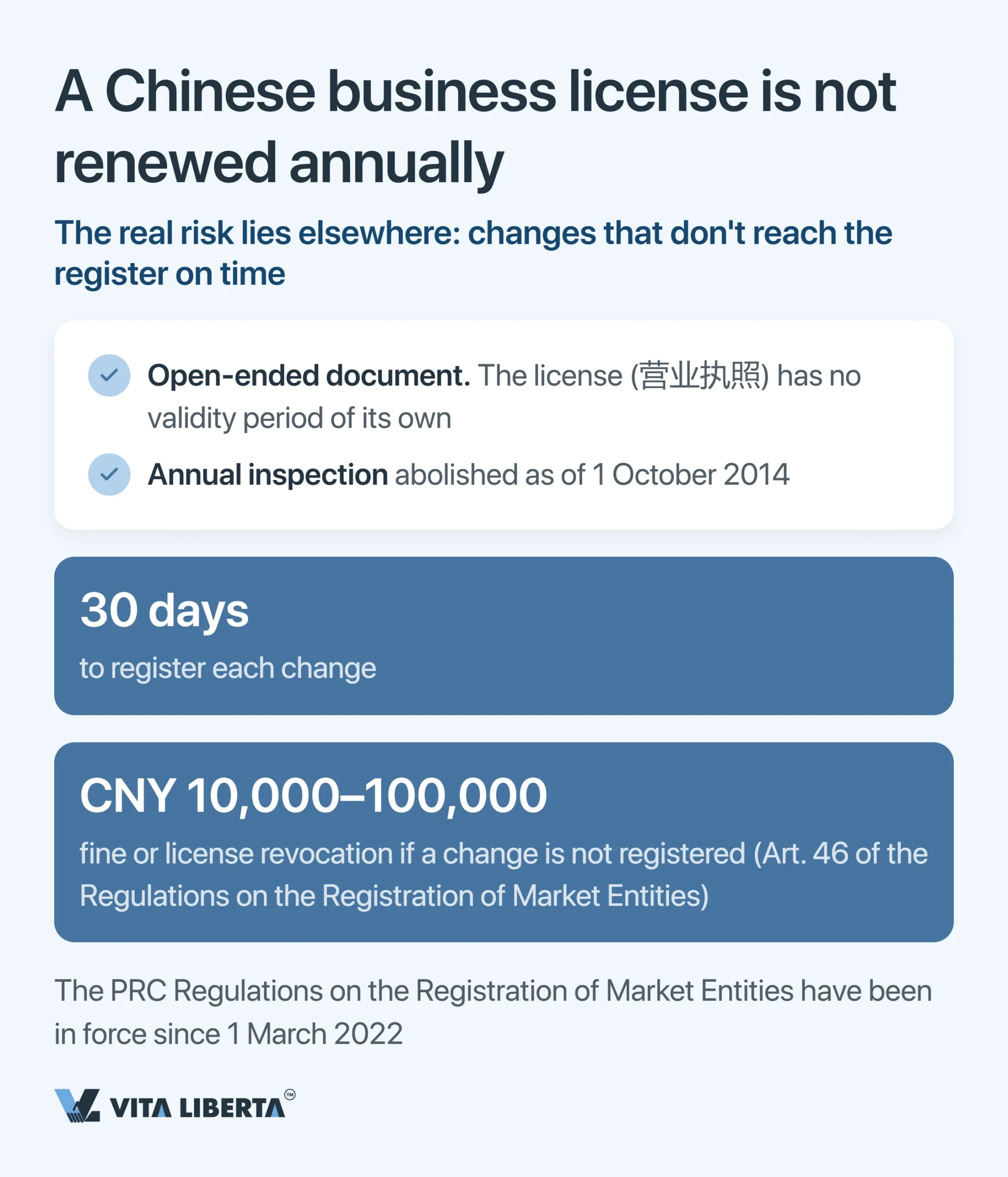
Ignore a correction order from the registration authority and your company pays CNY 10,000–100,000. In serious cases it loses the business license itself (营业执照). The rule is Article 46 of the PRC Regulations on the Administration of Market Entity Registration (中华人民共和国市场主体登记管理条例, State Council Order No. 746), in force since 1 March 2022. The trigger is usually routine: a new office, a new director, an operating term that is close to running out. For a WFOE or a joint venture, what counts is the 30-day window that opens after every corporate decision.
No Yearly Renewal: Your China Business License Lives On Through the Annual Report
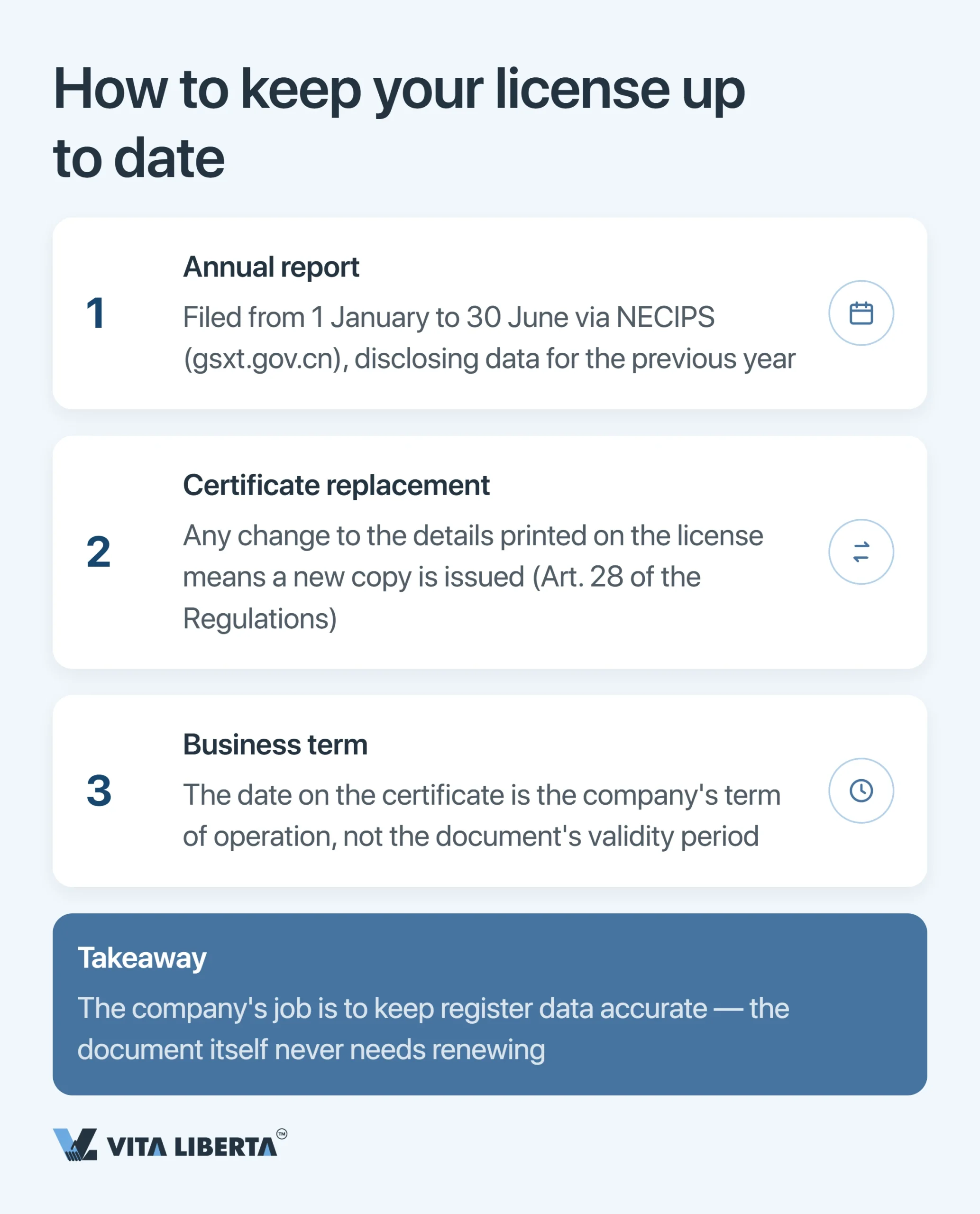
A Chinese business license has no validity period of its own. Nobody re-approves it at set intervals. The belief that you have to “renew it once a year” is a leftover from the annual inspection, abolished on 1 October 2014, and English-language reference guides still repeat it. What the law asks today is not that you renew a document, but that you keep the register accurate at three points:
- Annual report. Between 1 January and 30 June, you disclose last year’s data on the National Enterprise Credit Information Publicity System (国家企业信用信息公示系统, GSXT, gsxt.gov.cn). The duty sits in Article 8 of the Interim Regulations on Enterprise Information Disclosure (企业信息公示暂行条例, State Council Order No. 654, as amended by Order No. 777, effective 1 May 2024).
- New license form. Change any detail printed on the license and you get a newly issued copy (Article 28 of the Regulations).
- Operating term. The only end date on the form is how long the company may exist. It has nothing to do with the document.
Extending the Operating Term: Decide Before the Date, Not After
Your operating term (经营期限) is fixed in the articles of association and shown on the license. Some older-generation WFOEs carry a specific end date; newer companies are more often registered as “long-term”.
Shareholder Decision and Amended Articles of Association
SAMR’s Implementing Rules for the Regulations (市场主体登记管理条例实施细则, SAMR Order No. 52) treat the operating term, in Article 7, as a record-filing item (备案) rather than a registered item. The steps run in this order: a decision by the sole shareholder or a resolution of the shareholders’ meeting → a new version of the articles → filing with your local Administration for Market Regulation (AMR) within 30 days of the decision (Article 29 of the Regulations). The term appears on the license, so in practice the AMR hands you a license showing the new date. Put your own control date 6 months ahead of expiry. That margin leaves time to sign and certify the founder’s documents abroad.
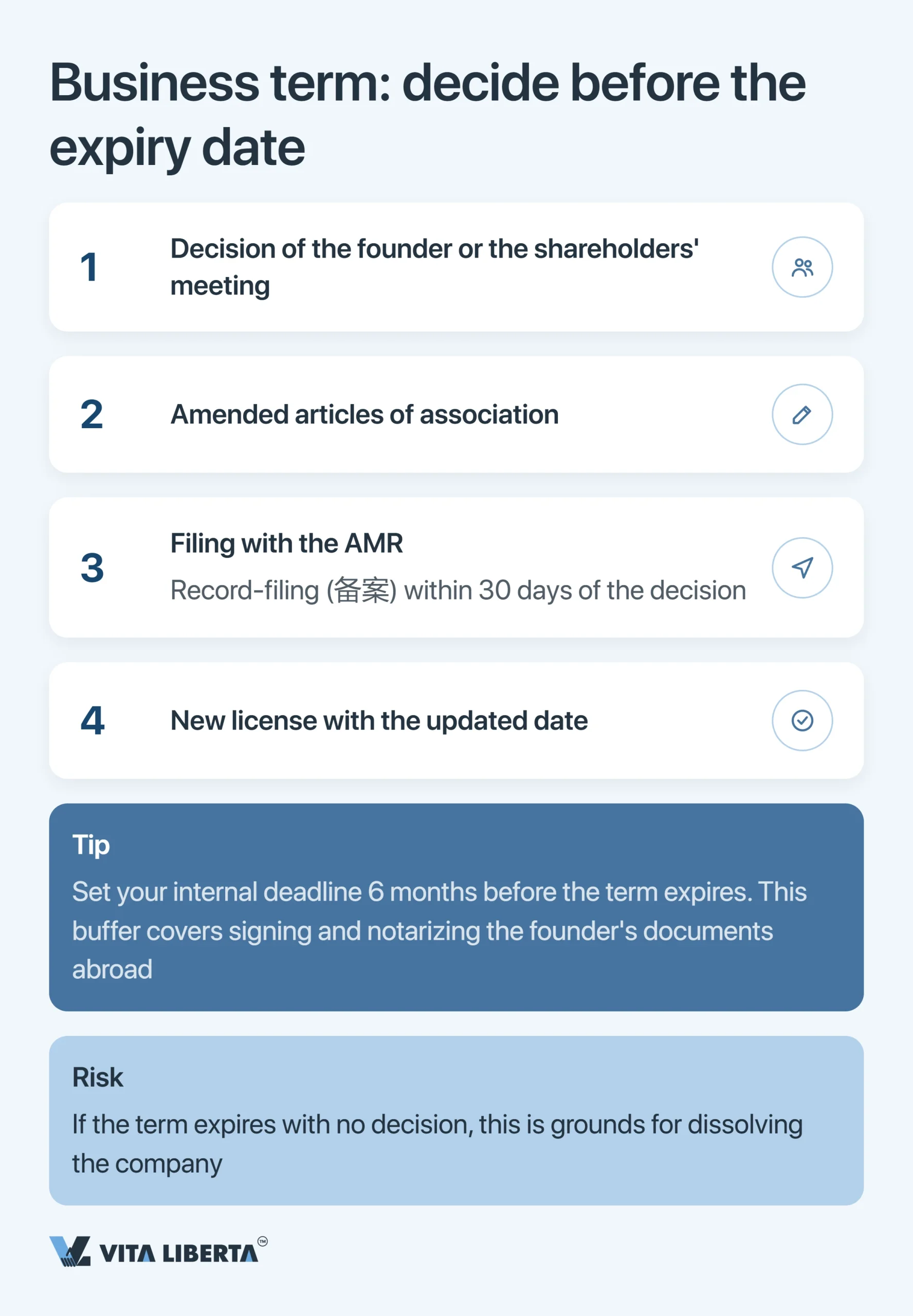
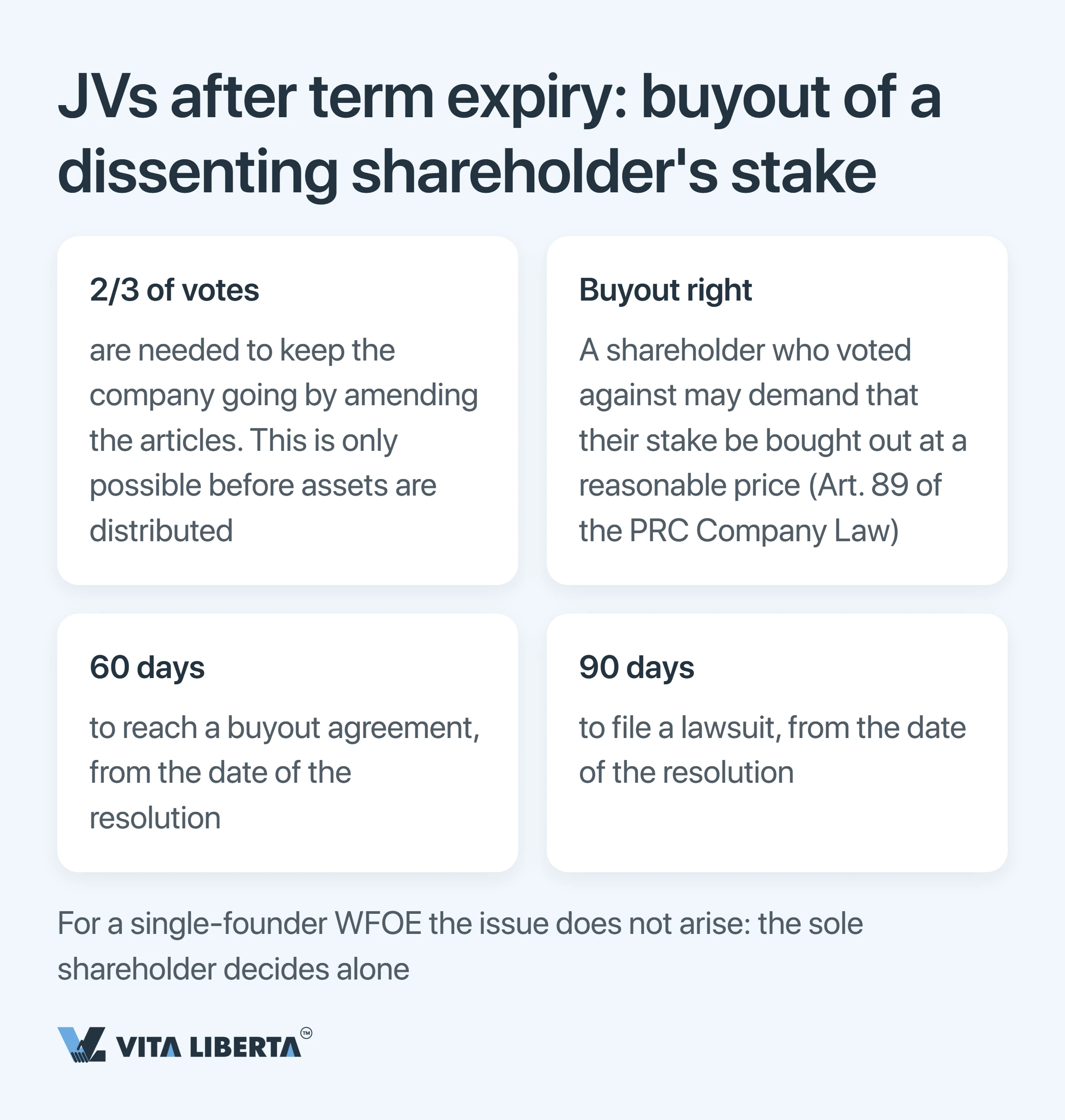
Important: if the term runs out and no decision has been made, the company faces dissolution. From then on, only an amendment to the articles can save it. That amendment needs at least two-thirds of the votes, and it is possible only until the company’s assets have been split among the shareholders. It also gives shareholders who disagree the right to exit.
Joint Ventures: A Dissenting Shareholder Can Demand a Buyout
Under Article 89(1)(3) of the PRC Company Law (中华人民共和国公司法, Presidential Order No. 15, version in force since 1 July 2024), a shareholder who voted against keeping the company going after its term expired can require the company to buy back their stake at a reasonable price. No deal within 60 days of the resolution? The shareholder may go to court. They have 90 days to sue, also counted from the resolution date. Practising lawyers note that courts do not see an early vote on extension as a way to sidestep this right. A WFOE with one founder is spared the issue: one person makes the decision.
Check your company’s registration data before a fine arrives
- Audit of your AMR records
- Operating term monitoring
- Drafting decisions and articles of association

Changing Details on a China Business License: 30 Days per Change
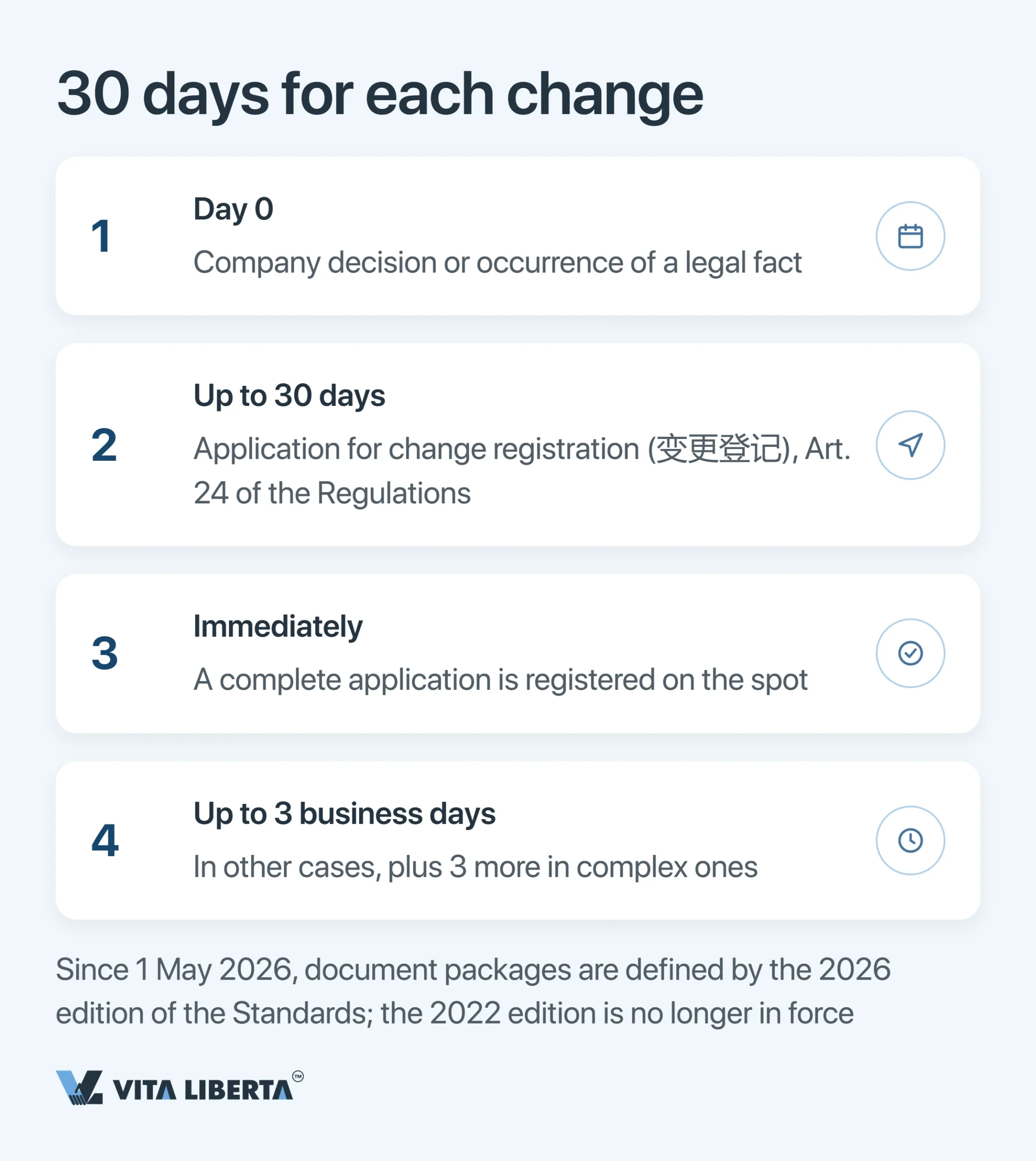
You apply for change registration (变更登记) within 30 days of the decision, or of the date the legal fact occurs (Article 24 of the Regulations). A complete application is registered on the spot. Otherwise registration takes up to 3 working days, and in complex cases that period can be extended by another 3 working days (Article 19).
Which Changes Trigger a New License
| Change | What you file with the AMR | Practice and risk |
| Company name | Resolution, amended articles | Once registered, update your details with the bank, the tax office and in contracts |
| Registered address | Resolution, document for the premises | The address on the license and the place you actually work must match |
| Legal representative | Resolution, documents of the new person | The new head goes through real-name identity authentication (Article 16 of the Rules) |
| Business scope | Resolution, permit for licensed items | Wording is taken only from the SAMR catalogue (Article 12 of the Rules); free-form text is not accepted |
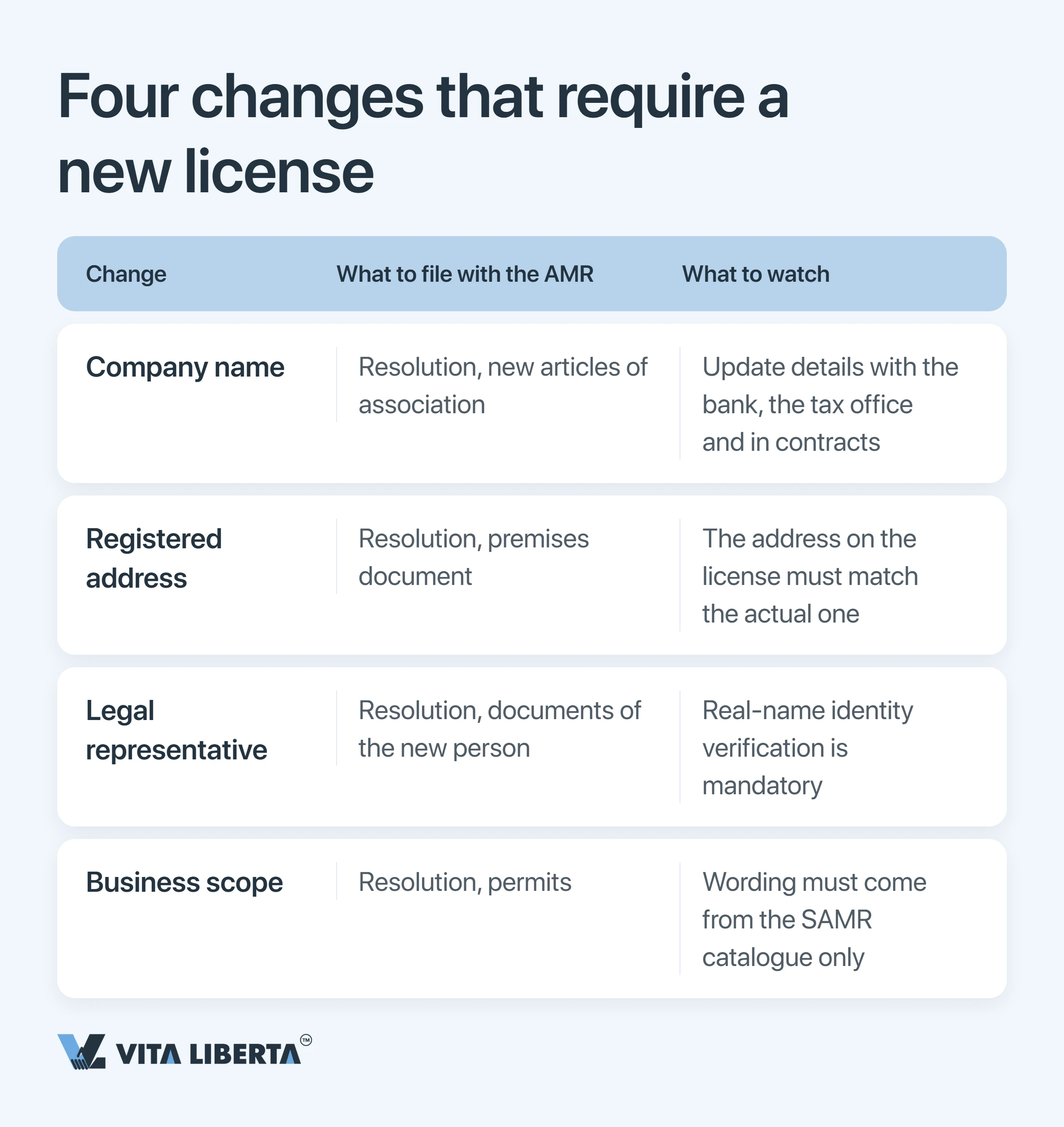
From 1 May 2026, the document sets for change registration follow the Standards for Registration Documents and the Standards for Submitted Materials of Business Entities (2026 edition, 国市监注发〔2026〕5号). The 2022 standards no longer apply. The table shows the core documents; the full set is defined by these Standards.
Relocating to Another City in the Same Province
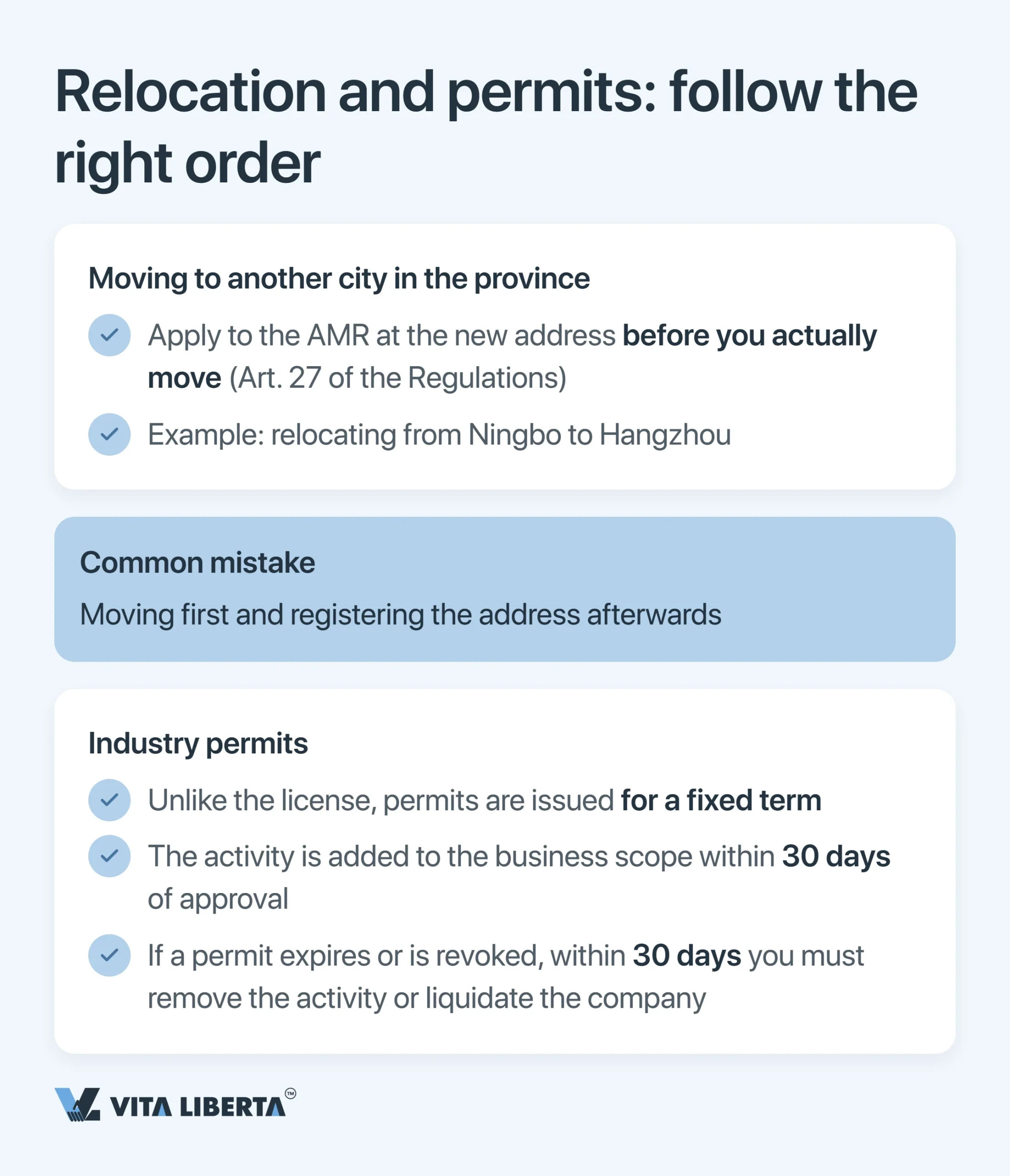
If you stay under the same AMR, the usual 30-day deadline applies. Moving, for example, from Ningbo to Hangzhou (Zhejiang province) is different: you apply to the AMR at the new address before you actually move in (Article 27). A frequent and costly mistake among foreign companies is to move first and register the address later.
Bottom line: when you relocate across jurisdictions, the application goes in before the office moves.
When an Industry Permit Expires
Industry permits, unlike the business license, have an expiry date. A licensed item goes into your business scope within 30 days of approval. If the permit is revoked, cancelled or expires, you have the same 30 days to either drop that item or wind up the company (Article 26).
Penalties: From a Correction Order to Losing the License
Sanctions come in two steps. First you receive a correction order; a fine follows only if you refuse to comply.
| Violation | Penalty | How to fix it |
| Annual report not filed by 30 June | Abnormal Operations List (经营异常名录), fine up to CNY 10,000 (Article 70 of the Rules); two years in a row and no contact at the address — license revoked (Article 18 of the Interim Regulations) | File the report, apply for removal from the list |
| Change not registered (Article 46) | CNY 10,000–100,000; revocation in serious cases | File the application within the period set by the order |
| Record-filing not made, including the operating term (Article 47) | Up to CNY 50,000 | Complete the 备案 filing |
| License not displayed in a visible place (Article 48) | Up to CNY 30,000; an online seller with no link to the license on its home page is penalised under the PRC E-Commerce Law | Display the original; online sellers add a link on the home page |
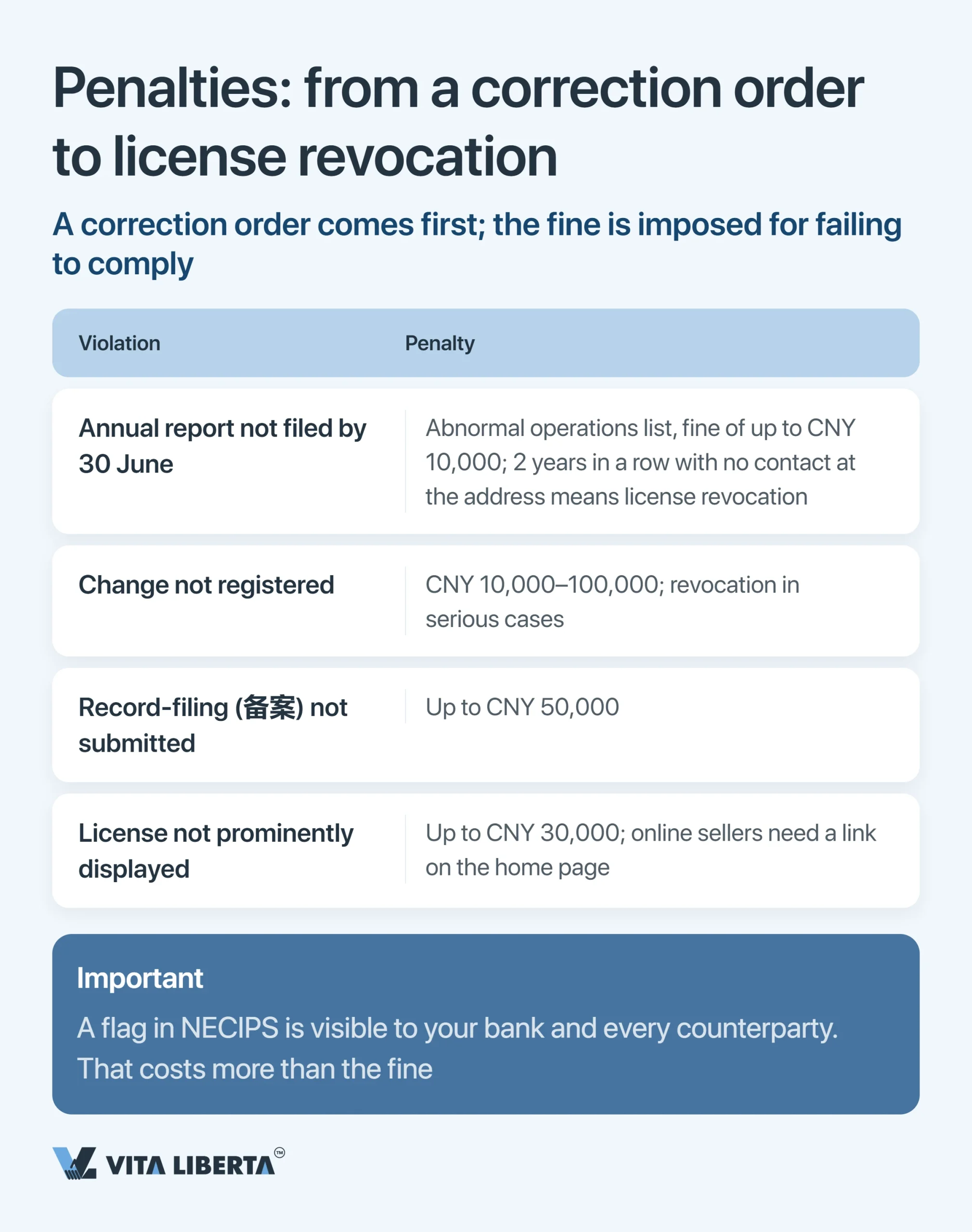
Bottom line: the fine costs less than what follows it. A GSXT mark is visible to your bank and to every counterparty.
Companies That Missed the Company Law Alignment Deadline
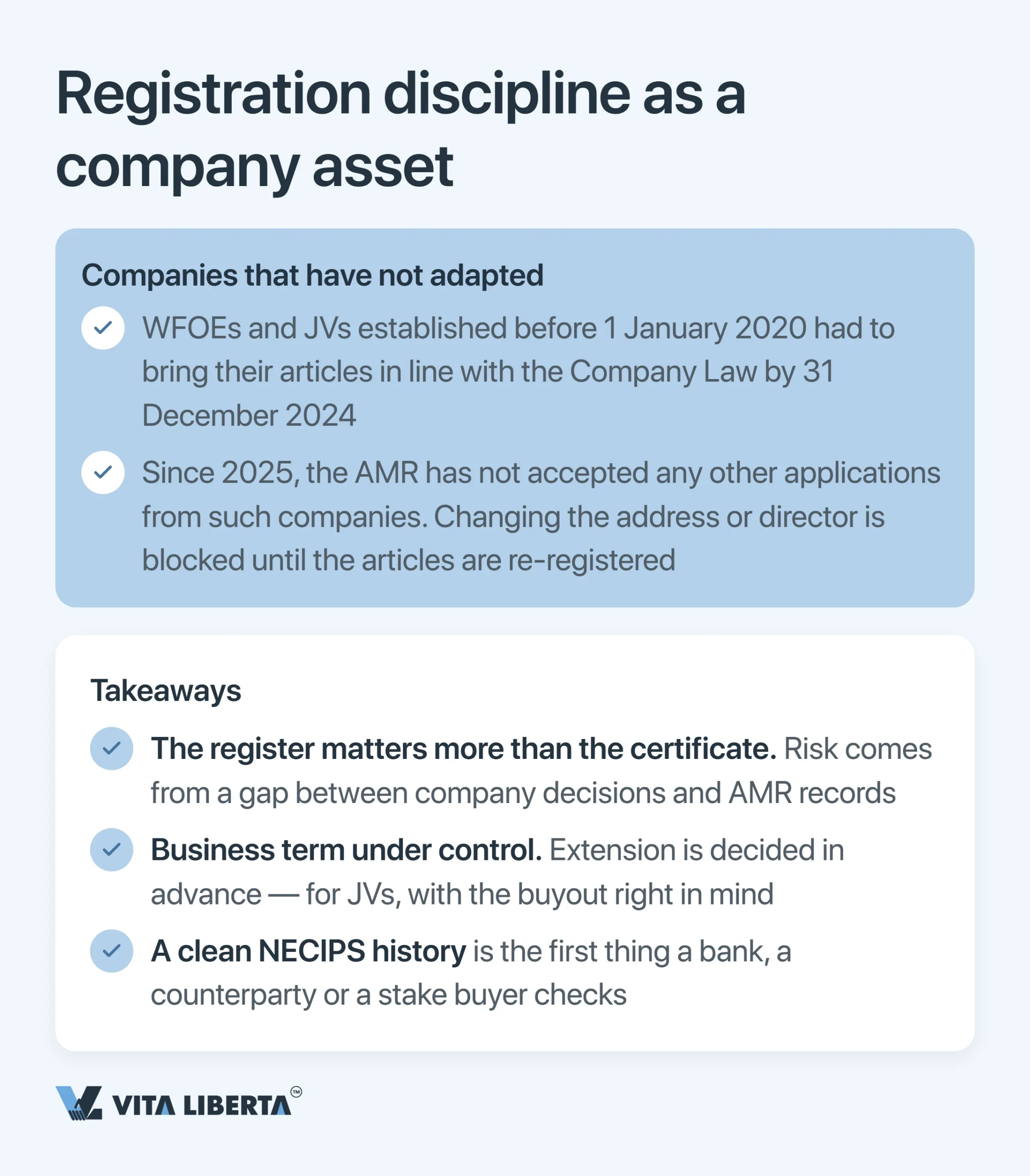
WFOEs and JVs set up before 1 January 2020 had until 31 December 2024 to bring their legal form and governance bodies in line with the Company Law, as Article 42 of the PRC Foreign Investment Law (中华人民共和国外商投资法) required. Since 2025, the AMR refuses their applications on other registration matters and publishes the breach (Article 44 of the FIL Implementing Regulations, 中华人民共和国外商投资法实施条例, State Council Order No. 723). For these companies, change registration — a new address or a new director, for instance — stays blocked until the articles are re-registered.
Get your China business license reissued without delays
- Filing changes with the AMR
- Operating term extension
- Removal from the Abnormal Operations List

Renewing and Replacing a China Business License: Strategic Takeaways
Here is the central paradox: the document never expires, yet every detail on it runs on a 30-day clock, and the company itself can come to an end on a date printed on that open-ended license.
- The register matters more than the paper. Risk arises when your company’s decisions and the AMR’s data drift apart.
- Keep the operating term under control. The extension decision comes before the end date and, in a JV, takes the dissenting shareholder’s buyout right into account.
- Registration discipline thus stops being a chore and becomes an asset: an up-to-date license and a clean GSXT record are the first things a bank, a counterparty or a buyer of a stake will check.
Frequently asked questions
No. The license has no term of its own, so you never renew it as a document. Your yearly obligation is different: the annual report on GSXT, filed between 1 January and 30 June. Missing it puts you on the Abnormal Operations List and may bring a fine of up to CNY 10,000, so assign this date to a responsible employee well in advance.
You need a founder’s decision to extend and a new version of the articles of association, filed with the AMR as a record-filing within 30 days of the decision. Since the term is printed on the license, in practice you receive a license showing the new date. Take the decision at least 6 months before the term ends, so there is time to certify the founder’s documents abroad.
You have 30 days from the decision to register the change, and the new legal representative goes through real-name identity authentication. If you miss the deadline, the AMR first issues a correction order; refusing to comply means a fine of CNY 10,000–100,000 and, in serious cases, revocation of the license. File the documents in the same month the decision is made.
No. When you move outside the old AMR’s jurisdiction, you apply to the authority at the new address before you actually move in. The old authority hands over the registration file and may not hold it back without grounds. Sign the lease at the new location with enough time left for this filing.
The Foreign Investment Law transition period ended on 31 December 2024, and since 2025 the AMR has refused applications on other registration matters from companies that have not adapted. Registering a new address, a new director or any other change will be blocked, so re-registering your articles under the Company Law has to come first in any change plan.